Introduction
Medical decision-making capacity is also referred to as treatment consent capacity and describes a higher-order functional skill related to a patient’s ability to make informed, sound decisions about medical care and treatment. Five core standards of medical decision-making capacity have been identified (Appelbaum & Grisso, Reference Appelbaum and Grisso1988; Marson, Ingram, Cody, & Harrell, Reference Marson, Ingram, Cody and Harrell1995): expressing a treatment choice (expressing choice); appreciating the personal consequences of a treatment choice (appreciation); providing rational reasons for a treatment choice (reasoning); and understanding the treatment situation, treatment choices, and respective risks/benefits (understanding). Of these standards, reasoning appears to be second only to understanding in terms of cognitive demand (Appelbaum & Grisso, Reference Appelbaum and Grisso1988; Marson & Ingram, Reference Marson and Ingram1996; Martin et al., Reference Martin, Okonkwo, Hill, Griffith, Triebel, Bartolucci and Marson2008; Okonkwo et al., Reference Okonkwo, Griffith, Belue, Lanza, Zamrini, Harrell and Marson2007). In a medical context, reasoning reflects the ability of a patient to consider information in a logical manner, allowing him/her to form a valid judgment or conclusion about diagnosis, prognosis, and treatment options. Consider, for instance, a patient with brain cancer attempting to choose between whole-brain radiation therapy and stereotactic radiation, each of which has its own advantages and disadvantages. The ability to mentally reason allows the patient to rationally and logically weigh the pros and cons of each treatment, so informed medical decisions can be made.
Little information is available in the research literature regarding the cognitive associates of the ability of patients with serious neurological illness to reason through treatment decisions. Measures of short-term verbal memory and executive functioning have been noted as predictors of reasoning through treatment decisions in patients with mild cognitive impairment, and measures of executive functioning and processing speed were predictors of reasoning through medical decisions in patients with mild Alzheimer’s disease (Okonkwo et al., Reference Okonkwo, Griffith, Belue, Lanza, Zamrini, Harrell and Marson2008). In patients with moderate–severe traumatic brain injury, short term verbal memory and attention were associated with reasoning through treatment decisions at baseline with short term verbal memory and working memory being associated at 6-month follow-up (Dreer, Devivo, Novack, Krzywanski, & Marson, Reference Dreer, Devivo, Novack, Krzywanski and Marson2008). Multiple cognitive abilities including short term verbal memory, verbal fluency, and executive functioning have been shown to be associated with reasoning through treatment decisions in patients with malignant glioma (Triebel, Martin, Nabors, & Marson, Reference Triebel, Martin, Nabors and Marson2009). As can be seen, the associations between cognition and reasoning through treatment decisions vary across patient groups. Thus, there is a need for further study of the cognitive capabilities underlying reasoning through treatment decisions in other neurologic diseases.
When cancer spreads to the brain from another location in the body, brain metastasis has occurred. Brain metastasis occurs in approximately 25% of adults with cancer and is associated with considerable morbidity and mortality (Posner, Reference Posner1995). Multiple factors including tumor volume and location and the presence of paraneoplastic process contribute to varying presentations of cognitive dysfunction in patients with brain metastasis. Moreover, although corticosteroids can sometimes improve cognitive functioning by reducing edema, many treatments of brain metastasis (i.e., corticosteroids, anticonvulsants, and radiotherapy) can cause impairments in executive functioning, memory, sustained attention, and other cognitive abilities (Platta, Khuntia, Mehta, & Suh, Reference Platta, Khuntia, Mehta and Suh2010).
In a previous study, we found that patients with brain metastasis possess significantly poorer medical decision-making capacity in relation to demographically matched healthy controls (Triebel et al., Reference Triebel, Gerstenecker, Marson, Fiveash, Meneses, Meyers and Nabors2015). In this previous study, at least half of the patient group was classified as exhibiting impaired performance on two Capacity to Consent to Treatment Instrument (CCTI) standards: reasoning and understanding. In a follow-up study, it was shown that performance on measures of verbal fluency and verbal memory were highly associated with the CCTI consent standard of understanding and that an actuarial equation could be constructed to identify patients at risk of impaired medical decision-making capacity with high accuracy (Gerstenecker et al., Reference Gerstenecker, Meneses, Duff, Fiveash, Marson and Triebel2015).
To our knowledge, there are no studies available that evaluate the cognitive abilities underlying the capacity of patients with brain metastasis to apply logical reasoning when making treatment decisions. To address this gap in the research literature, cognition and its effects on reasoning in a medical context in patients with brain metastasis were examined. The following hypotheses were made and based on previous research (Gerstenecker et al., Reference Gerstenecker, Meneses, Duff, Fiveash, Marson and Triebel2015): (1) the ability to use logical reasoning when making medical decisions will be positively correlated with scores on measures of attention, language, memory, and executive functioning; and (2) actuarial models predicting reasoning ability will be able to be constructed using performance on measures of verbal memory and verbal fluency.
Methods
Participants
Following institutional review board approval, 41 patients with brain metastasis were recruited from the University of Alabama at Birmingham (UAB) Radiation Oncology Department. Potential participants were approached about study participation by either faculty or residents from radiation-oncology or neurosurgery. All diagnoses were made by a board-certified radiation oncologist and were verified histologically. Only patients meeting the following criteria were accepted for inclusion: aged 19 or older; Karnofsky Performance Status (KPS) score of 70 or greater; presence of a supratentorial lesion; and absence of a serious psychiatric illness, history of substance abuse, or co-existing medical illness adversely affecting cognition (e.g., traumatic brain injury, multiple sclerosis, cerebral palsy).
The following treatments for brain metastases were used: conventional surgery; single fraction radiosurgery with Gamma Knife or LINAC technology (15 Gy–24 Gy) for tumors <4 cm; hypofractionated focal radiation with LINAC for tumors >3–4 cm (5–6 Gy×5 fractions for 25–30 Gy total); and whole brain radiation therapy (WBRT) (with LINAC technology) (30 Gy in 10 fractions to 37.5 Gy in 15 fractions). Tumor size (i.e., cm) refers to greatest diameter. Off-study guidelines for radiosurgical treatment at UAB followed maximum tolerated doses outlined in RTOG 9005 (Shaw et al., Reference Shaw, Scott, Souhami, Dinapoli, Kline, Loeffler and Farnan2000).
There were 15 men and 26 women in this sample with a mean age of 59 years (SD 12.4; range, 31–84 years) and a mean education of 13.7 years (SD 2.7; range, 9–20 years). The majority of the sample was Caucasian (85%). All other patients were either African-American (14%) or of Middle-Eastern decent (1%). Primary tumor types were as follows: lung 18 (43.8%) (14 non-small cell, 3 small cell, and 1 mixed small and large cell); melanoma 8 (19.5%); breast 8 (19.5%); gynecological 2 (4.9%); colon 2 (4.9%); renal 1 (2.4%); head and neck 1 (2.4%); and esophagus 1 (2.4%). In total, 28 (68.3%) patients had undergone chemotherapy treatments in the past, and 3 (7.3%) were receiving chemotherapy at the time of their study assessment. Eight (19.5%) patients underwent surgical resection before testing. Thirty-one patients were within a week of starting radiation treatment (9 whole brain, 22 focal treatment) at the time of the study assessment. The remaining 10 patients were assessed before receiving cranial radiation treatment. There were 12 (29.3%) patients treated with antiepileptic drugs, and 25 (61.0%) patients treated with corticosteroids. There were 17 patients with 1 tumor (41.5%), 6 with 2 tumors, and 18 (43.9%) with three or more tumors. Tumors were located in the left hemisphere for 12 (29.3%) patients, in the right hemisphere for 9 (22.0%) patients, and in both hemispheres for 20 (48.8%) patients. More than half (n=26, 63.4%) had active extracranial disease. Median KPS score for patients with brain metastasis was 90 (range=70–100; mean=82.4; SD=8.6).
Controls were 41 healthy adults who were volunteers (not relatives or friends of the patients) individually recruited from the community using advertisements. Controls were selected to match patients on age (±5 years) and education (±2 years). Controls met the same eligibility criteria as patient with the exception of not except having cancer or brain metastases. Controls were called over the telephone before study enrollment and asked a series of questions regarding medical and psychiatric health to screen out persons with a history of any medical or psychiatric conditions that could impair cognition. None of the controls reported any cognitive symptoms. Healthy controls were only evaluated for the purpose of classifying the brain metastasis group as exhibiting intact or impaired reasoning (see the Data Analyses section for details).
Measures
The CCTI (Marson et al., Reference Marson, Ingram, Cody and Harrell1995) was used to evaluate for treatment consent capacity. The CCTI is a conceptually based, reliable, and valid instrument designed to assess for medical decision-making ability in adults (Dymek, Marson, & Harrell, Reference Dymek, Marson and Harrell1999; Marson et al., Reference Marson, Ingram, Cody and Harrell1995) using clinical vignettes. In one vignette, a hypothetical medical problem and symptoms (i.e., cardiovascular disease) and two treatment alternatives with associated risks and benefits are presented. Participants answer standardized questions designed to test four core consent standards (Appelbaum & Grisso, Reference Appelbaum and Grisso1988; Marson et al., Reference Marson, Ingram, Cody and Harrell1995): expressing a treatment choice (expressing choice); appreciating the personal consequences of a treatment choice (appreciation); providing rational reasons for a treatment choice (reasoning); and understanding the treatment situation, treatment choices, and respective risks/benefits (understanding). For reasoning, scores range from 0 to 6 with higher scores being indicative of better performance. Interrater reliability on the reasoning standard has been reported as 0.83 (Marson et al., Reference Marson, Ingram, Cody and Harrell1995).
In a previous study (Triebel et al., Reference Triebel, Gerstenecker, Marson, Fiveash, Meneses, Meyers and Nabors2015), we noted that patients with brain metastasis were impaired in relation to healthy controls on the CCTI core consent standard of reasoning. Consequently, these analyses focused on this consent standard. CCTI administration and scoring were performed by trained research assistants according to existing standardized criteria (Marson et al., Reference Marson, Ingram, Cody and Harrell1995). The responses of each participant to the CCTI questions were audio-taped and subsequently transcribed to ensure scoring accuracy. In this study, there were three trained staff who administered and scored the CCTI protocol. The CCTI was the first measure administered and was presented before any neuropsychological tests. Order administration was formulated in a manner to prioritize the CCTI because of the fragility of the patient population being studied. Study investigators were not involved in administration or scoring and were blind to CCTI results. Study technicians were not blind to the results of neuropsychological testing.
The Hopkins Verbal Learning Test – Revised (HVLT-R) is a measure of verbal learning and memory in which subjects learn 12 words over three learning trials. After a 25-min delay, free recall of the list is queried as is recognition (Brandt, Reference Brandt2001).
The Digit Span subtest from the Wechsler Adult Intelligence Scale – Third Edition (WAIS-III) is a measure of attention and concentration in which subjects repeat orally presented digit strings, forward and backward (Wechsler, Reference Wechsler1997).
The Digit Symbol subtest from the WAIS-III is a measure of processing speed and divided attention in which subjects have 120 s to correctly match number and symbol pairs using a key at the top of the page.
To evaluate phonemic verbal fluency, patients were given one minute apiece to name as many words as possible that begin with the letters “C,” “F,” and “L.” To evaluate semantic verbal fluency, patients were given one minute to name as many animals—beginning with any letter—as possible (Ruff, Light, Parker, & Levin, Reference Ruff, Light, Parker and Levin1996).
Trail Making Test (TMT) Parts A and B from the Halstead-Reitan Neuropsychological Battery are measures of visuomotor processing speed and set-shifting, respectively. For TMTA, the patient was asked to draw a line connecting 25 numbers in numerical order. For TMTB, the patient was asked to draw a line connecting 25 numbers and letters by switching between numbers and letters (i.e., 1 to A, A to 2, 2 to B). For both tasks, raw score is equal to the number of seconds to completion (Reitan and Wolfson, Reference Reitan and Wolfson1993).
The Wide Range Achievement Test - Third Edition (WRAT-III; Wilkinson, Reference Wilkinson1993) is a test often used as an estimate of premorbid intelligence. For this measure, patients were visually presented with infrequently encountered words and instructed to read them aloud. A point is given for the correct pronunciation of each word.
The KPS (Karnofsky, Abelmann, Craver, & Burchenal, 1948) is a simple measure of disability. The KPS scale consists of 11 categorical ratings in increments of 10 (i.e., 100, 90, 80….) that range from 100 (normal, no complaints; no evidence of disease) to 0 (dead).
Depression symptoms were assessed with the Beck Depression Inventory – Second edition (BDI-II) (Beck, Steer, & Brown, Reference Beck, Steer and Brown1996). The BDI-II contains 21 questions scored on a Likert scale of 0–3, with higher scores indicating greater depressive symptoms.
Data Analyses
For all of the cognitive tests raw scores, higher scores indicate better cognitive performance, except for the TMT, in which lower scores indicate better performance.
Patients were classified as exhibiting intact or impaired reasoning based upon psychometric cutoff scores derived from control performance. This method is useful in categorizing level of decisional impairment and has been used in earlier capacity studies (Marson & Ingram, Reference Marson and Ingram1996; Marson et al., Reference Marson, Ingram, Cody and Harrell1995; Okonkwo et al., Reference Okonkwo, Griffith, Belue, Lanza, Zamrini, Harrell and Marson2007). In this study, intact reasoning was defined as a score >1.5 SD below the control group mean. Impaired reasoning was defined as a score <1.5 SD below the control group mean. A series of independent t tests were conducted to determine if neurocognitive performance, age, education, time since diagnosis, and BDI-II scores varied according to reasoning status. Two Pearson’s Chi square tests were conducted to determine whether gender or race varied according to reasoning status.
Pearson product moment correlations were calculated to examine the relationship among reasoning scores and neurocognitive performances, age, education, time since diagnosis, and BDI-II scores. An independent t test was used to determine whether reasoning scores varied by gender, and a one-way analysis of variance was conducted to determine whether reasoning scores varied by race (i.e., Black or African American, White or European-American, and other).
Variables that were found to be significantly associated with reasoning scores were then used to construct two predictive models. In other words, variables that were significantly correlated with CCTI reasoning scores were carried forward to construct two subsequent regression models. For the first model, a forced-entry linear regression was conducted to predict CCTI reasoning scores. For the second model, a backward elimination, binary logistic regression was conducted to identify patients with intact and impaired reasoning. Predictive accuracy of the resulting model was calculated using receiving operating characteristic (ROC) plots. Using ROC plots, sensitivity and specificity for each potential cut score was obtained by taking sensitivity against 1-specificity (Altman & Bland, Reference Altman and Bland1994). For both models, relative predictive power was obtained through either R2 or the coefficient of determination of Nagelkerke or pseudo-R 2 . An alpha level of .05 was used for all comparisons.
Results
Neurocognitive Performance, Demographics, and CCTI Reasoning Scores
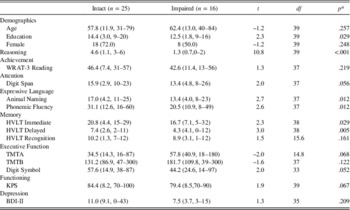
As can be seen in Table 1, education was significantly different between patients with and without impaired reasoning. Those with more education exhibited better reasoning. Performances on the following neurocognitive variables were significantly poorer for patients with impaired reasoning: Animal Naming, Phonemic Fluency, HVLT Immediate Recall, and HVLT Delayed Recall. Age, gender, WRAT-3 Reading, Digit Span from the WAIS-III, HVLT Recognition, TMTA, TMTB, Digit Symbol Coding from the WAIS-III, and BDI-II score were not significantly different for patients with either intact or impaired reasoning.
Demographics and neurocognitive performance of patients impaired and not impaired in reasoning

Note. Scores refer to raw scores. Except for male and female, values for Not Impaired and Impaired are mean (SD, range). For male and female, values are n (%). p* value for t-test analyzing group differences (age, education, and cognition) or Pearson’s Chi square test (gender).
HVLT=Hopkins Verbal Learning Test; BDI=Beck Depression Inventory; WRAT=Wide Range Achievement Test; TMT=Trail Making Test; KPS=Karnofsky Performance Status.
For patients with intact reasoning, 19 (76%) had undergone radiation therapy before assessment. For patients with impaired reasoning, 12 (75%) had undergone radiation therapy before assessment. A total of 17 (68%) of the intact group had underwent chemotherapy before assessment. A total of 11 (69%) of the impaired group had underwent chemotherapy before assessment. Tumor location for the impaired group was as follows: 3 (12%) left frontal, 1 (4%) right frontal, 2 (8%) left temporal, 3 (12%) right temporal, 2 (8%) left parietal, 2 (8%) right parietal, 1 (4%) left occipital, 1 (4%) right occipital, 12 (48%) multiple locations. Tumor location for the impaired group was as follows: 2 (13%) left frontal, 0 (0%) right frontal, 2 (13%) left temporal, 2 (13%) right temporal, 1 (4%) left parietal, 0 (0%) right parietal, 1 (4%) left occipital, 0 (0%) right occipital, 8 (50%) multiple locations. Of note, only descriptives of these variables are provided due to low sample/cell size.
Predicting Impaired Reasoning from Neurocognitive Performance
Out of demographic and cognitive variables, only HVLT Delayed Recall (r=0.38; p=.017) and TMTA (r=−0.38; p=.018) were significantly associated with CCTI Reasoning scores.
The following variables were not significantly associated with CCTI reasoning scores: age (r=-.011; p=.482), education (r=0.30; p=.058), Digit Span total (r=0.19; p=.247), Animal Naming (r=0.23; p=.163), Phonemic Fluency (r=0.31; p =.052), HVLT Total Recall (r=0.28; p=.081), HVLT Recognition (r=0.26; p=.119), TMTB (r=−0.16; p=.343), Digit Symbol Coding (r=0.18; p=.319), KPS (r=0.28; p=.080), and BDI-II scores (r=0.07; p =.692).
Gender was not associated with reasoning (t[39]=−1.17; p=.248), and no differences in reasoning (F[2,38]=1.7; p=.198) occurred among ethnicity groups.
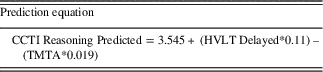
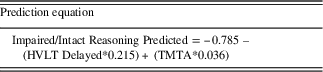
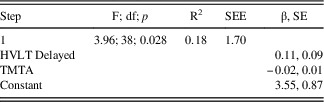
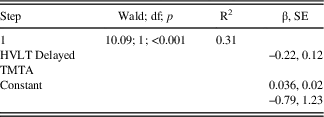
The final models for reasoning can be found in Tables 2 and 3. For the forced-entry linear regression model designed to predict CCTI reasoning scores (Table 2), R 2 was 0.18. Results of the model are presented in Table 4. Results of this model were highly consistent with results obtained after conducting a stepwise method. The resulting model met all assumptions for regression, including normality of residuals (Shapiro-Wilk[41]=0.97; p =.449). Pseudo-R 2 was 0.31 and ROC was 0.77 for the backward elimination, binary logistic regression model designed to predict intact versus impaired reasoning (Table 3). Results of the model are presented in Table 5. Based on sensitivity and specificity, the optimal clinical cutting score for predicted values generated by the equation was −0.88. This cutoff achieved sensitivity of.79 and specificity of .64. For scores falling at or above this cutoff, impaired reasoning is likely. However, intact reasoning is likely for those scoring below the cutoff. It should be noted that this cutoff score is not a raw CCTI score but rather the cut-score obtained from our model that achieved the best mixture of sensitivity and specificity.
Prediction equation for CCTI reasoning score

Note. CCTI=Capacity to Consent to Treatment Instrument; HVLT=Hopkin’s Verbal Learning Test; TMT=Trail Making Test.
Prediction equation for impaired/intact reasoning.

Note. HVLT=Hopkin's Verbal Learning Test; TMT=Trail Making Test.
Results of the linear regression predicting CCTI reasoning score

Note. SEE=standard error of the estimate of the regression model; β=unstandardized beta weights; SE=standard error of coefficient; HVLT=Hopkin’s Verbal Learning Test; TMT=Trail Making Test; CCTI=Capacity to Consent to Treatment Instrument.
Results of the binary logistic regression predicting CCTI reasoning status

Note. SEE=standard error of the estimate of the regression model; β=unstandardized beta weights; SE=standard error of coefficient; HVLT=Hopkin’s Verbal Learning Test; TMT=Trail Making Test; CCTI=Capacity to Consent to Treatment Instrument.
Discussion
In this study, we investigated the relationship between the ability to logically reason through medical decision and cognition in a sample of patients with newly diagnosed brain metastasis. Although the ability to reason through treatment decisions has been shown to be impaired in a large number of patients with brain metastasis (Triebel et al., Reference Triebel, Gerstenecker, Marson, Fiveash, Meneses, Meyers and Nabors2015), no studies have examined the impact of cognition on this standard of medical decision-making capacity. Our results indicate that reasoning is highly influenced by cognition, with processing speed and delayed verbal memory exerting particular influence. Using these two variables, we then demonstrated that simple equations can be constructed to screen at-risk patients for impaired reasoning. In sum, the ability to reason through treatment decisions involves complex cognitive skills, and impairments in specific cognitive domains may negatively impact a patient’s ability to make sound medical decisions.
In a previous study, we noted that this sample of patients with brain metastasis exhibited significantly poorer reasoning than healthy controls and that 50% of the sample group had suboptimal reasoning (Triebel et al., Reference Triebel, Gerstenecker, Marson, Fiveash, Meneses, Meyers and Naborsin press). In the current study, we noted that patients with impaired reasoning had significantly less education and performed significantly poorer on measures of verbal fluency and memory recall. In contrast, age, gender, race, scores on a self-report measure of depression, performances on measures of word reading, basic attention, recognition memory, processing speed, and executive functioning were not significantly different between impaired and intact groups.
In a previous study, we showed that reasoning is associated with verbal memory and verbal fluency in patients with brain cancer (Triebel et al., Reference Triebel, Martin, Nabors and Marson2009). Although the finding regarding verbal fluency was not replicated in this sample of patients with brain metastasis, we did note a significant relationship between verbal memory and the ability to reason through treatment decisions. In addition, we also found a significant association between reasoning and processing speed. Taken together, these associations indicate that a patient must first process relevant information at a certain level of speed and then be able to recall that same information over a delay to reason through that information. The relationship between reasoning and all cognitive variables proceeded in the expected direction—as neurocognitive performance decreased, so did reasoning ability.
Although this information adds to the research literature and is useful in a clinical context, more exploration of these associations is required for clinicians to put this information to use. Thus, two equations were constructed: one to identify patients with impaired reasoning and the other to predict CCTI reasoning scores. As expected, although the variables included in the final models accounted for roughly 20% and 30% of variance, respectively, other variables (e.g., sensory processes, fatigue, anxiety, disease factors, etc.) are contributing. Nevertheless, these models have the potential to help clinicians identify patients in need of a more comprehensive evaluation of their medical decision-making capacity.
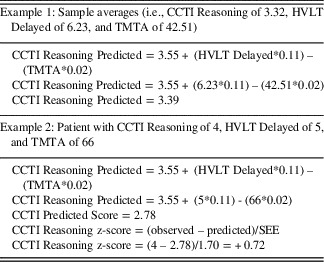
Examples may be useful for those not familiar with regression-based models (see Tables 5 and 6). In applying sample averages to the model designed to predict CCTI reasoning scores, this patient sample would have an overall score of 3.39 (Table 5)—well below that of the demographically matched control group average of 4.76 noted in our earlier study (Triebel et al., Reference Triebel, Gerstenecker, Marson, Fiveash, Meneses, Meyers and Nabors2015). However, the utility of this model extends beyond simply predicting performance. By dividing the difference of observed CCTI reasoning minus predicted CCTI reasoning by the standard error of the regression model (Table 5), a Z-score is calculated for each patient that shows how many standard deviation units he/she is away from his/her predicted score. For the case example located in Table 5 (i.e., CCTI reasoning predicted score=3.55 + [5*0.11] – [66*0.02]=2.78), the patient scored a 4 on CCTI reasoning but obtained an observed reasoning score of 2.78. Thus, this patient has an observed score that is over three-quarters standard deviation units better than the score predicted. For those interested, an Excel spreadsheet can be obtained from the first author of this study that will calculate both equations.
Examples for equation predicting CCTI reasoning scores

Note. CCTI=Capacity to Consent to Treatment Instrument; HVLT=Hopkin’s Verbal Learning Test; TMT=Trail Making Test.
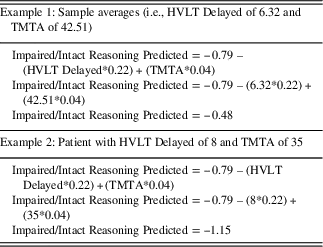
Case examples for the model designed to predict impaired reasoning are located in Table 7. This sample of patients with brain metastasis was observed to have the following means: 6.32 on HVLT Delayed and 42.51 on TMTA. If these averages are applied to the model found in Table 7, this sample would have an overall score of −0.48. This score lies above the clinical cutoff of −0.88 and indicates that the sample as a whole is likely to demonstrate suboptimal reasoning. However, most applications of this model will occur at the individual level, and this type of example can be found in Table 7. For this example (i.e., −0.79 – [8*0.22] – [35*0.04]=−1.15), the obtained score lies below the clinical cutoff, so intact reasoning is indicated by the prediction formula.
Examples for equation predicting impaired/intact reasoning

Note. CCTI=Capacity to Consent to Treatment Instrument; HVLT=Hopkin’s Verbal Learning Test; TMT=Trail Making Test.
There are several limitations and future directions to be considered. First, similar to most other studies of rare disorders in a university-based hospital, the current sample may not be representative of the population. Patients could not have other central nervous system disorders and needed to agree to participate in several hours of testing. This likely yields a select group of patients with brain metastasis. Therefore, results might not generalize to all patients with brain metastasis. More diverse samples should be examined in future studies. Second, patients may respond differently to hypothetical vignettes than to actual medical situations. For example, the emotions associated with real-life medical decisions are not triggered by hypothetical vignettes (Marson et al., Reference Marson, Ingram, Cody and Harrell1995). Third, clinical validation of the resulting model was beyond the scope of this study, and external validation is needed before clinical decisions can be influenced by these results. Future studies should examine the utility of the model in different samples of brain metastasis patients. Fourth, the current sample was not sufficient is size as to allow for investigation into the effects of disease factors (e.g., tumor size, tumor location, amount of radiation) on the ability to reason through treatment decision. Investigations into these effects should be examined in future studies. Finally, these results were based upon a rather homogenous sample of brain metastasis patients. The generalizability of the resulting models in brain metastasis as well as other patient groups should be examined in future studies. Despite the limitations, these preliminary findings suggest that reasoning and cognition are interconnected when making medical decisions. In addition, it is possible that improved cognition will positively influence the ability of patients to logically reason through treatment decisions. This could be examined in future studies.
Acknowledgments
Foremost, we thank the patients who participated in this study and their families. The authors also thank the following technicians for their data collection and entry: Amanda Eakin, Kathleen Lowry, and Angel Simmons. Special thanks are warranted for Dr. Christina Meyers for her ongoing support and consultation. Finally, the authors thank the UAB research staff and the Radiation Oncology Residents for their assistance with recruitment and data collection. This research was supported by a NIH/NCATS (KL2 TR000166; Triebel) and by funds from the UAB Department of Neurology. The authors report no disclosures.