In the first week of June 2015, at Jerusalem's Palestinian National Theatre (PNT), the play Roses and Jasmine opened to divergent reactions from local audiences, igniting controversy and leading to the expression of opinions that ranged from absolute support to clear opposition. Acted and co-produced by Palestinians, written and directed by the Arab French–Egyptian theatre artist Adel Hakim (1953–2017), in a co-production between the PNT and Théâtre des Quartiers d'Ivry in France, the play tells the story of three generations of Jewish and Palestinian characters and their intersecting lives during three distinct periods: first under the British Mandate of Palestine (1922–48), then following the creation of the state of Israel (1948–67), and then during the occupation of the West Bank and Gaza by the Israelis and the eruption of the popular uprising of the first Intifada (1967–88). Because the play depicted the arrival of Holocaust survivors in Palestine through portrayals of Jewish characters expressing politically diverse views, ranging from the extreme right wing to leftist and pro-Palestinian, many Jerusalemite audience members struggled to engage with the narrative of the play.Footnote 2 Critics of the production posed the question: why should a Palestinian cast depict Jewish suffering in the Holocaust while Palestinians continue to suffer Israeli occupation and the consequences of the foundation of the state of Israel in 1948?Footnote 3 Not since El-Hakawati's 1985 production of the Story of the Eye and the Tooth and Al-Kasaba's 1995 co-production with the Jewish–Israeli Khan Theatre, Romeo and Juliet, had a play stirred such controversy, layered public discourse, and opposing viewpoints in the Palestinian performing arts. Commenting on the spirited atmosphere in Palestine's first fully dedicated and well-equipped modern theatre, Al-Nuzha/Hakawati Theatre, a long-time technician stated after the opening-night performance, ‘the spirit of the production and the audience remind me of the 1980s’.Footnote 4 The simultaneously nostalgic and enthusiastic comment reflected a hunger for the energetic, multifaceted and vigorous debates that were characteristic of the 1980s, when Palestinian theatre in Jerusalem had a golden age of production in a competitive and intellectually stimulating atmosphere.Footnote 5 But why did the discursively complex and technically sophisticated spectacle generate opposing reactions, as evidenced by a partial standing ovation on the one hand and the adamant negative criticism by leading members of the cultural elite on the other? What made some members of the audience walk out of the theatre during the first act and during intermission? What makes the play so controversial?
Before attempting to address these questions, and delving into the argument of the play and its performance, I will consider the position of Palestinian cultural production as a reaction to overwhelming forces in a colonial orientalist public sphere. In the following discussion, I aim to describe the connection between tropes of orientalism, Palestine and the significance of Palestinian actors playing Jewish characters as an intervention into existing colonial narratives of Palestine.
Ventriloquized dialogue and a colonial rhetorical context
Over a period of several decades, Palestinian cultural producers have been placed in a position of self-defence in an existential battle against disinformation. Since 1948, the official Euro–American–Israeli mainstream narrative of the Palestinian struggle has been shaped, as Edward Said put it in The Question of Palestine, by the orientalist myth of ‘a land without a people’.Footnote 6 In debates, artistic representations and political forums, Palestinians have been forced to justify their claims to basic human rights, including the right to land, heritage, self-determination, peaceful existence and self-narration. Meanwhile, the ‘Western’ public sphere has been saturated with representations and narratives of Palestinians as terrorists and extremists.Footnote 7 Painted in significant parts of the Western media as violent and even intent on committing a Jewish Holocaust in Palestine, Palestinians have struggled to develop their means of production and to open avenues of self-expression on the world stage.Footnote 8 As a result of this colonial rhetorical context, those Palestinian cultural exports that have come to international attention over the past several decades in film, theatre, dance, music and literature have focused on combating contemporary orientalism through cultural preservation, underscoring the importance of telling stories about Palestinians, by Palestinians. As such, since the emergence of contemporary Palestinian theatre as an industry in the 1980s and its entry into international theatre venues through touring, particularly in Europe and the United States, examples have abounded of Palestinian productions that aimed to humanize Palestinians and their cause.Footnote 9
This is significant because the theatre presents a unique and generative critical forum for the analysis of the discourse and history of orientalism. In order for orientalist myths to succeed, racially coded ‘orientals’ may be represented in performance as standing in for or speaking the narrative and myth of the colonizer who sees an essentialized race as inferior. A particularly powerful, though rarely discussed, aspect of this strategy continues to be the creation of ‘oriental’ characters, who act as the emissaries of the colonizer. These fictional characters physically appear like a version of the ‘oriental’, adamantly uttering the myths of the colonizer, and thus reifying the racially charged fictions of orientalism. In this formulation, the character created by the colonizer performs like a puppet, speaking messages, in dialogue, under the influence of an invisible puppeteer. The most successful of these formulations are the ventriloquized characters, referred to by Said as puppets and scarecrows, who appear to be speaking independently while the ventriloquist imitates a recognizable voice, simultaneously entrenching the colonizer's gaze in multiple layers of dialogue.Footnote 10 This insidious ventriloquism preys on both conscious and latent fantasies. Familiar contemporary examples of this phenomenon range from peripheral clownish representations like the Arab Sheikh in Michael Frayn's Noises Off (1982), to the traditional Muslim terrorist in the latest blockbuster film or television hit.
In this article, I aim to discuss how reversing such orientalist ventriloquism can be seen as a key strategy of cultural resistance, and can be seen at work in the Jerusalemite production of Adel Hakim's Roses and Jasmine. I do not mean the reversal of the gaze from Orient to Occident, as some scholars have argued in an attempt to create equivalencies between hegemonic suppressions by the colonizers and resistant expressions by the colonized.Footnote 11 Rather, I am interested in the characters of the colonizer, occupier or oppressor as they are created and portrayed by the colonized, occupied and oppressed, not for the sake of reifying a master–slave relationship as traditionally achieved through orientalism, but for the purpose of illuminating injustices.Footnote 12 Building on Homi Bhabha's discussion of the phenomenon of mimic-men and reformed colonial subjects, which states that ‘what emerges between mimesis and mimicry is a writing, mode of representation, that marginalizes the monumentality of history, quite simply mocks its power to be a model, that power, which supposedly makes it imitable’, I suggest that ventriloquizing an oppressive colonial structure, not in mockery but in earnest sympathy, for the purpose of revealing it constitutes an actual reversal of the orientalist aesthetic in dialogue.Footnote 13
I am proposing that resisting colonialism in performance, while under colonial rule, necessitates an alienating effect comparable to the enactment of the ‘impossible’ event of the puppet playing the ventriloquist. What would it look like if the puppet wrote the dialogue for its ventriloquist, then performed it, expressing the unjust conditions of its own existence in the process? How can an anti-colonial or anti-orientalist ventriloquism be characterized and defined? In the case of Roses and Jasmine, can the orientalist/Zionist myth of ‘a land without a people’ be challenged by the people of a land earnestly depicting the arrival of a traumatized European Jewish population and the struggles of this population to reconcile their own history of victimhood with their newfound military domination over land, people and resources? In my examination of Roses and Jasmine, I first describe the phenomenon of Palestinian actors playing Jewish characters, and I address the reasons for this rhetorical and aesthetic strategy, which I refer to as a resistant ventriloquism.
A resisting cast: inhabiting occupation with a difference
The PNT's production of Roses and Jasmine presents an uncommon occurrence: Palestinians performing a Jewish-majority story on Palestinian and world stages. This production flips the interrogation table and reverses the traditional patterns of orientalist ventriloquism with integrity, playing the conditions, histories and rhetoric of the occupier with humility, humanity and accountability. Diverse Jewish characters, some with mixed Palestinian blood, grapple with Palestinian history. The members of the cast earnestly perform Jewish narratives while simultaneously maintaining non-negotiable aspects of their own identity as actors and individuals, including their firm stance on their native belonging to Palestine. From the early stages of development, the production challenged existing paradigms in Palestinian theatre and the representations of stakeholders in Israel/Palestine.
Roses and Jasmine was not the first partnership between Théâtre des Quartiers d'Ivry and the PNT. Beginning in May 2011, they co-produced Sophocles’ Antigone under the direction of Adel Hakim.Footnote 14 Through to 2013, this internationally renowned production ran for 120 performances in Palestine, France, Cyprus, Belgium and Sudan. Hakim took his inspiration from this earlier collaboration, which portrays a young woman's resistance to the leadership of her father's successor, while aiming to forgo the so-called ‘universal context’ of the Greek tragedy in favour of a gritty context in the Middle East. He held a week-long workshop with Palestinian actors at the PNT in the spring of 2014. The emerging pattern in the rehearsal hall established a number of guiding ideas. First, the new play would tackle personal relationships among British, Jewish and Palestinian characters from three periods: the 1940s, 1960s and 1980s. Second, drawing on epic theatre's episodic structure, the plot would establish emerging conflicts among family members in the Jerusalem area. Third, although some characters would be Palestinians, the majority of characters would be British, Jewish German, Israeli (post-1948) or of mixed heritage (post-1948). After gaining preliminary approval from the PNT and the Palestinian actors, Hakim left Jerusalem to write this epic play in tragic structure.Footnote 15
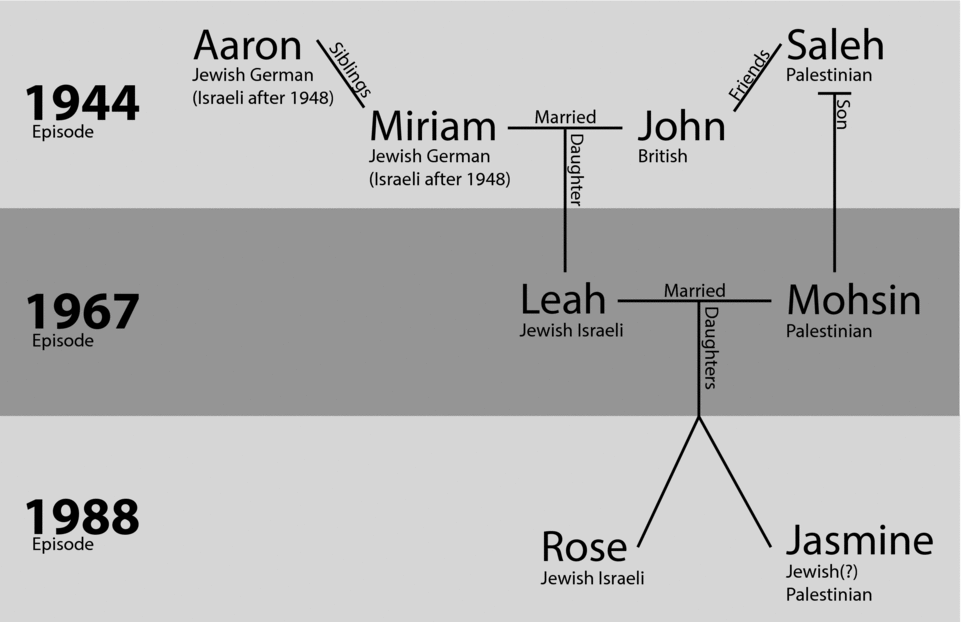
The result was a story that begins in 1944, when the Jewish German siblings Miriam and Aaron meet in Jerusalem as escapees of the Holocaust. Aaron updates his sister on the death of their family members in Germany. Settling in Jerusalem, Miriam marries a British officer, John, and has an Israeli daughter, Leah. A generation later, Leah marries Mohsin, the son of a Palestinian mosaic-craftsman-turned-resistance-fighter (and friend of John's), Saleh. Leah and Mohsin are separated in the 1967 war, each taking care of a daughter, and raising her in their own national setting. Rose becomes a Zionist Israeli soldier and Jasmine becomes a Palestinian resistance fighter. This third generation meets in the military's interrogation room where the Palestinian daughter dies under torture and the Israeli commits suicide.
Character relations chart. Created by Samer Al-Saber. Illustrated by Clint Sleeper.

In the spring of 2015, Hakim returned to Jerusalem to start rehearsals. Crucial debates emerged among the production team around the political orientation of the play and its focus on Jewish issues.Footnote 16 The actors and director negotiated their philosophical standpoints with each other: Hakim argued from a context of internationalism, while the actors insisted on the merits of the Jerusalemite context. Hakim, a Marxist humanist theatre-maker, believed in worldwide struggle against systemic oppressions such as blind nationalism, greedy capitalism, patriarchy, neoliberalism and genocide. Growing up in Egypt and Lebanon, then living in France, Hakim witnessed first-hand the emergence of Arab nationalism, the centrality of Palestine to the Arab ethos, and the civil war in Lebanon. He refused to join Lebanese militias in their conflict with Palestinians and closely followed the 1982 massacres of the Sabra and Shatila refugee camps. In Europe, he found community with Latin American Marxists in their struggles in Argentina, Brazil, Chile and Nicaragua, to name a few. He saw himself as a citizen of the world. From this personal history of internationalism, Hakim endeavoured to tell a humanist story in a script that would transcend nationalism, but acknowledge the context of Palestine.Footnote 17
While recognizing the international worldwide struggles for liberation, the Palestinian actors insisted on the centrality of the local context. Although they were intrigued by the artistic challenge of playing the ‘Other’ or the adversary – whether British, German–Jewish or Israeli – the majority of their discussions centred on everyday realities in Palestine. A utopian–humanist ideal contradicted the restrictions the actors faced in their daily lives. They objected to dialogue that idealized their heavily militarized adversary or presented a balanced conflict, which assumes some form of equality between the occupier and the occupied in the struggle.Footnote 18 Most importantly, they objected to Hakim's initial ending, which set the grandfathers of the characters in an alternate reality, acknowledging their actions as the seeds of tragedy on the ground. The actors argued against the trope of victimless children suffering the misdeeds of their dead forefathers, which absolves the Israeli occupation from its responsibilities towards the Palestinians.Footnote 19 These discussions led to Hakim's introduction of changes to the script, which rendered dialogue more current with Palestinian Jerusalemite everyday life under occupation and transformed the utopian ending into a gesture of political indictment, in which a bereaved and unarmed Palestinian father rejects the argument and rhetoric of the right-wing fighter Aaron by spitting in his face.Footnote 20
But aside from the ending, and despite cuts that significantly reduced the length of the play, the team's debates produced only minor changes to the original content of the script.Footnote 21 Rather, the cast became more committed to the historical responsibility of playing themselves, the non-national Jewish refugee before 1948, and the Israeli adversary after 1948. In a personal interview shortly after opening night, Hakim credited his team of Palestinian actors: ‘As soon as we got onstage, the debates ended. They forgot who was Jewish, British or not, and they committed to authentic acting of their characters’.Footnote 22
This testimony signals one of the key contributions of this production. Historically, the occasional presence of Jewish characters on the Palestinian stage has been primarily driven by representations of the Israeli military and official representatives of the state of Israel. In the absence of a normalized relationship between the overpowering occupier and the overwhelmed occupied, the majority of Palestinians in the Occupied Territories come into contact with Jews and/or Israelis through engagement with the Israeli military or security forces, or through the resulting restrictions over their movement, access to resources and economic independence. Thus, in this context, contemporary theatrical representations of Israeli Jews on the Palestinian stage can most often be categorized as symbolic vehicles for the purpose of speaking truth to power. For example, plays such as I Am Free by Valentina Abu Aqsa, Natrin Faraj (Awaiting Salvation) by Sanabel, an adaptation of Jean-Paul Sartre's No Exit by Al-Kasaba, and various adaptations of Kanafani's Returning to Haifa have represented Israeli soldiers as prison guards, interrogators or off-duty representatives of the state.Footnote 23 Palestinian plays frequently show the after-effects of military and state actions on the Palestinian population and on Palestine, demonstrating the overwhelming presence and influence of Israel on daily Palestinian life. In effect, the outcome is a near complete absence of Israeli domestic life on the Palestinian stage.
Roses and Jasmine challenges this trend by showing dialogue between Jewish and Israeli characters negotiating their own narratives in the absence of any Palestinians onstage. In this emergent phenomenon in casting and performance, the Palestinian actors play these Jewish characters in earnest, stepping outside their comfort zones and consciously sympathizing with the most militant of characters.Footnote 24 For example, the most dominant character in the play, Aaron, stirred controversy among Palestinian audiences not only by his presence in the play as a staunch Israeli nationalist, but also by his backstory as a Holocaust survivor, and his extreme actions toward women in his life in entirely domestic scenes. The audience first encounters the character, played by the Jerusalemite Hussam Abu Esheh, in 1944 as a new arrival in Palestine. Having escaped Nazi atrocities in Berlin, he informs his sister of the murder of their younger sister and mother. Deeply impacted by his experiences in Europe, he becomes a member of the Irgun, an extremist militant organization that acknowledged responsibility for the 1946 bombing of the King David Hotel, the governing headquarters of the British Mandate of Palestine.Footnote 25 Aaron recruits his sister Miriam into Irgun service and convinces her to spy on her British husband. Breaking apart the family for over four decades, he imprisons his niece, suppresses his sister's attempts at personal independence, and commits to ideologically co-opting younger generations into his nationalist project. This ‘Creon’ figure, unwavering in his opinions and committed to the institutions he creates, believes that he belongs to an exceptional Jewish race. For the sake of a higher purpose, he suppresses any sympathies towards Palestinians, who are simply necessary collateral damage for the achievement of his political goals. Aaron drives the plot of the play through his pathological need to subjugate the women in his life and to consolidate power in the state institutions he so values. Turning from oppressed to an overwhelming oppressor within the forty-year chronology of the play, he represents both a genocide survivor and a blind, yet victorious, militant ideology.
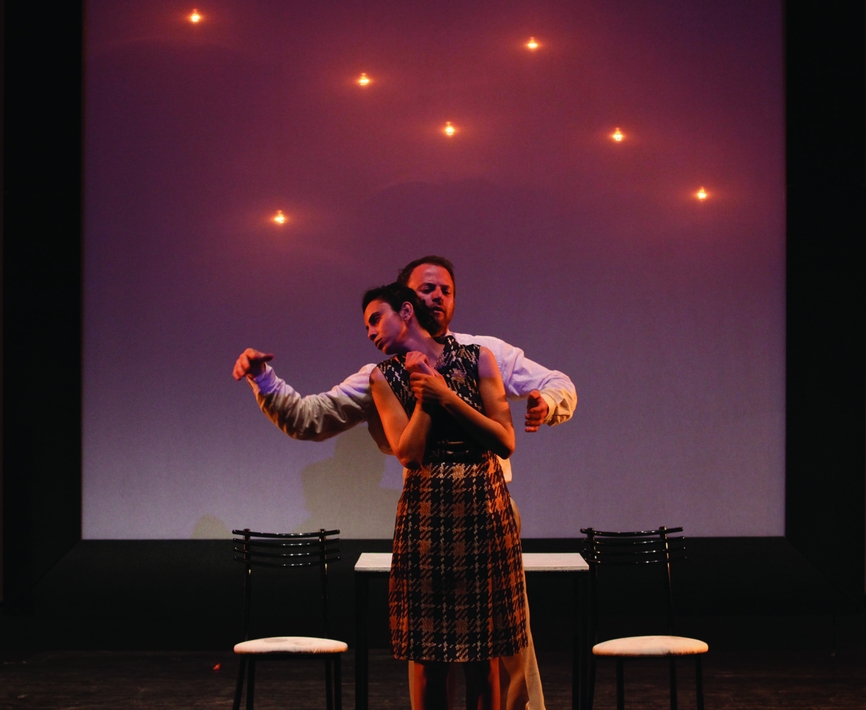
‘John, you're here’. Miriam imagines an romantic encounter with John after he is killed. Photograph courtesy of Nabil Boutros.
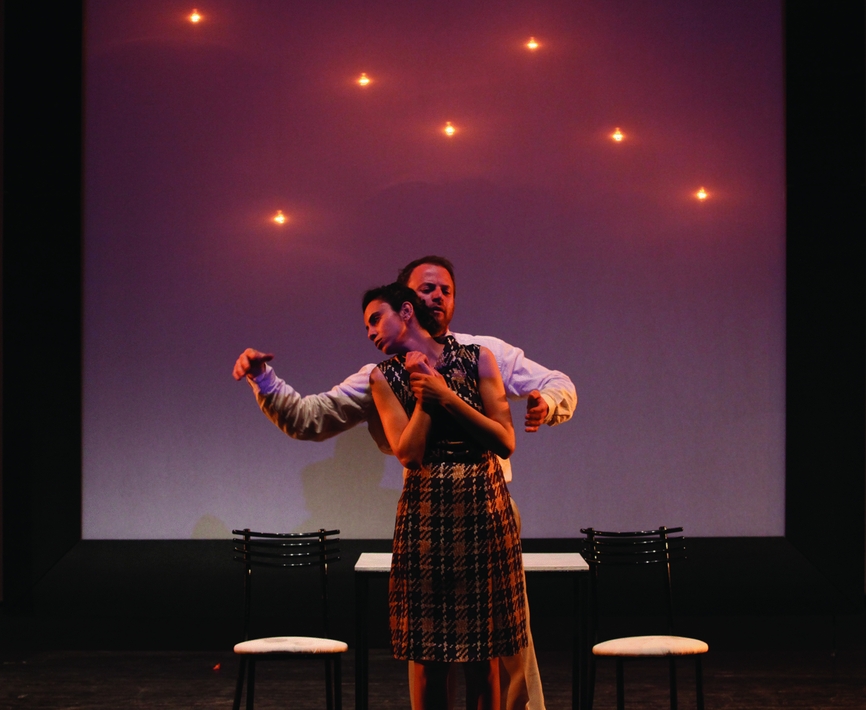
In contrast to Aaron's unwavering right-wing militancy stands his sister, Miriam (Shaden Salim). This character shows the most transformation throughout the play. She begins as an escapee from Berlin during the Second World War, then marries a British Mandate of Palestine officer in Jerusalem. Due to her recent experiences in Berlin and the Zionist dream of statehood, she is compelled to join the Irgun, spy on her husband and play a role in his death in the King David Hotel bombing. For forty years thereafter, she lives with her crimes and continues to suffer as her children and grandchildren choose divergent paths in relation to Palestine. In Salim's interpretation of the character, Miriam's Judaism does not play a significant role in her actions; rather, her fear of Nazis, the domineering character of her brother, dreams of statehood and pathological nightmares influence nearly all her decisions.Footnote 26 Miriam eventually attempts to atone for her choices and for membership of the Irgun. The complexity and mental suffering of this character ask audience members to question the sustainability of personal denial among participants of fundamentalist ideologies and extreme militaristic establishments.
Showing further diversity in the representation of the Jewish–Israeli spectrum in the play, the character Leah, played by Amira Habash, demonstrates sensitivity to the Palestinian history of dispossession. This character exemplifies a marginalized voice in Israeli public life. Leah refuses military service and marries a Palestinian man. Born of mixed heritage, her subject position on the margins of Israeli society prompts an internal battle within her conscience. Where does she belong and to whom? This idealistic character represents a human rights activist within Israeli society – she lacks political influence, but her strong sense of justice causes a rift in her immediate social environment. As a Jewish–Israeli woman, her commitment to the Palestinian cause and her explicit identification of the land as Palestine represent her rejection of the state of Israel and bring shame to her uncle, Aaron. Her political beliefs lead her to suffer just as the Palestinians do. Ultimately, the production suggests that the systemic state ideology rarely differentiates among races or positionalities in its treatment of dissenting voices.
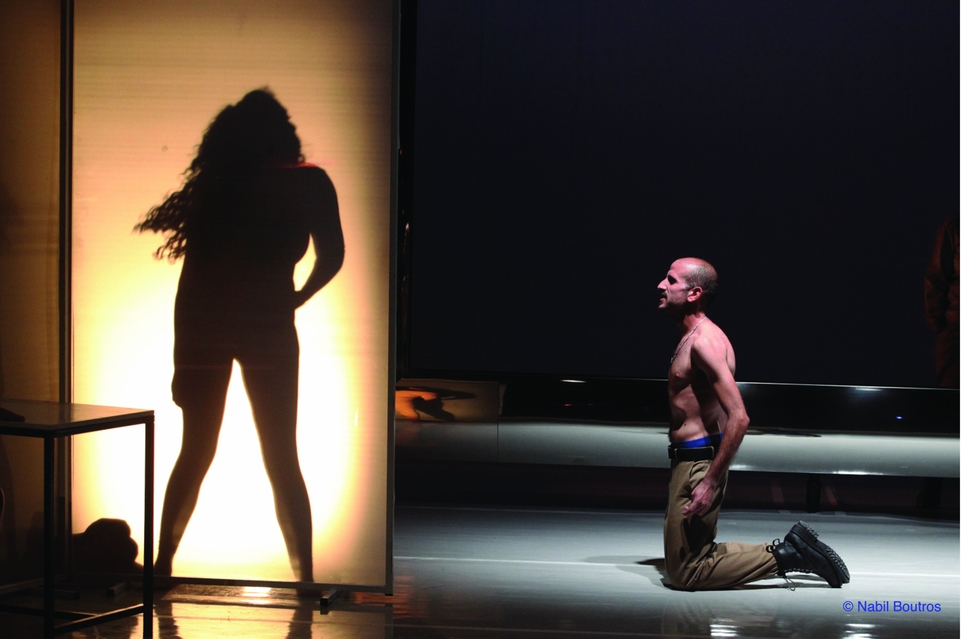
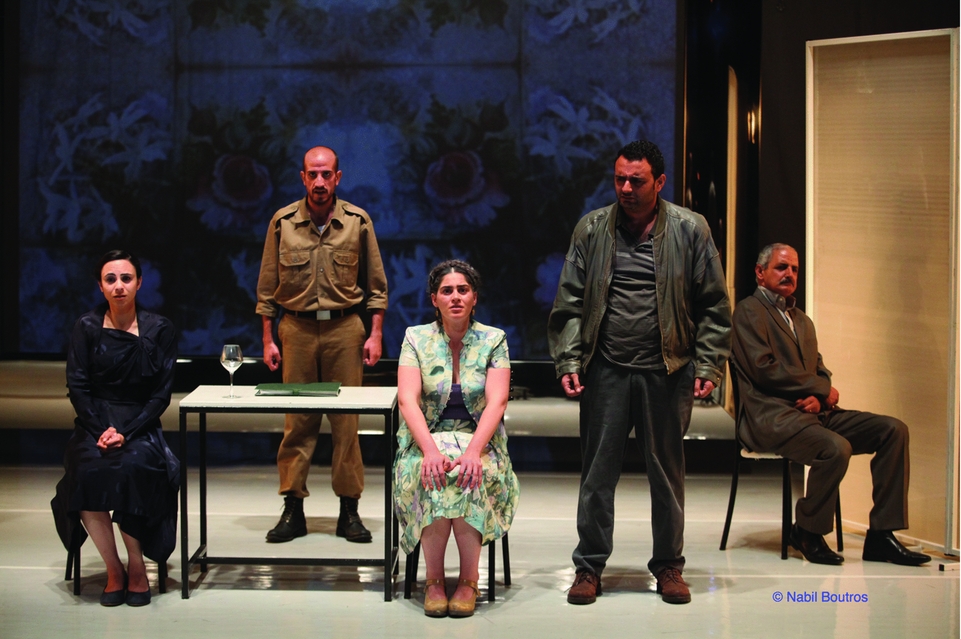
In the final scene of the play, the offspring of Leah and her Palestinian husband Mohsin, estranged in the aftermath of the 1967 war, meet in an unexpected circumstance. Their daughters Rose, an Israel Defense Forces (IDF) soldier, and Jasmine, a Palestinian stone-thrower from Gaza, meet in the Israeli interrogation room.Footnote 27 Unbeknownst to her, Rose facilitates the torture and rape of her own sister, ultimately leading to her death. By ventriloquizing the narrative of the contemporary IDF soldier and showing the final moment of realization that Rose is indeed Jasmine's victimizer, Hakim reveals his intended outcome through the experience of this Jewish family: the militant project which started before 1948 can only lead to a tragedy of immense proportions. In her anagnorisis, Rose must reconcile her actions with her own lineage. In the final scene of the play, she finds herself on IDF premises, in the presence of a fellow soldier, her uncle Aaron, her mother Leah, grandmother Miriam and her Palestinian father, whom she has just met, attempting to understand and overcome the destructive outcome of her received ideology. Unable to reconcile the contradictions she inhabits, she commits suicide.
‘This is my only way to enjoy your beauty’. The IDF soldier Dov declares his desire for the captive Jasmine after he forces her to remove her clothes. Photograph courtesy of Nabil Boutros.
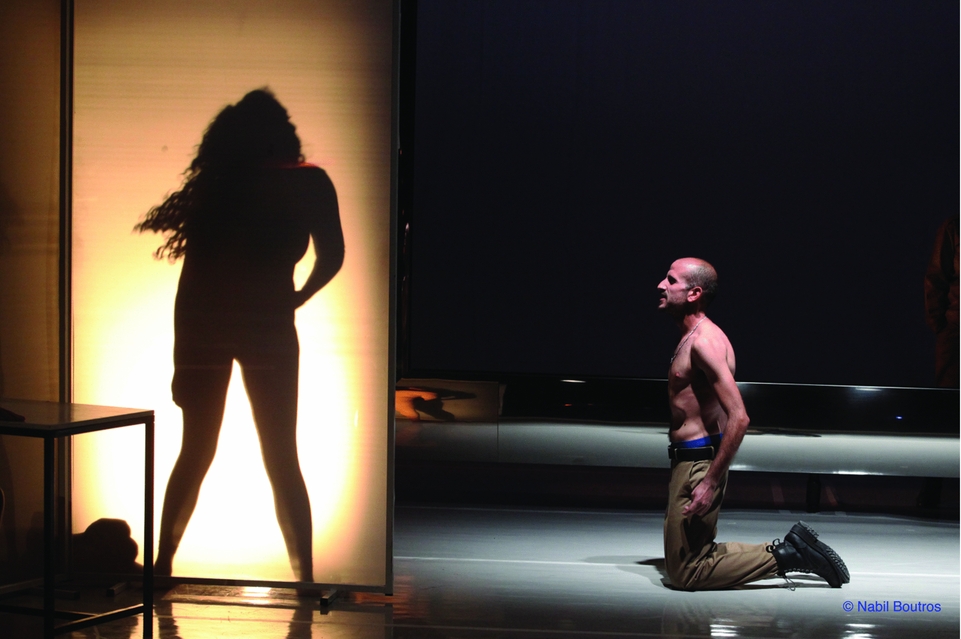
Unsuprisingly in a play inspired by a Greek tragedy, all the characters in the play suffer from personal and political pathologies in their own versions of traditional tragic flaws. While such characters are no strangers to the Israeli stage, which often tackles innumerable complex Israeli and Jewish cultural, social and political issues, including the state's relationship with Palestinian citizens, the creation and/or playing of the Jewish characters in Roses and Jasmine by a Palestinian cast and an Arab–French director for the Palestinian stage prompts an important question: why would the Palestinian National Theatre co-produce a play that primarily represents the story of a Jewish family and ventriloquizes nationalist Israeli rhetorics?
One answer is that, in a context where, as discussed above, the mere existence of a Palestinian identity continues to be a question of legitimate debate in the mainstream Euro--American--Israeli context and the Palestinian subject remains suspected of violence, terroism and criminality, Jewish characters can say much that Palestinians cannot. By ventriloquizing Israeli characters with integrity, the Palestinian actors can communicate that which would not be accepted from a Palestinian character. By bringing the exceptional and marginalized opinion in Israel into the centre, Palestinians permit audiences, particularly in Europe, to see injustices that they may simply refuse to see or accept otherwise. In lieu of a Palestinian account of an ongoing historical injustice, Roses and Jasmine draws from the periphery of Israel's political landscape, a Jewish opinion that speaks a truth. Actress Shaden Salim noted that, in her experience, European audiences have come to expect Palestinians to perform their suffering: ‘normally we tell the story from our perspective. This is an occasion of Palestinians telling the story from the Israeli perspective. Hearing the story in a different way allows people to see things differently’.Footnote 28
Such an interpretation may have been valid for international audiences of the play. But what about the Palestinian audiences, who overwhelmingly challenged the premise of the play, claiming that this attempt to acknowledge Israeli suffering marginalized Palestinian characters? If the production aims at resisting a hegemonic force, given the controversial outcome, what is the cost of this resistant ventriloquism? An overview of the critical reception of the play may shed some light on these quandaries.
Necessary objections to balancing systemic structures
After a period of eighteen months in development and seven weeks of rehearsal, Roses and Jasmine opened at the Palestinian National Theatre. Subsequently, word of mouth spread among Jerusalemites, particularly the cultural elite, that they should see the show. Controversy ensued.Footnote 29 In his review of the play, Jamal Al-Qawasmi stated a popular reaction: ‘The majority of the play is a narrative of a story that's not ours, and it tells a history from the heart of the Zionist narrative’.Footnote 30 Many Jerusalemite audience members questioned the centrality of the Holocaust and the idealization of a single British officer as he declared the necessity of saving Jews by creating a Jewish state in Palestine. Some asked, would the powerful Israeli media industry and its supportive international allies recognize the Nakba and refugee rights in a Palestinian-majority story? Why should Palestinian actors take on the burden of performing Jewish suffering in earnest when Palestinians have continuously suffered since the process of creating the state of Israel began? Others responded, why not?Footnote 31 But these discussions, extending from the lobby on opening night to performance reviews, traced a tension that was not only political, but also aesthetic: between the systemic European colonial structure embedded in the tragedy that inspired the play and the resistant ventriloquism that operated within it.
Critics of the play questioned the strict lens of the episodic narrative, which focuses the first act on the relationship between Jews and the British in the years leading to 1948, then follows Jewish characters as they define themselves in relation to the state of Israel.Footnote 32 By starting the narrative during the end of the British Mandate period, the play necessarily links the struggle to the contemporaneous context of the Second World War and the Holocaust. This choice of periodization marginalizes the Palestinian struggle against Zionism, resulting in a frank objection to the underrepresentation of a centuries-old struggle against colonization. The Palestinian characters throughout the story constantly escape death or imprisonment following a series of wars and displacements. In this never-ending pattern for survival, they must be performed as reactive to circumstances, rather than as agents of their struggle for liberation. Because of the intimate knowledge of their history of armed struggle in various historical periods, Palestinian audiences in Jerusalem detected the minor role of their characters in the onstage conflict. If, according to the play, Palestinians were not a primary agent as an ever-present legitimate force of resistance, then what is the production attempting to communicate by telling a Jewish story?
While critical audience members objected to the relegation of the Palestinians to secondary subject positions, defenders of the play suggested that it represents the precarious subject position of Palestinians and their victimhood, and not necessarily their acknowledged history of resistance. On his first entrance, Saleh, a Palestinian artisan played by Kamel El-Basha, asks the British officer John whether he will be able to preserve his craft of creating mosaics in his shop in Jerusalem's Talbiyyeh neighbourhood. In 1944, Saleh witnesses the influx of Jewish immigrants and sees an existential threat to his heritage and way of life. He notes that the Jewish immigrants refuse to appreciate the language and culture of Palestine. The British officer explains to him the realities of the Holocaust and the Jewish argument for a historical claim to the land. Saleh responds, ‘the Zionists began to occupy Palestine prior to the rise of Nazism’. John insists, ‘They were oppressed, that's why they sought a homeland’. Saleh exclaims, ‘In my homeland?! In my home?! In my shop?!’ Subsequently, Saleh's journey spirals into the story of a Palestinian Everyman who fights for his property and home, lives in exile, joins the resistance in the diaspora, and attempts to reclaim his rights in his native Jerusalem. Despite its significant representation of the Palestinian struggle and refugee life, this minor character did not satisfy the staunch opposition to the production because it was seen, structurally, as a counterpoint or balancing force to the Zionist historical account.Footnote 33
In Hakim's narrative, the British Mandate government attempts to create a just peace in their protectorate of the Mandate of Palestine, Jews seek to permanently end pogroms by creating their own state, and Palestinians react to maintain their way of life against extreme odds. Thus the play represents two active agents and a passive one.Footnote 34
The Palestinian characters’ decision to carry arms develops from the overwhelming power of the British Empire, their gradual loss of self-determination, the increasing power of Jewish militias, and the outlawed actions of groups such as the Irgun in the mid-1940s. In this overarching argument, Holocaust victims (primarily European Jews) and victims of Jewish paramilitary organizations (Palestinians) can be seen as two suffering entities vying for an honourable outcome in an existential battle. In spite of the production team's efforts to avoid this outcome, the appearance of a balance between the occupied and the occupier led to a frank rejection of the play's argumentation. Jamal Al-Qawasmi plainly declared,
What irritated me in the play is that Palestinians and Zionists are all equal victims; and probably if they were victims, as the play suggests, then perhaps they mean to say that they were all martyrs. It felt as if in our history since the Nakba there were no murderers or criminals, and that perhaps there was no crime at all.Footnote 35
This fundamental disagreement between critics and supporters of the play expresses a long-standing philosophical difference which cannot be avoided in the traditional structure of a tragedy. By adopting a combination of tragic and episodic narrative structure, Hakim creates a powerful Hegelian/Marxist dialectic that endorses a European tradition of a balanced interplay of opposites. In his critique of tragedy, famously based on a reading of Antigone, Hegel takes after Aristotle in arguing that a structure of ‘right versus right’ plays a driving role in the genre, where this tension appears in the battle between natural (human) rights opposite conventional (state or established) rights. In this structure, the conflict may only be resolved through the intervention of ‘the gods’ of Greek tragedy, or by the death of blameless victims, which establishes the basis for a new cycle of violence leading to another tragedy. Therefore, in the end, all parties are simultaneously equally right and equally wrong. In the death of a new generation of mixed Jewish–Palestinian offspring, children suffer from the actions of their parents. In the wake of innocent victims, the endless cycle of violence continues and everyone is considered guilty.Footnote 36 But on the ground, specifically for Palestinian audiences, not everyone is guilty or a victim. From such a perspective, the participants in the Israeli national project remain responsible for the dissection of Palestine since 1948.Footnote 37
‘Your daughter Jasmine is dead’. The IDF soldier Dov tells the family that their daughter Jasmine has been raped and killed. Photograph courtesy of Nabil Boutros.
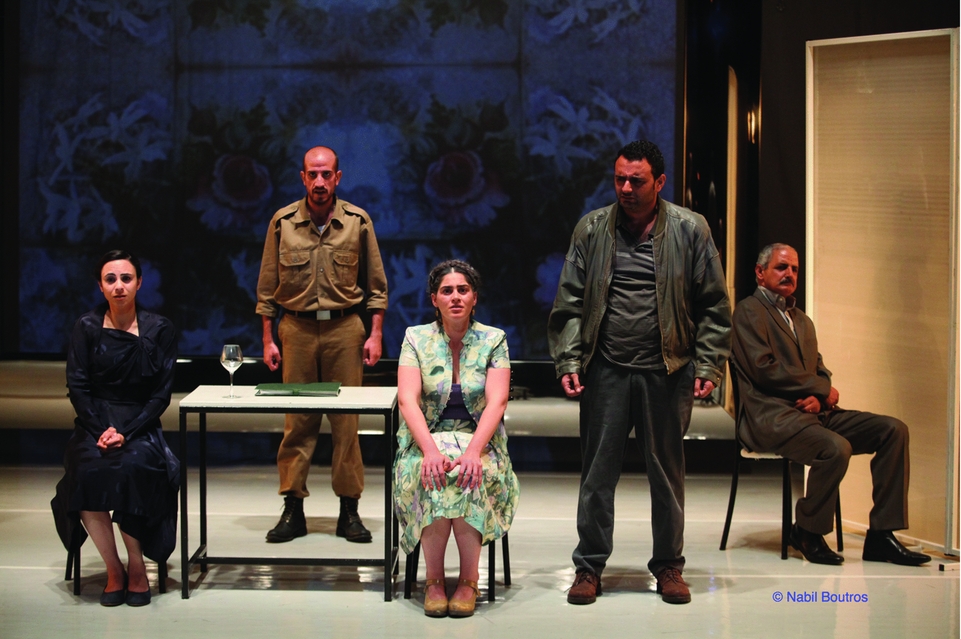
Despite these potentially counterbalancing forces to the Israeli narrative within the play, critics did not accept the dramatic structure.Footnote 38 In Hakim's dialectical argument, an Israeli/Jewish narrative appears to be replacing the Palestinian one, or, at the very least, the deeply humanizing performance appears to be peddling a coexistence message rather than a message of resistance.Footnote 39 Particularly since the Oslo peace accords of 1993, the tragic structure has become normative in the Euro–American understanding of Israel/Palestine and has been adopted as a rhetorical strategy in Israeli argumentation concerning Palestinians. This approach to the conflict leads to a perception of a stalemate between two ‘equal’ powers, which cause the suffering of innocent victims. In other words, the Euro–American–Israeli observer awaits a deus ex machina to resolve an ungovernable tragedy. In their keen awareness of this trend, most Palestinians have developed a strong sensitivity to such a structure in both narrative argumentation and theatrical staging.
Fundamentally, these criticisms – in terms of the structural inequalities in periodization, positionality and argumentation – questioned the value of a Palestinian resistant ventriloquism that occurs when the balance of power continues to favour a Jewish--Israeli narrative in the public sphere. In light of such a systemic imbalance, is this strategy appropriate?
Quandaries and outcomes of a resistant ventriloquism
If the critical eruptions following opening night were the only criteria of failure and success, the idea of ventriloquizing an adversary would be unacceptable, even if recognized as a mode of resistance and revelation. The employment of a resistant ventriloquism necessitates the adoption of the occupier's systemic structure and viewpoint, and by extension the acceptance of the relegation of the cultural producer's narrative to a secondary storyline because inhabiting the occupiers requires entry into their sphere of argumentation. Increasingly for Israelis, the conflict may be identified as a battle of right versus ‘right’, or, more precisely, a battle between a weak and floundering political left versus an overwhelmingly powerful political and religious right. In this simplified equation, the story of a Jewish family with diverse political opinions and positionalities, ranging from Aaron's right-wing ideology to Leah's pro-Palestine sensitivity, appears representative of Israeli politics today. The representation of Palestinians in the play traces a familiar path – a choice to move back and forth from passive to active resistance in reaction or protest, eventually leading to the painful outcomes of death, imprisonment or dispossession. The desire to inhabit the role of the occupier faces the obstacle of the necessity to relinquish full control of the narrative of the occupied. In this sense, the audience's criticisms are not only valid; they are inescapable.Footnote 40
The complexities and controversies of this production are dependent on the viewing audience, who are ultimately a primary reason to perform any play. My own synthesis suggests that critics objected to the aforementioned formulaic structural element of ancient Greek tragedy: equal opposite forces that lead to the victimization of innocents. Accordingly, many Palestinians reject the notion of a rhetorical or material treatment that does not openly situate the occupier in the position of oppressor. In a predominantly Israeli audience, objections may arise to similar perceptions of equality in the representation of Palestinians as natives to their homeland, to various reincarnations of Zionism as a modern European movement, and to the indigineity of world Jewry to their own multicultural and multinational origins, including, but not exclusively, to Palestine and Arabic-speaking nations. A pro-Palestinian audience applauds the earnest representation of Aaron as an extremist militant, who commits acts of terrorism for the sake of his own cause, but may not appreciate the appearance of a reductive interpretation of Palestinian history. A pro-Israeli audience applauds a story that begins with the recognition of Jewish suffering in the Holocaust. Certainly, a European audience applauds the semblance of a dialectic throughout the production, leading to a perception of neutrality. In the case of this play, for every detractor, a supporter can advocate the opposite, mirroring stances on the history of dispossession in Palestine.Footnote 41 This complex rhetorical environment provides fertile ground for a resistant ventriloquism to operate, precisely because audience members seek to see their own subject position represented onstage.
In the case of Roses and Jasmine, the reverse or resistant ventriloquism does much else in addition to changing the viewing angle and perspective. It permits the perception of a Jewish body onstage to communicate a message – for the European audiences and perhaps the Israelis to see themselves as they inhabit two realities: the victim and the oppressor.Footnote 42 More importantly, and this is the most remarkable achievement: underneath the body of the Jewish/Israeli character onstage breathes the Palestinian actor – living evidence of injustices over the better part of a century. This outcome establishes a purpose that exceeds the traditional sense of ‘playing the other’, as European critics evoked frequently in their reviews.Footnote 43 The production suggests that ethnic, religious and racial constructions fall apart when embodied by colonized subjects with sincerity and generosity. In other words, when the occupied inhabits the occupier, in the act of the oppressed performing the oppressor, denial of the coexistence of this master–slave reality cannot take place. Actress Shaden Salim recalled the reaction of one audience member after a Parisian performance,
So many audiences left the theatre in tears. An old Jewish lady came to see the play because she was concerned that Palestinians were playing Jewish characters. We convinced her because we did our homework. She said, ‘you are hitting a sensitive chord. We are not going to say it and the Israelis won't and cannot admit it’. They came out crying.Footnote 44
The performers’ ability to embrace Jewish, Israeli and Zionist characters, in their traumatic past and their ideologically staunch present, shows an embracing pluralism, perhaps a most idealistic vision of historic Palestine, where Judaism is a recognized native religion. Yet, as French critic Marina Da Silva noted, the ability to perform one's occupier is not self-evident.Footnote 45 Actor Hussam Abu Esheh explained the high stakes of this form of resistance: ‘It was a big challenge because I had to justify the actions of my character “Aaron” through my interpretation. But it is also a challenge before a Palestinian audience who find it difficult to consider that Jews [Israelis] are human beings too’.Footnote 46 Similarly, actor Kamel El-Basha responded to criticism in a television interview, stating, ‘In Jerusalem, it wasn't even a difference of opinion, it was a quasi-attack: “How could we be showing the Israeli point of view . . . and thus humanizing them”. But they are human beings’.Footnote 47 Nonetheless, the act requires a sacrifice of one's own narrative for a greater purpose: to unmask deeply repressed truths. In this case, the message arrived clearly that a resistant ventriloquism in the case of Roses and Jasmine functions as an effective entry way to, as Da Silva put it, ‘take account of the colonial paradox that Palestinians always pay the price’.Footnote 48
Based on the context of this production and the aforementioned history of orientalism that it battles against, I argue that this production consciously represents Jewish–Israeli characters, who struggle with their own religious and national identities, through Palestinian bodies as a form of resistance to occupation and colonial expansion. In this instance, the relationship between Israelis and Palestinians is representative of the colonizer and the colonized respectively. Accordingly, I define a resistant ventriloquism as an instance where the colonized portrays the colonizer in earnest and in a manner devoid of traditional demonization, representing a range of voices from the hegemonic structure of the colonizer for the purpose of revealing repressions and denials, which haunt the history of the colonizer.
This major strategic advancement in Palestinian cultural production presents a superb challenge: will the Israelis successfully embrace Palestinian characters with similar complexity and diversity in the future? Will Israeli theatre-makers produce mainstream Palestinian-majority works that tell the story of the Palestinian Nakba in earnest? Will the narratives of the ‘victors’ acknowledge the indigeneity and struggles of the oppressed? Only time will tell. This challenge also extends to a larger vision in cultural production and scholarship at large. For centuries, the artists of Western empires have established the character of the East in their orientalist genres. Orientalism in written and performed representation is nothing but ventriloquism: the colonizer's dialogue in the mouth of the colonized! Today, artists of conscience are reversing these trends of performed orientalisms by playing the dialogue of the oppressed in the mouth of the oppressor. Perhaps, in performance, the colonizers, the occupiers and the oppressors will understand themselves by looking into a mirror fashioned by subaltern subjects roaming in their own backyards.