Introduction
Childhood adversity covers a range of potentially harmful experiences, including emotional or psychological abuse, physical abuse, sexual abuse, neglect and other negative life events. It is a putative risk factor not only for clinical psychiatric disorders such as schizophrenia but also for subclinical symptoms, including subclinical, psychotic-like experiences (Rind et al. Reference Rind, Tromovitch and Bauserman1998; Molnar et al. Reference Molnar, Buka and Kessler2001; Edwards et al. Reference Edwards, Holden, Felitti and Anda2003; Read et al. Reference Read, van Os, Morrison and Ross2005; Bendall et al. Reference Bendall, Jackson, Hulbert and McGorry2008; Larkin & Read, Reference Larkin and Read2008; Kessler et al. Reference Kessler, McLaughlin, Green, Gruber, Sampson, Zaslavsky, Aguilar-Gaxiola, Alhamzawi, Alonso, Angermeyer, Benjet, Bromet, Chatterji, de Girolamo, Demyttenaere, Fayyad, Florescu, Gal, Gureje, Haro, Hu, Karam, Kawakami, Lee, Lepine, Ormel, Posada-Villa, Sagar, Tsang, Ustun, Vassilev, Viana and Williams2010). However, the evidence indicating that childhood adversity constitutes a risk factor for schizophrenia is inconsistent and controversial (Morgan & Fisher, Reference Morgan and Fisher2007), and specificity for schizophrenia relative to other psychiatric disorders has not been demonstrated (Chen et al. Reference Chen, Murad, Paras, Colbenson, Sattler, Goranson, Elamin, Seime, Shinozaki, Prokop and Zirakzadeh2010).
Two narrative reviews suggested a causal, dose-dependent relationship between childhood sexual or physical abuse and psychosis later in life (Read et al. Reference Read, van Os, Morrison and Ross2005; Larkin & Read, Reference Larkin and Read2008). Other narrative reviews outline methodological issues at the study level that limit the ability to draw such conclusions (Morgan & Fisher, Reference Morgan and Fisher2007; Bendall et al. Reference Bendall, Jackson, Hulbert and McGorry2008). Study limitations include a lack of statistical power, a lack of attention to moderating or mediating variables such as sex effects, and a lack of adequate control groups.
A recent meta-analysis assessing childhood sexual abuse in case-control and cohort studies reported significant increases in sexual abuse in patients with anxiety disorders, depression, eating disorders, post-traumatic stress disorder (PTSD), sleep disorders and suicide attempts, but not schizophrenia (Chen et al. Reference Chen, Murad, Paras, Colbenson, Sattler, Goranson, Elamin, Seime, Shinozaki, Prokop and Zirakzadeh2010). Two studies met inclusion criteria for schizophrenia in that review (Pettigrew & Burcham, Reference Pettigrew and Burcham1997; Spataro et al. Reference Spataro, Mullen, Burgess, Wells and Moss2004); both assessed rates of schizophrenia in people with a sexual abuse history compared to people with no sexual abuse history or population controls. One of these studies (Spataro et al. Reference Spataro, Mullen, Burgess, Wells and Moss2004) has recently been updated (Cutajar et al. Reference Cutajar, Mullen, Ogloff, Thomas, Wells and Spataro2010), and now reports that rates of psychosis, and schizophrenia in particular, were significantly higher in the abused group compared to population controls. Earlier meta-analyses have reported significant, small to medium effect size increases associated with sexual abuse in patients with depression, anxiety, eating disorders, dissociation, PTSD, somatization and borderline personality disorder (Neumann, Reference Neumann1994; Jumper, Reference Jumper1995; Rind et al. Reference Rind, Tromovitch and Bauserman1998; Fossati et al. Reference Fossati, Madeddu and Maffei1999; Paolucci et al. Reference Paolucci, Genuis and Violato2001). One narrative review reported increased rates of depression, PTSD and suicide attempts in adulthood in children exposed to a broader range of childhood adversities, including physical and emotional abuse and neglect (Gilbert et al. Reference Gilbert, Widom, Browne, Fergusson, Webb and Janson2009).
The aim of this systematic meta-analysis was to assess the current evidence pertaining to rates of all childhood adversities in people with schizophrenia compared to non-psychiatric controls; and furthermore to assess specificity to schizophrenia relative to other psychiatric disorders. The impact of adversity type and adversity measure on the results was investigated, along with quality assessment of reporting of included studies and the overall strength of the current evidence.
Method
Literature search
Inclusion/exclusion criteria
Included are cohort, Case-control and cross-sectional studies reporting rates of childhood adversity (age <18 years; including sexual abuse, physical abuse and neglect) in people with a diagnosis of schizophrenia (i.e. schizophrenia, schizo-affective disorder or schizophreniform disorder) and non-psychiatric controls or in people with other psychiatric disorders. Other psychiatric disorders were grouped into six categories: (1) affective psychoses (bipolar disorder, mania and psychotic depression), (2) other psychoses [delusional, atypical and psychosis not otherwise specified (NOS)], (3) depressive disorders (depression), (4) anxiety disorders (anxiety, panic and neurotic), (5) dissociative disorder, dissociative identity disorder (DID) and PTSD (which is defined in terms of adversity, although not necessarily in childhood), and (6) personality disorders. Inclusion criteria were not limited to published studies or studies written in English. The decision to include or exclude studies was conducted independently by two of the authors (S.M. and R.P.), with disagreements resolved by discussion.
Search strategy
Medline, EMBASE and PsycINFO were searched. The search was conducted in September 2011 and the strategy was designed to be sensitive while retaining acceptable specificity. The search terms were: exp Schizophrenia, schizophreni$.tw, exp Psychotic Disorders, schizo$.tw, child$ trauma.tw, child$ adversity.tw, exp child abuse, child$ abuse.tw, neglect.tw, incest.tw, child$ victimization.mp. Hand searching of reference lists of included reviews was also conducted.
Quality assessment
All quality assessments were completed independently by two authors (S.M. and A.S. or R.P.), with disagreements settled by discussion. The quality of reporting was assessed using the Strengthening the Reporting of Observational Studies in Epidemiology (STROBE) checklist, which outlines a preferred way to report observational studies (www.strobe-statement.org). Studies were assigned a low (>66% items checked), medium (33–66% items checked) or high (<33% items checked) possibility of reporting bias.
To assess the quality of the pooled evidence (not the quality of the individual studies contributing to the meta-analysis), the Grading of Recommendations, Assessment, Development and Evaluation (GRADE) approach was adopted (Atkins et al. Reference Atkins, Best, Briss, Eccles, Falck-Ytter, Flottorp, Guyatt, Harbour, Haugh, Henry, Hill, Jaeschke, Leng, Liberati, Magrini, Mason, Middleton, Mrukowicz, O'Connell, Oxman, Phillips, Schünemann, Edejer, Varonen, Vist, Williams and Zaza2004). GRADE was developed primarily to quality assess management strategies, using evidence from both randomized controlled trials and observational studies; however, in the absence of robust quality assessment guidelines for pooled aetiological evidence, we have applied GRADE criteria to derive a broad indication of the strength and quality of the meta-analytic results. GRADE suggests that pooled evidence from observational studies is inherently of low quality because of the effects of possible confounding factors. This evidence can be upgraded if sample sizes and pooled effect sizes are large or dose dependent, or if the evidence is direct, consistent or precise (Higgins & Green, Reference Higgins and Green2008). Indirectness pertains to approximated measures; inconsistency to significant heterogeneity between study results; and imprecision to wide confidence intervals (CIs) around the pooled effect size (CIs >0.25 in either direction) (GRADEpro, 2008).
Data extraction and analysis
All data extraction was completed independently by two of the authors (S.M. and A.S. or R.P.). The following variables were extracted: (1) rates of childhood adversity in schizophrenia patients, non-psychiatric controls and other psychiatric groups, (2) study characteristics including study design, diagnostic tool, adversity measure and adversity type, and (3) sample characteristics including number and diagnoses in each psychiatric group, number and characteristics of controls, and subject age and sex.
Comprehensive Meta-Analysis version 2 (CMA V2; Borenstein et al. Reference Borenstein, Hedges, Higgins and Rothstein2005) was used to conduct the meta-analyses. We report odds ratios (ORs) and 95% CIs. An OR >1.0 indicates greater reporting of childhood adversity in schizophrenia patients compared to controls or other psychiatric groups; an OR <1.0 indicates greater reporting of childhood adversity in controls or other psychiatric groups compared to schizophrenia. An effect size is considered medium to large if OR >2 or <0.5 and large if OR >5 or <0.2 (GRADEpro, 2008). A random effects model was used as heterogeneity across study results was expected. The I 2 statistic is the percentage of the variability in effect estimates that is due to heterogeneity rather than to sampling error. A guideline for interpreting I 2 (heterogeneity) is that 0–40% might not be important, 50–75% ‘may’ be important, and >75% should be regarded as ‘considerable’. Planned subgroup analyses were conducted to explore possible sources of heterogeneity in each comparison. These analyses considered adversity type (e.g. sexual abuse, physical abuse, neglect), adversity measure (e.g. questionnaire, clinical interview, medical chart review), specific diagnoses within other psychiatric groups, and sex. Publication bias was assessed by Egger's test to determine statistically the degree of funnel plot asymmetry, with asymmetry representing publication bias (Egger et al. Reference Egger, Davey Smith, Schneider and Minder1997). Forest plots were generated using RevMan 5.1 (Review Manager, 2011).
Where studies included the same individual in multiple adversity types, to prevent sample overlap within each diagnostic analysis we included only data on the most commonly reported adversity, sexual abuse. Where studies report several diagnoses for the one individual, these were able to be included in each analysis because analyses on diagnostic groups were conducted separately and samples therefore did not overlap.
Results
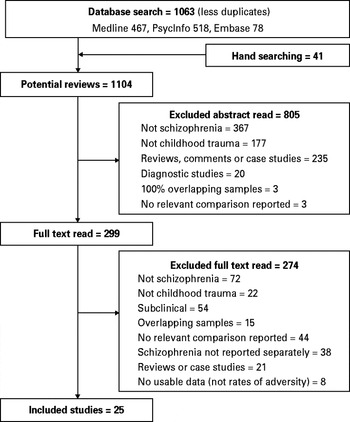
Search results (Fig. 1)
The searches yielded 1104 published and unpublished references, of which 805 were excluded following review of the abstract, and a further 274 were excluded following review of the full text. This left 25 studies meeting inclusion criteria (Friedman & Harrison, Reference Friedman and Harrison1984; Craine et al. Reference Craine, Henson, Colliver and MacLean1988; Stein et al. Reference Stein, Goldring, Siegal, Burnam, Sorrenson, Wyatt and Powell1988; Ross et al. Reference Ross, Heber, Norton and Anderson1989; Byrne et al. Reference Byrne, Velamoor, Cernovsky and Cortese1990; Fink & Golinkoff, Reference Fink and Golinkoff1990; Goff et al. Reference Goff, Brotman, Kindlon, Waites and Amico1991; Darves-Bornoz et al. Reference Darves-Bornoz, Lemperiere, Degiovanni and Gaillard1995; Nettelbladt et al. Reference Nettelbladt, Svensson and Serin1996; Nurcombe et al. Reference Nurcombe, Mitchell, Begtrup, Ramontana, Lababera, Pruitt and Volkmar1996; Wurr & Partridge, Reference Wurr and Partridge1996; Wexler et al. Reference Wexler, Lyons, Lyons and Mazure1997; Honig et al. Reference Honig, Romme, Ensink, Escher, Pennings and deVries1998; Friedman et al. Reference Friedman, Smith, Fogel, Paradis, Viswanathan, Ackerman and Trappler2002; Hlastala & McClellan, Reference Hlastala and McClellan2005; Spence et al. Reference Spence, Mulholland, Lynch, McHugh, Dempster and Shannon2006; Choi et al. Reference Choi, Reddy, Liu and Spaulding2009; Rubino et al. Reference Rubino, Nanni, Pozzi and Siracusano2009; Conus et al. Reference Conus, Cotton, Schimmelmann, McGorry and Lambert2010; Husted et al. Reference Husted, Ahmed, Chow, Brzustowicz and Bassett2010; Kingdon et al. Reference Kingdon, Ashcroft, Bhandari, Gleeson, Warikoo, Symons, Taylor, Lucas, Mahendra, Ghosh, Mason, Badrakalimuthu, Hepworth, Read and Mehta2010; McCabe et al. Reference McCabe, Maloney, Stein, Laughland and Carr2012; Aas et al. Reference Aas, Dazzan, Fisher, Morgan, Morgan, Reichenberg, Zanelli, Fearon, Jones, Murray and Pariante2011; Alvarez et al. Reference Alvarez, Roura, Osés, Foguet, Solà and Arrufat2011; Vogel et al. Reference Vogel, Meier, Gronke, Waage, Schneider, Freyberger and Klauer2011).
Flow diagram showing the flow of information through the different phases of this meta-analysis.

Study characteristics
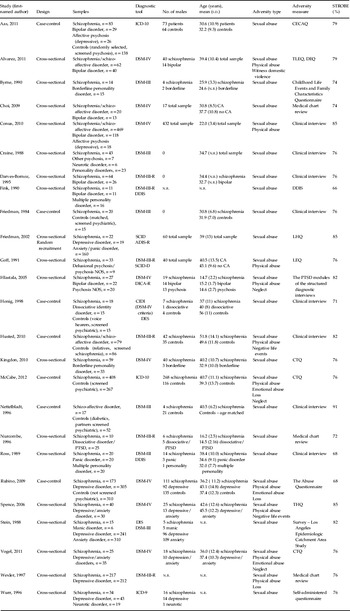
Study characteristics and STROBE assessments are presented in Table 1. Overall, inter-rater agreement on the STROBE checklist was 88% (range for individual items: 62–100%). All 25 studies scored ⩾66% on applicable items on the STROBE, indicating that studies adhered to recommended reporting methods. There were insufficient data reported separately for males and females to allow subgroup analyses of sex effects. Assessment of publication bias using Egger's test was not significant for any of the seven analyses (p > 0.05), so the results are unlikely to be subject to publication bias.
Characteristics of included studies

ADIS-R, Anxiety Disorders Interview Schedule – Revised; CA, childhood adversity; CECAQ, Childhood Experiences of Care Abuse Questionnaire; CIDI, Composite International Diagnostic Interview; CTQ, Childhood Trauma Questionnaire; DDIS, Dissociative Disorder Interview Schedule; DEQ, Distressing Event Questionnaire; DES, Dissociative Experiences Scale; DICA-R, Diagnostic Interview for Children and Adolescents – Revised; DIS, Diagnostic Interview Schedule; DSM, Diagnostic and Statistical Manual of Mental Disorders; ICD, International Classification of Disease; LEQ, Life Experiences Questionnaire; LHQ, Life History Questionnaire; NOS, not otherwise specified; n.r., not reported; PTSD, post-traumatic stress disorder; SCID, Structured Clinical Interview; SCID-D, Structured Clinical Interview Dissociative Disorders; STROBE, Strengthening the Reporting of Observational Studies in Epidemiology; THQ, Trauma History Questionnaire; TLEQ, Traumatic Life Events Questionnaire.
Meta-analyses results
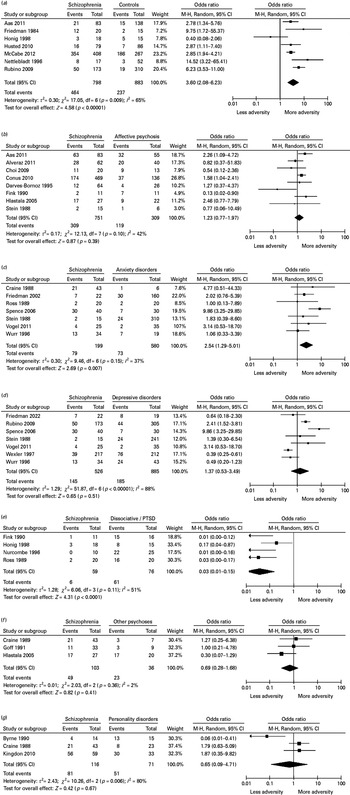
Schizophrenia versus non-psychiatric controls (Fig. 2a)
Meta-analysis of seven controlled studies was conducted on a total of 798 patients with schizophrenia and 883 non-psychiatric controls. The random effects estimate yielded a medium to large effect of increased reporting of childhood adversity among schizophrenia patients (OR 3.60, 95% CI 2.08–6.23, p < 0.00001). Data were imprecise and with moderate heterogeneity (I 2 = 65%, p = 0.009). One study was an obvious outlier, being the only study reporting reduced childhood adversity rates in schizophrenia compared to controls (Honig et al. Reference Honig, Romme, Ensink, Escher, Pennings and deVries1998). This study used non-patient (psychiatrically healthy) voice hearers as controls, and removing it from the analysis increased the OR to 4.15 and reduced I 2 to 51% (p = 0.07). Two other studies used unconventional non-psychiatric control groups; one used unaffected relatives (Husted et al. Reference Husted, Ahmed, Chow, Brzustowicz and Bassett2010); the other used diabetic patients, their partners, and the partners of the schizophrenia patients (Nettelbladt et al. Reference Nettelbladt, Svensson and Serin1996). Removing all three studies from the analysis did not change the overall results, and heterogeneity was reduced (four studies, n = 1414, OR 3.92, 95% CI 2.37–6.50, p < 0.001, I 2 = 55%, p = 0.08). Planned subgroup analyses of the complete set of studies indicated no differences in results due to adversity type (sexual; or combined sexual, physical and other adversity: Q B = 0.01, p = 0.92) or adversity measure (clinical interview or questionnaire: Q B = 0.00, p = 0.97). These findings indicate moderate to high quality evidence of increased childhood adversity in schizophrenia patients compared to non-psychiatric controls. This evidence is consistent (without the outlier), of medium to large effect, uses large samples, but has considerable imprecision.
Forest plots for comparisons between schizophrenia and (a) non-psychiatric controls, (b) affective psychosis, (c) anxiety disorders, (d) depressive disorder, (e) dissociative disorders and post-traumatic stress disorder (PTSD), (f) other psychoses and (g) personality disorders.

Schizophrenia versus affective psychosis (Fig. 2b)
Eight studies compared 751 patients with schizophrenia to 309 patients with an affective psychosis. The random effects estimate showed no differences between groups in childhood adversity rates (OR 1.23, 95% CI 0.77–1.97, p = 0.39). Data were imprecise but consistent (I 2 = 42%, p = 0.10). Planned subgroup analyses showed no significant differences in results due to diagnoses (bipolar disorder, manic disorder or combined bipolar and psychotic depression: Q B = 2.83, p = 0.24), adversity type (sexual; or combined sexual and physical, or other adversity: Q B = 3.58, p = 0.17) or adversity measure (clinical interview, questionnaire or chart review: Q B = 1.14, p = 0.54). This evidence is of moderate to high quality because of the large samples and consistent data, but it is also imprecise.
Schizophrenia versus anxiety disorders (Fig. 2c)
Seven studies compared 199 patients with schizophrenia to 580 patients with a diagnosis of an anxiety disorder. The random effects overall estimate showed a medium increased risk of childhood adversity in schizophrenia (OR 2.54, 95% CI 1.29–5.01, p = 0.007). Data were imprecise but consistent (I 2 = 37%, p = 0.15). Planned subgroup analyses indicated significant differences between adversity type (sexual; or combined sexual, physical and other adversity: Q B = 5.43, p = 0.02), with five studies of sexual abuse reporting no significant differences between groups (n = 649, OR 1.66, 95% CI 0.90–3.08, p = 0.10, I 2 = 12%, p = 0.27) and two studies with mixed sexual and physical abuse and neglect (Spence et al. Reference Spence, Mulholland, Lynch, McHugh, Dempster and Shannon2006; Vogel et al. Reference Vogel, Meier, Gronke, Waage, Schneider, Freyberger and Klauer2011) reporting increased childhood adversity in schizophrenia (n = 130, OR 6.95, 95% CI 2.48–19.51, p < 0.001, I 2 = 12%, p < 0.27). Other subgroup analyses showed no differences in adversity measure (clinical interview, questionnaire or chart review: Q B = 0.33, p = 0.57) or diagnoses (anxiety disorder, panic disorder, neurotic disorder or combined anxiety and depression: Q B = 5.21, p = 0.27). The evidence for the overall effect is of moderate quality; data are consistent, with a medium effect size and large sample size; however, there is considerable imprecision, and the subgroup analysis of the majority of the studies reporting only sexual abuse revealed no significant differences between groups.
Schizophrenia versus depressive disorder (Fig. 2d)
Seven studies compared 526 patients with schizophrenia to 885 patients with a diagnosis of a depressive disorder. The random effects estimate showed no differences between these patient groups (OR 1.37, 95% CI 0.53–3.49, p = 0.51). Data were imprecise and with considerable heterogeneity (I 2 = 88%, p < 0.00001). Planned subgroup analyses revealed no differences in adversity type (sexual; or combined sexual, physical and other adversity: Q B = 2.30, p = 0.13) but significant differences in adversity measure (Q B = 8.98, p < 0.01). The pooled estimate from six studies using questionnaires reported no differences between groups (n = 982, OR 1.77, 95% CI 0.73–4.25, p = 0.20, I 2 = 76%, p < 0.01) whereas the one study using chart review (Wexler et al. Reference Wexler, Lyons, Lyons and Mazure1997) reported significantly reduced childhood adversity in schizophrenia, with data imprecise (n = 429, OR 0.39, 95% CI 0.25–0.61, p < 0.001). There were also significant differences between diagnoses (Q B = 8.69, p < 0.01), with five studies including patients with depression reporting similar adversity rates to schizophrenia patients (n = 1281, OR 0.83, 95% CI 0.32–2.18, p = 0.71, I 2 = 88.0%, p < 0.001) whereas two studies with mixed samples of depression and anxiety patients (Spence et al. Reference Spence, Mulholland, Lynch, McHugh, Dempster and Shannon2006; Vogel et al. Reference Vogel, Meier, Gronke, Waage, Schneider, Freyberger and Klauer2011) reported increased childhood adversity in schizophrenia (n = 130, OR 6.95, 95% CI 2.48–19.51, p < 0.001, I 2 = 12%, p < 0.27). The evidence of no differences between patients with depressive disorder relative to schizophrenia is of moderate to low quality because of substantial heterogeneity and considerable imprecision, although the overall sample size is large.
Schizophrenia versus dissociative disorders and PTSD (Fig. 2e)
Four studies compared 59 patients with schizophrenia to 76 patients with a diagnosis of a dissociative disorder or PTSD. The random effects overall estimate showed a large effect such that patients with schizophrenia were less likely to report childhood adversity (OR 0.03, 95% CI 0.01–0.15, p < 0.0001). Data were precise and consistent (I 2 = 51%, p = 0.11). Planned subgroup analyses showed no significant differences between diagnoses (DID or combined dissociative disorder and PTSD: Q B = 0.92, p = 0.34) or adversity measure (clinical interview or chart review: Q B = 0.92, p = 0.34). All studies assessed only sexual abuse. This evidence is of moderate quality, with consistent, precise data, and a large effect size, although the sample size was small.
Schizophrenia versus other psychoses (Fig. 2f)
Three studies compared 103 patients with schizophrenia to 36 patients with other psychoses. The random effects estimate showed no significant differences between groups (OR 0.69, 95% CI 0.28–1.68, p = 0.41). Data were imprecise but consistent (I 2 = 2%, p = 0.36). Planned subgroup analyses showed no significant differences in results due to diagnosis (psychosis NOS or atypical psychosis: Q B = 1.98, p = 0.15), adversity type (sexual; or combined sexual, physical and other adversity: Q B = 2.03, p = 0.36) or adversity measure (clinical interview or questionnaire: Q B = 0.24, p = 0.63). This evidence is of moderate to low quality, with consistent but imprecise data, and uses small samples.
Schizophrenia versus personality disorders (Fig. 2g)
Three studies compared 116 patients with schizophrenia to 71 patients with a personality disorder. The random effects overall estimate showed no differences between these patient groups (OR 0.65, 95% CI 0.09–4.71, p = 0.67). Data were imprecise and with substantial heterogeneity (I 2 = 80%, p = 0.006). Subgroup analyses showed no significant differences according to diagnoses (borderline personality disorder or all personality disorders combined: Q B = 0.83, p = 0.36) or adversity measures (clinical interview or questionnaire: Q B = 0.83, p = 0.36). All studies assessed only sexual abuse. This evidence is of low quality due to substantial heterogeneity and considerable imprecision.
Discussion
The aim of this meta-analysis was to investigate the evidence for childhood adversity as a risk factor for schizophrenia, taking into consideration the effects of adversity type, adversity measure and psychiatric diagnosis. The effects of sex were not investigated because of lack of reporting in primary studies. We found a medium to large effect of childhood adversity in people with schizophrenia compared to non-psychiatric controls, with the evidence rated as moderate to high quality according to GRADE guidelines. These results are consistent with the, often tentative, conclusions of previous reviews of childhood trauma and psychosis (Rind et al. Reference Rind, Tromovitch and Bauserman1998; Read et al. Reference Read, van Os, Morrison and Ross2005; Morgan & Fisher, Reference Morgan and Fisher2007; Bendall et al. Reference Bendall, Jackson, Hulbert and McGorry2008; Larkin & Read, Reference Larkin and Read2008) and extend those previous conclusions by quantifying the effect size for schizophrenia. However, the findings are not consistent with the most recent meta-analysis (Chen et al. Reference Chen, Murad, Paras, Colbenson, Sattler, Goranson, Elamin, Seime, Shinozaki, Prokop and Zirakzadeh2010), which reported no significant association between childhood sexual abuse and schizophrenia. This is because of differing inclusion criteria: Chen et al. (Reference Chen, Murad, Paras, Colbenson, Sattler, Goranson, Elamin, Seime, Shinozaki, Prokop and Zirakzadeh2010) included case-control and cohort studies that assessed rates of schizophrenia in people with a sexual abuse history compared to people with no sexual abuse history or population controls only, whereas our review assessed rates of all childhood adversities in schizophrenia patients compared to controls, with no cohort study meeting inclusion criteria.
Moderate quality evidence supported a medium effect of increased risk of childhood adversity in schizophrenia patients relative to anxiety disorders, and a large effect of increased risk of childhood adversity in dissociative disorders or PTSD patients compared to schizophrenia patients. No differences were reported in moderate to high quality evidence comparing patients with schizophrenia and affective psychosis, or in moderate to low quality evidence comparing schizophrenia with depression, other psychoses and personality disorders. Compared to controls, Chen et al. (Reference Chen, Murad, Paras, Colbenson, Sattler, Goranson, Elamin, Seime, Shinozaki, Prokop and Zirakzadeh2010) reported significant medium-sized increases in sexual abuse in people with PTSD, anxiety disorders and depression. A small to medium size effect was also observed in one meta-analysis of childhood sexual abuse in borderline personality disorder patients compared to controls (Fossati et al. Reference Fossati, Madeddu and Maffei1999). No meta-analysis has yet been conducted that assesses rates of childhood adversity in affective psychosis.
In each comparison we conducted planned subgroup analyses for adversity type, adversity measure and, where applicable, specific diagnoses within the other psychiatric groups. As most of the primary studies were not designed to specifically address these questions, these analyses are not hypothesis driven, but hypothesis generating. Subgroup analyses indicated a lack of differences in adversity types, adversity measures or diagnoses (where applicable) when schizophrenia was compared to non-psychiatric controls, affective psychosis, other psychoses, and dissociative disorders and PTSD. The comparison of schizophrenia with depressive disorders revealed that the six studies using questionnaires reported no differences between groups whereas one study using chart review reported significantly reduced childhood adversity in schizophrenia. The result indicating lack of differences between schizophrenia and depressive disorder is more robust because of the larger samples and the use of standardized questionnaires, as chart review methods may not be as reliable as these methods (Read et al. Reference Read, van Os, Morrison and Ross2005; Larkin & Read, Reference Larkin and Read2008). In the anxiety comparison, the overall analysis was significant, showing increased childhood adversity in schizophrenia. However, five out of seven studies that included only patients with anxiety disorders and reported only on sexual abuse (versus combining patients with anxiety or depression and reporting combined sexual, physical and other forms of abuse) indicated a lack of differences between groups. Therefore, the larger subgroup analysis reporting no significant differences between groups is more robust, with larger samples using anxiety disorders only. The finding of increased childhood adversity in dissociative disorders and PTSD is not surprising given that PTSD requires the existence of prior trauma for a diagnosis, and flashbacks of abuse or trauma are a common symptom in people with dissociative disorders (Nurcombe et al. Reference Nurcombe, Mitchell, Begtrup, Ramontana, Lababera, Pruitt and Volkmar1996).
These findings highlight a lack of specificity of childhood adversity as a possible risk factor for schizophrenia. A pathological stress response that adversely impacts on psychological development, involving the hypothalamic–pituitary–adrenal (HPA) axis, is likely to be an important effect of childhood adversity and a component cause of a variety of different adult psychiatric disorders. Childhood adversity has been found to be associated with persistent sensitization and increased activation of the HPA axis, and hyperactivity of the HPA axis has been observed in people with first-episode psychosis (Mondelli et al. Reference Mondelli, Pariante, Navari, Aas, D'Albenzio, Di Forti, Handley, Hepgul, Marques, Taylor, Papadopoulos, Aitchison, Murray and Dazzan2010), and depression or anxiety (Heim et al. Reference Heim, Newport, Heit, Graham, Wilcox, Bonsall, Miller and Nemeroff2000). The finding that exposure to seemingly similar childhood adversities contributes to a variety of psychiatric disorder outcomes may reflect genetic influences, which may further interact with environmental factors such as obstetric complications (Cannon et al. 2002) to create a unique causal pathway.
Limitations
A limitation of this meta-analysis is the reliance on retrospective measures of childhood abuse experiences, such that results may be prone to recall bias, particularly as memory deficits are reported consistently in both schizophrenia and affective disorders (Stefanopoulou et al. Reference Stefanopoulou, Manoharan, Landau, Geddes, Goodwin and Frangou2009). However, if under-reporting of abuse in psychiatric disorders has occurred, then the effect reported in this review is lower than what would be indicated in the absence of under-reporting. Conversely, if over-reporting in psychiatric patients has occurred, then the effect reported here is higher than would be expected. This is unlikely to be the case. One study reported that incorrect allegations of sexual assaults were no different for patients with schizophrenia than the general population (Darves-Bornoz et al. Reference Darves-Bornoz, Lemperiere, Degiovanni and Gaillard1995). Another study reported that childhood histories of physical and sexual abuse can be reliably assessed in women with severe mental illness using a standardized instrument (Meyer et al. Reference Meyer, Muenzenmaier, Cancienne and Struening1996; Goodman et al. Reference Goodman, Thompson and Weinfurt1999) and most studies used standardized instruments. Moreover, there were no differences in the subgroup analyses of adversity measure in most comparisons. One record linkage study using prospectively recorded data did not meet inclusion criteria because it assessed psychiatric outcome in a large cohort of individuals selected for having been sexually abused, rather than assessing rates of childhood adversity in psychiatric groups (Cutajar et al. Reference Cutajar, Mullen, Ogloff, Thomas, Wells and Spataro2010). Therefore, we were unable to pool their data for this meta-analysis. Compared with a community-based control group, this study reported an OR of 3.3, which is similar to what is reported here for increased risk of schizophrenia in people with histories of childhood sexual abuse with penetration.
Other limitations of this review are that causation and specificity for schizophrenia have not been established. Without sufficient data that could be pooled or categorized regarding the severity of trauma and the severity of symptoms experienced, we were unable to investigate dose dependence. One large study conducted in England (the Adult Psychiatric Morbidity Survey, 2007) did not meet our inclusion criteria because rates for schizophrenia were not reported separately from other psychosis outcomes (Bebbington et al. Reference Bebbington, Jonas, Kuipers, King, Cooper, Brugha, Meltzer, McManus and Jenkins2011). The authors report a higher risk of psychosis after exposure to non-consensual sexual intercourse compared to non-consensual sexual talk or touching in children aged <16 years, a result that was not mediated by cannabis use. These findings suggest the effects may be dose dependent for psychosis; however, this has not yet been demonstrated in schizophrenia.
No included studies presented data on other potentially causal variables, such as family history of schizophrenia, cannabis use, paternal age and obstetric complications (Matheson et al. Reference Matheson, Shepherd, Laurens and Carr2011), which would have permitted analyses of possible effects of these variables on the relationship between childhood adversity and schizophrenia. Causality is also compromised by the assumption that the trauma precedes the psychopathology; however, there is evidence of developmental anomalies, such as antisocial and withdrawn behaviour in young children who later develop schizophrenia (Tarbox & Pogue-Geile, Reference Tarbox and Pogue-Geile2008), that may indicate early psychopathological processes operating prior to the experience of abuse. Children with developmental anomalies of these kinds may be more vulnerable to victimization (Bendall et al. Reference Bendall, Jackson, Hulbert and McGorry2008). Alternatively, it is possible that developmental anomalies result from abuse and may mediate the link between sexual abuse and later schizophrenia.
There is evidence that childhood adversities tend to cluster (Kessler et al. Reference Kessler, McLaughlin, Green, Gruber, Sampson, Zaslavsky, Aguilar-Gaxiola, Alhamzawi, Alonso, Angermeyer, Benjet, Bromet, Chatterji, de Girolamo, Demyttenaere, Fayyad, Florescu, Gal, Gureje, Haro, Hu, Karam, Kawakami, Lee, Lepine, Ormel, Posada-Villa, Sagar, Tsang, Ustun, Vassilev, Viana and Williams2010). Where multiple adversities were reported for the same individual, our review reported on sexual abuse, being the most commonly reported adversity, and thus our results may have overestimated the relative importance of this adversity (Green et al. Reference Green, McLaughlin, Berglund, Gruber, Sampson, Zaslavsky and Kessler2010). Similarly, many individuals with schizophrenia have co-morbid psychiatric diagnoses (Kessler et al. Reference Kessler, Ormel, Petukhova, McLaughlin, Green, Russo, Stein, Zaslavsky, Aguilar-Gaxiola, Alonso, Andrade, Benjet, de Girolamo, de Graaf, Demyttenaere, Fayyad, Haro, Hu, Karam, Lee, Lepine, Matchsinger, Mihaescu-Pintia, Posada-Villa, Sagar and Ustun2011). When co-morbid conditions were apparent, studies included in the meta-analysis allocated participants according to their ‘primary’ diagnoses, so any observed effects might be attributable to the co-morbid condition.
A potential source of bias in any review is a failure to retrieve a comprehensive sample of studies. This problem applies to the present meta-analysis, where our search strategy, although very sensitive, may have missed studies, particularly unpublished studies, although the results of our Egger's tests suggest that this review is unlikely to be subject to publication bias. Furthermore, our definition of childhood adversity was restricted to include studies of childhood sexual and physical abuse and neglect but not the loss of, or separation from, a parent. Nevertheless, three studies within the meta-analysis (Wexler et al. Reference Wexler, Lyons, Lyons and Mazure1997; Rubino et al. Reference Rubino, Nanni, Pozzi and Siracusano2009; McCabe et al. Reference McCabe, Maloney, Stein, Laughland and Carr2012) incorporated rates of loss and separation among their adversity data, potentially contributing to imprecision in our estimation of the effect of childhood adversity. Finally, in the absence of published quality assessment methods developed specifically for rating aetiological evidence, we applied GRADE guidelines. GRADE criteria were developed primarily for quality assessment of management strategies and provide only a broad indication of the strength of these findings.
Conclusions
This is the first meta-analysis to report moderate to high quality evidence of a medium to large effect of childhood adversity in people with schizophrenia relative to non-psychiatric controls. We also report no consistent differences in risk compared to other psychiatric diagnoses. These findings may give clinicians greater confidence to investigate the possibility of childhood adversity in patients with schizophrenia, and to enquire concerning possible symptoms of schizophrenia in patients reporting a history of childhood adversity. More research is required that incorporates longitudinal design and other environmental risk factors to assess possible additive and/or interactive causal effects.
Acknowledgements
This study was funded by the Schizophrenia Research Institute using an infrastructure grant from the NSW Department of Health. K. R. Laurens is affiliated with the National Institute for Health Research (NIHR) Specialist Biomedical Research Centre for Mental Health at the South London and Maudsley National Health Trust (NHS) Foundation Trust and the Institute of Psychiatry, King's College London, UK; she also gratefully acknowledges funding support from an NIHR Career Development Fellowship (CDF/08/01/015). This manuscript is part of an ongoing PhD with the University of New South Wales, Sydney, Australia.
Declaration of Interest
None.