Introduction
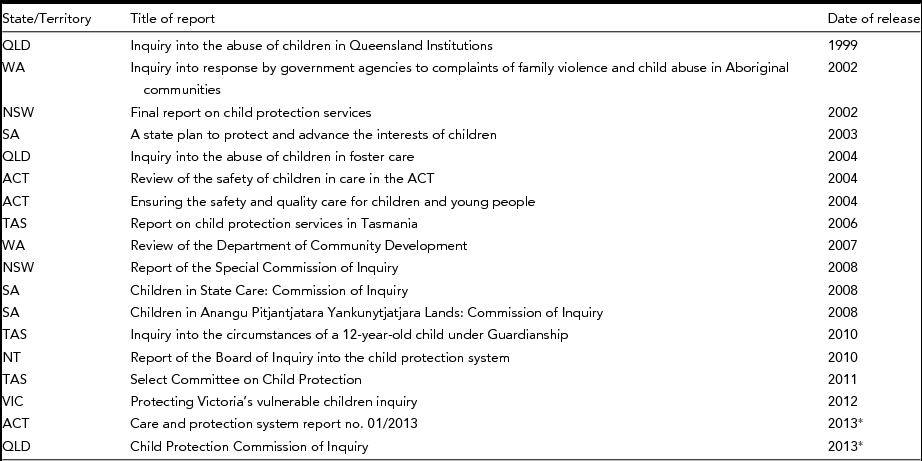
The Australian Institute of Health and Welfare (AIHW) 2013 annual report on child protection details 16 inquiries into child protection services since 1999 that cover all states and territories (AIHW, 2013, p. 136–137). Two more recent inquiries, the Auditor-General's Office (A-GO) in the Australian Capital Territory (ACT) (ACT, 2013) and the current Carmody inquiry in Queensland (Queensland Child Protection Commission of Inquiry, 2012), are not included in the AIHW list. In total, there will have been 18 reports across a 14-year period (Table 1). Many of these inquiries have claimed that the child protection systems in question are under-resourced, yet there is little evidence to suggest that, when additional resources have been made available, this has resulted in a reduction in the incidence of child abuse and neglect (Hansen & Ainsworth, Reference Hansen and Ainsworth2013, p. 107).
Inquiries (or similar) into child protection services by state/territory in chronological order.

Source: AIHW (2013), Appendix 1. *Material added.
The Cost of Child Abuse and Neglect
The claim that child protection systems are under-resourced needs to be examined as it may be based on questionable data about the incidence of child abuse and neglect. Indeed, the under-resourcing claim is made regardless of the fact that the Productivity Commission has indicated that the cost of the child protection service in Australia in the financial year 2011–12 was $A3.0 billion – a real increase of $A100.8 million (3.5 per cent) from the previous year (Productivity Commission, 2013). The Productivity Commission's costing is unlikely to include the cost of state and territory commissions of inquiry that were sitting during the above period, the cost of Ombudsman services associated with the review of child deaths or the cost of the care jurisdiction of the Children's Courts, all of which are significant. In New South Wales (NSW), in particular, there is also the part cost of the Commission for Children and Young People that accredits agency foster-care programmes and holds a record of deregistered foster carers. In that regard, the Productivity Commission's costing of $A3 billion is almost certainly a gross underestimate of the cost of child protection services in Australia.
What needs to be considered against these figures is the long-term cost of the individual and community consequences of abuse and neglect. These consequences may include individual drug and alcohol abuse, mental health issues, homelessness, and juvenile and adult offending, to which community services respond (Australian Institute of Family Studies (AIFS), 2012a). However, not all of these indicators of social disadvantage can be attributed to child abuse and neglect, as there are other factors that may contribute to these negative outcomes for some individuals, including intellectual disability as well as genetic factors that may underlie some aspects of mental illness.
In terms of the community costs of child abuse and neglect, the lifetime cost of services – based on the AIHW substantiation figures for 2007 – is estimated by Access Economics for the Australian Childhood Foundation as $A7,657 million across the lifetime of those abused or neglected (Taylor, Moore, Tucci, Goddard, & De Bortoli, Reference Taylor, Moore, Tucci, Goddard and De Bortoli2008). This estimate is arrived at by using a formula derived from a burden-of-disease model of costing, that includes health (health and mental health), homeless accommodation and income-support programmes.
However, comparing the yearly cost of child abuse and neglect services of $A3 billion in 2011–12 (Productivity Commission, 2013) and the cost of lifetime services of $A7,657 million in 2007 (Taylor et al., Reference Taylor, Moore, Tucci, Goddard and De Bortoli2008) is not very productive, given the different data points. These analyses provide competing perspectives on the economic cost of child abuse and neglect. Both sets of costing data appear to support an argument for more resources, or at least the diversion of resources from detection toward the prevention of child abuse and neglect, as a way of reducing the immediate and long-term cost of child abuse and neglect.
In our view, the importance of protecting children from child abuse and neglect can never be solely decided in terms of economic cost because of the human suffering that such abuse causes, but neither can economic costs be ignored.
Reducing the Incidence of Child Abuse and Neglect
The primary aim of state and territory child protection systems has to be a reduction in the incidence of child abuse and neglect. The detection and substantiation of child abuse and neglect, which remains the focus of many current services, is vital, but prevention of significant harm is always preferable. Curiously, it has been suggested to us that the purpose of child protection legislation is not a reduction in the incidence of child abuse and neglect, but that it is about responding to the needs of children who have already been abused or are at significant risk of harm. We find this a perverse view. It is as if nothing should be done until abuse and neglect has occurred. Surely, this was not the position of those who drafted the child protection legislation in Australian jurisdictions.
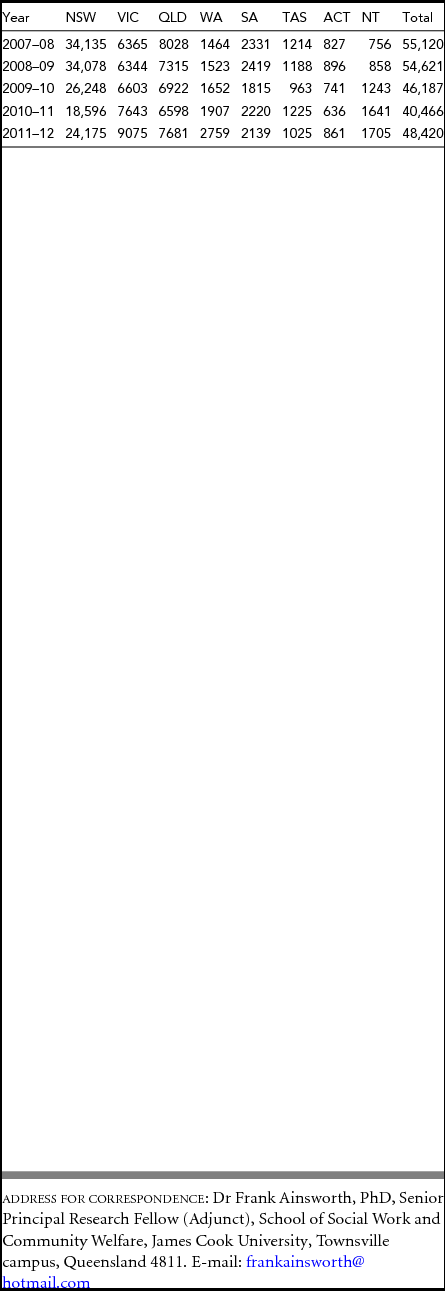
In fact, in 2011–12 there were 252,962 case notifications of suspected child abuse and neglect, involving 173,502 children, in Australia. Of these cases, 116,528 were investigated, resulting in 48,420 substantiated cases involving 37,781 children (AIHW, 2013, table 2.1, p. 8). As stated previously, there were an estimated 5,098,694 children and young people in Australia under the age of 18 years at 31 December 2010 (AIHW, 2013, table A37, p. 90). Therefore, it may also be estimated that slightly less than 5% of Australian children and young people were abused or neglected in 2011–12. Table 2 presents the state and territory data for the 5 years 2007–08 to 2011–12.
Number of substantiations of child abuse and neglect by state and territory and year.
Source: AIHW, 2013, table 2.6, p. 20.
These data show that, following a decline in substantiated cases of abuse from 2007–08 until 2010–11, the number of substantiations of child abuse and neglect is once again on the rise. This is across a period when recurrent expenditure on child protection services rose to $A3 billion by 2011–12 (Productivity Commission, 2013), suggesting that, regardless of the extra resources that have been allocated to child protection services, the primary aim of child protection services – namely the prevention of child abuse and neglect – is not being adequately addressed.
Child Deaths from Abuse and Neglect
In addition to child abuse and neglect substantiation figures from AIHW reports, there are annual or bi-annual reports of reviewable deaths produced by various state and territory bodies; for example, the NSW Ombudsman and the Victorian Death Review Committee. In recent years, these reports appear to have broadened the definition of what constitutes abuse and neglect; for instance, drownings are now classified as supervisory neglect, not accidents. This is in much the same way that child protection legislation from the 1970s has broadened the definitions and increased the number of persons designated as mandatory reporters (Wood, Reference Wood2008). In the light of this expansion of what is defined as child abuse or neglect, it is worth asking the following question: If your next-door neighbour was asked what he/she understood as a death caused by child abuse or neglect, would he/she talk about anything other than physical injury or a failure to provide food, clothing and warmth for a child? We think not.
But this is not how child deaths from abuse or neglect are now viewed by the reviewable deaths reporting bodies. A much broader definition is now used, as the recent New South Wales Ombudsman's report on reviewable deaths in 2010–11 shows (NSW Ombudsman, 2013). First, the report identifies 77 reviewable deaths in this 2-year period (on average 38.5 per year). This figure is then broken down into three categories:
• 27 children died as a result of abuse (24) or in circumstances suspicious of abuse (3);
• 21 children died as a result of neglect (14) or in circumstances suspicious of neglect (7);
• 29 children died while in the care of the state.
On further examination, 9 of the 77 deaths over the 2-year reporting period were adolescents killed in incidents of peer violence. Yet these cases are included in the 27 children who died as a result of abuse. We suggest that your next-door neighbour would not classify peer-related deaths as death from child abuse. Thus, it can be argued that the number of children who died from abuse in the 2-year period in question was actually not 27, but 18. In addition, we remain puzzled by this figure, as there does not appear to have been 18 murder trials, which would be expected if a child had died from abuse by parents or other caregivers. The perpetrators of these acts are referred to in the Ombudsman's Report as ‘offenders’ which is, of course, language from the criminal jurisdiction system.
There were 21 deaths of children as a result of neglect over the 2 years, but 6 of the 21 deaths were from drowning, and are viewed as the product of supervisory neglect. The next-door neighbour is unlikely to classify drowning as a death caused by child neglect. Rather, he/she is likely to see such events as tragic accidents. If we embrace this commonsense view, the number of children who died from neglect is reduced from 21 to 15 deaths in the 2-year period.
Twenty-nine children died while in state care over the 2 years. Of these 29 children, 15 died as a result of natural causes due to congenital or degenerative disorders. Of the remaining 14 children, 8 children died of ‘unintentional injuries’ (although this explanation is not allowed in relation to children who died while in parental care), including drowning and poisoning. One child committed suicide. In 2 cases information about the cause of death was unavailable. This leaves the death of 3 children unexplained. Noticeably, none of the carers of the children who died while in state care, even when the death is unexplained, are referred to as ‘offenders’ and this suggests some kind of reporting bias.
The next question is about the use of the phrase ‘or in circumstances suspicious of abuse’ (3 children) and ‘or in circumstances suspicious of neglect’ (7 children). What does this mean? Is this an attempt to convert a situation where the cause of the death of a child is unknown into a case of abuse or neglect, even when this cannot be properly established. In either case we would suggest that this is less than balanced reporting. We conclude that the 77 deaths in 2010–11, using your next door neighbour's commonsense yardstick, would be more fairly reported as no more than 38 deaths, not 77, an average of 19 per year, not 38.5 per year as claimed by the NSW Ombudsman. All child deaths are to be greatly regretted. But why is there a need to report in this manner? Is this a further part of the process of reinforcing the proposition that child protection services are under-resourced?
State and Territory Data
Australian Capital Territory (ACT)
No publically available information.
New South Wales (NSW)
The 2010 report of the Child Death Review Team (NSW CDRT, 2011) identified 139 children who died between 1 January and 31 December 2010. Regrettably, 13 of these children died as the result of fatal assault. Of these 13 children seven were allegedly killed by peers. One further child died as the result of an attack by an acquaintance and another child was killed by unknown assailants. The four other children were killed in parent homicide/suicide.
The 2011 Ombudsman biennial report (NSW Ombudsman, 2011) indicated that between January 2008 and December 2009 that there were 77 reviewable deaths. Of these deaths 26 children died of abuse or suspected abuse while 31 children died of neglect or suspected neglect.
Eight of the deaths from abuse or suspected abuse involved the biological parents of the child.
Four of the children who died of abuse or suspected abuse died in two incidents of homicide/suicide and three in two incidents of homicide/attempted suicide.
Of the 31 children who died as a result of neglect or suspected neglect 24 were in the direct care of their parents. The 31 deaths included 14 by drowning, 10 were sudden and unexpected deaths, 2 resulted from injuries sustained in a house fire and five as a consequence of a motor vehicle accident.
A further 20 children died while in-care. Of children in care 17 died from natural causes stemming from disability or a chronic medical condition. The remaining three died as a consequence of a motor vehicle accident (1) and suicide (2).
Unfortunately the Child Death Review Team and the Ombudsman's figures do not tally.
Northern Territory (NT)
The annual report of the Northern Territory Child Death Review and Prevention Committee (2011) indicates that in 2010 there were 44 child deaths in the Northern Territory. Information on whether any of these children were known to the child protection services is not reported. The causes of the child deaths are also not reported.
Queensland (QLD)
In Queensland the Commission for Children and Young People and the Children's Guardian annual report (CCYPCG, 2011) and the Child Death Case Review Committee (QLD CDCRC, 2011) provide information on child deaths. The Commission for Children and Young People's 2010–11 report notes 465 child deaths. Fatal assault and neglect accounted for the deaths of 5 children. Of the 5 maltreatment-related deaths, only 3 of the children were known to the child protection system. Two children died at the hands of an unspecified family member.
South Australia (SA)
The Child Death and Serious Injury Review Committee (CDSIRC, 2011) reviewed all child deaths in South Australia in 2010. The committee reported that 119 children died in that year. Two of these deaths were the result of fatal assault. The Child Death and Serious Injury Committee's annual report that covers the period 2006–2010 attributes 17 child deaths to fatal assault. Neither report offers any identification of the persons responsible for the fatal assaults.
Tasmania (TAS)
The most recent child death data from Tasmania is provided by the Department of Health and Human Services for 2005–06 (DHHS, 2006). In this period there were 10 deaths of children known to the child protection system. Of these cases, 3 were attributed to suspected abuse or neglect. Another 2 cases were the result of Sudden Infant Death Syndrome, and in a further 3 cases death was due to disability or natural causes. Two cases are unexplained.
Victoria (VIC)
The Child Death Review Committee (Vic CDRC, 2011) reviews reports prepared by the Office of Child Safety Commissioner. In 2010 the Department of Human Services referred 29 cases of child death that were known to the child protection system to the Child Safety Commissioner. No details of the causes of death are available.
Western Australia (WA)
The Ombudsman who has responsibility for reviewing child deaths reported that there were 118 child deaths during the period 2007–08 (Child Death Review Committee (WA CDRC), 2008). Sudden unexpected death, drowning and motor vehicle accidents, illness or medical conditions, suicide and other reasons accounted for 116 of these deaths. There were two homicide cases.
Other Sources of Data
Every Australian is horrified by news of a child dying because of abuse or neglect. Because a child death is such a shocking event, it is important for the public to have clear information about such events. This section provides accurate data that is collected by various authorities.
A 2003 report by the Australian Institute of Criminology (Mouzos & Rushforth, Reference Mouzos and Rushforth2003) estimated that on average, 25 Australian children are killed by their parents each year. This figure has remained almost static for two decades or more.
A more recent Australian Institute of Family Studies newsletter ‘Child deaths from abuse and neglect’ indicates that 241 children (aged 0–17) died in Australia in 2006 (AIFS, 2012b). Of these children, 66 died as the result of a motor vehicle accident, 46 from drowning and 27 due to fatal assault. The other 102 deaths are unexplained. No doubt some were from natural causes or disability.
This figure for fatal assault, although not necessarily confined to parents, is close to the estimated 25 child deaths per year from the Institute of Criminology report (Mouzos & Rushforth, Reference Mouzos and Rushforth2003).
Remembering that the population of children aged 0–17 years in Australia at 31 December 2011 was estimated to be 5,098,694 (AIHW, 2013), this figure puts into perspective the estimated 25 child deaths per year. Clearly, while a child death from abuse or neglect is appalling, such deaths are rare occurrences.
Overall, the estimates of child deaths provided by the Australian Institute of Criminology stand as a reliable indicator of the incidence of child deaths from abuse or neglect in Australia. State and territory data are fragmented, are collected at different points in time and cannot be seen as a reliable indicator of such events. Even less clear is the incidence of child death due to fatal assault by a parent.
Death Rate Estimates
In the US, the mean rate of child fatalities is 1.88 per 100,000. The variables that predict child fatalities reliably are poverty levels, crime rates and region of the country. Notably, for each additional percentage of the population that lives in poverty, the child fatality rate increases by .09 per 100,000 children. The rate of violent crime also predicts child fatalities, where each additional one-unit increase in the crime rate increases child fatalities by .02 per 100,000 children (Douglas & McCarthy, Reference Douglas and McCarthy2011).
Interestingly, the US research shows that new legislation in response to a child fatality makes no difference in child fatality rates, as there is no difference in these rates between those US states that passed legislation in response to a child fatality and those states that did not (Douglas & McCarthy, Reference Douglas and McCarthy2011).
Investing in the Future
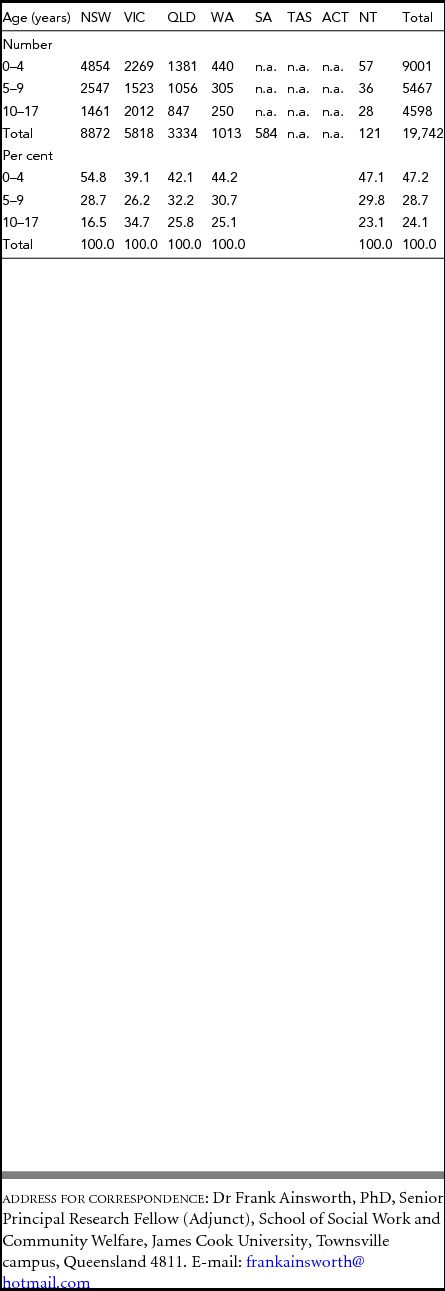
The Australian Institute of Heath and Welfare report on child protection also gives details of intensive family support services. The report identifies 227 services with 19,742 children involved with these services in 2011–12 (AIHW, 2013, table 6.1, p. 52). This is a good start to the process of re-aligning services so that the emphasis is on the prevention of abuse and neglect. These services are heavily focused on children under the age of 5 years (47.2%) and are distributed as shown in Table 3.
Number and percentage of children aged 0–17 years commencing intensive family support services, by age at commencement of service, state and territories, 2011–12.
Source: AIHW, 2013, table 6.2, p. 53. n.a., not available.
In NSW, there are a number of early intervention and intensive family support services, including Brighter Futures (Social Policy Research Centre, 2010), that are now fully managed by the non-government sector. Unfortunately, these services are not always available in rural areas and some of the services have eligibility criteria that mean some vulnerable families with young children are excluded. As Table 3 shows, there is a very uneven distribution of such services across the various states and territories. What has to be remembered is that these data may not be comprehensive, and other family support services may exist that do not report data to AIHW. In any case, the data from AIHW contained in this table suggest that there is still a significant way to go before there is a full emphasis on services designed to prevent, rather than detect, cases of child abuse and neglect.
Conclusion
The vast majority of Australian parents do not abuse or neglect their children and this has to be acknowledged and praised, thus there needs to be a more proportional response to reports of child abuse and neglect. In our view, many current reports and discussions about child abuse and neglect misrepresent the extent of the problem in the Australian community. Instead of acknowledging that abuse and neglect affects a minority of Australian children, the reports tend to encourage the view that there is an epidemic of abuse and neglect, when this is not the case. No child should be abused or neglected, but it is not possible to prevent every possible instance that might happen without draconian control of all parental behaviours.
Our plea is for the examination of the ever-rising costs of child protection services and the seemingly insatiable demand for even more resources. Such a demand is unlikely to be sustainable into the future and needs tempering now.
This in no way undermines the rightful attempts to detect cases of child abuse and neglect, but instead is supportive of a greater shift in emphasis towards prevention and support for vulnerable parents rather than removing their children from their care.
Postscript
To make a point – the day after this article was first submitted for review the Victorian Minister for Community Services (2013) announced an additional $A91 million funding boost for out-of-home care services.