Introduction
Lithium is associated with significant long-term adverse effects including impaired renal function (Shine et al. Reference Shine, McKnight, Leaver and Geddes2015). Polyuria is the most common renal effect with a 36% prevalence in community lithium patients (Kinahan et al. Reference Kinahan, Ní Chorcoráin, Cunningham, Freyne, Cooney, Barry and Kelly2015a). Polyuria is suggestive of renal tubular dysfunction which results from lithium-induced antidiuretic hormone (ADH) partial resistance (Grünfeld & Rossier, Reference Grünfeld and Rossier2009).
Lithium-treated patients with renal tubular dysfunction are at increased risk of dehydration, lithium intoxication and progressive renal damage (Livingstone & Rampes, Reference Livingstone and Rampes2006). There are a number of approaches to decrease the ADH resistance in lithium-treated patients but the clinical benefits and risks of these different approaches have not been fully described.
Studies of lithium patients with renal tubular dysfunction have demonstrated improvements in different renal parameters through the addition of amiloride (Batlle et al. Reference Batlle, von Riotte, Gaviria and Grupp1985; Bedford et al. Reference Bedford, Weggery, Ellis, McDonald, Joyce, Leader and Walker2008), non-steroidal anti-inflammatory medications (Berl et al. Reference Berl, Raz, Wald, Horowitz and Czaczkes1977; Stokes, Reference Stokes1981) and thiazides (Bichet, Reference Bichet2017). Dose reduction has been recommended on the basis that higher lithium doses (Vestergaard et al. Reference Vestergaard, Amdisen, Hansen and Schou1979; Lokkegaard et al. Reference Lokkegaard, Andersen, Henriksen, Bartels, Brahm, Baastrup, Jørgensen, Larsen, Munck, Rasmussen and Schröder1985; Bendz et al. Reference Bendz, Sjödin and Aurell1994) and concentrations (Waller et al. Reference Waller, Edwards, Naik and Polak1984) are associated with renal tubular dysfunction (Martin, Reference Martin1993; Malhi & Tanious, Reference Malhi and Tanious2011; Malhi et al. Reference Malhi, Tanious and Gershon2011). Substituting lithium with an alternative psychotropic is another strategy and improvements in different renal parameters have been demonstrated (Vestergaard & Amdisen, Reference Vestergaard and Amdisen1981).
This study aimed to describe the clinical benefits and risks of managing polyuria in different ways in lithium-treated patients.
Methods
This is a naturalistic prospective observational cohort study of lithium-treated patients at the Cluain Mhuire Community Mental Health Service, in Dublin, Ireland. All patients who were prescribed lithium during a 1-month period were recruited. Participants completed a 24-hour urine collection. All participants diagnosed with polyuria (i.e. 24-hour urine collection ≥3 l) (Bichet, Reference Bichet2017) were included in the prospective cohort study.
This study was conducted following a cross-sectional study investigating risk factors and methods of detecting polyuria in lithium-treated patients (Kinahan et al. Reference Kinahan, Ní Chorcoráin, Cunningham, Freyne, Cooney, Barry and Kelly2015a, Reference Kinahan, Ní Chorcoráin, Cunningham, Freyne, Cooney, Barry and Kelly2015b). After providing informed consent, participants were given clear instructions for completing a 24-hour urine collection, early morning urine sample and symptom questionnaire. Urine was collected at home during a convenient 24-hour period. Participants completed the early morning urine sample on the first void of the day. After recording this time (when the bladder was empty), subsequent urine was collected for following 24 hours including the final void which was as close as possible (but not after) the recorded time. Participants were advised not to change or restrict their fluid intake during the tests.
After the collection was completed, a questionnaire was posted to patients, asking about the subjective presence of polyuria, polydipsia and nocturia, and the severity of each on a scale of increasing severity (0–3). The frequency of episodes of clinically significant mood disturbances over the 12-month period preceding urine collection was extracted from medical records.
The results of the 24-hour urine collection were forwarded to the participant’s treating psychiatric team. For participants diagnosed with polyuria, the treating team in collaboration with the participant changed their management in one of four ways: (a) education alone: the participant was educated about the risks of polyuria but there was no pharmacological change; (b) dose decrease: the participant was educated about the risks of polyuria and the dose of lithium was decreased; (c) stop lithium: the participant was educated about the risks of polyuria and lithium was replaced with an alternative psychotropic; or (d) addition of amiloride: the participant was educated about the risks of polyuria and amiloride was added to lithium (Martin, Reference Martin1993). Twelve months after diagnosis with polyuria, participants repeated the 24-hour urine collection, early morning urine sample and symptom questionnaire.
Anonymised data were stored and described using IBM SPSS Statistics (Version 24). Changes in continuous variables were tested using Paired t-test or Wilcoxon signed rank test, as appropriate.
Results
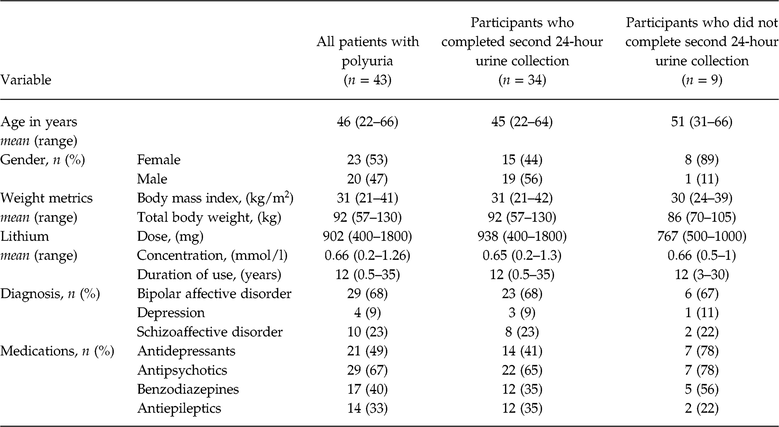
One hundred and thirty-eight patients were treated with lithium during the month of recruitment to the study. Forty-three participants were diagnosed with polyuria (31.1%) and included in the prospective study. Initial data were complete for 39 participants (90.7%) and 34 (79.1%) completed the 24-hour urine collection 12 months after diagnosis (one of which was inaccurate due to hyperglycemia). Of these 34 participants, 26 (76.5%) completed the questionnaires and 28 (82.4%) completed the early morning urine osmolality. Mean age of the participants diagnosed with polyuria was 46 years (Table 1). The characteristics of the participants who completed the second 24-hour urine collection (n = 34) did not differ from the full group initially diagnosed with polyuria (n = 43).
Characteristics of adult patients with polyuria during lithium treatment at a general adult psychiatry service over a 1-month period

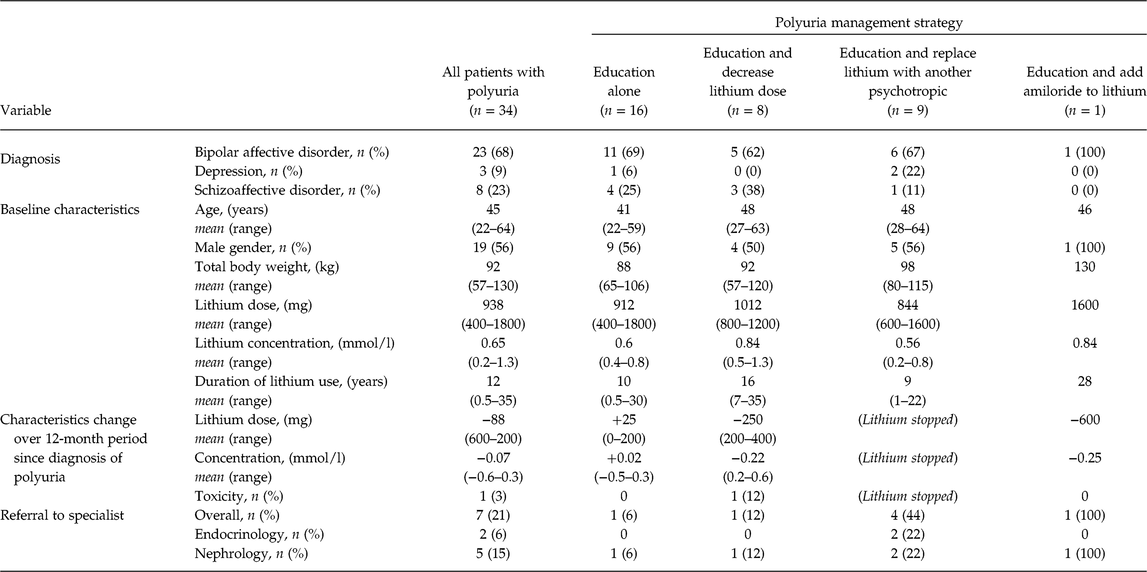
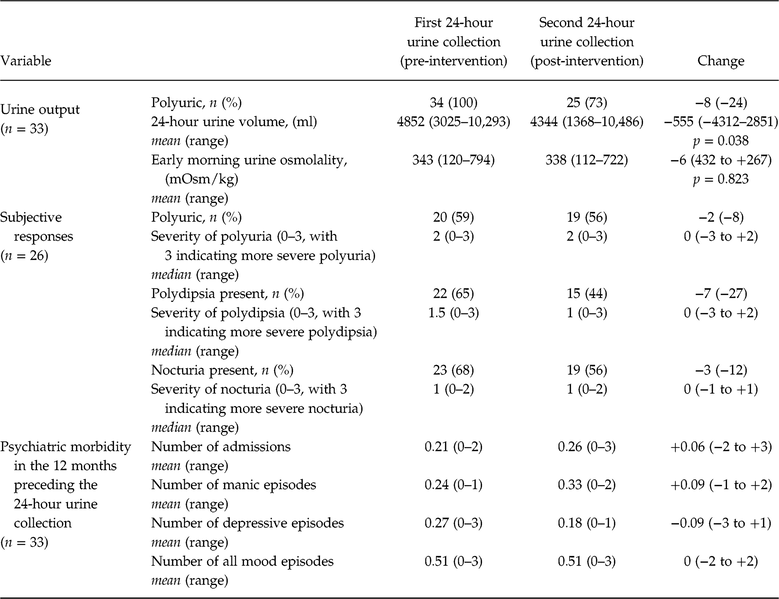
Of the 34 polyuric participants who completed two 24-hour urine collections, 25 remained polyuric (73%) (Tables 2 and 3). Mean 24-hour urine volume decreased from 4852 to 4344 ml (p = 0.038) and mean early morning urine osmolality decreased from 343 to 338 mOsm/kg (p = 0.823). The proportions of participants with subjective complaints of polyuria (59% v. 56%) or nocturia (68% v. 56%) did not change substantially but the proportion with subjective complaints of polydipsia appeared to decrease (65% v. 44%).
Characteristics of adult patients in a preliminary prospective observational study of polyuria management during lithium treatment who completed two 24-hour urine collections 12 months apart, stratified by polyuria management strategy

Changes in prospective outcome measures among adult patients in a preliminary prospective observational study of polyuria management during lithium treatment

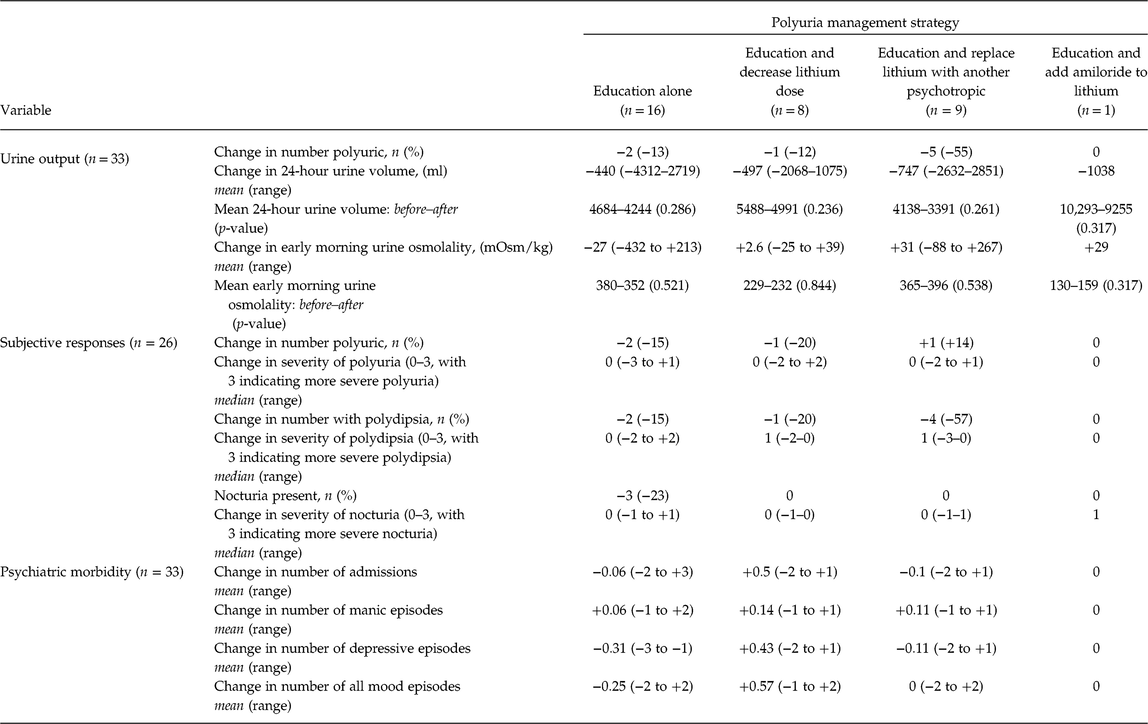
Eight participants (24%) were no longer polyuric after the interventions: 13% of participants who had no pharmacological change; 12% of those whose lithium dose was decreased; and 55% of those whose lithium was stopped (Table 4). We do not draw any conclusions about amiloride as only one patient received it. Mean 24-hour urine volume decreased with each type of intervention but this decrease did not attain statistical significance for any individual intervention group. The largest mean change in volume was in the participants whose lithium was stopped (mean decrease 747 ml). Of these, five had been treated for more than 10 years and four for fewer. There was no significant difference in change in urine volume after stopping lithium between these groups (decreases of 792 and 689 ml, respectively).
Changes in prospective outcome measures among adult patients in a preliminary prospective observational study of polyuria management during lithium treatment stratified by polyuria management strategy

Mean early morning urine osmolality decreased in participants with no pharmacological change and increased in participants who received a change in medication, but these changes did not attain statistical significance. The proportion of participants reporting the presence of the three symptoms appeared to diminish after all the interventions apart from the participants whose lithium was stopped (14% more of these participants complained of polyuria). The largest potential changes occurred in participants whose lithium was stopped (57% no longer reported polydipsia), but this group also experienced more manic episodes (although this was not significant). Admissions and all mood episodes appeared to tend to increase in participants whose lithium dose was decreased.
Discussion
Objective parameters of renal tubular dysfunction appear broadly stable 12 months after diagnosis of polyuria in lithium-treated patients. Decreasing lithium dose does not appear to be associated with a substantial improvement in renal tubular dysfunction but may be associated with a slight improvement in the symptoms of polyuria and an increase in psychiatric morbidity. Stopping lithium may be associated with substantial improvement in renal tubular dysfunction and improvement in the symptoms of polydipsia but an increase in psychiatric morbidity.
In our subgroup of polyuric patients who received no pharmacological change (education only), mean 24-hour urine volume decreased slightly but not significantly. For patients who remain on lithium, similar or increased urine volumes have been demonstrated over time in the past (Vestergaard & Amdisen, Reference Vestergaard and Amdisen1981; Hetmar et al. Reference Hetmar, Clemmesen, Ladefoged and Rafaelsen1987). Early morning urine osmolality, a surrogate marker for maximum renal concentrating capacity, decreased marginally but not significantly in our education only subgroup, and there was also no change in severity of polyuria, polydipsia and nocturia. This is consistent with studies showing no significant change in nocturia and various other symptoms over time (Vestergaard & Amdisen, Reference Vestergaard and Amdisen1981).
Several studies have demonstrated positive correlations between lithium dose and urine volume (Vestergaard et al. Reference Vestergaard, Amdisen, Hansen and Schou1979; DePaulo et al. Reference DePaulo, Correa and Sapir1984; Lokkegaard et al. Reference Lokkegaard, Andersen, Henriksen, Bartels, Brahm, Baastrup, Jørgensen, Larsen, Munck, Rasmussen and Schröder1985) and negative correlations between dose and maximal urine osmolality (Waller et al. Reference Waller, Edwards, Naik and Polak1984; Lokkegaard et al. Reference Lokkegaard, Andersen, Henriksen, Bartels, Brahm, Baastrup, Jørgensen, Larsen, Munck, Rasmussen and Schröder1985; Bendz et al. Reference Bendz, Sjödin and Aurell1994). In our study, mean 24-hour urine volume decreased slightly but not significantly in participants with dose reduction, and mean early morning urine osmolality remained relatively stable. The proportion reporting symptoms appeared to decrease but there appeared to be an increase in psychiatric morbidity. In contrast, the stop lithium subgroup’s change in urine volume appeared to be greater than those of the education only and dose decrease subgroups.
Substituting lithium with an alternative psychotropic has the potential to reverse the ADH resistance although a long-term defect can persist (Bendz et al. Reference Bendz, Aurell, Balldin, Mathe and Sjödin1996; Garofeanu et al. Reference Garofeanu, Weir, Rosas-Arellano, Henson, Garg and Clark2005). After lithium withdrawal, 24-hour urine volume has been reported to decrease significantly (Vestergaard & Amdisen, Reference Vestergaard and Amdisen1981) although stability of the 24-hour urine volume has also been documented (Hetmar et al. Reference Hetmar, Povlsen, Ladefoged and Bolwig1991).
Rej et al. (Reference Rej, Herrmann and Shulman2012), in a systematic review, concluded that there was little systematic evidence to suggest that lithium withdrawal was beneficial in chronic renal failure. One study examined 46 patients who had lithium discontinued and found that after 3 months mean urine volume decreased by 0.6 l per 24 hours (similar to the decrease in our stop lithium group: 0.7 l) and mean early morning urine osmolality increased by 76 mOsm/kg (similar to, but greater than, the increase we observed: 31 mOsm/kg) (Bendz, Reference Bendz1985). Bucht & Wahlin (Reference Bucht and Wahlin1980) reported on 87 patients in whom lithium was discontinued and found that concentrating capacity improved significantly during the first 2 months after withdrawal but not later; after 1 year, 17 of 27 patients still had concentrating capacities below 800 mOsm/kg. All patients in our study had concentrating capacities below 800 mOsm/kg at both time points.
Vestergaard & Amdisen (Reference Vestergaard and Amdisen1981) reported that lithium discontinuation resulted in normalisation of urine volume and improvement (but not normalisation) of maximum urine osmolality, while Bendz et al. (Reference Bendz, Aurell, Balldin, Mathe and Sjödin1996) followed up 13 lithium discontinuation patients for 9 weeks and found that concentrating capacity did not improve at all after discontinuation. In patients prescribed lithium for over 15 years, Bendz et al. (Reference Bendz, Aurell, Balldin, Mathe and Sjödin1996) reported that urine volume increased but the proportion of patients who were polyuric (50%) remained stable before and after lithium withdrawal. A similar finding was reported by Boton et al. (Reference Boton, Gaviria and Batlle1987) when the duration of lithium treatment was greater than 10 years. In our study, of the nine patients whose lithium was discontinued, five had been treated with lithium for greater than 10 years and four for fewer, but there was no significant difference in the change in urine volume after stopping lithium between these groups.
Also in our study, mean early morning urine osmolality appeared to increase after stopping lithium, but this change was not significant and contrasted with the apparent decrease in the education only subgroup. Lithium withdrawal studies have previously reported increases in maximal urine osmolality (Hetmar et al. Reference Hetmar, Povlsen, Ladefoged and Bolwig1991), but in one sample of patients prescribed lithium for at least 15 years the maximal urine osmolality was stable (Bendz et al. Reference Bendz, Sjödin and Aurell1994, Reference Bendz, Aurell, Balldin, Mathe and Sjödin1996).
Previous research has also explored symptoms of lithium patients initially and after a mean of 1.7 years (Vestergaard et al. Reference Vestergaard, Amdisen and Schou1980; Vestergaard & Amdisen, Reference Vestergaard and Amdisen1981); after lithium withdrawal, only 30% reported polydipsia compared to 70% initially. In our study, the proportion of the stop lithium subgroup who reported polydipsia decreased by 57% over 12 months. The proportion who reported polyuria increased by 14%, and there was no change in the proportion reporting nocturia. In addition, the stop lithium subgroup appeared to experience more manic episodes over the 12-month period since stopping, although the significance of this is not established.
Limitations of this study
This was not a controlled study. As a naturalistic study the intervention the participant received depended on a number of factors that may influence the outcomes of interest (co-morbid illness, participant preferences, etc.). Urine volume, polyuria and early morning urine osmolality are all parameters of renal tubular dysfunction but do not diagnose the tubular dysfunction. We used the Bichet’s (Reference Bichet2017) definition of polyuria as a urine volume ≥3 l in 24 hours. Volume of urine is, however, potentially subject to many other variables, such as weight, gender and age, and, in a larger study, it would have been possible to control these factors through study design or multi-variable analysis. It is hoped to do so in future work using the International Continence Society’s definition of polyuria as 40 ml of urine or more per kilogram body weight over 24 hours.
In addition, we did not establish the cause of the polyuria; a proportion of cases might be explained by primary polydipsia as opposed to a urinary concentrating deficit. Previous studies demonstrated the prevalence of a urinary concentrating deficit in polyuric lithium-treated patients as between 77% and 91% (Forrest et al. Reference Forrest, Cohen, Torretti, Himmelhoch and Epstein1974; Vestergaard et al. Reference Vestergaard, Amdisen, Hansen and Schou1979; Bendz et al. Reference Bendz, Sjödin and Aurell1994). A water deprivation test definitively diagnoses renal tubular dysfunction but is limited by its practicality in routine clinical settings (such as the setting of this study).
The accuracy of the 24-hour collections was not confirmed in this study and neither was the accuracy of the early morning urine osmolality. Participants were, however, given clear verbal and written instructions and advised not to withhold fluid intake overnight.
We used early morning urine to estimate maximum concentrating capacity but this may be affected by nocturia in certain patients. Ideally, a larger study would control for nocturia at design or analysis stages but this was not feasible in our work given the size of our study.
We found that the mean decrease in lithium concentration was 0.22 mmol/l, and this might not be sufficient to result in significant changes in urine osmolality and urine volume, thus possibly explaining the lack of differentiation between stopping lithium and just reducing the dose.
The small numbers of participants in our study prevent robust interpretation of inferential statistics. Studies with larger numbers of participants would facilitate more penetrating statistical analysis to determine if the differences described in this study are due to chance alone and permit greater examination of the management options. Our study was an observational study with four management branches rather than a randomised trial capable of delivering definitive answers about the merits and demerits of alternative management options.
Finally, our sample might not be representative of the general population, and length of follow-up was limited to 1 year. It is not, however, conclusively known how long it takes to induce or reverse the renal changes caused by lithium, and it should be noted that most studies that have investigated treating lithium-induced renal tubular dysfunction have demonstrated improvement within a much shorter time frame (Berl et al. Reference Berl, Raz, Wald, Horowitz and Czaczkes1977; Stokes, Reference Stokes1981; Batlle et al. Reference Batlle, von Riotte, Gaviria and Grupp1985; Bedford et al. Reference Bedford, Weggery, Ellis, McDonald, Joyce, Leader and Walker2008).
Conclusions
Our paper underlines the fact that lithium-induced polyuria is a significant and substantial problem among patients treated with lithium. We found that, without pharmacological intervention, objective parameters of renal tubular dysfunction appear broadly stable 12 months after diagnosis of polyuria. Managing polyuria by decreasing lithium dose does not appear to substantially improve objective measures of renal tubular dysfunction, whereas substituting lithium may do so, although both interventions may be associated with increased psychiatric morbidity. Looking to the future, controlled and adequately powered studies are required to establish the relative benefits of different methods of managing polyuria in lithium-treated patients. There is also a need for more work examining in greater depth the background to polyuria in lithium-treated patients in the first instance.
Acknowledgements
The authors are very grateful to the editor and reviewers for their comments and suggestions, and to the patients and staff of the Cluain Mhuire Community Mental Health Service, Dublin.
Conflict of interest
Authors [JCK, ANC, SC, SB and BDK] have no conflicts of interest to disclose.
Ethical standards
The authors assert that all procedures contributing to this work comply with the ethical standards of the relevant national and institutional committee on human experimentation with the Helsinki Declaration of 1975, as revised in 2008. The study protocol was approved by the ethics committee of each participating institution. Written informed consent was obtained from all study participants.
Financial support
This research received no specific grant from any funding agency, commercial or not-for-profit sectors.