INTRODUCTION
The spotted eagle ray, Aetobatus narinari (Euphrasen 1790), is a benthopelagic species that inhabits coastal waters (McEachran & Carvalho, Reference McEachran, Carvalho and Carpenter2002). This ray was previously considered as a cosmopolitan species; however, recent molecular studies demonstrated that there is a complex of species around the world. The spotted eagle ray is now considered to be confined to the western Atlantic Ocean (White et al., Reference White, Last, Naylor, Jensen, Caira, Last, White and Pogonoski2010; Naylor et al., Reference Naylor, Caira, Jensen, Rosana, White and Last2012; White & Last, Reference White and Last2012).
This ray is classified as ‘Near Threatened’ by the IUCN Red List due to its low reproductive potential and susceptibility to intense and non-regulated fisheries (Kyne et al., Reference Kyne, Ishihara, Dudley and White2006). In Mexico, despite its fishery importance in the State of Campeche, southern Gulf of Mexico, the spotted eagle ray fishery has limited management measures. The National Fishing Chart (DOF, 2010), a Mexican regulatory fishery instrument, establishes that fishing effort should not be increased for all batoid species, although there is no species-specific fishing licence for batoids, and none for batoids as a group. The target fishery for spotted eagle ray is regulated by including the authorization for the use of polyamide multifilament gill-nets in a few licences for teleost fishes (around 30 licences in Campeche).
Off Campeche, spotted eagle ray is the second most frequent batoid caught in small-scale fisheries following the southern stingray, Hypanus americanus (Hildebrand & Schroeder 1928). However, spotted eagle rays are the most economically important elasmobranch in Campeche due to its traditional consumption (Cuevas-Zimbrón et al., Reference Cuevas-Zimbrón, Pérez-Jiménez and Méndez-Loeza2011). Unfortunately, catches of spotted eagle ray have declined in recent decades due to its overexploitation as well as the presumed overexploitation of conch (Strombidae), their hypothesized prey (Cuevas-Zimbrón et al., Reference Cuevas-Zimbrón, Pérez-Jiménez and Méndez-Loeza2011).
In Campeche, the fishery for spotted eagle ray is carried out by ~30 small-scale vessels. The fishery occurs in coastal areas, between 10 and 30 km offshore (Cuevas-Zimbrón et al., Reference Cuevas-Zimbrón, Pérez-Jiménez and Méndez-Loeza2011), and their catch is apparently associated with areas of relatively high conch densities. However, little is known about the feeding habits of the species and the occurrence of potential prey in the area.
In addition, there are few studies or reports on the feeding habits of this durophagous ray species throughout its range. Bigelow & Schroeder (Reference Bigelow and Schroeder1953) noted that this species feeds mainly on bivalve molluscs, such as clams and oysters. Randall (Reference Randall1964) examined two specimens from the Virgin Islands (Caribbean Sea) that contained 41 prey items, including the roostertail conch Lobatus gallus and the queen conch L. gigas, and assumed that this batoid was a threat to the populations of these molluscs. In the Bahamas, Iversen et al. (Reference Iversen, Jory and Bannerot1986) analysed seven spotted eagle ray stomachs and found that one of the rays contained 14 queen conchs.
On the other hand, Ajemian et al. (Reference Ajemian, Powers and Murdoch2012) studied the feeding habits of spotted eagle ray in Bermuda by analysing the gut contents of 18 individuals using gastric lavage. The diet was dominated by molluscs, with calico clam Macrocallista maculata as the most important prey item. Other notable but less important bivalves were lucines Codakia sp., eared ark Anadara notabilis and purplish tagelus Tagelus divisus. The calico clam and the waxy gould clam Gouldia cerina were the most abundant bivalves in the benthic sampling; indicating some relationship between the diet of spotted eagle ray and prey availability in the area studied.
Considering the importance of the spotted eagle ray fishery in the southern Gulf of Mexico and the lack of information on its trophic ecology, the objectives of this study were to describe its feeding habits along the central coast of Campeche through stomach and intestinal contents analysis, and to characterize the potential prey in the fishing area via benthic sampling. We hypothesized that prey items in the stomach contents were reflective of available benthic fauna (mainly conch) in the fishing area.
MATERIALS AND METHODS
Study area
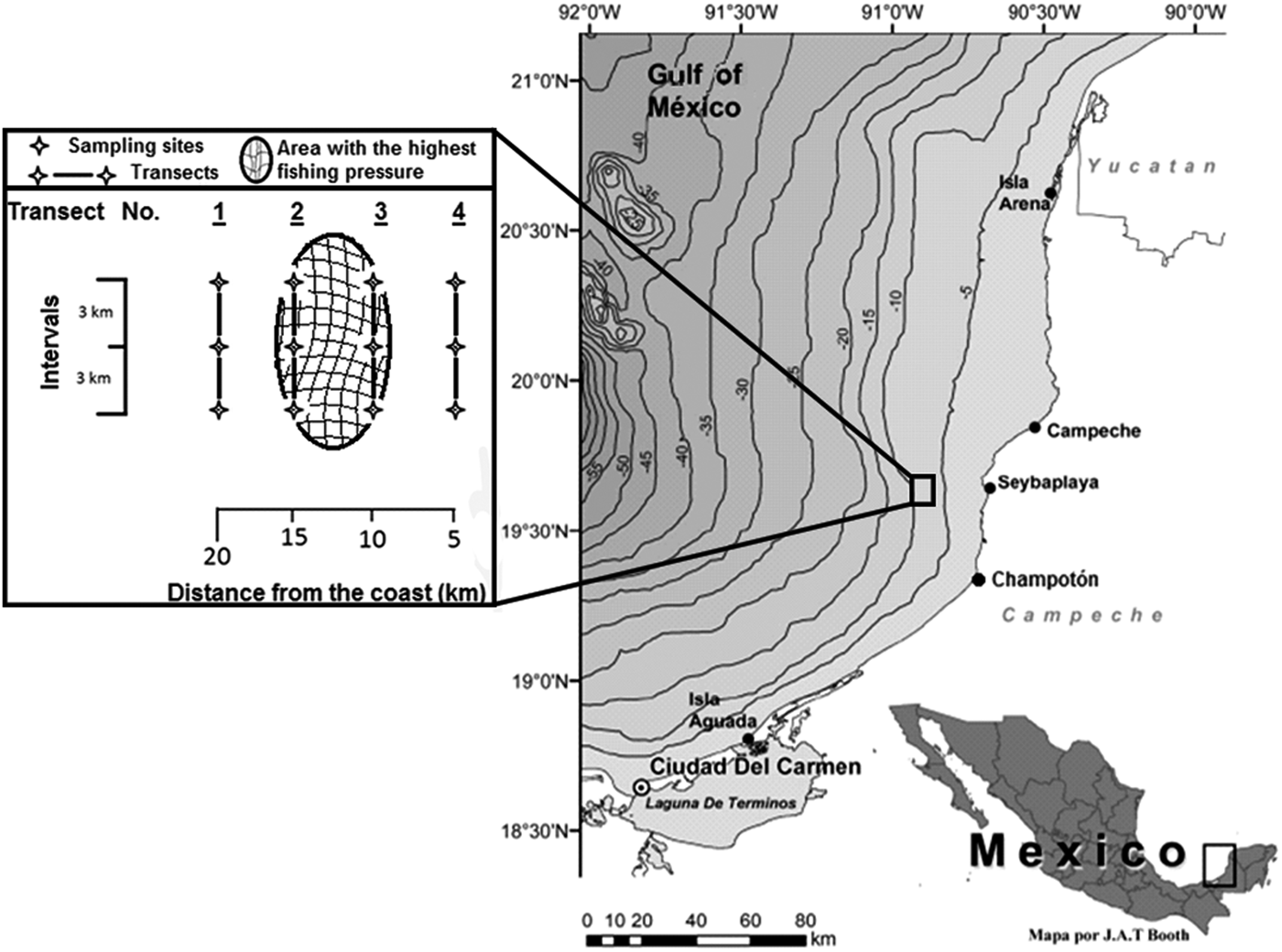
The State of Campeche is located in south-eastern Mexico, along the Yucatan Peninsula (Figure 1). The coast of Campeche spans 523 km, and is characterized by sandy and shallow areas (Rivera-Arriaga et al., Reference Rivera-Arriaga, Alpuche-Gual, Negrete-Cardoso, Nava-Fuentes, Edgar-Lemus and Arriga-Zepeda2012). Sea surface temperature varies seasonally from 22.5–25°C in winter to 25–28.9°C in summer (Gío-Argaez et al., Reference Gío-Argaez, Machain-Castillo and Gaytan Caballero2002). The coast of Campeche forms part of Campeche Bank, the continental shelf that surrounds the Yucatan Peninsula, and extends as far as 216 km offshore with depths ranging from 10 to 200 m (Gío-Argaez et al., Reference Gío-Argaez, Machain-Castillo and Gaytan Caballero2002).
Location of the fishing ports of Seybaplaya and Champotón in the State of Campeche, and the benthic sampling sites and transects off Seybaplaya, southern Gulf of Mexico.

The spotted eagle ray fishery
The target fishery for spotted eagle ray is carried out by small outboard-fitted vessels 7–7.6 m in length, made of fibreglass. The two main fishing ports for this fishery, Seybaplaya and Champotón (32 km apart), are located along the central coast of Campeche (Figure 1), and the area with the highest fishing pressure is off Seybaplaya (according to fishermen). Fishermen use polyamide multifilament gill-nets set at the bottom in Seybaplaya and at the surface in Champotón (because fishermen from this port also catch bull shark Carcharhinus leucas). Fishing trips last one day in Seybaplaya and from one to two days in Champotón, and the fishing areas are located from 8 to 15 km from shore (although fishermen from Champotón with drift gill-nets fish further offshore), and depths of 6–8 m. The fishing season is from November to June, however the highest catches occur in January–April (Cuevas-Zimbrón et al., Reference Cuevas-Zimbrón, Pérez-Jiménez and Méndez-Loeza2011).
Stomach and intestine collection
Stomach and intestine collection was carried out during fishery-dependent surveys in the fishing ports of Seybaplaya and Champotón from June 2013 to March 2016. Stomach and intestines were collected and stored on ice until return to the laboratory. Information on each individual such as disc width (distance between the tips of pectoral fins), sex, date of collection, locality and fishing area (fishermen were asked about the distance, depth and course from the fishing port) were recorded.
Benthic sampling
Benthic sampling sites were chosen based on Cuevas-Zimbrón et al. (Reference Cuevas-Zimbrón, Pérez-Jiménez and Méndez-Loeza2011), who established that the main fishing area was located at 8–15 km off Seybaplaya, at depths of 6–8 m. In addition, fishermen were interviewed to locate the area with the most intense fishing effort for spotted eagle ray. Then, four transects parallel to the coastline off Seybaplaya were established, separated by 5 km from each other (including 5, 10, 15 and 20 km from the shore), with a depth range of 6–12 m. Each transect had three sampling sites separated by 3 km. There were a total of 12 benthic sampling sites, six in the high fishing effort area and six in areas with less fishing pressure (Figure 1). A replicate sample was taken at each sampling site and two sampling cycles were conducted.
Diving was carried out at each site during 2016 (February–April, N = 6 days). Two quadrats of 0.5 × 0.5 m for the benthic sampling at each sampling site were used, following the methods of Eleftheriou & McIntyre (Reference Eleftheriou and McIntyre2005). A shovel was used to collect the benthic fauna from the upper 15 cm of the bottom (infaunal collection). The sample was poured through a 2 cm sieve. Epifaunal species close to the quadrants (radius of 2 m) were also collected following the methods of Alfonso & López (Reference Alfonso and López2005). For each benthic sample, the date, latitude/longitude, depth, visibility (with Secchi disc) and type of substrate (by visual method) were recorded. The benthic species collected were transported to the laboratory for additional analyses.
Size structure and sex of rays, and accumulation curve of prey in stomachs
Most of the rays sampled were juveniles and sub-adults and were therefore separated in three groups based on disc width (DW) in order to compare food habits among size groups. Group 1 comprised rays <100 cm DW (33 females and 33 males), group 2 were 100–120 cm DW (26 females and 32 males) and group 3 were >120 cm DW (9 females and 21 males). The sample size by sex and size groups was analysed according to Ferry & Cailliet (Reference Ferry, Cailliet, MacKinlay and Shearer1996), by comparing the cumulative number of prey species against the cumulative number of analysed stomachs with the software Estimate Version 9 (Colwell, Reference Colwell2013), and the equation of Clench to calculate the slope. A slope smaller than 0.1 indicated that the curve was asymptotic, and that the prey item collection was representative. Also, the proportion of recorded fauna (prey species) indicated the representativeness of the inventory, from zero (not representative) to 100% (highly representative) (Jiménez-Valverde & Hortal, Reference Jiménez-Valverde and Hortal2003).
Fullness and digestion indices
A fullness index was estimated following Cailliet (Reference Cailliet, Simenstad and Lipovsky1977) (values 0–4): 0 = 0% (empty), 1 = 25%, 2 = 50%, 3 = 75% and 4 = 100% (full). In addition, a digestion index (values = 1–5) was determined; the lower limit (value = 1) representing easily identified prey indicating recent consumption, and the upper limit (value = 5) representing fully digested prey that were unidentifiable.
Identification of prey items and benthic fauna
Identification was carried out to the lowest taxonomic level based on Williams (Reference Williams1984), González (Reference González1998), Hernández et al. (Reference Hernández, Ruiz, Toral and Arenas2005), Mikkelsen & Bieler (Reference Mikkelsen and Bieler2008) and Tunnell et al. (Reference Tunnell, Barrera and Moretzshn2014). Following Ajemian et al. (Reference Ajemian, Powers and Murdoch2012), a visual guide of potential prey was developed using the benthic fauna and gastropods caught by fishermen of Seybaplaya with the same bottom gill-nets used to target spotted eagle rays. The parts used to identify gastropods included opercula, radula and characteristics of soft tissue parts, such as colour, shape and texture of the organisms. Crustaceans were identified based on hard parts, such as cephalothorax and chelae. Echinoderms were identified by the Aristotle's lantern (mouth parts). Non-recognizable mollusc pieces were classified as unidentified mollusc (gastropod or bivalve), unidentified gastropod or unidentified bivalve.
Feeding habits description
The stomach and intestine were initially analysed separately, however, contents were not found to be statistically different (ANOSIM test, R = 0.076). Thus, subsequent analyses were conducted using the contents from both organs. The ANOSIM test was conducted with PRIMER v6 (Clarke & Warwick, Reference Clarke and Warwick2001). The reconstruction of prey was made by using the number of hard parts (e.g. opercula, radula or both) and soft parts (e.g. eye pairs) in order to enumerate prey items. Prey items by species were weighed (wet weight) for further analysis.
Three dietary metrics for all individuals combined, as well as by sex and size group, were computed based on Hyslop (Reference Hyslop1980): (1) Frequency of occurrence (%O), which is the per cent of stomach and intestinal contents in which a specific prey was found, (2) Numeric abundance (%N), which is the per cent of individuals of a specific prey relative to the total number of prey recorded in the stomach and intestinal contents, and (3) Per cent weight (%W), which is the per cent of wet weight of a specific prey relative to the total wet weight of all stomach contents combined (a scale with a precision of 0.01 g was used). These three metrics were used to develop an Index of Relative Importance (IRI) in order to describe the importance of every prey according to Pinkas et al. (Reference Pinkas, Oliphant and Iverson1971), with the equation IRI = (%N + %W) × (%O). The index was represented as a percentage following the method of Cortés (Reference Cortés1997):
 $$\% {\rm IRI} = \displaystyle{{100{\rm IRI}i} \over {\sum\nolimits_{i = 1}^n {{\rm IRI}\; i}}} $$
Predator feeding strategy and prey species classification
In order to examine the prey importance (dominant or rare), the methods of Costello (Reference Costello1990) were followed. Prey closer to 100% of frequency of occurrence (%O) and to 100% of abundance (%N or %W) were considered as dominant, and the prey with values closer to 0% were considered rare.
The feeding strategy was estimated by using the numeric (%N) and weight (%W) abundance, by calculating the Levin and Shannon–Wiener indices (Krebs, Reference Krebs1985). Both indices are complementary, as the first attributes greater importance to the abundant prey while the second gives more importance to rare prey.
Levin's Index (Krebs, Reference Krebs1985):
 $$Bi = \displaystyle{1 \over {n - 1[(1/{\rm \Sigma} P_{ij}2) - 1]}}$$
where Bi is the Levin's index, P ij is the proportion of each prey and n the total number of prey. Values of the index are from 0 to 1. Values <0.6 indicate that the diet is composed by few prey, therefore, indicative of a specialist predator; while values >0.6 indicate are representative of a generalist predator.
Shannon–Wiener Index (Krebs, Reference Krebs1985):
 $$ H = - \mathop \sum \limits_{i = 1}^s (P_{ij})(lnP_{ij}) $$
where H is the Shannon–Wiener Index, S is the total number of prey, P ij is the proportion of each prey and ln is the logarithm of the total number of prey. Values of the index are from 0 to 6; with values <3 indicating a low diversity diet (specialist), and values >3 indicating a high diversity diet (generalist).
Size groups and sex comparisons
A two-way crossed permutational multivariate analysis of variance (PERMANOVA) was carried out to examine the effects of sex and size groups (factors) on the weight contribution of prey species on all individuals with food items (N = 111), following the methods of Ajemian & Powers (Reference Ajemian and Powers2012) and Varela et al. (Reference Varela, Intriago, Flores and Lucas-Pilozo2017). The analysis was based on a Gower similarity matrix calculated from the total prey weight, after performing a fourth-root transformation. The test was permutated 999 times under a reduced model. Significant terms were obtained using a posteriori pair-wise comparisons with PRIMER v6. Also, non-metric multidimensional scaling (NMDS) was employed to visually assess feeding habits between groups.
Characterization of benthic fauna
The density of benthic fauna adjacent to ray collection sites was quantified to assess potential prey availability at the sampling sites (adapted indices from Hyslop, Reference Hyslop1980). Only live benthic fauna were used for this analysis. The frequency of occurrence (%O), which is the per cent of sites where a specific species was found; the numeric abundance (%N), which is the per cent of individuals of a specific species relative to the total number of individuals recorded in the sites; the per cent weight (%W), which is the per cent of weight of a specific species relative to the total weight of the sites.
Comparison between prey in the diet and potential prey in benthos
The indicators (%O, %W and %N) between the benthic fauna and the feeding habits of spotted eagle ray were compared to determine if there was a similarity between the potential prey and the stomach and intestine contents.
In addition, the proportion of the prey species in the diet of the three size groups was compared with the proportion of the potential prey in the four transects (5, 10, 15, 20 km) from benthic sampling by using the Ivlev index (Ivlev, Reference Ivlev1961):
 $$ {\rm E}i = \displaystyle{{{\rm r}i - {\rm p}i} \over {{\rm r}i + {\rm p}i}} $$
where, ri is the proportion of the prey ‘i’ in the diet and pi is the proportion of the prey ‘i’ in benthos. Species found only in the diet or only in the benthic sampling were excluded from the analysis. Values close to zero mean high similarity between proportions in the diet and benthos, while positive values mean that the potential prey is preferred and negative values mean that the potential prey is avoided.
RESULTS
Description of the sample
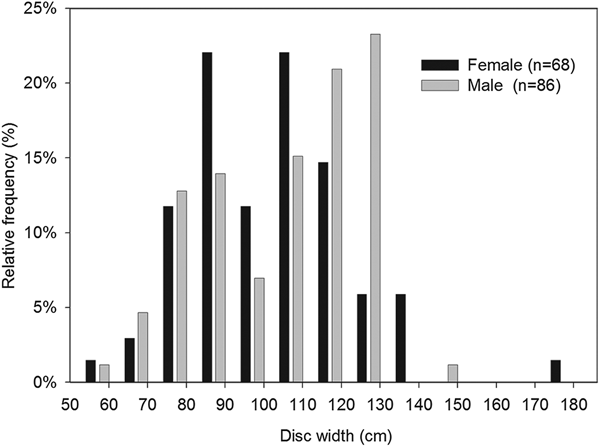
Between 2013 and 2016, a total of 154 spotted eagle rays were analysed, including 68 females and 86 males (Figure 2), with 154 stomachs and 110 intestines collected primarily from January to June (the main fishing season). Samples were obtained in the port of Seybaplaya (N = 144) and the port of Champotón (N = 10). The size range of the rays was 59–174 cm DW (average 99.7 ± 19.87) for females and 60–145 cm DW (average 103.5 ± 19.83) for males.
Size structure of females and males included in the analysis of the feeding habits of the spotted eagle rays off Seybaplaya.

Cumulative prey curve
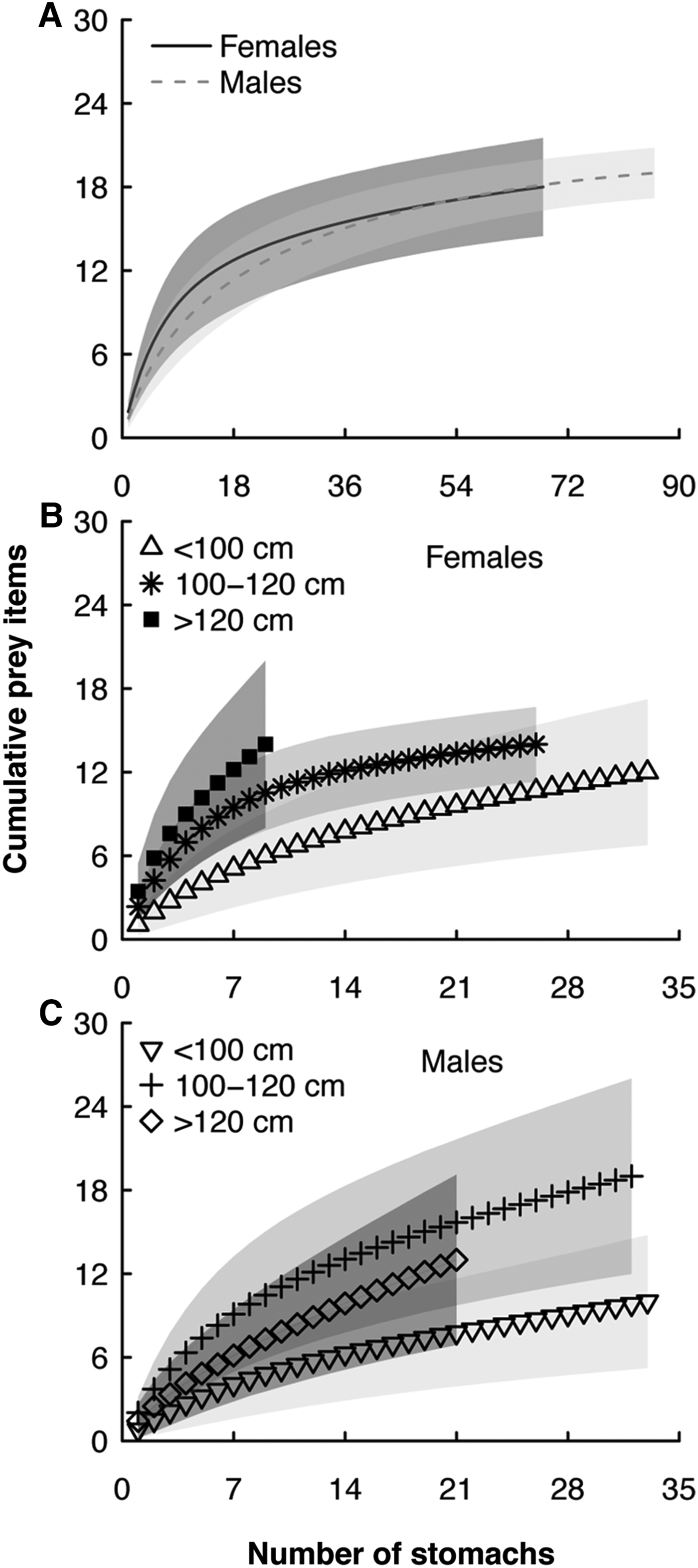
Cumulative prey curves showed a good fit (R 2 > 0.97), where the number of prey species was close to the asymptote predicted by the model for the whole sample, by sex and by size groups (Figure 3). The values of the slope were smaller than 0.1 (with the exception of large females and males with 0.36 and 0.17, respectively), and the proportion of prey species recorded ranged from 72 to 99%. The smaller per cent of recorded species with respect to the predicted value was for the large size groups of males (72%) and females (78%). For the rest of the groups (size groups, males and females) the proportion of the recorded number of species was 87% or larger with respect to the predicted number.
Cumulative curves (with standard deviation) of prey species for (A) both sexes, (B) three size groups of females and (C) three size groups of males of the spotted eagle ray.

Fullness index and digestion degree
In terms of fullness, 39% (N = 61) of stomachs were empty, 46% (N = 71) were at 50% of their capacity, and only 4% (N = 6) were apparently full. The intestines had no variation in the fullness index. Forty-five per cent of stomachs and 49% of intestines contained prey with high level of digestion (level 5); 22% and 30% of stomachs and intestines, respectively, had level 4. The rest of the stomachs (33%) and intestines (21%) had prey with a lower level of digestion.
Feeding habits
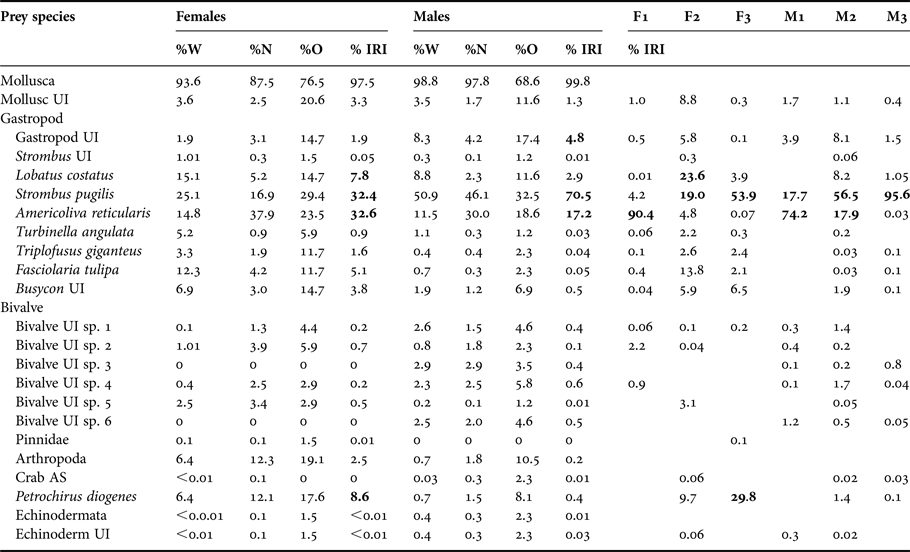
Overall, 1313 prey items were obtained from stomach and intestinal contents, with an average of 8.5 prey items and 1.6 prey species per ray. The diet was comprised of three phyla: Mollusca (98.8% IRI), Arthropoda (1.2% IRI) and Echinodermata (<0.01% IRI) (Table 1). Mollusca was represented by the class Gastropoda (92.7% IRI), which also possessed the highest values by weight (79.3%W), numbers (74.5%N) and occurrence (55.2%O). The class Bivalvia accounted for 2.2% IRI (Table 1).
Index of relative importance (% IRI), based on the frequency of occurrence (%O), weight (%W) and numerical (%N) contribution, of prey-species of the spotted eagle rays by sex, and size groups by sex (small females (F1), medium-sized females (F2), large females (F3), small males (M1), medium-sized males (M2) and large males (M3)).

UI, unidentified; AS, associated to seashell.
The highest values of IRI are shown in bold.
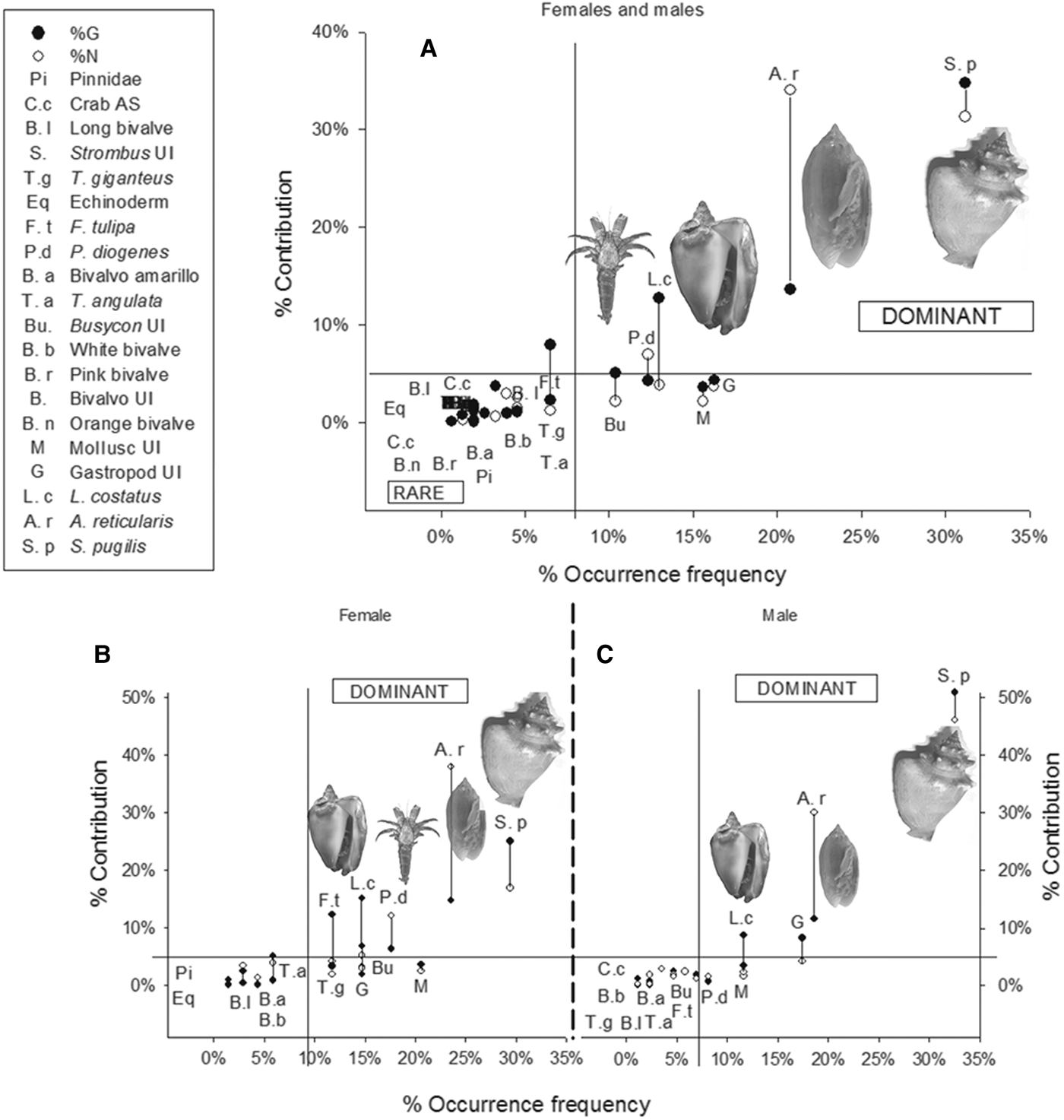
The most important prey species in the diet was the fighting conch Strombus pugilis (53.3% IRI). Fighting conch was recorded in 31.2% of the rays, had the highest %W (34.7%) of all species, and was the second most numerous prey species (31.3%N). The second most important prey species was the netted olive Americoliva reticularis (25.6% IRI), which was recorded in 20.8% of the rays, the second most important by %W (13.6%) and had the highest %N (34%). Other important prey species were the milk conch Lobatus costatus (5.6% IRI) and the hermit crab Petrochirus diogenes (3.6% IRI). Petrochirus diogenes was the most representative crustacean in the diet (Table 1).
Feeding habits of females, males and size groups
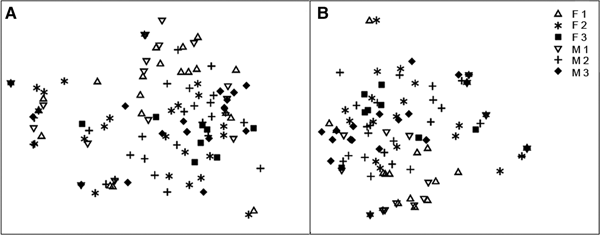
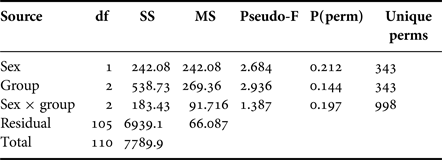
There were no differences in the feeding habits by sex and size groups (PERMANOVA, P > 0.05, Table 2). Also, the NMDS did not show clustering among size groups by sex (Figure 4). In both females and males, the most important prey species were S. pugilis and A. reticularis. For females, they had a similar IRI of 32.4% and 32.6%, for S. pugilis and A. reticularis, respectively, and for males the most important was S. pugilis with 70.5% IRI in comparison to a smaller 17.2% IRI for A. reticularis. The third most important prey species for females was the hermit crab P. diogenes (8.6% IRI) and unidentified gastropods for males (4.8% IRI) (Table 1).
NMDS (Non-metric multidimensional scaling) of the feeding habits for the spotted eagle ray, (A) gravimetric, size groups by sex and (B) numerical, size groups by sex. Size groups: group 1 < 100 cm, group 2 = 100–120 cm and group 3 > 120 cm. F1 = females group 1, F2 = females group 2, F3 = females group 3, M1 = males group 1, M2 = males group 2 and M3 = males group 3.

Results from the two-way crossed PERMANOVA of spotted eagle ray diet data.

According to the IRI and the Costello diagram, the most important prey species for the small size rays (<100 cm DW) of both sexes were A. reticularis, with an IRI of 90.4% and 74.2% for females and males, respectively. For medium-size females (100–120 cm DW), the most important prey species were L. costatus (23.6% IRI) and S. pugilis (19% IRI), whilst males in the same size group predated on S. pugilis (56.5% IRI) and A. reticularis (17.9% IRI). For the larger size rays (>120 cm DW) the most important prey species was S. pugilis, being 95.6% IRI for males and 53.9% for females, and the second most important for females was P. diogenes (29.8% IRI) (Figure 5).
Costello diagram for (A) both sexes, (B) females and (C) males of the spotted eagle ray. Black circle = %W and white circle = %N.

Feeding strategy
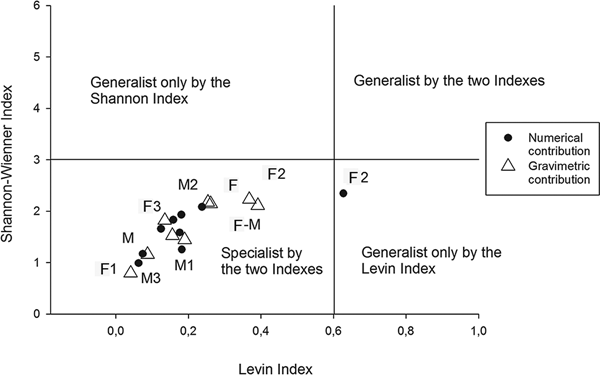
Based on the Levin's index and the Shannon–Wiener index, most of the size groups for both sexes had specialist feeding habits. One notable exception was medium-sized females, which had a more generalist feeding habit according to the Levin's index (Figure 6).
Feeding strategy of the spotted eagle ray for both sexes (F-M), females (F), males (M), females group 1 (F1), females group 2 (F2), females group 3 (F3), males group 1 (M1), males group 2 (M2) and males group 3 (M3).

Characteristics of the sampling sites and benthic fauna
The substrate of the sampling sites was comprised of sand and mud, with patches of seagrasses (Thalassia testudinum and Halodule wrightii). In the transect furthest from shore (20 km), average depth was 11.3 m, with sand the most frequent substrate (55% cover), an average visibility of 4.2 m, and no seagrass. The two transects from the area with the highest fishing pressure at 15 and 10 km from shore (with depths of 9–11 m and 7.5–8 m, respectively) were very similar with 83 and 72% of muddy substrate, respectively, low visibility (2 m) and no seagrass. The sampling sites of the transect at 5 km from the shore had an average depth of 5.8 m, with 55% of sandy substrate, an average visibility of 6.5 m and sea grass coverage of 14%.
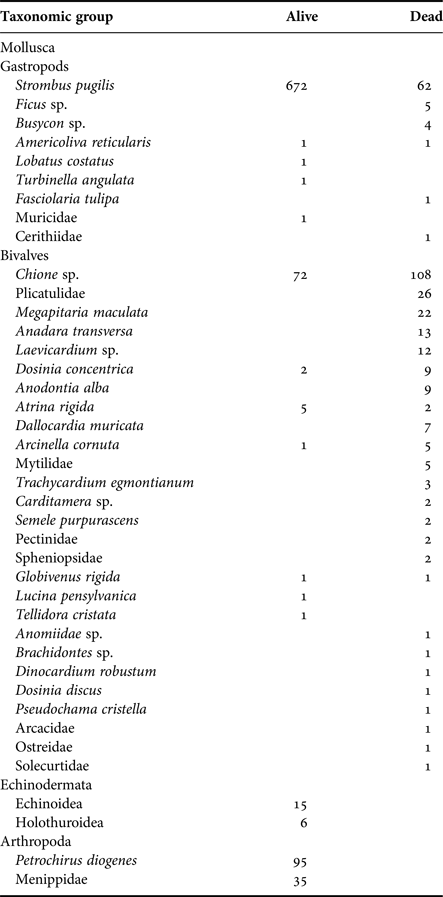
A total of 910 live and 312 dead individuals belonging to 40 species grouped into three phyla were recorded: Mollusca, Arthropoda and Echinodermata (Table 3). Mollusca was represented by nine species of gastropods and 27 bivalves. Arthropods included two species of the class Malacostraca (hermit crab P. diogenes, and a crab of the family Menippidae), and echinoderms with single species from the class Echinoidea (sand dollar) and Holothuridea (sea cucumber).
Benthic fauna collected at the sampling sites off Seybaplaya.

The highest number of species (N = 9) was found in the transect closest to the shore. The number of species diminished further from shore at 10, 15 and 20 km, with five, four and two species, respectively. Strombus pugilis (N = 672) and P. diogenes (N = 95) were the species found in most of the sampling sites (91.6 and 83.3%O, respectively), with the highest values of gravimetric (85.9 and 7.3%W, respectively) and numeric (78.6 and 11.1%N, respectively) abundances. The highest density for a sampling site was for Chione spp. (N = 72, 10.7 m−2 in a sampling site of the transect closest to shore), followed by S. pugilis (with 4 m−2 in a sampling site of the 20 km transect) and P. diogenes (with 1 m−2 in a sampling site of the 15 km transect).
Comparison between prey in the diet and potential prey in benthos
Of the 16 species collected in the sampling sites, four gastropod species (S. pugilis, L. costatus, A. reticularis and Turbinella angulata) and species belonging to three families (Pinnidae, Menippidae and Holothuroidea) were found in the stomach contents of spotted eagle ray. The most common benthic species were S. pugilis and P. diogenes, and the most important prey species in the diet were S. pugilis and A. reticularis.
The Ivlev index (Table 4) indicated that small rays (<100 cm DW) and medium-size rays (100–120 cm DW) showed a preference for A. reticularis (0.980 and 0.946, respectively), and that the small rays avoided the rest of the species (negative values >−0.511). Medium-sized rays also preferred L. costatus at 5 km from shore (value 0.825) and hermit crab at 20 km from the shore (value 0.468). The medium-sized rays avoided S. pugilis (negative values >−0.314) and the hermit crab at 5 and 15 km from the shore (−0.442 and −0.669, respectively). Large rays showed a preference for L. costatus at 5 km from the shore (value 0.721) and hermit crab at 20 km from the shore (value 0.704), but avoided T. angulata at 10 km from the shore (value −0.548) and hermit crab at 15 km from the shore (value −0.414). Finally, large rays consumed S. pugilis at all depths, hermit crab at 5 and 10 km, and A. reticularis at 15 km according to the proportion found in benthos (values are close to zero).
Comparison between the proportion of the prey species in the diet of the three size groups of the spotted eagle ray with the proportion of the potential prey species in the four transects (5, 10, 15, 20 km) of benthic sampling using the Ivlev index.

DISCUSSION
In the southern Gulf of Mexico, the spotted eagle ray is a specialist and selective predator that feed mainly on gastropods (92.7% IRI). The diets were statistically similar among females and males, size groups, and between stomach and intestinal contents. The most important prey species in the diet (S. pugilis) was also the most abundant benthic species in three of the four sampling sites off Seybaplaya, Campeche.
Gastropods and bivalves in the diet of eagle rays
Previous studies also recorded that the most important prey species for spotted eagle ray and related ray species belong to the phylum Mollusca (Bigelow & Schroeder, Reference Bigelow and Schroeder1953; Randall, Reference Randall1964; Iversen et al., Reference Iversen, Jory and Bannerot1986; Schluessel et al., Reference Schluessel, Bennett and Collin2010; Ajemian et al., Reference Ajemian, Powers and Murdoch2012). In the present study, gastropods constituted more than 90% (IRI) of the diet; however, Ajemian et al. (Reference Ajemian, Powers and Murdoch2012) documented that spotted eagle ray off Bermuda fed mainly on bivalves followed by gastropods. This difference could be due to a higher diversity and abundance of bivalves in Bermuda (Thomas, Reference Thomas2003), or due to the spatial limitations of the study as all animals were collected and analysed from a single inshore lagoon. Additionally, Ajemian et al. (Reference Ajemian, Powers and Murdoch2012) used gastric lavage to obtain gut contents, which could be less effective in dislodging gastropod prey remains. Schluessel et al. (Reference Schluessel, Bennett and Collin2010) also found that Aetobatus ocellatus feeds mainly on gastropods (Family Trochidae) in Australian waters and unidentified gastropods off Taiwan.
It seems that gastropods of the family Strombidae are common in the diet of spotted eagle ray, including L. gallus (Randall, Reference Randall1964), L. gigas (Randall, Reference Randall1964; Iversen et al., Reference Iversen, Jory and Bannerot1986), L. costatus (Ajemian et al., Reference Ajemian, Powers and Murdoch2012; present study) and S. pugilis (present study). It is possible that population decreases of species of the family Strombidae off Campeche could increase feeding pressure by spotted eagle ray to other prey species and increase intra-specific competition between the rays, which may cause the rays to move to other feeding areas. During recent field sampling, an increase of the fishery on small gastropods (mainly S. pugilis) in some ports of Campeche (including Seybaplaya) was observed, which could accelerate changes in the feeding behaviour or distribution of spotted eagle ray. Heithaus (Reference Heithaus, Carrier, Musick and Heithaus2004) considered that competition and/or food availability may play important roles in regulating population sizes of some elasmobranchs. Therefore, these factors should be considered in future studies on population dynamics of spotted eagle rays in the southern Gulf of Mexico.
Assessing the community consequences of elasmobranch predation is challenging. Benthic foraging rays provide a system where such experiments are possible, and rays may influence marine ecosystems through disturbance of bottom sediments (Heithaus, Reference Heithaus, Carrier, Musick and Heithaus2004). Ajemian et al. (Reference Ajemian, Powers and Murdoch2012) estimated the potential impacts of spotted eagle ray on benthic resources in Bermuda, in the context of a shark population decline. These authors concluded that this ray had modest impact on local shellfish populations at current population levels, suggesting a reduced role in transmitting cascading effects from apex predator loss. In the southern Gulf of Mexico, there is an apparent decline of shark populations (Pérez-Jiménez et al., Reference Pérez-Jiménez, Méndez-Loeza, Mendoza-Carranza, Cuevas-Zimbrón, Sánchez, Chiappa-Carrara and Pérez2012); however, the potential impact of spotted eagle ray on conch populations, due to cascading effects, could be masked due to the intense conch fishery off Campeche (the fishery caught mainly L. costatus, S. pugilis, T. angulata, Sinistrofulgur perversum and Triplofusus papillosus). Nevertheless, not a single fishermen from Campeche suggested that spotted eagle rays have negative effects on conch abundance in the area. Future studies could assess the interaction and/or the impact of the conch fishery and spotted eagle ray predation on conch populations.
Size class and sex comparisons of diet
The size structure of both sexes of spotted eagle ray was similar in the study area, which could explain why females and males had similar diets. The size structure included juveniles, sub-adults and adults of both sexes. However, there were only small numbers of younger juveniles (<60 cm DW) and adult females (>140 cm DW) in the samples analysed. According to Cuevas-Zimbrón et al. (Reference Cuevas-Zimbrón, Pérez-Jiménez and Méndez-Loeza2011), females have a size at maturity at about 155 cm DW and males at 107–128 cm DW. According to the IRI and the Costello's diagram, the small rays (<100 cm DW) of both sexes, prey heavily on A. reticularis and, to a lesser degree, S. pugilis. Medium-sized rays (100–120 cm DW) of both sexes feed mainly on S. pugilis, and additionally females fed on L. costatus and males on A. reticularis. Large females and males (>120 cm DW) fed mainly on S. pugilis and females also on P. diogenes. This pattern is in accordance with the results of the Ivlev index. It seems that smaller rays prefer smaller prey species, such as A. reticularis, and large rays feed mostly on medium-sized prey, such as S. pugilis and larger prey, such as L. costatus. The apparent preference for P. diogenes by large rays is particularly interesting and should be clarified with a larger sample size to determine if there is incidental consumption of this crab (which uses strombid shells) or is due to a foraging strategy to maximize the energy intake of sub-adult and adult females.
Schluessel et al. (Reference Schluessel, Bennett and Collin2010) found significant differences in the diet between different size classes of A. ocellatus, where small rays (<60 cm DW) fed more on crustaceans in comparison to large rays (>90 cm DW). In addition, Ajemian et al. (Reference Ajemian, Powers and Murdoch2012) found a probable ontogenetic difference in the diet of the spotted eagle ray, where large rays were the only group observed to feed on gastropods (L. costatus and Natica spp.). Future studies in southern Gulf of Mexico should include a large sample size of younger juveniles and adult females, which are the groups that apparently have distinct diets, probably due to habitat differences (juveniles close from the shore and adult females further from the shore) and also differences in their capacity to break small or large conchs.
Ontogenetic changes in diet or prey size are found within many elasmobranch species (Wetherbee & Cortés, Reference Wetherbee, Cortés, Carrier, Musick and Heithaus2004) and may result in changes in foraging tactics (Heithaus, Reference Heithaus, Carrier, Musick and Heithaus2004). In cownose rays, the shift from non-burying to deep-burrowing bivalves (Smith & Merriner, Reference Smith and Merriner1985) would result in a shift in foraging tactics from collecting benthic prey to excavation (Heithaus, Reference Heithaus, Carrier, Musick and Heithaus2004). It is probable that changes in foraging tactics also occur in the spotted eagle ray off Campeche, due to the great size difference between the small rays (<60 cm DW) and large rays (>150 cm DW), causing potential changes in the diet and prey size. However, Ajemian & Powers (Reference Ajemian and Powers2012) indicate that spatial effects (inshore vs offshore) should be considered in the analysis of diet variation to avoid the confusion with ontogenetic differences, as demonstrated for Rhinoptera bonasus in northern Gulf of Mexico.
Feeding habits vs benthic sampling
The most important prey species in the diet of the spotted eagle ray (S. pugilis) were among the most abundant benthic species in three of the four sampling sites (transects at 10, 15 and 20 km from shore). Some rare prey species (e.g. Turbinella angulata, Triplofusus giganteus and Busycon spp.) in the diet were not found at the sampling sites; however, fishermen reported these in the bottom gill-nets used to target rays. Based on the abundance of prey species in the sampling sites, the transects at 20, 15 and 10 km from the shore represent a potential feeding area for the spotted eagle ray, although the Ivlev index suggests that there is a great variability in the preference of consumption through all depths by the three size classes, indicating that rays are using the whole sampled area for feeding. However, the transect at 20 km is not used as a fishing area because fishermen indicate that the gill-net cannot operate efficiently due to the stronger currents and greater depth (>10 m). Also, at this transect (20 km) there was greater visibility compared with the area with the high fishing pressure (transects at 10 and 15 km from the shore), which potentially allows rays to avoid gill-nets. In fact, fishermen purposefully choose turbid areas to increase the probability of catching rays (Cuevas-Zimbrón et al., Reference Cuevas-Zimbrón, Pérez-Jiménez and Méndez-Loeza2011). Therefore, the fishing area is not only determined by the presence of rays but also by the appropriate physical conditions to operate fishing gear and increase the catchability of the species (Prellezo et al., Reference Prellezo, Lazkano, Santurtún and Iriondo2009), which includes areas around the transects at 10 and 15 km off Seybaplaya.
Ortega-Puch (Reference Ortega-Puch2008) studied the conch fishery off Seybaplaya and recorded large gastropods (Turbinella angulata, Busycon perversum, Triplofusus giganteus and L. costatus), which are rare in the diet of the spotted eagle rays. These species were caught by free diving at depths of 11–14.5 m and 37–112 km from the shore, where large rays are distributed, as suggested by Cuevas-Zimbrón et al. (Reference Cuevas-Zimbrón, Pérez-Jiménez and Méndez-Loeza2011). Large rays have been observed by dive fishermen feeding on those large gastropods, suggesting that the diet may be more diverse at deeper sites.
Stomach vs intestinal contents and prey identification challenges
The contents of stomachs and intestines were not significantly different from one another in the present study. Future studies could likely focus on the stomach, which contained a large per cent of prey feasible for identification. However, in some rays, opercula were found in the intestine that helped identification of the prey species found in stomach. It is probable that due to the similarity between recently ingested prey (i.e. found in the stomach) and the previously ingested prey (i.e. found in the intestine), rays may use the same feeding area for several days. However, since the digestion time and gastric evacuation rate remains unknown for this species, it was not possible to estimate residency. Evacuation time for elasmobranchs depends on several factors including the size of the prey, the ingested section of the prey, lipid composition, presence of skeletons, feeding periodicity and temperature of the environment (Papastamatiou et al., Reference Papastamatiou, Purkis and Holland2007). Future studies would benefit from involving techniques such as acoustic telemetry to estimate residence time in the fishing area.
Shell fragments were not found in the stomach and intestine of the spotted eagle rays, which is in agreement with the findings of Schluessel et al. (Reference Schluessel, Bennett and Collin2010) and Ajemian et al. (Reference Ajemian, Powers and Murdoch2012). Additionally, sometimes prey items were found as a single piece in the stomach, which demonstrates the winnowing ability of this ray, ingesting only the meat and excluding the shell (Dean et al., Reference Dean, Wilga and Summer2005). These characteristics challenge the identification of the prey items; however, the use of reference specimens, such as in the present study, facilitated prey species identification. Thus, use of such visual references is recommended in future studies of the spotted eagle ray and could be combined with molecular techniques for species confirmation.
Future considerations
The results of this study in the southern Gulf of Mexico suggest that it is necessary to evaluate the distribution and abundance of both spotted eagle rays and their mostly gastropod prey to better understand their impact on each other. The conch catch constitutes one of the four most important fisheries in Campeche (4263 annual tons) (CONAPESCA, 2013), with fishermen fishing further from the shore over time due to decreases in nearshore conch catch (Ortega-Puch, Reference Ortega-Puch2008, fishermen comments). This trend may explain what fishermen perceive as a likely contribution of the conch fishery to the decreased catch rate of the spotted eagle rays (Cuevas-Zimbrón et al., Reference Cuevas-Zimbrón, Pérez-Jiménez and Méndez-Loeza2011). This study emphasizes the importance of monitoring fishery impacts on prey species (e.g. the conch fishery off Campeche) of exploited predators to help support integrated assessment and management of fisheries.
ACKNOWLEDGEMENTS
We thank the fishermen of the state of Campeche (ports of Seybaplaya and Champotón) who allowed us to analyse their landings, collect samples and who provided us with information about their fishing activities. Special thanks to F. López, E. Bada, M. Chi, S. Villanueva and E. Flores for their help in the field, and to N. Tremblay who elaborated Figure 3. We would like to thank Mote Marine Laboratory Marine Operations and Center for Shark Research staff, including D. Dougherty, P. Hull, G. Byrd, T. Graham, R. Hueter, K. Wilkinson and B. DeGroot, for their fieldwork training and advice to the first author (F. Serrano-Flores) to conduct his Master's thesis project. Logistical support was provided to M. Ajemian by the Harte Research Institute for Gulf of Mexico Studies, as well as FAU Harbor Branch Oceanographic Institute. All applicable international, national and/or institutional guidelines for the care and use of animals were followed.
FINANCIAL SUPPORT
We thank the following organizations for supporting with private foundation grants the collaborative work (ECOSUR-Mote Marine Laboratory) through travel support: Save Our Seas Foundation (115–538), Disney Worldwide Conservation Fund (115–399) and the Mote Scientific Foundation (115–386).