Introduction
Loneliness, rarely out of the headlines, is amply addressed in academic literature, especially as it relates to older people (Victor et al., Reference Victor, Scrambler, Bond and Bowling2000; Savikko et al., Reference Savikko, Routasalo, Tilvis, Strandberg and Pitkälä2005; Victor et al., Reference Victor, Scrambler, Bowling and Bond2005; Victor et al., Reference Victor, Scrambler and Bond2009; Age UK, 2010; Age UK Oxfordshire, 2011; Windle et al., Reference Windle, Francis and Coomber2011; Age UK, 2012). A concern to UK social policy, loneliness has achieved such prominence that it has acquired a ministerial brief (DCMS, 2018). This article presents evidence from an empirical study into older people’s experience of loneliness in a Northern town, focussing on how temporal and spatial dimensions inter-relate. Set up to explore when people felt lonely, research results showed a notable connection between time and place. This linkage between temporal and spatial dimensions simultaneously supports and challenges dominant policy discourses, highlighting a possible disjuncture between preventative approaches for ‘the many’ and remedial approaches for ‘the few’.
The article proceeds as follows: a review of existing literature; an outline of the research approach; a summary of major findings; and finally, a discussion about the relevance of these to social policy. The article concludes by suggesting that policy-makers need to keep in mind lived realities of the ‘most lonely’ older people and resist an idealisation of ‘home’.
Literature
Recent analysis (ONS, 2018) reveals that older people may be less likely to experience loneliness than younger adults, and loneliness is not an inevitable part of ageing. Nevertheless, loneliness is commonly seen as being a problem of ‘older age’. Griffin (Reference Griffin2010) points to middle age as a time when key risks accumulate and Smith (Reference Smith2012) highlights how changes brought about by the ageing process can preclude older people pursuing previous activities. Moreover, as longevity increases, and families become more complex and dispersed, more older people live alone. This does not automatically mean that someone is lonely, but it does place people at greater risk (Friedli, Reference Friedli2009). Others have focused on the quantity and value of social support networks, finding that older people are at lower risk when the type of help available to them is local and informal (Wenger, Reference Wenger1996; Wenger, Reference Wenger1997), or suggesting that the quality of social relationships may be of greater importance (Antonucci, Reference Antonucci and Birren2001; Fiori et al., Reference Fiori, Antonucci and Cortina2006).
A growing body of evidence has identified factors that increase the prospect of experiencing loneliness. An early attempt to reliably quantify loneliness in the UK older population (Victor et al., Reference Victor, Scrambler, Bond and Bowling2000) found significant differences for different groups. Loneliness was most likely to be reported by women, ‘very old’ people, those who had never married, who lived alone, who had physical or mentally frailty, and who lacked material resources. Links with poverty and ill-health are picked up in several studies (Beach and Bamford, Reference Beach and Bamford2014; Shankar et al., Reference Shankar, McMunn, Demakakos, Hamer and Steptoe2016); the significance of impaired mobility or sensory impairment emphasised in others (Aebischer, Reference Aebischer2008; Griffin, Reference Griffin2010; Smith, Reference Smith2012); whilst the diminished social interaction and weight of responsibility felt by ageing carers also features (Jopling, Reference Jopling2015; Vasileiou et al., Reference Vasileiou, Barnett, Barreto, Vines, Atkinson, Lawson and Wilson2017).
Courtin and Knapp (Reference Courtin and Knapp2017) report that longitudinal studies show that experiences of loneliness are not uniform across the life course but, rather, are pre-empted by certain ‘trigger’ events. These are not necessarily exclusive to later life – events might link to relationship breakdown, to moving home, to losing a job – but some triggers disproportionately affect older people. Retirement is particularly notable amongst men and spousal bereavement particularly notable amongst women (Smith, Reference Smith2012; Beach and Bamford, Reference Beach and Bamford2014). The impact of bereavement, especially spousal bereavement, features prominently (Patterson and Carpenter, Reference Patterson and Carpenter1994; Aebischer, Reference Aebischer2008; Bennett and Victor, Reference Bennett and Victor2012; Smith, Reference Smith2012; Jopling, Reference Jopling2015). Aside from the pain of losing a loved one, this can cut off daily routines (Smith, Reference Smith2012) and impede social participation for practical or motivational reasons (Patterson and Carpenter, Reference Patterson and Carpenter1994).
Just as risk and triggers are linked, so too are cause and effect. Illness has been found to exacerbate loneliness and vice versa (Aebischer, Reference Aebischer2008); stress associated with spousal bereavement can contribute to health problems which in turn impact on leisure (Patterson and Carpenter, Reference Patterson and Carpenter1994). For some people, loneliness experienced in older age relates back to earlier experiences. Beach and Bamford (Reference Beach and Bamford2014) suggest that disadvantages and inequalities experienced through life can contribute to higher levels of loneliness, whilst Griffin (Reference Griffin2010) suggests that lonely people tend to have more of a history of loss, trauma, inadequate support and negative childhood experiences. Notwithstanding this continuity for some, evidence also suggests that loneliness is not static; feelings and intensity change over time and may decrease across the life course if people develop ways of coping (Victor, Reference Victor2012).
Some researchers argue that duration determines the degree of harm, with only persistent loneliness being an issue for serious concern (Griffin, Reference Griffin2010). Others suggest that even short periods of loneliness can impact negatively on cognitive function (Aebischer, Reference Aebischer2008). Almost all studies reviewed by Courtin and Knapp (Reference Courtin and Knapp2017) found that loneliness had detrimental effects on physical and mental health. Here again, there is a cyclical element; research by Cacioppo et al. (Reference Cacioppo, Hawkley, Crawford, Ernst, Burleson, Kowalewski, Malarkey, Van Cauter and Berntson2002) showed that lonely people spend more time awake during the night, making them less resilient partly because of sleeping poorly; Cacioppo and Hawkley (Reference Cacioppo and Hawkley2009) found that negative views of the social world held by lonely people could elicit behaviours validating their expectations. Left untended, loneliness has serious consequences for cognition, emotion, behaviour and health (Hawkley and Cacioppo, Reference Hawkley and Cacioppo2010). Longitudinal studies indicate that loneliness predicts increased morbidity and mortality and has physiological as well as emotional consequences. Griffin (Reference Griffin2010) reports that persistent loneliness leaves a mark via stress hormones, immune and cardiovascular functions.
The literature referenced above incorporates issues of time and space, but few studies have had either as a specific focus. In their quantitative study of prevalence and risk, Victor et al. (Reference Victor, Scrambler, Bowling and Bond2005) found that 54 per cent of respondents reporting loneliness indicated that it was felt most acutely at certain times, particularly evenings. Similarly, Patterson and Carpenter (Reference Patterson and Carpenter1994) found that continual loneliness and lack of communication during evenings was a major concern for their participants, whilst Cattan et al. (Reference Cattan, Kime and Bagnall2011) found that weekends and winter evenings were considered the worst times. Qualitative research into loneliness experienced by widowed older people (Bennett and Victor, Reference Bennett and Victor2012) confirmed that loneliness was felt especially keenly during evenings and at weekends. Other studies have highlighted the role played by crime and fear of crime in explaining the temporal difference (various, cited in Age UK Oxfordshire, 2011: 31-32) or pointed to the lack of mainstream services during these vulnerable times (Jopling, Reference Jopling2015).
Age UK Oxfordshire (2011) highlights the role played by transport and suitable physical environments in enabling social connection. Jopling (Reference Jopling2015) reports that although 95 per cent of urban residents live within thirteen minutes of regular bus services, the time is considerably longer for people with limited mobility, and the proportion much lower in rural areas. If capacity to travel beyond the vicinity of home is curtailed, the adequacy of neighbourhood services and activities, and perceptions of personal safety become more important. Griffin (Reference Griffin2010) suggests that the closure and decline of local neighbourhood services like post offices is highly relevant to loneliness because a key focal point for social and personal contact is lost. Lack of transport has been shown to inhibit ability to maintain contact with others, as has an individual’s functional immobility. Shankar et al. (Reference Shankar, McMunn, Demakakos, Hamer and Steptoe2016) confirm that poor mobility limits social contact; suggesting that this may explain the adverse association between isolation and loneliness and different aspects of functional status. Smith (Reference Smith2012) also found that factors such as impaired mobility and decreased sensory abilities prevented older adults from maintaining social connections with others.
In summary, as well as exploring the concept of loneliness in older age, the literature referenced above encompasses studies of prevalence, identifies risk factors and trigger events; highlights the key contextual factors of ability to travel and availability of local services; and points to people being particularly vulnerable to loneliness at certain times. This temporal dimension of loneliness was the starting point for the commissioned project that forms the basis of this article.
Approach and method
The research explored the situation in a Northern town, in collaboration with a local voluntary sector programme seeking to reduce loneliness amongst older people. As noted above, the study originally sought to address gaps in local knowledge about the temporal dimensions of loneliness but, as research progressed, results and conclusions also threw light on how these inter-related with spatial aspects.
Empirical fieldwork encompassed quantitative and qualitative dimensions. The general membership of the project was used as the sampling frame for a survey conducted in spring 2017. Questionnaires were sent via post with an option to complete online; 324 responses were received. Alongside basic socio-demographic information (allowing known risk factors to be assessed), the survey asked about personal experiences of loneliness, existing relationships, and connections to the local community; and how all played out in terms of time. Mostly comprising closed questions, a few open questions allowed respondents to make additional comments if they wished.
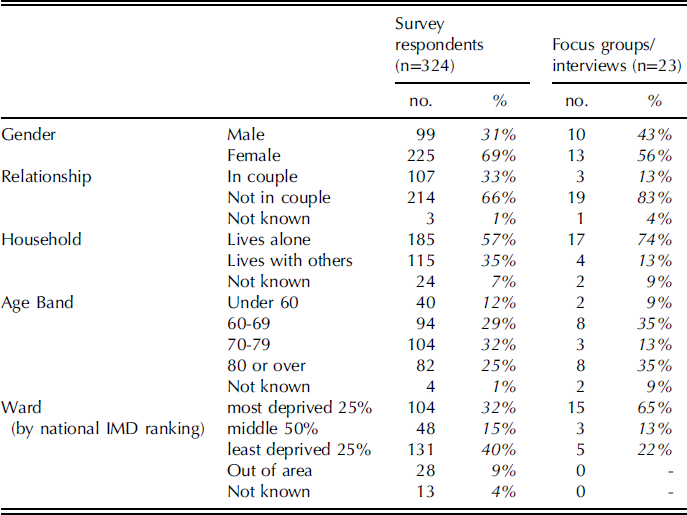
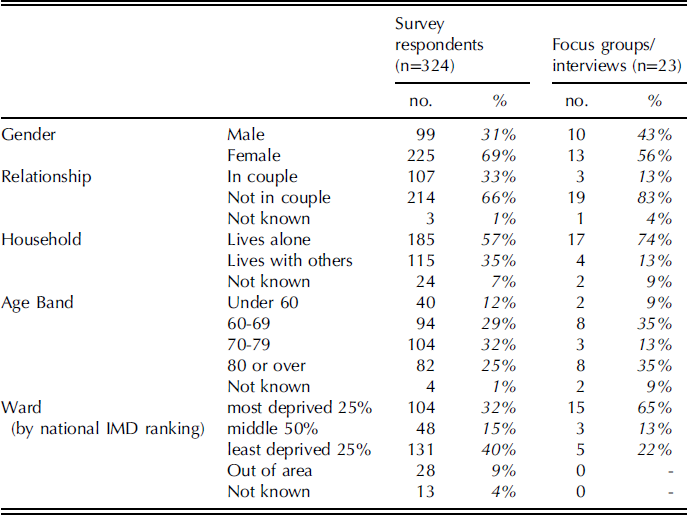
Amongst respondents to the survey, 225 (70 per cent) were women, 214 (66 per cent) not in a relationship, and 185 (57 per cent) lived alone; demonstrating that these risk factors were reflected. There was also a good range of representation between different age bands. Wards of residence were also cross-referenced with the Index of Multiple Deprivation (MHCLG, 2015) and respondents were reasonably distributed between different quartiles. However, because the town’s wards are heavily over-represented within the most deprived quartile, this translated as an over-representation from those living in more affluent wards; this was brought into balance in the qualitative dimensions of the research.
Three focus groups were conducted in summer 2017. The first two were made up of six members each, ranging in age from fifty to over eighty. Groups were mixed gender, though predominantly women, and it was noticeable that men were infrequently forthcoming. Consequently, an additional ‘all male’ focus group was held to ensure that the research captured men’s perspectives. Six semi-structured interviews were also carried out (three men and three women) conducted either in the participant’s home or on university campus depending upon their choice. The survey was used as a topic guide and, for both interviews and focus groups, discussions centred on issues of loneliness, how they played out over time, and potential local solutions.
The profiles of those taking part in the various elements are shown in Table 1.
Profile of Research Participants (n=337)
Results
Prevalence
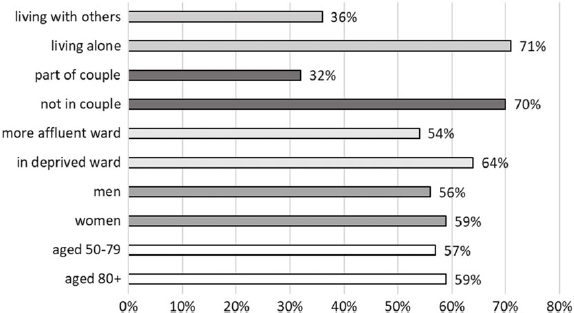
Survey data was analysed by gender, age, material hardship (based on the proxy of ward deprivation), partnership status, and living alone, confirming the differential exposure to loneliness identified in previous studies. Overall, 58 per cent of survey respondents reported feeling lonely sometimes or often during the last six months. Analysis showed a marginal divergence between those under and over eighty; a more pronounced variance between men and women; and a bigger gap still for deprivation. Finally, and echoing the literature, not being part of a couple, and living alone, revealed particularly notable differences (Figure 1).
Feeling lonely sometimes or often in the last six months (n=190).
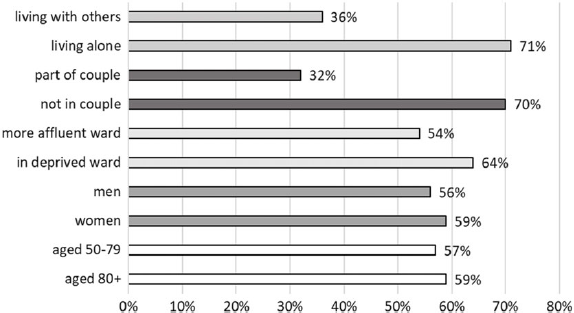
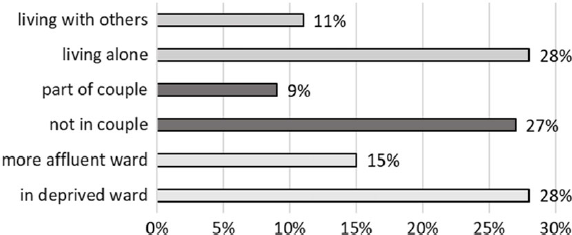
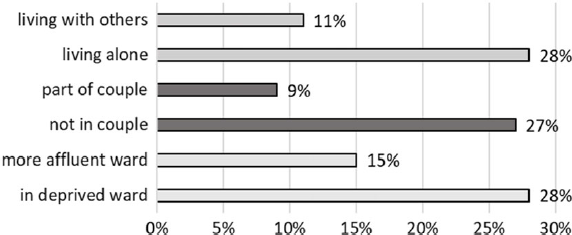
When results were examined only for the sixty-nine individuals who often felt lonely, more marginal differences were reversed. People over eighty were less likely to report frequent loneliness; men were more likely to report frequent loneliness than women. Conversely, the patterns for disadvantage, not being part of a couple, and living alone were even more pronounced (Figure 2).
Feeling lonely often in the last six months (n=69).
Experience
Asked what loneliness meant, people responded in various ways, reflecting the personal nature of experience. People talked about being alone, having too much spare time on their hands, having no one to talk to, and feeling depressed: ‘It’s like an empty space in your life, boredom, a black hole’. The impact on ‘everyday things’ was also noted. One participant commented: ‘I think, when you’re on your own, you’ve got… nobody needs you. You sort of let yourself go. You don’t feed yourself because you think, ‘Well, why bother?’ So you don’t cook and… when it’s just me, I’ll have a sandwich or a tin of soup.’
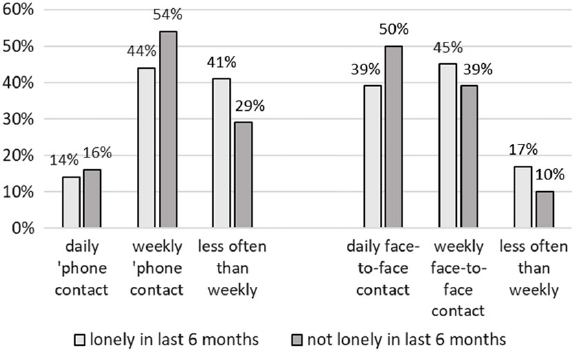
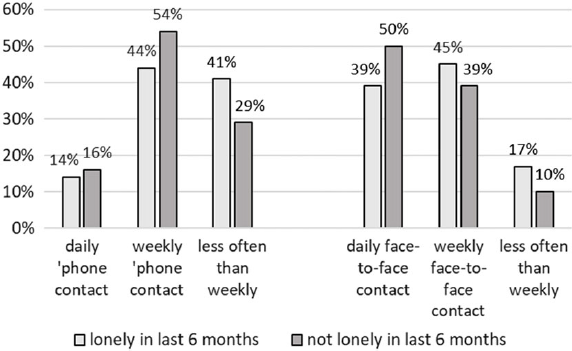
The survey showed a marked difference in the regularity of social contact when comparing respondents who had been lonely in the previous six months, and those who had not. People who had recently experienced, or were currently experiencing, loneliness were less likely to have daily face-to-face contact and more likely to have such contact less than weekly. The gap was smaller for daily telephone contact, but greater for those whose conversations happened less than weekly (see Figure 3).
Frequency of social contact by degree of loneliness (percentage).
Risks and triggers
One known risk factor not routinely collected by the survey was ‘physical or mental frailty’. However, of 205 people who identified a specific trigger for loneliness, over 10 per cent highlighted the importance of deteriorating health. Expanding upon this through open questions, comments encompassed straightforward attribution: ‘when I first started experiencing symptoms of MS’ and explaining effects: ‘when I could not drive anymore because of eye trouble’. Amongst focus group members, the ill-health of partners, family or friends were identified as trigger events, sometimes related to a care-giving role. For others it was direct; a man with dementia illustrated how his previous social world was increasingly impeded: ‘I do attend some groups or have done anyway. Like folk dancing… but this loss… dementia, is killing that… I don’t know if you know anything about folk dancing. It’s sort of assuming that dancers know the figures they’re going to do. If you don’t know them, you can’t do it!’
By far the most frequent self-reported trigger identified in the survey was bereavement. The open question comments of 127 respondents relayed more than 140 instances of somebody’s death acting as a trigger to experiencing loneliness. Over half of these recounted losing a partner, and over 20 per cent recounted a parent’s death, sometimes many years before. Others described loneliness arising from losing siblings, children, grandchildren, other family members, and friends. Some had experienced multiple bereavements; one survey respondent wrote: ‘All the deaths in my family. I seem to be losing them one by one. I just don’t want to be answering my door in case it’s bad news… I worry and bottle things up, don’t tell anyone how I’m feeling… just want to shut myself behind closed doors.’
Bereavement also featured prominently in focus groups and interviews; several people recounted their feelings when their spouse or partner had died, and the gaps this left in their lives: ‘It’s just you feel you want someone to put their arms around you, cuddle you and say I love you… I miss that’. For some, these feelings had been revisited when they had later lost friends and, for a few, the subsequent loss of a much-loved family pet who had gone through the experience with them, served to emphasise feelings of being alone.
Relationship breakdown was another prominent trigger. Over twenty survey respondents mentioned divorce in open comments, some relaying a relationship going very wrong: ‘a very violent abusive husband’. Others described break-ups with other family members, from life-changing divisions to temporary arguments. One interviewee recounted movingly how her marriage breakdown in older age had been associated with new technologies; her former husband had made a long-distance relationship via Skype; she was in touch with what was now happening with his new life via Facebook.
The importance of work, and therefore retirement, to people’s social lives was particularly prominent in the all-male focus group: ‘With me, I think I became lonely and depressed when I gave up work. At work, you had a routine, you talked to people, you went out with them, then when you retire from work, there’s no preparation. You then have to go out there and do it yourself and you haven’t experienced it.’
Other factors – moving home (and sometimes country); working away from home (or being the partner of someone who did); grown up children leaving home; and childhood trauma (abuse; neglect; being orphaned) – also featured in people’s accounts.
Many risks and triggers – bereavement, relationship breakdown, retirement, moving home, past trauma – related to issues of transition and of time.
Temporal dimensions
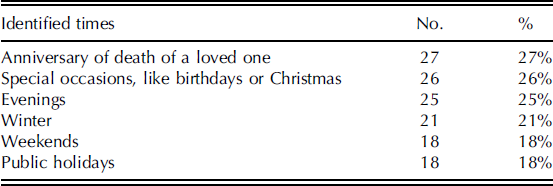
Amongst survey respondents, just over thirty per cent stated that they were lonely at specific times. Various examples were given, many echoing existing evidence. The most common responses are shown in Table 2.
Times identified by survey respondents as being particularly lonely (n=99)
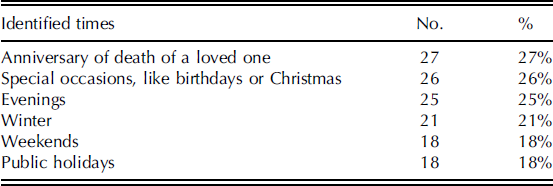
Ninety-four participants added detail through the survey’s open questions about ‘particular times’, and time dimensions also featured in discussions in interviews and focus groups. The association with bereavement featured heavily: ‘I feel particularly lonely around anniversaries and birthdays of members of the family who have died’ was a contribution conveying a frequent message.
Evenings were another prominent theme, with several participants identifying them as a time when loneliness was deeply felt. One woman, now in supported accommodation, recounted ‘When I lived alone, I was going to bed at 4 p.m.’. The impediment to evening socialising posed by financial constraints was also evident: ‘[I’m lonely] every night due to lack of money’. People spoke about how there was nothing to do on an evening other than being ‘left to your own thoughts’, particularly if living alone. One participant commented: ‘You’re on your own, the curtains are closed and you’re keen to go to bed. That’s when I’m at my loneliest’. As the following focus group extract shows, television is not a substitute for real, responsive company:
Participant 1: I mean, you can watch the television but there’s no feedback, is there? You’re just watching.
Participant 2: Well, I do. I answer the television back.
Participant 3: Oh, I talk to the telly. Especially when Piers Morgan’s on, like ‘This Morning’.
Participant 4: To share, you do want to share if you’ve seen something good on the telly or you’re reading a good book.
Participant 3: Or [if] you’re laughing. There’s nobody there.
Especially problematic were winter months, when lonely nights were longer: ‘Winter is often too cold and dark to feel like going out. Sometimes it takes so long for me to decide what to do, it’s too late. I can talk myself out of going places very easily.’ More generally, fear of going out was associated with evenings.
For others, weekends were crucial, as people struggled to find something to occupy their time. This was actively guarded against by some; one participant explained: ‘I appreciate my weekends, because I know I’m not going to do anything, and I’ve got nothing planned. But I get lonely… well, I don’t get lonely, because I can’t afford to get lonely. But if I don’t have anything planned for the coming week, then that would make me very, very lonely and feel lonely. But I always make sure that I’ve got something planned.’
Sundays were often associated with ‘family time’. Discussion sometimes concerned not having family, or not having family nearby, but could also centre on how limited time was for couples to spend with their children or each other. Participants talked about ‘not wanting to intrude’ and trying to avoid troubling others: ‘Sunday is associated with family get-togethers. When I moved… I did not want to disrupt the routine of my son and daughter going to their in-laws, felt it might cause problems’. Similarly, in a focus group:
Participant A: I think as well, at weekends, it’s family time. But… if you haven’t got any family or anything around you, it’s contacting other people and they have their families there. Do you know what I mean?
Participant B: You think you’re intruding…
Participant A: You don’t contact them because you know they’ve got family.
This shows how perspectives extended to social relationships outside of people’s own family unit. People interpreted ‘family time’ as being for an immediate ‘nuclear family’ of parents and children. As people standing outside of this ‘inner circle’, they saw themselves as ‘legitimately excluded’.
Spatial dimensions
There was a notable overlap in results between the times and the places when people felt lonely. Sometimes this related to their observation of others; witnessing, but not being part of, a wider social world: ‘Weekends, to a person like me, can seem lonely because everybody else seems to be getting on with and going to places… where I live, the families come down with the car and they go over the field and walk the dogs or they go around on to the fields and play football. They all seem to be doing something with families.’
Many comments concerned people feeling ‘cut off’ from communities and families, sometimes because they no longer lived locally: ‘When I was a kid, your auntie lived a couple of doors away and you didn’t have nurseries because you had your grandma or you had your auntie, whereas now, I think, families are in, like, Australia and they’re not as close.’ Mobility issues were also prominent in explaining impediments to getting out and about. For example: ‘I have Parkinson’s disease and have fallen several times so can only go out when with my husband’s help’ and ‘[I could go out] if I had my own electric wheelchair. I have got a wheelchair, but someone needs to push it.’ Similarly, effects of cognitive impairment and mental health problems were highlighted: ‘I often forget where I’m going or forget routes and need to be reminded.’
Notably, whilst social contact at home was mentioned in passing, participants’ primary focus was overwhelmingly about going out and getting a ‘change of scene’: ‘Sometimes I go out. A lot of it might be the same routine day in and day out but you’ve got to do that because if you don’t, you’ll probably just sit and look at four walls. If you didn’t get out, you’d probably go crazy, to be honest.’ Many contributors explicitly acknowledged their loneliness within their home specifically, and their consequent desire to ‘escape’; one carer relayed: ‘I’m always lonely, really, in the house’. Discussion in the male focus group touched on the effect of recent policy changes restricting eligibility for a Motability vehicle: ‘They’ve taken the cars off people but that’s not solving the problem, it’s making the problem worse. What it’s doing is house-bounding people.’
Contributors highlighted how public transport deficiencies constrained the space available to them, with many mentioning reduced bus services, especially at evenings and weekends. People felt constrained by changed routes, early last runs, and inadequate Sunday services. Constraints posed by the deregulated system, and more recently by austerity measures, featured heavily in the all-male focus group.
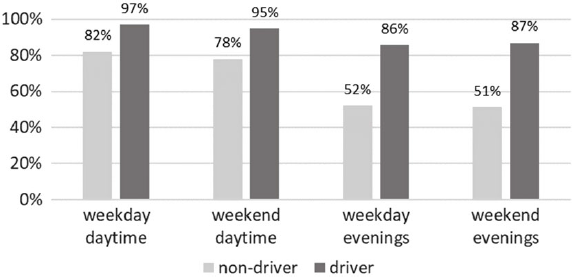
The most notable finding in relation to how people generally got out and about was the degree of reliance on cars, either as driver (162 respondents) or passenger (110 respondents). Getting a lift is inevitably contingent upon having a driver available and nearly a quarter of people having less than weekly face-to-face contact only travelled as a car passenger, suggesting their journeys were infrequent.
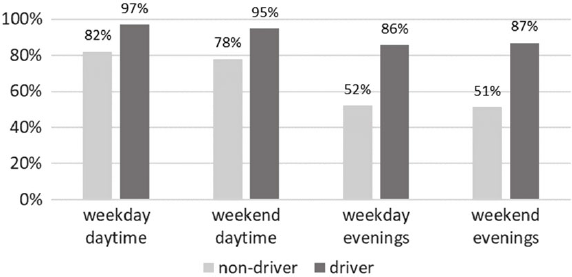
Asked whether they could get out and about, 88 per cent of survey respondents reported being able to during the day (slightly less at weekends) but this was notably lower for evenings (67 per cent, again with a slightly lower figure for weekends). There was a marked difference between car drivers and non-drivers when it came to when people could get out and about. As Figure 4 demonstrates, travel in the evening was notably higher amongst those who drove.
Getting out and about at different times (percentage).
Stretched finance was also a common theme limiting people’s travel, whatever their usual transport. Asked what might improve things, survey respondents within younger age bands were particularly likely to give answers such as ‘cheaper petrol’ and ‘need transport, unemployed on JSA can’t afford anything’. One woman explained that she had sent her driving licence back because she could not afford to run a car; another contributor, who no longer drove in the evenings, found taxis too costly to use: ‘It’s £5 there and £5 back. I just can’t do it’.
Driving was seen by many as crucial. One man stated: ‘to be able to go up and get in the car and drive. If it wasn’t for that, I don’t know what the hell I’d do’; and a woman forced to give up her car because of ill-health: ‘And that’s when it hits me, when I go in the garage and it’s empty’. Feelings of dependency induced when people relied on others for lifts were also evident – and unwelcome – in many contributions, as were the physical logistics if front seats were taken. Taxis too could be problematic if the driver did not offer assistance: ‘Where I live, the taxis come up and the taxi driver is just sat there… It’s sheltered [for] people of a certain age… We need help getting in the taxi. Don’t just sit there!’
For some people, apprehension about evening outings was lessened by car travel (‘only if I am picked up by car owners’) but even amongst drivers, evening travel could be ruled out for safety and security considerations. The greater freedom of movement for those with their own vehicle, sufficient finance, and the resource of confidence, was demonstrated by the following interviewee: ‘If there’s a good play on, I’ll just hop in the car, and if it starts at 7:30, I hop in the car at 7 o’clock and I go down to the theatre and I get myself a seat for myself on my own without having to ring up and ask if you’ll come, or are you coming, and all that… I just go.’
Existing literature (for example: Griffin, Reference Griffin2010) shows that curtailed capacity to travel beyond home’s vicinity makes local services and activities, and perceptions of personal safety, increase in importance. This was evident in this study: ‘We have no shop… Shops make people talk, meet and socialise, we have nothing…’. Anxieties provoked by vulnerability to crime provoked reluctance to walk in certain areas, seen as being frequented by people perceived as ‘undesirable’ (‘winos’; ‘druggies’; ‘yobs’). The weather was also an issue for some, both for going out in the immediate vicinity or venturing further afield. One man explained: ‘I can’t go out when it’s raining because I can’t hold an umbrella up, because I’ve got a walking stick in one hand or else I’m in my mobility chair. You just get wet.’ Other impediments to getting out and about included the lack of public toilets, and the absence of seats in shops.
Discussion and conclusion
In considering the nature of loneliness, and what might prompt it, several themes echoed existing literature. These included: the highly personal, and sometimes transient, nature of the experience; the association with living alone and financial constraints; the status of bereavement, relationship breakdown, ill-health or disability as major triggers; and the importance of retirement (particularly for men) and caring (particularly for women). In addition, the fieldwork explored – and confirmed – that feelings of loneliness can be experienced throughout the life course, and that people associate its prevalence with changing family structures and the nature of contemporary communities.
The connection between having social contact, loneliness and being able to get out is at one level self-evident. There may be a reliance – for people who live alone (or live with a person requiring constant care); for people with impaired senses or reduced mobility; and for people lacking financial resources – on a local community that no longer exists and a family network that stretches over several hundred miles. For some people, all three factors will apply.
Opportunities for social contact inevitably diminish as spatial horizons recede. This can (and does) lead to increased loneliness and social isolation. Spousal bereavement removes everyday contact; giving up a car removes potentially limitless spatial contact; retirement removes the spatial and social element of work. Moreover, if impairments and ill-health take their toll on the capacity to use space beyond the four walls of ‘home’, a concept so often lauded can be transformed into a place of confinement and negativity.
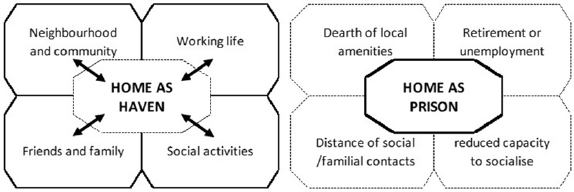
The meaning of ‘home’ is contested and complex; variously understood in terms of place, space, feelings, practices, existence and identity (Mallet, Reference Mallet2004). Whilst recognising that feminist sociology in particular has explored and exposed some of the ‘downsides’ of home (for example, Smith, Reference Smith1987), the relationship between home and social contact can sometimes be left hanging and uncharted within sociological debate. In the absence of critical scrutiny, ‘home’ can be imbued with all sorts of positive attributes, including being a ‘haven’ from the wider social world. However, people who, for whatever reason, are ‘confined’ to home – especially if they live alone – can perhaps be better characterised as being isolated from wider society, hidden behind closed doors, and unable to access the outside world.
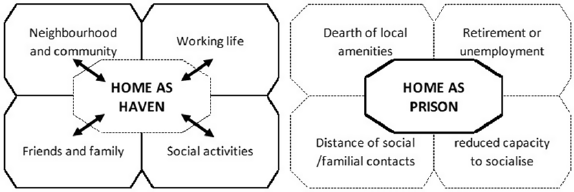
People living with others may have ‘in-built’ company, even if it is less than satisfactory. Those living alone do not have this; and, unless they receive visitors, they are dependent on leaving their home to find company. Whereas – especially during the day – people can ‘escape the emptiness’ of their homes if they have the physical, psychological, practical and financial means to do so, for those confined to their home space, only (possibly rare) visitors break into the hollowness they feel when ‘home alone’. For some people, far from offering refuge, it seems that the experience of ‘home’ may be more akin to incarceration. Figure 5 portrays the different extremes of how home may be experienced.
Concepts of home.
In recent decades ‘ageing in place’ has emerged as a prominent theme within western social policy discourse. The term suggests a concern with the ‘inclusion’ of older people and is often presented as providing a ‘cost-effective solution’ to ageing populations which also benefits older people’s quality of life. Within different jurisdictions, the phrase may be narrowly equated, implicitly or explicitly, with ‘existing home’, as is argued to be the case in Finland (Vasara, Reference Vasara2015: 55-56) or interpreted more broadly, as is argued to be the case in Australia (Bartlett and Carroll, Reference Bartlett and Carroll2011: 25). The focus on ‘ageing in place’ is not without critique. Wiles et al. (Reference Wiles, Leibling, Guberman, Reeve and Allen2011) expand upon problems that may arise if ‘place’ is interpreted narrowly as bricks and mortar or treated simply as a ‘container’; or if older people are viewed as a homogeneous block. Sixsmith and Sixsmith (Reference Sixsmith and Sixsmith2008) identify ‘everyday downsides’ to ageing in place when factors like weaknesses in social support undermine an individual’s capacity to be independent. Other research suggests that accessing formal help to remain ‘in place’ ‘is characterised by discontinuity and upheaval which tends to reinforce social exclusion’ (Barrett et al., Reference Barrett, Hale and Gauld2012: 364), whilst a UK select committee inquiry highlights the barriers (emotional, financial and practical) that face a sizeable minority of older people (estimated at around a third) who would prefer to move (CLGSC, 2018).
Findings from this study suggest that if ‘ageing in place’ is to have any meaningful advantage for older people confined to home, then priority should be given to ‘unbinding’ people who are ‘housebound’; and expanding, not just maintaining, social horizons. Some approaches to lessening loneliness – such as psychological support (Hawkley and Cacioppo, Reference Hawkley and Cacioppo2010) – have an evidence base but no obvious spatial or temporal dimensions. Increasingly advocated (though less well verified) digital solutions (Kim et al., Reference Kim, LaRose and Peng2009; Cattan et al., Reference Cattan, Kime and Bagnall2011; Jopling, Reference Jopling2015) can accommodate temporal aspects but not spatial dimensions, and are confined to those with aptitude, capacity and interest in technologies on offer.
However, there is the potential to integrate time and space into some of the oldest and most commonly used approaches to alleviating loneliness. There is an evidence base for befriending schemes’ capacity to foster meaningful relationships, enabling some recipients to (re-)enter a wider social world, and helping them deal with complex issues like bereavement and failing health (Andersson, Reference Andersson1998; Cattan et al., Reference Cattan, Kime and Bagnall2011). Befriending could specifically be geared towards evenings and weekends and, if services are face-to-face rather than telephone-based, they could be linked to widening spatial horizons too. Similarly, there are any number of volunteer driver services, but these are often linked to specific journeys and appointments. Befriending combined with volunteer driving offers the prospect of journeys for pleasure rather than simply for purpose. In a similar vein, befrienders with the confidence and capacity to push a wheelchair, accompany a mobility scooter, or simply provide an arm to lean on, might be invaluable to someone who wanted to ‘escape’ the four walls of home rather than only interact with people who venture within.
Involvement in the local community is another tried and tested approach, with projects accounting for several positive evaluations (Andersson, Reference Andersson1998; Cattan et al., Reference Cattan, Kime and Bagnall2011). The ability to engage in social and leisure activities is potentially very relevant to evenings and weekends, with the provisos that people can physically get to them and are made to feel welcome when they do. The present study confirms the value of ‘joining in’, but also the difficulties in doing so. People noted how difficult it was to find people with similar interests (especially in their own home) whilst others highlighted how daunting it could be to walk into a group alone. Again, with a slight change in focus, a ‘befriender’ – especially one who could assist with transportation – could be recast as a bridge that offered the prospect of people accessing places where ‘non-befriending’ friendships could be made.
Many studies have highlighted the importance of transport and transportation in helping people escape the loneliness they may experience in their own homes (Age UK Oxfordshire, 2011; Smith, Reference Smith2012; Jopling, Reference Jopling2015; Shankar et al., Reference Shankar, McMunn, Demakakos, Hamer and Steptoe2016). This was emphatically supported in this study’s fieldwork, and especially so for weekend and evening outings; times when loneliness was felt most acutely were times when social horizons were most constrained.
These three basics – somewhere to go, someone to go with, and some means of getting there – are hardly difficult to understand. In this study, participants’ suggested solutions were as much about integrating resources as they were about increasing them, but this does not mean that taking them on board would be cost-neutral. The crisis in care funding means that public services find it hard to move beyond agendas of feeding, cleaning and medicating. Arguably, the terminology of ‘ageing in place’ risks the same fate as a previous maxim – ‘successful ageing’. This has been subject to increasing critique (Dillaway and Byrnes, Reference Dillaway and Byrnes2009; Martinson and Berridge, Reference Martinson and Berridge2015) with critics suggesting that rather than being popular because of genuine choices, its popularity lies in the fact that it ‘defeats the political lobbying for more social support and resources’ (Katz, Reference Katz2013: 20).
A particular landscape – of individualised functional assessment; rising eligibility thresholds; discrete commissioned services; and the continued squeeze on public spending – means the importance of getting out, having company and accessing transportation are unlikely to be prioritised and, at best, may be pushed out to the voluntary and charitable sectors. Whilst the individual services provided there may be excellent, whether this is the most effective and efficient means of achieving integration is open to debate.
Moreover, if an uncritical view of ‘home’ is embedded in social (and health) policy discourses, scenarios of enforced solitude and unwanted confinement may well persist. In doing so, they may contribute to what the government itself has described as ‘one of our most pressing public health issues’ (DCMS, 2018). Whilst the popularity of ‘digital solutions’ could potentially tackle temporal dimensions of loneliness, it is more difficult to see how it can address spatial dimensions. Having a wider interpretation of ‘ageing in place’, including a less rose-tinted view of the (existing) home, could potentially address some spatial aspects, as implied in the recent committee inquiry (CLGSC, 2018) which highlights the value – and shortage – of specialist housing. Most importantly of all, perhaps, is for policy to recognise that when it comes to addressing older people’s loneliness, things that take place outside home may be equally or more important than those that take place within.