Introduction
Empirical evidence confirms that women with small children are less likely to be engaged in the labour market and are more likely to work part-time than women without children or whose children are grown up (Connelly, Reference Connelly and Blau1992; Mayers et al., Reference Mayers, Gornick, Ross and Sainsbury1996, OECD, 2007). This situation might have a negative impact on their further careers and competitiveness in the labour market. Parental leave is one way to enable women and men to reconcile work and family life and consequently limit the negative effects of parenthood on career (Esping-Andersen, Reference Esping-Andersen2002; Gauthier, Reference Gauthier1996; Van Kersbergen and Bussemaker, Reference Van Kersbergen, Bussemaker and Sainsbury1996).
Luxembourg's parental leave scheme was introduced in 1999, but up to now its outcomes have not been sufficiently researched or evaluated. The present article aims to examine anticipated parental leave take up of women of reproductive age in the context of their socio-demographic and labour market characteristics. It explores what proportion of women potentially eligible for parental leave provisions, i.e. those who are active in the labour market and who plan to have children in the near future, would actually take parental leave, in what form they would take it and what their labour market strategies would be after their parental leave. In a second step, it examines how the main individual socio-demographic and labour market factors affect anticipated parental leave take up.
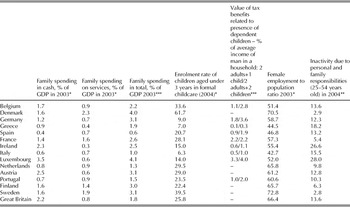
The importance of this research becomes apparent when we take into account the labour market context of the country. Luxembourg exhibits a strikingly high rate of women who are inactive in the labour market due to family responsibilities and, consequently, has a lower female labour market participation rate compared to other EU countries. According to Hardarson (Reference Hardarson2006), in 2004 28 per cent of women aged 25–55 were inactive in the labour market due to family responsibilities, which is the highest proportion in the EU-15 countries (see Table 1). Given this, the government has tried to motivate parents, mainly women, to re-enter or to stay in the labour market after having children. One of the tools to facilitate this process has been the introduction of a paid parental leave scheme. Thus, an in-depth assessment of anticipated parental leave take up can provide useful feedback for policy-makers in charge of employment and family affairs.
Key family policy and female labour market figures in EU-15 countries

Sources: *OECD (2007); **Hardarson (Reference Hardarson2006); ***Gauthier (Reference Gauthier2000).
The first section of the article describes the situation in Luxembourg regarding family-related welfare arrangements and women's labour market participation.Footnote 1 The second section provides a brief overview of the development and characteristics of parental leave schemes in the country. The third part of the article describes the dataset and methodology used in the empirical analyses. The fourth section contains the results of the analysis regarding anticipated take up of parental leave and its determinants. The last part summarises the main findings and presents concluding remarks.
Welfare context
Parental leave represents a welfare state effort to facilitate family and work balance. Parental leave has evolved differently in different European countries, and its character (e.g. duration, eligibility, whether it is paid or not) reflects the particular institutional, welfare and cultural settings of each particular country. Therefore, the role and outcomes of parental leave arrangements in modern societies cannot be analyzed and fully understood without placing them in a broader social and economic context, particularly that of existing family-related welfare policies, the labour market situation and the prevailing patterns of division of labour between men and women.
Regarding family policies, Luxembourg exhibits rather familialist/corporatist features (i.e. pro-male breadwinner), as Lewis (Reference Lewis1992), Sainsbury (Reference Sainsbury1996), Leitner (Reference Leitner2003) and Pfau-Effinger (Reference Pfau-Effinger2004) define them. A common feature of corporatist/familialist welfare models is that state support for families focuses more on financial support (tax relief, tax benefits, child benefits, etc.) than on services (Sainsbury, Reference Sainsbury1996). In many corporatist countries, including Luxembourg, we can find the so-called joint taxation system. Within this system, a married couple is treated as one tax unit, and the tax rate is based on the average income of a couple. When one partner earns significantly less than the other, or has no income at all, the income of the couple is taxed according to a lower tax rate than the equivalent income of a single person or that of a married couple where the income is more equally distributed between partners. The larger the discrepancy between the spouses’ incomes, the higher the tax relief. According to Gustafsson (Reference Gustafsson1992), this tax arrangement discourages women from participation in the labour market and favours the male breadwinner model of household division of labour. The main breadwinner also receives tax benefits related to the presence of dependent children. As presented in Table 1 (column 6), the value of child-related tax benefits as a percentage of the average income of a man in a household in Luxembourg is almost double compared to those in other EU countries except Germany.
According to the data in Table 1, Luxembourg is the biggest spender in the EU-15 zone with respect to family cash benefits. Conversely, concerning public spending on family-related services, Luxembourg belongs to the four countries with the lowest percentage of gross domestic product (GDP) spent on family-related services.
Parents of children under two years old who decide to quit the labour market to dedicate themselves fully to bringing up their children can profit from the so-called child raising allowance, which represents approximately one-third of the minimum salary. The return to a previous job after a break due to child-raising is not guaranteed by law.
The Organisation for Economic Co-operation and Development (OECD) (2007) report reveals that in Luxembourg the participation in formal care for children under three years of age is the fourth lowest in the EU-15 countries. In 2004, about 14 per cent of children under three years of age were enrolled in formal childcare. Among EU-15 countries, a lower enrolment rate was found only in Italy, Greece and Germany. This indicates that children in this age category are being taken care of either by family members (mainly mothers) or by other private care providers.Footnote 2 The cost of the childcare depends on the parents’ income; hence, low-income families pay less than their better-off counterparts. However, according to the OECD (2007), the cost of childcare in Luxembourg is one of the highest in all the OECD countries and certainly the highest in the EU. The data reveal that in Luxembourg, childcare fees per two-year-old child attending early years care or education services in 2004 represented 32 per cent of the average salary of an average worker, while the OECD average is 12.1 per cent. Higher childcare fees than in Luxembourg can be found only in Switzerland (34 per cent of the average salary of an average worker).
Statistics on employment-to-population ratios suggest that women in Luxembourg are engaged in the labour market less than in other countries, with the exception of the Southern European countries and Belgium (OECD, 2007, see Table 1). Low female participation in the labour market (female employment rate of 52 per cent) is due to the strikingly large number of women who are inactive. In 2004, almost 30 per cent of women aged 25–55 years were not engaged in paid labour due to family responsibilities (Hardarson, Reference Hardarson2006). Although the labour market inactivity rateFootnote 3 in Luxembourg dropped from 61 per cent in 1980 to 35 per cent in 2001 (ILO, 2003), it remains high relative to the EU average. A more detailed analysis of female inactivity in Luxembourg based on the national data from 2003 shows that inactivity due to family responsibilities is a generational problem and that there is a big difference in labour market strategies between younger and older women. Married women and women with more children are more likely to withdraw from the labour market than their counterparts who are unmarried or have fewer children. As Luxembourg is a country with a high proportion of foreign-born residents (about 40 per cent of the total population) and as Portuguese nationals represent the biggest national minority (around 17 per cent of the country's population), it is very important to keep this national and cultural diversity in mind when analyzing women's behaviour in the labour market. In particular, previous research (Valentova, Reference Valentova2005) has revealed that Luxembourg nationals are more likely to be inactive in the labour market than, for example, women of Portuguese nationality who live in Luxembourg.
Despite the rather alarming figures on female labour market inactivity, there are signs of improvement. For example, Eurostat data (2007) have revealed that in recent years female employment rates have increased more dramatically in Luxembourg than in other countries. The female employment growth rate in the country was 6 per cent in 2000, whereas the average growth in EU-15 countries was 2 per cent. This made Luxembourg the fastest changing country in the EU-15 zone with respect to female engagement in paid labour (Eurostat, 2007). Almost every fourth employed woman in Luxembourg worked part-time in 2003 (Lejealle, Reference Lejealle2008), and more than half of female part-timers state that they limited their labour market engagement due to the responsibilities of caring for their relatives (Dautel, Reference Dautel2005).
When speaking about the position of women/mothers in the labour market, we should not rely solely on objective indicators because the labour market behaviour of women is also shaped by their attitudes towards gender roles (Kangas and Rostgaard, Reference Kangas and Rostgaard2007; Crompton et al., Reference Crompton, Brockmann and Lyonette2005) and/or their preferences (Hakim, Reference Hakim2002). According to Valentova (Reference Valentova2008), Luxembourgers are more likely than inhabitants of other EU-15 countries to agree with the statement ‘being a housewife is as meaningful as being employed’ and to disapprove of the claim ‘both partners should contribute to the household budget’. They also show a rather conservative stance regarding the opinion that preschool children suffer if their mother works. However, it must be noted that younger women (16–35 years old) exhibit more progressive views than their older counterparts.
From the above description of the institutional setting we can deduce that the parental leave scheme in Luxembourg has been introduced into a rather familialist and corporatist welfare context. It is one of the first policies that explicitly encourages and allows parents to re-enter the labour market after spending some time in childcare, and it stimulates a dual-earner family structure. Another policy that promotes work–family reconciliation, which was introduced in the same year as parental leave, is family leave. Family leave entitles working parents to benefit from two days’ paid leave per year per child under the age of 15. In 2009, the government introduced the so-called ‘voucher system’, which is an attempt to reduce the costs of formal childcare for parents and to make childcare more accessible.
These pioneering initiatives, representing a shift from a rather pro-familialist orientation of social policy towards a more work–family reconciling one, were to a great extent a result of the EU top–down policy pressure taking the form of the EU Employment Guidelines (reflected in the National Plan of Employment) and EU Directives.
Parental leave
Parental leave policies have been implemented at different paces in different countries, and the duration of parental leave and the salary replacement rates also vary significantly from country to country. To harmonise parental leave arrangements across the EC countries, the EC directive 96/34/EC (Parental Leave Directive) was launched in 1996 (Gauthier, Reference Gauthier1996). This directive sets the rules for non-discriminatory use of parental leave and stresses the importance of equal opportunities and equal treatment of men and women, which means that parental leave should be made equally accessible for both parents. The deadline for the implementation of the parental leave provisions was set for June 1998.
Despite the above harmonising efforts, the arrangements for parental leave vary across the EU-15 countries in duration, income replacement rates, flexibility and take up. Duration of parental leave varies, for example, from three months in Belgium, Portugal and the Netherlands to 2–3 years in France, Spain, Austria, Germany and Finland.
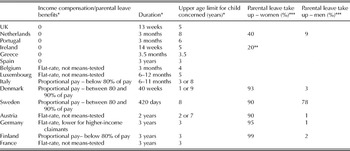
EU-15 counties vary as well with respect to financial support during parental leave. As the data in Table 2 reveal, the UK, the Netherlands, Portugal, Ireland, Greece and Spain have no parental leave benefits. On the other hand, in the Scandinavian countries and Italy the welfare state compensates 80 per cent or more of a parent's salary. The rest of the countries provide child caring persons with a flat-rate financial compensation. Leave is typically financed by a combination of payroll taxes and general government revenues, although some countries require direct employment contributions (Ruhm, Reference Ruhm1998).
Parental leave schemes in EU-15 countries

Notes:
Parental leave schemes – maximum statutory parental leave – full-time leave after birth of first child (not disabled or adopted) taken after maternity or paternity leave.
Sources:
*Math and Meilland (Reference Math and Meilland2004).
**Higgins (Reference Higgins2002).
***Wilkinson and Radley (Reference Wilkinson and Radley1997).
A universal scheme of parental leave that provides parents with universal parental benefits was introduced in Luxembourg in 1999, three years after the EU directive on parental leave. These delays were due to lengthy internal tripartite negotiations and, in particular, to the objections of employees’ and employers’ chambers (Feyereisen, Reference Feyereisen1998).
The parental leave has been designed as follows. After maternity leaveFootnote 4 has come to an end, an eligible parent may choose either part-time leave for 12 months or full-time leave for six months. Parental leave is granted to any parent receiving family allowances who takes care of a child under the age of five years, who spends most of their time on the education of a child or children and who is engaged at most part-time in paid labour during the parental leave period. Both parents are eligible to take parental leave under the condition that the first one takes it immediately after maternity leave. The second parent can then take it any time before the child reaches five years of age. During parental leave, the employment contract is suspended. The eligible parent is entitled to a monthly lump sum benefit that corresponds approximately to the minimum wage guaranteed in the country. The part-time form of parental leave is conditional on the employer's agreement and on a reduction of the professional activity by at least half. Non-resident workers, also called cross-border workers (i.e. people working in Luxembourg, but residing in one of the neighbouring countries, mainly Germany, Belgium and France),Footnote 5 who represent one-third of Luxembourg's labour force, are also eligible for parental leave (Hauret, Reference Hauret2008). The CNPF (caisse nationale des prestations familiales) (2006) data reveal that in 2002, almost half of the beneficiaries were cross-border workers.
According to the available administrative data (CNPF, 2006), which regrettably present only absolute numbers of beneficiaries without reference to the number of eligible individuals or give only rather general percentages, about 60 per cent of beneficiaries took full-time parental leave for six months, while the other 40 per cent took part-time leave for 12 months, and this pattern has remained stable over time. In 2002, the proportion of men taking parental leave was 19 per cent.
Parental leave take up and its determinants
Parental leave take up is one of the indicators of the implementation of the parental leave policy. It is mostly calculated by dividing the number of beneficiaries by the number of eligible individuals. The higher the percentage, the higher the take up and thus the response to the policy intervention, and consequently also a higher probability of the desired outcomes of the policy effort.
In the literature on the determinants of parental leave take up, we can find references to three groups of factors that may have an impact on parental take up: macro-, mezzo-, and micro-level factors. As this article focuses predominately on the analyses of the effect of micro-level factors, it is not possible to tackle all three groups of determinants in detail; nevertheless, we will mention at least the most important ones.
Among macro factors we can find, among others, country-specific gender regimes (i.e., arrangements concerning distinctive forms of division of labour between men and women) and the cultural values or attributes of existing parental leave schemes. For example, in more traditional/conservative societies, where housewifery is seen as a more appropriate status for women with children than being employed, it is more likely that women will withdraw from the labour market after child delivery or after parental leave just because it is considered ‘normal’ (Pfau-Effinger, Reference Pfau-Effinger2004).
It has also been shown in the literature (Hardy and Adnett, Reference Hardy and Adnett2002) that the design of parental leave schemes has influenced their popularity and usage among eligible individuals. Unpaid parental leave tends to encourage the ‘male breadwinner model’ because within a household it is usually the male partner who has a higher income than the female; thus, it is the female who will decide to take the leave to limit the household's income loss. In general, absence of compensation for income loss during parental leave leads to lower overall take up of parental leave. Flat-rate parental benefits might motivate people to take up parental leave more than unpaid leave; however, even this design often fails to narrow the gender gap in parental leave take up, especially if the benefits (compensation for income losses) are significantly lower than the parent's salary. Given this, eligible persons with higher income (usually males) may not be motivated enough to take parental leave. When parental leave is paid and benefits are income-related, the income-loss problems are minimised, and men as well as women are more motivated to be engaged in childcare.
Ruhm (Reference Ruhm1998) points out that despite the overall positive impact of parental leave on female employment following child delivery, a long parental leave may have some negative consequences for beneficiaries; for example, it may limit possibilities for accumulating work experience and human capital. This may then leave beneficiaries less attractive to employers or may lead to professional opportunity loss. Given this, individuals with high human capital, or working in a competitive work environment, may prefer not to take long parental leave to minimise these undesirable consequences.
At the mezzo level, parental leave take-up and post-parental leave behaviour depend on corporate culture and the willingness of employers to accept policies promoting reconciliation of family and professional life. The company level is essential for real implementation of work–life reconciling policies (such as parental leave), for some employers might implicitly discriminate against parental leave beneficiaries (Ruhm, Reference Ruhm1998).
The effect of key micro-factors such as age, marital status, presence of children, type of contract, supervisory position, occupation, educational attainment, wage and household income will be discussed in detail in the section dedicated to the hypotheses, as the present article focuses predominately on these factors.
Methodology and data
The main aim of this article is to answer the following questions: how many women who plan to have children in the near future would like to take parental leave, and do women who plan to take parental leave and those who do not differ significantly with respect to their socio-demographic and labour market characteristics?
The portrait of potential beneficiaries of parental leave provisions will be outlined in two steps. In the first step, bivariate associations between parental leave take up and selected socio-demographic and labour market characteristics of respondents are examined by using Chi-Square statistics and standardised adjusted residuals (Haberman, Reference Haberman1978). In the second step, binary logistic regression is employed to estimate the odds of ‘anticipated taking parental leave’ versus ‘anticipated not taking’ depending on relevant socio-demographic and labour market characteristics. The direct effects of selected individual characteristics can be investigated while confounding factors are controlled for.
The dependent variable in the regression model was derived from the question, ‘Do you foresee taking parental leave after the birth of your next child?’, which had four response categories: 1 = yes, 2 = no, 3 = I will stop participation in the labour market before delivery, 4 = I do not know. For the purposes of the present article (to measure anticipated take up and its micro determinants), this variable was dichotomised into two response categories. Response category ‘yes’ was attributed as value 1 and all other responses were re-coded as 0.
The analysis is based on the EU-SILC/PSELL3 data from 2003 concerning Luxembourg. The whole sample consists of 9,580 respondents residing in the country. However, analyses in this article are based on one module of the survey that was conducted on a subpopulation of 335 women who, at the time of the interview, were economically active,Footnote 6 who were younger than 40 years of age and who reported that they planned to have children in the near future. This subpopulation was chosen because, first, only these women were filtered in to answer a set of questions on anticipated parental leave take upFootnote 7 and post-birth labour market strategies;Footnote 8 and, second, these women best represent the population of individuals eligible for parental leave provisions in Luxembourg. The data were weighted by a design that corrects for different probabilities of selection by making the sample more representative of a true sample of individuals in the country.
The sample described above, and the hypothetical nature of the measurement of the parental leave take up, present certain limitations to our analysis that should be noted here. The fact that only women were interviewed in this module of the survey prevents us from comparing parental leave take-up rates between sexes. Another limitation is that the survey included only people residing in the country. This excludes from the analysis cross-border workers who, in fact, represent almost half of all beneficiaries of parental leave provisions paid by the country. Thus, the outcomes of our analyses can be generalised only to the female population of residents.
We could also argue that analyzing anticipated behaviour does not give a real picture of actual parental leave take up. It is true that findings based only on this type of information might not be the best predictors of actual behaviour. Anticipated behaviour might change over time, depending on personal, economic and societal circumstances. However, at the moment the data used in the study seem to be the best source of information for in-depth assessment of parental leave take up in the country. Existing administrative data are either not yet accessible, or they cover beneficiaries and not all eligible individuals (thus it is not possible to calculate take-up rates and compare between beneficiaries and non-beneficiaries), or they do not contain enough contextual variables to examine the effect of key socio-demographic characteristics. Even panel data are not very helpful. For example, the EU-SILC/PSELL3 panel traces individuals across time (from 2000 – i.e. a year after implementation of parental leave – until 2008), and provides information on individual labour market trajectories, including parental leave take up; however, the number of identified beneficiaries in the sample is too small to draw any reliable conclusions.
Hypotheses
The following presents the main hypotheses regarding the relationship between anticipated parental leave take up on the one side (dependent variable) and the selected socio-demographic and labour market characteristics of respondents on the other side (independent variables).
Since a large proportion of younger women prefers to work and a growing majority even puts career before motherhood (Esping-Andersen, Reference Esping-Andersen2002; Hakim, Reference Hakim1996), it can be expected that younger women in Luxembourg will follow this trend and will anticipate taking parental leave more than their older counterparts.
In countries with a corporatist welfare regime legacy, marriage and having children means that women are encouraged to withdraw from the labour market and profit from welfare state provisions as housewives and family caregivers. Thus, I assume that married respondents will be more likely to plan parental leave take up than unmarried/single respondents.
I expect that women who already have children will be more likely to take parental leave than will their counterparts who plan to have their first child. Following the existing evidence, which argues that Luxembourgish women are more often inactive in the labour market due to family responsibilities than are women of other nationalities (Valentova, Reference Valentova2005), it can be expected that Luxembourg nationals will be less likely to anticipate taking parental leave than residents of other nationalities. Special attention will be paid to Portuguese women who represent the largest national minority in the country and who exhibit stronger labour market attachment (higher labour market participation rates) than natives.
Human capital theory and theories dealing with an individual's costs of labour market withdrawal suggest that persons with larger human capital, higher earning potential and more stable jobs tend to withdraw less from the labour market due to family responsibilities (Becker, Reference Becker1975; Gauthier, Reference Gauthier2000; Desai and Waite, Reference Desai and Waite1991; Math and Meilland, Reference Math and Meilland2004). From this we can infer that women with a higher educational level, a higher hourly net salary, an indeterminate contract and an occupation higher up the professional ladder will be less likely to take parental leave and more likely to continue with their careers without taking parental leave.Footnote 9 It would be equally interesting to test the hypothesis that women in the public sector and in feminised occupations are more likely to take parental leave (Gornick and Jacobs, Reference Gornick and Jacobs1998; Bettio, Reference Bettio2002), but the dataset does not contain these variables.
As part-timers have, in general, lower monthly salaries and since the replacement rate of parental leave benefit is rather high (monthly parental leave benefit is approximately equal to a minimum salary and is independent of the salary and full- or part-time employment status of the beneficiary), I hypothesise that women working part-time will be more likely to take parental leave than full-timers, because taking parental leave will not represent a significant drop in their income.
Decisions regarding women's parental leave take up also depend on the labour market position and income capacity of other members of their households. Given this, I assume that the higher the level of total household income, the higher the probability of taking parental leave, because a drop in the woman's income would not mean a serious threat to the household budget.
It would be desirable to examine the effect of women's work–family preferences and their work-related attitudes on anticipated parental leave take up; however, the data used do not include variables that would allow these factors to be measured.
Results
By looking at their strategies after child delivery and maternity leave, we can see that 65 per cent of women of reproductive age who are active in the labour market and who plan to have children in the near future would like to take parental leave, 20 per cent of those women who anticipate having a child would not take parental leave, 14 per cent of women do not know yet and 1 per cent claim that they would withdraw from the labour market even before delivery.
The data reveal that out of those who would take parental leave, 61 per cent would opt for the full-time parental leave of six months, and the remaining 39 per cent would prefer the part-time option of 12 months. Of those women who do not anticipate taking parental leave, 86 per cent plan to re-enter the labour market immediately after maternity leave (i.e., two or three months after child delivery, depending on breast-feeding) and 14 per cent claim that they would quit the labour market.
Regarding the data on anticipated labour market strategies after parental leave, it is possible to conclude that 41 per cent of the women who would take parental leave would like to return to the same position they had before childbirth. Some 51 per cent of women would prefer to reduce their working time after their parental leave is finished. Reducing working hours for most of these women would mean shifting to half-time work, i.e. working 20 hours a week. Another 8 per cent of women plan to withdraw from the labour market entirely.
The outcomes of the bivariate analyses indicate that there is a statistically significant association between anticipated parental leave take up and nationality, age, marital status, occupation and type of work contract (Pearson Chi-Square test, p< 0.05). Portuguese nationals, women aged 35–40 years (i.e., the oldest category of women in our sample), women who already had children, married women and women having low or non-qualified jobs and undetermined contracts are statistically less likely to take parental leave (in the case of the aforementioned categories, standardised adjusted residuals were smaller than –2.)
In contrast, childless women (those who plan to have their first child), women 24 years old and younger (i.e., the youngest category in our sample), Luxembourg nationals, women employed in ‘medium-qualified’ or administrative jobs and women with fixed contracts exhibit a higher probability of benefiting from parental leave provisions (values of standardised adjusted residuals related to these categories were greater than 2).
Having provided a general description of women who anticipate taking parental leave, it is necessary to examine women who do not plan to take parental leave (20 per cent of our sample), for this group of women may be extremely mixed. Some of these women may not take parental leave because of a very strong labour market attachment, others because of a low attachment. The data reveal that after child delivery, 72 per cent of these women would like to continue working, 18 per cent would reduce their working hours and 10 per cent would withdraw from the labour market for some time. Among those who would go on working, 53 per cent would not take parental leave because they could not imagine staying for some time without professional activity (voluntary non-take up), 37 per cent state that it would not be financially possible to take the leave (involuntary non-take up) and 5 per cent that even if it would be financially possible to take parental leave, they would not wish to reduce the living standards of their household. Thus, among women clearly stating that they do not anticipate taking parental leave we find rather mixed profiles: more than a half of them exhibit a strong labour market attachment (voluntary non-take up), while about 40 per cent of them justified non-take up by the financial situation of their household (involuntary non-take up).
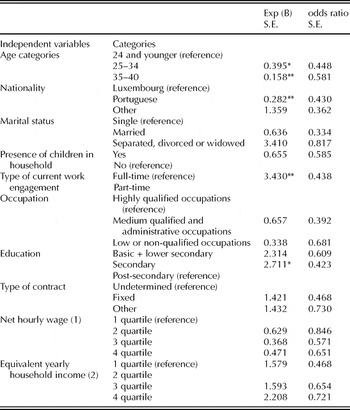
From the binary logistic regression (see Table 3), we can conclude that while controlling for all other variables in the model, age turns out to be one of the most important predictors of hypothetical parental leave take up. The older the women interviewed, the lower the likelihood of anticipating parental leave take up. Women currently working part-time are significantly more likely to anticipate parental leave take up compared to those working full-time. Respondents with a secondary education have higher odds of planned take up than those who have obtained a post-secondary education. These findings are, in general, in line with our hypotheses. Contrary to expectations, Luxembourgers are more likely to take parental leave than are Portuguese nationals. This can arguably be explained by the fact that in this study we considered mainly young women, who exhibit more progressive attitudes toward female participation in the labour market, while our hypothesis was based on the overall population of women. While, in relation to the hypotheses regarding marital status, presence of children, personal hourly wage and household yearly income, the direction of these effects corresponds to the hypotheses, they were not confirmed at a statistically significant level, with the exception being the variable concerning occupational hierarchy.
Binary logistic regression: the effect of individual characteristics on anticipated parental leave take up

Notes:
EU- SILC/ PSELL3 data 2002/2003, own analysis, N = 306.
*significance at the 0.05 level, **significance at the 0.01 level.
Model properties: –2Log likelihood = 330.8, Negelkerke R Square = 0.24, Hosmer and Lemeshow Test = 0.18
(1) Original continuous variable has been categorised into quartiles.
(2) Equivalent yearly household income is based on the net total household income from 2002, which is multiplied by the OECD coefficient controlling for household composition. The variable has been categorised into quartiles.
Conclusions
The principal goal of this article was to examine how the national parental leave scheme is accepted by women of reproductive age in Luxembourg, a country with a familialist and corporatist welfare legacy. In concrete terms, the article aimed to describe anticipated parental leave take up and to explore which individual socio-demographic and labour market characteristics determine parental leave take up so that potential beneficiaries of the provision could be identified.
The outcomes of the analysis reveal that 65 per cent of economically active women who would like to have children in the near future anticipate taking parental leave. When this figure is compared to the aforementioned female parental leave take-up rates in other European countries, it becomes apparent that Luxembourg lags behind Sweden, Austria and Germany, where female take-up rates reach 90 per cent. On the other hand, the anticipated female parental leave take-up rate in Luxembourg is twice that in the Netherlands and four times higher than in Ireland.
The vast majority (92 per cent) of women who intend to take parental leave plan to rejoin the labour market afterwards. This finding suggests that young Luxembourg women perceive parental leave as not inhibiting their further participation in the labour market; even if they choose to reduce their working hours, they do not perceive parental leave as a step toward withdrawing from the labour market. Thus, one of the objectives of parental leave appears to be met.
Broadly, the data from the labour market strategies that women plan to adopt prior to or after confinement suggest that only 9 per cent of young female Luxembourg residents active in the labour market who anticipate having a child in the coming years would withdraw from the labour market due to childcare (1 per cent of these would withdraw from the labour market before birth, 31 per cent after maternity leave and 62 per cent after parental leave). This confirms that young women value employment and that only a rather small proportion of young women consider labour market inactivity due to childcare to be an acceptable strategy. The availability of parental leave plays an important role in this process, leading towards a stronger attachment of women to the labour market.
With respect to the effects of the selected socio-demographic and individual labour market characteristics on parental leave take up, it can be concluded that age, educational attainment, current type of work engagement and nationality significantly influence parental leave take up. Luxembourg nationals, women with secondary education, younger women and women working part-time are more likely to anticipate taking parental leave than are Portuguese women, women with post-secondary education, older women and full-time workers.
It should be noted that women who do not plan to take parental leave are a rather diverse group, consisting of those women with a strong labour market attachment, on the one hand, and women who cannot financially afford to take parental leave. Thus, further detailed analyses allowing and controlling for the level of labour market attachment and distinguishing between voluntary and involuntary non-take up would be desirable.
This article is one of the first attempts to assess the parental leave scheme in Luxembourg; however, it focuses only on anticipated parental leave take up. Further research based on objective indicators of parental leave take up is needed to obtain a more accurate evaluation of outputs and outcomes of the parental leave scheme in the country. This will be possible when administrative panel data are made available.