Introducing Re-Orientalism
Almost three decades ago, Edward Said identified and articulated the processes of Orientalism, the relationship of power and dominance where the Oriental was submitted to being made the Oriental. As illustration of the concept, Said used the example of Flaubert's encounter with an Egyptian courtesan, “which produced a widely influential model of the Oriental woman; she never spoke of herself, she never represented her emotions, presence, or history. He spoke for and represented her. He was foreign, comparatively wealthy, male, and these were historical facts of domination that allowed him not only to possess Kuchuk Hanem physically but to speak for her and tell his readers in what way she was ‘typically Oriental’” (Said Reference Said1978: 6). Said's argument was that Flaubert's situation in relation to Kuchuk Hanem illustrated a parallel situation to that between the Occident and the Orient.
Orientalism has long been evident in the literature written about South Asia from the days of colonialism, which began with non-South Asians writing and representing the Indian Sub-Continent and its people. However, even in contemporary South Asian literature in English by South Asians, the process of Orientalism can be seen to be still occurring. The curious development over these few recent decades is that Orientalism is no longer only the relationship of the dominance and representation of the Oriental by the non-Oriental or Occidental, but that this role appears to have been taken over (in part at least) by other Orientals, namely, the diasporic authors. This process of Orientalism by Orientals is what I will be terming as ‘Re-Orientalism’ for the purposes of this article, which is the same relationship of the powerful speaking for and representing the other, who is all but consigned to subalternism. In Re-Orientalism, we have the curious case in which the positionality of the powerful is simultaneously that of the insider and outsider, where the representing power can be simultaneously self and other.
Because diasporic writers are based mainly in the Occident, some may regard this simply as Orientalism, as it has ever been, but I would argue that there has been a difference, because these diasporic authors can be identified as Orientals to some extent, culturally, ethnically, etc. They are not completely alien to the Orient, but derive both ancestry and identity from the Orient (and indeed many have very immediate and strong links to the Orient). However, they are located outside of the Orient, and relative to the writers based within South Asia, diasporic South Asian writers are in a position of power and dominance, particularly where the issue of literary representation and image construction is concerned.
Even the most cursory of observations will note the dominance of this literary sub-genre by the diasporic authors, which, for working purposes, we can designate as those based outside South Asia. In a previous article, I have already argued that apparently “. . . it is predominantly the diasporic women writers who are the creators and keepers of the global literary image of South Asian culture, and this trend looks set to continue” (Lau Reference Lau2005: 238). In terms of sheer numbers, not to mention visibility and accessibility, the output of the diasporic authors simply overwhelms that of the home authorsFootnote 1 (those writing from within South Asia), and in the literary arena, the very positionality of these diasporic authors has enabled them, voluntarily or otherwise, to re-orientalise.
This issue is an increasingly sensitive one, as can be seen from Perera's volatile response to Salgado's article about Sri Lankan writers; Salgado is quoted as having said, “Their [migrant writers'] residence in metropolitan centres and access to Western publishers gives them an international readership and the potential for publicity that is the envy of their counterparts in Sri Lanka . . .” (Salgado Reference Salgado2004: 6). Perera's tart response is that “Sri Lankan writers are not necessarily ‘envious’ of their expatriate counterparts' success . . . but they are justifiably aggrieved when those whose artistic integrity is occasionally compromised because they have become pawns of the publishing industry are given undue prominence. The manner in which Salgado has constructed the above sentence and its tone suggests (perhaps unintentionally) that she is in some way amused by the Sri Lankan writers' apparent discomfiture” (Perera Reference Perera2005: 241). The testiness of Perera's response indicates fairly strong undercurrents of dissatisfaction and even indignation over the disadvantageous or adverse positionality of home writers relative to their diasporic or expatriate counterparts.
Re-Orientalism is perhaps, in part, an extension of the totalisationFootnote 2 that had always been present in the literature, imposing the culture, values, attitudes, etc., of a select minority as representative of the diverse majority. This article focuses on the sub-genre of contemporary South Asian women's literature in English to illustrate my points. The reins of dominant representation may have shifted hands from the foreign, male subject to the diasporic, semi-Oriental female, but the Orient continues to be orientalised. It is exactly as Said explained that “Orientalism depends for its strategy on this flexible positional superiority . . . in a whole series of possible relationships with the Orient without ever losing him the relative upper hand” (Said Reference Said1978: 7). Re-Orientalism observes that while this ‘him’ can be taken on by different parties, the relationship of unequal power relations has not changed.
At this juncture I must add that it is not my contention that the diasporic authors necessarily have any insidious intention, or consciously conceived aim, to re-orientalise, but that it is precisely their positionality, both individual and collective positionality, that has rendered this process of Re-Orientalism so widespread as to be almost inevitable in the genre.
Nevertheless, intentional or otherwise, representations of South Asia, of South Asian culture, and particularly of South Asian women by the women writers – representations which emphasise and explore the sensitivities, mindsets, expectations, characteristics of South Asian women – are being largely created from without South Asia by the diasporic writers, and imposed upon South Asia as representative of their identity, or at least, a significant part of their identity construction.
Culturally and socially speaking, the problem of representation has always been one which has plagued this region, from the regional scale to the local. India's neighbours have feared the cultural dominance of India, and Indians themselves have felt threatened by the linguistic, cultural, religious dominance from various subgroups and communities. Meenakshi Mukherjee articulated her fear of the erasure of the diversity of India, identifying the threat as coming from “the category of writers called ‘The Third World Cosmopolitans,’ who are globally visible, who are taught in postcolonial classrooms the world over, and who are hailed in the review pages of Western journals as interpreters and authentic voices of the non-Western world [who] hardly ever include a writer from India who does not write in English” (Mukherjee Reference Mukherjee2000). Apart from the issue of India's multi-lingual literary heritage, even if we are considering only the literature written in English, Mukherjee would still have cause to be concerned that it may still be the case that those taught in postcolonial classrooms the world over, hailed and feted by the Western world as interpreters and authentic voices, may still not include a writer from within South Asia.Footnote 3
This is not to suggest that diasporic authors are all inaccurate and write distorted depictions; indeed, world literature owes some of its excellent pieces to very great South Asian authors who happen to be diasporic authors: Anita Desai, Amitav Ghosh, Rohinton Mistry, V. S. Naipaul, Michael Ondaatje, Salman Rushdie, Vikram Seth, to name but a few. However, this article focuses on the most recent developments, over the last 5 years, in the English literature produced by South Asian women writers, and an interesting, if slightly disturbing, trend seems to be emerging.
This article begins by identifying some of the patterns in the recent publications of South Asian women's writing, and proceeds to discuss some problematic trends emerging in this sub-genre which further muddy the already-troubled waters of representation and authenticity.
Analysis of Recent Trends in South Asian Women's Literature
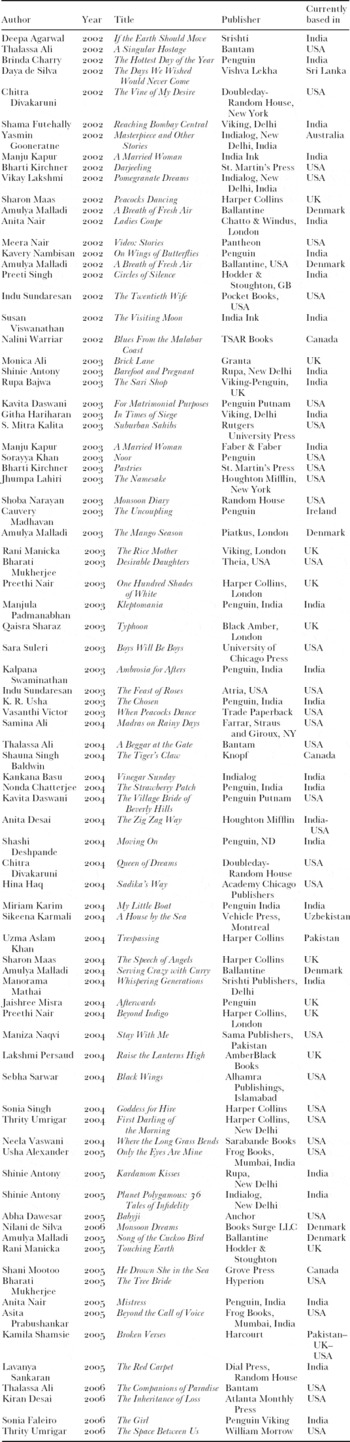
This section analyses the publication of literature written in English from 2002 to 2006 (Table 1).
South Asian Women's Fiction 2002–2006

This table does not attempt to be a comprehensive list of all the writings in English by South Asian women in the last half decade, but it does compile a fair representation of the publications that are fairly well known, discussed on Internet forums and sites, and at least reasonably accessible, available either online and/or in major booksellers in the United Kingdom. The intention of a quick perusal of such a table is to observe trends, not attempt to produce statistical evidence.
It is not possible to classify in a black and white manner as to which authors are diasporic, which are sojourner authors,Footnote 4 and which are home authors, but the right-most column on the table informs us as to where the author is (currently) based. In many cases, these diasporic authors are first-generation diaspora, who have been born, bred, even educated in South Asia before migrating abroad for studies and/or career purposes. Only in a very few instances are these authors of the second generation of diasporic South Asians.
The most obvious trend to be observed over these last 5 years is the consistent one that the diasporic authors are continuing to easily outnumber the home authors, in some cases, by quite a large margin. Their dominance on the literary scene of this sub-genre is unmistakable and undeniable, not only in terms of the weight of numbers, but also in terms of distribution, promotion, marketing and availability of their writings. In some cases, such as in 2004, the ratio of diasporic authors to home authors seems overwhelming; of the twenty-four authors listed in 2004, only six are based in South Asia (five in India and one in Pakistan), with the majority of the diasporic authors seeming to be based in the United States.
Not only are the South Asian–based authors in clear minority, the higher profile books are more likely to be the diasporic ones, which are simply better marketed, more widely distributed and generally available in major booksellers, and consequently, better known. Penguin IndiaFootnote 5 has been responsible for bringing many of the home authors' works to global attention (or at least to global accessibility) and introducing new authors to the reading public, intentionally giving opportunities as they do to debut writers. Were it not for Penguin India, this table would contain significantly fewer home writers than it already does.
Amongst the home authors, Indian authors were prevalent, with Pakistani authors (or authors of Pakistani descent) beginning to come to the fore more than ever before, and just within this list, there are over half a dozen: Thalassa Ali, Hina Haq, Sorayya Khan, Uzma Aslam Khan, Kamila Shamsie, Qaisa Sharaz, and Sara Suleri. The significant presence of Pakistani writers in the recent years would reward further research, but the case nevertheless remains that even though there may be some new strengths emerging amongst the home authors of non-Indian descent, only one of these Pakistani authors (Uzma Aslam Khan) is actually based in Pakistan. (Shamsie is based in Pakistan, the United Kingdom and the United States, making her perhaps more a sojourner author than a diasporic author.) The others are diasporic authors, with five of the seven listed here currently based in the United States.
Another trend we could observe from this table is that a fair number of these authors are producing books quite prolifically, even within this short period of less than 5 years, many have written two or more books: Shinie Antony publishing in 2003, and two books in 2005, Amulya Malladi also publishing three novels in 2002, 2003, 2005, and a good number of authors managing two publications in this 5-year period: Anita Nair (Reference Nair2002, 2005), Thrity Umrigar (Reference Umrigar2004, 2006), Chitra Divakaruni (2002, 2004), Indu Sundaresan (2002, 2003), Thalassa Ali (2002, 2004), Kavita Daswani (2003, 2004), Rani Manicka (2003, 2005), Bharati Kirchner (2002, 2003). These, of course, do not include those with other publications also appearing close on the heels of others prior to 2002. This may indicate a remarkable demand for more in this sub-genre which the publishers are trying to supply, and apparently from a relatively limited pool of authors.
The list contains a reasonable combination of ‘old-timers’ like Anita Desai, Shashi Deshpande, Bharati Mukherjee, who have been publishing steadily for several decades, and of debutants, Samina Ali, Brinda Charry, Lavanya Shankar, and others. This indicates that there is space and opportunity for development in this sub-genre, but the significant fact is that most of the space and opportunity is currently being occupied by diasporic writers.
The clear trend of the diasporic authors having dominance in numbers is in itself a matter of interest rather than concern, but the consequences of this trend may well be that not only have diasporic authors taken on the construction and representation of South Asian women's identity on the global literary arena and skewed the portrait, but that the sheer weight of their presence and volume of their voices may be gradually relegating the home authors ever closer to subalternism. It can hardly be thought that there are simply more and better South Asian women writers in the diaspora than there are to be found within South Asia, but clearly some writers are geographically better located to have access to publication of literature written in English, and thus, by virtue of their positionality, are able to re-orientalise South Asia.
As said before, many diasporic South Asian authors have in the past made valuable contributions to the body of South Asian literature in English, but the remainder of this article focuses on analysing the problematic techniques of some South Asian women writers, who have in recent years employed writing techniques which are particularly insidious in the process of Re-Orientalism, and which provoke the rise of its negative effects. And, what are these negative effects? They are not far different from the problems Said identified with Orientalism: “My fears are distortion and inaccuracy, or rather the kind of inaccuracy produced by too dogmatic a generality and too positivistic a localized focus” (Said Reference Said1978: 8).
The Problems of Re-Orientalism
Ironically, although as can be easily seen, in terms of sheer numbers and availability, diasporic writers overwhelm this writing scene, in many cases, diasporic literature displays internal insecurities, particularly over self-identity. Diasporic authors are, of course, having to negotiate the hybridity of their cultures, the multiplicity of their attachments and allegiances, “obliged to deal in broken mirrors, some of whose fragments have been irretrievably lost”, as Rushdie (Reference Salman1983: 76) notes. “Shaken about the globe, we live out our fractured lives. Enticed or fleeing, we re-form ourselves, taking on partially the coloration of our new backgrounds. Even our tongues are alienated and rejoined – a multiplicity that creates richness and confusion” (Seth Reference Seth2005: 403). The fragmented nature of the definition of self, the nostalgia, the learnt chameleon abilities, the sense of looking back or referencing a distant place, of being strangers in a strange land whether they are in the East or West, has naturally led a number of diasporic South Asian women writers to be notably prickly concerning the thorny issue of authenticity.
Some deal with this issue constructively, seeking to learn, requesting that their manuscripts and ideas be double checked, asking local residents of South Asia whether they have described and represented rituals, traditions, cultural and regional practices accurately and as they currently stand, in sum, looking to expertise from within South Asia to provide confirmation, and in a sense, further authentication. There are others which simply sidestep this issue and regard it as no issue at all.
However, there are still others who employ techniques in claiming authenticity, which result in adverse effects, because these techniques seek less to negotiate and tease out the complications and nuances of identities, than to stridently depict South Asian women and culture oversimplistically, stereotypically, and often sensationally. They are perhaps those who play to the gallery and target a readership that, they comfortably suppose, has little or no knowledge of South Asian customs and cultures. It is these techniques which re-orientalise the genre of South Asian literature in a particularly heavy-handed manner, which I identify as being problematic, contributing as they do to distortion and inaccuracy, and indeed, the kind produced by “too dogmatic a generality” and “too positivitistic a localised focus” (Said Reference Said1978: 8).
Not all methods of Re-Orientalism are necessarily damaging ones in terms of representation even if they do reinforce the dominance of a certain group, but in terms of contemporary diasporic writings (English) by South Asian women writers, there are a few troubling trends emerging that could, if they became too prevalent, seriously distort the representations in a way which could be harmful to both genre and the wider identity and image construction of South Asian women.
The remainder of this article therefore focuses on three characteristic problems within contemporary diasporic South Asian women's literature, each of which exacerbates the damaging processes of re-orientalising.
The First Problem: The Necessity of Being Recognisably South Asian
One common distortion of the images constructed by diasporic South Asian women writers occurs because of the overemphasis on being South Asian, and the almost rigid depiction of adherence of fictional South Asian characters to traditional ideals associated with South Asia. It is almost as if in an attempt to over-compensate and pre-emptively defend accusations of not being a ‘real’ South Asian, plotlines, narratives and characters in writings by quite a number of diasporic South Asian women writers are under pressureFootnote 6 to demonstrate so-called recognisably ‘South Asian characteristics’. This is in stark contrast to the literature by home South Asian writers, where the South Asian context just happens to be the background, the setting in which the narrative just happens to occur, rather than being the reason for the narrative in a deterministic fashion.
To take an example by way of illustration, I will discuss and compare two contemporary novels: the first by Anita Nair, an Indian author based in Bangalore, and whose Ladies Coupe was published in 2001, and the other by a diasporic Indian author, Amulya Malladi, who published The Mango Season in 2003.
Ladies Coupe is almost a montage of short stories. It begins with a protagonist who wishes to change her life completely, and begins by making what is, for her, an unusual journey alone, from her home in Bangalore to Kanyakumari. In the course of the long train journey, the protagonist meets five other women who ride in her carriage. These passengers tell their life stories to one another, and this sets the protagonist contemplating her own life. The six women come from various different situations and walks of life – some are married (with varying degrees of happiness), some are mothers, one is still a schoolgirl, most of them are middle- or upper-class women, but one of them is poor and uneducated. Nair provides her reader with a range of women and a spectrum of different stories and experiences. The fact that they are all Indian women does not prevent them from having very diverse lives and fortunes from one another, and also from having private and even secret lives. In fact, they merely seem to happen to be Indian women, and while this identity colours their experiences, it in no way determines them, let alone reducing the range of their experiences.
This is diametrically different from Malladi's The Mango Season, which on the very first page, in its prologue, we read, “Even though I was raised in a society where arranged marriage was the norm, I always thought it was barbaric to expect a girl of maybe twenty-one years to marry a man she knew even less than the milkman . . .” (Malladi Reference Malladi2003: 1). It is revealing that the author feels the need to explain that “arranged marriage is the norm”, an explanation one would seldom, if ever, come across in the writings by home Indian writers, where if something is the norm, it is hardly necessary to highlight it any further. This explicit and deliberate explanation of cultural norms is one of the defining characteristics of diasporic writing, and one of its most distinctive features. It is also one of the reasons why diasporic writing so often comes across as rather heavy handed.
The Mango Season is about an Indian girl who had been studying in the United States for 7 years, and at the late but still marriageable age of 27, is engaged to an African American man. The plot focuses on her returning to her home and family in India to break this news to them, news which she dreads will come as a blow to a family of Telegu Brahmins living in Andhra Pradesh, who want to marry their family members to others of the same caste, from the same state, and also Telegu speaking. The entire story and the life of the protagonist is apparently centred around the fact that she is Indian, with all the non-negotiable cultural baggage that being an Indian girl is made out to bring. The Re-Orientalism of this novel seems motivated by the need to make the protagonist and her family recognisably Indian and displaying ostentatiously Indian behavioural traits, such as being completely intolerant of their daughters marrying outside race and caste. Like all stereotypes, this depiction contains partial truths but omits significant conditions, subtleties and differences. The constant rehashing of a handful of stereotypes which supposedly accord with the expected representation of Indians is part of the damaging workings of Re-Orientalism as practiced by a fair number of diasporic South Asian women writers.
In both these novels, the protagonists are depicted as wishing to break the mould, wanting to do things which are conventionally frowned upon but which they are convinced would bring them individual happiness. In both stories, the protagonists take this step, and encounter various forms of protests and dismay and anger from family members, but the difference is in how this is portrayed. Ladies Coupe told a realistic and engaging tale of humans interacting and conflicting, whereas The Mango Season sensationalised the ‘defiance’, depicted the cultural conventions as insurmountable barriers, and placed the notion of ‘Indian culture’ at the centre of the conflict, as the reason for the conflict. This implicit insistence on there being such an entity as ‘Indian culture’, and moreover such a rigid, fixed, definitive one, is exactly the over-dogmatic generality Said wrote of, but nevertheless a fairly common representation of India and Indians as imposed on them by diasporic Indian women writers.
The Second Problem: Generalisations and Totalisations
A second and oft-occurring problem with the writings of diasporic South Asian women writers is the inclination to generalise with totalisations, sweeping statements appearing more the norm than the exception. For example, in her short story “Stop the Insanity”, Bella Mayani writes, “Coming from a generation in which you are in purdah till the wedding night and then become a servant for his family and less than human for your husband . . .” Another such example by Qirone Adhikary reads, “Being excitable, passionate, tempestuous – in a word, Bangali [sic] – she starts telling her story, interspersed by sobs, hyperventilation, hysteria, hair-pulling and chest-pounding.”
These generalisations serve to reinforce fables and stereotypes of Indian women being bound in perpetual servitude, and Indians as a race being hysterical and histrionic people. In making such statements, some diasporic South Asian women writers are seen to be propagating certain cultural images, implying and sometimes quite explicitly, that may apply only in a certain section of society, is in fact the norm in the wider South Asian community. In circulating stereotypes, pandering to clichés, carelessly totalising, writers like Mayani and Adhikary play a role in providing skewed and/or misleading information on South Asian, re-orientalising in damaging ways.
It is probable that this negative re-orientalisation by diasporic South Asian women writers via sweeping generalisations and thus glaring inaccuracies not to mention painful distortions may not entirely be with the cold commercial intent of exoticising in order to increase sales, nor even to brandish their colour and ethnicity as trophies. Being themselves in the less-than-comfortable position of constantly re-negotiating their own identities, these writers may have an unwritten agenda to simultaneously claim insider knowledge (and status), while somehow distancing themselves enough to claim the position of knowledgeable representative or emissary.
These diasporic writers wish to claim that they have the best of both worlds, implicitly offering themselves to a western readership as a guide and translator of South Asian customs, wishing to gain credibility as having authentic accounts to impart, but not wanting for a moment to be confused with being a local South Asian. To secure the latter end, rather simplistic strategies tend to be employed, such as firmly demonstrating a criticism of backward traditions and patriarchal oppressions, and equally firmly demonstrating a love of what is regarded as western ideals of equality, individual autonomy, freedom of speech, etc.
The Third Problem: Truth Claims
It is increasingly common in the last decade for South Asian women writers, both home and diasporic ones, to write novels blurring the boundaries between fiction and autobiography. In itself, this technique is not one which necessarily adversely impacts the process of Re-Orientalism. Authors such as Manju Kapur (Difficult Daughters, Reference Kapur1998), Manjula Padmanabhan (Getting There, Reference Padmanabhan2000), Thrity Umrigar (First Darling of the Morning, Reference Umrigar2004) have written thoughtful and sensitively handled stories drawing richly from their own lives, and, in thus doing, have stretched the genre to include some exciting new spaces.
However, there are a number of diasporic authors who have employed the blurring of boundaries between fiction and autobiography in exploitative ways, enabling a very skewed representation to be mainstreamed by virtue of possessing a ‘truth claim’. A ‘truth claim’ is the case of an author writing a tale that very closely resembles his or her own life-story, a tale which usually glorifies and justifies the actions of the protagonist, but a tale which is written under the guise of being fiction. Some writers even go so far as to issue vociferous disclaimers to the effect that this is not biographical writing although the plot corresponds extremely closely to their lives. So while the writing remains ostentatiously fiction, it can implicitly claim a larger degree of authenticity and validity through the closeness of personal experience. (This closeness of personal experience is made known to the reader, who is given enough information to easily notice the resemblance between the author's biography and the fiction.) The staking or establishing of this truth claim, even though implicit, renders the representation more powerful and influential than is proportionate, further contributing to the distorted representation of South Asian women, further re-orientalising.
In this section, I will use two examples to illustrate cases of diasporic authors making ‘truth claims’. These two instances are also cases in which the writing deliberately increases the chasm between ‘the West’ and India, further relegating India into the position of ‘the other’, further compelling Indian culture into ‘otherness’.
The first is example is Jaishree Misra's writings, author of Ancient Promises, Accidents Like Love and Marriage, and Afterwards. Misra is a Keralite who grew up in an army family in Delhi, and who in her own words, “did fall in love at seventeen . . . lost my teenage sweetheart to an English University and arranged marriage.” After a 10-year period of silence, Misra met her sweetheart “in circumstances not dissimilar to those described in the book [Ancient Promises], effectively ending my marriage”. Misra has a daughter with a learning disability. She moved to England when she was 32.
Ancient Promises, Misra's debut novel published in 2000, tells Janaki's story; a Keralite who grew up in Delhi with what was seen as modern western social influences and a relatively ‘free’ lifestyle. At 17, Janaki who fell in love but elected to give up her love relationship in order to please her parents and also because her boyfriend intended to go abroad to study at an English university. Janaki's loving parents arranged a prestigious marriage for her with a ‘traditional’ Keralite, an arrangement that would require her to reside in a joint-family system and to interact in a culture and language relatively alien to her. The story unfolds predictably enough that Janaki becomes an unhappy daughter-in-law and wife, and although not abused or deprived by her husband or in-laws, she is emotionally unfulfilled, socially alienated, and feels unappreciated and unwanted. When a mentally handicapped daughter is born to her, Janaki grows more defiant of her in-laws and resolves to take her daughter away to a country where facilities for her care and education are better. Coincidentally discovering her ex-lover now works in England, Janaki leaves her husband to join her lover and eventually, after a struggle, manages to take her daughter with her to start a new life in England with her ex-lover.
The reader can hardly help but be aware that the plot closely echoes Misra's own life story, especially since the novel includes a few paragraphs in ‘Author's Note’ describing Misra's life.
Misra states, “I am not Janu [Janaki's nickname], just as no character is ever the one it is based on.” This seems an inadvertent admission that Janaki was at least based on Misra's own character. She also claims, “While I had, obviously, a husband and in-laws in my first marriage, I wish to state quite clearly that they bear no resemblance to the corresponding characters in the book.” The interesting thing to note in this disclaimer is the phrase “corresponding characters”, rather than just ‘characters’.
Questions will invariably be raised as to how Misra's ‘corresponding character’, Janaki, was handled in the novel, and with what intentions. Were Misra's vindication and defense of Janaki's actions and choices a deliberate vindication and defence of her own?Footnote 7 On being asked how much of her story was true, Misra apparently “took refuge in the non-committal reply” that her novel was “semi-autobiographical” (Misra Reference Misra2000: 307). Misra writes that as a new novelist, the truth was something she did not “especially wish to be bothered with”. She thought it “mundane, restrictive” and discovered fiction was “quite simply much more fun” (Misra Reference Misra2000: 307). Misra appears to reject responsibility for the biographical elements in her writing by simply disclaiming and denying it. Simple rejection of her originally held ethics and responsibilities also appears to be Janaki's method of dealing with life; ‘corresponding’ perhaps, to her author's method?
Remarkably, Misra uses the plot of her life story not only in one of her novels but in yet another. Afterwards, published in 2004, begins with broadly the same plot and characters as Ancient Promises. In Afterwards, the story begins with a young Indian man from England who goes to stay in India for a short period of time, becomes greatly attracted to his neighbour, Maya, a lovely young woman with a mentally handicapped daughter, and whose husband largely neglects her. The young woman runs off to England with Rahul, the protagonist, bringing her daughter with her in hope of giving her daughter a better future in a country where her disability could be better addressed. The desertion of her husband, marriage, and life in India by Maya is portrayed in the same rose-tinted manner as Janaki's desertion and adultery. The rest of Afterwards deals with the events following the sudden death of Maya, the young woman, in a car accident, and how Rahul deals with her passing, and with the daughter who survives her.
Misra is not the only diasporic South Asian author to employ this technique of blurring fact and fiction in an insidious manner. Nilani de Silva is a diasporic Sri Lankan author who has just published her debut novel, Monsoon Dreams, in which the life of the glorified heroine closely resembles de Silva's own life experiences. Nilani de Silva grew up in Sri Lanka, did her master's degree in England, and now lives in Stockholm with her husband and three children: one daughter and two sons. This information is provided on the back cover of her book along with her photograph.
The protagonist of Monsoon Dreams, Anushka, also grew up in Sri Lanka. Anushka goes to the United Kingdom without visa or destination for her trip, is put in a detention camp for 3 weeks, and deported back to Sri Lanka. She then goes back to the United Kingdom a few years on (having thrown away her passport with “Deported” stamped in it and acquired a new one) to do a master's course in Leicester University. The novel's concluding chapters tell us that Anushka meets a Swede, gets married, moves to Sweden to live, and has an apparently perfect family life with her husband and three children: one daughter and two sons. de Silva concludes the novel with Anushka flying back to Sri Lanka with her husband and children, and, after being cast out, ostracised and despised by her Sri Lankan friends and family for two decades, she is welcomed back with open arms and apparent delight, and she is feted and admired universally – no explanations are provided.
Presenting semi-autobiographical stories as fiction, with their implicit truth claims, confers validity and authenticity on stories which may not be representative, adding to the distortion of the portrait being collectively painted of Indian culture and Indian women's lives by the diasporic writers. The Re-Orientalism in these cases is particularly insidious because South Asia is always placed in juxtaposition as not only The Other, but practically ‘The Opposite’ of the West, emphasising the exotica elements of South Asian culture. These diasporic authors, using their semi-autobiographical fiction, speak for and present a South Asia which they lay claim to have insider knowledge of, re-orientalising South Asian society and consigning it to an increasingly subaltern position.
Concluding Thoughts
It is a slightly curious situation which has arisen that inheriting a legacy of Orientalism, Orientals should then themselves be guilty of perpetrating Orientalism. Said already noted that even Orientalism in the past had not been without the consent of Orientals, nor were Orientalists all Westeners, but active and widespread Re-Orientalism is a relatively recent development, at least on the literary scene in the South Asian genre. Said noted that “Each age and society recreates its ‘Others’” (Said Reference Said1978: 332), and it seems in this age that the body of diasporic South Asian writing is at least partly responsible for Re-Orientalism, for continuing to keep the Orient as ‘The Other’. This is one of the salient differences between the writings of diasporic and home South Asian women writers that this sense of ‘othering’ South Asia is usually notably absent from the productions of the home authors.
This article does not seek to point the finger of accusation at all diasporic South Asian women writers, and indeed there are some who far from re-orientalising, have actually knit the different elements of two seemingly opposing cultures onto a single and wider framework. Moreover, it is also understood that diasporic authors necessarily have different concerns from home authors, consequently different themes in their writings, for after all, “A theory or idea that travels to different contexts get partly or fully accommodated or incorporated, and is ‘to some extent transformed by its new uses, its new position in a new time and place’. . . transformed by the reception context, their meanings, reproduced and reshaped to fit local agendas” (Amireh and Majaj 2000: 3).
Diasporic South Asian women's writings which frequently discuss the negotiation of a hyphenated identity, feeling as Lahiri puts it, “intense pressure to be . . . loyal to the old world and fluent in the new, approved of on either side of the hyphen” (Lahiri Reference Lahiri2006), may be more conducive to understanding the diasporic search for and construction of identities, and the balancing of hybridities and multiple realities, than as a representation of South Asia or South Asian women.
However, the influences on and preoccupations of diasporic writing have resulted in much of this literature insistently setting up South Asia and ‘the West’ as binaries. The presence and voices of diasporic South Asian women writers have been so dominant within the genre that in terms of how South Asia is constructed in narrative, it continues to be set in opposition to ‘the West’, thereby locking both into stereotypes, continuing to define the Orient relative to the Occident, in a word, to Re-Orientalise. At its worst, this has resulted in skewed, distorted and dogmatically generalised representations of South Asia, its culture and its women's positionalities in particular.
It is somehow mildly ironic that when the opportunity arose to move away from Orientalism, the direction some diasporic authors have chosen to move in is Re-Orientalism.