Sirex noctilio Fabricius (Hymenoptera: Siricidae) is an introduced woodwasp recently detected in Pinus Linnaeus (Pinaceae) trees in eastern North America (Hoebeke et al. Reference Hoebeke, Haugen and Haack2005; de Groot et al. Reference de Groot, Nystrom and Scarr2006). Its presence in North America is of great concern because, unlike our native species of woodwasps, it attacks and kills living pines, albeit more typically those that are already physiologically stressed (Neumann and Minko Reference Neumann and Minko1981; Dodds et al. Reference Dodds, de Groot and Orwig2010). Another reason for this concern is that S. noctilio has caused considerable economic impact in countries of the Southern Hemisphere, where it has been accidentally introduced on exotic pines (Bedding and Iede Reference Bedding and Iede2005).
Ground surveys are an effective method for detecting trees infested by S. noctilio in the early stages of establishment (Haugen et al. Reference Haugen, Bedding, Underdown and Neumann1990). In the Southern Hemisphere, visible symptoms include resinosis, the tree's defensive response to the wasp's oviposition activity, and needle chlorosis and/or wilting; signs include round exit holes 3–7 mm in diameter (Rawlings Reference Rawlings1948; Neumann et al. Reference Neumann, Morey and McKimm1987; Haugen et al. Reference Haugen, Bedding, Underdown and Neumann1990). Resinosis is an accepted symptom of woodwasp oviposition activity (Ryan Reference Ryan2011), and S. noctilio is believed to be the only woodwasp capable of producing this symptom because native woodwasps colonise dead trees that are not capable of producing this defensive response (Dodds et al. Reference Dodds, de Groot and Orwig2010). Knowledge of the location and timing of the appearance of resinosis on the tree stem would greatly enhance the effectiveness of detection using ground surveys. Female S. noctilio generally emerge between early July and mid-September in eastern Canada (Ryan et al. Reference Ryan, de Groot, Nott, Drabble, Ochoa and Davis2012a). This period of emergence is established from felled trees held in rearing containers, and therefore does not necessarily reflect when symptoms of S. noctilio appear on Pinus boles. To locate infested trees in the 1st year of S. noctilio attack, it would be useful to determine whether ground surveys should focus on living Pinus trees or include recently dead ones as well. After S. noctilio attack, the timing of tree mortality in the Southern Hemisphere is variable, ranging from 2 weeks to 8 months (Madden Reference Madden1988); the timing of tree mortality after S. noctilio attack is unknown in North America.
The goals of our study were to identify spatial and temporal distribution of resin symptoms of attack to optimise sampling, specifically: (i) to study the seasonal incidence of fresh resinosis to optimise the timing of ground surveys by determining when the greatest proportion of fresh symptoms appeared; (ii) to identify the region of the bole where fresh resin symptoms were found; and (iii) to establish the relationship between the occurrence of resinosis on a tree and the timing of tree mortality to determine whether newly dead trees could represent current-year S. noctilio attack. Our study focused on Pinus sylvestris Linnaeus because it is the most commonly attacked and killed Pinus species in the wasp's current range in North America (see Dodds et al. Reference Dodds, de Groot and Orwig2010).
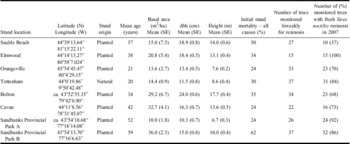
Eight sites were selected in southwestern and central Ontario, Canada according to the following criteria: pure P. sylvestris overstorey composition; closed canopy (as evidenced by the presence of overlapping crowns within the main canopy); presence of S. noctilio adults in attractant-baited traps; presence of trees with weathered resinosis from the previous year (2006); and relatively unobstructed sightlines, necessary for examination of the bole from the ground with binoculars or spotting scope. Site characteristics (basal density, mean tree height, mean diameter at breast height (dbh), and stand mortality) were measured using methods described in Ryan (Reference Ryan2011) and are summarised in Table 1. We established a transect (10 m × 100 m) in each of the eight sites, and within each transect we identified trees favourable to S. noctilio. A tree was considered favourable when it was suppressed or intermediate in dominance, had a deteriorating crown (⩽25% of expected foliage) or had stem injury (Dodds et al. Reference Dodds, de Groot and Orwig2010). A total of 231 trees considered favourable to attack by S. noctilio were labelled serially.
Location and attributes of eight Pinus sylvestris stands southern Ontario, Canada.

The bole of each labelled tree was inspected at 2-week intervals during a time period that corresponded approximately to the expected flight period of S. noctilio females (Ryan et al. Reference Ryan, de Groot, Nott, Drabble, Ochoa and Davis2012a), to determine whether resin beads were present. Each inspection consisted of scanning the entire stem of each tree in three overlapping, vertically oriented swaths from three equally spaced points around the tree using either binoculars or a spotting scope mounted on a tripod, depending on tree height and the vantage point available for the scan. Each stem was visually partitioned along its length into three equal sections (upper, middle, and lower bole), and for each section, the presence or absence of fresh resinosis was recorded for each one-third section of the bole. The initial scanning inspection took place the 1st week of July 2007. At that time, we also determined whether resin beads from the previous year (yellowed or with a weathered, irregular surface) were present anywhere on the bole. On each biweekly inspection, tree foliage was also examined for evidence of colour changes or wilting, and those with no remaining green foliage were deemed dead. Biweekly inspections ended in mid-September. The final assessment of 2007 was performed between mid-September and late October 2007 after the hardwood trees and shrubs had dropped their leaves. This was done to ensure that all resin symptoms had been recorded because, despite our best efforts to select sites with good visibility of the bole, the Cavan and Bolton sites had understorey shrubs that could have limited detection of the symptoms. In late April and early May 2008, all 231 trees were re-examined and those with no remaining green foliage were deemed dead. Trees that had died and had evidence of S. noctilio-induced resin symptoms, we assumed to have been killed by S. noctilio unless there was evidence of another cause of death.
Of the 231 S. noctilio-favourable trees followed biweekly, 75% (174) showed new symptoms of S. noctilio oviposition activity in 2007 (Table 1). Eighty-eight of the total 231 trees monitored (38%), and 65 of the 174 (37%) trees with fresh S. noctilio symptoms from 2007, also had evidence of S. noctilio resin symptoms from preceding years. Whether our finding that 74% (65 of 88) of the trees having old S. noctilio symptoms had new symptoms in 2007 was indicative of residual physiological stress to the tree from that previous S. noctilio activity (Madden Reference Madden1971; Madden Reference Madden1977), or simply that the tree was declining for other reasons, and therefore becoming more favourable to the wasp, is unknown.
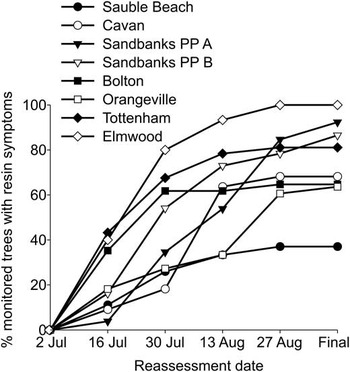
Fresh resinosis began to appear in mid-July, and the number of trees detected with resinosis increased until late August (Fig. 1). In Elmwood, Orangeville and Bolton, there was an early accumulation of trees with resinosis and by the end of July ⩾80% of the trees with resinosis had already been detected. In all sites but Sandbanks Provincial Park A & B and Tottenham, there were few new trees with resinosis detected after mid-August. The three sites that continued to have new trees with fresh symptoms after mid-August had many declining trees and a high proportion with resinosis, and therefore they may have had higher wasp populations (Table 1). The temporal appearance of resinosis in 2007 was consistent with the temporal emergence pattern of S. noctilio females observed from logs collected in southern Ontario and held in rearing containers that same year; >65% of females had emerged from these logs by late July and nearly 85% by mid-August (Ryan et al. Reference Ryan, de Groot, Nott, Drabble, Ochoa and Davis2012a).
Cumulative proportion of monitored Pinus sylvestris boles with resinosis between July and September 2007 in each of eight stands located in southern Ontario, Canada.

Resinosis was found throughout the bole on 33 of the 174 (19%) trees with fresh resinosis in 2007, and 56 (32%) trees had fresh symptoms in two of the three sections (18 [10%] lower and middle, 33 [19%] middle and upper, 5 [3%] lower and upper sections). The remaining trees had symptoms in only one section: 13 (7%) in the lower one-third only, 41 (24%) in the middle only and 31 (18%) in the upper third only. The observed distribution of resinosis along the bole is consistent with the distribution of S. noctilio individuals emerging from each section of the bole (Ryan et al. Reference Ryan, de Groot and Smith2012b), and with the distribution of symptoms reported by Haugen and Hoebeke (Reference Haugen and Hoebeke2005).
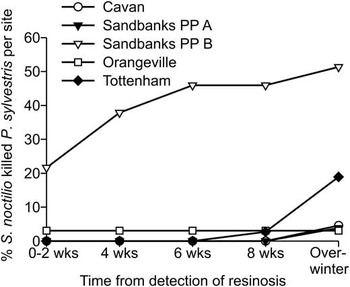
Of the 174 trees with evidence of S. noctilio injury in 2007, 31 (18%) of them from five sites subsequently died over the following 10 months (Fig. 2). At all sites except Sandbanks Provincial Park B, tree mortality was low and mostly occurred during the winter following attack (Fig. 2). In Sandbanks Provincial Park B, tree mortality was highest and became apparent within 2 weeks of initial detection of resinosis: most trees in this site died within 6 weeks of the detection of resinosis (Fig. 2). This site was a densely stocked stand of older trees (Table 1) planted on sandy substrate with evidence of a variety of insect pests and pathogens, including exit holes consistent with Siricidae. Thus, trees in this site were subject to a number of predisposing factors and S. noctilio attack may have merely been the final factor contributing to tree mortality. This range in the timing of mortality is similar to that described in Australia by Madden (Reference Madden1988), who also attributes this variability to the effect of location and site characteristics on tree resistance. These findings demonstrate that newly dead as well as live P. sylvestris should be examined for recent resinosis when surveying for current-year S. noctilio in stressed sites.
Cumulative proportion of monitored Pinus sylvestris that were classified as Sirex noctilio killed in 2007 as a function of the number of weeks after the first detection of resinosis in each of five sites located in southern Ontario, Canada.

The foliage of trees that died turned red; however, we never observed needle wilting on any P. sylvestris during our observation period. This is in contrast to observations from other regions where the woodwasp has been introduced (Neumann et al. Reference Neumann, Morey and McKimm1987) and from initial reports that wilting could be expected as a symptom of S. noctilio damage in North America (Haugen and Hoebeke Reference Haugen and Hoebeke2005). Whether needle wilting is a symptom of S. noctilio attack on other species of pines remains to be established.
Our findings will improve detection of S. noctilio-infested trees in northeastern North America as well as other regions.
Acknowledgements
The authors thank Chuck Davis for assistance with data collection; Taylor Scarr for helpful advice about tree assessment; several private landowners, Sandbanks Provincial Park, Bruce County, and Toronto Regional Conservation Authority for access to field sites; and two anonymous referees for providing helpful suggestions for revisions. Funding was provided by Ontario Ministry of Natural Resources, Natural Sciences and Engineering Council of Canada and Canadian Forest Service – Alien Invasive Species program.