


Political science developed as a research discipline in the United States under the influence of German universities in the quarter century before the establishment of the American Political Science Association in 1903. The outstanding reputation of the institutions of higher education in Germany attracted Americans interested in the study of history and government. Both the scope and the methods of what was called Staatswissenschaft in Germany shaped the curriculum of the first political science departments in the United States. The substantive emphasis was on public law and political theory, and the object of study was the establishment of causal relations through comparative analysis. John W. Burgess, the founder of the School of Political Science at Columbia, wrote that the distinction of his book, which he entitled Political Science and Comparative Constitutional Law, lay in its method:
It is a comparative study. It is an attempt to apply the [comparative] method, which has been found so productive in the domain of Natural Science, to Political Science and Jurisprudence. (1896, vol. I, vi)
The first generation of American political scientists continued to get its graduate training in Europe and was consequently familiar with the German and French literature. One of the earliest textbooks in comparative government, A. Lawrence Lowell's Governments and Parties in Continental Europe (1897), contained the texts of the major European constitutions in their original languages, conveying the expectation that students would be able to read foreign languages and would know the foreign literature.
This early European influence diminished in the discipline's second generation with the growing self-confidence of American political science departments. American political scientists no longer went to Europe to study. “Once American political scientists lost direct personal touch with their European counterparts,” Somit and Tanenhaus wrote in their history of the discipline, “they became increasingly parochial in outlook as well as in training” (1967, 38). The declining citation of foreign sources evident in journals, the increasing emphasis on American government in the curriculum, and the growing commitment to provide education for citizenship and public affairs led to the Americanization of the discipline in the second decade of the twentieth century. Courses in comparative government, often called courses in “foreign governments,” took second or third place to courses in American and state and local government, and the textbooks for such courses uniformly contained country-by-country descriptions. As Frederic A. Ogg, editor of the American Political Science Review from 1926 to 1949 and a prolific textbook author, wrote in the preface to his widely adopted text on European Government and Politics, “After twenty years of teaching in the field of foreign and comparative government, I am still of the opinion that…the best results in the survey type of course will usually be obtained by directing attention for successive periods to particular governmental systems viewed as entities….” (1935, v). It was the dominant view, derived from the model of teaching American government, that a national political system is to be understood as a self-contained entity, a unique product of its particular history and context. The pages of the Review in the 1920s and 1930s contained an article or two in nearly every issue reporting on a new constitution or an election in a European state, but even a two-country comparison was extremely rare.
European influence on American political science was revived by the arrival of a stream of European social scientists and by America's reentry onto the European stage after a decade of isolationism. Both of these developments were products of the crisis of democracy in Europe in the late 1920s and 1930s. The same concern for European civilization that gradually turned American foreign policy toward renewed intervention in Europe made a few American universities remarkably receptive to European émigré scholars. The cohort of European social scientists who came in the decades when Fascism and Nazism infiltrated European universities had an impact on many fields of political science in the United States, including political theory (Leo Strauss, Hannah Arendt), international relations (Hans Morgenthau), and social theory (Theodor W. Adorno), but their influence was particularly marked in comparative politics. It reestablished contact between what had become of comparative politics in the United States and its origins in European Staatswissenschaft and reignited the original purpose of the comparative study of politics: to provide explanation through comparison rather than merely offering discrete descriptions of non-American political systems.
By one count, 130 intellectuals who were or eventually became political scientists left Germany for the United States after 1933 (Lepsius 1981, 495–500). Perhaps an equal number came from all other European countries together, notably from Austria, Czechoslovakia, and Italy. I have selected 12 scholars from among this larger group who in my estimation had the greatest influence on comparative politics in the United States by virtue of their publications, the prominence of the institutions in which they developed their careers, and the positions they achieved in the profession. Because political science as a discipline, separate from public law and political theory, had not developed very far in Europe by the period between the two world wars, the educational background of the group of Europeans who came to the United States between 1925 and 1940 was in law and sociology. These were subjects in which comparative analysis was prominent in Europe, subjects that were informed by political theory. Four of these émigrés—Mario Einaudi, Herman Finer, Franz Neumann, and Sigmund Neumann—had also been exposed to the London School of Economics (LSE), an institution whose interdisciplinary focus encouraged comparison. Henry Ehrmann had his first appointment in the United States in the similarly interdisciplinary setting of the New School for Social Research in New York, Otto Kirchheimer served there in mid-career, and John Herz held visiting appointments there in the 1950s.1
The role of the New School for Social Research in providing a haven for refugee scholars in the social sciences is depicted by Klaus-Dieter Krohn (1993). Interestingly, Gabriel Almond, who decisively influenced comparative politics in the postwar period as the first chair of the SSRC Committee on Comparative Politics in the 1950s, was a predoctoral field fellow for the SSRC at the time when the New School's appointment of émigré scholars was in full swing (Almond 2002, 91).
THE FORERUNNERS, FRIEDRICH AND FINER
Chronologically, the first two Europeans destined to influence comparative politics in the United States were not refugees from Fascism but scholars who saw better opportunities at American universities than in Europe. Carl J. Friedrich arrived at Harvard in 1926. Herman Finer first went to Chicago as a visitor in 1935. Friedrich had received a Ph.D. from the University of Heidelberg in 1925, had first come to the United States with a group of European students on a study tour, and then received a lecture appointment at Harvard. He published significant works in public administration and political theory before he wrote Constitutional Government and Politics (1937), his most influential book, which eventually went through four editions. Finer, born in Romania, educated in Great Britain with a Ph.D. from LSE in 1923, spent intermittent time in the United States beginning in the 1930s and eventually held a continuous faculty appointment at the University of Chicago. In a department primarily focused on American politics, he had major responsibility for teaching the comparative politics of industrial nations (Zolberg 1969).
Friedrich and Finer each wrote comprehensive treatises on comparative government. Their books were path-breaking in organization: Finer, in the preface to his monumental two-volume Theory and Practice of Modern Government (1932), explained that what distinguished his book was that it
…treats the material…not in the fashion of previous studies…country by country, but subject by subject—each set of institutions is taken for all countries together. That is, it is truly comparative, and this affords the basis for sound generalization (1932, viii).2
The first edition of Finer's work was written while he was a lecturer at the London School of Economics and published in Great Britain. A one-volume revised edition was subsequently published in the United States in response to a strong and persistent demand (Finer 1949).
Friedrich's (1937) Constitutional Government and Politics opens with a methodological discussion of the nature of hypotheses in political science and the wide range of data needed to test them. The subsequent chapters are informed by classical political theory beginning with Aristotle, and by public law. Friedrich notes that “all the work of German political scientists during the nineteenth century bears the earmarks of the leading concepts of German public law” (10). Nearly half a century after its publication, his colleagues Judith N. Shklar and Arthur Maas, in a tribute to this influential work, wrote of Constitutional Government and Democracy (the title of the later editions) that it “really does deal with every aspect of that vast subject” (1985). Like Finer's, the book was organized topically, facilitating comparison across nations. These two books headed the list of required reading for the next generation of graduate students, providing a baseline for comparative politics for the generation of scholars that came of age in the decades of the 1940s and 1950s.
THE ÉMIGRÉS, 1933–1940
Friedrich and Finer's temporal priority among the émigré scholars made their work formative, but they were soon followed by a succession of émigré scholars, principally from central Europe and Italy. The intellectual migration to which these scholars belonged was the consequence of the persecution of Jewish academics, of left-leaning—often Marxist—intellectuals, and of Italian anti-Fascists, a persecution that spread throughout continental Europe in the 1930s. One or two members of this émigré cohort had studied sociology and one had received a degree in applied mathematics, but by far the largest number had been trained in law, in some cases in the sociology of law and in new specializations such as labor law. In Germany, a university career was essentially closed to Jews, but the legal profession was open (Lepsius 1993, 20). Lawyers educated in the continental European legal system were unprepared to practice law in the very different American case-law system. On the other hand, European legal education had a strong theoretical component that provided training in political philosophy, and that background made the transition to teaching government at American colleges and universities quite possible. Among those who had completed their education in Europe and who stayed in the United States for the remainder of their careers, 10 who had the greatest influence on the empirical study of comparative politics were Karl Deutsch, William Ebenstein, Henry Ehrmann, Mario Einaudi, John Herz, Otto Kirchheimer, Paul Lazarsfeld, Karl Loewenstein, Franz Neumann, and Sigmund Neumann. All but two of these had law degrees from major European universities. Lazarsfeld had a Ph.D. degree in applied mathematics and Sigmund Neumann had a Ph.D. in sociology. Franz Neumann, Ebenstein, and Deutsch subsequently earned Ph.D.s in political science in the United States.
These intellectuals belonged to the last pre-World War I generation, born between 1891 and 1912.3
Loewenstein, 1891; Finer, 1898; Franz Neumann, 1900; Friedrich, 1901; Lazarsfeld 1901; Einaudi, 1904; Sigmund Neumann, 1904; Kirchheimer, 1905; Herz, 1908; Ehrmann, 1908; Ebenstein, 1910; Deutsch, 1912.
The discipline of political science was remarkably receptive to this group of émigrés because their methods and their objectives, although varied, were generally consistent with the practices that were dominant in political science. The emphasis of these scholars on constitutions and institutions fit the established curriculum of the discipline. Their concern for the threat to democracy posed by fascism and communism attracted the attention of the academy as the international crisis of the 1930s affected the United States.4
That endeavor led to many of their earliest publications. See Franz Neumann 1942; Sigmund Neumann 1942; William Ebenstein 1939, 1943, 1945; and Karl Loewenstein 1939.
By contrast to the émigrés who quickly achieved an influential role in the discipline, another set of more theoretically oriented émigré scholars found the American discipline inimical. Prominent among them were Theodor Adorno, Erich Fromm, Max Horkheimer, and Herbert Marcuse, who had been members of an interdisciplinary, privately funded Institute of Social Research at the University of Frankfurt. They fled Germany in 1933 and, thanks to the support of Robert MacIver, chair of political science at Columbia, resumed their collaboration and reestablished their Institute there. Their work developing a critical theory of society from a neo-Marxist point of view, and their publications on the origins of national socialism and on the authoritarian personality had influence in the field of political theory and political sociology. But Adorno's administration of the Institute created a “patriarchally structured enclave critical of society…set up in the very lap of bourgeois society” according to its historian (Wiggerhaus 1994, 146), and this limited its reach into American political science. There were controversies among the Institute's members as well as between them and other émigré scholars. The Institute's ties to Columbia, never strong, frayed. Some members left to continue their writing outside of any institutional affiliation in Los Angeles, relying on private funding. In 1946 the Institute at Columbia closed and Adorno and Horkheimer began to reestablish ties with German institutions, and in 1951 the Institute returned to the University of Frankfurt, though some scholars who had been associated with it, including Franz Neumann and Otto Kirchheimer, obtained faculty appointments in the United States.
The history of what was later called the “Frankfurt School” illustrates the institutional and ideological factors that affected the varied reception that European scholars experienced in American political science. The privately endowed Frankfurt research institute could not be successfully incorporated into Columbia University. Furthermore, in the postwar environment in the United States, neo-Marxist theory was outside the mainstream of American political science (Hughes, 1975, ch. 4). A more successful reception to émigré scholars was afforded by the New School, where Alvin Johnson established a “University in Exile” as a rescue operation for European émigré scholars in 1933. Soon renamed the “Graduate Faculty of Political and Social Science,” it was “staffed by an international faculty unique among American institutions of higher learning” and “soon [became] the most significant center of its kind in the United States” (Krohn 1993, 59). Unlike Adorno's Institute, its members did not belong to a single intellectual “school,” nor did they exist in the intense and relatively isolated atmosphere of the group at Columbia. The New School was pluralist. The émigré scholars received there and at individual American colleges and universities were able to make the transition from Europe to America because they shared the dominant concern of American political science in the 1930s and 1940s: the defense of democracy against totalitarianism and depression-era social reform (Oren 2003).
PATTERNS OF INFLUENCE
The influence of this group of émigrés on comparative politics was through their writing of basic works in the field, their leadership in professional organizations, and the institution-building in which some of them engaged. Many were teachers of the generation of American graduate students who went on to expand comparative politics to include the study of developing nations and to provide a theoretical framework for that study. Deutsch and Friedrich eventually served as presidents of the American Political Science Association; Deutsch set up the Yale Political Data Program, leading to the World Handbook of Political and Social Indicators (Russett et al. 1964), which, through three editions, became a prime resource for testing hypotheses in comparative politics. Ehrmann served on the Editorial Board of the Review; Ebenstein directed an international UNESCO study of methods in political science. Einaudi (1959) left his imprint on comparative politics through books on communism and Christian democracy in postwar Europe, through his innovative comparison of European and American politics,5
The Roosevelt Revolution, which also appeared in French and Italian translations.
The American Political Science Association named Karl Loewenstein as a “convener” of a panel on comparative government less than a decade after his arrival in the United States. The panel's deliberations produced a report that reflected the effect that World War II was having on the field. Its report asserted that “comparative government in the narrow sense of descriptive analysis of foreign institutions is an anachronism.” It continued that “unless the customary juxtaposition of descriptive material, country by country, was replaced by an effective functional comparison, the actual achievement would belie the very name of the discipline.” The report went on to declare that
Only rarely is the attempt made really to compare political institutions and functions in the sense that a common denominator for diversified phenomena is found…. It is not accidental that American political science has produced so few books and treatises on the state in general, while there is an abundance of Continental European literature…. (542)
By the 1950s a new impetus to the revitalization of the subfield of comparative politics came through the initiative of scholars born and educated in the United States. The aim of this cohort of comparativists was to expand the field of study beyond Europe toward studies of “developing countries” and to reorient it from its focus on law and institutions toward studies of the cultural and interest-group substructure of politics. The prime movers, led by Gabriel A. Almond, persuaded the SSRC to establish a Committee on Research in Comparative Politics and to fund a series of conferences whose papers would lead to publications. Almond, whose University of Chicago education had sensitized him to the microfoundations of politics and to sociological theory, was the Committee's chair. “We…wanted these studies to be done in such a way as to enhance their cumulativeness, since we were concerned not only with increasing knowledge but also with developing theory,” Almond explained later. He recalled that he had contributed a paper “applying Weberian and Parsonian categories to the problem of comparative study” (Baer, Jewell, and Sigelman 1991, 130–31). The “structural-functionalism” that he derived from Max Weber via Talcott Parsons organized work in comparative politics for a generation.

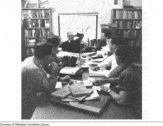
Sigmund Neumann, Presiding Over a Seminar at Wesleyan University c. 1958. Neumann Played a Prominent Role at that Time in the SSRC Committee on Comparative Politics.
Among the prestigious senior members of the original six-member SSRC committee in 1954 was Taylor Cole, who remembered that among his teachers in the Harvard Ph.D. program Carl Friedrich “had the greatest impact” on him (Baer, Jewell, Sigelman 1991, 70). Sigmund Neumann became a member two years later. Two émigré scholars, Karl W. Deutsch and William Ebenstein, participated in preparatory meetings leading to this new initiative, and Ebenstein, Ehrmann, and Finer were among the 14 participants in its first research planning session (Almond 1958, 270 n. 1; Almond 2002, 95–97; Social Science Research Council 1971)—further evidence of the influence of these émigré scholars.
Joseph LaPalombara, a younger member of the committee, recalls that Sigmund Neumann was the committee's “conscience.” He remembers that Neumann maintained “a healthy skepticism about the new-fangled ideas about how to do comparative political science,” called the committee back repeatedly to “pay careful attention to history,” and out of his broad European conception of methodology as theory and epistemology saved the committee from imposing on its authors a narrow conception of methodology as mere statistical technique. LaPalombara writes that
Neumann came to show us that whatever conceptual schemes we might develop regarding the processes of political development, one way to keep things grounded in reality would be to test ideas against a better understanding of how Western, and particularly European, political systems had evolved. (LaPalombara 2005, personal communication to the author)
The deliberations of the committee and the working papers presented at its conferences established a new research agenda and produced, among many other works, the influential 10-volume Studies in Political Development. The chapters in these books approached their subjects comparatively in most cases and, to the extent they were country-specific, they tried to maintain a common theoretical framework. Publications sponsored by the SSRC committee contained significant contributions from Ehrmann, Neumann, and Kirchheimer. The new research directions in comparative politics that marked the field in the 1950s and 1960s were therefore markedly influenced by the approaches of the European émigrés.
The new leaders in the field had, in notable instances, been the students of the émigré scholars. David Apter and Myron Weiner, who expanded the study of comparative politics to Africa and Asia, and LaPalombara, that influential member of the SSRC Committee, had all been taught by Ebenstein at Princeton. So had Sidney Verba, co-author with Almond of the seminal comparative study of political cultures, The Civic Culture (1963). Roy Pierce, who with Philip E. Converse expanded the studies of representation in the U.S. by comparing it with Political Representation in France (Converse and Pierce 1986), had studied with Einaudi. Harry Eckstein, co-editor of the influential collection, Comparative Politics; A Reader (Eckstein and Apter 1963), had studied with Friedrich at Harvard. Lewis J. Edinger, the author of important studies of comparative political leadership (1967), had had courses with Neumann at Columbia and had collaborated with John Herz as well as with another prominent émigré scholar, Hans Speier. These few examples suggest the broad influence that the leading émigré scholars had on the field of comparative politics as it developed in the next generation.
CROSS-NATIONAL COMPARISON IN RESEARCH AND IN UNDERGRADUATE INSTRUCTION
A trend toward cross-national comparison can be seen in the subjects of articles published in the profession's major journals, leaving aside for the moment whether that trend was significantly influenced by European émigré scholars. Nine out of 10 research articles in comparative politics published in the Review continued to be single-country studies through the 1960s, but that changed rapidly thereafter so that more than half of comparative politics articles were “large-n” studies by the 1990s (Sigelman 2006). The appearance in 1968 of two new journals devoted to comparative politics provides an additional measure of the changing pattern of research in this field. Between 1968 and 1981, four out of 10 articles in these journals were multicountry studies (Sigelman and Gadbois 1983); in the next 15 years that was true of nearly half of the published articles, many of them based on comparisons across a moderate number of countries (Hull 1999). Clearly, in the last quarter of the hundred-year history of the discipline, the field of comparative politics moved perceptibly from case studies of single countries, deemed “comparative” only by virtue of not being studies of American politics, toward comparisons across nations, whether of small groups of countries or “large-n” studies employing sophisticated statistical analyses.
The impact of émigré scholars on undergraduate education is more difficult to trace. In the recollection of some of their students, their syllabi dealt with sets of countries comparatively. There were attempts, mostly frustrated, to write undergraduate textbooks that approached the subject comparatively as the scholarly tomes of Friedrich and Finer did. Einaudi's effort to provide a comparative treatment of French and Italian politics in an early postwar textbook shows the obstacles to abandoning the country-by-country approach that was then standard in the undergraduate curriculum. For the first edition of a text organized by a German émigré scholar, Fritz Morstein-Marx, Einaudi had proposed writing a section “along functional lines.” He wrote that it “could be called Western Europe, with major emphasis on France and Italy” and that he would “discuss the developments of political currents in the whole area, and do the same for constitutional and economic problems” (letter to Morstein-Marx, April 22, 1947). The editor and the publisher at Prentice-Hall agreed and Einaudi wrote five chapters comparing the French and Italian constitutions, party systems, and policies (Morstein-Marx 1949). But when it came time for a second edition, the publisher wanted Einaudi to provide separate chapters on France and Italy, citing negative comments received on the comparative treatment in the first edition. Einaudi responded “that rather than moving in the direction of less integration, I would want to have more integration…. I am convinced that the curse of comparative government textbooks is the special country by country treatment (letter to Morstein-Marx, May 13, 1950). The publisher insisted, and Einaudi withdrew from contributing to the new edition. The publisher later wrote Einaudi, in an attempt to mollify him, that “from most teachers' point of view…the separate treatment of France and Italy,” which had been written by Edward G. Lewis for the second edition, was an “improvement…but in organization for teaching and certainly not in quality” (letter from William A. Pullin, Prentice-Hall, to Mario Einaudi, March 13, 1952).6
The correspondence quoted in this paragraph is contained in the Mario Einaudi private archive at the Fondazione Luigi Einaudi, Turin, Italy.
Textbooks in comparative politics therefore continued to take the country-by-country approach for at least a generation after the end of World War II, and those émigré scholars who contributed to them, notably Herz, Loewenstein, and Sigmund Neumann, were content to offer country-specific sections (Carter and Herz 1952; Cole 1953; Shotwell 1940). The move to comparison in textbooks—still only very partial—came 10 years later as a result of the work of Gabriel Almond and the SSRC's Committee on Comparative Politics, whose volumes depended for their coherence on a structural-functional theoretical framework that dominated research in comparative politics for two decades. That framework was the organizing principle of what came to be the most widely adopted textbook in the field, first outlined in Comparative Politics: A Developmental Approach (1966). Other truly comparative texts followed, such as LaPalombara's Politics Within Nations (1974). But few textbook authors have found it possible to combine the need for detailed information about a number of unfamiliar political systems with an introduction to the concepts and methods needed for comparison. The trend has been toward the inclusion of more countries, often spanning all the continents of the world, with, at best, separate and tenuously related sections on methods of comparison (Loewenberg 2005).
CONCLUSION
The agenda of political science has always been shaped by events in the political world. Less obviously, so has its methodology. When the first generation of American political scientists received their graduate education in German universities at the end of the nineteenth century, the comparative approach to the study of politics—in the form of public law and political philosophy—was dominant there. As American universities developed their own graduate programs early in the twentieth century, the comparative approach in political science was replaced by such an emphasis on American politics that comparison seemed to have no place. Even in the study of what was called “foreign governments,” a country-by-country approach was standard. The émigré scholars who entered the profession between 1925 and 1940 revived the comparative approach to the study of politics. The agenda of American political science on the eve of the Second World War influenced the receptivity of the profession to the émigrés, welcoming those who contributed to that agenda while resisting those with other interests. In the decade after the war, America's expanding role in the world widened the substantive purview of the field to include the study of “developing areas,” and the multiplication of systems to be studied provided a new incentive for treating governments as units for comparative analysis. The result was a steady decline in the country-by-country approach to the study of foreign governments.
To what extent was the revival of comparative analysis due to the influence of European émigré scholars on American political science? Would the expansion of the horizon of American political science after World War II have restored the comparative approach in any case? Perhaps, but the marked tendency to develop country-specific and region-specific area studies programs separate from the social science disciplines was a strongly competing alternative. Roy Macridis, who most succinctly articulated the aims of the SSRC Committee on Comparative Politics in the 1950s, rejected “the area approach with its interdisciplinary orientation” because it “failed to provide…a systematic frame for comparative analysis” (1955, 14). But area studies thrived and received significant federal support.
We cannot reliably weigh the relative influence of the European and the indigenous American factors that shaped comparative politics in the second half of the twentieth century. Clearly they interacted with each other. But the intellectual migration of European scholars to America between 1925 and 1940, the remarkable receptivity of a few leading American colleges and universities to some of these scholars, and their publications along with their teaching and their institution-building, gave an initial impetus to the renewal of comparative politics which other influences in the 1950s and 1960s carried further. The impact of the European émigrés restored the original connection between Europe and America in comparative politics, which became a reciprocal connection extremely fruitful for the discipline on both sides of the Atlantic.
I would like to thank Professor Joseph LaPalombara (Yale University) for his advice and Dr. Luigi Einaudi for obtaining the Mario Einaudi correspondence that I have cited.



Comments
No Comments have been published for this article.