Introduction
The Japanese Black breed, known as Wagyu (‘Wa’ refers to ‘Japanese’ and ‘gyu’ to ‘herd’), is considered a national treasure in Japan. The main Kuroge (black) lineages are Tajima, Shimane, and Kedaka, which originated according to the Japanese geographical division (Scraggs et al., Reference Scraggs, Zanella, Wojtowicz, Taylor, Gaskins, Reeves, de Avila and Neibergs2014; Facioli et al., Reference Facioli, De Marchi, Marques, Michelon, Zanella, Caires, Reeves and Zanella2020). The crosses of Wagyu with other breeds have increased the genetic variability among those animals. However, in 1910 it was identified that crosses between European and British breeds were not beneficial to the Wagyu animals, resulting in a closure of the herd to crossbreeding and intensification in the inbreeding programmes (ABCBRW, 2022; AWA, 2022).
Wagyu beef is highly appreciated worldwide due to its high intramuscular fat, or marbling. The marbling is responsible for its flavour, succulence, and texture (Motoyama et al., Reference Motoyama, Sasaki and Watanabe2016; AWA, 2022), and it is directly associated with higher percentages of monounsaturated fatty acids. In addition, Wagyu meat is highly healthy and top quality, having nine essential amino acids, the protein absorption rate of 97% (Gotoh et al., Reference Gotoh, Nishimura, Kuchida and Mannen2018), and high concentrations of omega-3 and omega-6 (Skarzynski et al., Reference Skarzynski, Siemieniuch and Majewska2009).
The first Japanese export of Wagyu was in 1976 when four bulls were traded to the USA. However, aware of their product’s unique value, after 1999 the government of Japan banned the export of live Wagyu animals. Therefore, the breed exists on several continents today, albeit in relatively low genetic variability (ABCBRW, 2022; AWA, 2022).
As a breed of high breeding value, the use of reproductive biotechnologies such as in vitro fertilization (IVF) allows fast dissemination of animals with superior genetics. In vitro fertilization started in Brazil in 1997 and, since 2007, biotechnology has been commercially used in herds to produce bovine embryos (Gonçalves and Viana, Reference Gonçalves and Viana2019). However, studies have shown variable results in the success of IVF in the Wagyu breed (Scraggs et al., Reference Scraggs, Zanella, Wojtowicz, Taylor, Gaskins, Reeves, de Avila and Neibergs2014; Facioli et al., Reference Facioli, De Marchi, Marques, Michelon, Zanella, Caires, Reeves and Zanella2020), and there is little information on the reproductive traits related to IVF in the breed worldwide. Due to the high metabolism associated with high levels of marbling, it is suggested there are endocrine changes that negatively affect embryo production and quality (Facioli et al., Reference Facioli, De Marchi, Marques, Michelon, Zanella, Caires, Reeves and Zanella2020). Thereby, the possibility of detecting a hormonal marker directly related to the ovarian follicle count and reproductive efficiency would allow the selection of females with greater reproductive capacity.
In cattle reproduction, and in other species such as sheep and horses, the evaluation of the anti-Müllerian hormone (AMH) has been widely used, showing a possible dependence on its expression according to the breed (Batista et al., Reference Batista, Guerreiro, Freitas, Silva, Vieira, Ferreira, Rezende, Basso, Lopes, Rennó, Souza and Baruselli2016; Kereilwe and Kadokawa, Reference Kereilwe and Kadokawa2019; Umer et al., Reference Umer, Zhao, Sammad, Weldegebriall Sahlu, Yunwei and Zhu2019). AMH was first described in 1947 by Alfred Jost as a dimeric glycoprotein belonging to the 140-kDa transforming growth factor-beta (TGF-β) family, produced only in the gonads (La Marca et al., Reference La Marca, Sighinolfi, Radi, Argento, Baraldi, Artenisio, Stabile and Volpe2010). In females, its production occurs in granulosa cells present in preantral follicles and small antral follicles of between 3–5 mm (Robertson, Reference Robertson2008; La Marca et al., Reference La Marca, Sighinolfi, Radi, Argento, Baraldi, Artenisio, Stabile and Volpe2010; Koizumi and Kadokawa, Reference Koizumi and Kadokawa2017; Cardoso et al., Reference Cardoso, de Oliveira, Kischel, da Silva, Arruda, Souza-Cáceres, de Oliveira, Nogueira, Nogueira and Melo-Sterza2018), with a considerable reduction in their levels in 5-mm follicles (Rico et al., Reference Rico, Médigue, Fabre, Jarrier, Bontoux, Clément and Monniaux2011; Sevgi et al., Reference Sevgi, Erdem, Karaşahin, Yılmaz, Satılmış, Okuroğlu, Ünal, Dursun, Alkan, Satılmış and Güler2019). Therefore, its production is directly associated with the follicle count and immature proliferating granulosa cells, characterized by low steroidogenic activity (Ireland et al., Reference Ireland, Scheetz, Jimenez-Krassel, Themmen, Ward, Lonergan, Smith, Perez, Evans and Ireland2008; Monniaux et al., Reference Monniaux, Drouilhet, Rico, Estienne, Jarrier, Touzé, Sapa, Phocas, Dupont, Dalbiès-Tran and Fabre2012). As its levels remain stable during the oestrous cycle phases (Rico et al., Reference Rico, Fabre, Médigue, di Clemente, Clément, Bontoux, Touzé, Dupont, Briant, Rémy, Beckers and Monniaux2009), AMH is considered an individual endocrine marker of follicle number and embryo production. It is responsible for evaluating the size of the ovarian reserve, ovarian function, response to superovulation protocols, fertility, and longevity of females in the herd (Jimenez-Krassel et al., Reference Jimenez-Krassel, Scheetz, Neuder, Ireland, Pursley, Smith, Tempelman, Ferris, Roudebush, Mossa, Lonergan, Evans and Ireland2015; Batista et al., Reference Batista, Guerreiro, Freitas, Silva, Vieira, Ferreira, Rezende, Basso, Lopes, Rennó, Souza and Baruselli2016; Fushimi et al., Reference Fushimi, Okawa, Monniaux and Takagi2020).
From another perspective, AMH secretion in bovine males occurs during the fetal phase through Sertoli cells (Robertson, Reference Robertson2008), causing the regression of the Müllerian ducts. The Müllerian ducts are structures responsible for developing the female reproductive tract and sexual differentiation (La Marca and Volpe, Reference La Marca and Volpe2006; Alward and Bohlen, Reference Alward and Bohlen2020). In males, there is a direct association between levels of AMH with the presence of the gonads, and their measurement can be used to assess the presence of testicular tissue (Kitahara et al., Reference Kitahara, El-Sheikh Ali, Sato, Kobayashi, Hemmi, Shirao and Kamimura2012). Furthermore, it is a way of detecting reproductive disorders such as cryptorchidism and monorchism in cattle and horses (Kitahara et al., Reference Kitahara, El-Sheikh Ali, Sato, Kobayashi, Hemmi, Shirao and Kamimura2012; Claes et al., Reference Claes, Ball, Almeida, Corbin and Conley2013), freemartinism (Rota et al., Reference Rota, Ballarin, Vigier, Cozzi and Rey2002), and male pseudohermaphroditism in cattle (Kitahara et al., Reference Kitahara, El-Sheikh Ali, Teh, Hidaka, Haneda, Mido, Yamaguchi and Osawa2018).
Therefore, the objective of the present study was to characterize AMH hormone levels in Wagyu females and evaluate its effect on oocyte and embryo production, as well as observe AMH hormone levels in Wagyu bulls.
Materials and methods
This experiment was conducted at a farm located in the mesoregion of the western centre of the state of Rio Grande do Sul (Júlio de Castilhos, RS, Brazil; 29°17′54.7′′S, 53°41′07.0′′W). The study was approved by the Ethics Committee on Animal Use of the University of Passo Fundo (protocol no. 006/2020).
Samples collection
In total, 29 Wagyu females (n = 29), aged between 18 and 72 months, and four Wagyu males (n = 4), aged ∼36 months, were used in this study. Blood samples were collected on the same day in all the animals from the coccygeal vein in vacuum tubes without anticoagulants at a random moment of the oestrous cycle. The samples were centrifuged at room temperature at 3700 rpm for 5 min to obtain the serum. The samples were placed in 1.5-ml centrifuge microtubes and stored at −20°C for 30 days until hormone analysis.
Animal’s genealogy
The animals’ genealogy was verified through Pedigree data of four previous generations provided by the Brazilian Association of Wagyu Cattle Breeders. The estimation of inbreeding coefficient levels (Fx) (Wright, Reference Wright1922) was performed using Wright’s coefficient formula and the R statistical environment:
 $$\rm {F_X} = \sum {\left[ {{{\left( {{1 \over 2}} \right)}^{{n_1} + {n_2} + 1}}\left( {1 + {F_A}} \right)} \right]} $$
Historical reproductive data
Previous data from seven oocyte collections and numbers of blastocysts produced in vitro were evaluated from 30 Wagyu females (n = 30). The procedures were performed in October and November 2018, January, April, June and October 2019, and November 2020. Follicular aspiration and subsequent in vitro embryo production were performed by a single commercial laboratory. Cows were further classified as having high oocyte production (≥14 oocytes/follicular aspiration) or low (<14/follicular aspiration).
Anti-Müllerian hormone
Serological measurement of AMH was performed by the LEAC Laboratory (São Paulo, SP, Brazil; 23°30′26.8′′S, 46°37′32.1′′W) using the bovine AMH ELISA kit (Ansh Laboratories, Webster, TX, USA). Measurements were performed in duplicate on all samples (n = 33), as recommended by the manufacturer. The sensitivity of the bovine AMH test was 11 pg/ml and the coefficient of variation of 2.49%.
Statistical analysis
All data were analyzed using the R statistical environment and MedCalc (v.19.5.3) by analyzing AMH serological levels for the variables of oocyte production, embryo production, and inbreeding coefficient (Fx). The data normality was evaluated using the Shapiro–Wilk test. Furthermore, Student’s t-test, Pearson’s correlation, and Pedigree were used for analysis. Student’s t-test was used to analyze AMH levels between females with high oocyte production (≥14 oocytes) and females with low levels of AMH and low oocyte production (<14 oocytes). Pearson’s correlation was used to determine whether there was a correlation between the variables oocyte production and blastocyst rate, serological levels of AMH and oocyte and embryo production, as well as animal inbreeding levels (Fx). For all analyses, differences with P-value ≤ 0.05 were considered significant.
Results
Characterization of AMH serological levels with oocyte and embryo production
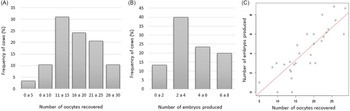
One female was removed from the statistical analysis because it was an outlier due to her high AMH levels, however her values were kept only for the descriptive summary. The mean of oocyte production was 17.74 ± 7.64 (min = 5; max = 28.66; Figure 1A). After IVF, the embryo production mean was 4.22 ± 2.42 (min = 0; max = 8.85; Figure 1B). A positive correlation was identified between oocyte production and blastocyst rate (r = 0.84; P = 9 × 10⁻⁹; Figure 1C).
Frequency of oocyte and embryo production in Wagyu bovine females. (A) Histogram of oocyte production (17.80 ± 5.91). (B) Histogram of embryo production (4.30 ± 2.05). (C) Correlation between oocyte and embryo production (r = 0.84; P = 9 × 10⁻⁹).

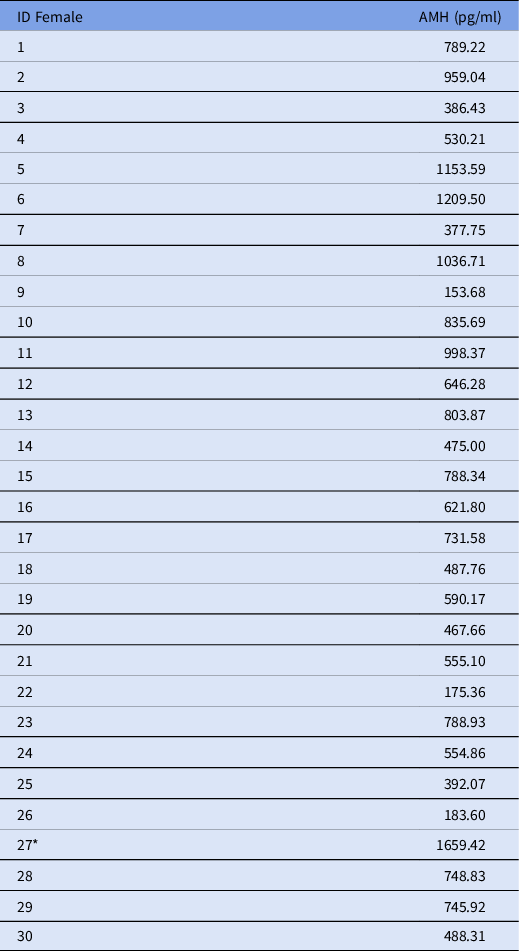
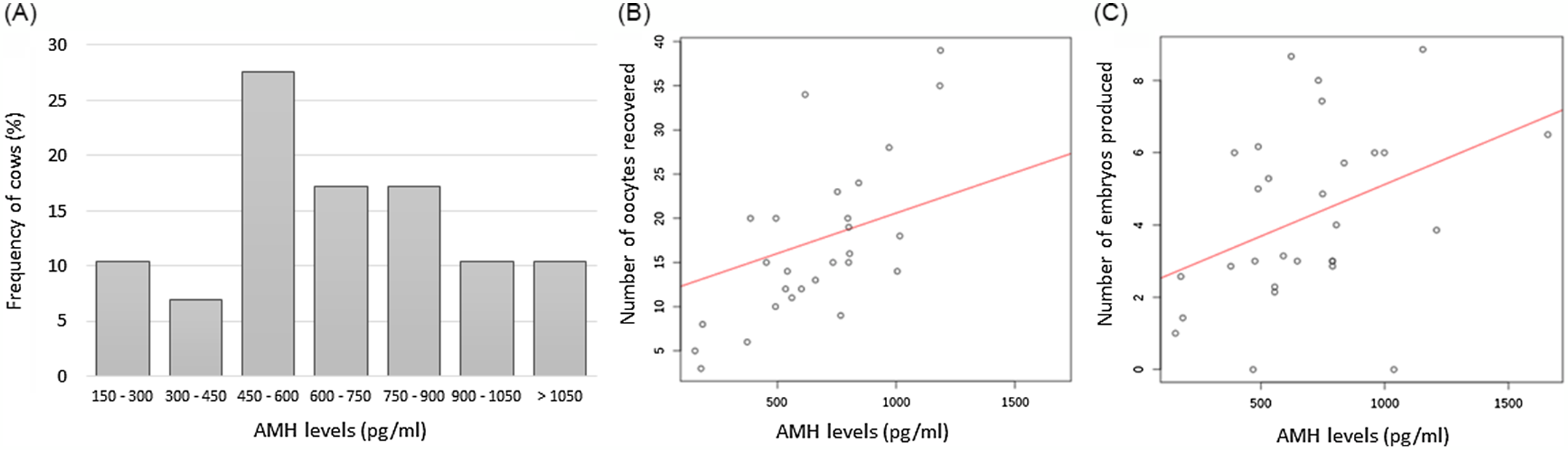
The serological concentration of AMH in Wagyu females ranged from 153.7 to 1659.4 pg/ml (Figure 2A and Table 1). The mean ± standard deviation and median concentrations were 685.6 ± 323.73 pg/ml and 634 pg/ml, respectively. A positive correlation between serological levels of AMH and oocyte production (r = 0.49; P = 0.006), and between AMH levels and embryo production (r = 0.39; P = 0.03) was identified (Figure 2B,C).
AMH serological levels of Wagyu females

* Was excluded for being an outlier.
Serological assessment of AMH levels and oocyte and embryo production in Wagyu females. (A) Histogram of the frequency of distribution of serological concentration of AMH (n = 29). (B) Correlation between the number of oocytes and serological concentrations of AMH (r = 0.49; P = 0.006). (C) Correlation between the number of embryos and serological concentrations of AMH (r = 0.39; P = 0.03).

Based on data obtained previously, which showed that oocyte production was directly correlated with embryo production, females were classified as high (≥14 oocytes; n = 15) or low (<14 oocytes; n = 14) oocyte production. The mean ± standard deviation obtained from females with high oocyte production was 20.75 ± 4.46 (min = 14; max = 28.67) while females with low oocyte production were 11.06 ± 3.01 (min = 5; max = 13.85). A significant difference (P = 0.01) between females with high levels of AMH and high oocyte production and females with low levels of AMH and low oocyte production was identified.
Characterization of AMH serological levels in males
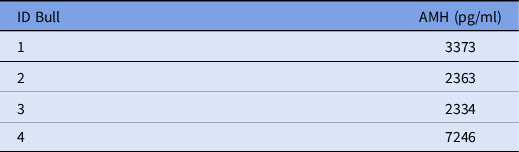
The serological levels of AMH of the four Wagyu bulls showed a mean ± standard deviation of 3829 ± 2328 pg/ml (min =2334 pg/ml; max = 7246 pg/ml) in a 1:20 dilution (Table 2).
AMH serological levels of Wagyu bulls 1:20 dilution

Inbreeding parameters
Statistical analyzes of inbreeding parameters showed a mean ± standard deviation of 0.020 ± 0.036. It was possible to observe a negative correlation between the inbreeding levels of the animals (Fx) with the oocyte production (r = −0.20; P = 0.36) and the levels of AMH (r = −0.31; P = 0.09).
Discussion
Characterization of AMH serological levels with oocyte and embryo production
To the best of our knowledge, this is the first study in Latin America that correlates AMH serological levels with oocyte and embryo production in registered purebred Wagyu cattle. In this study, we were able to identify a positive correlation between AMH serological levels and oocyte and embryo production. The same was observed in other species such as buffaloes (Liang et al., Reference Liang, Salzano, D’Esposito, Comin, Montillo, Yang, Campanile and Gasparrini2016), goats (Monniaux et al., Reference Monniaux, Baril, Laine, Jarrier, Poulin, Cognié and Fabre2011; Karakas Alkan et al., Reference Karakas Alkan, Alkan and Kaymaz2020), and sheep (Torres-Rovira et al., Reference Torres-Rovira, Gonzalez-Bulnes, Succu, Spezzigu, Manca, Leoni, Sanna, Pirino, Gallus, Naitana and Berlinguer2014). According to Facioli et al. (Reference Facioli, De Marchi, Marques, Michelon, Zanella, Caires, Reeves and Zanella2020), IVF is an alternative technique to reduce costs per embryo produced in Wagyu bovine females. Therefore, the measurement of AMH could be a helpful tool in selecting females with greater reproductive capacity and mainly used as oocyte and embryo donors.
Studies have shown that circulating levels of AMH in Wagyu females progressively increased from 2 months of age, and become stable from 11 months of age, a period close to the beginning of puberty, at ∼13 months (Hirayama et al., Reference Hirayama, Naito, Fukuda, Fujii, Asada, Inaba, Takedomi, Kawamata, Moriyasu and Kageyama2017). Similarly, a significant increase in AMH levels between the first and third months of age was observed in Maine-Anjou females, remaining elevated until the sixth month, and progressively regressing until stability near puberty, at ∼12 months (Monniaux et al., Reference Monniaux, Drouilhet, Rico, Estienne, Jarrier, Touzé, Sapa, Phocas, Dupont, Dalbiès-Tran and Fabre2012). Despite changes in circulating hormone levels during this period, there were no significant changes with age (Koizumi and Kadokawa, Reference Koizumi and Kadokawa2017). Therefore, the early assessment of circulating AMH levels makes it possible to detect early puberty, while postpubertal assessment can estimate future fertility (El-Sheikh Ali et al., Reference El-Sheikh Ali, Kitahara, Takahashi, Mido, Sadawy, Kobayashi, Hemmi and Osawa2017), in which a single measurement is effective (Souza et al., Reference Souza, Carvalho, Rozner, Vieira, Hackbart, Bender, Dresch, Verstegen, Shaver and Wiltbank2015). The same was observed in our study, as we did not observe an association between age and the AMH levels in the Wagyu females.
AMH serological levels in the Wagyu females evaluated in this study had a mean ± standard deviation of 0.689 ± 0.325 pg/ml. In contrast, a previous study with females from the same breed reported plasma levels with a mean ± standard deviation of 0.334 ± 0.318 pg/ml (Hirayama et al., Reference Hirayama, Naito, Fukuda, Fujii, Asada, Inaba, Takedomi, Kawamata, Moriyasu and Kageyama2017). It can be observed that the females in our study had higher average levels of this hormone compared with the females in the Japanese study, corroborating the Nabenishi et al. (Reference Nabenishi, Kitahara, Takagi, Yamazaki and Osawa2017) and Hirayama et al. (Reference Hirayama, Naito, Fujii, Sugimoto, Takedomi, Moriyasu, Sakai and Kageyama2019) reports. Both authors observed variations in circulating levels of AMH among individuals of the same breed. Furthermore, this variation may be directly associated with a greater genetic variability of the breed in Japan, as the genetic material present in other countries was restricted to animals exported by Japan from 1976 to 1999 (AWA, 2022).
According to Batista et al. (Reference Batista, Guerreiro, Freitas, Silva, Vieira, Ferreira, Rezende, Basso, Lopes, Rennó, Souza and Baruselli2016), in Nelore females (Bos indicus), the meat-purpose cattle breed highly responsive to IVF protocols, the AMH levels remained at ∼3.2 ± 1.0 pg/ml. In Bos taurus dairy females (Holstein, Jersey, and their crosses), plasma AMH levels remained between 0.010 and 0.319 pg/ml (Ribeiro et al., Reference Ribeiro, Bisinotto, Lima, Greco, Morrison, Kumar, Thatcher and Santos2014). Therefore, it was possible to observe that dairy animals had lower circulating levels of AMH compared with the females of the beef cattle (Baruselli et al., Reference Baruselli, Batista, Vieira and Souza2015). A study conducted by Okawa et al. (Reference Okawa, Monniaux, Mizokami, Fujikura, Takano, Sato, Shinya, Kawashima, Yamato, Fushimi, Vos, Taniguchi and Takagi2021) identified that inflammatory markers detected in the early postpartum phase were associated with a reduction in AMH levels, suggesting that the dynamics of AMH secretion might be affected by the inflammation state. These data could justify lower levels of the hormone in dairy females. In addition, studies showed differences in the expression of AMH mRNA between Holstein and Wagyu females (Kereilwe and Kadokawa, Reference Kereilwe and Kadokawa2019). In the Simmental breed, which has a dual purpose, the evaluated circulating levels varied from 0.233 pg/ml to 2531 pg/ml (Sevgi et al., Reference Sevgi, Erdem, Karaşahin, Yılmaz, Satılmış, Okuroğlu, Ünal, Dursun, Alkan, Satılmış and Güler2019), which was higher compared with the females in our study.
A positive correlation (P = 0.01) in females with high levels of oocyte and embryonic production and high serological levels of AMH was found in this study; that is, as the circulating levels of the hormone increased, the greater was the ovarian follicular dynamic. Therefore, the measurement of this hormone could be used as an indirect marker for oocyte capacity in the ovaries, following a study conducted by Ireland et al. (Reference Ireland, Scheetz, Jimenez-Krassel, Themmen, Ward, Lonergan, Smith, Perez, Evans and Ireland2008), and enabling the selection of females in the herd that have a greater reproductive capacity.
Elevated plasma AMH levels in Wagyu females indicate a higher response to superovulation protocols (Soquilla and Mingala, Reference Soquilla and Mingala2017). Also, the increased number of embryos produced is directly correlated with the total number of follicles, small follicles, embryos produced, and are transferable in females of this breed (Hirayama et al., Reference Hirayama, Kageyama, Naito, Fukuda, Fujii and Minamihashi2012; Nabenishi et al., Reference Nabenishi, Kitahara, Takagi, Yamazaki and Osawa2017; Hirayama et al., Reference Hirayama, Naito, Fujii, Sugimoto, Takedomi, Moriyasu, Sakai and Kageyama2019). In addition, AMH measurement can evaluate the fertility and longevity of the herd (Jimenez-Krassel et al., Reference Jimenez-Krassel, Scheetz, Neuder, Ireland, Pursley, Smith, Tempelman, Ferris, Roudebush, Mossa, Lonergan, Evans and Ireland2015; Batista et al., Reference Batista, Guerreiro, Freitas, Silva, Vieira, Ferreira, Rezende, Basso, Lopes, Rennó, Souza and Baruselli2016; Fushimi et al., Reference Fushimi, Okawa, Monniaux and Takagi2020). These studies corroborated our results, in which we identified a positive correlation (r = 0.84; P = 9 × 10⁻⁹) between the number of oocytes and the number of embryos produced. Therefore, it was possible to observe that AMH could be used as an individual endocrine marker of reproductive capacity in response to superovulation protocols and oocyte production for IVF protocols.
Characterization of AMH serological levels in males
The four males sampled in the study had circulating levels of AMH with a mean ± standard deviation of 3829 ± 2328 pg/ml in a 1:20 dilution, ranging from 2.334 pg/ml to 7.246 pg/ml, while levels in females in the study ranged from 0.152 to 1.675 pg/ml. From this, it was possible to observe that the levels were significantly higher than females.
Kitahara et al. (Reference Kitahara, El-Sheikh Ali, Sato, Kobayashi, Hemmi, Shirao and Kamimura2012) reported that the measurement of AMH in Wagyu males, aged ∼6 months, was above 1.9 pg/ml, and in neutered animals the levels were below the threshold (<0.006 pg/ml). Therefore, according to the author, hormone levels were directly associated with the presence of the gonads, and their measurement could be used to assess the presence of testicular tissue (Kitahara et al., Reference Kitahara, El-Sheikh Ali, Sato, Kobayashi, Hemmi, Shirao and Kamimura2012).
The measurement of AMH in humans is used to evaluate the activity of the Sertoli cells after birth and can be used to detect cases of hypogonadism (Grinspon and Rey, Reference Grinspon and Rey2011). In horses, serum levels in foals reach 26.4 ± 2.1 pg/ml, while in stallions the levels drop to 19.8 ± 0.65 pg/ml (Claes et al., Reference Claes, Ball, Almeida, Corbin and Conley2013), demonstrating that levels higher than the postpubertal phase accompany the prepubertal phases. In newborn bovine males, AMH levels reached >700 ng/ml; bovine is the species with the highest levels of the hormone (Rota et al., Reference Rota, Ballarin, Vigier, Cozzi and Rey2002).
In men, the measurement of AMH levels is performed in the seminal plasma. A correlation of AMH levels with sperm concentration and total testicular volume has been identified by Fujisawa et al. (Reference Fujisawa, Yamasaki, Okada and Kamidono2002). The hormone levels in seminal plasma can serve as a marker of spermatogenesis and the maturity of Sertoli cells. However, there are still a few studies on the association of AMH measurement with the number and function of Sertoli cells in cattle (Kitahara et al., Reference Kitahara, Kamata, Sasaki, El-Sheikh Ali, Mido, Kobayashi, Hemmi and Osawa2016). Further studies are needed to correlate AMH levels and their association with possible pathological processes involving the male reproductive tract.
Inbreeding parameters
The reduction of genetic diversity within the Wagyu breed, associated with the increased levels of the inbreeding rate, might result in reproductive losses (Scraggs et al., Reference Scraggs, Zanella, Wojtowicz, Taylor, Gaskins, Reeves, de Avila and Neibergs2014). According to Leroy (Reference Leroy2014) and Howard et al. (Reference Howard, Pryce, Baes and Maltecca2017), inbreeding depression is directly associated with a reduction in the average phenotypic value linked to a particular characteristic such as a reproductive capacity or physiological efficiency. The study data showed no significant correlation between oocyte production and AMH levels with the inbreeding levels. This observation may be associated with the small sample size used in the study and the low genetic variability of the Brazilian Wagyu herd.
Conclusion
There is a direct correlation between oocyte and embryo production in Wagyu females. There is also a direct correlation between AMH serological levels and oocyte production. Therefore, we suggest that the use of AMH as a hormonal marker related to reproductive efficiency is feasible for Wagyu females. Further studies are needed to correlate the serological levels of the hormone with the function of Sertoli cells in bulls of this breed.
Acknowledgements
The authors acknowledge the Brazilian Association of Wagyu Cattle Breeders for providing the Pedigree data of the animals, and Invernada Santa Fé and Agropecuária Zanella for providing the samples for the experiment.
Author contributions
Flávia Marchi: Conceptualization, Methodology, Writing – original draft; Renan Lazzaretti: Data curation, Investigation, Methodology, Formal analysis; Janine Camargo: Formal analysis, Writing – original draft; Eraldo Zanella: Conceptualization, Methodology; Pedro Jorge-Neto: Writing – Review and Editing Mariana Marques: Conceptualization, Methodology, Formal analysis; Kyle Caires: Formal analysis, Writing – review and editing Fernanda Facioli: Writing – review and editing; Ricardo Zanella: Formal analysis, Funding acquisition, Methodology, Project administration, Writing – original draft, Writing – review and editing.
Financial support
The authors received no specific funding for this research.
Competing interest
None of the authors has any conflicts of interest to declare.
Ethical standards
The authors assert that all procedures contributing to this work comply with the ethical standards of the relevant national and institutional committees on human experimentation and with the Helsinki Declaration of 1975, as revised in 2008. The authors assert that all procedures contributing to this work comply with the ethical standards of the relevant national and institutional guides on the care and use of laboratory animals.