Introduction
When investigating the reasons for the Allied victory in the First World War, David Lloyd George considered that the country’s efforts to ensure civilian food supply was the most important single reason.1 This was particularly evident during the food shortages that became increasingly widespread during the latter stages of the First World War. Both German and Russian civilian populations were forced to endure acute deprivations, contributing to the ultimate collapse of their respective war efforts. In the case of Russia, riots, partly caused by food shortages, led to the 1917 Bolshevik Revolution, the demise of the Tsarist regime and the withdrawal of the country from the war.2 In Germany shortages led to the so-called ‘turnip winter’ of 1917, which helped to undermine commitment to the war effort and contributed to the country’s defeat.3 In spite of the importance attached to food by Lloyd George, a comprehensive and effective system of control only slowly emerged even in Britain. What developed was primarily a reaction rather than a proactive response to the threat posed by food shortages.
In an effort to alleviate in Britain the effects of a potential food crisis the government eventually implemented a food production campaign, initially to encourage and later direct farmers to increase the home supply of calories by ploughing up pastureland to grow grain and potatoes.4 This was complemented with the mobilisation of new sources of labour such as the Women’s Land Army and Prisoners of War (POWs) to work on the land. In comparison with the Second World War, however, the increase in provision of labour was not that significant.5 This change in policy in the First World War to increasing food production was a pragmatic response prompted by the fear of a poor American harvest in 1916, coupled with mounting shipping losses.
Policy changes in respect of food distribution were even slower to evolve. It was not until late 1916 that food shortages and rising prices, coupled with industrial unrest, caused the government to establish the Ministry of Food. This organisation implemented a variety of strategies including voluntary restraint, which eventually culminated in food rationing. It was this initiative which, according to William Beveridge (1879–1963) – later to become famous as the acclaimed architect of the modern welfare state in the Second World War, and a leading postwar reformer – was instrumental in saving the country from widespread malnutrition, if not starvation. In particular, Beveridge eulogised the achievements of the second food controller, Lord Rhondda, arguing that it was his efforts during his thirteen months as food controller at the Ministry of Food that constituted a ‘heroic age’ of food control in Britain.6
British food policy has received little attention. The most detailed magisterial study is that compiled by William Beveridge himself, which as Peter Dewey has pointed out is not an official history.7 Subsequent studies of wartime food control have been less magnanimous in terms of endorsing the achievements of the Ministry of Food. For example, Derek Oddy’s research has shown that the Ministry of Food’s wartime initiatives were of limited value in saving the nation from starvation.8 The role of the Ministry of Food has not, however, merited the attention it deserves.9 This article seeks to reappraise the extent to which Lord Rhondda’s role as Minister of Food constitutes a ‘heroic age’ in terms of food policy. In addition to the secondary sources, the study has consulted a wide variety of primary sources, including unpublished records of the Ministries of Food and Labour, official reports, parliamentary debates and contemporary newspapers.
The wartime development of food policy
In order to evaluate fully the achievements of the wartime system of food control it is necessary first to explore why, and to what extent, Britain was so heavily dependent on imported food prior to the outbreak of the First World War. Primarily, this was a reflection of Britain’s historic commitment to free trade for agricultural produce, which dates back to the repeal of the Corn Laws in 1846. It was not until the 1870s with the increasing expansion of the railways, and ships driven by steam power, that the full effects of free trade became evident. By the early 1870s the trickle of cheap agricultural produce into Britain had become a flood, leading to the agricultural depression of the late nineteenth century.10 By the onset of the First World War, more than 60 per cent of the calorific value of food consumed in Britain originated from overseas, which amounted to about 40 per cent in terms of weight and more than half in terms of value.11 As a result of the country’s commitment to free trade, food imports into Britain were considerably greater than in other European countries, which had continued to use tariffs to protect their own agricultural sectors. Britain’s dependence on imports was particularly evident in the case of staple components of the British diet, namely wheat, sugar and meat. Nearly 80 per cent of wheat used in bread making was imported, mainly from the United States of America (USA) and Canada.
Immediately prior to the outbreak of the First World War, Britain was the world’s single largest importer of wheat. Wheat imports into Britain amounted to three quarters of the combined amounts purchased by Belgium, Italy, France, Holland, Switzerland and Brazil.12 In the case of sugar, more than half of the country’s supplies were produced from sugar beet grown in Germany and the Austro-Hungarian Empire, the adversaries with which Britain would be at war.13 Even in the case of meat, with Britain hailed as the stockyard of the world given its high quality pedigree livestock, imports still accounted for nearly 40 per cent of total consumption.14 The development of reliable railways and efficient steam engines in ships, coupled with the recent innovation of refrigeration, also made it possible to import meat in ever-increasing quantities. It was only in the case of heavy, bulky, low-value commodities such as potatoes or perishable products such as milk that Britain was virtually self-sufficient. However, imports of milk-based produce, such as cheese and butter, still amounted for more than 65 per cent of total consumption.15
Rather surprisingly, the outbreak of the First World War initially did not lead to any significant changes in food policy. The prevailing assumption was that as the conflict would be over by Christmas; this would not affect the country’s ability to import food. In explaining the government’s initial reluctance, it is tempting to argue that this reflected Britain’s doctrinaire commitment to laissez-faire. However, as David French’s research has shown, the reasons are more complex. Prior to the First World War, the prevailing view was that, protected by the country’s dreadnoughts, there would be minimal disruption to trading relationship and in turn little impact on food supplies.16 It was considered that as Britain possessed the largest naval fleet in the world, it would be unthinkable that Germany stood any chance of defeating them, and if that occurred Britain would have lost the war. Hence there was no need to be concerned about the country’s dependence on imported food.17
Herbert Asquith’s leadership as Liberal prime minister (1910–16), and the political crisis of May 1915, induced by shortage of artillery shells on the western front and social unrest at home, led on to a coalition government. Asquith, however, was still able to retain his position as prime minister. While the Munitions of War Act of 1915 alleviated the ‘shells crisis’, little progress was made in dealing with the impending food crisis. Asquith’s cabinets were notorious for their lack of order, formless discussions and decision-less adjournments, a situation for which the prime minister’s reluctance to engage in unpleasant and divisive issues was much to blame.18 It was only with the food crisis, precipitated in 1916 by an impending poor wheat harvest in Britain and North America and the growing threat of unrestricted submarine warfare, that the government finally intervened in a more coordinated way. Cold wet weather during summer 1916, compounded by a general deterioration in the condition of the land affecting root crops, led to the expectation that cereal yields would be considerably lower than usual.19 The outlook for the American wheat harvest was also particularly poor.
It was not until the political crisis of December 1916, which resulted in Lloyd George replacing Asquith as prime minister, that a more dynamic approach to food control was finally implemented, with the appointment of Hudson Ewbanke Kearley (1856–1934), Lord and later First Viscount Devonport, as food controller. Devonport had been Lloyd George’s parliamentary secretary when he was President of the Board of Trade. In this role, Lloyd George had hailed him as being clear-headed and business-like, masterful of any task allocated to him.20 Another source described him as being ambitious, courageous and enterprising, with a forceful personality. Such an assessment was based on his work as the Chairman of the Port of London Authority, when he had been engaged in a series of acrimonious controversies, particularly with the Union representatives of dock labour.21 His strong personality was also evident in his dealings with civil servants at the Ministry of Food, who he dismissed as ‘molluscs’.22 This hostility was particularly evident in his relationships with the second-level servants such as William Beveridge, Second Secretary at the Ministry of Food, and Stephens Tallents, who was in charge of the Local Authorities Division.23 It was, however, these two who were responsible for shaping many of the Ministry of Food’s ideas.
Tallents made no secret of his contempt for Devonport, in particular the frustration he felt for the slowness in introducing rationing.24 Devonport’s efforts to introduce a compulsory system of food rationing were not only vilified by the press, but also denigrated by the War Cabinet, and given this situation his reputation was in tatters. Hence he was dismissed in June 1917. It was Tallents and Beveridge after the war who were to document the wartime operation of the Ministry and in so doing leave Devonport’s reputation indelibly tarnished.25 In her detailed study, which in part attempts to redeem Devonport’s reputation, Margaret Barnett nevertheless reiterates the claim that he was in principle inextricably opposed to compulsory rationing with its need for ticket officials to police the system, its considerable expense and the fact that it was ‘un-English’ in character.26
The contribution of Lord Rhondda, the second food controller
Devonport was replaced by David Alfred Thomas (1856–1918), a wealthy Welsh industrialist who made his fortune as the owner and controller of the Cambrian Collieries, the largest coal combine in South Wales.27 He returned to politics as David Lloyd George’s emissary to the USA, for which purpose he was created Baron Rhondda in 1916, later Viscount Rhondda in 1918. The magnitude of the challenge Rhondda faced and the importance of his own role was not lost on him. In 1918 he was reported to have told his deputy that the work of the Ministry was so important that ‘it may well be that you and I stand between this country and revolution’.28 According to Beveridge, under Lord Rhondda’s dynamic leadership the civil servants at the Ministry of Food were now given the freedom to utilise their accumulated experience to address the issue of the introduction of rationing. Rhondda was credited with being ‘very successful, in introducing an efficient system of rationing’.29 Beveridge in particular was keen to eulogise Rhondda’s achievements, contrasting them vividly with those of his predecessor. As he explained, ‘Nothing of first rate importance, except of work of the two Commissions on wheat and sugar, carries on into it from the earlier ages of confusion.’ 30 Such a view is endorsed by Vyrnwy Morgan’s biographical account of Rhondda.31 Praise of this type is not necessarily surprising given that Rhondda had specifically commissioned him to write the biography.
Beveridge’s critique, especially in relation to rationing policy, was disingenuous in both his assessment taken under Lord Devonport’s term as food controller and of how ‘heroic’ and brave Rhondda was in the decisions he took. Having come to office determined to ‘make a clean sweep and start again’,32 his first major policy decision was to accept the recommendation made by his predecessor Lord Devonport. This related to the important question as to how any future rationing system was to be administered and controlled. However, three months later he then overturned this plan, even though by this time the organisation was in place. Rather than try to reform the system, he issued instructions for a completely new scheme to be developed. This led to considerable opposition within the Ministry and to confusion and delay. This decision, as even Beveridge was later to admit, produced a near breakdown within the Ministry.33 In spite of the fact that Lord Rhondda was officially appointed food controller on 15th June 1917, it was not until almost five weeks later that he made the first announcements regarding the policy of the Ministry. He outlined the plans for three schemes, which according to Beveridge were ‘of first rate importance’.34 Two were concerned with the system of price controls, and the third with the establishment of regionally-based food control committees, the members of which would be appointed by local authorities. Their function was to administer and police the sugar-distribution scheme. Approval of this was, however, based on the premise that any future rationing schemes would be administered through a decentralised system of organisation.
This idea was neither novel nor new. It had been the underlying principle of all the rationing schemes that had originally been proposed by a committee appointed by Devonport in early January 1917. This committee, chaired by Alfred Butt with Stephen Tallents as the secretary, in its report completed at the beginning of February had suggested the immediate rationing of sugar. The committee’s recommendations were ironically based on a memorandum prepared by Beveridge himself assisted by Tallents on 28th December 1916. This had proposed a sugar-rationing system based on individual sugar cards. The system, it was suggested, should be organised through food offices, established by and under the jurisdiction of local authorities. To Beveridge the advantages of this seemed self-evident, combining what he denoted as ‘central initiative with decentralised execution’.35 As José Harris has highlighted, this was very similar to the system of Labour Exchanges that Beveridge had established in 1910.36
Although the Committee’s recommendations were largely based on Beveridge’s ideas, he was not a member of the committee, his exclusion being primarily the result of Devonport’s dislike of him.37 Butt’s recommendations were not immediately accepted, but instead another committee under the chairmanship of Kennedy Jones MP was established. This endorsed the recommendations of the Butt Committee. It also advocated that not only sugar but also bread should be rationed because of the low stocks. A memorandum based on these findings, dated 2nd May 1917, was presented the War Cabinet. It proposed the introduction of a rationing scheme for bread that would be administered by local food controllers. Considering that the scheme would take an estimated two-and-a-half months to prepare, Devonport recommended that the arrangements for these measures should be implemented immediately. Devonport worked on the matter with the President of the Local Government Board, Lord Rhondda. In his letter to the elected leaders of all the local authorities, he asked them to provide every assistance, even if it involved delegating other duties that would normally be considered of primary importance.38
Even when the War Cabinet rejected the idea of bread rationing, the concept of what Devonport denoted as the ‘decentralisation so far as possible of the executive work of the Ministry’,39 was once more used, when the Ministry on the 28th May 1917 put forward a scheme for the compulsory rationing of sugar. Although the War Cabinet rejected the principle of compulsory rationing, it did agree to another scheme for the distribution of sugar, which had been proposed in the same memorandum. This was subject to the approval of the incoming food controller, as by then Devonport had resigned. The scheme, based on the number of persons in a household, was intended to make the distribution of sugar more equitable. Each household would be issued with a sugar card, and then be required to register with an individual retailer, who would supply the specified amount. The scheme was to be administered by Local Food Control Committees. Although the scheme was formally announced by Rhondda on 26th July 1917, it was not intended to come into operation until 1st January 1918, a time frame that Tallents suggested was ‘not unduly urgent’.40 Circulars were dispatched to nearly 2,000 local authorities on 2nd August 1917, requesting their assistance to establish a food office and Food Control Committee in their area. The committee was intended to consist of ‘persons well acquainted with local conditions and possessing the confidence of the public’.41
Many within the Ministry would have preferred a nationally coordinated compulsory scheme of rationing. It was considered that even if the War Cabinet was not prepared to accept a comprehensive system of rationing sugar, they would at least endorse a means of making its distribution more equitable. In the event, supporters thought that this decentralised system and the organisations that were to be established would become the ‘indispensable local machinery of the Ministry’.42 Beveridge later wrote that because of Lord Rhondda’s work as the President of the Local Government Board, he was ‘abundantly aware of the practical and tactical advantages of devolving real powers and responsibilities upon independent bodies representative of local opinions and familiar with local conditions’.43 Yet in spite of Rhondda’s appreciation of the merits of decentralisation, within two months of the announcement Rhondda reversed his approach, abandoning the principle of decentralisation in preference of the development of a more centralised system. This intensified the inherent conflict between the two factions within the Ministry as to which scheme should be implemented, in the event of the War Cabinet finally granting approval for a compulsory national system of rationing.
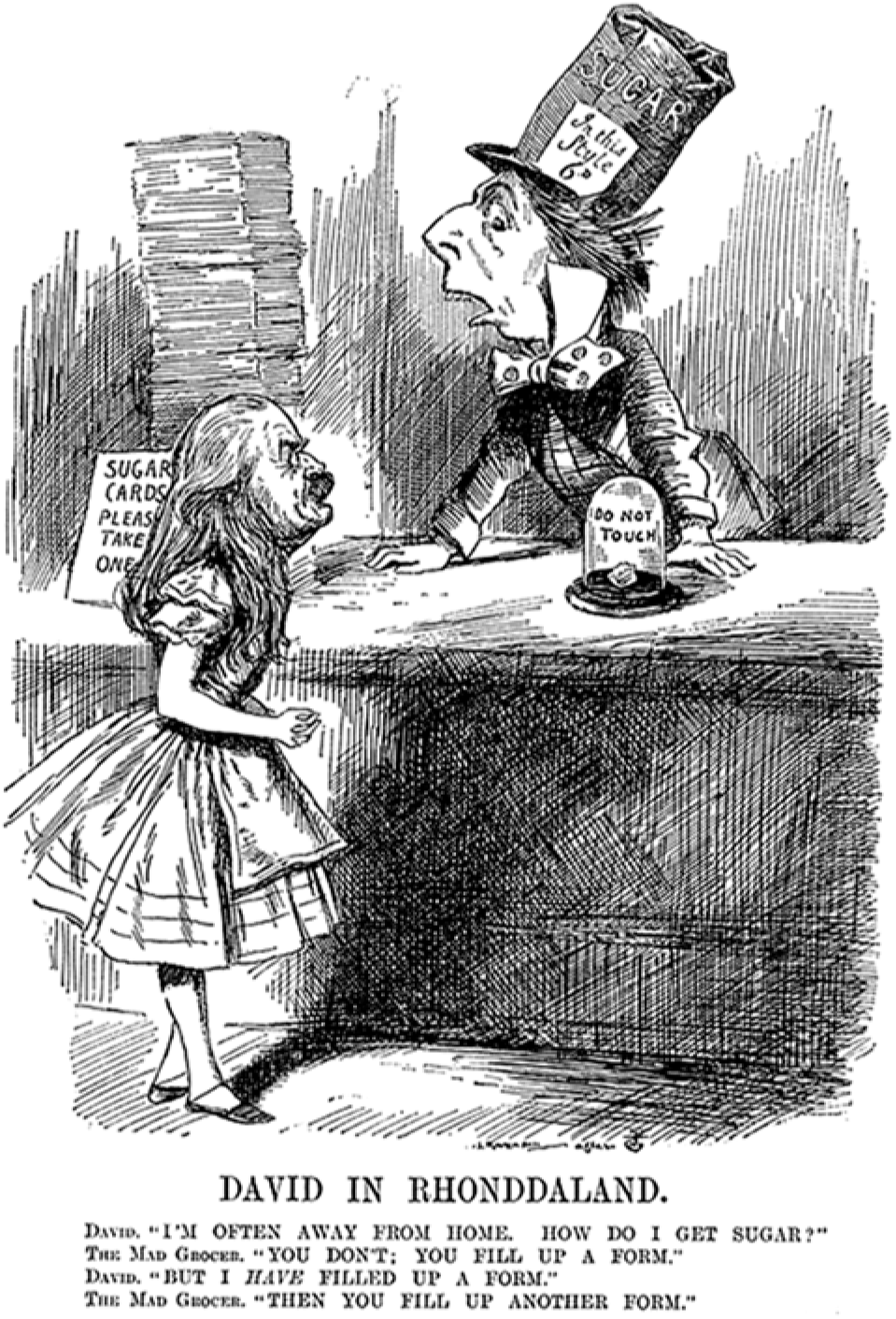
One of the key reasons for this reversal was the realisation among both the general public and even officials that there were major flaws in the sugar scheme, which had been endorsed, in principle, by the War Cabinet. One of the most evident of these was that as it was based upon households, and it was not possible to deal with the ‘nomadic’ part of the population. These included not only soldiers and sailors on leave, but mobile individuals and those with no fixed abode. As a Punch cartoon satirised (see Figure 1), the Ministry had no coherent plan to deal with individuals of this type. In an effort to resolve these issues, Alfred Butts appointed another committee. Although the committee proposed a number of minor changes to resolve the problem, its chairman criticised the whole system and advocated more radical changes, at which point (according to Tallents) Rhondda ‘took fright’ and persuaded the War Cabinet to change it to a full rationing system.44
Punch cartoon, 5th December 1917, illustrating the bureaucratic difficulties inherent in resolving the sugar shortage for nomads.

The possible breakdown of the sugar-rationing scheme led to Vivian and his staff beginning work on a Central Register of the country’s inhabitants. This was intended to provide a way of assisting those who had difficulty in registering locally. It was also envisioned that those who had initially registered locally would re-register as individuals, and that their details would in time be added to the Central Register. Vivian was keen to stress that this was purely an emergency measure due to the urgency of the situation.45 Neither Beveridge nor Vivian mentions that it would fall to local post offices, which would have to deal with most of the work involving the issuing of ration coupons to the ‘nomads’.46 It was originally anticipated that the local post offices would undertake this as part of their routine work, in a similar way to which they had dealt with ‘nomads’ in the sugar-rationing scheme. But the Postmaster General was opposed to that.47
As a result, it was necessary for the scheme to be administered by local food offices. The plan was to establish 6,000 of these, which would be appointed and coordinated by the regional food controllers, who were directly responsible to the Ministry of Food. A system of this type would take responsibility away from the Local Food Control Committees, which were under the jurisdiction of local authorities. Vivian and his supporters in the Ministry were sceptical of the willingness of local authorities to work with, or even take instructions from, central government. As Vivian later noted, ‘the local authorities behind the Food committees had evinced an attitude of independence and of resentment at interference in what they thought to be their own functions in regard to food.’48 In contrast, Beveridge and Tallents, the avowed apologists of decentralisation, strongly objected to this plan, which led to what Tallents described as ‘one of those battles of death, which are not rare with government departments’.49 According to Vivian, a stalemate ensued, between ‘those who wanted the local work of registration being performed by local officers of the Ministry of Food, [and] there was an equal insistence in other quarters upon this work being entrusted to local authorities’.50
To compound the problem, while this conflict was fermenting, Rhondda continued to be indecisive, failing to show clear leadership in terms of favouring one scheme or the other. In order to introduce a new rationing scheme, it was necessary to secure the War Cabinet’s approval. His presentations also appeared tentative and ill thought out. On 14th November he presented a memorandum to the War Cabinet on food rationing, and the machinery that would be required to make it work effectively. He argued that the time had arrived ‘for the compulsory rationing of essential food’.51 While the threatened food crisis would not materialise until March 1918 it was essential, he argued, that a decision was taken on the way forward by the end of November at the very latest. Not only would the system being prepared by the Ministry take at least four months to go into operation, but on Rhondda’s own admission no work had yet been undertaken on it.52 One of the integral aspects of the proposal was that the Post Office would be responsible for undertaking the task of issuing the rationing coupons, a proposal which the Postmaster General took strong exception to, and Rhondda was forced on 14th November to issue an amendment.53
This required Rhondda once more to prevaricate. At the War Cabinet meeting on 28th November, Rhondda now explained that he only wanted them to commit to the principle of a compulsory rationing system. Indeed he ‘was strongly opposed to rationing if it could be avoided’.54 He also suggested that by April the food situation might have improved, so that compulsory rationing would no longer be necessary. However, by this time several hundred thousands of pounds invested in the planning stages would have been wasted. Given that the proposed scheme would not be able, as originally proposed, to use the post offices to coordinate the distribution of rationing coupons, the War Cabinet decided that they required further details of the plans before arriving at a decision.
A committee was appointed at the end of November to respond to this request.55 Consisting mainly of officials from the Ministry, and including the apologists of centralisation Beveridge and Tallents as well as their arch opponent Vivian, this was where the battle that Tallents had previously referred to was fought out. A memorandum based on their report was presented to the War Cabinet on 24th January 1918. This recommended the development of a central index to check on fraud and duplication and that the Food Control Committee would prepare the local registers and administer the scheme.56 On 30th January, the War Cabinet authorised the food controller to introduce as soon as possible a national system of compulsory rationing, although only for meats and fats.
In spite of all the delays, debate and near breakdown, little had been gained. With the exception of the central index, the scheme was basically identical to the one proposed by Tallents and Beveridge in December 1916. Rather surprisingly, Rhondda and Vivian considered it possible to establish a central register of the total population, as well as organise and staff 6,000 local food offices, without utilising the knowledge and administrative of local authorities. By April 1918, when the index was finally abandoned, only three million out of a total population of more than forty million had been registered.
The worsening of the food crisis
The food crisis continued to worsen during 1917. Peter Dewey’s detailed research into food consumption levels has shown that in late 1917, there was an average 9 per cent fall in the calorific value of food consumed by the working classes.57 There were a number of reasons for this. One of the most obvious was the German submarine campaign. As the official history of seaborne trade shows, while the estimated weights of imports declined from 45 million tonnes in 1916 to 37 million tonnes in 1917, this was possibly not as disastrous as might appear at first glance. Measures were introduced to deal with the losses, including the curtailment of imports that were considered to be non-essential or for re-export, and priority was given to munitions and food.58
Food supplies, particularly to the capital, were also disrupted by the war. For example, in the early summer of 1917, six ships discharged their cargo amounting to 27,000 tonnes at Plymouth. This had originally been bound for London, but had been diverted because of the threat from German submarines. As a result of transport problems, only 7,000 tonnes were eventually forwarded.59 There were also numerous and widespread claims of food looting at the dockside, because of the lack of transport.60 Priority was also given to the transportation and supply of meat to the military.61 This meant, for example, that most imported meat was diverted for military consumption, and a shortage of cheese in late 1917 was primarily the result of efforts to build up army stocks.
Another cause of shortage, both locally and nationally, was the prevailing system of price controls and schemes for determining fair profit margins for producers, distributors and retailers. The introduction of these had been some of Rhondda’s first actions following his appointment as food controller. The aims of such directives were to counter working-class concerns over high prices and accusations of profiteering. Paradoxically, these controls had an adverse effect on those commodities whose price was controlled. For example, Holland and Scandinavia, which had previously exported margarine and butter to Britain, following the imposition of the price controls now diverted to other markets where they could obtain a higher price. In a similar way, in November 1917 the number of pigs sent to Birmingham pig markets declined from an average of 5,000 per week to 750. A large part of this shortfall had originated from Ireland, but the supply had virtually ceased because of a maximum price order.62
One reason suggested by Lord Rhondda for the shortage of certain supplies was the reluctance by the Treasury to give the Ministry greater financial freedom to purchase food from overseas. The Buying Commission in America was unable to purchase foodstuffs for more than three weeks in advance because of a lack of money. He also suggested that in spite of the acute and growing scarcity of fats in Britain, the Commission had been forced to turn down an offer of 10,000 tonnes of lard, solely due to the lack of money.63
The food crisis intensified in November 1917. Inspectors reported that in Birmingham there were long queues for butter and margarine as well as concerns that munitions workers, who could not queue as a result of their work commitments, would be unable to secure supplies.64 By mid-December, reports from London described instances of as many as 3,000 people, often women along with their children, waiting in thick fog and intense cold for margarine.65 In Lichfield, it was reported that flocks of people came from outlying areas to stand in queues, often two hundred yards long and six deep, with many being forced to go away empty handed.66 For many, this appeared to be the period when the war on the home front reached its lowest point.
Such experiences led to social unrest, which spilled over into strikes and walkouts among industrial workers. For example, in Walsall 7,000 miners threatened to leave their work and join the queues. As their leaders explained, ‘they could have work at any time, what they wanted now was food’.67 Lloyd George recorded in his memoirs, that ‘organised labor which had hitherto been opposed to compulsory rationing declared itself at the end of December 1917 in favor of it’.68 According to the leadership of the Labour Party, including J. R. Clynes who was eventually to succeed Rhondda as food controller, compulsory rationing would not be acceptable to the working classes. As Margaret Barnett has astutely observed, where they got this idea from is a mystery as organised labour had been actively campaigning for the control of food distribution and the rationing of certain types of food since the early days of the war.69
At this point the events of the Russian Revolution were a matter of concern for the British establishment. A number of commentators, both in the press and members of the government, expressed anxiety at what was regarded as the ‘evil of the queue’. The Herald noted with alarm that ‘almost all revolutions start because people wait in crowds for food’, while the more conservative Times speculated that food queues were a ‘fertile source of grumbling and discontent’.70 The Ministry of Labour was even rash enough to suggest that the ‘revolutionary element of Red Clyde was using the food queues as a means of developing their own agenda’.71
Problems of central and local food control
It was these growing concerns that prompted the deadlock within the Ministry of Food over central and local control to be finally resolved. At the instigation of Birmingham City Council, local food control committees and retailers were prompted into developing a local rationing scheme. Supporters welcomed the scheme on the grounds of decentralisation. As early as December, Pontypool and Gravesend had pioneered the development of a voluntary rationing scheme. This was followed shortly afterwards by Birmingham, which was the first large authority to introduce the scheme.
Practical ways of dealing with the queues were initially considered at a joint meeting of the Birmingham Food Committee and leading members of the city’s grocery trade on 7th December. As a result, the decision was made to establish a small joint committee, which because of the gravity of the crisis, met later on the same day. Based on their experiences with the original sugar scheme, this group decided that it was necessary for householders to be registered with a particular supplier, and that the experimental scheme should initially deal with tea, butter and margarine. In order to ensure that the scheme was able to operate effectively, it was also deemed essential that the local food control committee should be able to have control over the supply of these commodities. In order to guarantee that it worked effectively, the committee also reserved the right to restrict the number of customers who could register with an individual retailer.
On 10th December, these proposals were endorsed at a meeting of more than 200 grocers and retail distributors, who pledged their support for the initiative.72 At a conference the following day, which was attended by the Lord Mayor and leading grocers, the scheme was agreed, subject to it being approved by Food Controller Lord Rhondda. This approval was granted when the Lord Mayor and a number of local representatives met with Lord Rhondda the following day, and it was also then decided to implement the scheme on 1st January 1918.
Leading members of the Ministry, including Lord Rhondda, had in fact played an important role in unofficially promoting the initiative. Prior to the meeting in Birmingham, on 7th December Lord Rhondda had engaged in detailed discussions with the local divisional food controller, R. J. Curtis, in respect of dealing with queues and how the problem could be addressed at local level. Stephen Tallents had also produced a memorandum on the issue, in which he advocated that consumers should be required to register with a particular retailer for certain foods. Tallents also suggested that with the backing of the food controller, it should be possible to trial such a scheme at the local level. A handwritten note on the side of the original memorandum states: ‘Mr Curtis tells me that Birmingham are prepared to do this.’73 On 8th December Tallents informed Beveridge that Leicester was also in the process of drafting a scheme.74
On 19th December, Tallents revealed that local schemes were also being considered in Sheffield, Reading, Preston and Chesterfield, and that he had arranged to send reserve supplies of margarine and tea to these areas in order to ensure that these initiatives did not fail. In the memorandum, Tallents outlined two alternatives. One option was to wait until the results of these schemes had become available, and it was possible to introduce a comprehensive national scheme. The other alternative was immediately to implement a general rationing scheme, which would be enforced by order rather than by elaborate machinery. Tallents’s paper was discussed in detail at a meeting of departmental chiefs, and it was only following what Beveridge called ‘a prolonged departmental discussion’ that these ideas were accepted.75 The decision to run the scheme by order, marked a radical departure from the ideas for a comprehensive rationing system that had been considered over the previous nine months. In effect, it heralded the adoption of decentralisation.
On 21st December, the Ministry of Food issued the Food Control Committee (Margarine Requisition) Order, which empowered local authorities to requisition surplus stocks of margarine from retailers and distribute them to other retailers in the area. The following day, the Food Control (Local Distribution) Order gave authority to the committee to develop their own schemes subject to them meeting the approval of the food controller. The local committees were also informed that it was their duty to put an end to queuing in their districts. The only problem was that in terms of implementation many food committees were too small to develop their own viable scheme, and neighbouring committees were required to devise uniform schemes in order to be granted approval.76 Such an instruction was very hard on the committees, who had little power to control either supply or distribution. At this point, Lord Rhondda attempted to revive the much-vilified voluntary rationing scheme and economy drives, in an almost desperate attempt to restrain the demand for food. His efforts tended only to inflame the situation, encouraging demands for positive action, preferably in the form of a compulsory rationing scheme. Queues were not only regarded as undermining morale, but also as fermenting social unrest and raising the fear of revolution, in particular that of Bolshevism.
These concerns eventually prompted the War Cabinet to authorise Lord Rhondda to introduce a national compulsory rationing scheme. On 1st January 1918, sugar rationing began in Britain. For the first time in Britain’s history, there was to be a national compulsory system of rationing. At the same time, a number of local rationing schemes were also being introduced. Birmingham’s scheme, which started on the same day as that for sugar, ensured that one million of the town’s citizens when purchasing tea, butter and margarine were now restricted as to how much they could buy and where they could buy from. Four days later, delegates met to discuss a similar scheme for London and the Home Counties, which would eventually encompass ten million people. By 22nd January, 170 schemes, many covering extensive areas of the country, had been drafted for approval.77 Not surprisingly, these schemes were not implemented without difficulty and confusion. In Birmingham, for example, the distribution of tea, butter and margarine was still administered by the wholesalers. Although they were in theory under the supervision of the food control committee, they could still decide which retailers would be supplied and how much they were to receive. As one local official lamented, ‘a rationing scheme and the preservation of the ordinary channels of trade seem to be entirely antagonistic’.78
Immediately after Christmas 1917, an even more serious crisis emerged due to the virtual disappearance of meat in a number of areas. As early as mid-November 1917, Lord Rhondda had been formally warned of an impending meat shortage, but he had made little attempt to deal with this. As Beveridge later admitted, ‘it was certainly one (foodstuff) to which little attention had been paid’.79 In part, this neglect reflected the view of the Royal Society’s Food (War) Committee, that as meat played only a small part in the diets of the poorer sections of society, it was only right that it should be left to the ‘natural control’ of price.80
The problem was the unprecedented reduction in meat imports. Prior to the outbreak of the war, imports accounted for 40 per cent of total supplies, whereas by 1917 imports only amounted to 12.5 per cent and most of this was requisitioned by the armed forces.81 In an attempt to address this deficiency, the Ministry of Food embarked on a series of controls, to regulate the meat supply from the farm to the butcher. The county was divided into fourteen livestock areas, administered by its own commissioner. The aim was to ensure that meat wholesalers were registered with their regional office, and that retailers could register with only one wholesaler. Retail prices were limited by an order on 3rd September, restricting butchers’ profits to a maximum of 2½d per pound, which was very generous, when compared with the ½d to 1d margin, which was common in the prewar meat trade.82 In an effort to encourage farmers to sell their animals promptly, and to increase the meat supply, the Ministry introduced a descending sliding scale for fat cattle sold between September and January. Unwillingness of farmers to proceed with increasing their tillage acreage, as stipulated under the wartime ploughing-up scheme, led to the food controller, until Lord Milner’s direction, imposing a low and decreasing scale of maximum prices for fat cattle.83 Maximum prices were 74s for first-grade cattle in September 1917, falling to 67s in November and December, and there was a fixed ration for feeding stuffs for animals. The scheme was specifically intended to penalise those farmers who, fearful of having insufficient labour to undertake the additional work of arable farming, were reluctant to plough up their grassland.84
Such a scheme prompted farmers to sell their animals earlier in the season than normal, leading to an initial glut followed by a shortage in the new year. At Leeds cattle market, for example, there were normally 600–800 cattle for sale in the first week of the year, whereas in 1918 there were only 14. As sheep were excluded from these price controls, the beef shortage led to excessive slaughtering of sheep, many of which were ewes, a process which in turn depleted the size of the breeding flock for the following year. The meat crisis was further compounded by the innate conservatism of consumers as a result of their objection to having fish as a substitute for meat for their main meal.85
In a desperate attempt to address the meat shortages that were particularly evident in urban areas, a number of authorities began to introduce their own locally-based schemes. In Birmingham, for example, in an attempt to reduce purchases, the Food Committees stressed that butchers were only able to acquire half of their normal supplies. In addition, a committee of local butchers was established, in order to purchase fat cattle at local livestock markets.86 The food committee had assumed that butchers would only serve their local regular customers, but this appeal proved fruitless. On 19th January, meat queues were yet longer with some customers claiming that they had not been able to secure meat for two weeks.87 In London, the situation was even worse; with at peak an estimated 1.5 million people in queues. Press reports indicated that the mood in these queues was deteriorating rapidly and attitudes were becoming more hostile. In Birmingham, women who had completed their night shifts producing munitions had to stand in food queues for several hours, in order to obtain food for their families. Ad hoc attempts by employers were made to deal with this, by issuing tickets confirming that they were employed on vitally important munitions work, requesting that the policemen controlling the queues should grant them preferential treatment. This rapidly proved ineffectual, as the requests were so numerous the police ignored them.
Concerns about the gravity of the situation were articulated by a number of trade union organisations that were campaigning for a peace truce which, according to one Birmingham councillor, was along the lines that ‘the Bolsheviks were working for in Russia’.88 The food shortages were also having an effect on the morale of the troops. There were clear indications that while the troops embraced without question their duty to fight for King and Country, they were unhappy with their wives and mothers having to spend up to several hours each day waiting in queues for the basic necessities of life. Not only was this evident at first hand to the troops on leave, but many letters to the men lamented the amount of time those left at home were having to devote to queuing for food.89 But even though the War Cabinet acknowledged the change in attitude, it was not until 30th January 1918 that it finally allowed Rhondda to introduce a national scheme of compulsory rationing. The working classes were also actively campaigning for the State to do something about queues. This coincided with the introduction of a scheme for rationing in London and the Home Counties. It also encompassed a plan to ration meat in addition to butter and margarine. The introduction of these schemes was the initiative that Rhondda had little direct involvement with, and consequently does not really deserve credit for.
The main focus of the food economy measures was to ‘Eat Less Bread’. In order to economise in the use of wheat, the extraction rate was increased, as well as the wheat flour being supplemented with the addition of other cereals such as barley and even the use of potatoes. In January 1918, a representative of the Ministry met the local bakers in Leicester, in order to encourage the use of potatoes. As a result, many of the local bakers purchased machinery specifically for this purpose, which enabled the use of potatoes to average six tonnes, twelve hundredweight (cwt) per week.90
In an effort to combat the public’s opposition to the use of potato flour in bread, the editor of the Leicester Daily Post reported that outwardly the loaf was attractive, the crust crisp and brown, and when cut to be of good colour. Taste was reported as excellent, with the editor appealing to the public to give a trial to bread in which potato flour formed a part.91 The food economy campaign was considerably more successful in Leicestershire than other regions. Leicester was one of the first places to have a butter and margarine ration, and meat rations.92
In terms of meat supplies, the main shortages were evident in the large industrial centres, such as London and Birmingham, which depended heavily on imported meat, complemented with cattle, sheep and pig sales at the livestock market. In the larger conurbations, sales were undertaken in a rather impersonal way, with few of the buyers and sellers having a high degree of personal contact. Large markets operated more like a machine, and were less of a friendly gathering than smaller ones. In contrast, Leicester was a smaller urban centre, well served with a multitude of proximate livestock markets including Ullesthorpe, Hinckley, Loughborough and Melton Mowbray, which benefited from much higher degrees of personal contact. Farmers were reluctant to withhold their sales as they were financially committed to dealers and auctioneers, and found it difficult to break away from previous relationships. Rural and even semi-rural areas were considerably less affected by the wartime food shortages that were so evident in urban centres, in towns that offered fewer opportunities for inhabitants to grow some of their own food.
On 22nd February 1918, Lloyd George, Bonar Law and General Bonham-Carter visited Rhondda in an effort to ‘discuss’ the ongoing food crisis. Tallents, who also attended the meeting, described Lord Rhondda as a ‘bullied schoolboy, powerful but obviously perplexed, while his visitors standing over him, cross examined him about his plans for ending the queues’.93 Two days later, Lloyd George discussed the possibility of sacking Rhondda. If he had been sacked at this point he would have been considered a spectacularly incompetent food controller, possibly far worse than his predecessor.94
Even Beveridge, his most loyal supporter, was later to admit that Lord Rhondda’s response was to bring about a near breakdown within the Ministry. This was accompanied by a detailed discussion about reconstituting the Ministry into its component parts, namely Home Production, Foreign Purchase and Distribution and Control of Prices. Each unit would operate under the leadership of a separate Minister, and would meet as a board, which would be chaired by a member of the War Cabinet.95 Unwilling to be demoted to Director General of Distribution, Rhondda considered resigning.96 According to Beveridge, Rhondda tried as far as possible to avoid becoming involved in these discussions about his own future, or even that concerning the possible reorganisation of the Ministry.97
This coincided with the introduction of a locally-based scheme for rationing in London and the Home Counties. The introduction of these locally-based and directed schemes, introduced by regional authorities, were initiatives that Rhondda had little direct involvement with. He hardly deserves credit for them. It was the success of these locally coordinated rationing schemes that literally saved Lord Rhondda’s reputation. It is easy to exaggerate the role this national rationing scheme played in dealing with the food crisis. Although there was a definite decline in the supply of food in late 1917, this was only temporary and supply rapidly returned to prewar levels within the next few months.98 Social unrest over high food prices declined rapidly in 1918 when the supply of food improved following the introduction of a better coordinated convoy system and more effective anti-submarine measures to deal with the threat posed by U-boats. It would be completely disingenuous to claim that the increase in the supply of imported food was the direct result of any initiatives attributed to Lord Rhondda.
On 14th July, order was finally brought to the plethora of confusion when a national scheme was introduced. This scheme was based on individuals, who were directly linked to particular retailers. Rationing now encompassed meat, sugar, butter, margarine and lard. The scheme also involved bacon, but because of a buildup of stocks by the end of the month, it was removed from the list. Eleven days before rationing was introduced on 3rd July Lord Rhondda died, possibly in part induced by the stress he had been subjected to as food controller.
His death was accompanied by outpouring about his remarkable achievements, which helped to firmly cement his reputation as a leading figure in solving the food crisis. Following Rhondda’s funeral, in a private letter Beveridge claimed, ‘we are burying a popular idol who has achieved something like a miraculous success in every home in the country’.99 The Times subsequently eulogised Rhondda as ‘the greatest of food controllers’.100
The role of food control during wartime: conclusions
To claim that there was a centrally devised and coordinated rationing policy, during Rhondda’s period of tenure as food controller, is at the very least a misnomer. A policy implies that the plan is clear, coordinated, comprehensive and finely organised. This investigation of the unpublished records of Ministries of Food, Labour and contemporary newspapers shows that a coherent rationing policy, during Rhondda’s period of tenureship, was practically non-existent. His indecisiveness, in particular, led to confusion in the Ministry, rather than the evolution of a comprehensive rationing policy. As there were only a few ill-coordinated schemes to reform the distribution of food, it is not surprising that there was widespread working-class discontent, which some considered might precipitate a revolution. Because of this fear, some within the Ministry were forced to circumvent the system and encourage local agencies to develop their own rationing system. The multiplicity of these local schemes led to widespread confusion, a set of problems and issues that were only fully addressed when a national scheme was finally introduced in July 1918.
Indeed, in spite of Beveridge’s unstinting praise for Lord Rhondda, a close analysis of official primary sources arguably shows that his achievements fell considerably short of being regarded as a ‘heroic age’. Even when a system for rationing had been devised, such as the one for sugar, imperfect as it might be, the Ministry of Food was embroiled in an internal battle over central control versus local autonomy, which resulted in confusion and delay. Action was needed and not merely a debate on the most efficient form of organisation. As a result of changing plans over its operation, Rhondda went ill prepared and with a poorly drafted memorandum to the Cabinet in November 1917. In spite of the entrenched opposition within the Cabinet towards rationing, it is possible that if Rhondda had pressed his case about the impending food crisis in a more forceful and passionate way this would have been sufficient to overcome their reluctance.
Instead what eventually saved Rhondda was the introduction of ad hoc rationing schemes at the local level. Their introduction was not so much motivated by injustices over the distribution system or concern for the working classes, but the fear of revolution. With the exception of late 1917 and early 1918, there was no real shortage of food. If there had been real hardship on the scale that prevailed in some other countries, such as Germany and Russia, Britain’s lack of planning might have proved disastrous and the threat of revolution become a real possibility. In this event, Rhondda’s heroic age of food control would have been hailed as a disaster, rather than being praised in the annals of food history. Whatever lessons the British government learnt from the experience of food control and rationing in the First World War, it would be misleading, in the style of many contemporary accounts, to accredit Lord Rhondda as the person ultimately responsible for solving the wartime food crisis, and thus saving the nation from potential starvation. This case study serves to remind us of the difficulties of ensuring that the nation is adequately fed, and demonstrates that local initiatives are just as, if not more, important than a national system. In an age of potential climate change, and the threat that this poses to ensuring food security, this is a lesson that the country might decide to ignore at its peril.
Acknowledgements
I would like to thank Professor Keith Snell and Dr James P. Bowen for their constructive comments and unstinting assistance with this article.