Peacekeeping has been on the international agenda for a long time, but only relatively recently have peacekeeping activities been analysed with rigorous social scientific methods.Footnote 1 Cross-country empirical studies have tested competing hypotheses on the determinants of peacekeeping deployment, taking into account the motives of the countries that provide the troops as well as the features of the conflicts.Footnote 2 The effectiveness of the UN missions has usually been assessed by looking at the duration of peace after civil wars. Several studies have found that peacekeeping seems to help stabilize conflict-torn countries, decreasing the likelihood of recurrent conflict.Footnote 3 However, these conclusions have been questioned due to sample selection problems and statistical models dependence,Footnote 4 and several studies find that peacekeepers seem to have little effect on reducing the risk of renewed warFootnote 5 if they intervene in ongoing conflicts. Even though more comprehensive, multidimensional peacekeeping missions certainly have obtained some valuable results,Footnote 6 they have not completely escaped the criticism common in the 1990s that such missions do not significantly affect the conflict and sometimes have unintended consequences.Footnote 7
Recent literature on civil wars has shown that such conflicts are best understood by taking into account local-level issues and variation.Footnote 8 The outbreak of civil wars has been linked to inequality between specific groups, local features of the political and physical geography, and the location of ethnic minorities. Variation in the uses of violence during conflict has been connected to the degree of control the warring groups have on specific areas or the organizational features of groups. So far, however, there has been little attention to the local dimension in peacekeeping missions. Country-level comparative studies can certainly record outbreaks of new violence after cease-fires and may help in assessing the effectiveness of peacekeeping missions,Footnote 9 but they neglect important potential variation in the effectiveness of peacekeeping in different areas of countries. If we accept that the causes of violence are often local and conflicts often vary considerably within countries,Footnote 10 then a disaggregated approach is equally essential to investigate the effectiveness of peacekeeping missions in civil wars.
In this article I apply the disaggregated approach to studying civil wars to the effectiveness of peacekeeping by examining both where peacekeeping troops were really deployed in ongoing civil wars and their effectiveness in reducing subsequent local violence. Anecdotal knowledge abounds in studies about conflicts, but the available local narratives tend to be incomplete and biased. I perform a systematic analysis, using new high-quality disaggregated data on violence and peacekeeping in the Bosnian conflict (1992–95), which allows us to consider important and valuable information on the local variation across Bosnian municipalities over the duration of the war.
Bosnia-Herzegovina is an interesting case for assessing the effectiveness of peacekeeping, for a number of reasons. First, it is at the centre of a debate concerning not only the goals achieved, but also the inherent nature of the mission. Bosnia is not a case of a typical peace enforcement operation, but there was no peace ‘to keep’ either, as the personnel on the field operated during a conflict. General Rose, head of the UN forces in Bosnia in 1994, maintained that the mission was a case of peacekeeping,Footnote 11 while Fortna leans towards peace enforcement.Footnote 12 Moreover, the Bosnian War was an intense conflict that took place in a well-defined and relatively limited spatial and temporal context, showing remarkable internal variation.Footnote 13 These features make the UN intervention in Bosnia a particularly suitable case to investigate what peacekeepers can do to reduce violence and what they cannot do, as well as to learn more about what it would take to increase their capabilities and effectiveness.
The findings indicate consistently that peacekeeping activities took place where most needed (i.e. in areas of intense violence), but failed to have a significant impact on the reduction of subsequent violence. Two reasons can explain these findings. First, the United Nations Protection Force (UNPROFOR) dealt with local violence only in response to events and at the tactical level. A broader strategy to reduce and possibly stop the violence, based on the features of the terrain, warring factions and ethnic composition of the population, did not exist. Developing a unified strategic plan and close co-ordination between intelligence-gathering and operations is essential for interventions in ongoing civil wars, as the forces on the ground will actually find themselves in the context of a conflict. Unfortunately, this is a particularly difficult task for UN multinational missions.Footnote 14 Secondly, the ineffectiveness of UNPROFOR in reducing violence also arises from the gap between the ‘architecture’ of the UN mission and the stringent logics of warfare. If a UN mission intervenes in an ongoing conflict, it needs to show superior size and equipment, as well as the willingness to fight, if necessary. Otherwise, deterrence will not work and the UN troops can easily become just another faction in the conflict. Unfortunately, UNPROFOR was not provided with sufficient power and credibility for reducing the use of violence by the fighting groups effectively.
Explaining Intervention: Where Do Peacekeepers Go?
Intra-state conflict has become the principal form of violent conflict in the global security environment,Footnote 15 and this has intensified the focus on finding ways in which the international community can contribute to ending civil wars. There is a vast literature on peacekeeping,Footnote 16 elaborating many definitions and taxonomies to encompass the growing range of activities missions are required to carry out. As previously mentioned, Bosnia is not a clear case of traditional peacekeeping. Perhaps it would be best characterized as a ‘multidimensional peacekeeping operation’, but for simplicity I will follow the recent trend regarding UN involvement more generally and use the term ‘peacekeeping’ to refer to the mission.Footnote 17 I will mention the specific activities of the peacekeepers in Bosnia and refer to the appropriate UN documents when relevant.
Existing research has focused on two main questions regarding peacekeeping. The first refers to the decision to intervene, accounting for why some conflicts are offered peacekeepers while others are not. The decision to intervene in the Balkans and the failure to intervene in many African conflicts has sparked a harsh debate on the selection of places to intervene and the underlying rationale of interventions. The second issue concerns the effectiveness of peacekeeping interventions in bringing about the desired outcomes, for example protecting civilians and attaining durable peace.
To answer the first question, one strand of literature considers the decision-making process of the potential intervening actors.Footnote 18 This spans decision making at the national level,Footnote 19 the relationship between national actors and the United Nations,Footnote 20 or international-level issues that third parties take into account when deciding whether to intervene in an ongoing conflict.Footnote 21 Gilligan and Stedman argue that peacekeeping tends to occur in states where the risks to the intervening troops are relatively low.Footnote 22 Stated differently, military organizations confronted with politicians and advocacy groups asking for intervention to prevent further bloodbaths around the world after the Cold War may accept the challenges, but select intervention in the areas that seem the least risky.Footnote 23 Conversely, De Jonge OudraatFootnote 24 claims that UN intervention is more likely in difficult cases, where the chances of securing peace is low and the risk of renewed conflict higher. Fortna's empirical analysis confirms this view, and argues that the request for intervention from local actors is also an important factor in the decision to send in peacekeepers.Footnote 25 Gilligan and Stedman find that the total number of deaths during the conflict, as a measure of the severity of a conflict, is a good predictor of UN intervention.Footnote 26
These previous studies have investigated the factors that influence the decision to intervene through peacekeeping, but only at the level of the nation state. They do not consider local variation in the actual deployment of troops on the ground, even though recent literature on civil wars has underlined how crucial features of many conflicts are poorly captured by national measures.Footnote 27 Taking the local dimension of civil wars into account is important to assess the effectiveness of peacekeeping, as the intensity and logic of violence can change dramatically within the same country due to local variation in features such as key actors, geography and resources.Footnote 28 This article attempts to ‘disaggregate peacekeeping’, by looking at the local characteristics of conflict, the presence of the peacekeepers and its subsequent impact on conflict. A mission has barely begun once troops reach a conflict-torn country, and the context where the fighting takes place represents a constant concern to all the actors involved in the civil war, including the victims. We cannot take for granted that the troops automatically go where they are most needed, as a series of difficulties may prevent this. Once the decision to send troops has been taken, the international community may have agreed on the need to stop an ongoing conflict, but not necessarily the direct action of the peacekeepers and their role. During ongoing civil wars, communication can be difficult; roads can be interrupted or controlled by factions unwilling to co-operate with the peacekeepers; the contributing countries might be unwilling to risk their troops in armed clashes.Footnote 29 In addition, peacekeeping missions are often undermined by problems such as unclear mandates; fragmented command chains leading to contrasts and delays; or incapacity to develop a wide strategic plan.Footnote 30 So far, however, we lack assessments of the overall effect of these issues on the actual deployment of troops.
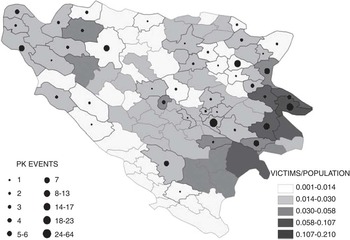
Figure 1 shows the marked spatial variation of violence and UN troop deployment in Bosnia-Herzegovina. The presence of peacekeepers can be detected by looking at the location of their activities on the ground. The map seems to indicate that the UN troops tended to go to the most violent areas, where they also enacted a number of initiatives. However, the map cannot tell us anything about the temporal variation of violence and troop deployment, and especially about the temporal ordering of these two phenomena.
UN Peacekeeping in Bosnia-Herzegovina (1992–95)
Note: The categorization has been created using the Jenks natural breaks classification method, opting for five classes of violence severity.

It seems reasonable to assume as a working hypothesis that peacekeeping forces should go to the areas where violence is most intense and the effects of the war are heaviest, even if this provision is usually not explicitly stated in the UN resolutions. In the case of Bosnia, UN Security Council resolutions 770 and 776 (1992) entrusted UNPROFOR with the protection of aid convoys and they provided grounds for intervention in Bosnia based mainly on a humanitarian logic.Footnote 31 The mandate focused primarily on reducing civilians’ suffering and, therefore, I test the more specific hypothesis that peacekeepers go to areas where civilians experience the most violence.
I also test the hypothesis that peacekeepers go to municipalities with more intense armed combat, as the most classical form of peacekeeping seeks to monitor ceasefires and keep belligerents in conflicts apart. However, even though the resolutions of the UN Security Council that led to the creation of UNPROFOR (S/RES/743–749/1992) stressed the need to ‘stabilize the cease-fire’ and the political/military situation on the ground, these resolutions were initially issued for the conflict in Croatia, and not directly or immediately applied to Bosnia-Herzegovina.Footnote 32 Under the aforementioned logic, forces should have been sent to the areas where major clashes were taking place. However, given that the mandate of UNPROFOR did not specifically include direct intervention in military battles, I expect past armed clashes to have less explanatory power than civilian casualties for the deployment of peacekeepers.
HYPOTHESIS 1. Peacekeepers will go where they are more needed, i.e. where the level of violence is higher.
HYPOTHESIS 1a. Peacekeepers will go to areas where civilians suffer the most, i.e. where the number of civilian casualties is higher.
HYPOTHESIS 1b. Peacekeepers will go to areas where armed clashes are more severe, i.e. where the number of casualties among armed personnel is higher.
Assessing Intervention: Does It Reduce Violence?
The second question concerns the impact of peacekeeping missions on violence reduction. The literature on Bosnia-Herzegovina and on the Balkan wars of the 1990s is vast and extremely heterogeneous, both in approach and in the findings concerning peacekeeping. Once again, social scientific empirical studies on peacekeeping have mostly focused on cross-national variation to investigate the effectiveness of peacekeeping operations. Doyle and Sambanis claim that multidimensional peacekeeping makes a decisive contribution to building a stable peace in countries plagued by civil wars,Footnote 33 but King and Zeng argue that their results are model-dependent and their inferences thus not robust.Footnote 34 Greig and Diehl cast some doubt on the ability of peacekeeping missions to promote peace in civil wars.Footnote 35 Gilligan and Sergenti use matching to deal with sample selection problems and find that peacekeeping is effective in stabilizing peace after civil wars, but not in bringing ongoing conflicts to an end.Footnote 36 Fortna confirms the results for post-conflict situations, but only briefly examines the effects of peacekeeping on ongoing civil wars.Footnote 37
Thus, it seems particularly important to focus on the local level and use disaggregated data to evaluate the effect of peacekeeping on a central issue in war: the intensity of violence. The peacekeepers on the ground are usually involved in multiple activities, but reducing military fighting is a central issue for interventions in ongoing civil conflicts. Both the inhabitants of the country as well as international public opinion expect this, and it is considered essential by the troops too.Footnote 38 A disaggregated analysis seems crucial to assess the action of peacekeepers during civil wars, and especially for evaluating their direct or indirect impact on violence. In fact, the logic that drives the use of violence is often strictly linked to local factors:Footnote 39 both the presence or absence of violence and its intensity show remarkable spatial and temporal variation.Footnote 40
According to the optimist view, peacekeeping should be able to reduce violence by decreasing the possibility of surprise attacks and raising the costs of aggression,Footnote 41 which would risk the involvement of international troops and, therefore, the need to fight against an additional actor.Footnote 42 Even though the peacekeepers in Bosnia were allowed to use armed force against the warring factions only in response, they were nonetheless acting within a Chapter VII mission (see e.g. S/RES/836/1993) and should have a deterrent effect. Fortna includes the Bosnian case in what she defines as ‘cease-fire-creating missions’ and finds that these missions are more effective than other types of enforcement missions. However, Fortna suggests that the results should be treated with some caution, given the small number of cases.Footnote 43 Therefore, I test the hypothesis that the presence of peacekeepers in a given Bosnian municipality will reduce the level of violence recorded in that municipality the following year. In addition, and more specifically, the local severity of violence should be affected differently by different types of intervention. I differentiate between active intervention and passive intervention according to the activities executed by the peacekeepers: the first refers to events where the personnel of UNPROFOR performed concrete actions on the ground, while the second deals with operations purely of observation and monitoring. Active intervention does not necessarily mean using military force, comprising also humanitarian assistance, such as repairing roads or restoring electricity.Footnote 44 It can involve direct contact with the warring parties or the population, and it implies a higher level of engagement than simple monitoring and reporting. This kind of action should be more effective than passive presence, as it indicates a substantial and organized presence of peacekeepers (not required for mere monitoring) and possible direct contact with the warring factions, using force in response or trying to reach agreements for improving the stability of the area and protect civilians. Nonetheless, ‘the optimist logic’ tends to overlook a structural problem concerning the presence and actual room for action of UN troops in ongoing civil wars, which military experts sometimes have highlighted.Footnote 45 If the peacekeepers have to remain neutral, they are likely to be considered enemies by all armed factions. In order for the deterrence to work, they should show overwhelming power and a real possibility of using it, both of which are unlikely features for UN missions. This circumstance might not be so problematic in accomplishing tasks such as delivering humanitarian aid to civilians who have been forcibly moved from their villages to areas that meet the strategic plans of the warring factions. However, it is certainly a constraint if the troops have to tackle the armed clashes and possibly reduce their severity.
HYPOTHESIS 2. The presence of peacekeeping troops should reduce local violence in the period following the intervention.
HYPOTHESIS 3. Active intervention of peacekeeping troops should be more effective in reducing violence than monitoring and assistance activities.
Data and Methods
Dependent and Independent Variables
The first part of the empirical section investigates the reasoning that drives the deployment of peacekeeping troops on the territory of the state where the conflict takes place. The second assesses the impact of the peacekeepers on the level of local violence. In both parts, the municipalities of Bosnia-Herzegovina represent the units of analysis, while the dependent variables change. The intensity of violence (against civilians, among military groups, or total) is expressed by the logged number of deaths that have been recorded in each municipality. The data have been derived from a new dataset obtained from a recent research project carried out by the Research and Documentation Centre of Sarajevo (RDC)Footnote 46 under the auspices and financial support of the Norwegian Ministry of Foreign Affairs. The project took place with the aim of building the largest database on the victims of the Bosnian War, grounded on primary sources about the single victims, without resorting to large-scale estimates. The whole process took more than three years and was finally assessed by an international committee composed of experts in gathering data concerning conflict victims and massive human rights violations. The staff of the RDC collected data from primary and secondary sources such as local civil registers, military lists and newspapers articles. All the entries were double-checked using more than one source, including more than 50,000 photographs, 8,000 oral statements and 3,500 hours of video material. The researchers also visited 363 mass graves, and the names only of the victims for whom well-documented proof exists were included in the database. The database includes only persons who were killed or kidnapped during direct military activities. Considering that the hostilities came to an end fifteen years ago, in this study the missing persons are equated with dead ones. According to written documents or declarations of eye-witnesses, these persons did not move because of free personal decisions, but disappeared as a consequence of military activities: the typical case may be characterized as that of persons taken away by the armed groups of the opposing ethnicity who never returned home. Their bodies have not been found, but the researchers could not find any evidence that they escaped the violence of the war and settled somewhere else. Since the administrative structure of the Bosnian state has now been reconstituted, national and international organizations have promoted policies to help refugees re-enter Bosnia-Herzegovina, refugee camps do not exist anymore and the human rights agencies have co-operated to circulate relevant information about the victims of violations and abuse, it is unlikely that persons who are still ‘missing’ as a result of military action have been mistakenly considered refugees and are still alive. At least, it is highly unlikely that they add up to a significant number.
Data concerning the peacekeeping troops derive from another new source; the latest version of the Peacekeeping Operations Location and Event Dataset (PKOLED), developed at the Department of Government of the University of Essex. The project has coded all the events reported by the troops involved in the UN peacekeeping missions to intra-state conflicts in the post-Cold War period (1989–2005).Footnote 47 PKOLED provides geo-referenced information about the location of the events involving the peacekeepers, but such events do not have to be conceived only as clashes, actions or encounters with the warring parties. The database includes a wide variety of ‘events’ and some types imply a role of observers for the peacekeepers, such as interposition, monitoring or reporting. The geographically and temporally disaggregated information contained in PKOLED derives from the reports of the UN Secretary-General to the Security Council. The reports give a regular, fairly extensive and systematic account of ongoing missions. Considering the abovementioned features of the events and the regular publication of the reports, PKOLED is a suitable indirect way to locate the peacekeepers on the territory of the state under scrutiny in the absence of a full record of the orders given by the commanders of the mission. The database also keeps track of the duration of the events and divides the year into three-month periods. If an event overlaps with more than one period, then the event gets two records, accounting for the long-term placement of the troops in certain areas. The reports of the Secretary-General are public documents, so that local and international media would reveal blatant inaccuracies or misleading statements. I used PKOLED to construct a dummy variable that equals 1 when peacekeeping troops are present in a given municipality. As has already been mentioned, PKOLED also includes a dummy variable that detects cases of active involvement of UN troops in the events, distinguishing them from pure monitoring.
Control Variables
In order to assess my hypotheses effectively, I control for the other major variables that might affect the processes under scrutiny. The ethnic dimension cannot be excluded from analyses of violence and intervention in the Bosnian War. Ethnic polarization measures to what extent the distribution of the groups in an area resembles a bimodal distribution. Therefore, it takes into account the relative size of groups, since it reaches its maximum when two groups have the same size. It seems reasonable to assume that peacekeepers would have been deployed in highly polarized areas as they were perceived to be more risk-prone. In a context like Bosnia, where groups mobilized along ethnic lines and the war was fought with symmetric military technologies,Footnote 48 ethnic polarization seems particularly important for capturing social conflict and the power of groups.Footnote 49 In areas where two groups of similar size are present, violence could be particularly harsh, as the struggle to control the area will inevitably be tougher.Footnote 50 Ethnic polarization has been calculated according to the method used by Reynal-Querol.Footnote 51 Data concerning population and its ethnic composition come from the Yearbooks of the Bosnian National Institute of Statistics (BNIS) and they refer to the last national survey that was carried out in the country in 1991, right on the eve of the war.Footnote 52 Thus, ethnic identification was self-designated before the outbreak of war and not driven by violence. It would be ideal to have data on the ethnic distribution of the population during the war, but to my knowledge such data are not available for the Bosnian conflict. The population of the municipalities in the years between 1992 and 1995 has been calculated by subtracting the number of fatalities that occurred in each of the previous years. All models also include the total population of the municipality under scrutiny as a control variable.
Another relevant issue deserving attention when dealing with civil wars is the presence and actions of bordering countries that intervene directly or indirectly in the conflict, as the political geography of the context in which military operations take place affects the likelihood of onset as well as the course of violence.Footnote 53 If contiguous states decide to intervene directly in order to ‘protect’ co-ethnics, respond to incursions (or risks thereof) in their own territories, or expand their influence in a situation of crisis,Footnote 54 bordering areas could be marked by high levels of violence. The same should happen if external states intervene in the conflict indirectly, providing support to one faction and relying on it to reach the aforementioned goals. Here, I control whether the municipalities were on the borders with Serbia and Croatia. As external decision makers could have appraised the importance of external borders in shaping the patterns of conflict, I could expect a higher probability of troop deployment on the borders of Bosnia, with the aim of avoiding or at least reducing the spillover of the conflict across the region.Footnote 55 Moreover, I check whether the municipality under scrutiny was on what then became the border between the Federation of Bosnia-Herzegovina and the Republika Srpska. Because of the way in which the war developed, and since the peace negotiations recognized that the ‘situation on the ground’ was meant to be respected in any possible agreement,Footnote 56 I assume that harsh clashes could have taken place in such areas, giving rise to relatively higher levels of violence, especially in the second half of the war. Accordingly, one could expect peacekeepers to take such military issues into account and monitor those areas carefully.
I also control for a set of variables concerning the nature of the terrain and the strictly geographical dimension of the war.Footnote 57 The first variable is a proxy of ‘open terrain’: a terrain free from dense vegetation (such as forests) and without mountains, that would provide better shelter and space for action for insurgent-style operations. The second variable, by contrast, measures urbanization and, therefore, detects areas densely populated by civilians. Peacekeepers could follow different types of logic in dealing with these issues,Footnote 58 but they both seem operationally relevant and thus possibly important to understanding troop deployment at the local level. Lastly, analysing troop deployment, I also check for income level, as decision makers might have considered this when assessing risk. The open terrain variable is simply the percentage of cultivated land relative to the total surface of each municipality, while the urban areas variable indicates the percentage of municipal soil occupied by buildings. Both these two variables and the income per capita derive from the statistics of the BNIS and they refer to 1991.Footnote 59
Methods
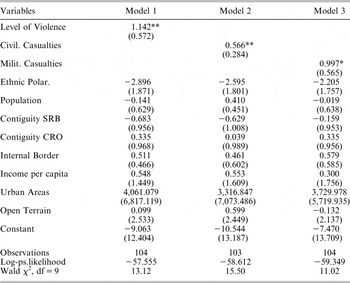
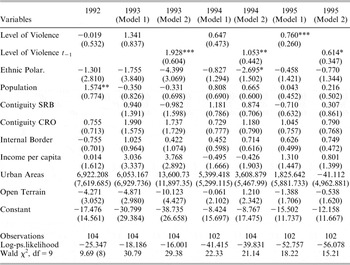
The first part of the quantitative analysis, focusing on the location of the troops on the ground, is based on logistic regressions. Table 1 shows a series of logit regressions performed on data that represent the four years of war as a single time period. Given the relatively small number of cases, there might be risks of non-independence among the observations and, therefore, the standard errors reported are calculated through bootstrapping. This procedure executes the same operation many times, re-sampling the observations and replacing them in the dataset. The tests performed did not show relevant problems of heteroscedasticity. Table 2 shows another series of logistic regressions on the presence of peacekeeping troops, but this time the data refer to each single year of war. The aim of this two-step strategy is to study whether the determinants of troop deployment on the ground change in the different phases of the war, especially as concerns the relationship between violent clashes and the intervention of peacekeepers. In the models of Table 2 I include both the level of violence in the year in which the presence of peacekeepers is recorded and the level of violence in the previous year. Through this strategy I can detect any temporal lags there may be between intense violence and intervention by UN troops.
Presence of UN Troops in Bosnia-Herzegovina: Logistic Regressions on the Whole War

Note: Bootstrap standard errors in parentheses. *p < 0.10; **p < 0.05; ***p < 0.01.
Presence of UN Troops in Bosnia-Herzegovina: Logistic Regressions Year by Year

Note: Bootstrap standard errors in parentheses. *p < 0.10; **p < 0.05; ***p < 0.01.
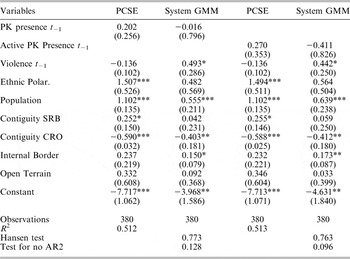
The second part of the quantitative analysis (Tables 3–7) considers the impact of peacekeeping intervention on the severity of local violence. For this reason, I used data concerning the presence of troops on the ground and their active behaviour in the year before the number of casualties was recorded. This allows us to assess whether the level of violence in t 0 was affected by the presence and activities of UNPROFOR in t −1. Studying the effects of the presence and work of peacekeepers on the level of local violence in the same year would involve two problems. First, it would magnify the potential problems of endogeneity, as the peak of violence could have been recorded months before the actual deployment of the troops in the area. Secondly, it would not allow enough time for a fair evaluation of the role of peacekeepers, given the many difficulties they face in a civil war context.
Effects of Peacekeeping on Violence

Note: Robust standard errors in parentheses for System GMM models. *p < 0.10; **p < 0.05; ***p < 0.01.
To test Hypotheses 2 and 3, I use one model to investigate the influence of the presence of peacekeepers and a second model to verify whether active intervention provides different results from simple presence.
Various studies based on data at the national level pointed out that peacekeeping missions are far from randomly assigned to civil conflicts.Footnote 60 This is likely to be the case at the local level as well, and may cause biased evaluations when we try to assess the effectiveness of missions. Focusing on the local level, the factors that may be responsible for non-random assignment are probably different from the ones mentioned in cross-country research. Presumably, they will be more closely linked to the actual situation of the conflict on the ground than the dynamics of international politics, but the core logic is the same. If my hypotheses about the central role of the intensity of local violence as a determinant of troop deployment are confirmed, selection problems are a serious risk. We need to be sure that the estimated effect of peacekeeping does not depend of specific features of the places where the peacekeepers went, especially the level of violence.Footnote 61 As a matter of fact, if the peacekeepers went to the most violent municipalities, a naïve analysis could understate the effect of their action, failing to recognize that the possible scarce effectiveness of peacekeeping is actually a consequence of the fact that the troops operate in areas which are more violent than the average. For this reason, we should compare pairs of locations with similar features (and above all pre-peacekeeping violence), where one received the troops and the other did not. This is exactly the basic idea behind matching, the nonparametric method that I use to select an appropriate sample of cases – thus reducing the selection bias – and check the robustness of my results. The usual way to address this problem is using a Heckman selection model,Footnote 62 but no reliable instruments for the severity of violence are available and recent studies have questioned the validity of estimating the causal effect of UN intervention with Heckman models.Footnote 63
Since endogeneity between the level of violence and the presence of peacekeepers cannot be excluded, even though the variable that detects the presence of the troops is lagged by one year, I decided to follow an instrumental approach via a system GMM.Footnote 64 This technique leads to consistent and efficient estimates,Footnote 65 improving the ‘difference GMM’ previously introduced by Arellano and Bond.Footnote 66 This method corrects for potential endogeneity by using moment conditions to derive a set of valid instruments for the potentially endogenous explanatory variables. It also corrects for serial correlation, controls for fixed effects and heteroscedasticity of unknown form.Footnote 67 Yearly dummy variables have been included in the models but are not shown in Table 3. Before using system GMM, I performed preliminary analyses using time-series cross-sections with lagged dependent variable and panel-corrected standard errors.Footnote 68
Matching selects the most similar cases in terms of all other possible causal variables and divides them into two groups: one that received the peacekeepers and one that did not.Footnote 69 In this way, I minimize the possibility that the differences between the groups can be attributed to issues other than peacekeeping. Matching seeks to reduce the imbalance between the treated and control groups, in order to study the effect of peacekeeping on a sample of municipalities with comparable levels of violence. This method will greatly reduce model dependence and statistical bias.Footnote 70 The selection process and the results are completely transparent and based on the data. It is impossible to know what would have happened had the peacekeepers not gone to a certain municipality, and the best social scientists can do is to get as close as possible by estimating the ‘sample average treatment effect on the treated’. Admittedly, selecting the most similar cases in order to estimate carefully the real effect of peacekeeping on violence reduces the number of observations. This is not a major problem in large-N studies, but in our case there could be some risks of losing relevant information. For this reason, I also show the results of parametric models without preprocessing that use all the observations. The system GMM analysis takes into account the problems aforementioned and serves as a useful comparison for the results of the regressions on post-matching samples.
Of the various matching techniques that are available, I decided to use Coarsened Exact Matching (CEM).Footnote 71 Contrary to other matching methods, such as propensity scores, CEM guarantees that the imbalance between the matched treated and control groups in the specific sample will be smaller than before matching, and it is easy to check the difference. Iacus et al. show in Monte Carlo that CEM dominates most other techniques in reducing imbalance, bias, estimation error and model dependence. In essence, CEM coarsens the independent variables, recoding them, so that very close values are grouped together. The exact matching algorithm is subsequently used to detect the matches within the coarsened data and to put aside the unmatched cases. Finally, the coarsened values are abandoned and the original values of the matched data are maintained for the analysis of the causal effect. With CEM, coarsening is executed variable-by-variable and the method allows the researcher to choose the ‘cut-points’ based on substantive knowledge of the issue and data, even though an automatic procedure is also available for comparison and for more ‘neutral’ coarsening.
The variables included in the first matching procedure are: ethnic polarization; the level of violence recorded in the municipality the previous year; the population of the municipality; contiguity with Croatia; contiguity with Serbia.Footnote 72 In the second matching I also included whether a municipality is located on what later became the border between the Federation of Bosnia-Herzegovina and the Republika Srpska, and the percentage of open terrain. In choosing these variables I tried to avoid the risks of post-treatment bias,Footnote 73 that is, controlling for possible consequences of treatment, which is sometimes mistaken for problems of endogeneity.Footnote 74 Indeed, the variables either do not change after the intervention of peacekeepers (e.g. the percentage of open terrain) or have been recorded before the intervention. With exact matching between the treated and control groups, a simple difference in means between the dependent variable in the two groups would be sufficient to estimate the causal effect, but in cases with some coarsening a statistical model allows us to deal with the remaining imbalance. The causal effect of peacekeeping on local violence was thus estimated through ordinary least squares (OLS) regressions, including the most important covariates derived from Table 3.
Results and Comments
The results emerging from the first part of the empirical analysis (Tables 1–2) show a clear and stable relationship between the location of the most violent areas and the presence of peacekeeping troops on the ground. In other words, just as previous macro level studies show that UN missions tend to go to the countries where they are most needed, namely the most violent and deadly conflicts,Footnote 75 the same rule seems to apply at the local level for the deployment of peacekeepers in Bosnia-Herzegovina. All the analyses I performed in order to investigate the contextual determinants of UNPROFOR's actual presence on Bosnian territory support the idea that the peacekeepers did not limit themselves to the easy areas of the conflict, but tried instead to address costly human suffering according to the mission and the spirit of the United Nations. Results in Table 1 prove that a higher level of violence in the municipalities is strongly associated with a higher probability of attracting peacekeepers to those areas.
Given the clearly ethnic features of the conflict, I expected a higher probability of intervention by UN troops in the more ethnically divided areas, since this kind of information was available at the time of the war. However, the empirical analyses find no support for this over the four years of the war. The only strong determinant is, again, the level of violence. While we can imagine that there were other factors in the decision-making process dealing with the positioning of troops on the ground, such aspects are probably related to the internal organizational dynamics of the contingents and, therefore, difficult to observe with this research design (and those comparable within the peacekeeping literature). What I can say is that other issues linked to the local context did not seem to have any influence on such decisions.Footnote 76
A closer look at the sub-hypotheses and at the changing weight of the variables over time offers a more nuanced picture of the deployment question. Concerning the rationale for intervention, civilian victimization is robustly linked to peacekeeping presence. Military casualties, by contrast, do not emerge as a significant variable according to conventional standards. The latter result is in line with the mandate provided by the UN Security Council, which was mainly focused on providing aid to civilians. The significant positive coefficient shown by the variable indicating civilian casualties suggests that the peacekeepers tried to deliver humanitarian assistance where it was most needed. Such assistance was more than food, including also shelter, health materials and the restoration of utilities. Yet, it is well known that the Bosnian War was a ‘war amongst the people’,Footnote 77 and this accounts for the strong result associated to the variable that detects the overall violence, including both civilian and military casualties.
The regressions in Table 2 consider the relationship between the severity of the conflict and the deployment of peacekeeping troops, taking into account variation over time. Although some limitations in the availability of data for single years prevent definitive and more complete answers, alternative possible contextual explanations for troop deployment continue to be irrelevant. The importance of violence as a reason for local intervention, instead, notably changes through the years and the peacekeepers react differently to the dynamics of violence as time goes by. In 1992, the level of violence seems to have had no significant influence on the decisions concerning where to send the personnel of UNPROFOR. In the following two years, the severity of violence recorded in the same year continues to be irrelevant as a determinant of local intervention, but the level of violence in the previous year is instead highly and steadily significant. Therefore, in the two central years of the war there is a remarkable time-gap between the actual occurrence of violence (Violence t −1 in Table 2) and the intervention of the peacekeepers in the most violent areas. The results show that in the first three years of war the troops of UNPROFOR intended to intervene where violence was particularly intense, but reached those areas with considerable delay. However, in 1995 the situation changes: peacekeeping troops operating in Bosnia-Herzegovina become more reactive. The variable that exerts a relevant impact and triggers their presence is the level of violence recorded in the same year.Footnote 78 The change in the ‘reaction time’ of the UN troops was mainly due to a reorganization of the Bosnia-Herzegovina Command of UNPROFOR operated in 1994. Two brigade-sized sectors were created together with a new Logistics Support Group. The reorganization of the Command was designed to link military and humanitarian operations into a common strategic plan. UNPROFOR's freedom of mobility was also increased, thanks to the substantial deployment of peacekeepers implemented along the confrontation lines and roads in order to monitor the Sarajevo cease-fire, the Croat–Muslim cease-fire, and the Goražde cease-fire. In addition, liaison officers were placed at key checkpoints as well as in the warring factions’ headquarters.Footnote 79
Hence, the peacekeepers generally went to the most violent areas. This can be considered an achievement of the mission, given that the mandate was unclear, changed repeatedly and the troops were at the centre of multiple pressures. They wanted to interveneFootnote 80 and international public opinion felt that ‘something had to be done’, but at the same time states providing the troops did not want to risk their personnel, and there were frequent conflicts in the command chain.Footnote 81 This may also be a reason for the lag in the response to violence. However, this ‘local violence-driven approach’ constitutes one of the weaknesses of the peacekeeping action in Bosnia. Smith calls it a ‘reflexive’ approach. The non-significance of the social, political and geographic variables hints at the absence of a strategic plan. As Smith says, all operations were tactical operations and the lack of a strategic level in dealing with local violence has also been highlighted by Autesserre for the case of Congo.Footnote 82 This leads us to the reasons why UNPROFOR cannot be considered a successful mission, at least regarding the central issue of violence, and why it probably could not have been successful on this matter.
The second part of the empirical analysis considers the impact of peacekeepers on the level of violence. In tune with the few recent disaggregated studies on peacekeeping,Footnote 83 I do not evaluate the overall success or failure of UNPROFOR, focusing instead on a specific dimension of the mission. As the case of Bosnia is an example of UN interventions in ongoing civil wars, I choose to investigate what seems to be a crucial issue: the effect of peacekeeping on violence. In my analysis, the impact of peacekeeping troops on the severity of violence is shown to be irrelevant during the war. Neither the variable indicating the presence of UN troops, nor the one tracing the active involvement of the peacekeepers during the previous year, have shown significant coefficients in the models used in this study.Footnote 84
Tables 4–5 show that matching strongly reduces the imbalance between the treated and the control group. The statistic L1Footnote 85 is an index that measures global imbalance between the groups, ranging from 0 to 1. L1 = 1 if the two empirical distributions are completely separated, and L1 = 0 if the distributions coincide exactly. L1 = 0.6 implies that 40 per cent of the areas under the two histograms overlap. The bottom lines in Tables 4–5 show the value of L1 before matching, demonstrating that there was a serious problem of selection. Less than 10 per cent of the distribution of the covariates relative to the treated and control groups overlapped before matching, but CEM strongly reduced L1, providing a much more balanced sample.
Nonetheless, Tables 6–7 show again that the UN troops were not effective in reducing the intensity of clashes and the fact that the lack of relationship is confirmed through the use of matching suggests that it is not an artefact of sample selection biases.Footnote 86 No significant impact was found, regardless of the criteria of coarsening and of the model specifications. Neither the simple presence nor active initiatives of the peacekeepers on the ground were able to reduce substantially the intensity of violence in the Bosnian municipalities.
The willingness to compare the most similar municipalities in order to estimate the effect of peacekeeping on violence carefully led to a significant reduction in the number of observations for the models performed after the second procedure of coarsening. Matching is a stringent and conservative strategy for causal inference and must be used cautiously with small samples. However, the central result seems very robust. First, none of the models performed after any procedure of matching or through system GMM without preprocessing shows any substantive differences in the results concerning the effect of peacekeeping on violence. Secondly, it is commonly acknowledged in Bosnia that the peacekeepers were not effective in reducing violence, and local narratives and anecdotal evidence do not support the view that UNPROFOR stabilized the political and military situation, although UNPROFOR delivered food and helped to rebuild roads during the war. The presence of the international community has certainly stabilized the political development of Bosnia-Herzegovina after the war, but the UN mission did not affect the intensity of violence during the conflict.
Such a clear and stable result runs against the ‘optimist view’, as no deterrent effect actually seems to have taken place. Studying the relationship between peacekeepers and local violence in Bosnia and in the CongoFootnote 87 provides a different view about the effectiveness of peacekeeping in (de facto) ongoing conflicts from the one sketched by Fortna.Footnote 88 Investigating the potential impact of the peacekeepers on local violence is legitimate even though the mandate did not command the UN troops to stop the ongoing fighting among the groups. In fact, they were there to provide humanitarian aid and assistance to the civilians in a war where the population was a constant and planned target of the warring factions, to the point that almost 50 per cent of the victims were civilians. The result seems even more puzzling, if not disappointing, if one takes into consideration the analyses in Tables 1–2, where it is clear that UNPROFOR did not limit deployment to the easiest places, but went where violence was more intense. Incidentally, this is also another reason why it is legitimate to look at the impact of peacekeepers on local violence: the number of casualties (and especially civilian casualties) was the main criterion for the decision on where to deploy.
The ineffectiveness of the peacekeepers can to some extent be linked to the remarkable delay that affected their reaction to violence during the first three years of war. Given the long gap between violence and the deployment of peacekeeping forces in an area, the troops were likely to find a situation on the ground that had changed notably from what originally drew the attention of the UNPROFOR command. If violence had already decreased as a result of the military operations and ethnic cleansing, the presence of peacekeeping troops could not make any difference. However, more structural reasons can also explain the poor performance of the peacekeepers in Bosnia. What happened in Srebrenica can provide some suggestions about possible additional explanations. According to Woodward, for instance, the creation of ‘safe areas’ was one of the factors that led to more civilian involvement in the war, as the zones were exploited by Bosniak forces as bases for their operations and then became the object of Serbian attacks.Footnote 89 Conversely, the then-Undersecretary-General for Peacekeeping Operations Kofi Annan had declared that UNPROFOR should not be ‘disarming the victims’.Footnote 90
The analysis indicates rather clearly that military necessity as perceived by highly motivated internal actors had a much more prominent impact on the intensity of violence than peacekeeping had. Political geography, embodied by the borders with Croatia and Serbia, as well as the internal fault-line that later became the border between the Federation of Bosnia-Herzegovina and the Republika Srpska, seems an important dimension to consider when studying the intensity of local violence in the Bosnian civil war. The municipalities that are situated on the borders with Serbia and Croatia experienced very different patterns of violence: while the municipalities on the border with Serbia do not show any significant difference from the average levels of violence, the areas bordering Croatia are relatively less violent in all models. Similarly, ethnic polarization played a role in shaping the intensity of local violence, since the armed groups formed along ethnic lines and tried to establish ethnically homogeneous areas by force. Actually, empirical analyses focused on the dynamics of violence in the Bosnian War show that the weight of these different factors changed substantially during the war.Footnote 91 The impact of ethnic heterogeneity on violence is very strong in the first phase of the war, while political and geographic factors become important in the second half.
Overall, these results on the relationship between peacekeeping and local violence, strengthened by the use of matching, help us to put into perspective the fragmented narratives about the problems faced by UNPROFOR. More specifically, they help our understanding of the many episodes of intense violence that took place despite the presence of peacekeepers. In 1994 UNPROFOR could not avoid the prolonged shelling of Goražde by Bosnian Serbs, which led to the destruction of the city hospital. NATO air strikes notwithstanding, the Serbs seized 200 UN and civilian personnel, managed to stall negotiations and continued their attacks with the aim of taking the town.Footnote 92 In the same year the peacekeepers had serious problems in Sarajevo, even though they had their headquarters in the city. The shelling of the Markala marketplace caused heavy civilian casualties and UN forces were not able to control the mountainous areas surrounding Sarajevo, where clashes between the Bosniak and Serb forces were harsh and widespread.Footnote 93 Shashi Tharoor, then the official in charge of the peacekeeping operations in ex-Yugoslavia at the UN headquarters, claimed in a confidential memo that UNPROFOR was in many areas unable to supply itself, to deter attacks, to defend itself from attacks or even to withdraw.Footnote 94 The famous case of Srebrenica is again a clear example of this general situation, as in the dramatic days of the last Serbian attack the Dutch troops were unable to resist the attack effectively, could not withdraw from their positions and did not get close air support because their request did not meet the restrictive criteria of the UN Peace Forces.Footnote 95
Military personnel have often stressed the communication problems they had to face on the ground, but also some more general and structural difficulties that could help to explain the ineffectiveness of UNPROFOR in dealing with violence, and provide starting hypotheses for further analyses of other cases. The extreme complexity of a fragmented command chain and the constant will to avoid open risks for the UN troops seem to be factors of major importance.Footnote 96 In the words of General Rupert Smith, Commander of UNPROFOR in the last year of war, ‘both the Bosniak–Croat Federation and the Serbs wanted to finish the issue between them with a fight’,Footnote 97 but the operations of the UN troops in the Balkans were not designed for the effective resolution of the conflict in question. The time gap highlighted in Table 2 and the irrelevance of the other contextual determinants of troop deployment show that the operations were managed with a reflexive approach.Footnote 98 The forces were used in response to events on the ground rather than with a view to attaining a strategic goal. This fact, coupled with a fragmented command chain,Footnote 99 led to incoherent operations. Similarly, a report of the US General Accounting Office emphasizes that the scanty effectiveness of UNPROFOR derived from the lack of effective leadership and unified direction of the national contingents, the resistance of the contributing states to providing the number of troops authorized by the UN Security Council, and the insufficiently consistent use of assertive action. According to the report, these features also tended to affect other interventions in ongoing conflicts.Footnote 100
Conclusion
Although this study is limited to a single case, its disaggregated approach and focus on the local level provide a more general insight into peacekeeping missions in civil wars and to what extent they actually work. Since the features of civil wars can change considerably within a few kilometres, a disaggregated research design is crucial to grasping the effects of peacekeeping missions in these contexts, and especially to looking at their impact on the use of violence.
As regards the rationale for the deployment of UN troops in Bosnia-Herzegovina, the results of the analyses raise mixed feelings. In Table 1, the coefficients of the variables indicating the overall level of violence and the number of civilian casualties show that the peacekeepers clearly went to the most violent areas, and especially to areas where violence against civilians was most severe. Given the difficulties of acting in an ongoing conflict, an unclear mandate, problems of communication, inadequate organization and a fragmented command chain, this can be considered an achievement. Nonetheless, the non-significance of all other contextual variables presented in the same table points to an utterly reflexive approach and to a lack of strategy, a problem that was also noticed by Autesserre when studying the UN mission in Congo.Footnote 101 Moreover, the problems listed above caused a systematic delay in the intervention of the peacekeepers in the violent areas. As can be seen in the results of the variables indicating the levels of violence in Table 2, the delay disappeared only in the last year of war.
Concerning the influence of the peacekeepers on the level of local violence, the picture is even bleaker. The values of statistic L1 in Tables 4–5 show that the risks of selection bias due to the non-random assignment of peacekeepers are high, even when using disaggregated data, and it is therefore essential to address them carefully. Admittedly, studying a single civil war for the four years of its duration involves limitations on the number of observations available, even with disaggregated data. Nonetheless, the results of all the models, irrespective of the specific methods, show that peacekeeping did not reduce the violence. As can be seen in Tables 6–7, this holds both for ‘passive’ and ‘active’ forms of intervention. The drama of Srebrenica was repeated on a smaller scale in other local contexts. Even when conducted in the key areas, intervention was unable to stop the violence or influence its patterns. How does this lack of effectiveness in reducing violence at the local level influence the performance of the mission at the macro-national level? As mentioned above, this study was not set up to judge the overall action of UNPROFOR, but nonetheless it provides support for Howard's classification of Bosnia among the peacekeeping failures.Footnote 102 UNPROFOR certainly achieved some success in providing humanitarian assistance and delivering aid, but the underlying conflict was solved in an entirely ‘classical’ way: linking diplomatic negotiations about the borders of the areas controlled by the various groups to real military action represented by the NATO bombings.
Results of Matching: Treatment = Presence of Peacekeepers

Note: Multivariate L1 Distance before Matching: 0.936
Results of Matching: Treatment = Active Peacekeeping

Note: Multivariate L1 Distance before Matching: 0.943
Causal Effect of the Presence of Peacekeepers on Local Violence

Note: Standard errors in parentheses. *p < 0.10; **p < 0.05; ***p < 0.01.
Causal Effect of Active Peacekeeping on Local Violence

Note: Standard errors in parentheses. *p < 0.10; **p < 0.05; ***p < 0.01.
In tune with Autesserre,Footnote 103 this article supports the idea that addressing local violence is essential to acquire more realistic knowledge about UN interventions in ongoing conflicts. The blatant ambiguity of the mandate on the political-military dimension of the missionFootnote 104 and its insistence on humanitarian assistance certainly influenced the performance of UNPROFOR. However, an often overlooked theoretical and structural factor raised by military experts, such as General Sir Michael Rose and General Sir Rupert Smith, seems important in this type of mission: if peacekeepers have to remain neutral, a problem arises when the warring parties are determined to solve their political dispute by sheer force.Footnote 105 In order to effectively enforce peace, intervening troops should be able to exert an overwhelming force in comparison to the resources of all the armed groups. This idea seems to be confirmed by Ruggeri, Gizelis and Dorussen,Footnote 106 who found that larger peacekeeping missions are more likely to promote co-operation between the parties of conflicts. In addition, the use of such force should be plausible and real and the UN mission should be able to control the territory effectively. Such activity is essential in civil wars, which often take the form of insurgency warfare, but requires a much more coherent structure than the one with which UNPROFOR was provided. If peacekeepers can only count on a force equivalent to that of the warring factions (or even less powerful, as frequently happened), it is perhaps better to use as little force as possible.Footnote 107 In fact, in that case the UN contingent would simply become another party to the conflict and the level of violence would not decrease, and could even increase. A survey of UNPROFOR's officers clarified that this view was widespread among the peacekeepers: 92 per cent of the respondents thought that reducing the fighting was important, but only 48 per cent thought that it was realistic.Footnote 108
My analysis joins, therefore, some recent pessimistic cross-national studies on the impact of UN missions during civil wars,Footnote 109 providing insights into the reasons why they do not seem particularly effective in creating peace. The use of violence in civil wars almost by definition involves civilians, and the international community may feel a duty to intervene. However, protecting civilians in ongoing civil wars almost certainly means ending up fighting a war, and the logic of warfare needs to be carefully considered. For the UN interventions in intrastate conflicts to succeed, a real strategic plan has to be elaborated before troop deployment, a clear and short command chain has to be given the power to direct the operations, and a well-equipped, large contingent has to be deployed. If these requirements are not met, deterrence is unlikely to work. Recently, delegations to national actions or NATO have solved some of the problems highlighted in the case of UNPROFOR. Nonetheless, imposing order by military means might not be enough to create a stable peace. For this reason, the UN initiatives should also include systematic negotiations with the warring parties, and provide economic and political incentives to moderate leaders, who will support the political isolation of the hard-liners in all the groups.