


Nearly every government agency engages in some type of policy-related forecasting. Effective program execution often depends on agencies producing high quality forecasts analyzing either the demand for services or the consequences of policy choices. Forecast quality can serve as a measure of the level of expertise in public agencies. Yet, executive agencies routinely receive intense political pressure to produce optimistic forecasts. Much of this political pressure arises from presidential demands to ensure that an administration's policies are seen in a favorable light. Because the consequences associated with forecast optimism1
Because we are interested in making comparative assessments both across time and agencies, we operationally define the concept of forecast optimism as being measured as forecast errors for the purposes of this study. That is, positive (negative) forecast errors represent greater forecast optimism (pessimism) than warranted by objective conditions.
There are obvious exceptions to our claim that politicians wish to have agencies generate optimistic forecasts. Under certain conditions, for example, politicians will have an incentive to see the negative consequences of policies exaggerated by agencies. Because it is more electorally beneficial for politicians typically to emphasize the “rosy scenario” view of their actual record and proposed policies, as opposed to advancing a “gloom-and-doom” portrait of future policy conditions or outcomes, our theoretical story examines this puzzle from the former perspective. Yet, the theory that we advance is sufficiently general that it can be applied to cases where politicians' want bureaucrats to generate pessimistic policy information. We revisit this issue in the Discussion section of this manuscript.
In this study, we advance a theory that explains variation in bureaucratic optimism across both time and executive agencies. Our theory rests on understanding how executive agencies balance competing demands for political responsiveness and bureaucratic competence within an intertemporal framework. The logic underlying our theory is straightforward. We claim that a public agency is increasingly likely to produce optimistic forecast errors as the time increases between the forecast and the observed outcome. Public agencies will discount reputation costs (related to their bureaucratic competence) incurred in the distant future. Therefore, as the forecast horizon increases, forecast optimism will increase. Further, agencies with a high level of organizational stability will place a greater premium on their reputation for bureaucratic competence, so stable agencies will be less likely to generate optimistic forecasts than unstable agencies. Thus, the level of forecast optimism for a given forecast horizon should be inversely related to an agency's level of organizational stability. Finally, we expect to see divergence in forecast optimism between less and more stable agencies as the forecast horizon increases.
We test our theory using U.S. macroeconomic forecasts published between 1979 and 2003 by a pair of executive branch agencies with different levels of organizational stability: the Office of Management and Budget (OMB) and the Social Security Administration (SSA). We uncover rather modest empirical evidence showing that forecast optimism for each executive branch agency rises as the forecast horizon increases. The statistical results, however, clearly demonstrate that sizeable differences in forecast optimism occur between OMB and SSA. These findings also reveal that such cross-agency differences generally rise as the forecast horizon is extended into the future. Taken as a whole, our empirical findings suggest that the institutional design choices made by politicians—which largely determine the level of organizational stability— influence the way that public agencies respond to demands from elected officials for good news. Next, we discuss how bureaucratic optimism is affected by the inherent tension between political responsiveness and the desire to maintain a reputation for bureaucratic competence in the realm of macroeconomic forecasting.
POLITICIZATION, REPUTATION COSTS, AND MACROECONOMIC FORECASTS
High-quality macroeconomic and fiscal forecasts are often requisite for both efficiently allocating scarce public resources and facilitating effective public and private sector planning. If government forecasts are too optimistic, then the federal government will have unanticipated declines in revenue and unanticipated demands for services and transfers. If private sector agents rely on government forecasts to allocate resources or anticipate government policy choices, then poor government forecasts will result in suboptimal decision making by private sector actors.
Although political scientists have recently begun to study the quality of U.S. federal macroeconomic and fiscal projections (Engstrom and Kernell 1999; Corder 2005; Krause and Douglas 2005, 2006), scholars have yet to focus on the intertemporal aspects of these agency decisions. Public agencies are compelled to weigh the current benefits of providing good news to incumbents versus long-run damage to their reputation for policy competence if forecasts are too optimistic. Incumbent politicians generally prefer that agencies provide optimistic estimates of future policies and conditions as a way to signal voters that the incumbent is a competent manager (Weatherford 1987; Keech 1995; Alesina and Roubini [with Cohen] 1997; Carlsen 1999). Incumbent politicians also wish to run on “good news” since an election is a referendum on their past performance in office (Fiorina 1981). Executive branch agencies thus possess tangible incentives to bias their forecasts towards serving a president's interests at the expense of objective quality.3
Incentives for forecast optimism that affect public agencies are distinct from incentives for optimism confronting private sector forecasters. Although incentives might exist for private sector forecasters to engage in forecast optimism (e.g., upbeat assessments of the market from equity analysts and real estate brokers), we are instead concerned with forecast optimism induced by electoral and policy goals of politicians that are responsible for the creation, oversight, and funding of public agencies.
Presidents can sanction executive agencies that fail to produce sufficiently optimistic forecasts by proposing a cut in the agency's budget, marginalizing or removing political executives, or advocating agency reorganization or outright termination. For instance, Mike Parker, Director of the Army Corps of Engineers in the Bush II administration, testified before Congress that proposed administration budget cuts would have adverse consequences for agency performance. Following his testimony, Parker was presented with a choice between tendering his immediate resignation or facing outright termination (Christian Science Monitor December 17, 2002).
Reputation costs can, however, constrain agency forecast optimism in several ways. First, professional norms influence bureaucratic behavior (Wilson 1989). If, for example, government economists value the esteem of their peers and act in ways that maintain their professional reputation, they will resist efforts by the White House to produce optimistic forecasts. Second, possessing a reputation for bureaucratic competence enhances an executive agency's credibility as an honest broker of information (Heclo 1975; Rourke 1992; Carpenter 2001).4
This is a central prediction of models analyzing the quality of stock market analysts' advice to their clients (Ehrbeck and Waldmann 1996; Graham 1999; Laster, Bennett, and Geoum 1999).
This assertion only holds true under a separating equilibrium where voters can discriminate a competent incumbent from an incompetent incumbent (e.g., Alesina and Roubini [with Cohen] 1997; Carlsen 1999).
Agencies that deliberately avoid making optimistic forecasts (i.e., TYPE II decision errors) are less likely to suffer a damaged reputation for competence because it is desirable to err on the side of caution. Agencies do not generally experience harsh criticism for committing TYPE II decision errors that pertain to overstating the potential dangers of a new pharmaceutical drug, overestimating the cost of construction projects, or taking excessive precautions to mitigate the effects of a natural disaster. Although agencies inefficiently utilize resources when erring on the side of caution (TYPE II decision errors), such costs are relatively minor compared to committing TYPE I decision errors that reflect forecast optimism (Heimann 1993, 422–23).
In the absence of reputation costs pertaining to bureaucratic competence, agencies possess a strong incentive to produce the most highly optimistic forecasts feasible. In the presence of such reputation costs, agencies must balance the risks and rewards associated with forecast optimism. We argue that public agencies routinely face political pressure to produce optimistic forecasts, and that these reputation costs impose a constraint on their intertemporal decisions. Next, we present a theory that explains how variable reputation costs influence forecasting decisions made by public agencies when strong political incentives exist for forecast optimism.
BUREAUCRATIC FORECAST OPTIMISM AND INTERTEMPORAL DECISION MAKING
The level of forecast optimism tolerated by an agency is a function of the present value of discounted future reputation costs.7
The analytical foundations of our theory appear in a technical appendix that was originally submitted for review purposes to the APSR. Due to space limitations, this material is contained in an unpublished appendix to this article, which can be obtained from http://www.pitt.edu/~gkrause/krause&corder.appendix.APSR2007.pdf.
H1 (Forecast Horizon Hypothesis): As the forecast horizon increases, the level of forecast optimism will rise.
We also maintain that the tradeoff between political pressures and reputation costs will vary according to an agency's level of organizational stability. An agency's level of organizational stability is largely determined by its institutional design. Agencies exhibiting high levels of organizational stability are characterized by low personnel turnover and considerable autonomy from political influence. Because it is easier to trace the source of decisions in highly stable agencies back to specific individuals or units, these reputation costs are discounted at a lower rate. Stable agencies also possess a greater incentive to build a durable reputation for bureaucratic competence than less stable agencies. This, in turn, can enable an agency to preserve, or even expand, its future level of political independence (Wilson 1989, Chapter 10). An agency that places greater weight on maintaining a favorable reputation for bureaucratic competence than accommodating short-run political pressures enhances its autonomy in the long run (Carpenter 2001). In contrast, less stable agencies often rely on close ties to elected officials and retain only low levels of discretionary authority. In addition, unstable agencies experience greater personnel turnover across both political appointee and civil servant positions (Lewis 2003), reducing both organizational memory and bureaucratic accountability. Because it is more difficult to blame specific individuals or units for poor decisions, less stable agencies can produce more optimistic forecasts than more stable agencies. Thus, our second hypothesis is:
H2 (Static Organizational Stability Hypothesis): Less stable agencies will produce more optimistic forecasts than more stable agencies for a given forecast horizon.
In both the static and dynamic organizational stability hypotheses (H2 and H3), the observed outcome appears in the forecast error for both agencies, so the relative level of forecast optimism is simply the difference in the level of the forecasts across agencies (H2) and the change in the difference in the level of the forecasts across agencies as the forecast horizon extends (H3).
We can also expect that organizational stability will exert a dynamic impact on forecast optimism as the forecast horizon increases. Specifically, we posit that an “optimism gap” will emerge between less stable and more stable agencies as the forecast horizon increases. The theoretical mechanism underlying this phenomenon is simple. For a fixed discount rate, the present value of discounted reputation costs associated with low bureaucratic competence in distant future periods should decline at a faster rate for an unstable agency compared to a stable agency. As the forecast horizon extends into the future, the unstable agency should exhibit a successively greater level of forecast optimism relative to that exhibited by the stable agency. Our third theoretical hypothesis is:
H3 (Dynamic Organizational Stability Hypothesis): The difference in forecast optimism between less stable and more stable agencies will grow as the forecast horizon increases.
A summary of our theory and its empirical implications are in order. Our basic claim is that public agencies possess an incentive to accept greater forecast optimism as reputation costs are more heavily discounted, ceteris paribus.9
Decision bias is not a statistical artifact attributable to greater inaccuracy due to experiencing greater difficulty forecasting more distant future events. Bias and accuracy are distinct concepts. For example, politicization can conceivably reduce forecast accuracy without inducing absolute bias. Although it is valid to presuppose that absolute decision errors (inaccuracy) might necessarily rise in tandem with the forecast horizon, whether the decision errors exhibit any directional pattern (relative bias) depends upon an agency's preference for producing optimistic forecasts. We leave an intertemporal treatment of agency decision accuracy for future inquiry because it is well beyond the purview of the present manuscript.
AN APPLICATION TO U.S. FEDERAL EXECUTIVE AGENCY MACROECONOMIC FORECASTS
Macroeconomic forecasting within federal executive agencies serves as a suitable empirical laboratory for analyzing how intertemporal decisions might be affected by the discounting of reputation costs. OMB and SSA publish forecasts of identical macroeconomic indicators. Further, these forecasts are directly comparable because the agencies follow similar reporting conventions. OMB and SSA each annually publish macroeconomic projections for current year outcomes and extend the forecast to 5 years into the future.10
Because we wish to assess institutional design differences in public agency performance, we do not consider private sector forecasts in this study. On a practical level, the use of private sector forecasts possesses several nontrivial shortcomings. First, private sector forecasts have generally proven to be either equal or inferior to government forecasts (e.g., Kamlet, Mowery, Su 1987; McNees 1995; Romer and Romer 2000), and therefore, may not serve as appropriate benchmarks for government forecasting agencies. Second, government agency forecasts often temporally precede private sector forecasts, and are thus used as information by the latter group (e.g., Krause and Douglas 2006: Note 2).
OMB and SSA macroeconomic forecasts provide a natural experiment to test our theory because both agencies are housed within the executive branch, but have different levels of organizational stability. These differences permit a test of specific expectations about the link between intertemporal decision making and organizational stability. OMB is located directly in the Executive Office of the President and functions as a political support agency for the White House. The SSA, specifically the Office of the Chief Actuary, is more insulated from the president. SSA was part of a cabinet agency from 1953 to 1994 (initially, Health Education and Welfare and, later, Heath and Human Services), but the Office of Chief Actuary maintained a close direct working relationship with the congressional committees overseeing Social Security and Medicare (Rosenblatt and DeWitt 2004). In addition to differences in agency insulation, the rate of leadership turnover differs among they key agency executives largely responsible for these macroeconomic forecasts. The average OMB director has tenure of a little over 2 years: 11 directors were appointed between 1981 and 2005 (OMB 2005). The Office of the Chief Actuary experiences remarkably low turnover: since 1981 two Chief Actuaries have directed the office. Robert J. Myers held the post of Chief Actuary from 1945 to 1970 and established many of the norms of professionalism and independence that characterize this particular office (Rosenblatt and DeWitt 2004).
A recognized tension exists between the optimistic biases of elected officials and the credibility of the Office of Chief Actuary. “The political leaders, whether Democrat or Republican, believe that their economic and fiscal policies will produce positive results in the short term. They would like the trustees reports to reflect their optimism” (Former Chief Actuary Harry Ballantyne quoted in Rosenblatt and DeWitt 2004, 4) We maintain that the relatively high level of organizational stability afforded SSA vis-a-vìs OMB by its institutional design translates into a smaller discount rate for reputation costs within SSA. OMB should thus be more accommodating of politicians' desire for optimistic macroeconomic forecasts relative to SSA.
Our research design allows us to analyze a rich data set consisting of multiple comparable indicators produced by a pair of executive branch agencies for varying forecast horizons. Our statistical analysis examines both OMB and SSA forecasts for three U.S. national macroeconomic variables: the annual percentage growth rate of real Gross Domestic Product (GDP), the inflation rate based on the annual percentage growth of the Consumer Price Index (CPI), and the unemployment rate (reported as a calendar year average).11
The data consist of agency projections published in the first quarter of each calendar yearfrom 1979 to 2003. The OMB data are directly from the January (occasionally later) budget submission, Budget of the United States Government, various fiscal years. The SSA data are from the Annual Report of the Board of Trustees of the Federal Old-Age and Survivors Insurance and Disability Insurance Trust Fund, usually published in February of each year. SSA publishes historical tables of observed/true values for inflation and unemployment, so the accuracy of the forecasts can be evaluated by simply comparing past projections to current performance. Actual values for real GDP growth were obtained from the Department of Commerce, Bureau of Economic Analysis, National Economic Accounts (11/30/05).
One might presume that SSA macroeconomic forecasts are less optimistic than OMB's because SSA experiences more serious policy consequences than OMB for optimistic forecast errors. SSA forecasts are closely linked to a core mission—keeping the social security trust fund solvent for the long haul. An unanticipated depletion of social security trust funds can arise if SSA produces overly optimistic projections of real output growth or unemployment.12
We thank an anonymous APSR reviewer for raising this point.
MODEL SPECIFICATION AND ECONOMETRIC TESTING
The three empirically testable hypotheses derived from our theory are investigated using OMB and SSA annual forecast data on U.S. real GDP growth, inflation, and the unemployment rate for 1979 to 2003. We propose that an agency's level of forecast optimism can be measured as its forecast error. Each forecast error is specific to a given macroeconomic variable, forecast horizon, agency, and calendar year. This can be represented by the general two-equation system,


where the forecast error dependent variable in each equation is a function of a series of dummies representing forecast horizons for successive years (h = 1, h = 2, …, h = 5), a vector of control variables (j = 1, j = 2, ……, j = 6), and a stochastic disturbance term. To preserve positive forecast errors as an indicator of forecast optimism, real GDP growth forecast errors appearing in (1)–(2) are appropriately amended by switching the order of the forecast and actual values for the dependent variable such that the terms on the left hand side of the equal sign are
, and
. We pool all of the forecasts (h = 0, ……, h = 5) made in a given year for the 1979 to 2003 period. Each agency equation contains 137 usable observations for the real GDP growth model, and 139 usable observations for both the inflation and unemployment rate models.
Our statistical control variables account for the independent effects of staffing politicization within each agency, the president's party, the presence of divided government, presidential elections, and past macroeconomic conditions. Staffing politicization is measured as the annual percentage of political appointees within each agency at the staff levels for each executive agency.13
We wish to thank David Lewis for graciously sharing these data with us from his larger project on presidential politicization of U.S. executive branch agencies (Lewis 2005).
We estimate our two-equation system via the Seemingly Unrelated Regression (SUR) estimator (Zellner 1962). This statistical technique has two important advantages for our particular research design. First, we wish to directly compare OMB and SSA, yet treat them as conceptually distinct agencies with varying behavior and responses to exogenous political and economic conditions. The SUR estimator also permits us to test cross-equation coefficient equality restrictions across agencies, which are useful for statistically analyzing both static and dynamic orgainzational stability hypotheses (H2 and H3). Also, the SUR estimator increases statistical efficiency by exploiting the cross-equation correlation of contemporaneous residuals. Useful information can be gleaned from analyzing each model's contemporaneous residuals—that is, the forecast error shocks experienced by OMB and SSA. We have strong reason to believe that these forecast error shocks are highly correlated. Similar responses to exogenous shocks might be attributable to either shared unobserved forecasting technologies or commonly held assumptions about future conditions. This type of shared agency response is likely since bureaus possess a strong incentive to avoid being singled out as the inferior agent when output quality can be easily observed (e.g., Kunioka and Rothenberg 1993), and also wish to reduce information costs in the presence of bureau competition (Miller and Moe 1983). It is thus rather plausible that similar responses to exogenous shocks are indicative of private information sharing between these agencies (Krause and Douglas 2006).14
The theoretical logic underlying this private information sharing explanation is advanced in Williams and McGinnis's (1988) rational expectations arms race model.
Because we are concerned with several possible violations of least squares' assumptions involving the disturbance term, we calculate bootstrapped standard errors in all of our statistical analyses. These bootstrapped estimates are robust to heteroskedasticity and nonnormality. This approach also handles the moving average error processes induced by an overlapping data problem—specifically, the relationship between regression disturbances and the forecast horizon (Hansen and Hodrick 1980). The bootstrapped standard errors will not only yield more accurate inferential tests of our statistical hypotheses compared to those generated from SUR-GLS estimates, but are also superior to those which correct for any single statistical problem.15
Although inclusion of forecast horizon dummies accounts for any unobserved heterogeneity arising from pooling six forecast horizons, we do not adopt a cluster-based adjustment to our standard errors. This is because such clustered-based adjustments produce artificially inflated standard errors when the number of cross–sectional units are small (Kezdi 2004, 96; see also, Wooldridge 2003, 135). Moreover, this small cluster–dimensional problem produces biases which occur even when clustered on the correct dimension (Peterson 2006, 20).
EMPIRICAL FINDINGS
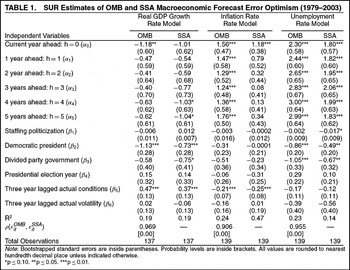
The SUR regression results appear in Table 1. The first five rows in the table report coefficients on the forecast horizon dummy variables. The estimates indicate that OMB and SSA forecasts of unemployment rates include positive forecast errors at each forecast horizon. The OMB forecast of the inflation rate also contains positive errors at each time horizon. Both variables reveal positive forecast errors, net of other exogenous influences, consistent with the desire of elected officials to report good news. But, unlike OMB, SSA inflation forecast errors are significantly different from zero only for the current year (h = 0: α0 = −1.18). SSA forecasts at distant time horizons are less optimistic. Further, and surprisingly, both executive branch agencies' forecast errors for real GDP growth are negative, and thus pessimistic in absolute terms. OMB's real GDP growth forecast errors are not statistically distinguishable from zero (except for the current-year forecast), whereas SSA forecasts contain marginally significant pessimistic bias for only longer time horizons (h = 4: α4 = −1.03 and h = 5: α5 = −1.04). One possible explanation for these results is that real GDP growth might be less tangible to voters than unemployment or inflation; thus incentives for OMB and SSA to generate optimistic forecasts for this variable are low.

The statistical control variables also uncover several interesting empirical findings. For instance, staffing politicization generally has no discernible bearing on each executive agency's forecast biases. In only a single instance, SSA unemployment forecasts, do we observe a significant effect of staffing politicization. In this particular case, however, the sign of the coefficient is inconsistent with our expectations. Higher staffing politicization actually led to lower SSA forecast optimism. Moreover, the standard difference in staffing politicization's impact between OMB and SSA is negligible.16
In auxiliary statistical analysis, we also tested for this cross-equation difference for each forecast model specification by allowing the values of the staffing politicization measures to vary in all possible combinations according to its minimum, one standard deviation below the mean, mean, one standard deviation above the mean, and maximum values for each agency. Our results show that in 16 out of 90 instances (12 occur in the extreme case when the SSA's staffing politicization variable is held at its maximum value and we allow OMB's staffing politicization variable to vary in the real output growth and unemployment models), we reject the hypothesis that these staffing politicization coefficients are equal at p < 0.10. However, these “significant” results should be viewed with skepticism given that only in a single case do we observe a correctly hypothesized positive coefficient sign associated with the staffing politicization variable (real output growth model: SSA equation). We also tested for a conditional staffing politicization effect on agency forecast optimism with respect to forecast horizon in auxiliary statistical analyses. These specifications fail to markedly improve the overall model fit to these data in all but the OMB inflation rate and SSA unemployment rate equations. Yet, we fail to uncover any evidence indicating that these conditional staffing politicization effects possess both the correct sign and obtained statistical significance at conventional levels. This leads us to conclude that staffing politicization rarely exerts a systematic positive influence on agency forecast optimism.
One might surmise that partisan differences in optimistic macroeconomic forecasts would grow as the forecast horizon increases. This logic suggests that we should find that these executive agencies provide increasingly optimistic real output growth and unemployment rate forecasts through time under Democratic administrations vis-a-vìs Republican counterparts in order to please the former's core constituency. Conversely, executive agencies should provide increasingly more optimistic inflation rate forecasts through time under Republican presidents vis-a-vìs Democratic administrations. We tested this proposition in auxiliary statistical analysis by testing the equality of coefficients for the president's party variable for each of the forecast horizons. The Wald tests easily fail to reject the equality of these coefficients for both real output growth and unemployment rate forecasts at each of the multi-year ahead forecast horizons at p < 0.10 [Real Output Growth Model—OMB equation: χ2(5) = 4.59, p = 0.47; SSA equation: χ2(5) = 6.00, p = 0.31; Unemployment Rate Model—OMB equation: χ2(5) = 0.75, p = 0.98; SSA equation: χ2(5) = 1.07, p = 0.96]. Yet, the Wald test results provide mixed evidence regarding the failure to reject the coefficient equality among these variables with respect to inflation rate forecast error optimism [OMB equation: χ2(5) = 13.33, p = 0.02; SSA equation: χ2(5) = 8.80, p = 0.12]. One notable difference between this conditional partisan model and the baseline model reported in the manuscript is that static cross-agency partisan differences occur only under Republican administrations consistent with H2. Otherwise, the results from these conditional partisan models of inflation rate forecasts are generally consistent with those reported for H1–H3 in the manuscript. We thus remain confident of the reported statistical results that are based on a parsimonious statistical model consistent with our theory.
These findings do not suggest that OMB generates forecasts favorable to the core constituencies of the party controlling the White House. When a Democrat is in the White House, the OMB does not forecast lower unemployment or higher economic growth. It could be the case that Democrats prefer less optimistic forecasts of real output growth and unemployment to retain a compelling justification for entitlement and social insurance programs that comprise the social safety net. Alternatively, Democratic administrations' might just simply do a poor job signaling competent macroeconomic management.18
For instance, Bartels (2004, 22–23, footnote 24) has shown that across all income levels, real income growth under Democratic administrations is smaller during election years relative to nonelection years. Republican administration have, by contrast, used real income growth during election years to signal competent management to prospective voters. We thank an anonymous APSR reviewer for bringing this point to our attention.
Consistent with our expectations, we obtain some empirical evidence that divided party government is associated with a lower level of agency forecast optimism. Under divided party government, forecast optimism is lower for SSA real GDP growth projections and both OMB and SSA unemployment rate projections. The effects of divided party government are greater for OMB unemployment rate forecasts than for SSA. OMB (SSA) forecasts of the unemployment rate are typically 1.05% (0.67%) lower under divided government compared to unified government. The Wald test indicates the difference between the agencies is statistically significant (χ2 ∼(1) = 21.06, p = 0.00). The existence of divided party government fails to affect inflation forecast biases for either agency. We find no evidence indicating that any of these executive branch agency forecasts are influenced by the timing of presidential elections.19
In auxiliary statistical analyses, we also examined models where the presidential electoral cycle impact varies by forecast horizon. We found that such dynamic conditional presidential electoral cycle effects were rarely consistent with our hypothesized positive impact on agency forecast optimism. In the case of the real GDP growth model, only one of the electoral cycle dummies is statistically significant and the correct hypothesized sign (SSA equation: electoral cycle × h = 2, p = 0.09), yet its full impact is not significantly different from zero [χ2(1) = 1.61, p = 0.20]. In addition, these conditional electoral cycle coefficients are jointly equal across forecast horizons based on a chi–square test [OMB equation: χ2(5) = 7.23, p = 0.20; SSA equation: χ2(5) = 7.24, p = 0.20]. The inflation rate model shows that only one of the electoral cycle dummies is statistically significant—but it is the incorrect hypothesized sign (OMB equation: electoral cycle × h = 2, p = 0.09); and these coefficient impacts are jointly equal across forecast horizons based on a chi–square test [OMB equation: χ2(5) = 3.85, p = 0.57; SSA equation: χ2(5) = 2.22, p = 0.82]. Finally, the unemployment rate model fails to uncover any statistically significant electoral cycle effects at each horizon for each agency equation; and these coefficient impacts are jointly equal across forecast horizons based on a chi–square test [OMB equation: χ2(5) = 0.75, p = 0.98; SSA equation: χ2(5) = 1.07, p = 0.96]. This auxiliary statistical analysis produces electoral cycle effects on agency forecast error optimism that do not substantively differ much from those reported here.
Finally, the levels of recent past observed real GDP growth and inflation have a significant influence on the level of forecast error in both agencies. Higher levels of past observed real GDP growth leads to higher output growth forecast optimism for both SSA and OMB. Similarly, lower levels of past observed inflation tends to have a positive effect on the level of forecast optimism for both SSA and OMB. Such adaptive behavior suggests that recent recent macroeconomic conditions do affect the quality of future forecasts. Past volatility of the macroeconomic indicators has no impact on forecast optimism. Thus, OMB and SSA forecasting behavior are risk neutral: neither public agency responds to recent past volatility in macroeconomic conditions when formulating forecasts. The contemporaneous forecast error shocks are highly correlated in a positive direction [
]. This result indicates that OMB and SSA respond very similarly to exogenous shocks.20
Because these forecast error shocks entail the unexplained variance in forecast errors, one might question their sensitivity to model specification choices. We believe, however, that this issue does not pose statistical artifact problems. Conceptually, the level of forecast error shocks is not theoretically dependent to the extent that contemporaneous forecast error shocks are correlated between agencies. On a practical level, we are confident of the soundness of these particular findings since the strength of these contemporaneous forecast error shock correlations are incredibly high (0.906–0.969 range). Further, although these correlations were of equal or slightly lower in magnitude (0.88–0.96 range) under alternative models that we estimated, they remain statistically significant at conventional levels.
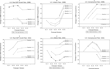
The statistical results for the forecast horizon hypothesis (H1) appear in Figure 1. These results assess the difference in each agency's forecast optimism in an exhaustive pairwise manner. Positive changes in agency forecast errors represent an increase in forecast optimism from the baseline forecast horizon in relation to a more distant forecast horizon located on the X-axis. Statistical significance (or lack thereof) is assessed through a Wald test where the null hypothesis is that the change in agency forecast error is equal to zero. The statistical evidence only supports the Forecast Horizon hypothesis (H1) in a few cases. These particular cases involve OMB current year and near-term real GDP growth rate forecasts (Figure 1A) and OMB current year and long-term unemployment rate forecasts (Figure 1C). Specifically, the change in OMB real GDP growth rate forecast errors moves closer to zero from the current-year forecast (h = 0: α0 = −1.18) for each of the subsequent three forecast horizons (h = 1: α1 = −0.47, h = 2: α2 = − 0.41, and h = 3: α3 = −0.40). The level of OMB unemployment rate forecast optimism increases significantly from the current year forecast (h = 0: α0 = 2.30) to the long-term forecasts (h = 4: α4 = 3.00 and h = 5: α5 = 2.99). As expected, OMB introduces the most optimistic bias in the long-term forecasts of the unemployment rate. One potential explanation for this result is that the unemployment rate may be the most politically tangible indicator of macroeconomic performance to the electorate—so that OMB has a strong incentive to signal low and stable unemployment rates for the long term. Yet, many of the observed differences regarding the change in agency forecast errors are statistically indistinguishable from zero.

Statistical Testing of the Forecast Horizon Hypothesis (H1): The Dynamics of OMB and SSA Forecast Optimism Across Varying Forecast Horizons (U.S. Real GDP Growth, Inflation Rate, and Unemployment Rate: 1979–2003)
Paradoxically, we detect significant reductions in the level of forecast optimism from SSA current year inflation forecasts (h = 0: α0 = 1.18) to those made two years (h = 2: α2 = 0.32) through 5 years (h = 5: α5 = 0.34) ahead into the future (Figure 1D). Why might the SSA wish to avoid generating highly optimistic forecasts of future inflation beyond the current year? Because the SSA has responsibility for administering social security programs, the SSA inflation forecasts might be influenced by the agency explicitly factoring in the automatic Cost-of-Living Adjustments (COLAs) for these programs.21
As we noted earlier in the manuscript, the absence of positive SSA inflation rate forecast errors beyond the current period may signify the importance of Social Security benefits being indexed to the price level during our entire sample period.
The SSA may be minimizing the probability of unanticipated costs in the form of higher than expected COLAs for Social Security benefits. Although many other U.S. federal government programs of interest to presidents are indexed to inflation, OMB may not possess an equally strong incentive to generate forecasts for high inflation. Our statistical evidence does not reveal any significant drop in OMB inflation forecast optimism as the forecast horizon increases. It is possible that observed differences in OMB and SSA inflation rate forecasts for a given forecast horizon arise from the use of COLAs for Social Security benefits. This potential problem should not affect our empirical tests of H2 or H3 for real GDP growth or unemployment rate forecasts. Nor should our statistical tests of H3 involving inflation rate forecasts necessarily be affected by such considerations.
On a substantive level, the empirical evidence indicates that these executive branch agencies possess an internal conflict between their short-run desire to curry favor with presidents by providing optimistic forecasts and a long-run preference for making less rosy forecasts which enhance their bureaucratic reputation. Although we typically observe an upward swing in forecast optimism for longer–term forecasts (h = 4, h = 5), they are only statistically discernible for OMB forecasts of U.S. unemployment rate (Figure 1C). It could be the case that public agencies' desire to maintain a positive organizational reputation (Carpenter 2001) simply outweighs immediate political pressures to generate optimistic forecasts. This should be especially true in the executive branch insofar that presidential administrations are relatively short-lived. Nonetheless, while both OMB and SSA may care more about possessing a reputation for bureaucratic competence on a general level, they may systematically differ in how much weight they place on this goal vis-a-vìs political responsiveness.
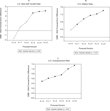
We now turn our attention to the statistical testing of the static organizational stability hypothesis (H2). This hypothesis involves examining differences in OMB-SSA forecast optimism at each fixed forecast horizon. These results appear in Figure 2. The points in the figure are computed by subtracting the SSA forecast horizon dummy coefficient from the OMB forecast horizon dummy coefficient at each forecast horizon. The OMB-SSA forecast error difference is hypothesized to be positive because OMB is the less stable agency. Wald tests allow us to ascertain whether the coefficient differences are statistically different from zero. At a given forecast horizon, our statistical evidence shows that in most cases OMB forecasts are more optimistic than those generated by SSA at p < 0.05. This holds true across all forecast horizons for both unemployment rate forecasts (Figure 2C), and in all but the current-year inflation forecasts (Figure 2B). Support in favor of H2 with respect to real GDP growth rate forecasts is only observed for longer forecast horizons: h = 3, h = 4, and h = 5 (Figure 2A).

Statistical Empirical Testing of the Static Organizational Stability Hypothesis (H2): OMB—SSA Difference in Forecast Optimism Across Fixed Forecast Horizons (U.S. Real GDP Growth, Inflation Rate, and Unemployment Rate: 1979–2003)
Strong statistical support for H2 indicates that OMB discounts reputation costs at a higher rate than SSA. It is interesting to note that these institutional design effects are statistically negligible for current year forecasts of real GDP growth and inflation rates, as found elsewhere (Corder 2005; Krause and Douglas 2005, 2006). This empirical finding is compatible with our theory any difference involving intertemporal discounting of reputation costs by agencies operating under different institutional designs will be minimal in the current period. The ability to sanction agencies for poor performance should only marginally differ across agencies if errors are immediately revealed (Krause and Douglas 2005, 303). Politicians can more easily distinguish between an inferior and superior agency in the immediate period, thus agencies will have a strong incentive to behave similarly to avoid either political sanctions for being singled out as being too pessimistic—or loss of bureaucratic reputation for being singled out as being too optimistic (Krause and Douglas 2006).
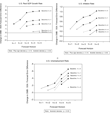
The statistical results for the dynamic organizational stability hypothesis (H3) appear in Figure 3. Each entry represents the change in OMB-SSA forecast error differences at varying forecast horizons in relation to a specified baseline forecast horizon. Statistical significance is determined by a series of Wald tests for each of these pairwise combinations. Our statistical evidence shows abundant, if not unanimous, support for H3 across all three macroeconomic forecast variables. In every instance, the graphs clearly show that change in OMB-SSA forecast optimism differences is both positive in magnitude and is positively related to forecast horizon length. Substantively, this means that less stable agencies discount reputation costs at a higher rate than more stable agencies. As the forecast horizon is extended, the difference in the present value discounted reputation costs between these executive branch agencies appears to be amplified. The statistical support for H3 is strongest when comparing cross–agency differences in forecast optimism for current year and longer term forecasts. That is, evidence in favor of H3 is strongest when the forecast horizon grows in relative terms (i.e., the time between the baseline and more distant forecast horizons become greater). In addition, the sharper upward slopes of these estimated forecast error differences for both the inflation and unemployment rate forecasts (Figure 3B and 3C) indicate that differences in agency forecast optimism grow at a faster rate for these indicators than compared to real GDP growth rate forecasts (Figure 3A). Overall, the empirical findings from Figure 3 suggest that OMB-SSA differences with respect to the discounting of their reputation costs for bureaucratic competence has more important implications for long-term forecasts than for short-term projections.

Statistical Testing of the Dynamic Organizational Stability Hypothesis (H3): Change in OMB-SSA Difference in Forecast Optimism Across Varying Forecast Horizons (U.S. Real GDP Growth Rate, Inflation Rate, and Unemployment Rate: 1979–2003)
DISCUSSION
Public agencies perform a number of critical tasks and a central feature of this work is the use of bureaucratic expertise to produce forecasts concerning future conditions and outcomes. Analyzing forecast quality provides us with insight into how public agencies balance political pressure for optimism with the desire to maintain a reputation for bureaucratic competence. This tension underscores a fundamental normative issue: should the executive branch agencies be loyal to the president (Moe 1985), or should these agencies be independent of presidential influence (Heclo 1975; Kaufman 1956)? Our study has made a novel contribution to the study of executive branch politics and public bureaucracy by analyzing how public agencies make decisions that involve intertemporal tradeoffs. The capacity of elected officials to influence such decisions is a function of the extent to which public agencies discount reputation costs. If an agency does not steeply discount reputation costs, then the agency will place a greater premium on bureaucratic competence at the expense of satisfying political demands. Conversely, if reputation costs are heavily discounted, then the agency is more apt to produce optimistic forecasts at the expense of possessing a reputation for bureaucratic competence. Our theory generates three empirically testable predictions. First, agencies' concern with their reputation for bureaucratic competence will decline as the forecast horizon increases. Second, if we presume that a highly stable agency discounts reputation costs at lower rate than less stable agencies, then our theory predicts that a highly stable agency should be less optimistic. Relatedly, our theory also suggests that the differences in the discounting of reputation between highly stable and less stable agencies grows as the forecast horizon extends. As a consequence, cross-agency differences in forecast optimism should increase as the forecast horizon extends into the future.
We find modest statistical evidence consistent with the forecast horizon hypothesis. This supportive evidence occurs only for some of the current-year baseline forecast horizons involving OMB real GDP growth and unemployment rate forecasts. Our statistical evidence, however, uncovers very strong support for the theoretical hypotheses pertaining to organizational stability. That is, OMB produces more optimistic macroeconomic forecasts compared to SSA for a given fixed forecast horizon. Moreover, these cross-agency differences increase as the forecast horizon lengthens. The statistical evidence leads us to conclude that the organizational stability of executive agencies is directly linked to the ways that these public organizations balance the competing objectives of political responsiveness and neutral competence within an intertemporal framework.
It is worth noting two important caveats of our study. First, our theory is limited insofar that it is not applicable to every class of intertemporal bureaucratic decisions. Nonetheless, the logic that we advance in this study applies to a broad category of decisions. Our theory can still be of explanatory value, with some minor modifications, in those situations where a politician wants agencies to provide pessimistic policy information. Specifically, we could apply a modified version of our theory to recent projections about the long-term solvency of the Social Security Trust Fund. Trust fund insolvency could be used as a means to justify partial privatization of this major longstanding federal government program (VandeHei and Wiseman 2005). For this stylized example, we should expect that SSA forecasts of Social Security Trust Fund solvency would be less pessimistic than comparable OMB forecasts since the OMB has a stronger political incentive to portray the current state of this fund in the worst possible light. A second caveat is the small number of public agencies that we examine in this study. Our statistical evidence comes from a pairwise agency comparison, and thus some degree of caution is appropriate in generalizing the conclusions.22
This particular caveat is equally germane to the vast majority of empirical studies on bureaucratic politics which attempt to cull statistical generalizations from either a single agency or a pair of agencies.
Because an agency's level of organizational stability is largely a function of its institutional design, our statistical findings yield two important implications for political scientists studying the origins and consequences of institutional design (McCubbins, Noll, and Weingast 1989; cf. Moe 1989). It is clear from our statistical findings that institutional design has direct tangible consequences for bureaucratic performance within intertemporal settings. Specifically, we demonstrate that a highly stable agency (SSA) exhibits greater concern than a less stable agency (OMB) with maintaining a reputation for bureaucratic competence. These differences tend to grow as the forecast horizon increases. On a broader level, this study underscores the importance of institutional design choices made by elected officials as it relates to how executive agencies intertemporally balance the conflicting goals of political responsiveness and bureaucratic competence that are part and parcel of the administrative state. Our hope is that future research will build on the foundation advanced in this study to further understand the ways that unelected government officials balance the short-term passions arising from democratic politics with the long-run desire for competent governance.
An earlier version of this paper was delivered at the 2004 Midwest Political Science Association meetings, Palmer House Hilton, Chicago, IL: April 15–18, 2004; and 2004 American Political Science Association meetings, Palmer House Hilton, Chicago, IL, Sept 3–6, 2004. We greatly benefitted from the helpful comments and suggestions of Anthony Bertelli, Patrick Brandt, Daniel Carpenter, Suzanna DeBoef, Susan Hoffmann, LeeAnne Krause, David Lewis, Kenneth Meier, Scott Morgenstern, Jim Rogers, Sebastian Saiegh, Jennifer Victor, Andrew Whitford, and both the anonymous reviewers and the APSR editor during various stages of this project. We also thank David Lewis for graciously sharing his data on OMB and SSA political appointments with us. This article is dedicated to the memory of Kathy Corder.



Comments
No Comments have been published for this article.