1. Introduction
Extensive chemostratigraphic work in the Scandinavian (Melezhik et al. Reference Melezhik, Gorokhov, Fallick and Gjelle2001a, Reference Melezhik, Gorokhov, Fallick, Roberts, Kuznetsov, Zwaan and Pokrovsky2002a,b, Reference Melezhik, Zwaan, Motuza, Roberts, Solli, Fallick, Gorokhov and Kuznetsov2003, Reference Pokrovsky, Melezhik and Bujakaite2005; Slagstad et al. Reference Slagstad, Melezhik, Kirkland, Zwaan, Roberts, Gorokhov and Fallick2006) and Scottish and Irish Caledonides (Thomas et al. Reference Thomas, Graham, Ellam and Fallick2004), and in Greenland (Fairchild et al. Reference Fairchild, Spiro, Herrington, Song, Grotzinger and James2000) has shown that Sr and C isotopic data, even from high-grade marble formations, can be compared with secular variations in the isotopic compositions of Neoproterozoic and Phanerozoic seawater (Melezhik et al. Reference Melezhik, Gorokhov, Kuznetsov and Fallick2001b and references therein) to obtain an apparent depositional age range. Despite a number of complicating factors (Melezhik et al. Reference Melezhik, Gorokhov, Kuznetsov and Fallick2001b, Reference Melezhik, Zwaan, Motuza, Roberts, Solli, Fallick, Gorokhov and Kuznetsov2003), carbonate chemostratigraphy may provide the age constraints necessary for deciphering the tectonostratigraphic assembly of areas where it is difficult, if not impossible, to do so using other methods. The carbon and strontium isotopic work in the Scandinavian Caledonides has demonstrated an oversimplification of some previously advanced geotectonic models based solely on lithological correlations. Some thick metasedimentary successions formerly considered to be stratigraphically homogeneous units have been shown to be complex assemblages of Neoproterozoic to Lower Silurian carbonate formations which were tectonically imbricated and emplaced in a non-chronostratigraphic order. Moreover, parts of the tectonostratigraphic successions were affected by a pre-Scandian deformation and metamorphism prior to their emplacement onto Baltica (Roberts, Heldal & Melezhik, Reference Roberts, Heldal and Melezhik2002; Melezhik et al. Reference Melezhik, Zwaan, Motuza, Roberts, Solli, Fallick, Gorokhov and Kuznetsov2003; Roberts, Nordgulen & Melezhik, Reference Roberts, Nordgulen, Melezhik, Hatcher, Jr, Carlson, McBride and Catalán2007).
One of the drawbacks of the chemostratigraphy approach is its crucial dependence on reliable constraints for seawater evolution through time. Moreover, reconstructions of both δ13C- and 87Sr/86Sr-reference curves become less robust with geological age. This is particularly true for Precambrian time where reliable δ13C and notably 87Sr/86Sr data remain sparse, and only very few precise radiometric age constraints are available. Recently, high-resolution carbon isotope records have been obtained from several continents covering the 635 to 548 Ma time interval (Halverson et al. Reference Halverson, Hoffman, Schrag, Maloof and Rice2005), that is, of the Ediacaran (Vendian) period (635–542 Ma), and have documented the global deposition of carbonate formations depleted in 13C below −8‰ (Le Guerroué et al. Reference Le Guerroué, Allen, Cozzi, Etienne and Fanning2006; Fike et al. Reference Fike, Grotzinger, Pratt and Summons2006). This has been termed the Shuram (Le Guerroué et al. Reference Le Guerroué, Allen, Cozzi, Etienne and Fanning2006) or Wonoka (Halverson et al. Reference Halverson, Hoffman, Schrag, Maloof and Rice2005) isotopic event. In this contribution the name Shuram–Wonoka is used.
In the light of this recent advance in the global C-isotope database, we review some of our previously suggested chemostratigraphic correlations within the Scandinavian Caledonides. Here, we report geochemical, carbon and strontium isotope data which, collectively, provide consistent evidence for the presence of a marble recording the Shuram–Wonoka isotopic event, whose geochemical and isotopic patterns were largely preserved during the course of polyphase, high-grade metamorphism and deformation.
2. A ‘Tripartite Marble Unit’ in the Scandinavian Caledonides
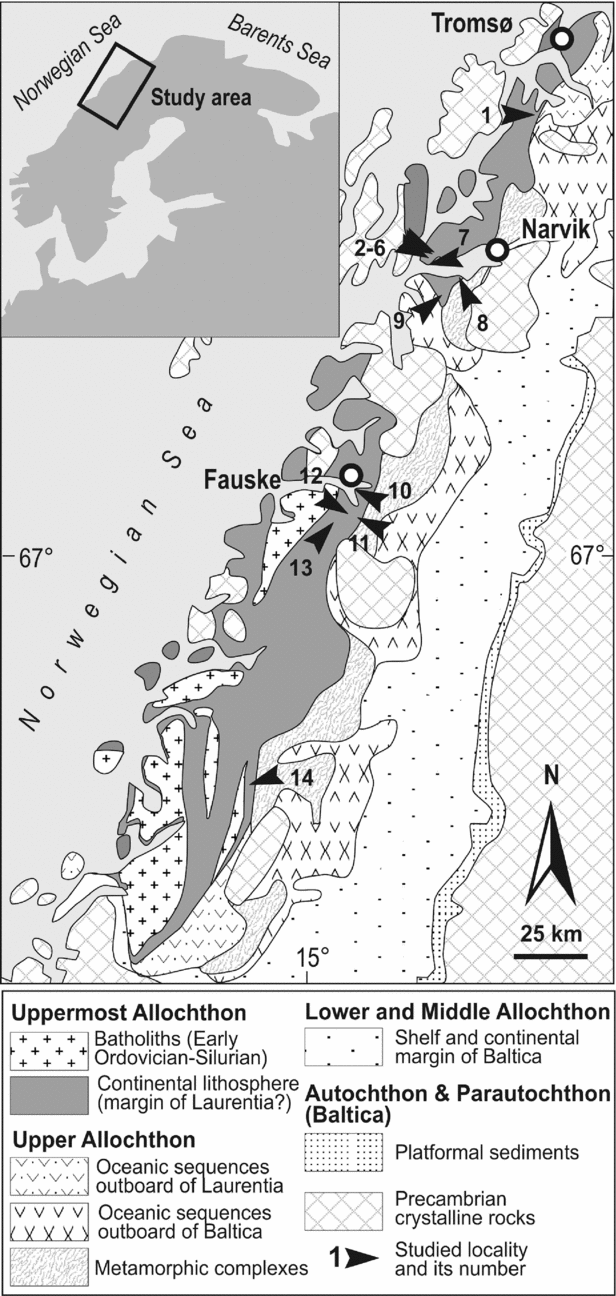
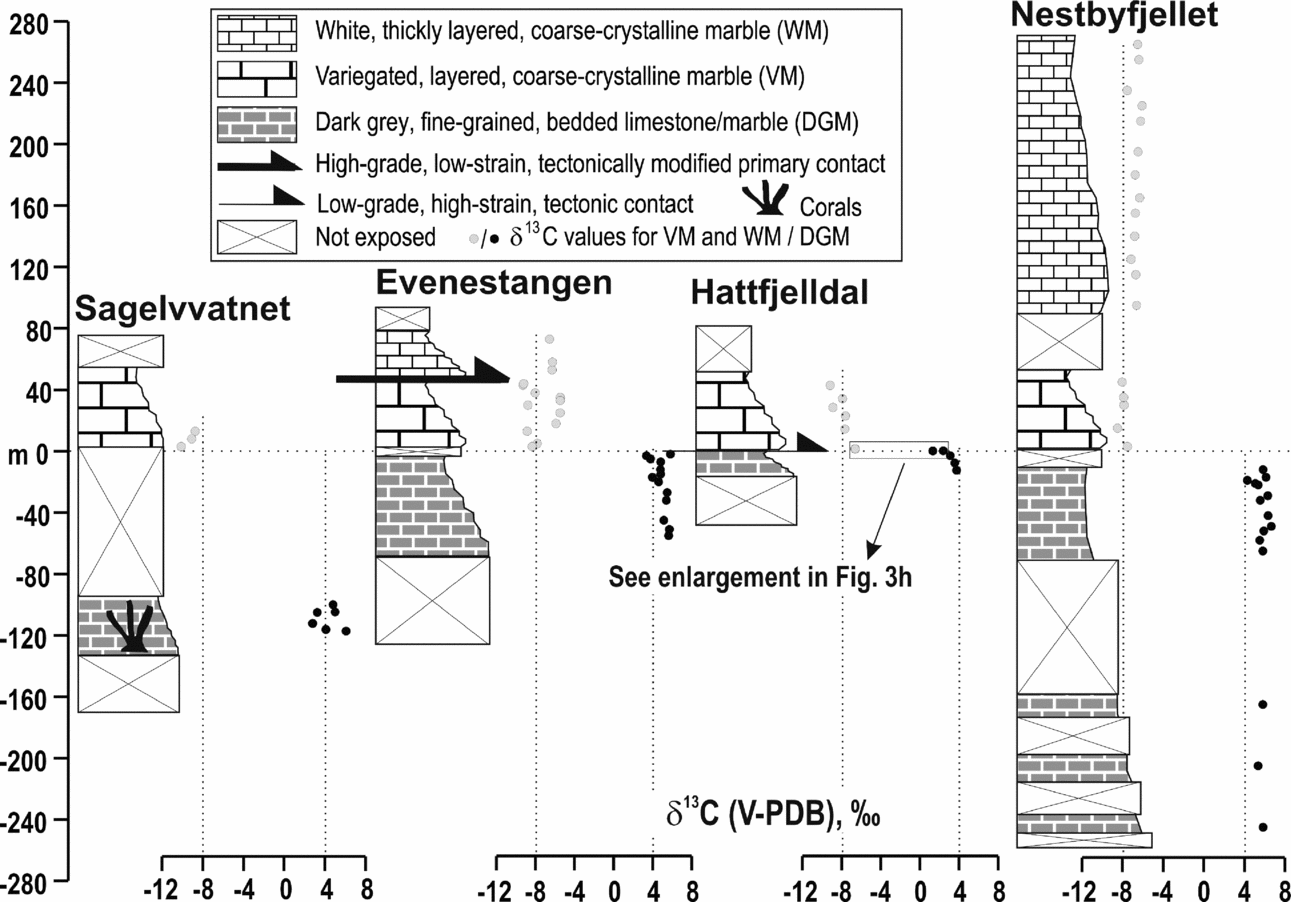
An extensive mapping programme combined with a detailed carbon and strontium isotope chemostratigraphic investigation in the Scandinavian Caledonides (Melezhik et al. Reference Melezhik, Zwaan, Motuza, Roberts, Solli, Fallick, Gorokhov and Kuznetsov2003; Fig. 1) resulted in the discovery of a ‘Tripartite Unit’, consisting of 13C-rich, dark grey metalimestones/marbles, and 13C-depleted, variegated and white calcite marbles (Fig. 2). Together, the variegated and the white calcite marbles form the so-called ‘Leivset marble’, which was named after the type locality at Leivset near Fauske (area 10, Fig. 1). The contact between the structurally lowest unit, the dark grey marble, and the overlying variegated marble is sharp, whereas the variegated marble passes gradationally upwards into the white marble. Because of an unusual combination of colour (Fig. 3) and widespread, albeit discontinuous development over a distance of 450 km throughout the Uppermost Allochthon in North-Central Norway (Fig. 1), the Tripartite Unit was suggested as a lithostratigraphic marker horizon (Melezhik et al. Reference Melezhik, Gorokhov, Fallick, Roberts, Kuznetsov, Zwaan and Pokrovsky2002a, Reference Melezhik, Zwaan, Motuza, Roberts, Solli, Fallick, Gorokhov and Kuznetsov2003).
(a) Geographic location of the study area (inset map) and (b) simplified tectonostratigraphy of the North-Central Scandinavian Caledonides. Locations of main studied sections: 1 – Sagelvvatnet, 2 – northern slope of the Kolan Mountain, 3 – Evenskjer, 4 – Soltun, 5 – Boltåsen, 6 – northern slope of the Sørtuva Mountain, 7 – Evenestangen, 8 – Stella–Sinklien, 9 – Fjelfors (western slope of the Håfjellet Mountain), 10 – Leivset, 11 – Brene, 12 – Nestbyfjellet, 13 – Austerheim, 14 – Hattfjelldal area.

Simplified lithological sections and isotopic profiles showing the sharp offset of δ13Ccarb by 7–16‰ at the contact between dark grey (δ13Ccarb ≈ +4‰) and variegated marbles (δ13Ccarb ≈ −8‰).

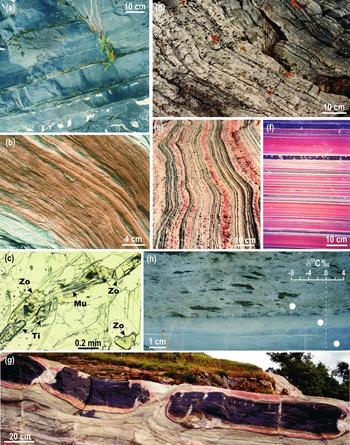
Lithological features of the Tripartite Marble Unit. (a) Road-cut showing dark grey, partially dolomitized, fossiliferous, thickly bedded, greenschist-facies metalimestone from Sagelvvatnet (no. 1 in Figure 1). (b) Variegated marble with tectonically thinned metamorphic layering, and thin intercalations of dismembered schist from Sagelvvatnet; outcrop is structurally about 100 m above (a) (no. 1 in Fig. 1). (c) Muscovite–titanite–zoisite–calcite, amphibolite-facies metamorphic paragenesis in variegated marble from Sagelvvatnet (no. 1 in Figure 1). (d) Dark grey marble with preserved relict sedimentary bedding from Evenestangen (no. 7 in Fig. 1). (e) Variegated marble with very prominent, bright orange-pink colour and tectonically modified, composite, marble-calcareous schist rhythmic layering at Evenestangen; outcrop is structurally about 10 m above (d) (no. 7 in Fig. 1); a unique isotopic composition (δ13C=−11‰ to −7‰), unusual colour and wide lateral distribution in the Uppermost Allochthon of the Scandinavian Caledonides make this particular marble a very distinctive marker. (f) Variegated marble with parallel metamorphic layering affected by a considerable tectonic thinning; the photograph was taken from a near-vertical, smooth wall in a quarry at Leivset (no. 10 in Fig. 1). (g) Prominent amphibolite boudins developed in variegated and white marbles exposed in a quarry at Leivset (no. 10 in Fig. 1). (h) A 2 cm thick, low-grade mylonite zone developed above dark grey marble (bottom) in contact with bleached variegated marble at Hattfjelldalen (no. 14 in Fig. 1). The parallel mylonitic fabric transects a mineral lineation in the bleached variegated marble at an oblique angle. An approximately 7‰ shift in δ13Ccarb occurs within 1 cm across the tectonic contact.

At Sagelvvatnet (area 1 in Fig. 1; Fig. 2), the dark grey metalimestone of the Sandvika Member and the variegated marble (pink metalimestone of the Bukkhaug Member) have been considered as a coherent stratigraphic unit with the dark grey metalimestone forming the stratigraphic base (Bjørlykke & Olaussen, Reference Bjørlykke and Olaussen1981). Based on the fact that the dark grey metalimestone at Sagelvvatnet contains Llandovery-age (c. 440 Ma) halysitid corals and brachiopods (Bjørlykke & Olaussen, Reference Bjørlykke and Olaussen1981), the entire Tripartite Unit was earlier assigned to an Early Silurian time (Melezhik et al. Reference Melezhik, Gorokhov, Fallick, Roberts, Kuznetsov, Zwaan and Pokrovsky2002a). However, we acknowledged the striking isotopic dissimilarities between the 13C-rich dark grey metalimestone and the 13C-depleted Leivset marble. At that time, the extremely 13C-depleted values of the Leivset marble represented a great problem for interpretation, whereas in 2004 we realized the possibility of a worldwide negative isotopic event occurring at around 680–540 Ma (Melezhik, Fallick & Pokrovsky, Reference Melezhik, Fallick and Pokrovsky2005). The current realization that such extreme 13C depletion is a typical feature of the Ediacaran Shuram–Wonoka isotopic event is discussed below.
3. Isotopic features of the Tripartite Unit
Major and trace element concentrations, and carbon, oxygen and strontium isotopic ratios of the Tripartite Unit are compiled in Appendix 1. The dark grey marble is commonly partly dolomitized. Non-dolomitized and non-mylonitic rocks, regardless of their geographic position, exhibit only positive δ13Ccarb values ranging between +3.8 and +6.6‰ (Vienna Standard Peedee Belemnite, V-PDB) (n=41), whereas δ18Ocarb fluctuates between 17.2 and 30.8‰ (Vienna Standard Mean Ocean Water, V-SMOW). Sr concentrations lie within the range 132–2050 ppm (638±379 ppm on average, n=43). 87Sr/86Sr ratios vary between 0.70821 and 0.70887 (n=24) and do not show a significant correlation with Sr. However, two samples with Sr < 200 ppm have a 87Sr/86Sr ratio greater than 0.70880. The dolomitized and mylonitized rocks show δ13Ccarb values ranging between −1.3 and +5.0‰ (n=16), whereas δ18Ocarb varies between 18.5 and 24.7‰.
In contrast, the Leivset marble exhibits a low degree of dolomitization (Appendix 1); all δ13Ccarb values are considerably depleted in 13C and cluster between −11.9 and −5.5‰ (n=93). δ18Ocarb values fall between 14.2 and 27.2‰. In thick sections (Fig. 2, Nestbyfjellet), δ13Ccarb shows an upward increase from −8.5 to −6.2‰. Sr content is variable (171–8740 ppm) but generally high, averaging 1372±1636 (n=99). 87Sr/86Sr ratios show a considerable variation from 0.70802 to 0.70921 (n=36).
The dataset involved in this study shows that each member of the Tripartite Unit has a distinctive and consistent carbon isotopic composition over a strike distance of more than 450 km throughout the North-Central Scandinavian Caledonides. The problem of post-depositional resetting of the carbon and strontium isotope system of the Tripartite Unit was specifically addressed by Melezhik, Fallick & Pokrovsky (Reference Melezhik, Fallick and Pokrovsky2005), who selected the ‘least altered’ carbon and strontium isotope ratios by use of multiple criteria with the additional aid of different cross-plots (Melezhik et al. Reference Melezhik, Zwaan, Motuza, Roberts, Solli, Fallick, Gorokhov and Kuznetsov2003). The least-altered δ13C values of the dark grey marble were considered to be +6, whereas the least-altered 87Sr/86Sr ratio was assumed to be between 0.70821 and 0.70826. Comparison with the Phanerozoic database (e.g. Veizer et al. Reference Veizer, Ala, Azmy, Bruckschen, Buhl, Bruhn, Carden, Diener, Ebneth, Godderis, Jasper, Korte, Pawellek, Podlaha and Strauss1999) indicates that the carbon and strontium isotopic ratios agree perfectly with the isotopic composition of seawater of Early Silurian (Llandovery) time.
It might appear obvious to interpret δ13Ccarb < −6‰ as the result of post-depositional alteration because such values are not consistent with the isotopic composition of marine bicarbonate equilibrated with atmospheric CO2. However, the 13C-depleted marbles show a very limited δ13Ccarb range over a great lateral extent (Appendix 1). When marked variation has been documented it shows a stratigraphic step change (Fig. 2, Nestbyfjellet) rather than post-depositional resetting. Moreover, a systematic change in δ13Ccarb by 10–14‰ across the dark grey marble–Leivset marble boundary (Figs 2, 3h) is not accompanied by a corresponding change in δ18O (Appendix 1). Both the 13C-depleted Leivset marble and the 13C-rich dark grey marble have comparable ranges and averages of δ18O. Thus, the oxygen isotope system, being more sensitive to post-depositional resetting (Banner & Hanson, Reference Banner and Hanson1990; Jacobsen & Kaufman, Reference Jacobsen and Kaufman1999), does not indicate any specific post-depositional overprint associated with 13C-depleted marbles. Any explanation as to how these rocks could just randomly end up with such similar δ13Ccarb values would certainly be less plausible than the explanation that they all represent the same isotopic excursion in primary seawater compositions. Similar arguments for a primary origin for the low δ13Ccarb values, though involving the worldwide database, have been presented in Melezhik, Fallick & Pokrovsky (Reference Melezhik, Fallick and Pokrovsky2005).
The carbon isotope characteristics of the Leivset marble are not compatible with Early Silurian seawater. Moreover, their δ13Ccarb values do not match the isotopic composition of seawater at any given time during the Phanerozoic, as based on data reported by Veizer et al. (Reference Veizer, Ala, Azmy, Bruckschen, Buhl, Bruhn, Carden, Diener, Ebneth, Godderis, Jasper, Korte, Pawellek, Podlaha and Strauss1999). The best proxy to initial 87Sr/86Sr ratios of the Leivset marble is constrained to the range 0.70802–0.70872, based on rocks having Sr concentrations in the range 2240–8740 ppm (Appendix 1). The high Sr abundances support the view that there was a minimal post-depositional overprint of initial 87Sr/86Sr ratios. These values correspond with seawater composition during several time intervals and are therefore alone, without the C-isotope data, not conclusive for an apparent age estimate. However, as discussed in more detail below, taken together, the C and Sr isotopic data indicate a late Neoproterozoic depositional age for the Leivset marble.
4. Structural and petrographic evidence for a non-coherent unit
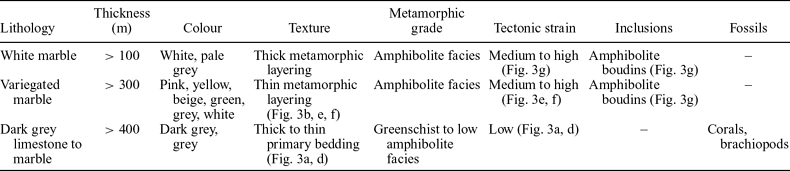
Since it became apparent that the δ13Ccarb of the Tripartite Unit is in conflict with the notion of a coherent stratigraphic succession (Melezhik, Fallick & Pokrovsky, Reference Melezhik, Fallick and Pokrovsky2005), additional limited structural fieldwork was carried out in order to assess the nature of the contact between the Leivset marble and the fossiliferous dark grey metalimestone/marble at Sagelvvatnet (Bjørlykke & Olaussen, Reference Bjørlykke and Olaussen1981) and elsewhere. The result of this work is summarized in Table 1, demonstrating some principal characteristics of the three members constituting the Tripartite Unit.
Some characteristic features of the dark grey metalimestone/marble, variegated and white marble from the Tripartite Unit of the North-Central Scandinavian Caledonides

It has been reported that at Sagelvvatnet (area 1 in Fig. 1), both the dark grey metalimestone and the Leivset marble (pink metalimestones of Bjørlykke & Olaussen, Reference Bjørlykke and Olaussen1981) were metamorphosed at greenschist facies. The results of our study, however, demonstrate a significant difference in tectonic strain and metamorphic grade between the dark grey and ‘pink metalimestone’. The dark grey metalimestone preserves primary bedding, lamination (Fig. 3a), locally graded bedding and, in places, corals and brachiopods. The dolomitized varieties do not demonstrate any dolomite + quartz reaction, thus suggesting only low-temperature, greenschist-facies metamorphic conditions. In contrast, the Leivset marble occurs as a retrograde chlorite–muscovite–calcite schist with tectonized, metamorphic layering and a granoblastic fabric (Fig. 3b). Importantly, the Leivset marble is observed to contain titanite and zoned zoisite (Fig. 3c), indicating that these rocks had once experienced an amphibolite-grade metamorphism.
At Evenestangen (area 7 in Fig. 1), the dark grey marble retains relics of primary sedimentary layering (Fig. 3d), whereas the overlying Leivset marble shows a composite metamorphic layering (Fig. 3e). At Leivset (area 10 in Fig. 1), the Leivset marble was further modified by a prominent tectonic flattening of the bedding (Fig. 3f) accompanied in places by boudinage of amphibolite bodies (Fig. 3g). The actual contact between the Leivset marble and the dark grey marble, where observed (at Soltun and Hattfjelldal, areas 4 and 14 in Fig. 1), is clearly tectonic and expressed as a 2–4 cm thick, bleached dark grey marble representing a fine-grained, layered mylonite with low-grade features (Fig. 3h). In contrast, the contact between the variegated and white marble members of the Leivset marble shows high-grade parageneses with tightly folded, recrystallized, coarse-crystalline, dismembered variegated marble layers infolded into the white marble.
Structural evidence and metamorphic mineral assemblages thus now collectively demonstrate that the dark grey marble and the Leivset marble of the Tripartite Unit have experienced different tectonometamorphic histories and consequently cannot be considered as a single coherent stratigraphic unit. The Leivset marble was affected by a deformation and amphibolite-facies metamorphism prior to its ultimate tectonic juxtaposition with the Llandovery-age dark grey metalimestone/marble during the Scandian orogeny. This also implies that the earlier assumption that all three members of the unit are of a similar, Llandovery age cannot be sustained. Therefore, in the following text the Leivset marble is considered separately from the dark grey marble.
5. The Shuram–Wonoka isotopic event of the Ediacaran period
Several recent reports have shown that extensively developed Neoproterozoic carbonate formations depleted in 13C below −8‰ were deposited worldwide (Kaufman, Jacobsen & Knoll Reference Kaufman, Jacobsen and Knoll1993; Kaufman et al. Reference Kaufman, Jiang, Christie-Blick, Banerjee and Rai2006; Pell et al. Reference Pell, McKirdy, Jansyn and Jenkins1993; Burns & Matter, Reference Burns and Matter1993; Pokrovsky & Gertsev, Reference Pokrovsky and Gertsev1993; Grotzinger et al. Reference Grotzinger, Bowring, Saylor and Kaufman1995; Saylor et al. Reference Saylor, Kaufman, Grotzinger and Urban1998; Yang et al. Reference Yang, Sun, Wang, Xue and Tao1999; Corsetti & Kaufman, Reference Corsetti and Kaufman2003, Reference Corsetti and Kaufman2005; Jiang, Kennedy & Christie-Blick, Reference Jiang, Kennedy and Christie-Blick2003; Jiang, Sohl & Christie-Blick, Reference Jiang, Sohl and Christie-Blick2003; Condon et al. Reference Condon, Zhu, Bowring, Wang, Yang and Jin2005; Halverson et al. Reference Halverson, Hoffman, Schrag, Maloof and Rice2005; Melezhik, Fallick & Pokrovsky, Reference Melezhik, Fallick and Pokrovsky2005; Le Guerroué et al. Reference Le Guerroué, Allen, Cozzi, Etienne and Fanning2006; Pokrovsky, Melezhik & Bujakaite, Reference Pokrovsky, Melezhik and Bujakaite2006a, Reference Pokrovsky, Melezhik and Bujakaiteb). This so-called Shuram–Wonoka isotopic event with such low δ13Ccarb is, at present, unique in Earth history. Halverson et al. (Reference Halverson, Hoffman, Schrag, Maloof and Rice2005) provided a high-resolution model carbon-isotope record for the Early Neoproterozoic and Ediacaran period which includes detailed data from Oman (Le Guerroué et al. Reference Le Guerroué, Allen, Cozzi, Etienne and Fanning2006). However, even in this compilation, the time-scale of the δ13Ccarb record of the Shuram–Wonoka isotopic event remains poorly constrained. The best estimates of dating the event, as reported in the literature, are either between c. 600 and 550 Ma (Le Guerroué et al. Reference Le Guerroué, Allen, Cozzi, Etienne and Fanning2006), from c. 580 to c. 550 Ma (Fike et al. Reference Fike, Grotzinger, Pratt and Summons2006), at or around 551 Ma (Condon et al. Reference Condon, Zhu, Bowring, Wang, Yang and Jin2005), or broadly corresponding with the Gaskiers glaciation at c. 580 Ma (Halverson et al. Reference Halverson, Dudás, Maloof and Bowring2007).
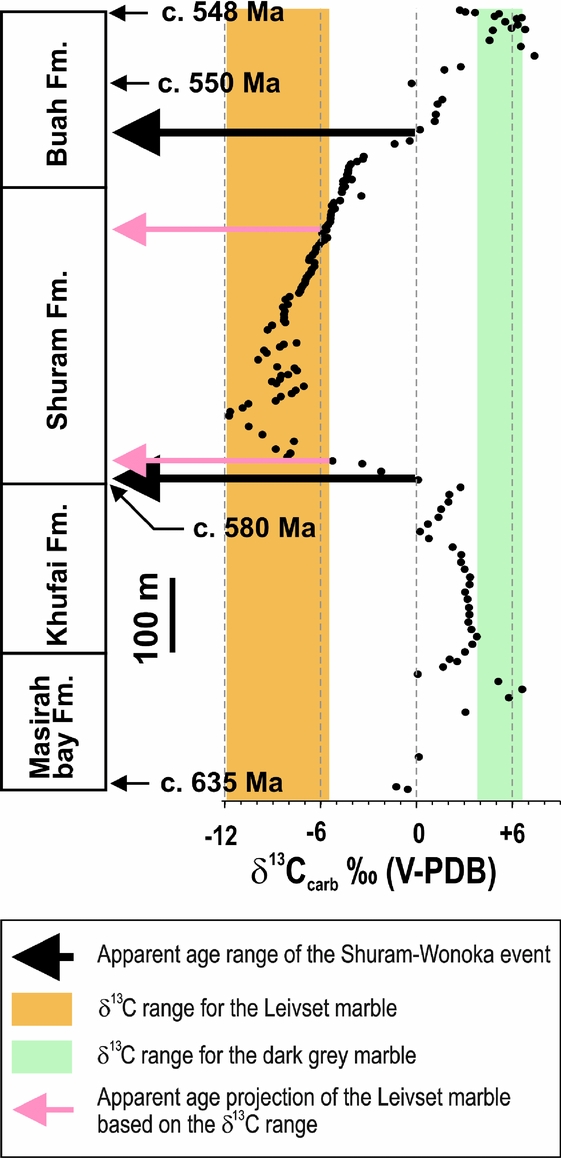
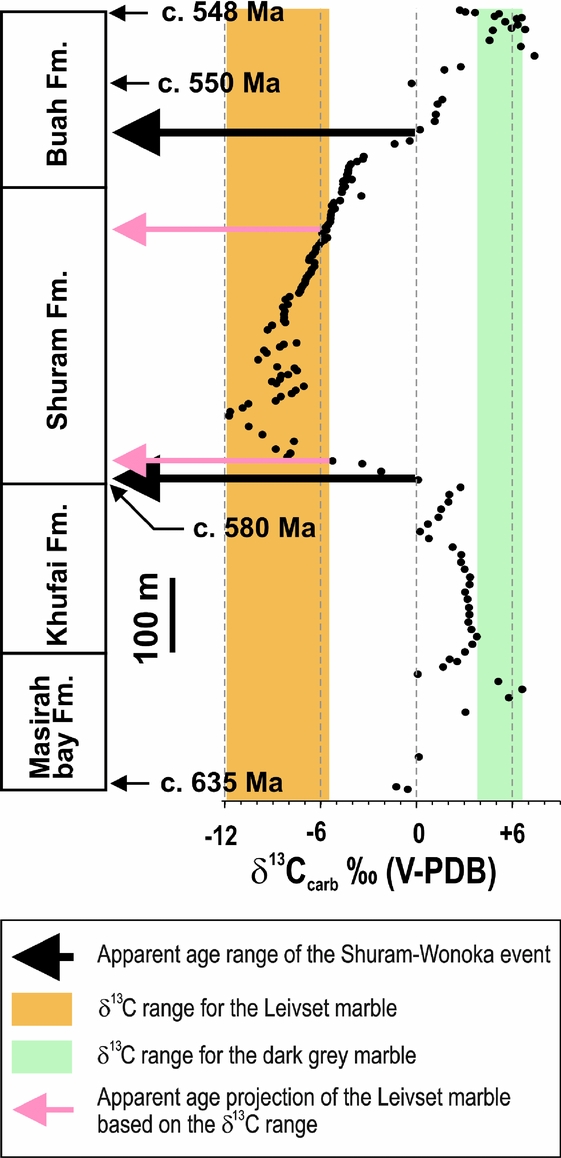
If the apparent age constraint and significance of the 13C-depleted Leivset marble of the Scandinavian Caledonides is viewed in the light of these recent advances in carbon isotope stratigraphic correlation, the overall C-isotope range and stratigraphic change (e.g. at Nesbyfjellet, Fig. 2) mimics that observed elsewhere worldwide during the Shuram–Wonoka isotopic event of the Ediacaran period (Halverson et al. Reference Halverson, Hoffman, Schrag, Maloof and Rice2005; Le Guerroué et al. Reference Le Guerroué, Allen, Cozzi, Etienne and Fanning2006; Fike et al. Reference Fike, Grotzinger, Pratt and Summons2006) and cannot be mistaken for any yet known isotopic excursions of another age. Projection of the overall δ13Ccarb range and the apparent stratigraphic trend (e.g. at Nesbyfjellet, Fig. 2) of the Leivset marble onto the detailed isotopic profile from Oman (e.g. Fike et al. Reference Fike, Grotzinger, Pratt and Summons2006) suggests that the time of deposition of the Leivset marble apparently occupies only the lower and middle parts of the Shuram–Wonoka isotopic event (Fig. 4). Although the least altered 87Sr/86Sr ratios of 0.70802 to 0.70872 are characteristic of the entire period from the Early Ediacaran through to the end of Early Cambrian time, they can be directly compared with Sr isotope values from Oman spanning the same negative excursion (Burns, Haudenschild & Matter, Reference Burns, Haudenschild and Matter1994; Brasier et al. Reference Brasier, McCarron, Tucker, Leather, Allen and Shields2000). However, we consider this option to be less probable because the 87Sr/86Sr evolution of seawater through the Ediacaran period remains poorly constrained.
Detailed δ13C profiles through the Ediacaran period (after Fike et al. Reference Fike, Grotzinger, Pratt and Summons2006) showing the apparent age projection of the Leivset marble based on the δ13C range.
6. Preservation potential through high-grade deformation and metamorphism
A high preservation potential of original δ13Ccarb may not be considered as a particular surprise (Ghent & O'Neil, Reference Ghent and O'Neil1985; Baker & Fallick, Reference Baker and Fallick1988, Reference Baker and Fallick1989a,b; Wickham & Peters, Reference Wickham and Peters1993; Boulvais et al. Reference Boulvais, Fourcade, Gruau, Moine and Cuney1998; Melezhik et al. Reference Melezhik, Gorokhov, Fallick and Gjelle2001a). However, the 87Sr/86Sr ratios and highly variable Sr concentrations reaching 8740 ppm of the Leivset marble also echo the Sr variation in 13C-depleted, non-metamorphosed limestones representing the Shuram–Wonoka event in Siberia. There, oolitic and stromatolitic limestones show a Sr variation between 200 and 3000 ppm (Pokrovsky, Melezhik & Bujakaite, 2006a). The least altered 87Sr/86Sr ratios of the Leivset marble (0.70802–0.70872) are comparable with those reported from the Shuram (0.70852–0.70876: Burns, Haudenschild & Matter, Reference Burns, Haudenschild and Matter1994; Brasier et al. Reference Brasier, McCarron, Tucker, Leather, Allen and Shields2000) and Wonoka (0.70868–0.70876: Calver, Reference Calver2000) formations, as well as from several Siberian sections (0.70786–0.70832: Pokrovsky, Melezhik & Bujakaite, Reference Pokrovsky, Melezhik and Bujakaite2006a), all representing the Shuram–Wonoka event. Thus, surprisingly, despite the high-grade metamorphism and deformation, the Leivset marble retains many of the geochemical peculiarities of its non-metamorphosed counterparts.
7. Isotopic evidence for contrasting ages and cryptic stratigraphic discontinuity
The abrupt δ13Ccarb shift of 10–12‰ across the 2 cm thick mylonite zone, through the dark grey marble–Leivset marble boundary (Fig. 2), cannot be reconciled either with a temporal change in seawater chemistry or with post-depositional resetting. Such a considerable shift is, instead, indicative of a tectonic contact between the isotopically disparate units, thus corroborating the structural and mineralogical observations. The dark grey metalimestone contains Llandovery-age fossils only in one locality, at Sagelvvatnet, whereas elsewhere it occurs as apparently non-fossiliferous, recrystallized limestones or even marbles. Because of the general lack of fossils, we cannot therefore confirm palaeontologically that the dark grey metalimestone/marble is everywhere of a Silurian age. Similarly, structural data alone do not discriminate between interpretations of the dark grey marble–Leivset marble contact as simply a tectonized stratigraphic boundary rather than a tectonic contact juxtaposing Neoproterozoic and Silurian rocks. Moreover, the overall δ13Ccarb shift from the highly positive (dark grey marble) to the highly negative (Leivset marble) values (Fig. 2) mimics many Neoproterozoic isotopic profiles (e.g. Fig. 4).
Considering a steep, monotonous increase in 87Sr/86Sr ratio of seawater from 600 to 550 Ma, the assertion of a continuous Neoproterozoic succession predicts that the 87Sr/86Sr of the dark grey metalimestone/marble should be significantly lower than in the Leivset marble. However, the isotopic data show that the lowest 87Sr/86Sr ratio (0.70821) of the dark grey marble is much higher than the lowest 87Sr/86Sr ratio (0.70802) of the Leivset marble, thus being in conflict with such a prediction. Instead, close similarities of 87Sr/86Sr and δ13Ccarb ratios between the fossiliferous and non-fossiliferous varieties of the dark grey marble, and with all Llandovery seawater (e.g. Veizer et al. Reference Veizer, Ala, Azmy, Bruckschen, Buhl, Bruhn, Carden, Diener, Ebneth, Godderis, Jasper, Korte, Pawellek, Podlaha and Strauss1999), do suggest that the discussed contact is a major tectonic feature in the Scandinavian Caledonides juxtaposing rocks of Late Neoproterozoic and Early Silurian age.
8. The litho-, chemo- and chronostratigraphic marker horizon
The Leivset marble displays several of the necessary requirements for a marker horizon. It is a relatively thin unit of highly distinctive character (variegated in colour, prominently layered, extremely depleted in 13C and rich in Sr), capable of being unequivocally identified and traced over geologically and structurally complex terranes. The unit has a significant lateral extent (>450 km) and shows minimal changes in lithology and geochemistry, which have facilitated its identification over a wide geographic area. Although the Leivset marble is not radiometrically dated, the extremely low δ13Ccarb reliably links its deposition to the Shuram–Wonoka event of the Ediacaran period. Thus, the Leivset marble is a very valuable chronostratigraphic marker which permits stratigraphic correlation in structurally complex, high-grade, marble-dominated terranes in the Caledonides of Baltica and Laurentia where such correlations are not currently possible by any other means.
9. Conclusions
(1) A 13C-depleted, amphibolite-facies, variegated marble (locally termed the ‘Leivset marble’) of the North-Central Scandinavian Caledonides has preserved many original geochemical and isotopic features, which support a robust correlation with the Shuram–Wonoka isotopic event occurring within the 600–550 Ma time interval of the Ediacaran period.
(2) A unique combination of variegated colour, 13C-depletion and Sr enrichment of the Leivset marble combined with its apparent depositional ages and wide geographic distribution meet the requirements for a chronostratigraphic marker. Such a marker can potentially be employed for the stratigraphic correlation of high-grade, marble-dominated terranes within the Caledonian orogenic belt both in Baltica and in Laurentia.
(3) This study shows that isotope chemostratigraphy can aid in the recognition of prominent cryptic stratigraphic discontinuities in polydeformed, polymetamorphosed, carbonate-dominated sequences where such features are difficult, if not impossible, to recognize by any other means due to a limited ‘structural memory’ of marbles. Such a major stratigraphic discontinuity has been revealed between the Late Neoproterozoic and Llandovery rocks which experienced separate tectonometamorphic histories prior to their tectonic juxtaposition on the Baltoscandian margin of Baltica during the Scandian orogeny.
Acknowledgements
The work is a contribution to IGCP 512, and to the Programme ‘Isotope Systems and Isotope Fractionation in Natural Processes’ of the Earth Sciences Branch of the Russian Academy of Sciences. Analytical work was supported by the Consortium of Scottish Universities and the Natural Environment Research Council, the Geological Survey of Norway (project 291200) and the Institute of Precambrian Geology and Geochronology (RFBR 05–05-65329). T. Prave and G. Shields, official reviewers, are acknowledged for constructive criticism leading to improvements in the manuscript.
Appendix 1. Chemical and isotopic composition of the Tripartite Unit, Uppermost Allochthon, North-Central Scandinavian Caledonides

‘Dashes’ – below detection limits: 0.1% for Na20; 0.01% for SiO2, Al2O3; 0.003% for K2O.
‘n.d.’ – not determined.
Mg§, Ca§, Fe§, Mn§ and Sr§ – Mg, Ca, Fe, Mn and Sr contents in acid-soluble constituents analysed by ICP-AES. Unmarked elements were analysed by XRF on whole-rock samples. δ13C as ‰ V-PDB, δ18O as ‰ V-SMOW.
Data were compiled from Melezhik et al. (Reference Melezhik, Zwaan, Motuza, Roberts, Solli, Fallick, Gorokhov and Kuznetsov2003) and Melezhik, Fallick & Pokrovsky (2005). Details on the methods employed can be found in Melezhik et al. (Reference Melezhik, Zwaan, Motuza, Roberts, Solli, Fallick, Gorokhov and Kuznetsov2003).