


Introduction
Clinical trials represent the gold standard for evaluating the efficacy and safety of new pharmaceuticals in humans. Their successful completion depends critically on maintaining participant engagement from screening through study closure. Low retention rates impose significant time and financial burdens on sponsors and investigators and introduce attrition bias that may compromise the internal validity of randomized studies[Reference Poongothai, Anjana and Aarthy1,Reference Coyle, Rogers and Copland2]. This is a particularly salient concern in Phase 1 studies, where pharmacokinetic and pharmacodynamic assessments usually require complete or near-complete datasets.
Phase 1 studies are predominantly conducted in healthy participants under closely supervised, often inpatient conditions. Despite this controlled setting, dropout and withdrawal remain non-trivial operational challenges. Understanding their frequency, timing, and causes is essential to help unit management, improve protocol design, and devise participant support strategies. Published data on retention in Phase 1 studies remain limited, with most available evidence derived from long-term Phase 2/3 trials in patient populations [Reference Gillies, Kearney and Keenan3,Reference Walters, Bonacho Dos Anjos Henriques-Cadby and Bortolami4].
We report a five-year retrospective analysis of participant flow, dropout, retention, and demographic characteristics at a Phase 1 Clinical Studies Unit in Porto, Portugal, covering the full operational period from January 2021 to December 2025. This analysis extends and updates a preliminary report presented at the European Association for Clinical Pharmacology and Therapeutics 2025 Congress [Reference Oliveira, Valois, Souto, Carneiro, Cecatto and Fonseca5] which covered the period up to December 2024.
Materials and methods
Study design and setting
A retrospective observational study was conducted at BlueClinical (Porto, Portugal), a Phase 1 Clinical Studies Unit operating under Good Clinical Practice (GCP) guidelines [6] and certified for the European Medicines Agency, Food and Drug Administration, and Agência Nacional de Vigilância Sanitária regulatory environments [7]. In November 2023, BlueClinical was integrated into Astrum CRO, a pan-European contract research organization. All trials conducted between January 2021 and December 2025 were included in this analysis. Trials not registered in the unit’s electronic trial management system (Viedoc) were not included, such as control groups of studies in special populations and some studies in healthy participants whose eCRF was not Viedoc. Reporting follows the Strengthening of the Reporting of Observational Studies in Epidemiology guidelines. BlueClinical, founded in 2012, is a private, independent Phase 1 Clinical Studies Unit located within Hospital da Prelada (Porto), with inpatient capacity for 76 participants and direct access to on-site laboratory, imaging, and emergency support. It is staffed by dedicated medical, nursing, laboratory, pharmacy, recruitment, and documentation teams. The Unit specializes in bioequivalence and early-phase studies in healthy participants, including relative bioavailability, drug-drug interaction, food-effect, first-in-human, and dose-escalation studies. The study population comprised healthy adult participants, predominantly young adults, with a balanced sex distribution and a majority of Caucasian ethnicity.
Data collection
Participant flow and demographic data were extracted from the unit’s electronic trial management system. For each trial, we recorded: number of scheduled screening visits; number of signed informed consent forms (ICFs); number of enrolled participants (used interchangeably throughout this paper with “randomized,” i.e., participants that were confirmed to satisfy all eligibility criteria and assigned a randomization or identification number before first dosing); number of participants completing all study procedures; and reasons for post-randomization withdrawal, coded according to a standardized internal classification. Adverse events (AEs) leading to discontinuation were additionally coded using the Medical Dictionary for Regulatory Activities (MedDRA v26.1) [8] at the System Organ Class (SOC) level. For enrolled participants, age, sex, and race/ethnicity were extracted when recorded in the trial management system.
Informed consent
All participants provided written informed consent prior to enrollment, in accordance with applicable regulatory requirements and GCP guidelines [6]. This retrospective analysis was conducted on aggregated operational data; no individual participant data were accessed beyond those collected as part of routine trial conduct. Ethics Committee review was not required for this retrospective analysis.
Outcome measures
The primary outcome was the post-randomization retention rate, defined as the proportion of enrolled participants who completed all study procedures. Secondary outcomes included: (a) the pre-ICF withdrawal rate (proportion of scheduled visits not resulting in ICF signature); (b) the ICF-to-enrollment dropout (screening failure) rate; (c) the distribution of reasons for post-randomization withdrawal; and (d) the demographic characteristics of enrolled participants.
Statistical analysis
Descriptive statistics were used throughout. Continuous variables are summarized as mean, standard deviation (SD), median, and range. Proportions are reported as percentages. No inferential statistical testing was performed. Analyses were conducted using the Unit’s electronic trial management system reporting tools. As an exploratory analysis, post-randomization retention was additionally summarized after stratification by participant characteristics (sex and age group) and by study type (bioequivalence, relative bioavailability, and other early-phase studies); no formal hypothesis testing was applied to these subgroups.
Results
Trial and participant characteristics
Between January 2021 and December 2025, 99 trials were included in this analysis, with a substantial increase in 2025 (65 trials up to December 2024) [Reference Oliveira, Valois, Souto, Carneiro, Cecatto and Fonseca5]. An additional 7 trials conducted at the Unit during this period were not included in the analysis (e.g., control groups of studies in special populations and studies whose data were not registered in the unit’s electronic trial management system). The majority of included studies were bioequivalence trials (56/99; 56.6%), followed by relative bioavailability studies (26/99; 26.3%), drug-drug interaction (DDI) studies (9/99; 9.1%), and food-effect studies (4/99; 4.0%). First-in-human single ascending dose studies (2/99; 2.0%) and dose-escalation studies in non-first-in-human settings (2/99; 2.0%) accounted for a further 4.0%, with one thorough QT interval (QT)/corrected QT (QTc) study and one pharmacodynamic study comprising the remainder.
Participant characteristics
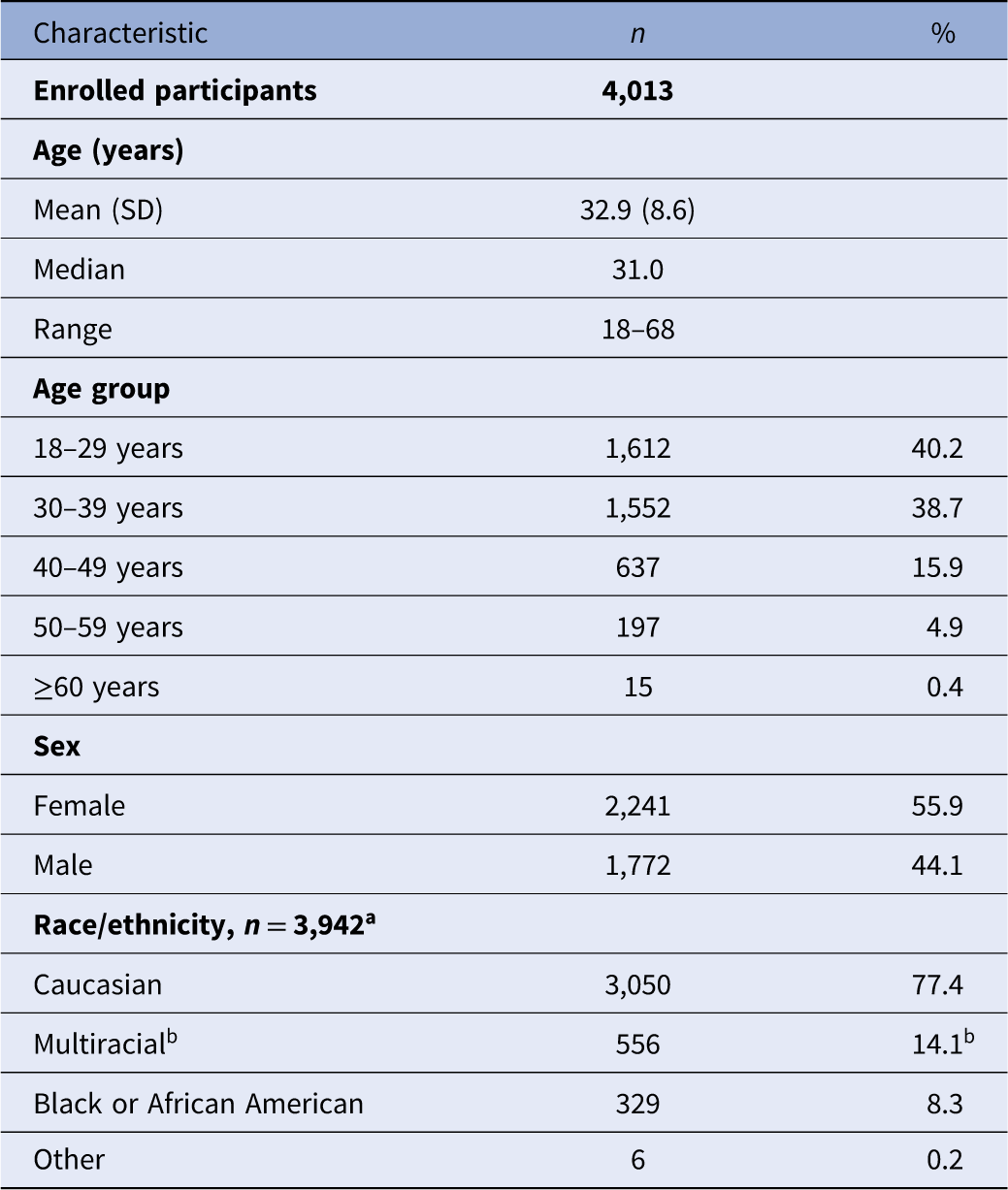
Demographic data were available for all 4,013 enrolled participants (Table 1). The study population was predominantly female (2,241/4,013; 55.9%) with a mean age of 32.9 years (SD 8.6; median 31.0; range 18–68). The majority of participants were aged 18–39 years (3,164/4,013; 78.9%). Race/ethnicity data were available for 3,942 participants (98.2%); of these, 3,050 (77.4%) were reported as Caucasian, 556 (14.1%) as multiracial, and 329 (8.3%) as Black or African American.
Demographic characteristics of enrolled participants (n = 4,013)

Table 1. Long description
The table describes the characteristics of the 4,013 participants enrolled. The mean age was 32.9 years (SD 8.6) and the age range was 18–68 years. Participants aged 18–29 years represented 40.2% (1,612 participants), followed by those aged 30–39 years, representing 38.7% (1,552). Participants aged 40–49 years accounted for 15.9% (637), those aged 50–59 years for 4.9% (197), and those aged 60 years or older for 0.4% (15). There were 2,241 female participants (55.9%) and 1,772 male participants (44.1%). Data on race/ethnicity was available for 3,942 participants, as information was not collected for 71 participants (1.8%); 3,050 (77.4%) were Caucasian, 556 (14.1%) were multiracial, 329 (8.3%) were Black or African American and 6 (0.2%) were classified as other. Multiracial participants were defined as those self-reporting more than one racial category. Percentages were calculated using the 3,942 participants with available race/ethnicity data.
a Race/ethnicity data not collected for 71 participants (1.8%); percentages calculated on participants with available data (n = 3,942).
b Multiracial: participants self-reporting more than one racial category (e.g., Black or African American/Caucasian).
Participant flow
A total of 14,331 screening visits were scheduled. Of these, 8,980 (62.7%) resulted in ICF signature; the remaining 5,351 (37.3%) represented pre-ICF withdrawals (participants who either did not attend [“quits”] or who withdrew prior to ICF signature after reading the consent form). Following ICF signature, 4,013 participants were ultimately enrolled, representing an ICF-to-enrollment conversion rate of 44.7%. The participant flow is summarized in Figure 1.
Participant flow funnel from scheduled screening visits to study completion, Phase 1 Clinical Studies Unit, 2021–2025. ICF = informed consent form.

Figure 1. Long description
The figure summarises participant flow through the Phase 1 Clinical Studies Unit between 2021 and 2025. Of the 14,331 scheduled screening visits, 5,351 (37.3%) did not proceed to screening. This included 4,322 visits (30.2%) lost because the participant did not attend or withdrew before the visit, 515 visits and 514 individuals who withdrew after reading the informed consent form (ICF). In total, 8,980 screening visits were performed with a signed ICF. Of these, 4,299 participants (47.9%) did not meet eligibility criteria and were counted as screening failures and 668 withdrew by their own decision before randomisation, which left 4,013 randomised participants. After randomisation, 315 participants (7.8%) were excluded or discontinued. The remaining 3,698 participants completed all study procedures across 99 trials, a retention rate of 92.2% among randomised participants. Overall, 25.8% of scheduled screening visits and 41.2% of performed screenings led to study completion.
Post-randomization retention
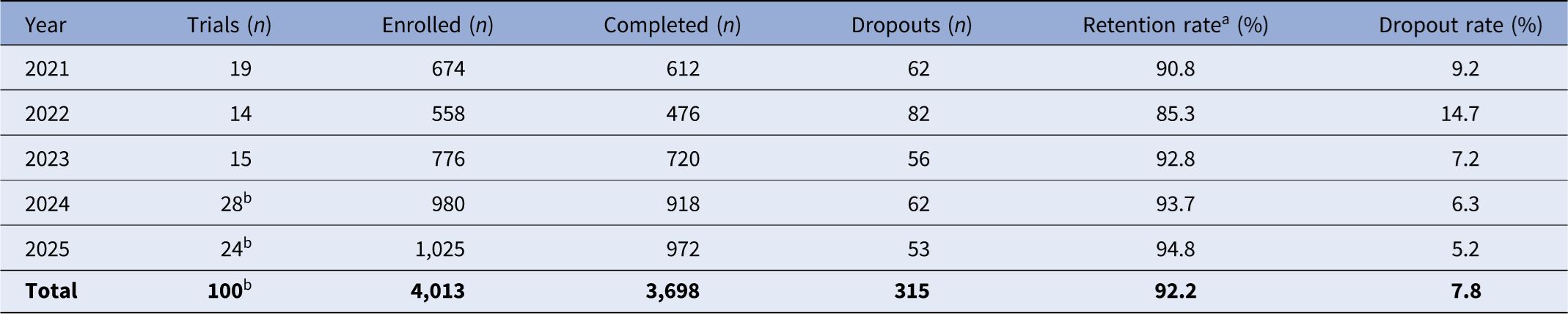
Of the 4,013 enrolled participants, 3,698 completed all study procedures, yielding a post-randomization retention rate of 92.2%. This represents an improvement over 2021–2024 data (retention rate 87%) [Reference Oliveira, Valois, Souto, Carneiro, Cecatto and Fonseca5]. The annual evolution of retention rates is shown in Table 2. The lowest rate was observed in 2022 (85.3%). Retention improved progressively from 2023 onwards, reaching 94.8% in 2025.
Post-randomization retention and dropout by year, 2021–2025

Table 2. Long description
The table presents the number of trials, enrolled participants, participants completing all study procedures, dropouts, and retention and dropout rates for each year from 2021 to 2025. In 2021 (19 trials) there were 674 enrolled participants: 612 completed all study procedures and 62 dropped out. Retention rate was 90.8% and dropout rate 9.2%. In 2022 (14 trials) there were 558 enrolled participants: 476 completed all study procedures and 82 dropped out. Retention rate was 85.3% and dropout rate 14.7%. In 2023 (15 trials) there were 776 enrolled participants: 720 completed all study procedures and 56 dropped out. Retention rate was 92.8% and; dropout rate 7.2%. In 2024 (28 trials) there were 980 enrolled participants: 918 completed all study procedures and 62 dropped out. Retention rate was 93.7% and dropout rate 6.3%. In 2025 (24 trials) there were 1,025 enrolled participants: 972 completed all study procedures and 53 dropped out. Retention rate was 94.8% and dropout rate 5.2%. In total (99 trials), there were 4,013 enrolled participants: 3,698 participants completed all procedures and 315 dropped out. The overall retention rate was 92.2% and the dropout rate was 7.8%. One trial was conducted across 2024 and 2025 and is therefore counted in both years. Consequently, the total represents 100 trial-years across 99 unique trials. Participants are allocated to the year in which they were randomized. Retention rate is defined as the proportion of enrolled (randomized) participants who completed all study procedures.
a Retention rate = participants completing all study procedures/enrolled (randomized) participants.
b One trial was conducted across both 2024 and 2025; accordingly, it is counted in both years in the trial count (hence total = 100 trial-years across 99 unique trials), while enrolled participants are allocated to the respective year of randomization.
Reasons for dropout
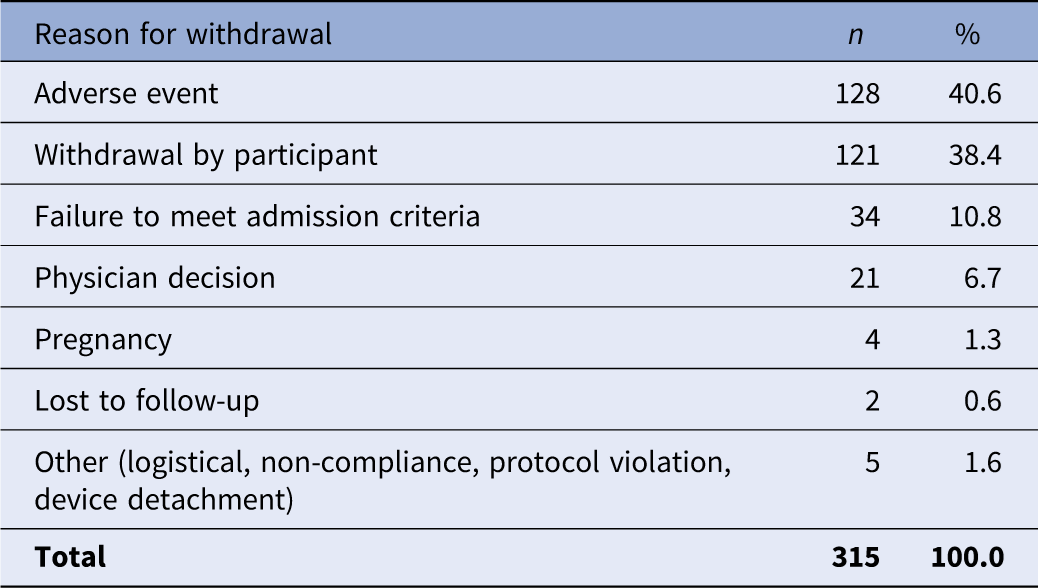
A total of 315 participants (7.8%) were discontinued after randomization. The two leading causes were AEs (n = 128; 40.6%) and participant-initiated withdrawal (n = 121; 38.4%). Failure to meet admission criteria at a post-randomization period admission accounted for 34 withdrawals (10.8%), and physician decision for 21 (6.7%). Pregnancy (n = 4; 1.3%), lost to follow-up (n = 2; 0.6%), and protocol violation, non-compliance with study schedule or drug, logistical problems, and device detachment (n = 1 each) accounted for the remainder (Table 3).
Reasons for post-randomization withdrawal (n = 315)

Table 3. Long description
The table categorizes the reasons for withdrawal among 315 participants who discontinued participation after randomization: Adverse event in 128 participants (40.6%); Withdrawal by participant in 121 cases (38.4%); Failure to meet admission criteria in 34 participants (10.8%); Physician decision in 21 participants (6.7%); Pregnancy in 4 participants (1.3%); 2 participants (0.6%) were lost to follow-up; 5 participants (1.6%) were discontinued for other reasons, including logistical issues, non-compliance, protocol violations and device detachment.
Adverse events leading to discontinuation
Among the 128 participants who discontinued due to an AE, a total of 132 MedDRA-coded AEs were identified (four participants reported more than one contributing event). The most common AE-related SOC was Infections and Infestations (70/132; 53.0%), substantially driven by SARS-CoV-2 infections during the COVID-19 pandemic period (2021–2023). COVID-19–related discontinuations were confined to this period, numbering 9 in 2021, 27 in 2022, and 5 in 2023, with none recorded in 2024 or 2025. Gastrointestinal Disorders ranked second (27/132; 20.5%), followed by General Disorders and Administration Site Conditions, Musculoskeletal and Connective Tissue Disorders, and Investigations (5/132 each; 3.8%).
Factors associated with retention
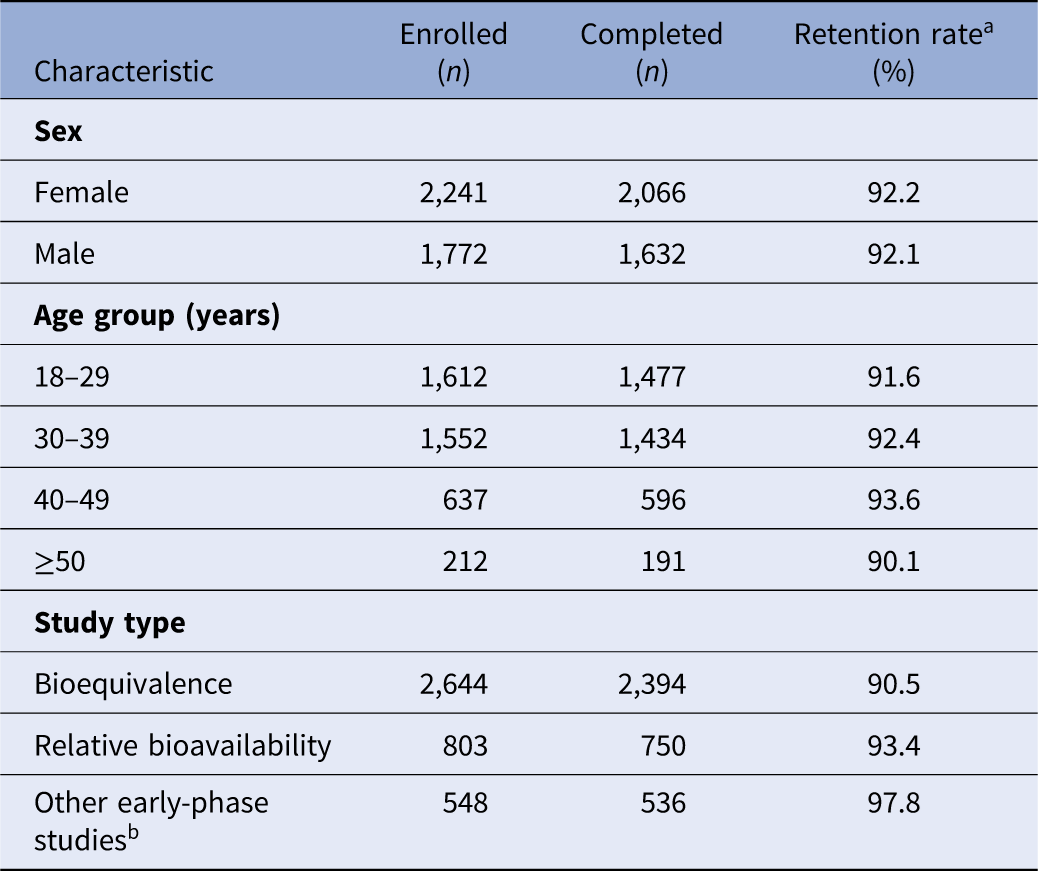
Exploratory stratification showed that post-randomization retention was comparable between female (2,066/2,241; 92.2%) and male (1,632/1,772; 92.1%) participants, and was broadly similar across age groups (range 90.1–93.6%). Retention differed more noticeably by study type, being lowest in bioequivalence studies (2,394/2,644; 90.5%), intermediate in relative bioavailability studies (750/803; 93.4%), and highest in other early-phase studies grouped together – DDI, food-effect, first-in-human, dose-escalation, and pharmacodynamic studies (536/548; 97.8%). Retention by participant and study characteristics is summarized in Table 4.
Post-randomization retention by participant and study characteristics

Table 4. Long description
The table presents the number of enrolled participants, those who completed all study procedures and the retention rate according to sex, age group, and study type. From the 2,241 enrolled female participants, 2,066 completed all study procedures (retention rate 92.2%). Among the 1,772 enrolled male participants, 1,632 completed all study procedures, retention rate of 92.1%. In participants aged 18–29 years (1,612 enrolled; 1,477 completed all study procedures) the retention rate was 91.6%. In participants aged 30–39 years (1,552 enrolled; 1,434 completed all study procedures) the retention rate was 92.4%. In participants aged 40–49 years (637 enrolled; 596 completed all study procedures) the retention rate was 93.6%. In participants aged 50 years or older (212 enrolled; 191 completed all study procedures) the retention rate was 90.1%. In bioequivalence studies (2,644 enrolled participants; 2,394 completed all study procedures) the retention rate was 90.5%. In relative bioavailability studies (803 enrolled participants; 750 completed all study procedures) the retention rate was 93.4%. In other early-phase studies (548 enrolled participants; 536 completed all study procedures) the retention rate was 97.8%. Retention rate is defined as the proportion of enrolled participants who completed all study procedures. Other early-phase studies include drug–drug interaction, food-effect, first-in-human, dose-escalation, and pharmacodynamic studies. Eighteen participants from one study without a recorded study-type classification are not shown.
a Retention rate = participants completing all study procedures/enrolled participants.
b Other early-phase studies comprise drug-drug interaction, food-effect, first-in-human, dose-escalation, and pharmacodynamic studies. Eighteen participants in one study without a recorded study-type classification are not shown.
Discussion
This five-year analysis of 99 Phase 1 trials demonstrates a high and improving post-randomization retention rate over the study period. Published benchmarks for retention and dropout in Phase 1 healthy participant studies remain scarce; available data derive primarily from Phase 2/3 studies in patient populations, which report median completion rates of approximately 85–90% across diverse designs and populations [Reference Gillies, Kearney and Keenan3,Reference Brueton, Tierney and Stenning9]. Direct comparison is therefore limited, but our findings are consistent with the expectation that the highly controlled inpatient model and healthier population of Phase 1 research supports higher retention than outpatient, higher-comorbidity, longer-duration designs.
The demographic profile of enrolled participants – predominantly female, young adults, and Caucasian (77.4%) – is representative of the urban healthy participant population of the Porto Metropolitan Area, in Portugal. The female predominance reflects the composition of the trial portfolio, which included a substantial number of studies with hormonal contraceptives and metabolic agents. The proportion of multiracial participants (14.1%) reflects the diversity of the local population. These demographic data contribute to the limited published characterization of Phase 1 participant populations in Southern Europe.
AEs and participant-initiated withdrawal were the dominant causes of dropout, jointly accounting for 79.0% of post-randomization discontinuations. The predominance of AE-related dropout – particularly in the Infections and Infestations SOC – reflects the impact of COVID-19 on trial conduct during 2021–2023, when SARS-CoV-2 infection was the most frequent individual AE leading to discontinuation. The marked improvement in retention from 2023 onwards is consistent with the diminishing operational impact of the pandemic. Consistent with this interpretation, COVID-19–related discontinuations peaked in 2022 (27 events), the year of lowest retention, and were absent from 2024 onwards, paralleling the recovery in retention. In exploratory stratified analyses, retention was largely independent of participant sex and age, whereas study type emerged as the characteristic most associated with retention: bioequivalence studies showed the lowest retention and other early-phase designs the highest. This pattern may reflect differences in confinement duration, number of periods, and participant burden across study types, and should be regarded as hypothesis-generating given the descriptive, unadjusted nature of these comparisons.
The high proportion of participant-initiated withdrawals (38.4%) underscores the importance of pre-study counseling, realistic expectation-setting, and ongoing participant engagement, particularly in confinement-based studies where perceived burden may increase over time [Reference Poongothai, Anjana and Aarthy1,Reference Gillies, Kearney and Keenan3]. Failure to meet post-randomization admission criteria (10.8%) represents a potentially preventable category of dropout, most often attributable to laboratory abnormalities (including positive drug-of-abuse urine test results) or clinical findings identified on admission day; closer adherence to study entry criteria at admission may reduce this proportion of dropouts. Enhanced pre-screening algorithms and more granular eligibility confirmation visits may also help prevent this type of exclusions [10,11].
Pre-randomization losses were substantial: 37.3% of scheduled visits did not result in ICF signature, and only 44.7% of ICF-signatories were ultimately enrolled. These rates reflect both the stringent eligibility criteria of Phase 1 protocols and the competitive participant recruitment environment in an urban Phase 1 Clinical Studies Unit [7,Reference Sully, Julious and Nicholl12]. Strategies to improve pre-screening efficiency – including refinement of existing pre-screening questionnaires, rapid eligibility assessment tools, and participant registries – merit prospective evaluation [Reference Kearney, Harman and Rosala-Hallas13,Reference Treweek, Lockhart and Pitkethly14].
This study has several limitations. Firstly, the retrospective single-center design limits generalizability. Reasons for withdrawal were categorized using a standardized internal classification rather than a validated external taxonomy, which may also affect comparability with other published series. In addition, race/ethnicity data collection was inconsistent across studies during part of the observation period, reflecting an operational gap that has since been addressed; these data should therefore be interpreted with caution. Secondly, AEs were not systematically characterized regarding treatment emergence, causality, or severity, limiting a more granular interpretation of AE-related discontinuations. These attributes were not available in the aggregated operational dataset used for this analysis, as they are documented at the level of each study’s individual case report form rather than in the unit’s trial management system from which data were extracted. Furthermore, the version of MedDRA used for coding varied across the study period, which may introduce minor inconsistencies in SOC-level classification. AEs were therefore neither inconsistently recorded nor deliberately excluded, but fell outside the scope of the operational data source. Thirdly, the study period coincided partially with the COVID-19 pandemic, which unusually inflated AE-related dropout rates, particularly in 2021–2022. Finally, the reasons for screening failure were not characterized in the present analysis, as they are coded according to each study’s protocol and require manual review that is currently ongoing; a dedicated analysis of the causes and mitigation of screening failures is planned as a separate study.
In conclusion, this analysis demonstrates high and improving retention rates at a Phase 1 Clinical Studies Unit over a five-year period, with AEs and participant-initiated withdrawal as the primary drivers of post-randomization dropout. The progressive improvement in retention rates following the pandemic period supports the value of unit-level tracking and operational refinement. These findings provide a reference dataset for Phase 1 units conducting similar analyses and highlight priority areas for improvement.
Data availability statement
Aggregated data supporting the findings of this study are available from the corresponding author upon reasonable request.
Acknowledgements
The authors made use of Claude (Anthropic, claude-sonnet-4, May 2026) to assist with data analysis, table formatting, and manuscript drafting.
The authors are entirely responsible for the scientific content of the paper, which adheres to the journal’s authorship policy.
Author contributions
Paula Ferraz Oliveira: Conceptualization, Data curation, Formal analysis, Investigation, Methodology, Project administration, Supervision, Validation, Writing – original draft, Writing – review & editing; Sofia Luz Gouveia: Conceptualization, Data curation, Formal analysis, Investigation, Methodology, Validation, Writing – original draft, Writing – review & editing; Miguel Souto: Conceptualization, Writing – review & editing; Filipa Borges Carneiro: Writing – review & editing; Beatriz Campos: Data curation, Formal analysis; Susana Paixão: Data curation, Formal analysis, Validation, Writing – review & editing; Suzana Cecatto: Writing – review & editing; Marlene Fonseca: Writing – review & editing.
Funding statement
This research received no specific grant from any funding agency, commercial, or not-for-profit sectors.
Competing interests
All authors are employees of BlueClinical – an Astrum company, with the exception of Sofia Gouveia. No other competing interests are declared.


 Open access

