

Introduction
By introducing the concept of ‘nationalization of politics’, Rokkan (Reference Segatti1970: 227–232) portrayed the homogenization of politics across national territory as the by-product of the breaking down of traditional loyalties to local rulers and of the diffusion of functional conflicts (on economic and ideological issues) As Caramani has re-stated, nationalization implies ‘the increasing integration of peripheral electorates into national political life and the transformation of local electorates and segmented party systems into national electoral constellations’ (Reference Caramani2004: 5).
In many Catholic countries the resistance of the periphery was supported by the religious establishments (Rokkan, Reference Segatti1970; Madeley, 2003: 102–103). The confessional parties, whose formationFootnote 1 was generally stimulated by the liberal elites’ secular drive after the 1880s (Kalyvas, Reference Kalyvas1996, Reference Kalyvas1998; Gould, Reference Gould1999; Ertman, Reference Ertman2009), opposed the universalistic and national imprint of the secular rulers by defending traditional and religious loyalties. Pursuing this aim the Catholic parties ‘inserted’ themselves into the local politics, because the locality was imbued of traditional and religious values and more resistant to the secular forces. As Rokkan (Reference Segatti1970) demonstrated for Norway, the religious dissenters (the various pietistic movements) arose on the isolated periphery to counter the standardizing impetus of the centre (in that case backed by the Norwegian national church).
The entrenched relationship between religious political entrepreneurs on one side, and local, traditional, elites on the other, produced two effects: (a) the uneven distribution of the Catholic parties over the national territory because of the differing strength of either the religious constituency in the various localities, and the local interests and elites; (b) the delay or incompleteness of the process of nationalization of politics (Caramani, Reference Caramani2004).
This schema applies to the late 19th and early 20th century. The post-45 party systems in Western European Catholic or mixed countries offered a completely novel scenario. The confessional parties were no longer the expression of a resistance to secular elites; rather they were the pillars of the new party systems and the ‘natural’ parties of government. Moreover, the Catholic Church performed a volte facia and, contrary to the turn of the 19th century, it welcomed and even endorsed the Catholic parties (van Kersbergen, 2008; Kalyvas and van Kersbergen, Reference Kalyvas and Van Kersbergen2010; Ignazi, Reference Ignazi2011). This support encouraged the Catholic parties to abandon of their local ties and pursue the nationalization of their constituency (Caramani, Reference Caramani2004).
In this paper we test whether in post-war Italy the dominant Catholic party, the Dc (Democrazia Cristiana – Christian Democracy) operated as a nationalizing agent of politics. Drawing upon a more fine-grained level of analysis within and across regional analysis, and new statistical measures of votes’ spatial distribution, we suggest a more nuanced interpretation compared with the previous literature (Pavsic, Reference Pavsic1985; Agnew, Reference Agnew2002; Caramani, Reference Caramani2004; Cartocci, Reference Cartocci1990).
Our thesis states that in the first post-war years the Dc pursued the nationalization of politics by emphasizing the religious–secular cleavage on the impulse of the Pius XII anti-communist crusade, which identify the enemy precisely in the materialist–atheist ideology (Riccardi, 1999). However, as we will show, religion did not suffice to guarantee a durable territorial homogenization of political preferences across Italy because it encountered resistance both from long-standing cultural and religious traditions in the different areas of the country, and from a territorially uneven process of modernization and secularization which re-instated and re-framed the previous regional differences.
In other words, different trends of modernization and secularization in the various areas of the country, interacting with persisting cultural–religious differences, brought forth the de-nationalization of the Dc vote.
Catholic vote and territorial homogenization of politics
The Dc at the core of the nationalization of the vote
The mainstream historical literature concurs in arguing that the Dc was central to the nationalization of politics in Italy. Accordingly, Giovagnoli (Reference Ginzburg1996) defined the Dc the ‘national party’. Following the same route of other post-war Christian Democratic parties in Europe (Kalyvas and van Kersbergen, Reference Kalyvas and Van Kersbergen2010), the Dc discarded local and sectorial interests while, at the same time, co-opted the traditional local elites, especially in the South. Where local parties could gain a relevant role, the Dc marginalized them, even unscrupulously as in the case of the separatist movement in Sicily in the late 1940s. In sum, the Dc did not draw upon the deep-seated reservoir of territorial resistance to the centre: on the contrary, by emphasizing the religious/secular cleavage it minimized the centre–periphery cleavage and the territorial divisions of Italy. In this endeavour, the Church actively supported the Dc’s territorial nationalization by pursuing the harmonization of religion across territory, seeking to overcome long-time religious divergences in the different areas (Garelli, Reference Garelli2007, Reference Garelli2011; Pollard, Reference Pollard2008).
Political science analysis supported this interpretation. According to Caramani,Footnote 2 ‘the electoral support for the main Italian parties was homogeneous, the most uniform support being for the predominant Catholic party Democrazia cristiana’ (Caramani, Reference Caramani2004: 126; our emphasis). Previous works, most particularly by Agnew (Reference Agnew2002), Cartocci (Reference Cartocci2011), and Pavsic (Reference Pavsic1985), had reached the same conclusion. Agnew argues that not only the Christian Democracy (Dc), but also the Communist party (Pci), especially in the period 1963–76, achieved a significant degree of nationalization (Agnew, Reference Agnew2002: 95). Pavsic states that in the period 1953–83 ‘the process of homogenization of the geographic distribution of votes in Italy (…) concerns only a couple of parties’, above all the Dc, but not the Pci (Pavsic, Reference Pavsic1985: 97). Cartocci follows the same line arguing that ‘the electoral decline of the Dc [between 1953 and 1987] made the country more homogeneous’ (Reference Cartocci2011: 68). Beyond some nuances, all these studies concur that the Dc has been the driving force for the nationalization of vote in Italy.
Our analysis challenges this interpretation also thanks to new resources and tools not available to previous authors. In fact, we employ a more fine-grained level of analysis (over 6000 communes instead of the 92 provinces used in previous studies) and measures of spatial clustering that are not considered by other works. These innovative data source and statistical tools enabled us to test the influence of the different geo-political areas in the process of nationalization and to test the role of modernization and secularization in the same process. In a nutshell, we advocate that, after a process of nationalization of politics, since the late 1970s an inverse process of de-nationalization was ingrained; and the Dc was at the core of that process.
The relevance of geo-political regions
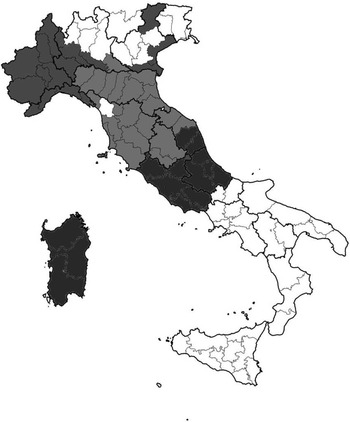
To fully understand the dynamics of nationalization and de-nationalization of the Dc we must examine these processes below the national level. In fact, a wealth of studies dating back to the fundamental work by the Istituto Cattaneo in the late 1960s (Galli et al., 1968; Galli and Prandi, Reference Galli and Prandi1970), and then re-assessed by more recent analyses (see in particular Segatti, Reference van Kersbergen1999 and Cartocci, Reference Cartocci2011), demonstrated that the electoral behaviour in Italy differs in a marked way by ‘geo-political areas’, which represent enduring territorial identities and cleavages in Italian politics. These geo-political units are more central to understanding nationalization because they form long-standing cultural and political identity cohesions. The original contours of the geo-political areas have been slightly re-framed by later studies. Arculeo and Marradi (Reference Arculeo and Marradi1985) subdivision is now customary among scholars of Italian electoral behaviour. The areas are as follows: (1) Secular North, (2) White North, (3) Red Belt, (4) Centre, and (5) SouthFootnote 3 (see Figure 1 for a detailed description).
Italy’s geo-political areas. Darker grey: Secular North (North-West); White: White North (North-East); Light grey: Red Belt (Centre-North); Black: Centre (Centre-South, including Sardinia); Dark white: South (South). Provinces constituting the geo-political regions: Secular North: all the provinces of the regions Piedmont, Friuli-Venezia Giulia, and Liguria; the Lombardy’s Provinces of Milan, Pavia, Cremona, Varese; and the Veneto’s Provinces of Belluno and Rovigo. White North: Lombardy’s Provinces of Como, Sondrio, Bergamo, Brescia; Veneto’s Provinces of Verona, Vicenza, Treviso, Padua; Trentino-South Tyrol’s Province of Trento; and Tuscany’s Province of Lucca. Red Belt: all the provinces of the regions Emilia-Romagna and Tuscany (except Lucca); and Marche’s Provinces of Pesaro, Ancona. Centre: all the provinces of the regions Lazio, Abruzzi, Molise, and Sardinia; and the Marche’s Provinces of Macerata, and Ascoli Piceno. South: all provinces of the regions Campania, Apulia, Basilicata, Calabria and Sicily. The provinces of Aosta Valley and Trieste are excluded. For a discussion of the selection of the provinces see Arculeo and Marradi (Reference Arculeo and Marradi1985).

The geo-political differentiations were particularly salient for two areas, the White North (the Catholic area) and the Red Belt (the socialist and communist area), where the strength and consistency of the ideological connotation were very strong and neat. The capillary diffusion of a network of associations linked to the respective parties in all spheres of the society encapsulated citizens in an organizational environment to the point of creating and enforcing loyalty to the political expressions of each ‘subculture’ (Galli et al., 1968; Galli and Prandi, 1970). The vote for a specific party – Catholic or socialist–communist –was the inevitable by-product of a dominant ideological–cultural presence and of an organizational encapsulation through the web of flanking associations. The electoral behaviour was therefore ‘dependent’ on the territory (Diamanti, Reference Diamanti2009). For this reason, the analysis of the electoral behaviour at the national level, taking the country as a single unit, hides significant variation both within and across the geo-political regions.Footnote 4
The Dc vote by geo-political areas shows in fact a remarkable differentiation in the party share of vote. The White North represented the bulk of the Dc support, whereas the Red Belt was a ‘terre de mission’ for the party. The huge difference of the first post-war decades, when more than 25 percentage points separated the Dc vote in the two areas, tended to diminish over time. From the 1980s onwards the gap shrunk, due especially by the Dc steep decline in the White North. Furthermore, this decline led to a change in the geo-political balance of the Dc vote: the South got a higher and higher share of the party’s vote and at the 1992 election it even surpassed the White North.
This paper extends the analysis also below the regional patterns to examine the distribution of the vote by showing the vote clustering – that is, the concentration of communes with high or low vote – within the regions.
The nationalization of politics: definitions and measures
As we stated above nationalization of politics, according to Caramani refers to the ‘process of political integration translate[d] into the territorial homogenization of electoral behaviour, both electoral participation and the support for the main party families. […] Peripheral and regional specificities disappear, and sectional cleavages progressively transform into nationwide functional alignments’ (Reference Caramani2004: 1, emphasis in the original). National politics substitutes local politics.
In order to analyse this process we decompose the nationalization of politics into three dimensions: (a) geo-spatial, (b) vertical, and (c) temporal.
(a) The geo-spatial dimension
Definition: The geo-spatial dimension refers to the dynamic in which peripheral polities, represented by local territorial parties, are incorporated into the national polity. Variation in the geo-spatial vote distribution decline as parties achieve presence in all communes and demonstrate similar levels of support. In the ideal-typical case of pure geo-spatial homogenization of the vote, party vote would present the same percentage in all communes with std. dev. of 0.
Measures: Measures of dispersion are the basis for several measures of nationalization of party vote (Jones and Mainwaring, Reference Jones and Mainwaring2003; Caramani, Reference Caramani2004; Aleman and Kellam, Reference Aleman and Kellam2008; Kasuya and Moenius, Reference Kasuya and Moenius2008; Bochsler, Reference Bochsler2010). Typical of these measures, Caramani (Reference Caramani2004) and Bochsler (Reference Bochsler2010) examine the mean and standard deviation across Italian provinces. Their measures are intended to capture the homogenization of the vote taking the 92 Italian provinces as unit of analysis. Hence, within-province variation is ignored. We consider these measures, if taken alone, flawed on two counts.
First, these measures rely on large units of analysis, the Italian provinces. The provinces contain many smaller units – commune – which have considerable variance within and across the provinces. This within-province variation is not captured with the above-mentioned measures. More fine-grained analysis increases variance in the data.
Second, these measures miss the spatial distribution of the vote within and across the geo-political regions and the provinces, that is instead captured by lowering the level of analysis to the commune. For example, two provinces might display identical means and standard deviations, but have markedly different internal distribution of the vote: in one province the vote for a party is concentrated in a handful of communes, while in the other the vote is evenly distributed in each commune, but means and standard deviations might be the same. Moreover, provincial and regional boundaries may cross-cut spatial concentration or clusters and, therefore, geo-political regions or provinces fails to captures the party vote clusters which spread across two or more regions or provinces.
In order to overcome these flaws, we look for spatial concentration that is, the existence of clusters of geographically contiguous communes. These clusters display groups of commune where the vote for a party is homogenously high, or homogenously low; it may also happen that the vote is evenly distributed, that is, it is randomly distributed, and thus no cluster appears. The more clusters are present (either high or low), the less the vote is homogeneously distributed across country. The geo-spatial measures are drawn from the geographical information system (GIS) and the Moran’s I.
The Optimized Getis-Ord Gi* Statistic estimates the best fitting spatial decay function across contiguous commune and the algorithm compares local areas with the global average to identify local areas of strong autocorrelation. For example, we know the Northeast is a stronghold of the Dc, but we do not know the strength of spatial densities (the clusters) within the region. Getis-Ord identifies and estimates the strength of these clusters and the algorithm estimates the optimal size of the cluster. In 1953 optimal number of commune for a cluster in the Northeast is 40, whereas in the South is 15: this indicates a broader spatial base of the Dc in the Northeast, and more isolated pockets in the South. For 1992, the situation in reversed with the South showing an optimal size of 15 and the Northeast a cluster size of eight. This reflects the fragmentation of the Dc occurred in 1992 in the Northeast and the party’s relative strength in the South.
Moran’s I measures spatial autocorrelation and the degree to which party vote in one commune is surrounded by communes with similar votes. Moran’s I can range +1 to −1, where minus values indicate great dispersion, and plus values great concentration. A value of 0 indicates a random distribution. Thanks to the Moran’s I, we can better grasp, in comparison with mean and standard deviation only, the difference in the spatial vote distribution in the various regions.
(b) The vertical dimension
Definition: Caramani defines this dimension of the nationalization as ‘uniform responses of constituencies or territorial units to national factors’ (Reference Caramani2004: 37). In other words, the political moves up a vertical axis from the local to the national. Local politics is nested within national politics and the nationalization of politics infuses national political questions into local politics.
Measures: The vertical integration of local politics into national politics is indicated by homogeneity of electoral shifts across time. Do the commune follow the national trend in vote shifts? Butler and Stokes (Reference Butler and Stokes1974) defined this as the ‘national vote swing’ measured by the deviation of commune party vote from the national average vote for a party. For example, if the Dc increased its national vote by 3%, the increase will be homogeneous across commune. The greater the deviation, the less the nationalization. In this analysis we follow the generally accepted measure: the change in the party vote at the local units from election to election across each of the elections from 1953 to 1992. We test the presence of a national swing with analysis of variance within and across geo-political regions and provinces.
(c) The temporal dimension
Definition: Geo-spatial and vertical homogenization takes place across time with the incorporation and standardization of peripheral polities into the national norms, that is, peripheral distinctions subsumed into a nationwide polity.
Measures: Change is measured across 10 elections from 1953 to 1992 for each commune.
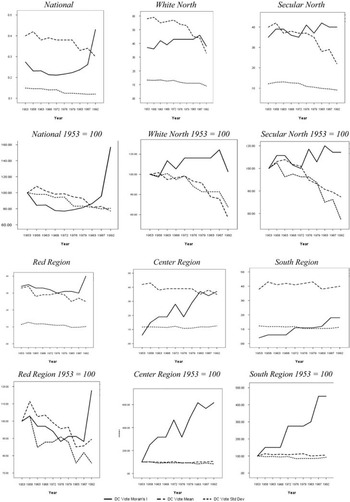
Plotting the measures: Figure 2 presents the mean, standard deviations, and Moran’s I of the Dc vote at national and geo-political level. The upper rows present the observed values, the lower ones the same data indexed to 1953=100. Comparing the windows, we see actual and relative changes in the measures. For example, in the upper window (observed values) for the White North, we see that the Dc vote declined from 58% in 1953 to 38% in 1992; the lower window (indexed values) shows that the 1992 vote was 65% of its 1953 vote, that is, a loss of 35%. Moreover, the standard deviation declined by over 20%. In contrast, Moran’s I remained constant for most of the time, but for a sharp decline in 1992 after a little surge in 1987.
National and regional Democrazia Cristiana vote 1953–92: observed and indexed statistics.

This informs us that, although the Dc vote was becoming more similar across the communes, the uneven geographical distribution of the vote was unchanged. The Secular North shows a similar pattern to the White North. The Centre and South present the opposite pattern to the Secular North and White North. In the Centre and the South, vote mean and standard deviation are almost constant, but the Moran’s I increases markedly. Finally, the Red region presents a distinctive pattern: the mean and standard deviation of the Dc vote show a similar decline to the Secular North and White North, however, Moran’s I also shows a decline. This suggests a generalized decline similar to the Secular North and the White North, but here the party was not able to retain support in its (limited) traditional strongholds in that area.
In sum, the plotting of these measures at national and geo-political level suggests the Dc vote was relatively stable, with a tendency to concentrate in particular clusters of communes. Therefore, these results contradict the nationalization thesis which postulates that vote nationalization is indicated by greater similarity across the units and the decline of geographical strongholds.
These conclusions are better illustrated if we contrast the White North and the South. In the White North the Moran’s I is 0.37, thus indicating statistically significant clustering, while the mean is 0.58 and the std. dev. is 0.12. On the other hand, the Moran’s I for the South is 0.04, thus indicating no clustering at all, while the mean is 0.38 and the std. dev. is 0.12. The mean and the standard deviation are similar in the two areas, but the Moran’s I is very different. Only by employing this measure we can assess that the Dc vote in the White North is highly clustered while the South presents no pattern at all. Moran’s I therefore provides additional information not captured by the mean and standard deviation.
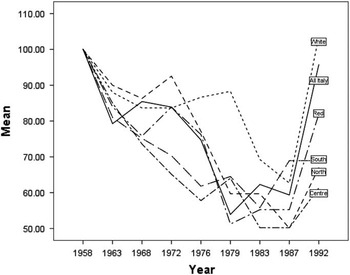
Finally, the vertical dimension shows no tendency towards a national swing: the Dc did not nationalize its vote along this dimension. Figure 3 highlights this tendency illustrating the changes in the standard deviation vote change index to 1958=100 for Italy and for all regions. If vertical integration is proceeding, the lines of the standard deviations in each area should converge on the national standard deviation. This is not the case. First, the lines do not converge to the national average. Second, the standard deviations of the changes in the Dc vote increase after 1972, and increase dramatically for the White North with the collapse of the party in 1992. We can conclude the there is no evidence that Dc developed a ‘national vote swing’ across the 10 elections from 1953 to 1992.
Index of national swing of Democrazia Cristiana vote by geo-political regions.

In conclusion, the analysis by geo-political areas skewed different trajectories of the Dc vote. In particular the South appears almost as an outlier. This needs an ad hoc investigation.
The territorial cleavage of religiosity
Because both territory and religion figure so prominently in Italian elections, we must also highlight the peculiar territorial cleavage of the religiosity in Italy. The religious sentiment, in fact, takes different forms according to the various geo-political areas. Religiosity, in terms of self-declaration of belonging to the Catholic religion and in terms of behaviour, that is, attending to the rites, particularly the Sunday mass, has always been very high in the White area; second came the South area, and at the very bottom, with very low levels, the Red area (Garelli, Reference Garelli1991: 104–110, Garelli, Reference Garelli2011: 62).
The religiosity in the South differs also on another respect. The large adhesion to the ‘Church religion’ (religione di chiesa), that is the formal and ritualistic adhesion to the religion through the Church, coexists with, at times, the reception by the believers and the same clergy of a different kind of religiosity: the ‘popular religiosity’. By this term it is meant a syncretistic mix of traditional (even pagan) and magic references on one side, and Catholic rites and prescriptions on the other side. The cult of saints, comprising all the related manifestations, well expresses such ‘popular religiosity’ (De Rosa, Reference De Rosa1979). Actually, this kind of religiosity affected the entire country (Ginzburg, Reference Giovagnoli1972), but in the South it was particularly entrenched in society.
The origin of this religious–territorial cleavage dates back to the Counter-Reformation. The Church propelled a massive effort to halt the potential development of dissenters and pro-Reform believers on one side, and the loosing of authentic faith and ‘Church religion’ on the other, through a pervasive and radical ‘re-christianization’ of the country in the XVII century. This initiative was carried on in two different ways in respect to the north and the south of the country, precisely because the challenges were different in the two areas. In the North, where the Reform periodically surfaced, the Catholic Church responded, beyond repression and the Inquisition, by expanding its organizational networks of parishes, seminaries, and monasteries. In the South, the Church reacted in a different way because it faced a different phenomenon: not the diffusion of Protestantism but rather the magic and pagan flavour of the religiosity. As De Rosa wrote, the active mobilization of the Church in the XVII century ‘documents a desperate and frequently unsuccessful struggle to lead the South to a Roman and institutional consciousness of the faith, even against a local carnal and mundane clergy which found it easier to connect to a miserable and hungry populace through the compromise-channel of the magic’ (Reference De Rosa1971: 11–12). Ultimately, the counter-reformation Church ‘gave up’ and accepted to coexist with the magic and pre-Christian traditions.
This accommodation ceased after the Council Vatican II. The Church made an effort to eradicate that tradition and stimulate the believers towards a more ‘authentic and spiritual’ reception of the religion by the transfer of priests and bishops from the North to the south. Apparently this effort has not been very successful. One indicator of this difficulty comes from the limited presence of Catholic organizations (Acli, Ac, Scouts) and religious movements such as Communion and Liberation (Comunione e Liberazione) (Faggioli, Reference Faggioli2012). Moreover, some bishops concluded that eradication of the cult of saints and other expressions of popular religiosity would have produced a negative backlash on the involvement of the local Catholics.
In sum, religion in Italy was never homogeneous; however, it did function to suppress or deflect alternative social cleavages, particularly territorial identifications.
This brief description of the different kinds of religiosity which characterizes the various areas of the country offers the background for understanding the different reception of the process of secularization, a variation which negatively affected electoral nationalization. As advanced in previous works (see in Ignazi and Wellhofer, Reference Ignazi and Wellhofer2013b) in Italy the driving force for secularization was represented by modernization. The socio-economic development has not been uniform in the various areas of the country (Zamagni, Reference Zamagni1993; Iuzzolino et al., Reference Iuzzolino, Pellegrini and Viesti2011), and this has stimulated territorial variation in the level of secularization (Diotallevi, Reference Diotallevi1999). In the following, we investigate whether, beyond the socio-economic divide between North and south which determines a different level of modernization and consequently of secularization in the two areas of the country, the above-mentioned peculiarity of the religious cleavage between North (Secular North and White North) and South adds an additional drive to the impact of secularization by further limiting its development in the South vis-à-vis the North. Finally, we will test whether the different process of secularization by geo-political areas have affected a different territorial pattern of Dc vote and thus a limited level of nationalization of the vote. In sum, our driving hypothesis considers the declining territorial homogenization of Italian electoral politics as a by-product of the different level of secularization due not only to socio-economic factors but also to the intra-religious–territorial cleavage (religione di chiesa vs. religione popolare). And the Catholic party reflected in itself this cleavage producing a territorial dis-homogenizing of the vote.
Dimension and causes of the Dc vote territorial differentiation
In order to explain the process of nationalization and de-nationalization and its relationship to the Dc’s decline, we provide here an empirical test of the determinants of the Dc vote from 1953 to 1992, again carrying the analysis by geo-political regions. We focus our attention on two questions. (1) Were there significant regional variations in the change over time of the Dc vote and in its spatial concentration? (2) What accounts for the differences among regions?
Our analysis divides the post-war period in two phases: 1953–72 and 1973–92. We choose 1972 as break point not only because it divides the period into two precise ventennials, but because it represents a turning point in the process of secularization in Italy and of political dominance of the Dc (Ginsborg, 1989; Wertman, Reference Wertman1993; Giovagnoli Reference Ginzburg1996; Caciagli, Reference Caciagli1990).
Secularization ‘emerged’ in the mid-1970s with the contested and hotly debated approval of the divorce law in 1970 and, above all, with the landslide victory of the secular pro-divorce front against the Dc in the 1974 referendum on that law. Even more dramatic was the defeat suffered by the Dc and the religious constituency in the 1978 referendum on the abortion law. These modifications in these political behaviour did not translate immediately in a distancing from religious habits, conventions and practices. In fact, the behavioural (not attitudinal) indicators of secularization adopted in the present research display a clear increase only in the following decades (Ignazi and Wellhofer, Reference Ignazi and Wellhofer2013a).
Dimensions of regional variations of the Dc vote
Our first question is how did the Dc vote vary across the regions and across time? We have already illustrated the curves of the three measures of nationalization employed in The nationalization of politics: definitions and measures section (Figure 2). Here, we provide a test of statistically significant differences of the decline curve for each region from the whole and from each other region. We employ structural equation modelling (SEM) to estimate the latent curve decline, that is, structural equation modelling with latent curve analysis (SEM-LCA).Footnote 5 SEM-LCA estimates the intercepts (i.e. the initial values) and slopes (i.e. the rate of change across time) for each region. The comparative analysis of the regional intercepts and slopes highlights the dynamics of de-nationalization and the changing spatial vote clusters.
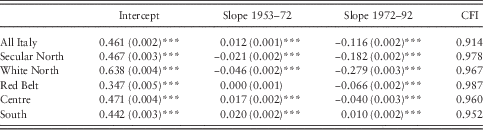
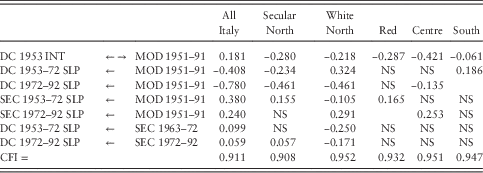
Table 1 presents the unconditional initial intercepts (i.e. using none of the independent variables) and slopes for each region for the two time periods, 1953–72 and 1972–92. The number in brackets indicates the variance of the intercepts (how much variation exists in the intercepts across commune within the regions), and slopes (how much variation exists for the changes across commune within the regions across time).Footnote 6 Each regional model achieves a better fit to the data and is statistically different from the national model and each of the regional models. Therefore, regional distinctiveness persists and the nationalization thesis is not supported. This result is also consistent with the clustering results discussed above.
National and regional intercepts and slopes of the Democrazia Cristiana vote 1953–72 and 1973–92

The different religious traditions in the White North and the South can shed light on how the two traditions responded to the forces of modernization and secularization. As we shall see, while the White North ‘Church religiosity’ provided a feeble barrier to those societal changes, the South ‘popular religiosity’ proved more resilient. The clustering effects and the slopes in Figure 2 show that in the White North the Dc vote rapidly declined, while in the South we see a slight increase.
We should also point out the contrasts between the Secular and White North: the two northern regions had a very different profile in terms of modernization in 1953: Secular North was the most developed region in Italy in 1953 since it was the cradle of the Italian industrial revolution; thus, giving its initial high level of modernization, its rate of modernization was slower compared with the other regions, except the South which lagged behind. Meanwhile, the White North, starting from a low level of modernization, modernized later but at a more rapid rate (Iuzzolino et al., Reference Iuzzolino, Pellegrini and Viesti2011).
This is also evident in the Table 1. The White North has a higher intercept in 1953 and the slope in the White North shows greater decline than in the Secular North in the 1973–92 years. These estimates of the intercepts and slopes at regional level are in the expected direction and, more significantly, focus on the persistence of the North–South cleavage that was instead masked by the national level data. These results provide the starting point for the explanations of change below.
The changing geography of the Dc vote
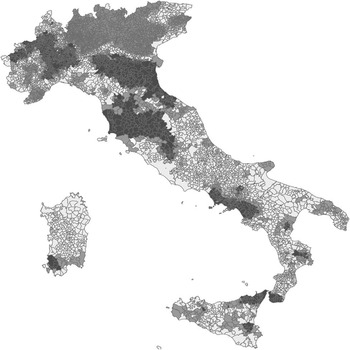
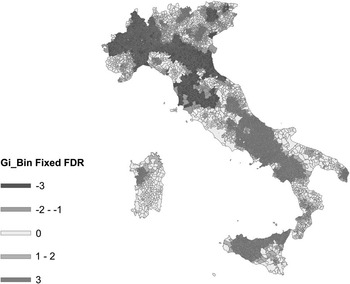
The SEM models above present the statistical analysis of the shifting geography of the Dc vote. However, the most dramatic method to present our conclusions is to map the territorial shifts of the geographical base of the Dc. Figures 4 and 5 presents the same results of increasing distinctiveness of the geo-political areas in a visual format.
1953 Democrazia Cristiana vote: statistically significant clusters of high and low values (using optimized Getis-Ord Gi*Statistic).

1992 Democrazia Cristiana vote: statistically significant clusters of high and low values (using optimized Getis-Ord Gi*Statistic). ‘The Gi_Bin field identifies statistically significant hot and cold spots [high and low clusters of values], corrected for multiple testing and spatial dependence using the False Discovery Rate (FDR) correction method. Features in the +/−3 bins (features with a Gi_Bin value of either +3 or −3) are statistically significant at the 99 percent confidence level; features in the +/−2 bins reflect a 95 percent confidence level; features in the +/−1 bins reflect a 90 percent confidence level; and the clustering for features with 0 for the Gi_Bin field is not statistically significant’ (Arcview 10.3, 2014). Also see Getis and Ord (1992) and Ord and Getis (1995).

In Figure 4 we observe that in 1953 the Dc is a distinct regional party concentrated in the traditional stronghold of the White North. Moreover, the Dc is weakest in the Red region: the Po River valley and Tuscany, long a regions of militant left politics, stand out in the map. The Dc support is also weak in the Secular North, a region where the Socialists and other secular parties performed better.
In 1992 the picture is quite different. Comparing Figures 4 and 5, we clearly see the decline of the Dc in the Northeast and the party shift to the Centre and South. The Northeast shows fragmentation and the breakup of vote concentration. A few isolated enclaves continue to exist in the Northeast, but the party suffers a loss of cohesion and the consequential weakening of the interactive effects. Meanwhile, the Dc migrates southward and its concentration become located in the Centre and South. Therefore, the Dc shifts from a Northeastern party to a Southern party, if not the party of the South.Footnote 7
Causes of the regional variation of the Dc vote
The second question we ask is What accounts for the regional differences in the Dc decline, the endurance of the North–South cleavage, the failure of the Dc’s nationalization strategy, and the consequential de-nationalization of politics? Our hypotheses are that modernization and secularization interacted with the geo-cultural/religious traditions to undercut the nationalization of the vote built on religion and embodied in the dominant, religious, party, that is, the Dc. Regional geo-cultural religious differences responded differently to secularization and the Vatican II reforms. Both enlarged the gulf between the ‘Church religion’ in the North and the ‘popular religiosity’ in the South increasing the distinctiveness of the South; moreover, the weakening of religion and the re-emergence of the North–South cleavage, not only undercut the Dc’s support, but opened the path to regionally based parties, for example, the Lega Nord.
If we are correct, different regional dynamics of modernization and secularization affected the Dc vote. Hence, we seek the best fitting models for each region employing our measures of modernization and secularization. Modernization is measured by several, widely employed, indicators at three time points, 1951, 1971, and 1991: (1) the rise of industrial and service sector employment, (2) the increase in education, particularly formal, state sponsored education, and (3) the rate of urbanization. Secularization is measured by changes in civil marriage as a percentage of all marriages (See Data Sources for the measures).
The modernization thesis holds that socio-economic modernization and secularization generate social and cultural homogenization; therefore modernization and secularization would further the nationalization of politics, and regional dynamics would wither. Consequently, the Dc vote should have become more homogeneous across-time and across the regions. If, however, modernization and secularization generate different outcomes across the regions, then the standard interpretation is not supported.
In the following, we will argue that a period of nationalization of the vote was in action ( as sustained by Caramani, Reference Caramani2004), but this occurred in the first post-war decades only (1953–72), and that it was followed by de-nationalization period in the later decades (1973–92). Data presented in Table 2 Footnote 8 support our hypothesis.
National and regional direct effects of modernization and secularization on the Democrazia Cristiana (Dc) vote

CFI=comparative fit index.
Intercepts and slopes, 1953–72, 1973–92
The summary statistics of the fit for the models in last row of Table 1 show that the models perform adequately in all regions.Footnote 9 The correlation between modernization in the period 1951–72 and Dc vote in 1953 for all of Italy is moderately positive. But when we examine the across-time dynamics, the effects of modernization on the Dc vote are negative: −0.408 for the 1953–72 years and increasing to −0.780 in the 1973–92 years.
Once more the coefficients across the regions have pronounced differences. Controlling first the northern regions, in the Secular North the coefficients are negative in both periods (−0.234 and −0.461), while in the White North the coefficients shift from positive to negative (0.324 to −0.461). The explanation is found in the differences previously highlighted between the two regions: the Secular North modernized earlier and was the most developed region in Italy in 1953; development came later and more rapidly in the White North. The remaining three regions evidence greater stability, and the South even demonstrates a slight positive effect of modernization on the Dc vote.
Modernization is often accompanied by secularization and has been considered integral to modernization theory. For this reason, we examine both the direct effects of modernization on secularization, and of secularization alone on the Dc vote, and the indirect effects of modernization via secularization on the Dc vote.
For the effects of modernization on secularization, as measured by the proportion of civil marriages, the greater modernization increases the probability of civil marriages in the Secular North and the Red Belt. The White North follows the same pattern but only in the more recent period (1973–92). In the initial period (1951–72) instead modernization is associated with a decline in civil marriages; this is likely explained by the resilience of the region’s traditional greater religiosity and Church’s penetration in the social life. The last two rows in Table 2 present the impact of secularization on the Dc vote in the two periods. While secularization has little effect on the Dc vote at the national level, it has significant effects in the White North. This dynamic is absent in the other regions.
In conclusion, both modernization and secularization have major effects on the Dc vote decline in the White North.
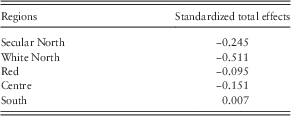
All coefficients discussed so far are the direct effects. Direct effects are the partial effects, that is controlling for the effects of other variables. To include the effects of moderating variables, we turn to the total effects coefficients. Total effects are the combined direct effects of modernization on Dc vote and the indirect effects of modernization mediated by secularization on Dc vote. The White North is unique: both modernization and secularization combine to bring about the decline of the Dc: −511. In the Secular North effects are similarly negative but much lower: −0.245. In the other regions, the effects are absent or weak (Table 3).
Regional total effects coefficients of modernization and secularization on the Democrazia Cristiana vote, 1973–92

These results contrast with the standard interpretation of the homogenizing effects of modernization. The several regions become more distinct under the effects of modernization. To confirm the regional differences, we ask the question: What the probability that the model for each region can predict the results for each other region.Footnote 10 These statistical tests of significance indicate that the models have <0.001 chance of being identical.
In addition, resistance to homogenization and nationalization of the Dc vote is manifest in the clustering patterns of the vote within the regions. If the nationalization thesis is correct, then clustering should decline and the level of clustering should become more equal across and within the regions. Actually, our results show the opposite. While the Secular North and the White North experience a general decline in Dc support, they retain their historical clustering patterns. In the other regions, clustering increases slightly, again contradicting the nationalization thesis.
However, the most traditional region of Italy, the South, resisted these same forces as it has resisted most all efforts at change in the past.
Conclusions
A widely shared interpretation is the nationalization of the vote in Italy rested mainly upon the dominance of the Catholic party, the Dc. The standard narrative goes that in the first post-war years the Dc marginalized both the centre–periphery cleavage and the class cleavage by subsuming these under the religious–secular cleavage. The strategy sought to generate a national polity. Many scholars concluded this strategy was successful: politics became more nationalized.
Our analysis provides a more nuanced interpretation. We argue that the nationalization of politics rested on a fragile foundation as evidenced by the regional variation in Dc support.
First, the clustering pattern of the Dc vote changes little across time in the strongholds of the Dc in the Secular North and White North. In other words, communes in these regions where the Dc performed well in 1953 continue to be the party’s strongholds in 1992. While the party in these two regions experienced a general decline, the spatial distributions of its vote changed little. Support for the nationalization thesis would show a weakening of such strongholds. In the Centre and South, spatial clustering increased, again this is contrary to the nationalization thesis.
Second, homogenization was never complete at the national level and even less so at regional level as evidenced in the persistence of regional variations in Dc support. In other words, the North–South cleavage persisted in a latent form, and would regain salience later.
Third, the success of Church–Dc strategy to marginalize the North–South and class cleavages depended on the homogenization of religion across the country. Church efforts to achieve greater religious coherence across the country met with resistance, particularly in the South. Localized customs and practices, reminiscent of a ‘popular religiosity’ more in tune with a ritualistic rather than spiritual adhesion to the religion, persisted. And this territorial religious divide impacted both secularization and catholic party voting.
Fourth and paradoxically, the economic development policies of the ruling Dc party coalition set in motion the forces of modernization and secularization. Modernization and secularization became the driving forces behind the Dc’s demise, and generated the de-nationalization of the vote.
We could draw these conclusions by employing the most fine-grained level of analysis (the commune) and the most advanced statistical techniques (GIS and SEM) ever brought to bear on these questions. The findings demonstrate that the dynamics of nationalization of the vote differ from the established interpretation. At the national level the Dc’s relatively high and stable vote in the first post-war years suggested the emergence of a national party, but these appearances were deceiving. Starting from the 1970s and accelerating dramatically in the late 1980s, the Dc’s hegemony declined. Spatial concentration of Dc vote, which never disappeared entirely, increased in intensity and the several regions began to diverge. The processes of modernization and secularization, by enforcing the Dc’s decline, contributed to the de-nationalization of vote.
These dynamics are not linear or straightforward. Our analysis revealed a complex spatial and temporal series of interactions. The dynamics resulted in a paradoxical process because the uncontested successes of the Dc’s development policies in the first post-war decades, and the Church’s efforts to modernize after Vatican II, contributed to the Dc demise.
The overall significance of this research is the contrast with the standard interpretation of the homogenizing effects of modernization and secularization on politics. De-nationalization of the vote re-opened the latent the North–South divide and paving a path for political realignment: the emergence of a regional party such as the Lega Nord which has its stronghold in the former White area is another by-product of those changes.
Acknowledgments
This paper is developed from research sponsored by the National Science Foundation under Grant SBR-94-2281. The Foundation’s support is gratefully acknowledged. The Istituto Cattaneo of Bologna, the Dipartimento di Politica, Istituzioni, Storia of the University of Bologna, and Istituto degli Studi Advanzati of the University of Bologna, the Ministero dell’Interno, and the Istituto Nazionale di Statistica in Rome also provided invaluable assistance.