




No CrossRef data available.
Everyday Life in the First Hungarian Socialist City
Published online by Cambridge University Press: 06 December 2005
Abstract
This paper examines the official discourses that shaped the parameters of everyday life and the reactions of socialist citizens to them in Hungary's first socialist city, Sztálinváros, during the 1950s. Concentrating especially on the regulation of working-class leisure, it argues that the authorities sought to frame social conflict in terms of a struggle between the civilized and the backward, the rural and the urban. In so doing it provides an insight into the nature of early state socialism as a project of cultural transformation.
Information
- Type
- Research Article
- Information
- Copyright
- © 2005 The International Labor and Working-Class History Society
Sztálinváros was intended to become the most socialist city in Hungary; its residents were to be the most socialist of citizens. Because of this the settlement came to symbolize a gateway between old and new, as well as good and bad. It was perhaps for this reason that many came to believe that whoever passed through this gate were left without hope. It is, however, important to consider to what degree the residents of the city were able to maintain relative freedom and autonomy in the face of attempts by the state to determine the circumstances in which they lived. Indeed, this question is fundamental to the study of every ideologically-based political system. In the course of the research on which this article is based, it became ever more clear that the histories of Sztálinváros's residents not only revealed much about the impact of socialism on everyday life, but they also cast light on the limits of dictatorship and the self-determination practised by ordinary people in the face of state power. It was precisely these limits that shaped the everyday lives and culture of ordinary people, even when they stepped through a gate which symbolized a new way of life, which was precisely what Hungary's first socialist city was.
Political and social elites have long used the foundation and planning of cities as a means of projecting their power and advancing their own programs of social transformation. Sztálinváros was not simply brought into being by the socialist state in order to realize concrete goals related to the development of Hungary's armaments' industry or other social policy measures, but to demonstrate the strength of the country's new rulers. Rulers have dreamed for time immemorial of creating cities from nothing or shaping civilization from the wilderness. Despite this, Sztálinváros did not, or only in a very restricted sense, meet the criteria of a city in the eyes of contemporaries. In order to ensure that its residents began to consider the settlement in which they lived a city, the very social definition of a city had to be changed. In this process a decisive role was played by official discourse, which privileged a representation of the city's construction as a struggle between the urban and nonurban, and, using older analogies, as a struggle between the civilized and the wild.

1. The Dedication of the Stalin Steel Works, Sztálinváros, 1951.
Source: Intercisa Múzeum, Dunaújváros, Hungary.
The city and those who lived in it were interpreted and represented in different ways. A city can be just as easily characterized by the desires of its planners as it can by the ways in which its builders deviated from those plans or by the way residents understand the place where they live. Despite the beliefs of its planners, Sztálinváros never truly became the model socialist city either in the eyes of its residents, or in the eyes of those who lived in other parts of Hungary, nor did it become the best city in the country as defined by socialism or by society in general. At the same time different social groups—the intelligentsia, skilled workers, those who migrated from the villages, or the writers of propagandistic texts—ascribed different meanings to the notion of the city as characterized by Sztálinváros. Similarly, the phenomenon that can be understood as “the attempt to create a new culture,” which was seen as central in official discourse to the construction of socialism and attempts to shape “a new socialist person,” carried different meanings for various social groups. Sztálinváros's history can be understood as that of an entirely new settlement, where social groups confronted new conditions, largely the products of state action, which formed, reshaped, and determined the social processes of the socialist decades.
The construction of the city, seventy kilometers from Budapest, began in the spring of 1950. On November 7, 1951, it took the name of Stalin and, aside from a period in the autumn of 1956 when it used the name of Dunapentele, it retained the name of Sztálinváros until November 25, 1961. At the time the city, which had been built from nothing over the previous decade, had a population of over thirty thousand. In October 1961 the XXII Congress of the Soviet Communist Party initiated a new campaign of de-Stalinization in socialist countries. As part of this campaign the city of Stalingrad in the Soviet Union was renamed Volgograd, Hungary's Sztálinváros became Dunaújváros, and East Germany's Stalinstadt was rechristened Eisenhüttenstadt.
The Urban Villagers
The question of how migrants from rural areas adapt to urban life has been a central issue of urban anthropology. In almost every modern, large city, one district has been regarded in popular consciousness as a village within the city.1
From the early 1800s to the 1930s the Budapest district of the Tabán, close to the castle on the Buda side of the river Danube, was regarded as such, see Gábor Gyáni, Bérkaszárnya és nyomortelep (Budapest, 1992), 139–146.
Herbert J. Gans, The Urban Villagers: Group and Life of Italian-Americans (New York, 1962), 11–12 and especially Chapters 3, 5 & 11.
The city of Sztálinváros was the largest single investment project of Hungary's first five-year plan; therefore it had to select its residents carefully. To do this the Ministry of the Interior attempted, by means of a directive issued on September 23, 1951, to directly control settlement in the city. In practice the allocation of a flat was sufficient for a “new” resident to acquire a settlement permit; it was the construction workers, who lived in temporary barrack accommodations, whom the authorities wished to prevent from becoming permanent residents of the city. For this reason it is possible to reconstruct the social makeup of those who settled permanently in the city from the applications for settlement permits. The permits provide considerable information on those residents who were well qualified and enjoyed preferential treatment in their workplaces, as white-collar staff and skilled manual workers were overrepresented among those who gained the right to settle permanently in the city. Those who described their own social origin as “smallholder” or “unskilled worker,” who represented a majority of those working in the city due to the scale of construction there, only made up twenty percent of those who gained the right to settle permanently.3
The settlement permits are analyzed statistically by Ferenc Erdő s, “Dunapentelétő l Sztálinvárosig” in Ferenc Erdő s & Zsuzsanna Pongrácz, eds., Dunaújváros Története (Dunaújváros, 2000), 260–1.
It is clear from analysis of the settlement permit applications that those who settled permanently in the city had come from urban environments. Immediately before the beginnings of construction at Sztálinváros in 1949 there were fifty-four settlements classified as towns or cities in Hungary, in which slightly more than a third of the total population lived. Sixty-five percent of Hungary's population had been born in villages or on farmsteads. The eastern half of the country, from which most of the construction workers on the Sztálinváros site had come, was less urban than the country as a whole.4
Tibor Valuch, Magyarország társadalomtörténete a XX. Század második felében, (Budapest, 2001), 62.
A number of districts in Sztálinváros came to be defined as “village-like” because of the everyday culture of those of who settled in them (e.g. Technikum, Déliváros, and Radar). The authorities regarded the existence of a quasi-rural culture in the city as undesirable, and issues arising among new residents were, in official discourse, seen as symptomatic of the opposition between rural and urban norms. The primary function of this was to ensure that the transformation of the culture of the migrants would occur in ways that were consistent with official, state-supported goals, namely that under socialism differences between village and city would disappear. The majority of the sources that contain information on the “customs” of those migrating from rural areas, explain the migrants' adaptation to urban culture through these lenses. In consequence, the sources tendentiously highlight phenomena that point to a kind of conflict over the nature of everyday culture; thus they define the settlement of the city as part of an eternal struggle between “villagers” and “urban residents.”
On the basis of the estates of deceased persons who lived in Sztálinváros it seems, insofar as material culture was concerned, that differences between “rural” and “urban” cultures were not as marked as one might infer from the official discourse of the local council, the police, the courts, and press. Furthermore, “village” and “urban” cultures fused, and the consequent transformation of the values of migrants reflected the fact that in many cases those who maintained “village” and “urban” value systems lived together in the same family; indeed, an almost mythical value was attached to the maintenance of land ownership. This was clearly marked in the contents of the estates of the deceased, for it was not uncommon for those living in flats in Sztálinváros's city centre to continue to own ploughs even after agricultural collectivization, while migrants from villages owned the kinds of items that were considered unambiguously “urban” during the period. One man, born in the agricultural community of Mező kövesd, was employed as a “work group” leader, and lived in a flat in the city center. When he died in 1962, he owned both agricultural land and also items like a wristwatch and a suite of furniture which were unambiguously associated with an urban existence.5
Fejér Megyei Levéltár (Fejér County Archive, hereafter FML). Sztálinvárosi közjegyző iratai (Sztálinváros Notary's Papers, hereafter SZki). 3. d. 1962.
Similar kinds of personal goods could be found among the residents of the agricultural village that had been swallowed by Sztálinváros as it was built; indeed, there was often little to distinguish the personal items of agricultural workers from those of engineers. In a traditional, three-doored wardrobe, one could find, for example, three sets of work clothes, a cloth coat, a silk raincoat, a leather jacket, different spring and winter coats, three pairs of pajamas, three pullovers, a rabbit-skin hat and a raincoat.6
FML. SZki. 2. d. 1961. K. János. 1961. Aug. 30. hagyatéki tárgyalás (Discussion of the will of János K. Aug. 30, 1961)
FML. Szki. 2. d. 1961. B. Lászlóné. 1961. jún. 21. hagyatéki tárgyalás (Discussion of the will of Mrs. László B., June 21, 1961)
Nonetheless, official discourse from the very beginning of the city was based on an opposition between the culture of the “urban villagers” and the “true urban residents.” Patterns of behavior associated with “village” and “city” people were privileged in representations of several of the city's streets. Planned residential streets, the “village-like” streets around the construction workers' barracks, and broad “boulevards” like Stalin street were all represented through the oppositions of modern and traditional, alienated and sociable, and urban and rural. The first street in Sztálinváros to be defined as an “urban” street, May 1st Street,8
Tibor Weiner, “Sztálinváros,” in: Aladár Sós, Kálmán Faragó, Géza Hermány, György Korompay (eds.), Sztálinváros, Miskolc, Tatabánya. Városépítésünk fejlő dése (Budapest, 1959), 17–88.
For the authorities, a key condition of “urban” existence was what they considered to be a “consolidated” life. The creation of a border between the May 1st Street houses and a “nonurban” outside world was determined by the creation of locked external doors on the houses and the employment of caretakers. One basic reason for employing caretakers was to drive manifestations of nonurban behavior to streets further away. A set of regulations consistent with “socialist morality” was drawn up for residents of the blocks of flats codifying official goals; such regulations were updated by the local council annually. At each end of May 1st Street was a guesthouse. The reform and “urbanization” of these guest houses became key issues for “urban” residents. Many considered the reform of these guesthouses necessary because the street itself played a central role in the socialization of particular social groups, especially of children.9
Ulfert Herlyn, “Die Stadtstraß e als Lernort für verschiedene soziale Gruppen,” In: Hans-Jürgen Hohm, (eds.) Straß e und Straß enkultur. Interdisziplinäre Beobachtungen eines öffentlichen Sozialaumes in der fortgeschrittenen Moderne (Konstanz, 1997), 233–248.
The measures taken in 1954 to civilize the city center included prosecution of residents for disturbing the peace or for keeping animals. They also included expanding public parks, viewed as essential to the behavioural norms an urban resident should internalize. The clash between rural and urban norms became a central problem insofar as local public opinion was concerned. The wave of regulations left two possibilities open to the urban villagers: they could remain outside the life of the city or adapt to those norms that the authorities defined as urban. It became clear in 1955 that those accommodations which did conform to urban norms needed to be concentrated in one area of the city.10
FML. Sztálinváros Városi Tanács Végrehajtó Bizottsága ülések jegyző könyvei (Minutes of the meetings of the Implementation Committee of Sztálinváros City Council, hereafter XXIII / 502.) 10. d. 1955. január 6.
FML. XXIII / 502. 8. d. 1954. November 11.
Sztálinvárosi Hírlap, December 19, 1956. 4.
In articles in the local newspaper, the Sztálinváros Post (Sztálinvárosi Hírlap), the “urban” person was represented as living a sober life, in place of visits to the pub, (s)he went to the cinema, the theater, or listened to the radio. (S)he liked walking and enjoyed spending free time at the open-air pool. An urban person would buy “urban” furniture brands or whole suites in place of individual pieces made by local joiners defined as “rural,” and would sleep on a practical “sofa-bed.” But in fact, contrary to the stereotype, the commercial department of the local council reported in 1954 that the residents of villages adjoining Sztálinváros also bought their furniture in the city.13
FML. XXIII / 502. 7. d. 1954. március 17.
Furthermore, the local newspaper argued that “urban” citizens used their bathrooms regularly for bathing and their pantry for storing goods bought on the market and neither for keeping their animals. They only spent time in their kitchen while cooking and eating; the remainder they spent in the sitting room with their family. They used their balcony either for sunbathing or for giving their children a breath of fresh air, or for sewing, but they would never dry their clothes on it, using instead the common washroom—something which in reality rarely existed. From the turn of 1959 the city council's enforcement department fined those who used their balconies to dry clothes, ostensibly because the authorities believed it diminished the outward appearance of the city. The balcony was viewed as part of an effort to “beautify the city,” and the authorities worked to ensure that “healthy flower boxes” instead of clothes should be displayed.14
FML. XXIII / 502. 16. d. 1959. július 17.
According to the local paper, “urban” girls and the city's “working women” visited hairdressers and beauticians, although they knew how to take care of their appearance themselves. They attended the ball held during carnival in evening dress, and went to work in suits.15
Sztálinvárosi Hírlap, January 21, 1958., 3.
Sztálinvárosi Hírlap, April 19, 1957., 2; Sztálinvárosi Hírlap, February 26, 1957., 3.
Sztálinvárosi Hírlap, December 15, 1956., 3; Sztálinvárosi Hírlap, August 3, 1957., 5.
At many of the meetings of Sztálinváros's city council, council members complained that playgrounds were empty because the children played in the streets. The bulbs of between 300 and 350 street lamps were broken in the city every month, at a time when the number of local children under fifteen years of age was somewhere between two and three thousand. Local councillors believed that these “street children” could be confined to one street by designating it as a play area. They closed the street off in vain, and the children continued to play precisely as they had done before. Soon this street, named after the writer Attila József who had himself been a street child, was redesignated a normal street.18
FML. XXIII / 502. 7. d. 1954. május 26, 10. d. 1955. február 24.
The authorities in the city also campaigned for a number of years against street peddlers and the street stalls that were scattered in a random fashion across the city. They wanted to concentrate the street stalls and the peddlers in one place: the city market. Their reasons for this choice of site were “aesthetic” and done in “the defence of public order.” At the beginning of 1954 employees of the local council and the police conducted a raid directed against the “occupation” of Stalin Street by black marketeers, and “sent the peddlers there to the market, through agitation designed to educate them.” The “agitation” that was “designed to educate them” did not seem to have had the desired impact, for the peddlers continued to sell on Stalin Street, which was wide and had been planned originally for political demonstrations.19
FML. XXIII / 502. 7. d. 1954. január 13, 1954. március 17.
FML. XXIII / 502. 7. d. 1954. május 5.
Sztálinváros's market was most akin to a “village” fête. In the market one could find handmade knives, fairground games, sugar and honey cakes, knitwear, parrots, doormats, womens' sandals, dyed handkerchiefs, rubber window-cleaners, ornaments, “eastern sweets,” a cooks' stall, shoes, hats and caps, headscarves, used clothes, candy-floss, wood products, nylon purses, textile paintings, picture frames, and household crafts.21
FML. Sztálinváros Városi Tanács Végrehajtó Bizottsága Termelés-Ellátás Felügyelő (Production and Distribution Supervisor of the Implementation Committee of Sztálinváros City Council, hereafter XXIII / 509). 1. d. Árusítási engedélyek (Sales permits).
FML. Sztálinváros. Születési anyakönyvek. 1954–1955 (Sztálinváros. Registers of Births).
FML. XXIII / 502. 13. d. 1957. március 19.
The development of the city's parks has defined its urban image in local culture. In this reading of their role the parks and playgrounds filled the social function of creating space for urban forms of leisure and for restricting children's play to certain carefully-defined areas. Nothing illustrates the representative function of Sztálinváros's parks better than the fact that the saplings and the flowers were partly brought from Budapest, and that children who played outside the official playground were viewed as committing an infraction. The authority's employee responsible for enforcing the rules complained of an inability to fine those who broke them because they were all under fourteen years of age. The leader of the city council, Jenő Tapolczai, angrily noted that “the children play football or run across the grass in front of those responsible of bringing them up and their teachers, who do absolutely nothing to stop them.”24
FML. XXIII / 502. 7. d. 1954. május 5.
FML. XXIII / 502. 11. d. 1956. április 12; május 17; 10. d. 1955. szeptember 9; 7. d. 1954. április 21.
A reference to the Margaret Island in Budapest; an island in the Danube, it is also a park,
FML. XXIII / 502. 10. d. 1955. március 10; 11. d. 1956. április 12.
Sztálinvárosi Hírlap., December 10, 1957., 3.
From 1954 onwards the city authorities paid ever greater attention to ensuring the “urban” management of traffic. They introduced speed limits of fifty kilometers per hour within the city limits and of only twenty-five kilometers per hour on Stalin Street, where, in view of the its heavy traffic, they also placed street signs and created pedestrian crossings.29
FML. XXIII / 502. 7. d. 1954. május 26; június 23.
FML. XXIII / 502. 10. d. 1955. március 10; 1955. június 9; 1955. augusztus 4.
Residents of the city who kept animals were popularly regarded as villagers. In the barracks and camps of the Radar district the local council attempted several times to ban the keeping of pigs, but never managed to do this successfully.31
FML. XXIII / 502. 16. d. 1959. November 9.
FML. XXIII / 502. 13. d. 1957. December 27
FML. XXIII / 502. 16. d. 1959. December 14; Sztálinvárosi Hírlap., January 16, 1958., 3.
In 1960 in order to enhance the city's modern, urban nature, the barracks that had been built in the market square during the earliest stages of the town's construction were demolished. A public toilet was planned on Stalin Street, other streets were decorated with “urban clocks,” “bistros” were opened in place of “pubs,” and electrically-lit billboards were erected to advertise the State Savings Bank and the National Lottery. At the same time, however, other barracks remained, in winter the flats in the Technikum district were still unheated, and a third of the shops of the local retail enterprise were located in former barracks.34
FML. XXIII / 502. 18. d. 1960. január 19; 1960. február 16; 1960. március 1; 1960. május 24; 1960. július 3.
In the creation of a Sztálinváros identity the concept of rootlessness played a decisive role: the rigid separation of the traditional from the new everyday culture prescribed by official norms. In 1959 the local writer András Sándor wrote of the city that “rootlessness itself is dangerous. In Sztálinváros there were relatively few who were able to establish roots in a few years and these were the germinating plasma of the new city, or its very first drops.”35
Történeti Hivatal (Archives of the Historical Authority, Budapest), O–13582.
Ten years after its creation Sztálinváros continued to be popularly seen as a mixture of markedly different urban and rural cultures. The criteria used to popularly assign a person to an urban or rural identity had a significant influence on official discourse. Yet someone who slaughtered their pig on Saturday would spend Sunday dressed up in factory-made clothes promenading along the shop windows on Stalin Street. The population did not jettison their past, they merely adapted to the new conditions. How this occurred is shown with reference to a case-study of the struggles about popular leisure, especially pubs in the city.
The Knife Thrower and the Gold Star: Pubs in a Socialist City
The pub known as The Knife Thrower played a very particular role in the history of the shaping of the growing city.36
Weiner, “Sztálinváros”, 38.
The Knife Thrower was located at one of the major transport hubs of the city, the Peace Square (Béke tér). It began as a bar in one of the barracks, but by 1953 it caught the attention of the local newspaper, which described its core patrons as undesirables. The report described a pub that was full of drunken patrons whose shouting and tuneless singing disturbed the peace in the area. Those who entered the pub, according to the newspaper, ran the risk of being beaten or stabbed by its clientele. The pub's dangerous nature was heightened by its proximity to the bus station; the local newspaper reported that the bar had become a favorite place for brawls between groups of transients.37
Sztálinvárosi Hírlap October 20, 1953., 2.
The Knife Thrower's history went back to the “heroic period” of the city's construction in 1950, when Peace Square had been nothing more than cornfields. The first construction workers arrived and on one side of what later became the square the first barracks were built. These were the first buildings in Sztálinváros, and it was in this district that the first offices and flats were built. In 1953 The Knife Thrower was housed in one of these early barracks. “Time has to some extent worn the buildings, and it isn't a real surprise that the workers only went into this smoky and filthy place for a glass of something with poor expectations.”38
Sztálinvárosi Hírlap December 31, 1953, 5.
The construction undertaken at Peace Square created the impression that this would become the future center of the city. The first general store and the first factory canteen were located on the square.39
Miklós Miskolczi, Az első évtized. Dunapentelétő l–Dunaújvárosig (Dunaújváros, 1975), 37, 39.
The first residential areas sprang up to the west of Peace Square: the workers' barracks, the Attila József House of Culture, the general store, and the construction site's occupational health center. The construction site where the first houses of the city were being built was to the east of Peace Square. For the first residents of the city, the construction workers, Peace Square stood mid-way between their home and work. The buses that brought in workers from neighbouring villages also arrived and departed from the square. For this reason Peace Square became one of the first landmarks of the new city, and The Knife Thrower was at its heart. For those arriving or departing, the first and last they saw of the city was he crowd that stood in Peace Square around the pub. According to one worker, “the buses waited in Peace Square at around five. The people leaving work on the construction site gathered there. There was an incredible gathering there! Outside the door of the general store there wound long queues.”40
Miklós Miskolczi, Város lesz csak azért is . . . (Budapest, 1980), 20.
Largely due to the reputation of The Knife Thrower, Sztálinváros itself gained a reputation, unsupported by police reports, as place where those with criminal records worked. In addition, Peace Square, especially on market days, was a favorite gathering place for itinerant beggars.41
FML. XXIII / 509. 1. d. A tanácstörvénnyel kapcsolatos kisgyű léseken felvett jegyző könyvekbő l. 1954. szeptember 18.
From my own sample of 448 workers in the Sztálin Steelworks Machine Factory who had gained the right to permanently settle in Sztálinváros (those working on the construction site hardly ever gained permanent residence in the city), only forty-three percent were born in villages, while twenty percent were born in Budapest. Fifty-eight percent of the skilled workers were born in the capital, something that was true for only eight percent of the unskilled workers. The unskilled workers had a much lower chance of getting a flat.42
The total employed in the first factory ranged at between 1200 and 1500, therefore my sample can be considered to be more than thirty percent of the total. In my sample thirty-six percent were unskilled workers, administrative workers made up twenty-one percent, skilled workers twenty-two percent, and engineers and managers twenty-one percent, which are close to the skill structure of the whole workforce. Magyar Országos Levéltár (Hungarian National Archive, hereafter MOL). Dunai (Sztálin) Vasmű (Papers of the Danube (Stalin) Steelworks, hereafter XXIX–F–2–a.) 10; 20; 73; 74; 76; 84. d.
In 1953 there was substantial outward migration from the city, as centrally-mandated budget cuts led to the suspension of construction, and consequently, the geographically mobile construction workers left. Workers of urban origin thus came to dominate life in the city, and “cleansing” the city, especially its center, became an ever more urgent task.
Even in 1953 most Hungarians saw the city as a surreal dream. The future writer, Bulcsú Bertha, arrived shortly after graduating from high school; he gained a strong impression of Peace Square and those who populated it. He equated the city with the pub he found there: “Immediately behind the bar in Peace Square was a growing wood, with newly planted three or four meter-high trees. The back windows of the pub were open to the wood. When there were huge fights they opened the windows, so the winners could throw out the losers, or the waiters shouted into the wood. By the time the police arrived, everyone was quietly sipping their wine, or more precisely their beer laced with rum, because that was the fashion at that time.”43
Bulcsú Bertha, “A legendás város.” in István Matkó, (ed.), Ipari közelképek (Budapest, 1986), 7–23.
The police calls were no surprise, for in contrast to the leniency of his predecessors,44
ibid., 15.
Our city appeared in police reports . . . year in, year out, as the county's most infected city . . . therefore we launched the struggle to close down all those establishments, which were clearly disreputable. Examples of such disreputable establishments were The Leper Guesthouse, The Buffet, The Knife Thrower, and later The Blue Mouse. The rumour about the Leper was that before one went in, you needed to fire one shot into the establishment, and only if they didn't fire back, was it advisable to go inside. The elimination of the Leper, that is the gathering place of the local underworld, was a real test of strength for the council, as we placed it under constant police supervision. Our first line of attack was to shut the temporary bus station behind The Leper and the barracks that stood next to it, then we took measures to shut down the guesthouse, which was not as easy as it sounds.45
Jenő Tapolczai, Egy elnök naplója (Budapest, 1977), 43.
The place Tapolczai referred to in his memoirs as The Leper,46
“Leper” was also the nickname for a pub in the Radar area of the city. Miskolczi, Az első évtized, 72.
In 1953 the construction of the city center was complete and Peace Square, on its fringe, did not conform to the ideals of the urban lifestyle that the council sought to promote. The pub in Peace Square was the pub of those who lived in the “barrack village” and of the “village dwellers” who commuted from rural areas. As a result the struggle against The Knife Thrower came to symbolize the struggle between rural and urban in the developing city.
In the winter of 1953 the building in which The Knife Thrower was located was renovated with larger windows47
Sztálinvárosi Hírlap., December 31, 1953, 5.
FML. Sztálinvárosi Bíróság. Büntető perek. 1954–1956. (Sztálinváros City Court. Criminal Trials) L. Emánuel izgatás és hatósági közeg elleni erő szak. 146/1954. During the police investigation the witnesses interviewed sought to minimize their own involvement in the affair.
Around the same time as the police investigation, on March 2, 1954, the local newspaper printed an article titled “We Must Restore Order in the Peace Square Bar!” The article revealed that at the time the bar was the most popular leisure spot in Sztálinváros, but that its “reputation was not appropriate” for the city, as it was the location of almost permanent “scandals” and fights. During the day it was full of loud drunks, and clothes, shoes, and stolen goods were being sold there. “During evening mealtime it seems relatively friendly,” stated the newspaper, “the visitors arrive in an orderly fashion, but within half-an-hour it has turned into the kind of turmoil from which only scandals arise. After the required amount of alcohol has been consumed by the customers, by, say, around ten in the evening shouting and fighting breaks the raucous singing that is going on. Virtue is more important, than thinking clearly and consequently a fight starts as if from nowhere . . . The gypsy music49
The local band of gypsy musicians was employed during the day to provide music for the labour competition and to wake the workers in the morning.
Sztálinvárosi Hírlap, March 2, 1954., 4.
The disciplining and “cleansing” of restaurants, pubs, and guesthouses began in other establishments in the city center. The management of the Peace Restaurant decided in 1954 that they would exclude drunks, those not smartly dressed, and those who “wore a cap on their head” from the establishment. The manager declared “I would like the Peace Restaurant to become the favourite place of the worker who wants to relax in a sensible manner.”51
Sztálinvárosi Hírlap., February 23, 1954., 2.

2. A Ball in the Gold Star Hotel, Sztálinváros, 1954.
Source: Intercisa Múzeum, Dunaújváros, Hungary.
The renovation and police raids failed to solve the problem of The Knife Thrower. A fight outside the pub in June 1954 ended in the death of one of the combatants.52
Sztálinvárosi Hírlap., 25th June 1954., 4.
Tapolczai, Egy elnök naplója, 44.
Sztálinvárosi Hírlap, October 8, 1954., 3.
Around a month and a half later on the opposite corner of the city center the Gold Star Hotel and Restaurant—“the most beautiful building in the city”—opened.55
Sztálinvárosi Hírlap, November 26, 1954., 2.
Sztálinvárosi Hírlap, November 30, 1954., 3.
On Sunday afternoon a week after it opened, the management of the restaurant invited guests to “tea at five in the afternoon” charging them five forints for the compulsory use of the cloak room.57
Sztálinvárosi Hírlap, December 3, 1954., 4.
In 1959 the writer András Sándor described the Gold Star as the place of recreation for the “local elite”:
“Those who drank together and knew each other and trusted each other, either went to visit each other, or relaxed in the Gold Star . . . It was noticeable, for example, that they looked out of the Gold Star at the workers and the director of the restaurant purposely attempted to distance his establishment from the workers, though he did maintain a bar for them behind in one of the side-streets. On another occasion an enormous fight broke out, when a ball for engineers was organized in one of the rooms on the first floor, and they refused to let workers in and tried to use violence to keep them out. In the Gold Star huge amounts of money were written on the bills of the customers and in its atmosphere one could strongly feel a certain bourgeois stuffiness.58
Történeti Hivatal. O–13582. 5.
This strict segregation of leisure and residential spaces had existed in other socialist cities too. Decades earlier in the Soviet city of Magnitogorsk a separate district was built at the beginning of construction for the American engineers and planners (Amerikanka—or American town), where, according to one official report, Vodka was not bought, and the foxtrot was danced “to the accompaniment of a balalaika.”59
Stephen Kotkin, Magnetic Mountain: Stalinism as Civilization (Berkeley, 1995)., 126.
ibid., 128.

3. An open air pub in the city centre, Sztálinváros, undated, but thought to be late 1950s.
Source: Intercisa Múzeum, Dunaújváros, Hungary.
A survey of the last three months of 1955 showed that fifty-two percent of what was served at the Peoples' Bar consisted of spirits. Clearly this establishment attracted those in the city center who were accustomed to hard-drinking. On the other side of the building in the restaurant, spirits represented only eleven percent of the alcoholic drinks served; here bottled beer, which was relatively expensive, was the most popular drink.61
MOL. Belker. (Ministry of Commerce, hereafter XIX-G-4-rr) / 14. d.
FML. Sztálinvárosi Városi Bíróság. Büntető perek. 1954–1956. G. László, V. László és Cs. Gyula rongálás. 137/1955.
The closing of The Knife Thrower further contributed to a process of ever more visible social differentiation in the city. Outside the ring-roads which surrounded the core of the city center, several semirural or “village”-like pubs remained.63
- for example, the 103 Drink Shop, opened in a converted ground-floor flat on a corner, the “Dúlás” pub in the old town, the Liberation Guesthouse and the “Blue Mouse,” the “Leper” bar in the Radar suburb, the “Aranykapca,” and the Southern City Pub. Tapolczai Egy elnök naplója, 44; Miskolczi Az első évtized, 72.
MOL. Belker. XIX-G-4-rr / 8. d.
There was a sense of the wild-west in these pubs. Along with the bean soup that one could eat from morning through until night, a guest might also get a good thump. Guests like Gorilla, Faláb, Jocó, Nagykockás, and a few other crooked types were well-known to the police. Csöpi was the biggest attraction in these pubs, who at the time was the tallest man in the country, alongside Jancsi, who was two centimetres shorter than the dwarf with the visiting circus . . . In the neighborhood of any of the Peoples' Bars one could find Cékla, whom the whole construction site loved like a long-lost child, as they gave him endless nicknames and food.65
Miskolczi Az első évtized, 72.
The expulsion of the pubs regarded as rural from the city center contributed to the development of highly particular local subcultures. At the end of December 1956, just after the defeat of the 1956 Revolution, two visitors from the city center to a southern suburban guesthouse were beaten up by other customers, because they sang “one of our slogans is peace,” along with other socialist political songs. The two attempted to telephone the state security agency, but the manager of the guesthouse refused to allow it because those who had started the fight were his best customers. The two visitors managed to find a phone at the general store, but even there the manager gave them a similar answer. When they left the store, between eight and ten people were waiting for them. They were so badly beaten that they could only crawl back avoiding main routes to get to the health center.66
Sztálinvárosi Hírlap, January 12, 1957., 3.
In the popular consciousness of city residents the campaign against The Knife Thrower was seen as part of the struggle between urban and rural ways of life. The eventual closure of The Knife Thrower did not mean that an urban way-of-life automatically replaced a rural one, but that the culture identified as rural was confined to a particular part of the city. The local authorities hoped that by closing The Knife Thrower they could upgrade Peace Square and, by extension, the reputation of Sztálinváros itself. Yet the reputation of Peace Square and The Knife Thrower proved more resilient than the will of the local council.

4. Free time at the construction workers' barracks, Sztálinváros, undated, but thought to be late 1950s.
Source: Intercisa Múzeum, Dunaújváros, Hungary
A factory culture group and a factory canteen moved into the space vacated by The Knife Thrower. The large amount of traffic in the square continued to attract itinerant beggars, while some of the regulars of the “Knife-Thrower” became customers of the bus station bar instead.67
FML. XXIII / 502. 8. d. 1954. szeptember 30-i ülés. 225 / 1954. sz. VB határozat; FML. XXIII / 502. 11. d. 1956. február 9. VB ülés; 16. d. 1959. április 24. VB ülés
FML. XXIII / 502. 11. d.
FML. XXIII / 502. 18. d.
Sándor Horváth, A kapu és a határ: mindennapi Sztálinváros (Budapest, 2004), 158–72.
Trial records concerning a 1958 disturbance in the Peace Restaurant illustrate the extent of city-center “gentrification.” The case resulted from an incident in which a drunken man who had noisily interrupted the evening entertainment program was ejected with such force that he later died from his injuries. The records showed that the witnesses were mostly skilled workers and local middle-class residents. Among the waiters responsible for his fatal injuries was “Uncle Sányi” who, prior to the Second World War, had worked in elite Budapest establishments like the Margaret Island Hotel and the Hungária Restaurant; furthermore for a time he had owned his own guest house in the town of Újpest. Another of the waiters had worked in a number of elite Budapest coffee houses.71
FML. Sztálinvárosi Városi Bíróság. Büntető perek. 1958. Sz. Gyula és tsa. halált okozó testi sértés. B. 48 / 1958.
The Sztálinváros City Council's campaign against alcoholism contradicted its pressure on the Catering Enterprise to fulfil its plan. It was because of this contradiction that in no restaurant was the serving of alcohol ever banned.72
FML. XXIII / 502. 13. d. 1957. május 31.
ibid.
FML. Sztálinvárosi Bíróság. Virágos János és társa. 310/1958.
Official discourse was simply incapable of conceiving of the pubs as centers of sociability and social integration rather than sites of deviant and disruptive behavior. This was demonstrated in a trial where the defendant testified that “during a work break three colleagues invited me to one bar, where we returned at the end of work, with the same lads. There we began drinking, and as it was new wine, and the lads mixed brandy (pálinka) with my wine, I got so drunk that I didn't know any more what was happening.” But the police report represented the case as though the defendant was alone rather than part of a group: “F. Ferenc . . . went after work to bar no. 301 in Sztálinváros and drank alcoholic beverages. When the named individual was in an intoxicated state he left for his temporary lodgings, and there in front of his roommates made certain unacceptable statements about the party and about Communists.”75
FML. Sztálinvárosi Bíróság. 11/1954. ügy. 1958-as dobozban.
As a consequence of official policies pursued in the city the reputation of “drink shops,” coffee bars, and their public image was continually changing. The Dúlás in the old town or the 102-Drink Shop in Radar were seen as rural pubs, the Steelworkers' Drink Shop or the Gomba pub were seen as “proletarian” meeting places. In contrast, the Sport Club, located in the city's main office block, was seen as gentrified. The Gold Star Peoples' Bar was visited by every social group, so to a lesser extent was the Gold Star Restaurant. A regular at the Steelworkers' Drink Bar, might also be seen going to a more elegant place for a special occasion. Yet The Knife Thrower and the Gold Star Hotel and Restaurant could also be depicted as symbolizing two completely different ways of life.
Certain pubs held particular meanings in local discourse. Migrants to the city saw the pub subcultures as markers of social differentiation. They were not merely centers of resistance to the ideal lifestyle promoted by the authorities, but provided alternative public space founded on sociability and solidarity. Pub culture appeared in official discourse as “oppositional” because the authorities sought to stigmatize every phenomenon not planned by them or contrary to their institutional aims. The pubs and their patrons were stereotyped as offensive to the city and opposed to socialism's image of morality and respectability.
Official notions of the legitimate boundaries of public space were far too restricted to allow the authorities to accept forms of relaxation like visiting local pubs. Instead these working-class cultural practices were seen as a challenge to the local authorities, notions of the family, the city, the factory, the nation, and the interests of socialism. Identities that tied residents to the factory or the city were bolstered by the authorities, while those that connected them to certain pubs were rejected, and official actions ranged from articles in local newspapers to the shaming of certain individuals and beyond to more sweeping police investigations and criminal prosecutions.
In Sztálinváros the police campaigns against pubs which began in 1954 and reflected the changing social composition of the city show the influence of certain patterns of informal official discrimination. The police distinguished between acceptable and unacceptable pubs. The more luxurious establishments which were meeting-places for the social elite were dealt with flexibly by the police, while the pubs frequented by unskilled workers were subject to constant raids. The actions of the local council and the police were predicated on a vision of the city which saw the city center as its most important area and required that “harmful elements” must be excluded. The city planners' goal of making residents lives transparent and thus more easily supervised by the authorities could only be realized through the local authorities' struggle against city center pubs and their “cleansing.” This contributed to the fact that to contemporaries the pub was not merely a place of relaxation, but an oppositional space resistant to the official notion of a socialist way of life in the model city. The stigmatization of the pubs and their customers also contributed to the way in which more modern forms of leisure like the cinema and the dance hall became central to the younger generation. The younger, better-paid skilled workers tended to go to places which had been transformed from pubs to places like the Peace Restaurant which held concerts and dances. When younger skilled workers went out they were not concerned about going to the same place, but were more interested in the music played and the fashions worn there. The identities and practices of local youth tended to be more influenced by the emerging modern consumer culture than by that of Sztálinváros's first residents, among whom were the guests of The Knife-Thrower.76
Horváth, A kapu és a határ, 172–85.
Conclusion
The nature of the regime in Budapest determined the image of the city of Sztálinváros. This was especially significant given the fact that the city was not created as an urban community in the way that its planners had imagined. In the words of contemporary discourse they had sought to replace “grown” cities, with “planned” cities. The state, however, had been unable to master the social processes that shaped urban society, at least not to the extent they had believed they could. The state's role in the shaping of the image of the city was determined by the informal reactions of public opinion to the idealized picture of the city promoted in official propaganda. These reactions served as the basis for certain myths that developed to contradict official propaganda—those of chaos, of the neglect one's family or moral values, of pub violence, or of endemic prostitution. These myths acted to counter attempts by the state to promote Sztálinváros as a symbol of the realization of equality of opportunity, secure and modern housing, and the creation of a “new” socialist man.
Yet it was the cultural consequences of the process of settlement which rested on notions of migration and a clash between concepts of “urban” and “rural” that played the decisive role in shaping both the image of Sztálinváros and the identities of its inhabitants. In official discourse notions of an urban way of life were contrasted with the rural. The notions rested on an older contrast between the civilized urban and the disorder that was said to stem from the migration of many who came simply to perform labor. The socialist state transformed this older set of contrasts. A preexisting group of long-term residents did not exist in Sztálinváros. Everyone in the new city was an immigrant and for this reason there was no preexisting set of local urban norms. For this reason the “new socialist man”—resident in the city center—was constituted in official discourse in opposition to the construction workers, who were defined as both rural, uncivilized, and “rootless.” They had, however, not lost their roots, but their norms, relations, and cultural practices had been transformed in their new circumstances. “Urban” and “rural” cultural practices were contrasted with each other as a way of justifying certain goals of the socialist state, especially those that aimed at eliminating distinctions between villages and towns. The second function of this contrast was to ensure that those phenomena which were to be stimgmatized and those which were to be promoted could be defined from above.
The conflicts that arose as a result of this process created a space for the construction of the social identities of the city's residents. Sztálinváros's residents' experiences were determined by their roles as participants in an attempt to shape a new urban culture. The construction of their identities was determined by the clash between official discourses and the Eigensinn shown by the residents themselves in the face of those discourses.
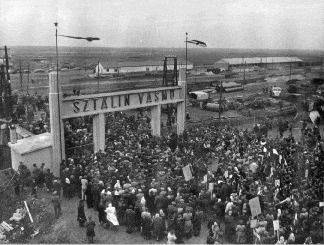
1. The Dedication of the Stalin Steel Works, Sztálinváros, 1951.Source: Intercisa Múzeum, Dunaújváros, Hungary.
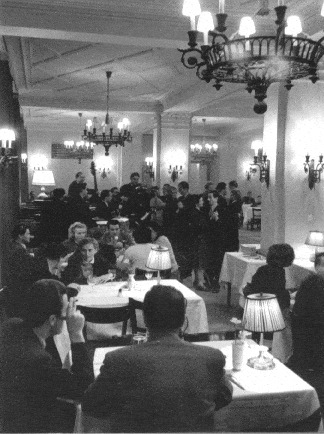
2. A Ball in the Gold Star Hotel, Sztálinváros, 1954.Source: Intercisa Múzeum, Dunaújváros, Hungary.
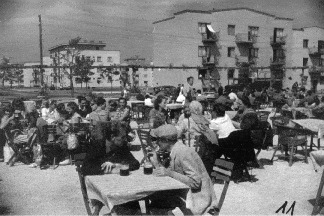
3. An open air pub in the city centre, Sztálinváros, undated, but thought to be late 1950s.Source: Intercisa Múzeum, Dunaújváros, Hungary.
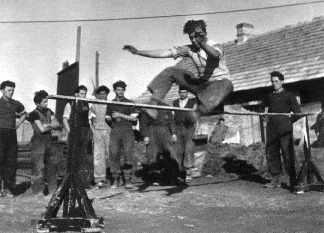
4. Free time at the construction workers' barracks, Sztálinváros, undated, but thought to be late 1950s.Source: Intercisa Múzeum, Dunaújváros, Hungary
 You have
Access
- 11
- Cited by