Introduction
Decades of research have converged on findings that environmental adversity, such as low socioeconomic status (SES) and poverty, can “get under the skin” in early life to shape the development of infant behavior and physiology (Blair & Raver, Reference Blair and Raver2016; Finegood, Rarick, & Blair, Reference Finegood, Rarick and Blair2017; Frankenhuis & Nettle, Reference Frankenhuis and Nettle2019; Hackman & Farah, Reference Hackman and Farah2009; Herzberg & Gunnar, Reference Herzberg and Gunnar2019; Lipina & Posner, Reference Lipina and Posner2012). Early development appears to be particularly vulnerable to the effects of adversity, as evidenced by sensitive period research involving both human studies (Davidson & McEwen, Reference Davidson and McEwen2012; Feldman, Reference Feldman2015; Masten & Cicchetti, Reference Masten and Cicchetti2010) and animal experiments explicating underlying causal mechanisms (Cameron, Reference Cameron2001; Curley & Champagne, Reference Curley and Champagne2016; Opendak & Sullivan, Reference Opendak and Sullivan2016; Roth & Sweatt, Reference Roth and Sweatt2011; Upton & Sullivan, Reference Upton and Sullivan2010). However, the specific mechanisms underlying transmission of risk from poverty-related adversity exposure to the infant's developmental processes remain poorly understood and are not well validated.
Chronic elevation of glucocorticoids (cortisol in humans, corticosterone in rodents, i.e. CORT) is an indicator of hypothalamic–pituitary–adrenal (HPA) axis system hyper-functioning and is one likely mechanism by which poverty-related risk can shape developmental trajectories starting in infancy. Across human and animal research, ample evidence illustrates that chronic elevation of stress hormones shapes the brain across levels of analyses – from gene activity to structural plasticity – to influence developmental outcomes (reviewed in McEwen & Gianaros, Reference McEwen and Gianaros2011; Perry & Sullivan, Reference Perry and Sullivan2014). A consistent message across decades of research and from myriad multispecies models of early-life adversity is that chronic or frequently repeated stress exposure can lead to dysregulation of the HPA axis, mediating the effects of adversity on brain and behavioral development (Badanes, Watamura, & Hankin, Reference Badanes, Watamura and Hankin2011; Callaghan, Sullivan, Howell, & Tottenham, Reference Callaghan, Sullivan, Howell and Tottenham2014; Dallman, Reference Dallman2007; Koss & Gunnar, Reference Koss and Gunnar2018; Loman & Gunnar, Reference Loman and Gunnar2010; McEwen, Reference McEwen1998).
Yet, very few studies (reviewed herein) have examined the mediating role of CORT as it relates to the transmission of poverty-related adversity to subsequent developmental outcomes. A psychophysiological measure of stress, which included CORT, has been shown to mediate relations between poverty status and socioemotional adjustment using cross-sectional data of 8- to 10-year-old children (Evans & English, Reference Evans and English2002). Similarly, chronic physiological stress during childhood has been shown to longitudinally mediate the inverse relation between childhood poverty and working memory in adulthood (Evans & Schamberg, Reference Evans and Schamberg2009). Similar longitudinal research has demonstrated that factors of early-life environmental risk predict elevated cortisol in early childhood which in turn is associated with decreased IQ (Suor, Sturge-Apple, Davies, Cicchetti, & Manning, Reference Suor, Sturge-Apple, Davies, Cicchetti and Manning2015), decreased executive functions (Blair et al., Reference Blair, Granger, Willoughby, Mills-Koonce, Cox and Greenberg2011b), and increased risk for adjustment and social competence problems (Lengua et al., Reference Lengua, Thompson, Moran, Zalewski, Ruberry, Klein and Kiff2019).
Animal models of scarcity-adversity have also been used to experimentally demonstrate that environmental scarcity causally produces elevated CORT in mother rats and infant pups (Ivy, Brunson, Sandman, & Baram, Reference Ivy, Brunson, Sandman and Baram2008; Perry, Finegood, et al., Reference Perry, Finegood, Braren, DeJoseph, Putrino, Wilson and Blair2019b; Raineki, Moriceau, & Sullivan, Reference Raineki, Moriceau and Sullivan2010; Raineki, Morgan, Ellis, & Weinberg, Reference Raineki, Morgan, Ellis and Weinberg2019), with subsequent disruption of neurobehavioral developmental outcomes (Avishai-Eliner, Gilles, Eghbal-Ahmadi, Bar-El, & Baram, Reference Avishai-Eliner, Gilles, Eghbal-Ahmadi, Bar-El and Baram2001; Bale et al., Reference Bale, Baram, Brown, Goldstein, Insel, McCarthy and Nestler2010; Baram et al., Reference Baram, Davis, Obenaus, Sandman, Small, Solodkin and Stern2012; Doherty, Blaze, Keller, & Roth, Reference Doherty, Blaze, Keller and Roth2017; Junod, Opendak, LeDoux, & Sullivan, Reference Junod, Opendak, LeDoux and Sullivan2019; Perry et al., Reference Perry, Braren, Rincón Cortés, Brandes-Aitken, Chopra, Sullivan and Blair2019a; Perry et al., Reference Perry, Finegood, Braren, DeJoseph, Putrino, Wilson and Blair2019b; Perry et al., Reference Perry, Rincón-Cortés, Braren, Brandes-Aitken, Opendak, Pollonini and Sullivan2019c; Raineki, Rincón-Cortés, Belnoue, & Sullivan, Reference Raineki, Rincón-Cortés, Belnoue and Sullivan2012; Rincón-Cortés et al., Reference Rincón-Cortés, Barr, Mouly, Shionoya, Nuñez and Sullivan2015; Rincón-Cortés & Sullivan, Reference Rincón-Cortés and Sullivan2016; Robinson-Drummer et al., Reference Robinson-Drummer, Opendak, Blomkvist, Chan, Tan, Delmer and Chopra2019; Sevelinges et al., Reference Sevelinges, Moriceau, Holman, Miner, Muzny, Gervias and Sullivan2007; Walker et al., Reference Walker, Bath, Joels, Korosi, Larauche, Lucassen and Taché2017). Taken together, these studies support the idea that chronically elevated CORT in infants and children may be one mechanism by which poverty-related adversity “gets under the skin” to influence child development. However, much remains unknown about how the effects of poverty-related risk are transmitted from the environment to the child to influence their stress physiology.
Of the few studies that have examined stress-mediated pathways for the transmission of poverty-related risk to child development, none that we are aware of have considered infant stress physiology together with caregiver stress physiology as a potential mediating pathway. However, the role of the caregiver has been increasingly examined as a potential mechanism of the social transmission of environmental risk to child outcomes. Decades of research have converged on findings that early-life stress, including poverty-related adversity, can impact child development through the quality of parenting behaviors (e.g., Blair & Raver, Reference Blair and Raver2012; Brooks-Gunn & Duncan, Reference Brooks-Gunn and Duncan1997; Granero, Louwaars, & Ezpeleta, Reference Granero, Louwaars and Ezpeleta2015; Hackman, Gallop, Evans, & Farah, Reference Hackman, Gallop, Evans and Farah2015; Holochwost et al., Reference Holochwost, Gariépy, Propper, Gardner-Neblett, Volpe, Neblett and Mills-Koonce2016; Luby et al., Reference Luby, Belden, Botteron, Marrus, Harms, Babb and Barch2013; McLoyd, Reference McLoyd1998; Perry, Blair, & Sullivan, Reference Perry, Blair and Sullivan2017; Perry et al., Reference Perry, Finegood, Braren, DeJoseph, Putrino, Wilson and Blair2019b). Negative caregiving behaviors have also been modeled in nonhuman primates and rodents since the 1950s, with animal findings converging with human findings, ultimately demonstrating that child development is shaped by the quality of care received in infancy (reviewed in Gunnar, Hostinar, Sanchez, Tottenham, & Sullivan, Reference Gunnar, Hostinar, Sanchez, Tottenham and Sullivan2015; Perry et al., Reference Perry, Blair and Sullivan2017). However, while research has predominantly focused on the behavioral components of caregiver-infant interactions as they pertain to the regulation and scaffolding of child development, far less has considered physiological components of caregiver-infant interactions as they relate to the social transmission of risk between caregiver and infant.
Those studies that have considered physiological mechanisms linking adversity to child development have typically only focused on the child's physiology. For instance, it has been demonstrated that elevated salivary CORT across infancy partially mediates the effects of poverty and parenting on executive functions in early childhood (Blair et al., Reference Blair, Granger, Willoughby, Mills-Koonce, Cox and Greenberg2011b). Yet, several studies have also found associations between caregiver and child physiology over and above observed global measures of caregiver behavior (Braren, Perry, Ursache, & Blair, Reference Braren, Perry, Ursache and Blair2019; Halevi et al., Reference Halevi, Djalovski, Kanat-Maymon, Yirmiya, Zagoory-Sharon, Koren and Feldman2017; Waters, West, & Mendes, Reference Waters, West and Mendes2014; Zelenko et al., Reference Zelenko, Kraemer, Huffman, Gschwendt, Pageler and Steiner2005). In other words, the joint contribution of caregiver and infant stress physiology may explain variability in developmental outcomes that cannot be explained by caregiver behavior or infant stress physiology alone. Along these lines, it stands to reason that elevated child CORT may be necessary, but without elevated caregiver CORT, may not be sufficient in mediating the effects of environmental adversity on development. Rather, the relation between the caregiver's and infant's CORT may be a sufficient mediator of adversity on child development. This interpersonal association may be indicative of a route of social transmission of environmental risk from caregiver to child. Thus, in the present cross-species study, we evaluated not only infant CORT on its own, but also the association of maternal CORT with infant CORT and caregiving behavior (i.e., a social transmission pathway), as potential mediators of poverty-related risk and subsequent child behavior. Specifically, by integrating human and rodent research, we were better able to determine whether these potential mediators were necessary and/or sufficient for the transmission of environmental risk to developing offspring.
In examining physiological mechanisms by which poverty-related adversity might “get under the skin” to influence child development, human researchers face technical and research design restrictions that limit the ability to make causal inferences (Perry, Reference Perry, Lipina and Segretin2019; Perry et al., Reference Perry, Finegood, Braren, DeJoseph, Putrino, Wilson and Blair2019b). Specifically, in correlational studies, human researchers often rely on statistical tests of mediation that probe hypothetical causal relations between variables. However, as this is merely a statistical approach, in the absence of randomization and experimental manipulation of variables, there is no logically valid means by which to formally determine causality. Understandably, this is a normal limitation of correlational research. As such, experimental studies are needed to validly infer causal relations. However, as human research cannot experimentally control conditions of adversity, we often look to animal models for the discernment of causality and directionality of relations between adversity exposure and developmental outcomes, and to explore intermediary physiological mechanisms. To this end, in the present manuscript, we capitalize on both the ecological validity of human research and the experimental control of animal research to examine relations between early-life poverty-related adversity, mother and infant stress, and infant behavioral development. To do so, we utilized a well-validated model of early-life scarcity-adversity, whereby mother rats are provided with insufficient materials for nest-building, which produces aberrant maternal behavior, as well as an increase in both mother rats’ and infant rat pups’ basal CORT levels (Ivy et al., Reference Ivy, Brunson, Sandman and Baram2008; Perry et al., Reference Perry, Finegood, Braren, DeJoseph, Putrino, Wilson and Blair2019b; Raineki et al., Reference Raineki, Moriceau and Sullivan2010; Raineki et al., Reference Raineki, Opendak, Sarro, Showler, Bui, McEwen and Sullivan2019; Walker et al., Reference Walker, Bath, Joels, Korosi, Larauche, Lucassen and Taché2017). Furthermore, this animal model of scarcity-adversity has previously been successfully integrated alongside human developmental research related to poverty, demonstrating translational validity of rodent findings as it relates to scarcity's impact on caregiving behaviors and subsequent infant developmental outcomes (Perry et al., Reference Perry, Braren, Rincón Cortés, Brandes-Aitken, Chopra, Sullivan and Blair2019a; Perry et al., Reference Perry, Finegood, Braren, DeJoseph, Putrino, Wilson and Blair2019b). When carefully designed and considered within the context of human research findings, rodent models provide powerful means for efficient assessment of theory-based mechanisms of change. Moreover, integrative cross-species research enables the assessment of potential cause-effect mechanisms across multiple levels of analyses, while allowing for direct assessment of the translational relevance of mechanistic findings.
Thus, the purpose of the current study was to utilize a translational cross-species research approach to examine stress-mediated pathways by which poverty-related risk can influence infant development. To this end, we drew from the Family Life Project (FLP; n = 1,292), a prospective longitudinal study examining the impact of poverty on child development, as well as the rodent scarcity-adversity model. Our overarching hypothesis, across both species, was that elevated infant CORT levels would be a necessary component linking environments of risk to developmental outcomes. We first tested this hypothesis in humans using data from the FLP. Specifically, we first examined if infant chronic CORT levels across multiple time points, when considered on their own, were sufficient in mediating the relation between scarcity-adversity exposure and infant behavioral development. Second, to probe for evidence of social transmission of risk between the mother and child, we assessed if caregiver maternal CORT levels through infant CORT levels serially mediated the relation between poverty-related exposure and infant behavior. We then utilized the rodent model to challenge the causal nature of scarcity-adversity, mother–infant CORT, and child behavior relations indicated in our human data. Specifically, using a pharmacological manipulation, we tested if elevated pup CORT, independent of maternal influences, was causally sufficient for the disruption of pup social behavior. Furthermore, we tested the causal, necessary mediating role of pup CORT in the presence of a stressed mother for the social transmission of scarcity-adversity effects on pup social behavior. By using a cross-species research approach, we aim to scientifically advance mechanistic research related to poverty and child development.
Method
Human
Participants
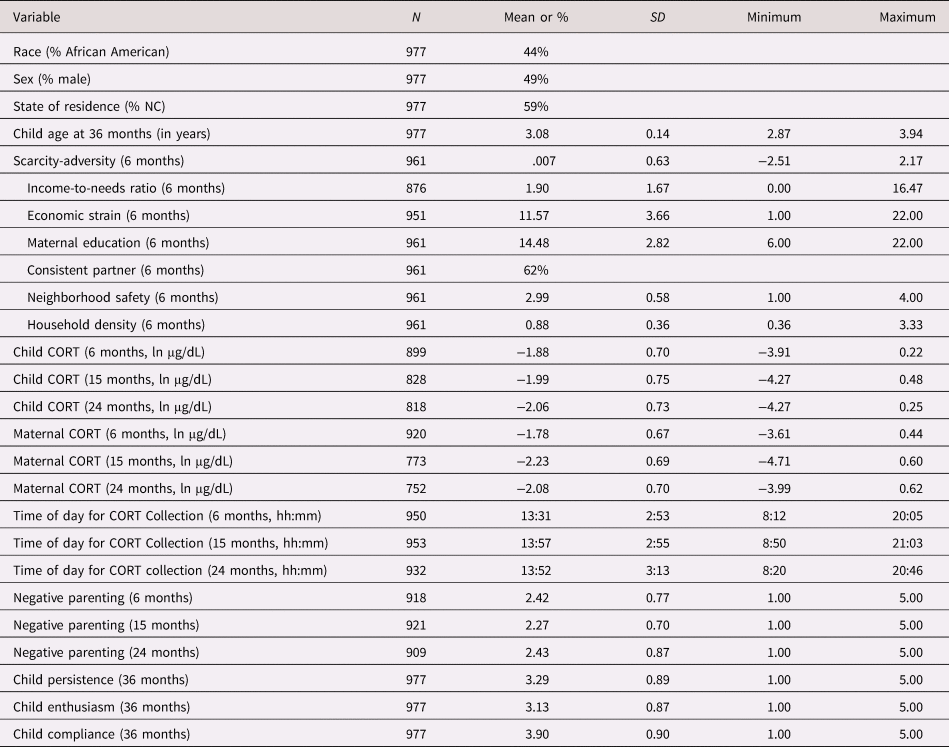
Data came from the FLP, a prospective longitudinal, population-based, observational study of 1,292 children and their families living in predominantly low-income, nonurban communities in central Pennsylvania (PA) and eastern North Carolina (NC). Families were recruited locally in hospitals after the birth of the target child, with consent from the primary caregiver, most of whom were biological mothers. Low-income households were oversampled in both states and for African American families in NC. Further details regarding the recruitment process and sampling plan have been previously published elsewhere (Vernon-Feagans & Cox, Reference Vernon-Feagans and Cox2013). The data presented here were collected during a series of home visits to the families when the target child was approximately 6, 15, 24, and 36 months old. Home visits were conducted by two trained research assistants, with each visit lasting 2–3 hr., including semi-structured interviews and self-reported measures assessing household characteristics and family demographics, as well as assessment of infant and caregiver behavior in a mother-child interaction task, and primary caregivers’ and infants’ CORT levels. For the current analysis, only data from children and their primary caregivers who were biological mothers were used. In addition, participants were included in the analyses if the mother and child both had at least one CORT sample and were not missing data on the main dependent variable (child engagement during the mother-child interaction at 36 months). Table 1 shows descriptive statistics of the sample used in the present analysis.
Demographics and descriptive statistics for observed study variables

Scarcity-adversity exposure
Early-life scarcity-adversity exposure was assessed through a poverty-related risk index, as used in prior analyses of the FLP (Perry et al., Reference Perry, Finegood, Braren, DeJoseph, Putrino, Wilson and Blair2019b; Vernon-Feagans & Cox, Reference Vernon-Feagans and Cox2013). This cumulative risk index was computed as a composite of six indicators measured at 6 months (family income-to-needs ratio, neighborhood safety, maternal education, economic strain, household density, and consistent partnership of a spouse/partner living within the home). Specifically, the continuous cumulative risk index was generated by reverse-scoring positively-framed indicators, standardizing each measure, and then averaging the standardized variables. Correlation coefficients between the six indicators included in the cumulative risk index ranged from r = .13 to .53, p < .001.
Child behavior in a mother-child interaction task
Child behaviors during play interactions with their mothers were videotaped during the 36-month home visits. During a 10-minute task, mothers and children were asked to complete a set of three puzzles of increasing difficulty selected to appropriately match cognitive and motor skills at 36 months of age. The task was video recorded, and child behavior was coded for multiple subscales on an adapted parent-child interaction coding system developed for use by the Study of Early Child Care and Youth Development (Cox, Reference Cox1997; NICHD ECCRN, 1999), including enthusiasm, persistence, and compliance subscales. The enthusiasm subscale refers to the child's eagerness and agency regarding the task. The persistence subscale refers the child's concentration on and perseverance in the puzzle task. The compliance subscale refers to the child's willingness to comply with and follow out the parent's instructions during the task. The child's behavior was coded by highly trained raters on each subscale and rated between 1–5, with 1 indicating “not at all characteristic” and 5 indicating “highly characteristic.” Coders were trained by a master coder until acceptable reliability was achieved, as determined by intra-class correlation coefficients greater than 0.80. After establishing reliability, coders worked in pairs to complete a minimum of 30% of the same videos as their master coder. Coding pairs met biweekly to resolve scoring differences, and consensus codes were used for analysis.
Mother and infant cortisol
Mother and infant cortisol levels were assayed from saliva samples collected near the end of the 6-, 15-, and 24-month home visits. Samples were collected after data collectors had been in the home for a minimum of one hour, allowing the caregivers’ and infants’ cortisol levels more than sufficient time to return to baseline following arrival of the data collectors. Baseline saliva samples were collected immediately preceding administration of emotion induction tasks as an index of resting or basal levels of CORT. Unstimulated whole saliva was collected using cotton or hydrocellulose absorbent material and stored in 2 mL cryogenic vials using a needleless syringe (from cotton) or by centrifugation (from hydrocellulose). Samples were then immediately placed on ice and stored at −20°C. Samples of 25 μL of saliva were assayed in duplicate using a highly sensitive immunoassay (Salimetrics, State College, PA). The test had a range of sensitivity from 0.007 to 3.0 μg/dl, and average intra- and inter-assay coefficients of variation less than 10% and 15%, respectively. The average of duplicates was used in all analyses. Natural log transformations were applied to the cortisol values to correct for positive skew, and cortisol values greater than ±3 SD after transformation were excluded from analyses. Because home visits were scheduled at times most convenient for the families, time of day for saliva collection varied between families, although the majority of families were seen in the afternoon (Table 1). Prior research demonstrates that afternoon cortisol is more related to environmental (vs. genetic) factors and thus may serve as a more reliable biomarker of environmental stress (Schreiber et al., Reference Schreiber, Shirtcliff, Van Hulle, Lemery-Chalfant, Klein, Kalin and Goldsmith2006; Van Hulle, Shirtcliff, Lemery-Chalfant, & Goldsmith, Reference Van Hulle, Shirtcliff, Lemery-Chalfant and Goldsmith2012). Time of day of saliva collection was controlled for in all analyses.
Covariates
Observed variables for state of residence (PA = 0, NC = 1), race of infant (not African American = 0, African American = 1), sex of infant (male = 0, female = 1), age of infant, and time of day for each saliva collection timepoint were included as covariates in all models. For models incorporating maternal CORT levels, observed variables for body mass index (BMI) of the mother, duration of breastfeeding, tobacco usage, and pregnancy status, and negative parenting behavior were also included as covariates. Negative parenting behavior at 6-, 15-, and 24-months was captured during a mother–child play task. Specifically, highly trained coders scored mother-child interactions from video recordings, scoring mothers’ intrusiveness, detachment, and negative regard, with each dimension of behavior coded from 1 (“not at all characteristic”) to 5 (“highly characteristic”) (Cox, Reference Cox1997; NICHD ECCRN, 1999). Negative parenting was calculated as the average of intrusiveness, detachment, and negative regard at each timepoint. A latent variable of negative caregiving behavior at 6, 15, and 24 months was included as the final analysis covariate.
Statistical analyses
Descriptive analyses and correlations were conducted using IBM SPSS Statistics software (Version 21.0). Structural equation modeling was used to test direct effects, mediation, and serial mediation, using the bootstrapping procedure (5,000 bootstraps) (Shrout & Bolger, Reference Shrout and Bolger2002) in Mplus 7 software (Muthén & Muthén, Reference Muthén and Muthén1998-2012). Specifically, structural equation modeling was used to examine relations between early-life scarcity-adversity exposure, measures of infant and maternal CORT, and child behavior in the mother-child interaction task in the FLP. To capture a more chronic index of CORT levels, and to improve measurement reliability, latent variables of infant and caregiver CORT were created from observed basal levels of CORT at the 6-, 15-, and 24-month home visits. To ensure CORT levels at each time point were given an equal weight, factor loadings were constrained to equality when creating the latent variables. Furthermore, child engagement during the mother-child interaction task at 36 months was modeled as a latent variable using infant enthusiasm, persistence, and compliance as indicators (Skinner, Kindermann, Connell, & Wellborn, Reference Skinner, Kindermann, Connell, Wellborn, Wentzel and Vigfield2009). Parameter estimates are reported as standardized effects (Preacher & Hayes, Reference Preacher and Hayes2008). The comparative fit index (CFI), standardized root square mean residual (SRMR), and root mean squared error of approximation (RMSEA) fit indices were used to evaluate model fit, with CFI ≥ 0.95, SRMR < 0.08, and RMSEA < 0.05 indicating good model fit (Kline, Reference Kline2015). Raw data of this manuscript will be made available by the authors without reservation to any qualified researcher.
Rodent
Subjects
Long-Evans hooded rat pups were generated through breeding in a temperature (20°C), humidity, and light (12-hour light/dark cycle) controlled animal room within the Sullivan Lab, where they continued to live throughout the experiment with ad lib food and water. The pregnant dams were placed alone in their own polypropylene cages (34 cm × 29 cm × 17 cm) with wood chips approximately one week before giving birth. Litters were culled on PN (postnatal day) 1 (day of birth is PN 0) to 12 pups per litter with an approximately equal number of male and female pups. Cages were cleaned twice a week; however, the nest was retained and placed into the cleaned cage. All procedures pertaining to the use of live rats were approved by the Institutional Animal Care and Use Committee and followed National Institutes of Health guidelines.
Scarcity-adversity model
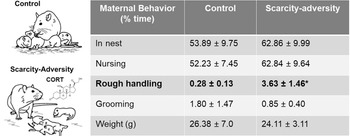
Litters were randomly assigned into control or scarcity-adversity conditions on PN 8. In control-reared litters, mothers were given ample bedding materials (4500 mL of wood shavings), which permitted construction of a nest for her pups. In scarcity-adversity conditions, bedding materials were reduced to 100 mL, producing a thin 1 cm layer of bedding. Depriving the mother of nest-making materials is stressful to both the mother (Ivy et al., Reference Ivy, Brunson, Sandman and Baram2008) and pups (Raineki et al., Reference Raineki, Opendak, Sarro, Showler, Bui, McEwen and Sullivan2019), as evidenced by heightened CORT production. As such, as previously reported, the impoverished cage environment produced aberrant maternal care, including frequent unsuccessful attempts to build a nest and increased incidental rough treatment of the pups (Raineki et al., Reference Raineki, Moriceau and Sullivan2010; Raineki et al., Reference Raineki, Morgan, Ellis and Weinberg2019; Rincón-Cortés & Sullivan, Reference Rincón-Cortés and Sullivan2016), as well as disruption of neurobehavioral development in pups (Perry et al., Reference Perry, Finegood, Braren, DeJoseph, Putrino, Wilson and Blair2019b, Roth & Sullivan, Reference Roth and Sullivan2005; Walker et al., Reference Walker, Bath, Joels, Korosi, Larauche, Lucassen and Taché2017). Furthermore, we have previously demonstrated that our rodent model of scarcity-adversity has translational validity pertaining to at least some aspects of the human condition of poverty, including scarcity-adversity exposure, parenting behaviors, and infant development (Perry et al., Reference Perry, Finegood, Braren, DeJoseph, Putrino, Wilson and Blair2019b). Scarcity-adversity exposure occurred for 1 hour a day from PN 8-12, which has been validated to induce stressed maternal behavior and disrupt pup neural and behavioral development (Asok, Bernard, Roth, Rosen, & Dozier, Reference Asok, Bernard, Roth, Rosen and Dozier2013; Blaze & Roth, Reference Blaze and Roth2013). Videos were recorded and hand-scored by highly trained raters to validate that the adversity-rearing treatment induced rough handling by mothers (Figure 1).
Depiction of rodent model of scarcity-adversity. Rodents are randomly assigned into control or low bedding (scarcity-adversity) conditions. Limiting the mother's access to bedding needed for nest-building increases maternal and pup corticosterone (CORT) levels, and rough handling of pups (t (6) = −3.34, p = .02).

Drug manipulations
To pharmacologically elevate pup CORT levels independent of the mother rat's stress levels, pups received daily (from PN 8-12) administration of corticosterone (CORT) 2-hydroxypropyl-β-cyclodextrin complex (3 mg/kg; Sigma) or an equal volume of saline 30 minutes before being placed (without the mother) in a chamber with a polyethylene tube for 90 minutes per day. To block CORT changes associated with the scarcity-adversity rearing, pups received intraperitoneal injections of the corticosterone inhibitor metyrapone HCL (50 mg/kg, Sigma) or an equal volume of 0.9% saline. Pups received daily metyrapone or saline injections 90 minutes before scarcity-adversity exposure and were returned to their home cage 90 minutes after the injection. Timing of this procedure limited CORT reduction effects to within the daily window of scarcity-adversity exposure. Prior work by Sullivan lab and others has shown that metyrapone reliably reduces pup corticosterone levels by 55%–75% in this age range, and that the drug effect is gone after 90 minutes (Faturi et al., Reference Faturi, Tiba, Kawakami, Catallani, Kerstens and Suchecki2010; Raineki et al., Reference Raineki, Opendak, Sarro, Showler, Bui, McEwen and Sullivan2019; Rosenfeld et al.,Reference Rosenfeld, Suchecki and Levine1992; Suchecki, Nelson, Van Oers, & Levine, Reference Suchecki, Nelson, Van Oers and Levine1995; Upton & Sullivan, Reference Upton and Sullivan2010).
Infant behavior test with mother after 5 days of treatment
Pup behavior was tested 24 hours after the last drug injection. Specifically, after 5 days of scarcity-adversity rearing paired with CORT blockade, or 5 days of CORT increase without the mother present, pup behavior with the mother was tested using a semi-structured social behavior test with an anesthetized mother. The use of an anesthetized mother facilitates the analysis of pups’ behavior without interference from the mother's scaffolding of pups’ behavior. The mother was placed on her side in a polypropylene cage (34 cm × 29 cm × 17 cm; 2,000 mL bedding), so that the pups had access to her nipples. The pup was then placed on the opposite side of the cage and allowed to freely behave during the 5-minute test. Video recordings of the interactions were scored offline by highly trained raters blind to rearing conditions or drug manipulations. The pup behaviors measured were categorized as pup engagement with the mother (i.e. crawl to mother's ventrum, nipple attachment) or disengagement (i.e. pup sleeping/laying alone, pup behind the mother).
Statistical analysis
Rodent data were analyzed by two-way analysis of variance (ANOVA), with Sidak's multiple comparisons tests. Data used for figure-making are expressed as mean ± standard error of the mean (SEM) in all cases. Group differences were considered statistically significant when p < .05.
Results
Human
Descriptive statistics and correlations
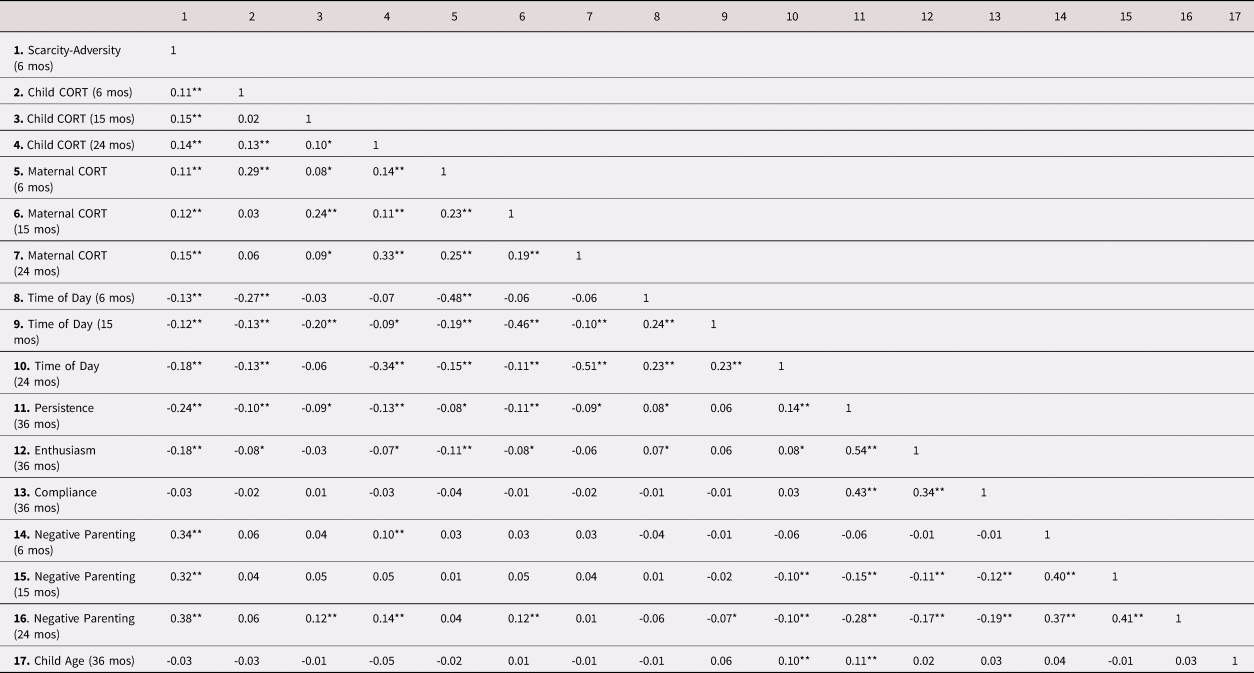
Descriptive statistics and bivariate correlations among all analysis variables are presented in Tables 1 and 2, respectively. Early-life scarcity-adversity exposure was positively associated with both child and maternal CORT levels across the infant's first 2 years of life. Scarcity-adversity at 6 months was also negatively associated with measures of child engagement in the mother-child interaction task at 36 months, including infant persistence and enthusiasm. Furthermore, infant CORT measures at 6, 15, and 24 months, as well as maternal CORT measures at 6, 15, and 24 months, were negatively associated with measures of child engagement in the mother-child interaction task. Finally, child and maternal CORT levels were positively correlated with one another at the 6-, 15-, and 24-month timepoints. This pattern of significant associations supported testing of the mediating models presented in Figures 2 and 4.
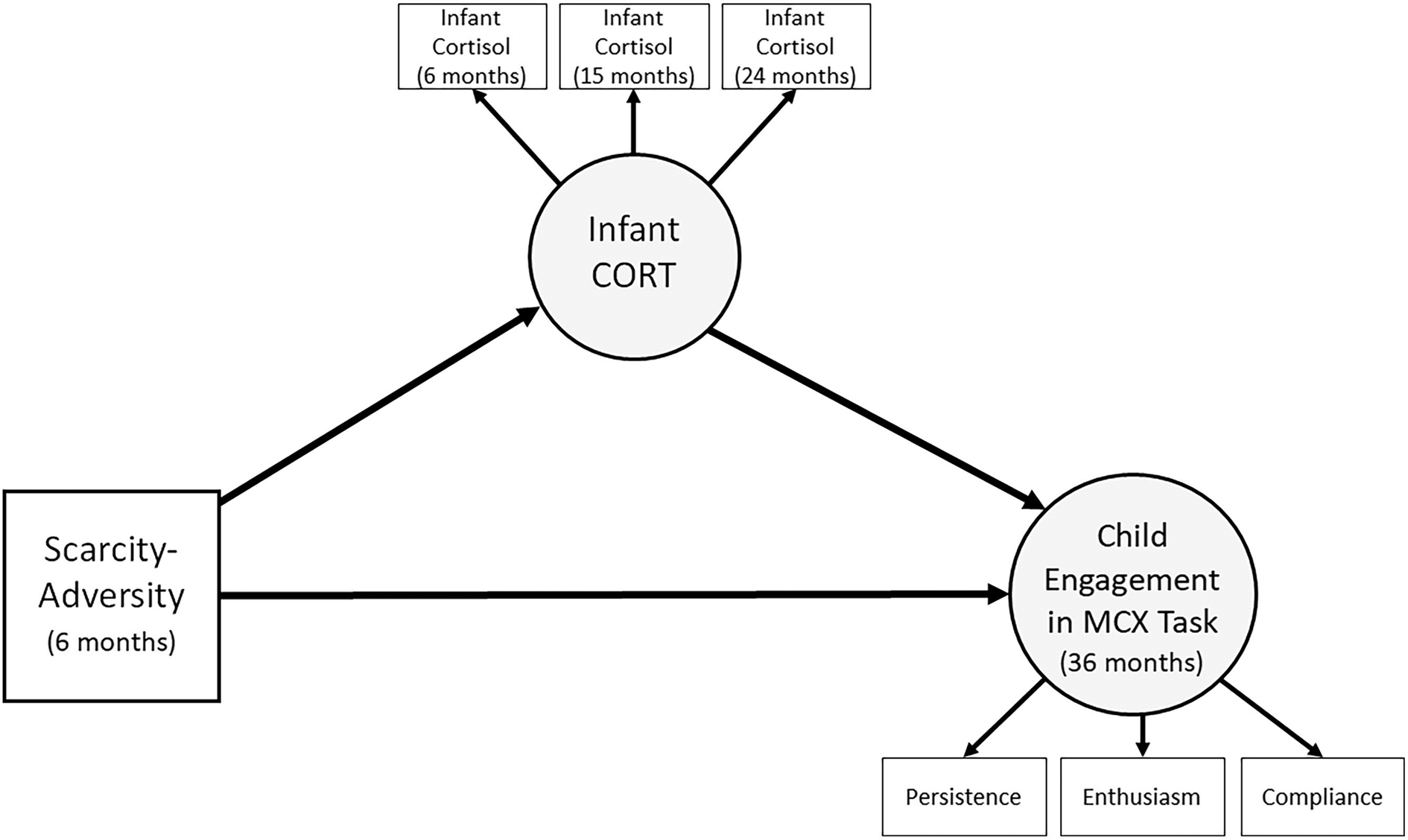
Proposed structural mediation model relating scarcity-adversity (6 months), infant cortisol (CORT; 6, 15, and 24 months), and child engagement in a mother-child interaction task. MCX = mother-child interaction task. Covariates are not shown.

Correlations among analysis variables.

Note: mos, months; **p < 0.01, *p < 0.05
Measurement model
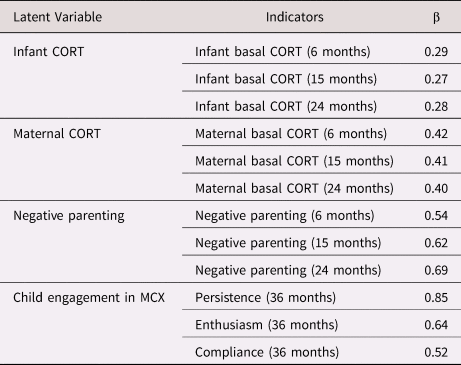
Prior to addressing our main research questions, we evaluated our measurement model, which included infant CORT, maternal CORT, and negative parenting at infant ages 6, 15, and 24 months, as well as child engagement in the mother-child interaction task at 36 months as latent variables. The measurement model showed good fit to the data: CFI = 0.95; RMSEA = 0.03 (90% confidence interval [CI] [0.027, 0.041]); SRMR = 0.04. Factor loadings of observed indicators on latent variables are reported in Table 3. Parameter estimates indicated that loadings were statistically significant and in the anticipated direction, and that all latent variances were statistically significant.
Loadings of observed indicators on latent variables

Note. All coefficients are standardized and significant at p < .0001. CORT, cortisol; MCX = Mother×Child interaction task.
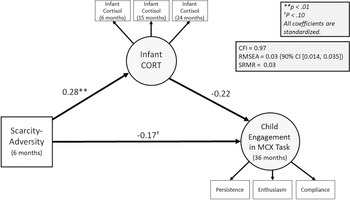
Prior to testing mediation, in three separate models, we also evaluated independent, direct associations with early-life scarcity-adversity predicting infant CORT across 6, 15, and 24 months, maternal CORT across 6, 15, 24 months, and child engagement at 36 months. As expected, scarcity-adversity negatively predicted child engagement in the mother–child task at 36 months (β = −0.17, SE = 0.05, p = .001). Scarcity-adversity also positively predicted infant CORT (β = 0.28, SE = 0.09, p = .002) and maternal CORT (β = 0.07, SE = 0.02, p = .002). Finally, both infant CORT (β = −0.22, SE = 0.11, p = .04) and caregiver CORT (β = −0.22, SE = 0.11, p = .04) negatively predicted child engagement in the mother–child interaction task.
Is infant CORT on its own sufficient to mediate the impact of scarcity-adversity exposure on behavioral development?
Figure 2 displays our proposed structural model of infant CORT mediation (without covariates). In this model we estimated a mediation model that included scarcity-adversity exposure as assessed when the infant was 6 months of age, infant CORT (across 6, 15, and 24 months), and child engagement in the mother-child interaction task at 36 months. Specifically, we examined direct effects of scarcity-adversity and infant CORT on child engagement in the mother-child interaction task. Furthermore, we examined the indirect effect of scarcity-adversity on child engagement through infant CORT to determine if infant CORT mediated the effect of poverty-related scarcity-adversity on child engagement in the mother-child interaction task.
The observed structural model fit the data well: CFI = 0.97; RMSEA = 0.03 (90% CI [0.014, 0.035]); SRMR = 0.03 (Figure 3). All coefficients are presented as standardized estimates, reflecting changes in standard deviations (SDs) (e.g., for every 1 SD increase in scarcity-adversity levels, it is estimated that infant CORT increases by 0.28 SD). Scarcity-adversity was negatively associated with infant CORT across 6, 15, and 24 months. Furthermore, scarcity-adversity was negatively associated with child engagement in the mother-child interaction task. However, infant CORT was not significantly associated with child engagement.
Results of mediation model relating scarcity-adversity (6 months), infant cortisol (CORT; 6, 15, 24 months), and child engagement in a mother-child interaction task (36 months). MCX = mother-child interaction task; CFI = comparative fit index; SRMR = standardized root square mean residual; RMSEA = root mean squared error of approximation. Covariates are not shown. Circles represent latent variables.

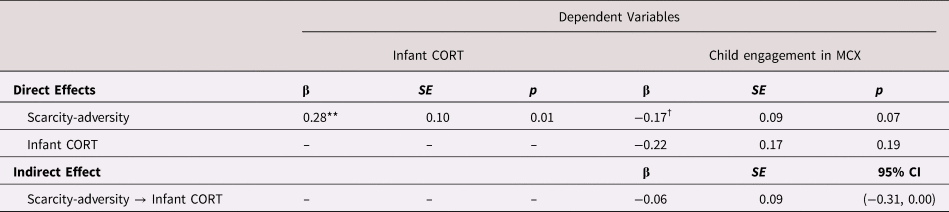
We hypothesized that infant CORT, when considered independently of maternal factors, would not be sufficient to mediate the relation between early-life scarcity-adversity and child engagement in the mother-child interaction task at 36 months. To evaluate this hypothesis, we tested the indirect effect of scarcity-adversity (6 months) on child engagement (36 months) via infant CORT (6, 15, 24 months). Table 4 displays the mediation results and indicates that infant CORT did not mediate the effects of scarcity-adversity on child engagement in the mother-Child interaction task.
Mediation analysis: direct and indirect effects of poverty-related scarcity-adversity on child engagement in mother–child interaction task

** p < .01, †p < .10; CORT, cortisol; MCX = mother-child interaction task; SE = standard error; CI = confidence interval. All coefficients are standardized.
Does social transmission of risk from mother to child mediate the impact of scarcity-adversity exposure on behavioral development?
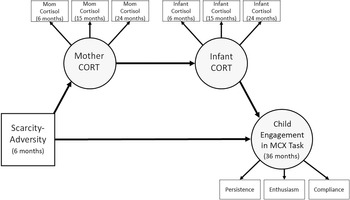
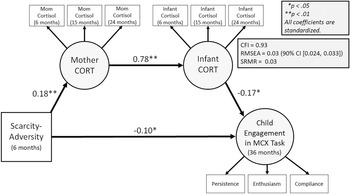
Figure 4 displays our proposed structural model of social transmission (without covariates). We estimated a serial mediation model that included scarcity-adversity (6 months), maternal CORT (6, 15, 24 months), infant CORT (6, 15, 24 months), and child engagement in the mother×child interaction task (36 months). We examined direct effects of scarcity-adversity and infant CORT on child engagement in the mother-child interaction task, the direct effect of scarcity-adversity on maternal CORT, and the direct effect of maternal CORT on infant CORT. Furthermore, we examined the indirect effect of scarcity-adversity on child engagement in the mother-child interaction task via caregiver CORT through infant CORT.
Proposed structural serial mediation model relating scarcity-adversity (6 months), maternal cortisol (CORT; 6, 15, 24 months), infant CORT (6, 15, 24 months), and child engagement in a mother-child interaction task (36 months). MCX = mother-child interaction task. Covariates are not shown. Circles represent latent variables.

The observed structural model fit was adequate: CFI = 0.93; RMSEA = 0.03 (90% CI [0.024, 0.033]); SRMR = 0.03 (Figure 5). Scarcity-adversity was negatively associated with maternal CORT across 6, 15, and 24 months. Furthermore, scarcity-adversity was negatively associated with child engagement in the mother-child interaction task. Maternal CORT was positively associated with infant CORT. Finally, infant CORT was negatively associated with child engagement in the mother-child interaction task.
Results of serial mediation model relating scarcity-adversity (6 months), maternal cortisol (CORT; 6, 15, 24 months), infant CORT (6, 15, 24 months), and child engagement in a mother-child interaction task. MCX = mother-child interaction task; CFI = comparative fit index; SRMR = standardized root square mean residual; RMSEA = root mean squared error of approximation. Covariates are not shown. Circles represent latent variables.

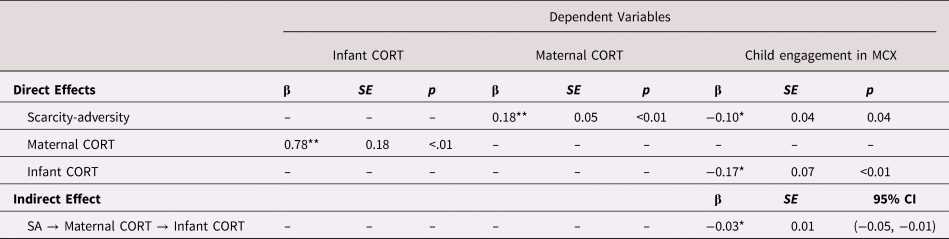
We hypothesized that maternal CORT through infant CORT would serially mediate the relation between early-life scarcity-adversity and child engagement in the mother-child interaction task at 36 months. To evaluate this hypothesis, we tested the indirect effect of scarcity-adversity (6 months) on child engagement (36 months) via a serial pathway involving maternal CORT and infant CORT (6, 15, 24 months). Table 5 displays the serial mediation results and indicates that maternal CORT through infant CORT significantly mediated the effects of scarcity-adversity on child engagement in the mother-child interaction task, with this pathway mediating 26% of the total effect.
Serial mediation analysis: direct and indirect effects of poverty-related scarcity-adversity on child engagement in mother-child interaction task

* Indicates that p < .05 or that confidence interval does not contain zero; **p < .01; CORT, cortisol; MCX = mother-child interaction task; SE = standard error; CI = confidence interval; SA = scarcity-adversity. All coefficients are standardized.
Rodent
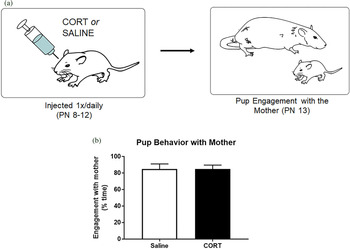
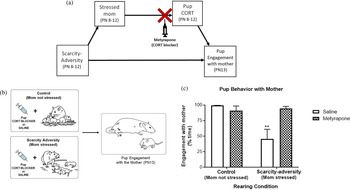
We next turned to the rodent model to evaluate causation in the relations between early-life scarcity-adversity, maternal and infant CORT, and child behavior indicated by the FLP data findings. Across a 5-day treatment, we tested if pharmacologically increasing pup CORT levels in the absence of the mother was causally sufficient for the disruption of pup social behavior with the mother (Figure 6a). Furthermore, we tested if causally disrupting social transmission from a stressed mother to pups – by pharmacologically blocking pups’ CORT in the presence of a stressed mother – would prevent negative effects on pup behavioral development despite scarcity-adversity exposure (Figure 7a). Results demonstrated that the 5-day CORT injection treatment during a brief separation from the mother was not causally sufficient to disrupt subsequent social behavior with the mother. Specifically, results of a t test did not reveal a significant difference in social engagement with the mother for pups pharmacologically injected with CORT versus pups injected with saline (Figure 6; t (8) = 0.04, p = .97). Furthermore, findings indicated that pharmacologically blocking pup CORT (via metyrapone [CORT synthesis inhibitor] injections) in the presence of a stressed mother prevented social transmission of scarcity-adversity effects on pup social behavior. Specifically, results of a 2 × 2 ANOVA indicated a significant interaction of drug (metyrapone vs. saline) and rearing experience (scarcity-adversity vs. control) on time spent engaged with the mother during the social behavior test (Figure 7; F (1,28) = 10.45, p = .003). Post hoc tests indicated that saline injected pups exposed to a stressed mother in scarcity-adversity conditions displayed decreased engagement with a mother, while the intraperitoneal injections of metyrapone (CORT blocker) during scarcity-adversity conditions normalized pup behavior in the social behavior test (post hoc tests, p < .05). Metyrapone injections did not significantly affect social behavior levels in control-reared pups (post hoc tests, p < .05).
Pharmacologically elevating infant corticosterone (CORT) in the absence of the mother is not sufficient to disrupt subsequent social behavior with the mother. (a) Depiction of experimental procedure. (b) Pup engagement with mother in a social behavior test as a function of pharmacological manipulation (saline vs. CORT injection) during a brief separation from the mother. Data are displayed as mean (± SEM) percent time the pup spent socially engaged with the mother, as calculated from total time pups spent crawling to the mother, probing the mother, sleeping/laying on the mother, and nipple attached to the mother (n = 5/group).

Corticosterone (CORT) blocker injection (metyrapone) prevents social transmission of scarcity-adversity effects to pup engagement with a mother in a social behavior test. (a) Depiction of model of disruption of social transmission via CORT blockade (metyrapone). (b) Depiction of experimental procedure. (c) Pup engagement with mother in a social behavior test as a function of early-life rearing condition (control vs. scarcity-adversity) and pharmacological manipulation (saline vs. metyrapone injection). Data are displayed as mean (± SEM) percent time the pup spent socially engaged with the mother, as calculated from total time pups spent crawling to the mother, probing the mother, sleeping/laying on the mother, and nipple attached to the mother (** indicates p < .01; n = 8/group).

Discussion
Children raised in poverty are at increased risk for altered health and developmental outcomes (Blair & Raver, Reference Blair and Raver2016; Duncan, Ziol-Guest, & Kalil, Reference Duncan, Ziol-Guest and Kalil2010; Hackman & Farah, Reference Hackman and Farah2009; Lipina & Posner, Reference Lipina and Posner2012; Yoshikawa, Aber, & Beardslee, Reference Yoshikawa, Aber and Beardslee2012), with altered stress physiology increasingly recognized as a likely, primary mechanism by which early-life poverty-related adversity is embedded biologically to produce disparities (Blair, Reference Blair2010). Yet, the specific mechanisms by which this occurs remain unclear and have been relatively under-explored. This research gap likely arises in part from limitations faced by both human and animal researchers alike, as well as challenges associated with translating across the theoretical silos of each research domain. While most research investigating mechanisms linking the early environment with alterations to the stress response and neurobehavioral development has been conducted using animal models, the implications of such findings cannot be easily extrapolated to real world contexts, such as the complex condition of human poverty. Conversely, human research cannot control the assignment process into adversity nor manipulate physiological processes for the determination of cause–effect mechanisms, as can be done with animal models. Fortunately, there has been a rise in translational cross-species studies to balance the mechanistic and ecological utility of findings related to the effects of early adversity on child development (Cohen et al., Reference Cohen, Jing, Yang, Tottenham, Lee and Casey2013; Opendak et al., Reference Opendak, Theisen, Blomkvist, Hollis, Lind, Sarro and Sullivan2020; Loman & Gunnar, Reference Loman and Gunnar2010; Perry, Reference Perry, Lipina and Segretin2019; Perry et al., Reference Perry, Braren, Rincón Cortés, Brandes-Aitken, Chopra, Sullivan and Blair2019a; Perry et al., Reference Perry, Finegood, Braren, DeJoseph, Putrino, Wilson and Blair2019b; Tottenham, Shapiro, Flannery, Caldera, & Sullivan, Reference Tottenham, Shapiro, Flannery, Caldera and Sullivan2019).
In the present study, we utilized a cross-species translational approach to provide evidence that elevated infant CORT is necessary, but not sufficient without elevated caregiver CORT in mediating the effects of environmental scarcity-adversity on child development. Specifically, human findings indicated that infant CORT levels alone did not significantly mediate the relation between early-life scarcity-adversity exposure and later child engagement in a mother-hild interaction task. However, maternal CORT through infant CORT serially mediated the relation between scarcity-adversity and child engagement. This indirect effect was observed when controlling for multiple relevant covariates, including race, gender, age, and parenting.
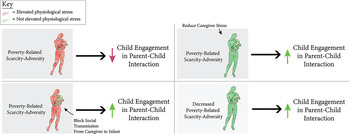
Capitalizing on an animal model, these findings were further, and causally, supported by rodent data through manipulation of both environmental adversity and CORT levels. Specifically, our rodent findings revealed that repeated pharmacological increases of pup CORT during brief separations from the mother did not disrupt subsequent pup engagement with the mother in a social behavior test. Thus, similar to our human results, elevated infant CORT alone was not sufficient in altering infant social behavior. However, repeated pharmacological blockade of pup CORT in the presence of a stressed mother prevented social transmission of scarcity-adversity effects on pup social behavior, providing causal evidence for stress-mediated social transmission of risk from the caregiver to pup. These casual findings broadly support our interpretation of the human data: that the interpersonal association of elevated CORT between the primary caregiver and child uniquely contributes to the transmission of risk to children exposed to environmental scarcity. Thus, our closely aligned cross-species research efforts provide translational implications for future research and interventional efforts for the promotion of optimal child development. Namely, they suggest potential benefits in going beyond directly targeting reduction of infant stress to targeting reduction of caregiver stress and/or the caregiver's environmental adversity for the benefit of the child (Figure 8).
Summary schematic of the current study's findings and their implications for future research and interventional efforts. The present study's findings provide novel, mechanistic support that poverty-related scarcity-adversity “gets under the skin” to raise infant physiological stress levels and disrupt child behavioral development by way of elevated caregiver physiological stress levels (top left). Blocking physiological social transmission from the primary caregiver to the infant might serve as one way to prevent negative impacts of environmental risk on child development (bottom left); however, future research is needed to determine the appropriateness and/or means by which to achieve this in real-world settings. Targeting upstream mechanisms of child outcomes via reduction of primary caregiver physiological stress (top right) and/or reduction of poverty-related scarcity-adversity exposure (bottom right) are additional, more readily translatable means by which to prevent or reduce the negative impacts of environmental risk on child behavioral development.

Our findings suggest that primary caregivers are uniquely positioned to shape child developmental trajectories of risk versus resilience. Bi-directional, translational human and animal research has provided ample support for the powerful role social context plays during early development. Cross-species research has revealed that in early-life the caregiver mediates “a stress hyporesponsive period” (SHRP) in the infant, marked by an absence or reduced presence of HPA axis activation in the infant's response to external stress, which occurs via maternal sensory stimulation (Gunnar & Fisher, Reference Gunnar and Fisher2006; Hofer, Reference Hofer1994; Rosenfeld, Suchecki, & Levine, Reference Rosenfeld, Suchecki and Levine1992; Sapolsky & Meaney, Reference Sapolsky and Meaney1986). Furthermore, following the SHRP, rodent (Stanton & Levine, Reference Stanton and Levine1988; Stanton & Levine, Reference Stanton and Levine1990), nonhuman primate (Coe, Franklin, Smith, & Levine, Reference Coe, Franklin, Smith and Levine1982; Hennessy, Kaiser, & Sachser, Reference Hennessy, Kaiser and Sachser2009; Stanton, Patterson, & Levine, Reference Stanton, Patterson and Levine1985; Wiener, Johnson, & Levine, Reference Wiener, Johnson and Levine1987), and human research (Gunnar & Donzella, Reference Gunnar and Donzella2002; Hostinar, Johnson, & Gunnar, Reference Hostinar, Johnson and Gunnar2015; Seltzer, Ziegler, & Pollak, Reference Seltzer, Ziegler and Pollak2010) have demonstrated that maternal presence can diminish the infant's response to threat, via attenuation of CORT levels during threat exposure. Experimental rodent research has demonstrated that the mother's presence during threat blocks pups’ CORT release at the level of the hypothalamus, by inhibiting norepinephrine release into the paraventricular nucleus (Shionoya, Moriceau, Bradstock, & Sullivan, Reference Shionoya, Moriceau, Bradstock and Sullivan2007). This CORT blockade switches off the amygdala and the pup's fear response to threat, as well as the pup's fear learning: the infant rat pup's amygdala is uniquely dependent upon CORT to function (Barr et al., Reference Barr, Moriceau, Shionoya, Muzny, Gao, Wang and Sullivan2009; Moriceau, Wilson, Levine, & Sullivan, Reference Moriceau, Wilson, Levine and Sullivan2006). This buffering process wanes as pups mature and prepare for independence (Opendak et al., Reference Opendak, Robinson-Drummer, Blomkvist, Zanca, Wood, Jacobs and Kirschner2019; Robinson-Drummer et al., Reference Robinson-Drummer, Opendak, Blomkvist, Chan, Tan, Delmer and Chopra2019). In humans, maternal presence during an aversive conditioning procedure has similarly been shown to block threat learning in children, with the strongest effects noted among children with the lowest CORT levels (Tottenham et al., Reference Tottenham, Shapiro, Flannery, Caldera and Sullivan2019).
The presence of the scent of the mother alone has also been demonstrated to decrease the threat response in children (Jessen, Reference Jessen2020). In children, as found in rodent research, the presence of maternal stimuli suppresses amygdala reactivity, with this effect waning with maturation (Gee et al., Reference Gee, Gabard-Durnam, Telzer, Humphreys, Goff, Shapiro and Tottenham2014). Social buffering of threat-induced CORT is known to be phylogenetically conserved and widespread across social species (Culbert, Gilmour, & Balshine, Reference Culbert, Gilmour and Balshine2019; Edgar et al., Reference Edgar, Held, Paul, Pettersson, Price and Nicol2015; Faustino et al., Reference Faustino, Tacão-Monteiro and Oliveira2017; Hennessy, Zate, & Maken, Reference Hennessy, Zate and Maken2008; Kikusui, Winslow, & Mori, Reference Kikusui, Winslow and Mori2006; Sullivan & Perry, Reference Sullivan and Perry2015). In addition, cross-species research is providing evidence that the quality of the mother–infant relationship might influence how well the mother can socially buffer the stress response of her young (Ahnert, Gunnar, Lamb, & Barthel, Reference Ahnert, Gunnar, Lamb and Barthel2004; Gunnar et al., Reference Gunnar, Hostinar, Sanchez, Tottenham and Sullivan2015; Gunnar & Sullivan, Reference Gunnar and Sullivan2017; Hostinar, Sullivan, & Gunnar, Reference Hostinar, Sullivan and Gunnar2014). Since the mother communicates with the offspring via sensory systems, these results suggest that the ability of maternal cues to reduce CORT appears to be diminished with adversity. This idea is supported by emerging neuroscience in rats (Perry et al., Reference Perry, Finegood, Braren, DeJoseph, Putrino, Wilson and Blair2019b) and humans (Callaghan et al., Reference Callaghan, Gee, Gabard-Durnam, Telzer, Humphreys, Goff and Caldera2019) suggesting that maternal cues, such as maternal odor, have reduced value in the infant brain following scarcity-adversity rearing.
The present study's findings dovetail with an increasing body of literature demonstrating that maternal physiology uniquely contributes to the modulation of child physiology. The infant and caregiver are oftentimes attuned on a biobehavioral level, regulating child development, for better or worse (Barrett & Fleming, Reference Barrett and Fleming2011; Davis, West, Bilms, Morelen, & Suveg, Reference Davis, West, Bilms, Morelen and Suveg2018, Dozier, Stoval, Albus, & Bates, Reference Dozier, Stoval, Albus and Bates2001; Feldman, Reference Feldman2017; Gottlieb, Reference Gottlieb, Cairns, Elder and Costello1996; Gunnar & Quevedo, Reference Gunnar and Quevedo2007). During caregiver-infant interactions, the caregiver and child engage in dynamic, bidirectional, reciprocal exchanges of conscious and nonconscious behavioral, affective, and physiological cues (Beebe, Reference Beebe2017; Feldman, Reference Feldman2007, Reference Feldman2012; Feldman, Greenbaum, Yirmiya, & Mayes, Reference Feldman, Greenbaum, Yirmiya and Mayes1996; Field, Reference Field2012; Papousek, Reference Papousek2007; Welch et al., Reference Welch, Firestein, Austin, Hane, Stark, Hofer and Myers2015; ). This behavioral and physiological linkage is thought to serve as a foundation for social affiliation, bonding, and attachment, and prepares one for the transmission and reception of information within dyads (Bornstein, Reference Bornstein and Haley2013; Fleming & Li, Reference Fleming, Li and Bornstein2002; Feldman, Reference Feldman2017; Harrist & Waugh, Reference Harrist and Waugh2002; Papoušek & Papoušek, Reference Papoušek, Papoušek, Bornstein and Marc2002).
Thus, the caregiver is well positioned to serve as a powerful regulatory presence, particularly before children fully develop the mechanisms needed for self-regulation and homeostasis (Bernier et al., Reference Bernier, Carlson and Whipple2010; Hofer, Reference Hofer1984; Hofer, Reference Hofer1994). However, just as the caregiver may buffer stress, the caregiver is also well positioned to exacerbate or transmit stress to the infant in contexts of increased adversity. Rodent research has demonstrated that caregivers can communicate information about threat via social exchanges, including from mothers to her pups, via CORT-mediated mechanisms (Carew et al., Reference Carew, Mukherjee, MacIntyre, Ghosh, Li, Kirouac and Yuan2018; Debiec & Sullivan, Reference Debiec and Sullivan2014; Keum & Shin, Reference Keum and Shin2019; Monfils & Agee, Reference Monfils and Agee2019; Rickenbacher, Perry, Sullivan, & Moita, Reference Rickenbacher, Perry, Sullivan and Moita2017). Similar human research has documented social transmission of stress from mother to infants (Halevi et al., Reference Halevi, Djalovski, Kanat-Maymon, Yirmiya, Zagoory-Sharon, Koren and Feldman2017; Hibel, Trumbell, Valentino, & Buhler-Wassmann, Reference Hibel, Trumbell, Valentino and Buhler-Wassmann2018; Hibel, Mercado, & Valentino, Reference Hibel, Mercado and Valentino2019; Waters et al., Reference Waters, West and Mendes2014). Collectively, these findings demonstrate that social influences can operate independently of overt caregiving behaviors and physical contact for the transmission of risk, as a function of CORT-mediated covert cues between mother and infant. This is in line with the present study's findings that maternal CORT through infant CORT serially mediates the effects of scarcity-adversity on child behavior even when controlling for negative parenting behaviors. However, far more research is needed to disentangle the unique contributions of parenting behaviors versus caregiver physiology, especially within the context of chronic early-life adversity.
The present study's findings support the idea that in contexts of increased stress, relations between caregiver-child physiology may serve as a pathway of stress transmission between a parent and child. Attuning one's stress physiology to another may be adaptive under well-resourced and supportive circumstances in which one's stress is well regulated, but not in environments of chronic adversity and high stress. For instance, a child who is physiologically linked to their chronically stressed caregiver may be at risk for compromised neurodevelopmental via chronic up-regulation of HPA axis or autonomic nervous system (ANS) activity. Prior research with the FLP data set revealed relations between maternal baseline CORT levels and infant CORT reactivity to an emotion induction task at child ages 7, 15, and 24 months of age. However, by 24 months of age, the association between mother and infant CORT was moderated by poverty-related risk, such that maternal baseline CORT and infant CORT reactivity remained associated only in dyads characterized by low poverty-related risk (Braren et al., Reference Braren, Perry, Ursache and Blair2019). These findings might indicate a loss of maternal regulation of infant CORT responses following chronic exposure to poverty-related adversity, as has been evidenced in human and rodent studies that report decreased social buffering of children/pups by high-stress mothers (Gunnar & Herrera, Reference Gunnar, Herrera and Zelazo2013; Raineki et al., Reference Raineki, Moriceau and Sullivan2010; Sullivan & Perry, Reference Sullivan and Perry2015; Tottenham et al., Reference Tottenham, Shapiro, Flannery, Caldera and Sullivan2019). However, decoupling of infant CORT activity from that of the mother in environments of chronic stress might serve as an adaptive response, to protect the child from continued exposure to the mother's high level of physiological stress. Far more research is needed to understand how linkage of caregiver–infant stress physiology functions in contexts of risk. Investigating how linkage operates in at-risk populations will be critical and especially important for understanding pathways of social and intergenerational transmission of risk.
The present study is an important contribution to a growing body of literature regarding the effects of poverty-related adversity on infant CORT activity (Blair et al., Reference Blair, Granger, Kivlighan, Mills-Koonce, Willoughby, Greenberg and Fortunato2008; Blair et al., Reference Blair, Raver, Granger, Mills-Koonce, Hibel and Investigators2011a; Blair et al., Reference Blair, Granger, Willoughby, Mills-Koonce, Cox and Greenberg2011b; Blair, Berry, Mills-Koonce, Granger, & Investigators, Reference Blair, Berry, Mills-Koonce, Granger and Investigators2013; Braren et al., Reference Braren, Perry, Ursache and Blair2019; Clearfield, Carter-Rodriguez, Merali, & Shober, Reference Clearfield, Carter-Rodriguez, Merali and Shober2014; Finegood et al., Reference Finegood, Rarick and Blair2017; Hill-Soderlund et al., Reference Hill-Soderlund, Holochwost, Willoughby, Granger, Gariépy, Mills-Koonce and Cox2015). Namely, we report evidence that early-life poverty-related adversity is associated with elevated CORT levels across infancy. This finding is in line with prior reports of hypercortisolism in contexts of high socioeconomic risk (Blair et al., Reference Blair, Raver, Granger, Mills-Koonce, Hibel and Investigators2011a; Blair et al., Reference Blair, Granger, Willoughby, Mills-Koonce, Cox and Greenberg2011b; Blair et al., Reference Blair, Berry, Mills-Koonce, Granger and Investigators2013; Evans & English, Reference Evans and English2002; Finegood et al., Reference Finegood, Rarick and Blair2017; Lupien, King, Meaney, & McEwen, Reference Lupien, King, Meaney and McEwen2000; Lupien, King, Meaney, & McEwen, Reference Lupien, King, Meaney and McEwen2001). However, other studies have reported evidence of hypocortisolism following exposure to poverty-related adversity (Badanes et al., Reference Badanes, Watamura and Hankin2011; Bernard, Zwerling, & Dozier, Reference Bernard, Zwerling and Dozier2015; Chen, Cohen, & Miller, Reference Chen, Cohen and Miller2010; Chen & Paterson, Reference Chen and Paterson2006; Fernald, Burke, & Gunnar, Reference Fernald, Burke and Gunnar2008; Karb, Elliott, Dowd, & Morenoff, Reference Karb, Elliott, Dowd and Morenoff2012; Kliewer, Reid-Quiñones, Shields, & Foutz, Reference Kliewer, Reid-Quiñones, Shields and Foutz2009; Zalewski, Lengua, Kiff, & Fisher, Reference Zalewski, Lengua, Kiff and Fisher2012). These seemingly contradictory results are also found in the animal literature, with findings of both elevated CORT levels (Ivy et al., Reference Ivy, Brunson, Sandman and Baram2008; Raineki et al., Reference Raineki, Moriceau and Sullivan2010) and blunted CORT levels following infant adversity (Perry et al., Reference Perry, Rincón-Cortés, Braren, Brandes-Aitken, Opendak, Pollonini and Sullivan2019c).
The disparate results regarding the directionality of CORT levels following poverty exposure may stem from differences in the age of CORT assessment across studies, as findings of hypercortisolism tend to occur in samples of infants exposed to poverty-related adversity (Blair et al., Reference Blair, Raver, Granger, Mills-Koonce, Hibel and Investigators2011a; Blair et al., Reference Blair, Granger, Willoughby, Mills-Koonce, Cox and Greenberg2011b; Finegood et al., Reference Finegood, Rarick and Blair2017; Ivy et al., Reference Ivy, Brunson, Sandman and Baram2008; Raineki et al., Reference Raineki, Moriceau and Sullivan2010), while hypocortisolism oftentimes occurs in samples of older children and adolescents (e.g., Chen & Paterson, Reference Chen and Paterson2006; Karb, Elliott, Dowd, & Morenoff, Reference Karb, Elliott, Dowd and Morenoff2012; Kliewer et al., Reference Kliewer, Reid-Quiñones, Shields and Foutz2009; Perry et al., Reference Perry, Rincón-Cortés, Braren, Brandes-Aitken, Opendak, Pollonini and Sullivan2019c). Moreover, studies examining age effects have reported that poverty exposure relates to higher CORT among younger children, but not older children (Lupien et al., Reference Lupien, King, Meaney and McEwen2001; Ursache, Noble, & Blair, Reference Ursache, Noble and Blair2015). Furthermore, using the rodent scarcity-adversity model, it has been experimentally shown that pharmacologically blocking CORT rescues scarcity-adversity effects on neurobehavioral development in early life (Raineki et al., Reference Raineki, Opendak, Sarro, Showler, Bui, McEwen and Sullivan2019), whereas pharmacologically increasing CORT rescues scarcity-adversity effects on neurobehavioral development in later life (Perry et al., Reference Perry, Rincón-Cortés, Braren, Brandes-Aitken, Opendak, Pollonini and Sullivan2019c). These findings converge with results of a meta-analysis of human studies, supporting the idea that the time elapsed following adversity onset is negatively associated with CORT production such that as more time passes the more an individual's CORT secretion decreases (Miller, Chen, & Zhou, Reference Miller, Chen and Zhou2007). In other words, following hyper-activation of the HPA axis earlier in development, a process of down-regulation may occur to produce patterns of blunted CORT secretion (Miller et al., Reference Miller, Chen and Zhou2007). However, more longitudinal and mechanistic research is needed to disentangle the effects of poverty-related adversity on stress physiology across development.
Limitations
While the present study provides novel evidence regarding stress-mediated pathways for the transmission of environmental risk to infant development, they should be interpreted with the following limitations in mind. First, our rodent findings should be interpreted within a domain-specific framework of poverty-related adversity. That is, while the human condition of poverty is complex and involves a multitude of risks factors (e.g., greater family instability, more crowded homes, elevated stress levels, increased exposure to violence, less cognitive stimulation, greater exposure to environmental toxins, poorer diets, scarcity of material resources, less parental nurturance), our rodent model mirrors conditions of scarcity in terms of material resources only, with subsequent negative effects on caregiving behaviors (Darmon & Drewnowski, Reference Darmon and Drewnowski2008; Evans, Reference Evans2004; Perry et al., Reference Perry, Finegood, Braren, DeJoseph, Putrino, Wilson and Blair2019b). Furthermore, while both rodents and humans are altricial species where caregiver-infant interactions are fundamental to development and early-life programming of the brain for later-life adaptive behavior (Perry et al., Reference Perry, Blair and Sullivan2017), the rodent data should be interpreted with the understanding that the complexity of human behaviors and conditions cannot be fully modeled by rodents. In addition, while our human mediational analyses use prospective longitudinal data to imply a causal role of caregiver and infant CORT for the transmission of environmental risk to infant development, they are ultimately based upon correlational data only. Collectively, these limitations bolster our rationale for utilizing human and rodent research approaches in tandem. Finally, the present study's findings are explored in relation to only one aspect of infant development (social behavior with the primary caregiver), as well as only one indicator of physiological stress (CORT). Future experiments should assess if infant and/or caregiver CORT levels, as well as other markers of HPA axis and ANS activity, similarly mediate the effects of scarcity-adversity on additional aspects of infant development.
Conclusion
For the present study, we capitalized on a cross-species research approach to provide novel, mechanistic evidence that scarcity-related environmental adversity “gets under the skin” to disrupt child behavioral development via physiological social transmission between the mother and child. Our cross-species findings revealed that on its own, elevated infant stress hormones (cortisol in humans, corticosterone in rats) are not sufficient in mediating the effects of adversity on development. Rather, only when considering both maternal and infant stress hormone levels did we observe the mediating effects of environmental adversity on child behavioral development, suggesting an interpersonal, physiological route of social transmission. These findings support a growing literature indicating that there are covert pathways by which the caregiver regulates infant development, including increasing evidence that infant and caregiver physiology are oftentimes attuned for the regulation of child development, for better or worse. Furthermore, these findings underscore the importance of considering infant stress physiology within the context of caregiver stress physiology when devising interventions for at-risk families. Continued cross-species research will enable further testing and discernment of causal, yet ecologically relevant interpersonal pathways of social transmission of risk or resilience.
Acknowledgments
Any opinions, findings, and conclusions or recommendations expressed in this material are those of the authors and do not necessarily reflect the views of the NSF. We thank the families and research assistants for making this study possible.
Funding Statement
Research was supported by NSF 1810208 (REP), NSF DGE1342536 (SHB), BBRF NARSAD (MO), R25NS080686 (JW), NIH R37-HD083217 (RMS) and NIH P01 HD039667 to The Family Life Project with Phase I Key Investigators: Lynne Vernon-Feagans, University of North Carolina; Martha Cox, University of North Carolina at Chapel Hill; Clancy Blair, New York University; Margaret Burchinal and Patricia Garrett-Peters University of North Carolina; Mark Greenberg, The Pennsylvania State University; Roger Mills-Koonce, The University of North Carolina; and Michael Willoughby, RTI International.
Conflicts of Interest
None.