Introduction
Mobility is the hallmark of modern society and is associated with control, freedom and the possibility to make choices (Urry Reference Urry2000). Previous research has shown that mobility and the ability to leave the home are essential in the quality of life of older people (e.g. Farquhar Reference Farquhar1995; Gabriel and Bowling Reference Gabriel and Bowling2004; Marottoli et al. Reference Marottoli, Mendes, Glass, Williams, Cooney, Berkman and Tinetti1997), and an ability to use the transportation system without assistance has long been defined as one of the seven most important areas in the Instrumental Activities of Daily Living (IADL) of older people's welfare and quality of life/wellbeing (Fillenbaum Reference Fillenbaum1985). As we get older, the mobility that in younger age is taken for granted is challenged through reduced access to transport and often reduced health as well.
The ageing of populations in most Western countries is challenging the ability of transport systems to provide mobility for older people: the vehicles, passenger comfort, the provision of information, the road system and the quality of public transport are all important factors that have to be taken into consideration.
The challenge, however, can vary from one age group to the next. The socio-demographic heterogeneity within the older population is massive. On the one hand, living a longer and healthier life – with an active lifestyle, increased availability of a car and, for some, a higher income – is creating possibilities and needs for more varied activities, including travelling, than previous generations ever had (Berleen Reference Berleen2003; Organisation for Economic Co-operation and Development (OECD) 2001). Coming generations of older people are likely to have different expectations and demands than those before them. In an age-aware society, as current Western societies are and where most people wish they were younger than they actually are (Daatland Reference Daatland and Fernandez-Ballesteros2007), this attitude is likely to affect activity and mobility patterns by way of increased daily activities and travelling. This is demonstrated, for example, by older people in Scandinavia today having a more active lifestyle compared to the same age groups 20–30 years ago (Hjorthol, Levin and Sirén Reference Hjorthol, Levin and Sirén2010). On the other hand, a large proportion of the new generation of old-aged people will be in the oldest age group, i.e. 85 years and older, who may have problems travelling, walking and driving or using public transport (OECD 2001). Women will be in the majority in this group. Understanding the travel needs and travel patterns of these different groups of older people will be paramount in the thinking of traffic and transport planning authorities. A large part of mobility research on older people is concentrated on mapping travel behaviour, with the existing literature indicating lower mobility among older people, fewer and less far-from-home daily outings (e.g. Metz Reference Metz2005; Rosenbloom Reference Rosenbloom2004; Schwanen, Dijst and Dieleman Reference Schwanen, Dijst and Dieleman2001; Vilhelmson Reference Vilhelmson, Norrbom and Ståhl1991).
The existing research indicates that people stop driving at a younger age in Europe than they do in the United States of America (USA) (Hakamies-Blomqvist, Sirén and Davidse Reference Hakamies-Blomqvist, Sirén and Davidse2004), and that individuals with no driving licence are much more dependent on others to fulfil their activities than Europeans in general (OECD 2001). Car use among older people has increased in European countries over time; in England (Oxley Reference Oxley and Rosenbloom2000), Sweden (Dillen Reference Dillen2005; Kranz Reference Krantz1999), Denmark (Magelund Reference Magelund2001) and Norway (Hjorthol Reference Hjorthol, Priya Uteng and Cresswell2008; Hjorthol, Levin and Sirén Reference Hjorthol, Levin and Sirén2010). These studies also indicate gender differences. In general, fewer women than men hold a driving licence.
In a national Finnish study examining the connection between various demographic background variables and community-related mobility (Sirén and Hakamies-Blomqvist Reference Sirén, Hakamies-Blomqvist and Lindeman2004) it was found that mobility problems in the older population are significantly related to the absence of a driving licence and that older women do not have the same opportunity to drive as men do. In general, women have poorer mobility and are more dependent on being in good health and in getting help from others for their personal mobility.
Hjorthol, Levin and Sirén's (Reference Hjorthol, Levin and Sirén2010) cohort analysis of different generations of older people in Denmark, Norway and Sweden has shown both an increase in daily travel among most age groups and a tendency to maintain travel patterns and car use up into high age (around 80), but with significant gender differences. Men are more likely to maintain their level of car use than women are.
Since the car is important for many older people carrying out activities, it would be of interest to know the age at which car-driving ceases. In a British study from 1996, the average cessation age for car-driving is 72 years (Rabbit et al. Reference Rabbit, Carmichael, Jones and Holland1996). Rimmö and Hakamies-Blomquist (Reference Rimmö and Hakamies-Blomqvist2002) show that, in Sweden, there is a significant reduction in car-driving after the age of 75 years. Another Swedish study indicates that women stop driving earlier than men (Dillen Reference Dillen2005), which is the same as in Finland (Sirén and Hakamies-Blomquist Reference Sirén and Hakamies-Blomqvist2006). The reasons for stopping car-driving are health, age and reduced sight (Marottoli et al. Reference Marottoli, Mendes, Glass and Williams2000). Men, more than women, tend to carry on driving even if they have health problems (Freund and Szinovacz Reference Freund and Szinovacz2002). Lack of comparable statistics makes it difficult to give an indication of the age at which older people give up driving in different countries and what the age trends are.
Despite general consensus that there is a relationship between mobility and wellbeing, welfare and quality of life of older people, the empirical research evidence is limited and the indicators of wellbeing and mobility vary. Banister and Bowling (Reference Banister and Bowling2003) examined the transport dimension of quality of life of older people in Britain and measured on the basis of five open-ended survey questions about its various aspects. They found that mobility seemed to play an important part. A comparative study from several European countries (The Netherlands, Finland, Germany, Italy and Hungary) examined the relation between measured mobility (actual travel behaviour) and level of satisfaction with mobility (Mollenkopf et al. Reference Mollenkopf, Marcellini, Ruoppila, Széman and Tacken2005). The main finding in this study was that satisfaction with mobility is correlated with the mobility level, measured as number of either trips or activities. In a longitudinal study (from the USA in 1982, 1985 and 1988), Marottoli et al. (Reference Marottoli, Mendes, Glass, Williams, Cooney, Berkman and Tinetti1997) found that the decision to stop driving was one the strongest predictors of increased symptoms of depression in older people. Analysis of the same data demonstrated a very strong reduction in out-of-home activities as a result of giving up driving also when controlling for age and socio-demographic variables (Marottoli et al. Reference Marottoli, Mendes, Glass and Williams2000). Fonda, Wallace and Herzog (Reference Fonda, Wallace and Herzog2001) found that older Americans who had stopped driving were at greater risk of worsening depression symptoms. A qualitative study from the USA of older women who had stopped driving found that giving up car-driving resulted in loss of spontaneity, loss of control and a fear of being a burden on the family (Bauer, Rottunda and Adler Reference Bauer, Rottunda and Adler2003). A recent study from the United Kingdom (UK) giving a more positive picture of driving cessation (Musselwhite Reference Musselwhite2011) suggests that older people who plan to give up driving are less negatively affected than are those who do not.
The existing literature is limited in the degree to which the transport needs of older people are satisfied, their unmet transport needs and the relation between transport-dependent activities, welfare and wellbeing.
This knowledge is needed because measures enhancing the mobility of older people may help them live independently for longer, which is an advantage for both the individual and society. Most people want to stay in their own home as long as possible. A British study indicates that there are cross-sector benefits in the form of savings in the provision of domiciliary care where there is accessible public transport (Carr et al. Reference Carr, Lund, Oxley and Alexander1994 in Metz Reference Metz2000).
The aim of this paper is therefore to examine the mobility situation of different groups of older people and the variations in age, gender and place of living, the type of activity they find important for their welfare and wellbeing, and the role of transport in their everyday lives.
The main questions addressed are: How do the different older groups vary in regard to mobility and transport? How are transport resources distributed among older groups? Are the transport needs of older groups satisfied, and, if not, which activities are lacking or they want to do more of? How important are these activities for their wellbeing and quality of life?
Theoretical frame of reference
In transport research tradition, mobility (or travelling) is seen primarily as a derived demand (Mokhtarian and Salomon Reference Mokhtarian and Salomon2001) – a manifestation of travel activity derived from people's activity patterns or lifestyle. But mobility can also be a goal in itself. Metz (Reference Metz2000) has suggested a division of mobility into five elements: (1) travel (achieving access to different people and places); (2) psychological wellbeing (the benefits of movement, i.e. getting out and about); (3) exercise (the benefits of); (4) involvement in local community affairs; and (5) potential travel (i.e. knowing that a trip can be made even if not actually undertaken). Musselwhite and Haddad (Reference Musselwhite and Haddad2010) have suggested three levels of mobility needs: primary travel related to utilitarian needs (e.g. access to shops), secondary travel connected with affective needs (e.g. independence and control) and tertiary travel related to aesthetic needs (travel for its own sake). Although these two perspectives give an understanding of the relation between mobility and aspects of welfare and wellbeing, they are not directly connected with theories of welfare or wellbeing.
Erik Allardt (Reference Allardt1975) defined welfare or wellbeing as satisfaction of needs related to three aspects of life – having, loving and being. In a Nordic survey of welfare by Allardt, income, housing standards, employment, health and education are classified as having; relations with family, friends and other social relationships as loving; and self-esteem, leisure activities, social reputation, political resources as being. These components are partly values in themselves and partly resources (Allardt Reference Allardt1975: 37). They are important as input in a welfare arena and as results. Employment, in a job, provides income and is at the same time an important aspect of self-realisation. Thus employment belongs to both having and being.
If we connect mobility with this way of considering welfare and wellbeing, mobility and transport resources will be the remedies and tools satisfying the needs in these three areas. Access to transport resources means being able to attend different welfare arenas, and mobility and travel are rough estimates of participation. In simple terms we can say that shopping trips, service trips (for medical purposes) and commuting are indicators of having; visiting trips and driving are expressions of social interaction – of loving; while trips connected with different types of leisure activity can be seen as indicators of being. Some activities can satisfy more than one aspect of welfare. For example, shopping can be both an instrumental activity (having) and an expressive activity (being). The strength of Allardt's conceptualisation is that it comprises both subjective and objective measures of welfare and wellbeing, which is an advantage regarding the choice of policy measures.
The differences in welfare and wellbeing in the three arenas are reflected in access to transport resources, activity pattern and the mobility of different groups. Mobility and travel can be considered as rough, but difficult, indicators of welfare, and, unlike resource components such as education and income, they are advantageous. A long commuting distance is usually no advantage, but not having the possibility to take a job because the transport resources available do not make it possible might be worse. To be able to visit friends on foot is probably better than having to use public transport or the car. But if friends or relatives live too far away to walk, having transport available, private or public, is important. The main point is the possibility to satisfy these social needs. The capability to attend welfare arenas can be seen as interplay between the ability to move, measured as individual or personal resources as access to means of transport, health conditions, available time, and societal characteristics such as temporal and spatial organisation of service and activities, public transport supply, special transport services, and other types of infrastructural adjustment.
Data and method
The analysis presented in this paper is based on a Norwegian nationwide study of activities and daily mobility among people aged 67 or older (no upper age limit) and was carried out as a postal questionnaire. The data were collected and analysed within the project ‘“Mobil-age”: The Impact of Everyday Mobility of Older People's Welfare and Wellbeing’. The letter accompanying the questionnaire reported on the aim of the study, where the funding came from, and emphasised anonymity and voluntary participation. As part of this project, but prior to the survey, focus groups were formed in five municipalities in Norway (Hjorthol and Nordbakke Reference Hjorthol and Nordbakke2008; Hjorthol et al. Reference Hjorthol, Longva, Skollerud and Vågane2009) and the questionnaire was constructed on the basis of the results of their discussions.
To secure a good representative sample of the group 80 years and older in the survey, the gross sample was stratified with 40 per cent in the age group 67–79 years and 60 per cent in the 80+ group, which meant an oversampling of the oldest groups. This was done purposely to find out more about those groups in particular, because most surveys and studies provide less information about this group than about those under 80. The sample was drawn from the population database of TNS Gallup, i.e. everyone in the country living in private homes. People living in institutions were not included. The objectives and questions of this study relate to situations in a person's own home and to people who are primarily independent. It is acknowledged that this limits the population, but an important aspect of the study was examining the mobility-related conditions that facilitate older people living independently.
The response rate was 40 per cent and the net sample was 4,723.Footnote 1 The numbers that answered the different questions varied. The questionnaire dealt with the following topics: background information including age, sex, marital status, education and income; daily activities and transport modes; access to transport resources; the effect on daily mobility of having a car available and holding a driving licence; unmet transport needs (activities that would have been done more often); the experience of being without a car (after giving up driving); social contact by telephone and the internet; the actual and desired quality of public transport; access to the Special Transportation Service (STS); transport help from friends and relatives; self-rated health and quality of life; and characteristics of transport related to different aspects of living.
The survey was carried out from 22 October to 23 November 2010 and one reminder with a new questionnaire was sent out. The results are weighted by age and sex according to public statistics. The data are analysed with the help of SPSS (Statistical Packages of Social Sciences).
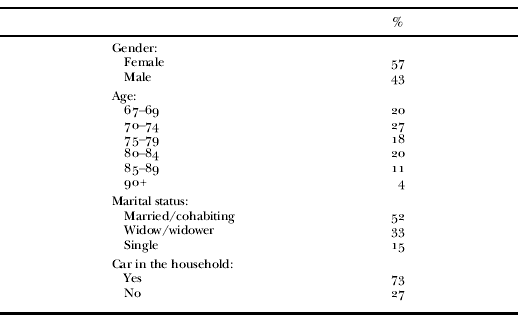
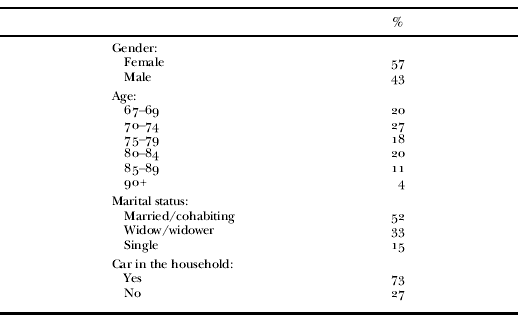
Table 1 provides descriptive statistics of the sample which correspond fairly well with figures from public statistics of gender, age and marital status (Statistics Norway 2011). The sample contains fewer respondents of 85 years and older (15 per cent) than in the population (18 per cent). Compared to the Norwegian National Travel Survey 2009, the respondents in this survey have slightly better access to a car in the household, 73 per cent versus 71 per cent for the same age group, which is lower than for the total population (85 per cent) (Vågane, Brechan and Hjorthol Reference Vågane, Brechan and Hjorthol2011).
Sample overview
In the following presentation the total number of respondents will vary in the tables. The reason for this is that some questions are not relevant for all respondents or some respondents have failed to answer the question.
Results
Transport resources
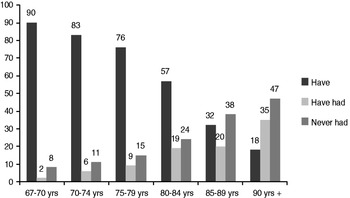
Holding a driving licence is important for daily mobility. Figure 1 shows the distribution of those who have a licence in the different age groups, and of those who have had/never had one. Of those under 80 years, a large majority hold a driving licence, while the share decreases with increasing age. After 80 years there are relatively large shares of people who have never had a licence, and a majority of them are women. In these age groups, 40 per cent of women have never had a licence compared to 4 per cent of men (p<0.01).
Driving licence holders by age group.

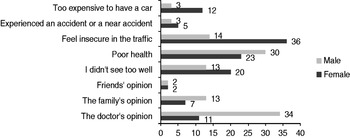
In this survey, the average age of giving up a driving licence is 76.5 years for women and 79.5 years for men (p<0.01, t-test). Part of the explanation for this difference can be found in the reasons men and women give for not renewing their licence (see Figure 2).
Reasons for not reviewing the driving licence (%).

The most frequent reason stated by women is that they feel insecure in traffic, while the reason given most frequently by men is that the doctor has told them to stop driving.Footnote 2 While the reasons that women give for giving up driving are related primarily to their own evaluation of the situation, it seems that men need some pressure from others, i.e. from a doctor or the family. This is an indication of women stopping driving too early because of lack of confidence in traffic. It is also interesting to note that women much more than men make their reason for not continuing to drive on economic grounds (10% versus 4%, p<0.001).
Men more often have access to a car than women do (87% versus 62%, p<0.001), and more women than men have never had a car (21% versus 6%, p<0.001). After the age of 80 the percentage of car-owners decreases, but still 27 per cent of people 90 years and older live in a household with a car. Some in this age group may be living with a younger partner who still drives, or with children or other relatives.
People who live in the bigger cities have less access to a car (64% versus 74%, p<0.001), but have a better public transport supply. Questions about the quality of the public transport indicate this: the distance to the bus stop is shorter (78% have less than 500 metres to the bus stop compared to about 50% in small communities, p<0.01), the bus comes along more frequently, and often there is a bench or other possibility of taking a rest on the way to the stop or bus station and at the stop itself.
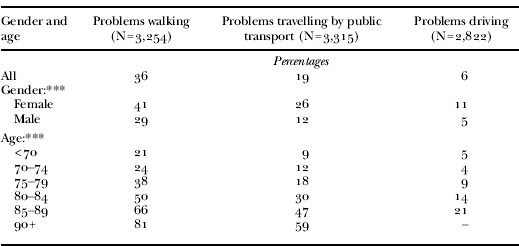
Mobility also has health-related aspects. Many in the older groups have difficulty using the ordinary public transport supply because they have trouble walking or because public transport is difficult to use for one reason or another. Table 2 indicates that these problems increase with age and are more prevalent among women than among men.
Problems1 walking, travelling by public transport and driving a car by gender and age
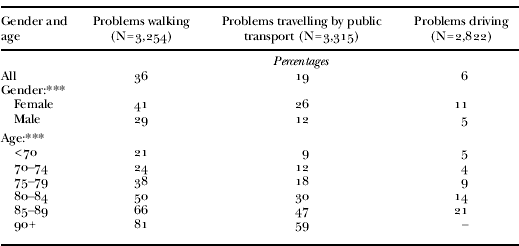
Note: 1. Based on the question: Do you have health problems that make it difficult to travel in different ways?
Significance level: *** p>0.001 (χ 2).
It is interesting to note that problems using public transport are greater than problems driving a car, which up to about 85 years only a minority say they have trouble with.
This indicates that men have better access to transport resources and fewer health-related problems than women have. In these age groups, the situations of men and women differ in other ways, too. While 76 per cent of men in this sample are married or have a partner, no more than 34 per cent (p<0.001) of women are in the same situation. The differences increase with increasing age. Among men in the age group 80–84 years, 68 per cent are married, 24 per cent are widowers and 9 per cent are single. The corresponding figures for women in the same age groups are 23, 62 and 15 per cent, respectively (p<0.01). This implies that a large number of older women do not have a driving licence nor do they have a ‘chauffeur’.
Special Transportation Service and private transport support
What are the alternatives for these groups when the public transport supply is inadequate, a car no longer available and the distance too far to walk? In the survey, questions about the knowledge and use of STS were raised.Footnote 3
In this survey, questions were asked about how the system works, its use and the degree of satisfaction felt by users. Less than half of the respondents knew about the STS and only 18 per cent were users, more women than men (25% versus 7%, p<0.001) and older groups more than younger (while 6% of those aged 75–79 are users, the corresponding figure for the age group 85–89 years is 36 percent, p<0.001). Only one-third confirm that the service meets their travel needs, with those under 80 years the most discontented with it.
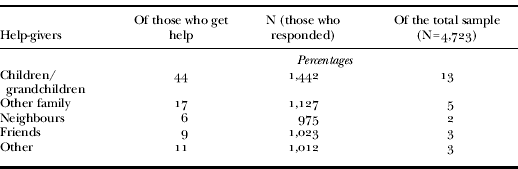
To find out to what degree other types of practical transport help were available, the respondents were asked whether they received assistance when shopping for groceries; 30 per cent confirmed that they did get help. Table 3 indicates those who get assistance for this activity weekly from different help-givers.
Getting weekly help for shopping groceries
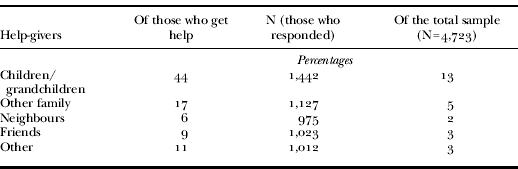
Children and grandchildren are those who offer shopping assistance most frequently, but, as the figures indicate, only 13 per cent of the total sample get weekly help from members of the family. The percentage is higher among the oldest, and women receive more help than men do (Hjorthol et al. Reference Hjorthol, Nordbakke, Vågane, Levin, Sirén and Ulleberg2011). Other family, friends and neighbours also contribute, but to a lesser degree than the immediate family do.
The types of activity people want to do more often
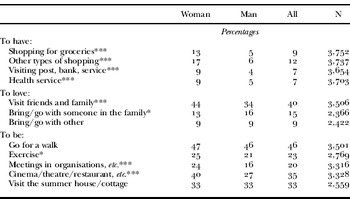
Are the available transport resources sufficient to satisfy the travel needs of older people? The activities are categorised according to Allardt's conceptualising of the different welfare arenas. Table 4 gives information about the types of activity that women and men would have taken part in more frequently if they had been able to. The table indicates that visiting friends and family and going for a walk are the types of activity that people miss most and feel that they would have done more of if they had had the opportunity. Approximately one-third emphasise that they would have liked the possibility to visit the cinema more often, go to the theatre, restaurants, and similar activities. In most cases, women want to do these things more than men do, which might be because the transport resources available to them are fewer than for men.
Activities that people want to do more often by gender

Significance levels: * p>0.05, ** p>0.01, *** p>0.001 (χ 2).
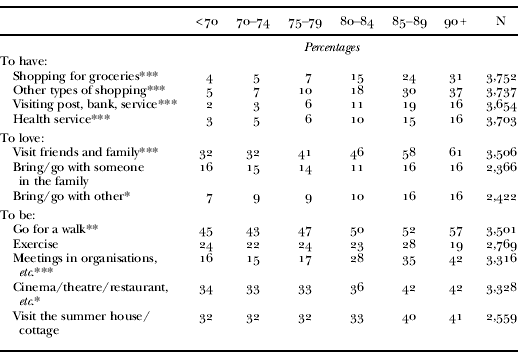
The desire for more frequent activities increases with age for most of these activities, especially those categorised under the dimensions having and loving (Table 5). Visiting friends and family is mentioned nearly twice as often as a missing activity among the oldest group as among the youngest. It is also interesting to see that everyday activities such as shopping and visiting the bank or the post office become more problematic with age. Shopping for groceries can be characterised as a ‘basic’ activity and therefore an indicator of independence and control in everyday life.
Activities that people want to do more often by age group
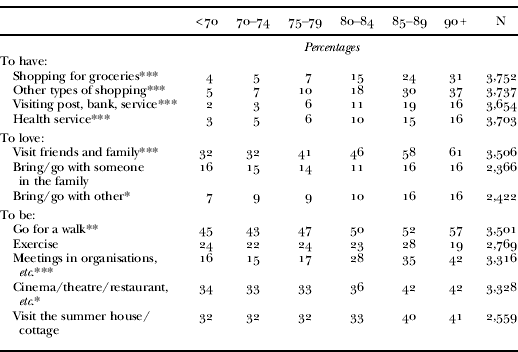
Significance levels: * p>0.05, ** p>0.01, *** p>0.001 (χ 2).
There can be several reasons for not being as active as one would want, not just the lack of transport.
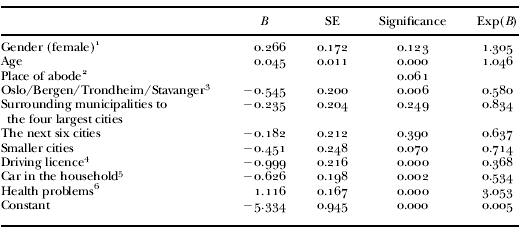
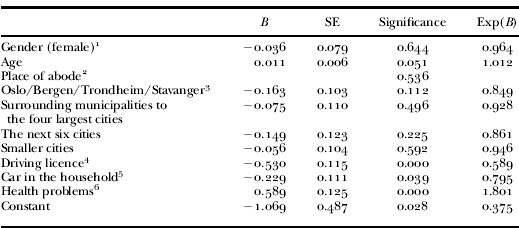
To examine the impact of transport in relation to health problems for old people not being as active as they would wish regarding basic activities such as shopping and visiting friends, multiple analyses (logistic regression) were carried out (Tables 6 and 7). Gender, age, place of abode (as indicator both of the quality of public transport and access to service), driving licence, car in the household and health (self-rated) were all considered in the analysis.
Logistic regression: want to shop more often
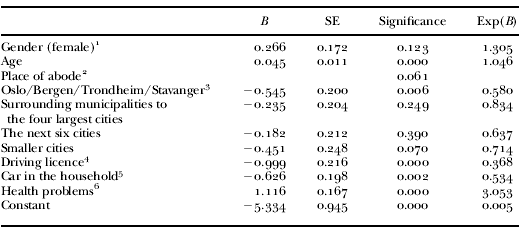
Notes: N=3,542; −2 Log likelihood=1,480.567. 1. Male. 2. Small towns and sparsely populated areas. 3. Four largest cities in Norway. 4. Has no driving licence. 5. Has no car. 6. Has no health problems.
Logistic regression: want to visit friends and relatives more often
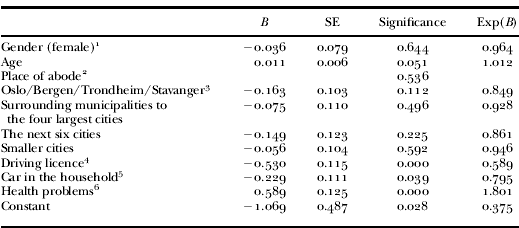
Notes: N=3,542; −2 Log likelihood=4443.891. 1. Male. 2. Small towns and sparsely populated areas. 3. Four largest cities in Norway. 4. Has no driving licence. 5. Has no car. 6. Has no health problems.
Table 6 shows that with the exception of gender, the variables in the analysis are all significant. People with health problems express the wish to do more shopping and this increases with age. Others without a driving licence and no car articulate the need to be able to do more shopping than those with a licence and a car. The need increases with age, but although not significant it is women who express this need more than men.
In examining the unmet need of visiting others, it was found that health, age and transport resources (driving licence and access to a car) have a significant impact (Table 7), whereas gender and place of living do not have any effect on the need to visit outside the home.
Activities and quality of life
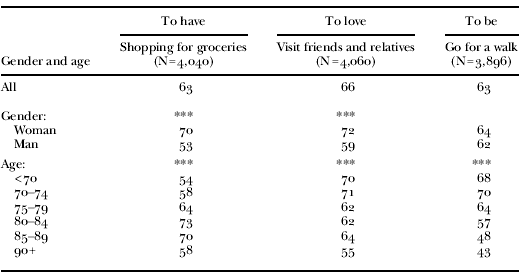
The respondents were asked in the survey whether having different activities was important for their quality of life. The concept was not defined, so the degree to which the respondents associated quality of life with these specific activities was up to them to determine. In this context we have chosen to present what may be called ‘basic’ activities, i.e. shopping, visiting others and going for a walk, to examine the significance these have for older people's quality of life. Visiting and being in contact with friends and relatives are important in maintaining social networks. Being able to go walking in the neighbourhood or further afield also gives positive health benefits, both mental and physical. Shopping for groceries is an activity very much related to the experience of managing and of being in control of everyday life. How strongly these activities are valued differs between genders and age groups (Table 8).
Percentage saying that activities are very important for their quality of life
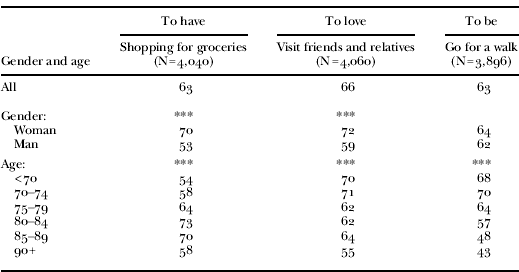
Significance level: *** p>0.001 (χ 2).
Food shopping and visiting friends and family, representing the having and loving dimensions, are things that women do more often than men (cf. Table 4). One explanation might be that this type of shopping is traditionally the female domain and that visiting each other is a more typical way of social interaction for women than it is for men, who more often interact together in specialised activities. But it might also be connected with differences in the access to transport resources. The activity might be less important if it is readily accessed. Tables 6 and 7 indicate that the effect of gender on wanted activities (shopping and visiting others) disappears when controlled for transport resources.
For people under 75 years of age, the possibility of being able to visit friends and relatives and take a walk is often cited as more important for their quality of life than shopping for groceries (Table 8). With increasing age, visiting friends and relatives occurs less often and going out walking becomes less and less, while being able to carry out basic activities such as shopping for groceries becomes more important.
These activities are valued a little lower among the oldest (90+ years), where the level of activity is less and both the possibility and the need for different social activities seem to decrease. With increasing age, friends and acquaintances of the same age become fewer, resulting in fewer people to visit if one's circle of friends is not renewed. Health problems hamper the possibilities for physical activity such as going for a walk, and other activities probably take place instead.
Summary and discussion
The aim of this study was to come to a better understanding of the mobility situation of different groups of older people and the relationship between transport-dependent activities and aspects of welfare and quality of life. The empirical analysis was based on a nationwide survey in Norway in 2010. Daily mobility was approached in a welfare perspective, with access to means of transport and level of activity (daily trips) seen as indicators of different welfare dimensions – dimensions conceptualised as having, being and loving, and developed by Erik Allardt (Reference Allardt1975). More specifically, the aim of the study was to investigate which activities people wanted to do more of, the impact of the transport resources on reduced activity levels, and the relation between ‘basic’ activities within this welfare perspective and quality of life.
The main findings indicate a lower level of activities than people desire for all three welfare dimensions. Activities related to the ‘loving’ and ‘being’ dimensions are more in demand than those subsumed the ‘having’ dimension.
In general, women express the need for a higher level of the different activities than men do, with few exceptions. Previous studies have indicated that older women take fewer daily trips (by car) than men do (e.g. Collia, Sharp and Giesbrecht Reference Collia, Sharp and Giesbrecht2003; Hjorthol, Levin and Sirén Reference Hjorthol, Levin and Sirén2010; Mercado and Páez Reference Mercado and Páez2009; Rosenbloom Reference Rosenbloom and Rosenbloom2000), part of the explanation being less access to transport resources. This was also found in our study. The desire for a higher frequency of activities increases with age, especially concerning those connected with the ‘having’ dimension, activities that are probably taken for granted for the younger older. The same variation by age, however, is also found for activities of the other two welfare dimensions. The desire to visit friends and relatives more than they do currently increases with age, as also the wish to attend meetings in organisations. Multivariate analysis (logistic regression) of the desire to do more shopping and more visits reveals that the effect of gender disappears, while age, health and transport resources have significant effects. This means that when women have equally good access to transport resources as men do the differences will decrease.
Among the oldest (80+ years) in the focus groups preceding the survey, going shopping was seen as one of the most important activities – this shows an ability to handle everyday life quite well and is an indication of being in control (Hjorthol et al. Reference Hjorthol, Longva, Skollerud and Vågane2009). In rural areas, in particular, shopping is sometimes combined with social activities, e.g. meeting others at the local café. Shopping is connected not just with the ‘having’ welfare dimension, but also with the ‘loving’ dimension (Hjorthol et al. Reference Hjorthol, Longva, Skollerud and Vågane2009).
When respondents are asked about activities important for their quality of life, activities representing all three welfare dimensions are mentioned, and the percentage that miss these things increases with age. Activities such as visiting others, going for a walk and shopping for groceries are often (stated by more than 60% of the respondents) given as important for quality of life among the older group. This suggests it is important that the different dimensions of welfare are taken into consideration when providing transport for older population groups.
Possession of a driving licence and access to a car decrease significantly with age, and the gender differences are significant for the cohorts in this study. In other studies, too, it has been found that women give up driving at an earlier age than men (Davy Reference Davy2007; Sirén and Hakamies-Blomqvist Reference Sirén and Hakamies-Blomqvist2006).
Since the reasons for stopping driving differ between men and women in this study – men are exposed to pressure from others, while women to a much greater degree relate the decision to their own experience of driving – one might think that men would have stopped earlier and women later. A study from Finland supporting this last assumption found that older women are prone to giving up their licence while still able to drive (Sirén, Hakamies-Blomqvist and Lindeman Reference Sirén, Hakamies-Blomqvist and Lindeman2004).
Since women on average live longer than men and often marry a man older than themselves, they live a longer period single than men do. When they have less driving experience than men and often reduced economic means as single women, their private (transport) resources also decrease.
When women become widows they lose not only a life partner, but also a man who can take care of transport in the family, since distribution of the driving licence is gendered. Even if a woman in these generations has a driving licence she gets too little driving experience because in most cases her husband is the driver when the two of them travel together (Hjorthol Reference Hjorthol, Priya Uteng and Cresswell2008).
The coming generations of older people, especially women, have the formal possibility to drive a car that previous generations had not. It is not age in itself that is important, but the social changes that occur over a historic period, and this might be due to an increase in equality between the genders or to higher income in general, as has been discussed in a previous work (Hjorthol, Levin and Sirén Reference Hjorthol, Levin and Sirén2010).
Health, too, is a resource related to both age and gender. Problems using different forms of transport and difficulty walking increase with age and are more prevalent among women than among men. This is so in the case of walking, car-driving and in the use of public transport. Both men and women have fewer problems connected with car-driving, which is a clear indication of the challenge facing public transport authorities in adjusting their supply to an increasing customer group. Several studies have shown that older people do not use public transport as much as other groups (Schmöcker et al. Reference Schmöcker, Quddus, Noland and Bell2007; Schwanen, Dijst and Dieleman Reference Schwanen, Dijst and Dieleman2001; Whelan et al. Reference Whelan, Langford, Oxley, Koppel and Charlton2006). Apart from the quality of the public transport supply, a reason for not using it is there being nowhere to take a rest on the way to the bus stop or at the stop itself. The STS, which is provided for people who cannot use the ordinary public transport supply, is not well publicised among the older groups, and according to previous studies older groups horde their ‘taxi coupons’ for special occasions because there are so few of them (Hjorthol et al. Reference Hjorthol, Longva, Skollerud and Vågane2009).
Even though availability of a car and holding a driving licence are increasing among older groups, there will still be a need for an increased transport supply catering for those who cannot or do not want to drive. There is a clear indication of gender differences when it comes to the actual time of life people give up driving, and the conditions leading to this. While women give up willingly, because they feel it necessary for health reasons or because they feel insecure in traffic (cf. Figure 2), men more often have to be advised to give up driving by their doctor or relatives.
The quality and frequency of the public transport supply varies between urban and rural areas, and a considerable number among the older groups, especially those over 80 years of age, have problems using it, as shown in this study. An adjusted supply is required. The STS for people who are not able to use the ordinary supply is not well known by the older groups. Only 18 per cent are users, and of these only one-third are satisfied with the system. These results point to the need for information and enhancement of the service. Older people also get help from relatives and others, primarily children and grandchildren, but at 13 per cent is not very high. Not all have family in the vicinity, and some are reluctant to ask for help knowing that the children are busy with their own lives. This indicates that private support from family and friends will only to a minor degree satisfy the mobility needs of older groups.
Mobility and the possibility to carry out everyday activities are central to the welfare and quality of life of older people. In this article, we have examined the conditions for mobility access to different types of transport among women and men in different age groups, and the types of activity they consider important for their quality of life and want to do more of.
The results from this study indicate that desired level of activity reduces with age, but the experienced importance of being mobile is not diminished. The study has shown that the possibility to manage the elementary part of daily life – the part that involves getting out of the home – is very important for older people's quality of life. The quality of being mobile and able to get out of the home, even if for no more than just going to the nearest shop to buy bread and milk, is greatly valued.
Our context is Norway, which might limit the possibilities to generalise the results. However, a recent cohort analysis of the development of daily travel of older people in Scandinavia indicates relatively minor differences between Denmark, Norway and Sweden (Hjorthol, Levin and Sirén Reference Hjorthol, Levin and Sirén2010). Compared to other European countries (EU-27), the number of cars per 1,000 inhabitants is lower in Norway, 445 versus 466 (Eurostat 2009), but the share of car use of daily mobility is higher than in France, UK, Switzerland, Denmark, Germany and Sweden (Denstadli Reference Denstadli2011).
Looking at other western European countries, there are similarities on some mobility indicators, but the general economic situation and transport policies for the older population may vary, as do (winter) weather conditions, which can make comparison difficult. International comparative studies are of great interest in this field and will lead to a more solid basis for policy measures.
Acknowledgements
This paper was written as a part of a project entitled ‘The Impact of Everyday Mobility for Elderly People's Welfare and Well-being’ (project no. 187780/S20), which is being funded by the Research Council of Norway, the Research Program on Welfare. We thank the Editor and two anonymous referees for very helpful comments on an earlier draft of this paper.