


Today’s organizations face an extremely competitive, quickly changing, and complex environment. This results in a need for companies to be faster and more responsive and to systematically search for changes in laws and individual preferences as well as technologies that could lead to an advantage in their market. Several different strategies have been proposed for companies to deal with these changes. The notion of becoming an agile organization to deal with uncertainty and an unpredictable environment has been one of the most popular lately (Sherehiy & Karwowski, Reference Sherehiy and Karwowski2014). Companies are hoping to foster speed, adaptability, and innovation by rolling out an agile strategy, implementing agile methods, and creating an agile mind-set among their leaders and employees. In line with this, 59% of the respondents in the latest Hays report rated the importance of agility for their company as high or extremely high. Furthermore, the significance of agility seems to be growing, as 69% of respondents stated that this topic will become more important within the next 3 years (Eilers etal., Reference Eilers, Möckel, Rump and Schabel2018). An additional 19% of respondents already worked or partly worked in an agile way and were hoping to increase adaptability, innovation, flexibility, speed, and self-organization of employees with this new way of working. Many organizations, such as ING, Spotify, or Zappos are redesigning their organization to be more agile. The large German car company Daimler AG nominated agility to be one of the main drivers in its campaign “Leadership 2020,” in which it intends to change its organizational culture to become more modern. They further developed an agile work form especially tailored to their needs, which involves employees being able to work independently to develop new products and integrates different professional perspectives with the goal of meeting customer needs more effectively. However, there is still considerable ambiguity about what the concept of agility entails and how it could be successfully implemented in an organization. In a recent attempt to better understand agility in the work context, a Society for Industrial and Organizational Psychology (SIOP) white paper by Baran and Bible (Reference Baran and Bible2019) suggested that agility is crucial for organizations to handle the changes they are facing. They give a brief overview about the origin of the concept and suggest first steps for organizations to take to become more agile. In this practice-focused paper, we go into more detail by giving an overview of different definitions of agility; discussing evidence-based factors that contribute to agility at the individual, team, and organizational levels; and describing three practical examples of implementing agility at Daimler AG. Finally, we suggest potential steps that organizations can take to increase agility in their workforce.
Defining agility and agile organizations
Even though several authors propose that agility is one of the most important challenges for companies address relative to staying competitive and profitable in the modern business environment (Braun etal., Reference Braun, Hayes, DeMuth and Taran2017), a common definition does not exist. Furthermore, agility has been examined by only a few empirical studies, which have mostly focused on broader organizational and workforce agility. In contrast, only a very small number of studies have been conducted on team and individual agility. In the following, we review several definitions and contributing factors of the agile organization, agile teams, and agile individuals (see also Table 1 for a summary of the factors that predict agility at different levels, based on the current literature).
Factors Influencing Agility in the Workplace

Agile organizations
There are several different definitions for organizational agility in the literature. Even though they focus on different aspects, most definitions agree on four main components of agile organizations. The first component is that agile organizations are able to respond to change in internal or external business environments in a timely manner (Sherehiy & Karwowski, Reference Sherehiy and Karwowski2014; Winby & Worley, Reference Winby and Worley2014; Zhang & Sharifi, Reference Zhang and Sharifi2000). The second component is the capability to act proactively on and anticipate change, to exploit it and take advantage of the change as an opportunity (Sherehiy & Karwowski, Reference Sherehiy and Karwowski2014; Zhang & Sharifi, Reference Zhang and Sharifi2000). A third factor included in many definitions of organizational agility is learning and constantly building up skills, knowledge, and experience. This is emphasized given the need for constant renewal in an agile organization and the necessity to adapt existing competencies to fit an ever-changing environment and to design and develop new capabilities (Ragin-Skorecka, Reference Ragin-Skorecka2016; Weber & Tarba, Reference Weber and Tarba2014; Winby, & Worley, Reference Winby and Worley2014). Finally, it is noteworthy that especially the practitioner literature emphasizes a network structure, a people-centered and purpose-driven culture, and iterative processes to refine a product as trademarks of an agile organization (Aghina etal., Reference Aghina, Ahlbäck, De Smet, Lackey, Lurie, Murarka and Handscomb2017; Eilers etal., Reference Eilers, Möckel, Rump and Schabel2018). Specifically, this literature often defines an agile organization as a network of self- organized teams in which employees are able to autonomously make decisions and change the course of action. This definition might be especially helpful when looking at practical examples of what is happening in organizations.
The agile workforce
The notion of the agile workforce is a relatively new concept that is mostly concerned with behaviors, attitudes, and prerequisites of a workforce that is or is becoming agile. Similar to organizational agility, there is no consensus on a single definition of workforce agility (Muduli & Pandya, Reference Muduli and Pandya2018). Recent definitions and descriptions of the agile workforce focus mainly on an agility-oriented mind-set or attitude and agility-oriented behavior. An agile mind-set or attitude has been defined as the understanding of the workforce that agile behaviors are necessary for the organization to survive in a changing marketplace (Dyer & Shafer, Reference Dyer and Shafer2003). Further, definitions of the agile mind-set highlight a positive attitude toward learning and self-development, as well as a positive attitude toward change (Muduli & Pandya, Reference Muduli and Pandya2018; Plonka, Reference Plonka1997).
From a behavioral perspective, workforce agility has been defined along three behavioral dimensions (Dyer & Shafer, Reference Dyer and Shafer2003; Sherehiy & Karwowski, Reference Sherehiy and Karwowski2014). The first dimension entails proactive behaviors of employees, including anticipating change-related problems and initiating activities that lead to solutions for these problems. The second refers to adaptive behaviors of employees, such as constantly learning new skills and being able to assume different roles across teams. Finally, the third dimension involves the resilience behaviors of employees that involve functioning effectively under stress and in changing environments, having a positive attitude toward change and new ideas, and being able to tolerate uncertainty and different opinions.
Agile teams
Agile teams are typically defined as teams that use agile methods in their daily business (Whitworth & Biddle, Reference Whitworth, Biddle, Concas, Damiani, Scotto and Succi2007). Even though there are many different agile methods and practices, most of them share common characteristics (Maruping etal., Reference Maruping, Venkatesh and Agarwal2009). That is, the team should be self-organized and mainly responsible for its own process. An agile team delegates tasks to its members autonomously and creates a culture in which team members quickly share information and help each other. Furthermore, agile methods typically have a strong focus on the customer. They emphasize fast and frequent communication and feedback from the customer as well as within the team. Based on these characteristics, agile teams create high transparency and a way to measure progress. Agile teams use iterative processes and focus on simple designs that show incremental steps that are easy to understand for everyone involved. Other authors stay closer to the definition of organizational agility and define agile teams as high-performance teams that sense and adapt to change successfully (Baran & Bible, Reference Baran and Bible2019).
Agile individuals
Agile individuals are people who have the abilities, knowledge, and skills to proactively seek opportunities, and they are able to adapt quickly to new situations (Doeze Jager-van Vliet, Reference Doeze Jager-Van Vliet2017; Razmi & Ghasemi, Reference Razmi and Ghasemi2015). They are further defined as individuals who are equipped with the skills to anticipate, implement, and exploit changes and take advantage of them (Braun etal., Reference Braun, Hayes, DeMuth and Taran2017; Chonko & Jones, Reference Chonko and Jones2005). In sum, there is no universally accepted definition of agility. Furthermore, other concepts like climate for innovation, resilience, proactivity, adaptability, or the learning organization share many characteristics with agility. Agility could be considered as an overarching concept that integrates some aspects of these concepts. However, more research has to be conducted to obtain a clearer picture and differentiate agility from other concepts that are discussed in the literature.
Possible advantages of agility and being agile
Only a small number of empirical studies on agility have been conducted so far, and most of these studies focus on organizational and workforce agility. Furthermore, these studies focus mainly on predictors of agility (see Table 1), whereas outcomes of agility have been largely neglected. This leads to a situation wherein many positive outcomes of agility are hypothesized, but these predictions are only partly supported by empirical research. In one of the few empirical studies on the outcomes of agility, Braun etal. (Reference Braun, Hayes, DeMuth and Taran2017) found that individual agility relates positively to performance. Yet, a focus on agility without a similar focus on resilience might lead to a higher stress level among employees and, subsequently, lower performance. Additionally, research has shown that an agile organization can increase employees’ autonomy or control over their work, as well as enriching their work tasks and training them more effectively, which enables the organization to employ their workforce in a more flexible way (Sherehiy & Karwowski, Reference Sherehiy and Karwowski2014).
Examples of organizational practices
As organizations realize that agility could be an appropriate answer to quickly changing markets and fading stability, they are trying to integrate an agile mind-set and agile behaviors more strongly into their daily business. Especially in large and traditionally hierarchical organizations, this step toward agility is proving to be a challenging enterprise. As discussed, agility and its components are, to a large extent, not completely new concepts for most organizations; however, the need and urgency to integrate agile components into companies’ culture has strongly increased. To integrate agility into their culture, organizations are using different strategies like large-scale cultural change programs, test runs with affiliate companies, or agile methodologies. In this section, we describe the process of the integration of agility into an organization’s culture using the example of Daimler AG. This company is using several different levers to create a more agile culture. In the following, we provide a brief introduction into the change process and, subsequently, focus on three examples of a change toward becoming more agile. This company is covering as many different aspects of the move toward agility as possible and is creating a strong basis from which to communicate a cultural change to their workforce. To do this, the company has created a large cultural change program that addresses topics like empowerment, agility, cocreation, purpose, a winning mentality, customer orientation, pioneering spirit, and learning. From these eight cultural change principles, measures were taken and communicated into the organization. One measure was, for example, an advertisement campaign to increase feedback. Employees were encouraged to give and ask for feedback with the help of tools that created a psychologically safe work environment. These measures were very strongly backed by the top management and intended as a stepping stone toward a more agile mentality on all levels of the organization. It challenged the assumption that change could only come from a hierarchical perspective and gave employees a leading role in the change process.
Additionally, the company offered several training programs to leaders to teach them about agility and how to implement it in the company. The company created a network of ambassadors who helped to change the culture in their parts of the organization. It further created a way in which employees could work in a safe and diverse environment on topics outside of their line duties to increase innovation and adaptability in projects. Whole departments were arranged as network organizations that were for the most part self-organized. Affiliate organizations were founded to test agile methods in their daily business. All of these measures were created to change the organization’s culture and to make the company more agile. Next, we provide further insights into the implications of this change based on three different exemplary projects.
An information technology department as a network organization
The first example focuses on a department that constructs information technology (IT) solutions for a warehouse. Due to an ongoing organizational change, it became necessary to adapt the IT tools for this warehouse constantly to the new organizational structures and requirements. Given that the old adaption cycles and processes for this warehouse were 12 months long and the warehouse needed quicker adaptions, the department decided to organize itself in an agile manner. Diverse teams consisting of storage workers, managers, and IT specialists were formed and organized in a network structure. An agile coach was hired, who helped the teams to form and to work in a more agile fashion. The agile method Scrum (Schwaber & Sutherland, Reference Schwaber and Sutherland2017) was used to provide the teams with structure and to help them work in an iterative fashion. Scrum leaders, who coordinated the work that was done by the team and were in regular contact with other the scrum leaders to synchronize the efforts of the different teams, were assigned to projects. The managers of the entire plant were trained to lead employees who work in an agile fashion to be able to understand and support these employees in their new roles. Several surveys showed that this approach led to higher employee satisfaction, as the company was better able to address their employees’ needs. Furthermore, as the teams consisted of members with different occupational backgrounds, they had more insight into the needs of employees were working in the warehouse. The use of the Scrum method in this approach led to an increased integration of the customer as well as a higher feeling of responsibility of the teams for the complete cycle of the product. They also had shorter development cycles to test and integrate their solutions into the IT system. These actions led to a better prioritization of the features that needed to be integrated into the products. This decreased the development and integration times from 12 months to 12 weeks, resulting in a significantly faster reaction time to address customer needs and consequently much higher customer satisfaction.
A holarctic organization
As the second practical example, we describe an affiliate company that was set up to try out agile working to be more innovative, to react more quickly to changes, and to become more flexible in shifting personnel. It was set up with relatively few employees and grew rapidly in the last few years. Especially noteworthy is that this company uses an agile work organization called holacracy. In the holocratic system, the company is organized into different areas, called circles, which have a predefined purpose and goal. Circles are, however, free to organize their work autonomously to reach their goals. Each circle is led by a circle link, which is in constant contact to the other circle links to align the circles under a common goal. The circle links are chosen by election and have to be reelected every year. This system was chosen because it allows for personnel and task flexibility and sets up a collective purpose while still granting a great amount of autonomy, fast decision making, and clear accountability to the individuals working in the company. The company is set up to have clear and structured processes, for example, fixed meetings every Monday in which the circle links discuss the most important challenge of the week, as well as open processes in which individuals within the circle determine how they work on a given project. This way, they establish collective goals, create transparency, and have a structured way to prioritize and ask for help while at the same time offering room for innovation and experimentation. The company further introduced the position of a problem solver for each team. This position focuses mainly on a smooth workflow over the course of the project and acts as an impartial coach to dissolve arguments. As the company was founded, several core values were installed, including experimentation, reflection, error management, and optimization to create learning opportunities in a safe environment. During the startup phase, the company invested much time into finding the right structure for their work; in interviews this time was estimated at up to 50% of their working day. To do this, they created a shield that protected them from the exertion of external influence. This company was therefore in a comfortable position to set up a working agile organization within a safe environment and hire employees that were a good fit for this organization. They were able to build a company culture that is based on agile core values. They further installed several structures (e.g., circle meetings, position of the problem solver) to help them with the integration of these values into their everyday life. Special governance meetings are held on a regular basis to continuously work on the organization and to prepare it for challenges that might arise in the future. This investment into building an agile organization from scratch resulted in an organization that is now described by employees as more innovative and adaptive with respect to the products that they develop. It also resulted in a company that has fast decision-making processes, clear roles and accountabilities, an autonomous way of working, a diverse and lively culture, and highly motivated and satisfied employees.
An external innovation lab
The third example involves an innovation lab, “the Innolab,” which was set up to help the company become more innovative and to explore new business opportunities for the future. The lab was set up to allow the employees work as an agile team outside of the usual structure of the company. A modern workspace was rented that could be tailored to the needs of the people who would be working in the innovation lab. Several external PhD candidates from different vocational backgrounds were hired to make up a diverse team that had an unbiased view of the company itself. The team leader and one other team member came from within the company and connected the innovation lab to an internal network and knowledge about the company. This way, the team was free to ask provocative questions about the future of work without being tied down to the actual reality of the current state and to research this question from different disciplinary viewpoints. At the same time, however, it was ensured that new products could be tailored to the needs of the organization. This led to a culture in which employees had more freedom than did their counterparts in the established organization.
Especially in the beginning, this created more stress for the employees of the Innolab, given that the structure and processes were sometimes unclear and exchange with the established organization was challenging. However, the team at the Innolab was able to create new products and ideas for the internal as well as the external market. Furthermore, they were able to give impulses to the established organization from an outside perspective.
Reflection on the practical examples
When considering these examples, several different observations can be made. The first is that the shift toward agility seems to be a process that creates a company culture that gives individuals the freedom and the autonomy to be innovative and to adapt to the needs of the customer. This shift toward agility appears to result in higher success rates, considering for instance the reduction of development times in the first example or the growth of the company in the second example. Second, these examples suggest that employees who were working in such a culture were more satisfied with their working experience. Both results were reached by observations and short interviews. They should be further studied through empirical research.
Third, implementing an agile culture seems to be a very time demanding and complicated process that needs many discussions, iterations, and a strong will. Although the teams were all founded under the premise that they ought to work in an agile fashion and create an agile culture, they had to overcome several obstacles on the way. Finally, it should be mentioned that several problems arose from challenges that were related to cooperation with other departments or companies that had a very hierarchical culture and structure. In these efforts, the autonomy of the individuals who were working in an agile way was often neglected and the hierarchical structures were enforced. This led to demotivation and frustration among the employees who were working in an agile fashion, as well as to arguments with the cooperation partners. These side effects might be especially interesting in light of the shift toward agility in organizations and should be further investigated by empirical research.
What can organizations do to become more agile?
Organizations can increase their agility by implementing some practices that address factors that have been shown to contribute to agility in organizations (see Table 2 for a summary).
Examples of Organization Practices to Increase Agility
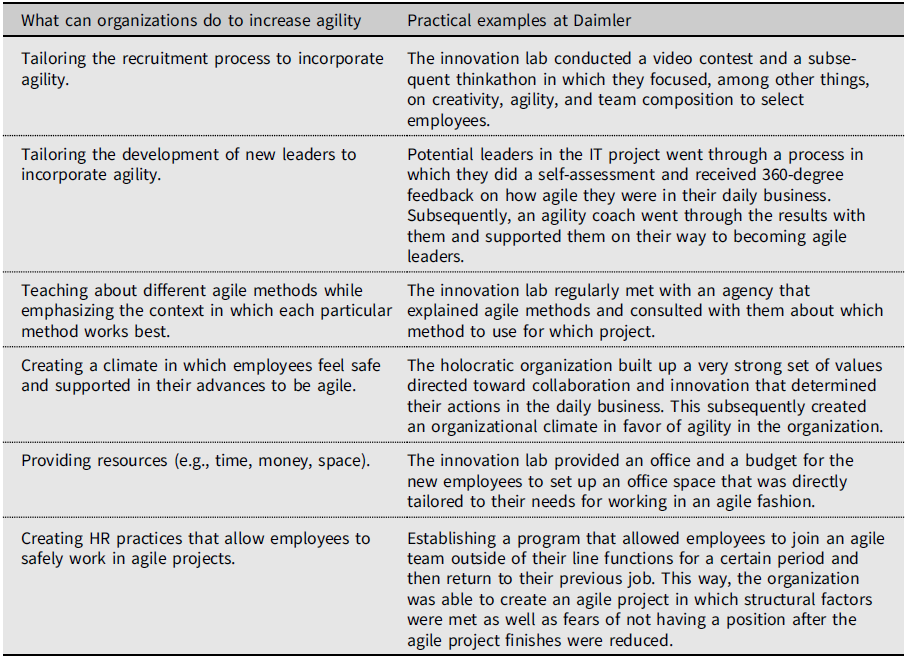
Several of these factors are not exclusively related to agility but rather develop the organizational culture as a whole and might even already be a part of many company’s cultural change programs. It should be noted, however, that the circumstances, legislation, and environments of different companies make it very difficult to give universal directions and that these recommended actions need to be tailored to the exact background and context of the company.
Furthermore, it is important to consider where exactly to implement agility in an organization. It can be suggested that especially departments such as research and development, which have highly creative and change-orientated functions, might benefit the most from organizing the work in an agile fashion. However, especially when considering the broader agile work culture, other departments might also benefit from an agile work organization.
Recruitment and selection
Because individual factors as well as team composition play a great role in implementing agility, we recommend that organizations reassess their recruiting and development practices. Job postings could emphasize agility to attract candidates with a more agile mind-set and personality. Organizations need to use new media as well as recruitment events to advertise more strongly that they are working in an agile fashion to appeal to the best-fitting applicants. Human resources practitioners and managers should also direct more attention toward the selection process and focus on personality characteristics and cognitive abilities, as well as beliefs and attitudes toward change. These characteristics should be assessed via validated tests and tailored interviews. Furthermore, tests and interviews should be used to assess the level of resilience of candidates because it plays an important role in predicting their later success in an agile environment.
The same applies for the development of leaders inside the company. As the leadership role in an agile organization is much different from that in a traditional organization, development processes need to be adapted to the new criteria. The leadership role changes from that of being a manager with a lot of expert knowledge in their discipline toward that of being a supportive force that leads the team through a vision and guidelines. Development practices need to be tailored toward this new skill set and should strongly focus on personality traits and attitudes as well as different soft skills like communication and empathy.
Training and development
Organizations can increase their agility with the help of interventions and training (Braun etal., Reference Braun, Hayes, DeMuth and Taran2017). Especially in highly uncertain and agile work environments, the training and development of employees’ knowledge and skills can be crucial to adapting to changing work requirements. Organizations should offer compulsory training programs that increase self-awareness of one’s agility and resilience. Additional training programs and coaching sessions need to be offered to leaders to help them adapt to their new roles and lead agile teams. This might also help to decrease the fear that accompanies a role change that leaders might undergo when becoming agile.
Simultaneously, organizations should teach employees about different methods and tools (e.g., Scrum) that could help them to work in an agile fashion while emphasizing that not every context needs the same amount of agility and that not every method fits with every environment. Employees need to ensure that the methods they use fit the environment in which they are applied, so they need to have background knowledge of agile methods. For example, it might be possible to use Scrum—a very structured method that relies on iterative processes, reflection, and experiments—in IT development, given that software products can be repeatedly tested and refined. However, it is less suitable for production lines wherein employees have limited freedom for experimentation. In such a setting, it might be more promising to use methods like job rotations or stand-up meetings to create greater transparency, more learning, and an environment in which employees ask for help from others and quickly share information.
Finally, we advise organizations to increase the general knowledge and skill base of their employees. A workforce that has more knowledge and skills is also better able to be adaptive or innovative because it is able to make quick changes and work in different roles and areas. Therefore, it yields an even bigger payoff to invest in training programs as well as job rotation, job enlargement, and job enrichment programs in an agile environment (Muduli & Pandya, Reference Muduli and Pandya2018).
Create an agile culture
Organizations need to create a culture in which employees feel safe and supported in their efforts to be innovative and adaptive. This entails empowering and enabling employees as well as a strong emphasis on feedback, exploration, learning behaviors, and support for each other. Employees need to be prepared and authorized to make decentralized decisions within their field of expertise (Baran & Bible, Reference Baran and Bible2019). This may lead to higher motivation and self-efficacy and will eventually result in greater proactivity and adaptability in projects (Muduli & Pandya, Reference Muduli and Pandya2018). A strong emphasis on exploration and learning can lead to a culture in which employees focus more on experimentation and the growth of their knowledge and skill set, instead of the prevention of mistakes. In this way, employees are more likely to take risks and use opportunities to advance the organization. Leaders should directly encourage and support employees in their efforts to explore and experiment with new or faster ways of working. However, it is important to mention that the degree of freedom and the terms for experimentation vary for different organizations and within departments, and they should be assessed and communicated beforehand. Leaders should also advertise a shared goal instead of individual goals. This way, they are able to increase supportive behaviors among team members, which may lead to more cooperation and consequently more agile behavior. Additionally, feedback plays a great role in increasing agility in organizations, as it gives employees and leaders a clearer perspective on where they stand in reference to becoming more agile. Therefore, it is important to promote feedback within the company. Leaders and employees should be trained to give and to receive feedback on a regular basis.
Finally, organizations should create a shared vision or purpose that unites the company behind a common goal. This vision needs to be communicated and advertised to be the guiding force that determines every action of the organization. This way all employees know and can work toward this vision in their field.
Resources
Organizations need to provide resources such as time, money, and services to their employees to make a successful change toward an agile organization. Because a transition into a new way of working can be very time demanding in the beginning, the organization must take a decrease in production at the beginning of the transition into account. Individuals need to have the opportunity to invest time, for example, into training or the formation of new processes and structures. This is likely to pay off through more innovation and faster adaption in the future; however, it is an investment that organizations need to make in the beginning. Additionally, organizations need to invest in meeting rooms, offices, and campuses to create an environment that promotes agility and innovation. To support a diverse set of projects and products, office spaces need to allow employees to meet in a comfortable and safe environment.
Finally, it is important to invest into human resources practices. Employees need to be able to try out agile working and be a part of agile projects without having to fear not having a job after the project is done. To encourage employees to try out and participate in agile projects, several organizations are now setting up programs to provide these resources. For example, there is, a program at Daimler that allows employees to join an agile team outside of their line function for a certain period and then to return to their previous job. This way, the organization is able to create an agile project in which structural factors are met and fears of not having a position after the agile project finishes are reduced.
Conclusion
Agility as a concept is profoundly different from planned mass production in that it focuses more on individuals and how they work together to deliver the best possible product or service for the customer. It moves away from the Tayloristic view, which views employees as a resource that has no opinion and needs to be told what to do, toward an approach that acknowledges and uses the potential of an empowered workforce. Due to the shift toward individuality, agility is expected to strongly influence the nature of work. Given the need to quickly and constantly adapt to changes in technologies or customer desires, it is reasonable to expect that working in an agile organization will become more complex and cognitively demanding for the individual. This could lead to increased uncertainty and the strong need to quickly learn and develop new skills. On the other hand, an agile organization and the shift in the nature of work they bring on are expected to provide significant benefits to individuals.
Employees will be more autonomous and have more job control as well as a more diverse set of tasks and skills. This could, in turn, positively influence employee performance and well-being. Organizations might be able to contribute to these positive effects by recruitment, training, and development and by creating an organizational culture that emphasizes and supports agility. Agility could then become a valuable asset in dealing with an increasingly fast and dynamic environment in which organizations constantly need to adapt to changing customer needs and marketplaces. Therefore, it is of utmost importance that more empirical research be conducted to systematically analyze the effect of agility on an organization and its employees.



