“The right to permanently replace,” writes former National Labor Relations Board (NLRB) chairman William Gould, is the “right to use nuclear weaponry in the arsenal of industrial warfare.”Footnote 1 As Gould suggests, the use and threatened use of permanent replacement workers during economic strikes has been one of the most devastating antiunion tactics used by American employers in recent years. It has allowed hostile firms to defeat numerous strikes, undermined unions during contract negotiations, provided powerful antiunion propaganda during organizing campaigns, and enabled firms to instigate strikes, then recruit permanent replacements as a means of unloading unwanted unions. The origins of “management's big gun”Footnote 2 are found in the 1930s, several decades before the issue became a major concern for unions. But important changes in the economic environment, gradual changes in the law, the emergence of sophisticated “strike management” firms, and a shift in the balance in power in labor-management relations over the next few decades set the stage for a significant intensification in management opposition to unionization, including an increase in the use and threatened use of permanent replacements.
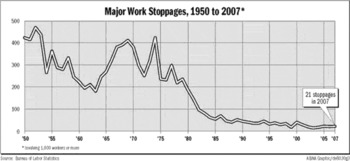
The efforts of organized labor and its political allies to change the law on permanent replacements have all ended in defeat. In recent years, strike levels have fallen to a postwar low, in large part due to workers' fear that they will be putting their jobs on the line in any work stoppage (see Table 1).Footnote 3 And with companies making increasingly elaborate and extensive strike preparations, under the right circumstances, practically any group of employees can now be replaced. In the early 1990s, United Mine Workers president Richard Trumka warned that without a ban on permanent replacements, unions would “almost certainly lose their only true weapon—the right to strike. Without that weapon, organized labor in America will soon cease to exist.”Footnote 4 Trumka's words may yet prove to be prophetic.

1. Origins of the Striker Replacement Doctrine
Why then, does US law allow the permanent replacement of economic strikers? Previous analyses of the striker replacement issue have mistakenly suggested that the Supreme Court's 1938 MacKay decision,Footnote 5 which established employers' legal right to hire permanent replacement, was the first time that legal status of replacement workers under the National Labor Relations Act (NLRA) was debated. Along with the issue of whether unions and management were required to produce written agreements as a result of collective bargaining, state regulation of unions' and management's economic weapons—including the status of replacement workers—was one of the most vigorously debated issues in the years prior to the enactment of the NLRA. One member of the National Recovery Administration era labor boards who would also serve on the first NLRA-era labor board, Edwin Smith, believed that the new law restricted employers' right to hire permanent striker replacements. If at any time during a work stoppage, economic strikers indicated to the employer their willingness to end their strike and return to work, Smith insisted, the employer “must receive them back, displacing [their replacements]. … The utility of the strikebreaker to the employer has ended. As a tool the strike breaker can be discarded—as an employee, dismissed.”Footnote 6 Thus, Smith argued, employers could hire replacements to continue production during strikes, but they could not legally retain replacement workers beyond the duration of a current strike.
Several commentators recognized the potentially disastrous consequences for unions and collective bargaining of allowing employers to use this potent weapon. In early 1936, just a few months after the enactment of the new law, NLRB attorney Daniel Shortal wrote to a fellow board lawyer that the labor board must outlaw permanent replacements—even in the absence of unfair management practices—or risk allowing employers the opportunity to undermine the entire purpose of the law:
To hold that in strikes, not caused by an alleged unfair labor practice, where the job of a striking employee had been filled before the striker signified his willingness to return to work, it would not be a violation of the Act to retain the new employee and to refuse to replace them with the striker would open up a most prolific field for hostile employers to circumvent the true purpose of the Act. This could… permit employers to practice many different forms of interference and coercion by the use of strike-breakers immediately after the commencement of a strike.Footnote 7
A few months later, Shortal elaborated on what he saw as the grave dangers associated with legalizing permanent replacements:
If the theory of giving permanent status to an employee who was called into replace a man on strike is followed to its logical conclusion, it would destroy all unions, abolish all efforts at bargaining and emasculate all strikers. … Such a practice would put before an employer a temptation, perhaps too great to withstand. … An argument “reductio ad absurdum” can be advanced whereby an employer one hour after a strike, and possibly even by strike-baiting, by hiring new employees, could render the administration of the Act anemic.Footnote 8
But not all policymakers agreed with Shortal's position on state regulation of employers' economic weapons, including the new law's chief sponsor, Senator Robert F. Wagner of New York. Wagner believed that it was “impossible to prevent employers from exercising pressure upon strikes in the same sense that we want to prevent them from exercising pressure upon free organization and unionization of their workers. … The object of unionism should not be to outlaw the exertion of economic pressure by either employer or employee in the actual process of collective bargaining.”Footnote 9 Likewise, the NLRB's first chairman, J. Warren Madden, believed that the NLRA outlawed certain unfair management practices, but having created this “nearer approximation of equality of bargaining power, it leaves the parties to depend upon their economic power. It does not require either side to be kind, or even considerate and mindful of former happier relations. Good morals might teach such conduct, but the law has not undertaken to enforce it.” On the specific question of whether an employer must decline the option of hiring permanent replacements, Madden stated categorically, “I see no such provision in the statute.”Footnote 10
Wisconsin schools labor arbitrator William Leiserson, chairman of the National Mediation Board and a future influential member of the NLRB, agreed that Madden was “entirely right in this matter. It seems to me very strange,” Leiserson wrote, “that your Board should take any other position… . Once the employees strike, the employer, of course, must discriminate against the strikers and must try to defeat the strike. If in doing this he is to be charged with unfair practices, the law is reduced to an absurdity.”Footnote 11 Within a few years, a majority of the labor board agreed with Madden and Leiserson on permanent replacements, especially after the appointment of another Wisconsin school labor arbitrator, Harry Millis, as chairman of the NLRB in 1940.Footnote 12 Millis and Leiserson were more responsive to employer and right-wing attacks on the board. The critical test of board policy for them was whether state regulation of employers' and unions' economic weapons—including the use of permanent replacements—encouraged or impeded free collective bargaining. In the 1930s and early 1940s, they believed that, in the interests of promoting free collective bargaining, the labor board should not regulate employers' use of permanent replacements. The manner in which employers have used and threatened to use permanent replacements since the 1970s, in contrast, has clearly undermined the process of free collective bargaining.
The legal status of permanent replacements was finally settled by the Supreme Court's MacKay Radio decision in 1938. In October 1935 the Mackay Radio and Telegraph Company hired replacement workers to continue operations during a strike over contract negotiations, and the union returned to work. After the company reinstated all of the strikers except five union leaders, the NLRB ruled that it had discriminated against the five men on the basis of their union activism. When the circuit court overturned the reinstatement order, the NLRB appealed the decision to the Supreme Court. In May 1938 ruling, the Court upheld the reinstatement of the five union activists but stated that the company had not committed an unfair labor practice by hiring permanent replacement workers. In an oft-quoted passage, the Court declared: “It does not follow [from the NLRA] that an employer guilty of no act denounced by the statute, had lost the right to protect and continue his business by supplying places left vacant by strikers.”Footnote 13
Although the decision upheld the board's reinstatement order, the Court's Mackay case attracted considerable interest from employers' organizations, which immediately recognized the potential significance of the ruling. The Chamber of Commerce pointed out that a “vital point” was that the strikers had walked out concerning a dispute over terms of employment (i.e., an economic strike), not as a result of an unfair labor practice. Consequently, the strikers were “not entitled to automatic reinstatement.” In a number of economic strikes in the late 1930s and early 1940s, employers cited the decision to justify the permanent replacement of economic strikers. In a strike at the Johnson-Carper Furniture Company—which the furniture workers' union claimed would “determine organization of unorganized furniture workers in the South”—the company insisted: “We have followed the decisions of the Supreme Court by replacing the strikers with new employees … We will not, therefore, discharge any employee in order to give a striking employee a job.”Footnote 14 A decade after the MacKay decision, the Truman NLRB acknowledged that the striker replacement doctrine had created a policy and legal precedent “more liberal in the employer's favor than the [Wagner] Act concept.”Footnote 15
The legal status of permanent replacements did not seem terribly important in the 1940s–1960s, as relatively few employers used or threatened to use permanent replacements.Footnote 16 Strikes involving permanent replacements were mostly restricted to the South and to other regions of the country and industries where unions were vulnerable and replacements were easily recruited.Footnote 17 A minority of employers did use permanent replacements to break strikes and unload unwanted unions in the 1940s and 1950s—most notably, in the textile and furniture industries in the South—especially after the 1947 Taft-Hartley Act allowed permanent replacements, but not replaced strikers, to vote in union elections.Footnote 19 The American Federation of Labor attacked the new provision as “one of the most powerful [employer] weapons available” that had converted strikes into a “suicide” tactic, and shortly before the 1952 election Dwight Eisenhower acknowledged its antiunion potential: “America wants no law licensing union busting and neither do I.”Footnote 20 The 1959 Landrum Griffin Act revised the law to allow economic strikers to vote in union elections, but the change in policy came too late for many unions attempting to organize vulnerable workers in the South.
In the 1960s and 1970s, however, the balance of power in labor-management relations shifted dramatically in employers' favor: intensified global competition and domestic nonunion competition heightened the economic incentives for employers to fight unions, while the rise of the multi-plant conglomerate, subtle changes in the law that had outlawed many of labor's alternatives to the strike weapon,Footnote 21 and technological innovations, made it easier for firms to operate during strikes. And the 1970s and 1980s saw a sea change in management attitudes toward fighting unions and collective bargaining. One union avoidance consultant explained that, in the 1960s, employers “used to sneak into seminars on keeping your plant nonunion. They were as nervous as whores in church. The posture of major company managers was, ‘Let's not make the union mad at us during the organizing drive or they'll take it out at the bargaining table.’”Footnote 22 A decade later increasing numbers of large employers were openly attending seminars on union avoidance and “deunionization,” promoting their “union-free philosophy,” and using a wide variety of legal and illegal tactics to fight against organizing drives and to undermine existing unions.Footnote 23 The stage was set for a significant increase in the use and threatened use of permanent replacements.
2. The Emergence of the Strike as a Management Weapon
Scholars have often attributed the increased use of permanent replacements by antiunion employers in the 1980s and 1990s to a dramatic shift in the nation's labor relations climate brought about by Ronald Reagan's 1981 decision to fire 12,000 striking air traffic controllers. But the increasing use of permanent replacements predates the events of the infamous Professional Air Traffic Controllers' Organization (PATCO) strike.Footnote 24 By the mid-1970s, unions were increasingly concerned about the use of permanent replacements as an offensive weapon by hostile employers. The AFL-CIO documented numerous instances in which employers, with the assistance of union avoidance consultants and law firms, had provoked an economic strike and then recruited permanent replacements in their efforts to unload unwanted unions. One large management law firm involved in several such “management strikes,” argued the AFL-CIO, was Chicago-based Seyfarth Shaw. In both the private and public sectors, a “trail of strikes follow in the wake of this law firm… . These strikes appear to be not so much the result of a union decision but rather developed from a management planned impasse in bargaining; where the strike becomes the weapon of management rather then the union. Management plans for a strike seem to have as their purpose … not the settling of collective bargaining issues but rather the destruction of the union as an institution.” In addition to orchestrating strike tactics in the private sector, management law firms assisted public employers devising strategies to defeat strikes involving municipal workers, police, and firefighters, among others.Footnote 25 Some public-sector strikes involving permanent replacements date back to the 1960s. But permanent replacement as an antiunion strategy is best understood as part of the broader employer offensive against organized labor that, while it started in certain regions and certain sectors of the economy in the 1940s and 1950s, intensified significantly and became more sophisticated in the 1970s and 1980s—and this was overwhelmingly a private-sector phenomenon.
The increasing use of permanent replacements may have predated PATCO, but for many employers, Ronald Reagan's actions represented a watershed moment that had legitimized the use of permanent replacements.Footnote 26 Throughout the 1980s, the AFL-CIO complained repeatedly about employers who viewed the “right” to permanently replace economic strikers as “an opportunity” to unload unwanted unions.Footnote 27 While in previous decades employers had viewed strikes as an “interruption, not a termination” of the labor-management relationship, they now viewed the strike as the “management weapon of choice. … Companies that hire permanent replacement workers have one goal—to break a union.”Footnote 28 Nor did the law's prohibition of “bad faith bargaining” present an obstacle to the offensive use of the strike weapon by hostile employers. An employer could lawfully insist upon “regressive and unreasonable terms” that were certain to prevent agreement without crossing the line between lawful “hard bargaining” and unlawful “surface bargaining.” Under the NLRA's duty to bargain in good faith, employers could seek onerous concessions with the intention of forcing a strike, and then permanently replace the strikers.Footnote 29
Strikes in which employers had recruited permanent replacements tended to be longer, more intense, and more contentious than other disputes. The decision to recruit permanent replacements frequently transformed limited economic disputes into broader struggles that deeply damaged relations between labor and management even after the conclusion of a strike. The use of permanent replacements as an offensive weapon had effectively turned every work stoppage into a potential fight to the death. Many unions reported that the mere threat to use permanent replacements—and most unionists believed that the fear instilled by the threat of replacement posed a more serious problem than that of the actual use of permanent replacements—had effectively rendered them powerless in bargaining situations. In 1992, for example, striking Caterpillar workers immediately called off a strike after the company played its “trump card” and threatened to hire permanent replacements. The president of the one union stated that while only one of its locals had actually been involved in a strike involving permanent replacements, the membership had “on numerous occasions” failed to support a strike action as a result of the employer's threat to use permanent replacements: “In all of those cases, the employer eventually implemented its last, best and final offer.”Footnote 30
By the late 1980s, the situation had degenerated to the point where hostile employers were advertising for, and sometimes recruiting, replacement workers while contract negotiations were still taking place. One union official described labor's predicament in stark terms: “We have nothing to bargain with now. Labor has an empty gun.”Footnote 31 If labor had an empty gun, management's gun was fully loaded and ready for use. Clinton's Labor Secretary Robert Reich explained that it was impossible for unions to approach negotiations with trust when management had a “gun pointed at the union's head. Management has the option of simply eliminating the other side.”Footnote 32
3. The Growth of Permanent Replacement in the 1980s and 1990s
Labor leaders were convinced, and the available evidence appeared to confirm, that, in contrast with earlier decades, the use and threatened use of permanent replacements had increased significantly in the 1980s and 1990s. The General Accounting Office found that seven out of eight union representatives and two out of three employer representatives believed that permanent replacements were used “more often” or “far more often” in the late 1980s than in the late 1970s. In 1985 and 1989, one-quarter of employers said that they would use permanent replacements and fifteen percent had actually used permanent replacements in economic strikes.Footnote 33 Another study concluded that between 1984 and 1988, employers used permanent replacements in sixteen percent of strikes. When asked if they had used permanent replacements in previous strikes, “every single manager” in the study responded that this strike was their first attempt to hire replacements.Footnote 34
The Bureau of National Affairs' (BNA) annual survey of employer attitudes provided additional evidence of the increasing willingness to hire replacement workers. In 1986, seventy-six percent of employers stated that they would use or consider using replacements during a strike. In 1990, eighty-two percent of employers said they would use or consider using replacements. In 1993, the BNA's Employer Bargaining Objectives survey asked specifically about employers' intent to permanently replace economic strikers. That year, seventy-nine percent of respondents said that they would attempt to replace strikers or consider doing so, while twenty-four percent said that they would permanently replace striking employees. The following year, eighty-two percent of respondents indicated that they would replace strikers or consider doing so, while twenty-six percent said that they would permanently replace striking employees.Footnote 35 The BNA surveys of employer attitudes, union leaders argued, provided incontrovertible evidence that permanent replacements presented a serious threat to the postwar system of collective bargaining.
The growing number of high-profile strikes involving permanent replacements provided further evidence that employers were using the tactic more frequently. Work stoppages involving permanent replacement or the threat of permanent replacement in the 1980s and 1990s included those at Brown and Sharpe Manufacturing Co. (1981), Phelps Dodge (1983), Continental Airlines (1983), Magic Chef/Maytag (1983), Greyhound (1983 and 1990), Chicago Tribune Company (1985), Hormel Meat Packing (1985), Trans World Airlines (1986), Colt Firearms (1986), Boise Cascade Mill (1986), International Paper Co. (1987), Eastern Airlines (1989), New York Daily News (1990), Ravenswood Aluminum (1990), Delta Pride Catfish, Inc. (1990), Caterpillar (1991), Diamond Walnut Growers (1991), Frontier Hotel (1992), Pirelli Armstrong (1994), Bridgestone/Firestone, Inc. (1994), Oregon Steel (1997), and Continental Tire (1998). The 1990s also witnessed a shift in the type of employer that was recruiting permanent replacements. In the 1970s and 1980s, many firms that hired permanent replacements were facing tough economic times, and were thus seeking to maintain profits by reducing labor costs. But by the late 1980s, many of the firms hiring permanent replacements—such as Frontier Hotel and Diamond Walnut Growers, the country's largest walnut processor that employed mostly Latino women, earning $5–6 per hour—were financially successful firms that had provoked strikes by demanding sweeping reductions in wages and benefits established through collective agreements. On the basis of these studies and the use of permanent replacements by nationally-recognized firms, Secretary of Labor Reich concluded that it was “beyond dispute” that the climate of labor relations had changed in a “fundamental way” in the 1980s and that US employers were now “far likelier to use extreme weapons” such as the permanent replacement of strikers.Footnote 36
4. Permanent Replacements and Union Organizing Campaigns
Striker replacement was not simply an issue that affected unionized workplaces and bargaining situations—it was also of critical importance for unions and employers in organizing campaigns, where the threat of permanent replacement was omnipresent. Echoing the words of NLRB lawyer Daniel Shortal half a century earlier, one union official wrote to AFL-CIO President Lane Kirkland in 1991:
Aside from the diminution of a worker's right to strike … a more chilling impact of this phenomenon exists in the organizing context. In considering to vote for or against unionization in an organizing campaign, a worker often votes “no” because of the fear associated with being replaced in the event of a work stoppage. This message is invariably articulated by management and can often mean the difference to a trade union between winning and losing NLRB elections… . If organized labor cannot attract new members because of the implied threat to those it seeks to organize, then organized labor in this country will die and wither on the vine.Footnote 37
In almost every organizing campaign, employers would convey to employees (through one-on-one meetings with supervisors, antiunion letters, fliers and videos, or group “captive audience” meetings) that even if the union were to win the election, it must then negotiate a contract with the employer and this was no easy matter—negotiations often take months or years and contract improvements are not automatic. Moreover, the company was not required to reach an agreement, and the union may have to resort to a strike to win its contact demands. If that were to happen, the employer was legally entitled to replace the strikers. Their jobs would then belong to the replacements and they may never be rehired. Employers would often circulate notices to striking workers stating, “Your job has now been filled by a permanent replacement,” and distribute stories of high-profile strikes involving permanent replacements.Footnote 38 Although the vast majority of bargaining situations were settled without strikes, this antiunion correspondence would imply that “union strikes” (and the resulting threat of permanent replacements) were virtually inevitable in the event of a vote for unionization. The message was that employers do not have to agree to anything in bargaining, unions' only recourse was to call a strike, and that during strikes workers would likely be permanently replaced.
That antiunion strike message was almost universal in organizing campaigns in the 1970s and 1980s (and remains so today). One study of thirty-five private-sector organizing drives in the 1970s found that in virtually every campaign, the firm would announce its intention to “bargain tough so that employees would have to strike to gain substantial benefits. The employees were also told that, in the event of a strike, they would be vulnerable to permanent replacement, an option that the employer would not hesitate to exercise.” Thus, the threat of permanent replacement infected “every part” of the union organizing process “from initial interest to final vote.”Footnote 39 A more recent study reached similar conclusions: “In every organizing drive examined … management raised the prospect of permanent replacement in written materials, in captive-audience meetings, and in one-on-one meetings where supervisors spoke with workers under their authority.”Footnote 40 So long as it was legal for employers to permanently replace economic strikers, one union official concluded, hostile employers would “use that as an issue in an organizing drive.”Footnote 41
Adding to labor's problems, the 1970s saw the development of an increasingly sophisticated and influential “union avoidance” industry worth several hundred million dollars per year. Union avoidance consulting and law firms consistently stressed the importance of telling employees that they may be permanently replaced during economic strikes. One prominent firm stated that, in one-on-one meetings with employees, supervisors must emphasize the “legal right of the employer to hire a new employee to replace any one who goes on a strike for economic reasons.”Footnote 42 Another national firm argued that the right to hire permanent replacements provided firms with “important leverage” in union organizing campaigns.Footnote 43 Employer groups also appreciated the importance of the threat of permanent replacement to organizing campaigns and the need to protect that right. If unions were able to “guarantee” that a strike could be conducted without job losses, the US Business and Industrial Council believed, the “biggest disincentive” against organizing would be “magically removed.”Footnote 44 Finally, in its efforts to rally the business community around opposition to striker replacement legislation, the Bush Administration explained that this issue affected all employers, not just unionized employers, as a ban on permanent replacements would provide unions with a “tremendous organizing tool.”Footnote 45
5. The New Lions Who Guard the Gates
By the 1970s, a number of factors—technological innovation, the rise of the multi-plant conglomerate, subtle changes in the law, and a growing number of workers willing to take the jobs of strikers—allowed firms to continue production during economic strikes more easily. Also tilting the balance in management's favor was a growing number of “strike management firms.” Strikebreaking firms have operated in the United States since the era of the Pinkerton Detective Agency in the nineteenth century, but the 1960s and 1970s saw the emergence of a new generation of strike management firms, which often had a close working relationship with union avoidance consultants and law firms. Firms such as BE&K, Wackenhut, Metropolitan International, Special Response Corporation, Nuckols & Associates, Alternative Workforce, and Vance International developed national reputations for assisting employers to maintain production during strikes by providing workplace security and replacement workers and transporting replacements across picket lines. In 1989, U.S. News & World Report wrote that strike management was “one of the fastest-growing specialties in the security industry. The chief lure is money.” These “new lions who guard the gates” would charge $150–200 per day for every security agent in the field, and large strikes frequently involved hundreds of such agents.Footnote 46
Three of the most active and prominent of this new breed of strike management firms were Vance International (VI), Metropolitan International, Inc., and Special Response Corporation. The activities of these three firms demonstrate the paramilitary nature of the strike management business, and the tremendous size of the industry. The principal figure in VI was Charles Vance, the president and founder of the company. After working in law enforcement with the Los Angeles Police Department, Vance moved to the US Secret Service, where he remained until 1979. In 1984, he formed VI and began recruiting security guards through advertisements in the National Rifle Association magazine, Soldier of Fortune, Air Force Times, and other military and mercenary periodicals. As a result of its work on the major strikes at Detroit newspapers and Caterpillar, VI's financial situation thrived: The company posted record revenues of $90 million in the fiscal year 1996. By 1998, VI was a $75 million-a-year business with 2,000 employees and a twenty-percent annual growth rate.Footnote 47
The principal figure in Maryland-based Metropolitan International (MI) was its president, George Herman. Like Charles Vance, Herman's background was in law enforcement—he had spent two years in the army and six years with the Maryland State Police. Between 1954 and 1978, Herman ran the Metropolitan Bureau of Investigation, Inc., and in 1978 formed MI, a company dedicated to providing strike management services throughout the nation. Again, like Vance, MI relied heavily on veterans of the armed forces and most of their advertising was done through the publications of the National Rifle Association.Footnote 48 The President of Maryland-based Special Response Corporation, which advertised its services as “a private army when you need it most,” was Martin Herman, George Herman's son. Martin Herman had worked for MI between 1978 and 1986 before establishing his own strike management firm. Like VI and MI, Special Response often hired veteran police officers and military personnel and stated that its personnel are “either law enforcement or military experienced, highly-disciplined and trained to meet the intensity of labor unrest.” The firm would offer to provide clients up to 200 guards “equipped with the latest in security and non-lethal weaponry.”Footnote 49
Strike management firms have played key roles in dozens of acrimonious strikes in the 1980s and 1990s, including those at Continental Airlines, Phelps Dodge, Chicago Tribune, International Paper Co., Eastern Airlines, Greyhound, New York Daily News, Caterpillar, Bridgestone-Firestone, and Detroit News and Free Press. In addition to participating in high-profile strikes throughout the nation, large firms such as VI, MI, and Special Response would also contract out work to smaller strike management firms in regions of the country where they had few local contacts.
6. Cooperation At Home, Permanent Replacements in the United States
After the Democrats' victory in 1992, President Clinton and Labor Secretary Reich attempted to enact reforms that would move the nation from an adversarial to a cooperative system of labor-management relations. They wanted to transform workplace relations, restructure the existing adversarial model of labor-management relations, and facilitate the diffusion of productivity-enhancing innovations in order to enable American firms to compete more effectively in an increasingly global economy. The new administration wanted American firms to become more like German and Japanese firms—with whom social partnership was the dominant model—and argued that the use of permanent replacements was incompatible with this new spirit of cooperation. In common with most developed democracies, Germany and Japan had laws protecting the jobs of economic strikers, thereby refuting the notion that such legislation was inherently anticompetitive. Clinton insisted that the threat or implementation of permanent replacements “must stop” because it would deter the “cooperative work forces that we need to prosper” in the global economy, while Reich believed that the tactic exemplified the “practices and attitudes” that make real labor-management cooperation impossible. US employers, Reich argued, needed to “close the book” on the conflict-ridden labor-management relations of the 1980s and 1990s.Footnote 50
US policy of allowing the permanent replacement of economic strikers had contributed to the profusion of low-road competitive strategies. If firms were allowed to instigate strikes then replace their existing workforce, they would likely respond to heightened international competition by cutting wages and benefits, rather than by improving productivity and investment in skills, technology, and workplace innovation. In response to these arguments, labor's critics claimed that burdensome regulations in Germany and Japan had directly contributed to their economic woes. The Detroit News warned its readers that if they harbored any doubts about the negative impact of restrictive labor legislation, they should look to Germany, “a nation that bans permanent replacement workers… . Mercedes Benz and BMW are seeking to escape the high cost of these German labor protections by starting plants in the United States, with BMW's factory to be in decidedly non-union South Carolina.”Footnote 51
The magnitude of the challenge faced by the Clinton Administration was demonstrated by the antiunion actions of several US subsidiaries of German and Japanese multinationals. As Clinton and Reich were encouraging firms to be more like their German and Japanese counterparts, some German and Japanese firms operating in the US were acting exactly like their American counterparts. While these firms frequently enjoyed a cooperative relationship with unions at home, in the United States they aggressively opposed organizing campaigns, demanded sweeping concessions in bargaining, and used or threatened to use permanent replacements.Footnote 52 US subsidiaries of foreign multinationals that have used permanent replacements in strikes include Bridgestone/Firestone and Continental Tire.
Japanese tire manufacturer Bridgestone acquired the US firm Firestone in 1988, forming the world's largest tire company. In 1994, the company, once a “model of management-labor cooperation,” demanded a number of sweeping contract concessions, which the United Rubber Workers (URW) believed were designed to provoke a strike. In 1993, the union obtained a company memo stating that while it had been “nice” to enjoy a cooperative relationship with the URW in the past, it would no longer be in the company's best interests to do so in the future.Footnote 53 In July 1994, 4,200 members of the URW walked off their jobs at five plants. In January 1995, in one of the largest recruitments of permanent replacements in the nation's history, management announced plans to replace over half its striking workforce—paying the replacements thirty percent below the union rate—and the work stoppage soon started to lose momentum. Infuriating the Clinton Administration, the Japanese president of the company repeatedly refused to meet with Labor Secretary Reich to discuss the strike. The union abandoned its ten-month-old strike in May 2005, and the following year a much-weakened URW merged with the United Steelworkers of America. As a result of its hard-line approach and high profile, the company quickly became the poster child for those seeking to outlaw permanent replacements. Clinton stated that Bridgestone's “flagrant” refusal to resolve the acrimonious dispute through peaceful means showed “exactly why” legislation protecting strikers was necessary.Footnote 54
German-owned Continental Tire of North America has also adopted antiunion measures in the United States while cooperating with unions at home. The company permanently replaced 1,450 striking workers and engaged the services of a notorious strike management firm during a divisive year-long strike in 1998 at its Charlotte, North Carolina, plant. It later stopped tire production at its two unionized plants in Kentucky and North Carolina—blaming high labor costs for its poor financial position—and shifted production to facilities in Brazil, Malaysia, and South Africa.Footnote 55 When asked to justify his decision to hire permanent replacements, which contrasted starkly with the company's cooperative behavior in Germany, the CEO of Continental Tire replied: “It's a different culture with different relationships. This country is different. The labor laws are different.”Footnote 56
7. The Striker Replacement Campaign and Its Opponents
As a result of the growing use and threatened use of permanent replacements, unions sought a change in the law that would outlaw management's “nuclear option.”Footnote 57 By the mid-1980s, the Teamsters, Paperworkers, Electrical Workers, Steelworkers, Machinists, Mineworkers, and others started to pressure the AFL-CIO to lead a campaign for striker replacement legislation. The International Union of Electrical Workers stated that striker replacement was an issue of “life or death to the labor movement,” while the Chemical Workers Union warned that “the entire labor movement is now facing an insidious threat from employers, the likes of which we've never seen before.”Footnote 58 The striker replacement campaign also appeared to enjoy widespread support among ordinary members. The Washington Post reported that it “appears to be the one exclusively labor issue to galvanize union rank-and-file support in more than a decade,” while the New York Times stated that permanent replacement was organized labor's “hottest button… . It so terrifies strikers that the mere threat of it blunts the strike, labor's most effective weapon.”Footnote 59
But support was not universal. Unions were split into two camps on the wisdom of a national campaign to outlaw permanent replacement workers.Footnote 60 Several large industrial unions, some public- and service-sector unions and the Industrial Union Department of the AFL-CIO enthusiastically supported the campaign to outlaw permanent replacements. They believed the priorities of the labor movement should be “defensive” legislative campaigns that were intended to protect the interests of existing union members. Comprehensive reform of the NLRA to strengthen organizing rights was probably unattainable in the current political environment and fighting for fundamental reform might jeopardize the brief window of opportunity to win more incremental, but important, reforms such as striker replacement.
Several service-sector unions, some industrial and public-sector unions, and certain members of the AFL-CIO leadership questioned the efficacy of striker replacement legislation. They believed that striker replacement reform would require a political campaign on the same scale as one required for comprehensive labor law reform. Employers would fight replacement legislation just as vigorously as they would fight fundamental NLRA reform, so why not go for what the labor movement really needed? Even if the campaign for striker replacement legislation were successful—which was by no means certain, given the unpopularity of strikes with the general public and the resolute opposition of employer groups—it would not matter if it did not help unions to reach out to the unorganized sector of the workforce. Service Employees International Union (SEIU) Organizing Director Andy Stern warned that, while fighting for striker replacement legislation was a “legitimate” objective, it would only allow unions to “hold on to what we have or retard our demise.”Footnote 61 Thus, the labor movement needed to battle for comprehensive labor law reform, because the outcome of that campaign would determine their ability to reverse the decline of the past few decades.
In response to this increasing pressure for action from its affiliates and from its own Industrial Union Department, the AFL-CIO leadership somewhat reluctantly took up the issue of permanent replacement in the late 1980s. AFL-CIO Secretary-Treasurer Tom Donahue later recalled that President Lane Kirkland had asked if there was any way to avoid a major campaign on striker replacement, but Donahue advised him that the issue had built up so much momentum that there was simply no way around it.Footnote 62 Thus, by the early 1990s, legislation outlawing permanent replacements had effectively become organized labor's top legislative priority.
If organized labor was divided on the wisdom of campaigning for striker replacement legislation, the business community was resolute in its opposition to it. Unlike their more cooperative and better-organized German or Japanese counterparts, US employers are an unusually fragmented bunch and are unwilling or unable to act collectively on issues such as healthcare reform and free trade. However, on rare occasions, they are able to able to transcend their narrow corporate or industrial interests and work in a determined and cohesive manner. Opposition to striker replacement reform provided a conspicuous example of a unified employer front. For the business community, striker replacement was a “no compromise” issue of paramount importance. Defeating the striker replacement bill was one of the top legislative priorities for the Chamber of Commerce, National Association of Manufacturers, and National Right to Work Committee, among others. The campaign against the striker replacement bill was spearheaded by the “Alliance to Keep Americans Working,” an umbrella organization representing more than 300 member companies and trade associations. The Chamber formed a separate organization, Grassroots Action Information Network, to campaign in the districts and states of key members of the House and Senate.Footnote 63
If hostility from employer groups and antiunion organizations were not enough, unions also faced stern opposition from the Bush Administration and from much of the mainstream media. In 1991, President Bush announced his intention to veto the bill early in the campaign, Labor Secretary Lynn Martin played a “decisive role” in orchestrating business opposition, and the administration dismissed the International Labor Organization's ruling that there was no practical difference between discharge and permanent replacement and that permanent replacement risked the derogation of the right to strike.Footnote 64 Over 160 national and regional newspapers published editorials against a ban on permanent replacements between February and December 1993 alone.Footnote 65 Newspapers that ran editorials hostile to labor's cause included more liberal papers such as the New York Times and Washington Post, as well as the Detroit News, Chicago Tribune—generally considered a good barometer of the tone of editorials across the country—and the Wall Street Journal.Footnote 66
The first obstacle was to get the bill through the House of Representatives. On July 15, 1991, the House voted 247–182 to ban permanent replacements, but fell 43 votes short of the 290 votes required to override a threatened presidential veto. The Senate vote was always going to be a much tougher challenge than was the House vote. The need to gain a super-majority of 60 votes in the Senate has consistently presented the greatest obstacle to achieving labor law reform during the past four decades, and the striker replacement campaign was no exception. On June 16, 1992, the Senate voted 57–42 for cloture (i.e., to end the Republican filibuster) thereby falling three votes short of the required sixty votes. Five southern Democrats voted against cloture, while five Republican Senators, all from northeastern or Pacific states, voted for cloture. Three of the dissenting Republicans—Specter of Pennsylvania, D'Amato of New York, and Packwood of Oregon—were facing tough reelection battles in the fall and did not want to antagonize the influential labor lobby in their states. The Chamber of Commerce celebrated the outcome, but recognized that it had gone “toe-to-toe” with the AFL-CIO; “they blinked and we won.” Opponents of the legislation had no doubt that the business lobby was responsible for labor's defeat. The International Paper Co. boasted that the outcome had demonstrated the ability of employers to “affect legislative decisions when we take the time and effort to get actively involved,” while the Republican leader in the House, Congressman Mickey Edwards of Oklahoma, applauded the “no” campaign as “the best effort I have seen the business community undertake” since its defeat of the Labor Law Reform Bill in 1977–78.Footnote 67
After the election of Bill Clinton in 1992, supporters of the bill insisted that the AFL-CIO push ahead with striker replacement as the completion of “unfinished business.” On June 15, 1993, the striker replacement bill passed the House by a margin of 239 to 190, slightly lower than the total in the 1991 House vote and well short of veto strength, but this time the President had pledged to sign the legislation. But, once again, labor's hopes were to flounder in the upper chamber. On July 12, 1994, the Senate voted 53–46 for cloture, falling well short of the required 60 votes, and the striker replacement bill died. In the end, the outcome represented a virtual replay of the “death-by-filibuster” vote two years previous. All but three Republicans opposed cloture, while six Democrats voted with the business lobby. As in 1992, the Democrats opposing cloture came from Southern states, where unions were weak and the business lobby dominated local politics, while the Republicans who voted for cloture represented industrialized northern or Pacific states, where labor's political influence was strongest.Footnote 68 President Clinton and Vice President Gore managed to deliver only one of four Democratic senators from their home states, contributing to a widespread perception that their campaigning had been lackluster and ineffectual. Teamsters President Ron Carey complained that Clinton had not invested the same effort on behalf of striker replacement that he had done to ensure the passage of the North American Free Trade Agreement over labor's opposition, while Iowa Senator Tom Harkin believed that the bill would have passed if the White House had “put in one-tenth of the effort it did to pass NAFTA.” The New York Times agreed that Clinton's efforts were halfhearted, reporting that the bill had “never inspired the midnight phone calls and political arm twisting the White House had lavished on other difficult political issues.”Footnote 69
9. Clinton's Executive Order on Permanent Replacements
The 1994 Republican filibuster of labor's striker replacement bill in the Senate was not quite the end of the affair. On March 8, 1995, President Clinton signed into law Executive Order 12954 declaring that, in an effort to promote economy and efficiency, the federal government would refuse to contract with employers that permanently replaced lawfully striking employees.Footnote 70 But Clinton declined to sign it in public because, Republicans argued, he was “embarrassed” by the prounion order.Footnote 71 Labor leaders, of course, welcomed the order, which, according to AFL-CIO President Lane Kirkland, placed “the moral authority and market power of the federal government against employers who resort to the discredited practice” of hiring permanent replacements.Footnote 72 Senate Republicans attempted to overturn the president's directive, which they claimed had usurped authority of Congress to write labor law, but fell two votes short of the 60 votes needed to end a Democratic filibuster and abandoned their efforts.Footnote 73
Almost immediately, the Chamber of Commerce, National Association of Manufacturers, Labor Policy Association, and a number of other employer organizations challenged the Executive Order in the courts. On February 2, 1996, the US Court of Appeals for the District of Columbia Circuit overturned the order. Judge Lawrence Siberman criticized the order as an improper attempt to set “broad” and “far-reaching” labor policy that violated the NLRA by interfering with employers' “undisputed” legal right to hire permanent replacements. Siberman did not rule on the merits of the executive order's premise that permanent replacement prolongs and widens strikes and disrupts the “proper balance” between workers and employers but concluded, “Whatever one's views on the issue, it surely goes to the heart of United States labor relations policy.” The business community immediately hailed the D.C. court's “very, very significant” ruling on striker replacements—one of the first legal opinions to “clearly delineate the power of the president vis-à-vis Congress in the arena of labor-management relations.”Footnote 74 In September 1996, the Clinton Administration announced that it would not appeal the decision. Labor Secretary Reich stated that while the president still believed that he had the authority to issue such an order, any further litigation on the validity of the executive order would not be productive.Footnote 75 And as a policy issue, striker replacement, more or less, ended there. The AFL-CIO considered including a prohibition of permanent replacements in a proposed labor law reform bill in the late 1990s—which was put on hold after the Republican victory in 2000—but quickly dropped it in favor of the issues related to organizing and bargaining rights that constitute the Employee Free Choice Act. While a few academics continue to believe that overturning the Mackay doctrine should be a priority for labor,Footnote 76 striker replacement has effectively been a dead legislative issue for the past decade.
10. Conclusion
In recent years, the number of major strikes in the United States has declined precipitously. In 2007, there were just twenty-one strikes involving 1,000 or more workers, only twelve of which were in the private sector, down from 298 major strikes thirty years earlier.Footnote 77 The number of major strikes declined from a high of 470 in 1952 to 145 in 1981 and has not exceeded 100 in any year since 1981. The number of workers participating in these major strikes has also fallen drastically. In 1952, 2,746,000 workers took part in stoppages involving 1,000 workers or more; a half-century later, 46,000 workers participated in major strikes.Footnote 78 Only 173 work stoppages of any size ended in 2007, according to the Federal Mediation and Conciliation Service, representing the lowest number in the organization's sixty-year history, and a remarkable ninety-five percent drop over the past three decades.Footnote 79 Indeed, one journalist recently questioned if the brief strike by the autoworkers' union against General Motors in September 2007 would prove to be the “last national strike.”Footnote 80
Shortly after the enactment of the NLRA, labor board attorney Daniel Shortal warned that the right to recruit permanent replacements might “put before an employer a temptation, perhaps too great to withstand” that could ultimately “destroy all unions, abolish all efforts at bargaining and emasculate all strikers.”Footnote 81 Since the 1970s, it appears that the ability to use and threaten to use permanent replacements has been too great a temptation for many American employers to withstand. Even more than the actual use of permanent replacements, the threat of permanent replacement has, in recent decades, hung “like a ‘Sword of Damocles’ partially paralyzing the union movement,” and thereby contributing to a dramatic decline in strike levels.Footnote 82 One NLRB attorney recently suggested that the growth in the use of contingent workers, which makes it easier for firms to operate during strikes with temporary rather than permanent replacements, might give the labor board cause to reconsider the legitimacy of the MacKay doctrine, which is based, in part, on the assumption that employers need to hire permanent replacements in order to continue operations. According to the labor board's own figures, the temporary supply industry increased in size 577 percent from 1982 to 1998—compared with a forty-one percent increase in the entire workforce—and particular industries and communities now rely heavily on agency employees.Footnote 83
But there is little chance that employer groups would permit such a change in policy and even less chance that it would revive the fortunes of organized labor and reverse the drastic decline in union density of recent decades. Indeed, if things were not already bad enough for workers contemplating strike action, in 2007 the Bush NLRB made it easier for employers to refuse to rehire strikers by altering the definition of permanent replacements to include “at-will employees.” Attacked by the AFL-CIO for making it “even easier for employers to deny work to returning strikers by grossly expanding the definition of permanent replacements,” the decision overturned a 1997 Clinton NLRB decision stating that at-will employment was inconsistent with permanent replacement status.Footnote 84
In the midst of the fight for legislation outlawing permanent replacements, Daniel Yager of the antiunion Labor Policy Association explained that every fifteen years or so, there has to be a “holy war” on labor law reform.Footnote 85 Consistent with Yager's forecast, organized labor's campaign for striker replacement legislation came approximately fifteen years after its failed effort to strengthen organizing rights under the NLRA in the late 1970s. Fifteen years after the striker replacement campaign, unions have once again taken up the cause of NLRA reform. The Employee Free Choice Act (EFCA) would strengthen organizing and bargaining rights by increasing penalties for unfair management practices during organizing campaigns, providing for mediation and arbitration of first contract disputes, and allowing the labor board to certify unions on the basis of a majority of signed membership cards. Unlike striker replacement legislation, EFCA would remedy the real problems with the NLRA process and help millions of workers who want union representation but who cannot get it under the current system. As Yager's comments indicate, however, employers' resolute determination to defeat any effort to protect workers' rights may well result in another “holy war” over labor law reform after the 2008 election.