Human adenoviruses (HAdVs) typically cause a wide range of minor respiratory, gastrointestinal, and ocular illnesses in otherwise healthy persons. Adenovirus infections occur worldwide and year-round, although respiratory disease may be more common from late winter through early summer in temperate regions. A surveillance project conducted in Beijing from 2011 to 2013 reported an adenovirus detection rate of 0.97% (45/4617, 95% confidence interval [CI]: 0.69-1.25%).Reference Chen, Zhu and Huang 1 Respiratory infections caused by HAdV are mostly self-limiting; however, severe and even fatal infections can occasionally occur. Certain HAdV species and serotypes are related to specific disease manifestations, epidemiologic settings, and demographic risk groups.Reference Qurei, Seto, Salah and Azzeh 2
Repeated HAdV-associated outbreaks have been described among young people in China, especially in senior high school students and some military troops.Reference Walsh, Seto and Jones 3 These patients were reported to have an acute respiratory syndrome usually caused by HAdV-3 and HAdV-7. HAdV-associated fatalities in military trainees and civilians are well documented in the literature;Reference Walsh, Seto and Jones 3 , Reference Vento, Prakash and Murray 4 however, the incidence of severe or fatal adenovirus infections in young, healthy military trainees remains low, despite high attack rates. In 2005, HAdV-14 (a B subtype, respiratory HAdV) emerged at Lackland Air Force Base in Texas and elsewhere in the United States as a novel cause of febrile respiratory illnesses, pneumonia, and deaths in military and civilian populations.Reference Carr, Kajon and Lu 5 Surveillance data show that HAdV-55 infections and HAdV-7 infections lead to severe symptoms (pneumonia), whereas HAdV-3 and HAdV-4 infections cause minor symptoms (symptoms of upper respiratory tract infection or bronchitis).Reference Chen, Zhu and Huang 1 Historically, adenovirus-associated febrile respiratory illnesses has been linked to mild upper or lower respiratory tract disease, lost training time, high respiratory disease transmission rates, and outbreaks. Recently, an HAdV infection with severe clinical manifestations was rumored to be SARS owing to a lack of knowledge about the novel serotypes of HAdV, particularly about how HAdV-55 presents in a population.
HAdV-B55, which contains a partial hexon recombination conferring a change in serotype, and hence an escape from immune reactivity against HAdV-B14, was recently isolated from an acute respiratory disease outbreak in China and incorrectly termed “HAdV-B11-like.”Reference Kajon, Hang and Hawksworth 6 In the present study, we describe an outbreak of acute respiratory tract infection at a training base (a combination of a boarding and commuter school) in Tianjin, China, from December 2012 to February 2013.
Methods
Infection Diagnosis
Patients with mild febrile respiratory illnesses are routinely removed from their assigned living units. At the same time, terminal disinfection is carried out and patients are placed in dedicated outpatient fever units (comprising only febrile patients) to limit their physical activity and the spread of respiratory disease to asymptomatic trainees. The decision to hospitalize is based on illness severity as determined by a clinician at the time of presentation. Patients requiring hospitalization are admitted to a single medical center with intensive care unit capabilities.
Clinical specimens were collected from patients and close contacts to identify the etiological agent responsible for this outbreak. Viral nucleic acid was directly extracted from the clinical specimens by using a QIAamp Viral RNA Mini Kit or a QIAamp DNA Mini Kit (Qiagen, Valencia, CA). Reverse transcription–polymerase chain reaction (RT-PCR) or PCR after reverse transcription was performed by using different special primer pairs for adenoviruses (forward primer, 5’-ACCCACGATGTGACCACCGA-3’, nucleotides [nt] 157 to 176; reverse primer, 5’-TGTCAAAGAATGTGCTGGCC-3’, nt 286 to 305; the nucleotide positions were according to the hexon gene of HAdV-3 [GenBank accession number AF542126], and the primers were designed at the China Center for Disease Control and Prevention and are specific for species B of HAdV).
Virus Genome Sequencing and Analysis
A commercial firm (BGI Co., Shenzhen, China) was employed to carry out HAdV virus genome amplification and sequencing directly from clinical specimens. The procedure included designing of primers, amplification and gelose electrophoresis, purification of amplicon, and sequencing. The genome was assembled by segment according to the sequencing results. After blasting by using the neighbor-joining method, the virus was determined.
Statistical Analysis
All independent and dependent variables were assessed for normal distribution with standard statistical tests. We used Student’s t-test to compare the mean values of normally distributed continuous variables. Mann-Whitney U or Kruskal-Wallis tests were used if continuous variables were not normally distributed. Pearson’s chi-square test or Fisher’s exact test was used to compare categorical variables. A P value <0.05 was considered statistically significant for all 2-tailed analyses.
Ethics
The study was approved by the human use committee and institutional review board of the Affiliated Hospital of the Logistics University of the Chinese People’s Armed Police Force (PAP).
Results
The Outbreak
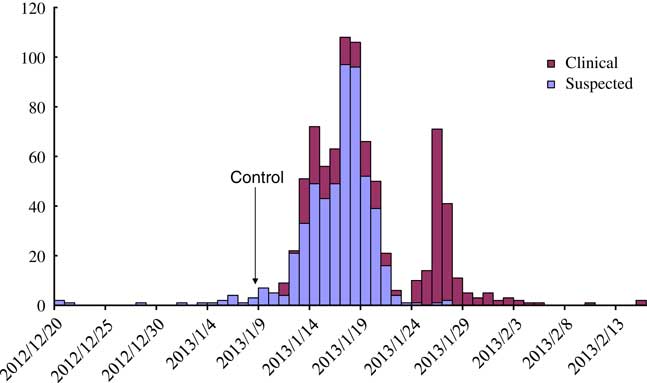
On December 20, 2012, a patient from the training base experienced febrile symptoms and cough accompanied by a maximum body temperature of approximately 41°C. Considering the foggy, hazy weather conditions of the cold winters, the patient was diagnosed as having a common cold. After antibiotic treatment and outpatient therapy support, the trainee recovered. Subsequently, more trainees from the same base presented the same febrile symptoms (body temperature >38°C), with fever being the initial symptom in all patients. The number of cases increased dramatically beginning January 9, 2013, and included severe cases (clinical cases) requiring hospitalization (Figure 1). Because of these conditions, stringent control measures were employed to control the spread of the outbreak. In total, 562 mild and 294 severe cases were diagnosed; all patients recovered quickly after treatment of symptoms, with good prognoses. On February 25, 2013, outbreak control measures were finally discontinued.
Epidemiological Curve of Human Adenovirus Serotype 55 Infectious Outbreak From December 2012 to February 2013 in Tianjin, China.

The Pathogen of the Outbreak
Three strains of HAdV DNA were determined by genome sequencing. Blasting revealed that the pathogen of this outbreak was HAdV serotype 55. The adenovirus of the outbreak was closely related to the previously reported HAdV-B55 strain—the QS-DLL (accession no. FJ643676) and the CQ-2903 (accession no. JX123029). Further analysis showed that the virus was a recombinant from HAdV-B14 and HAdV-B11.
Clinical Symptoms
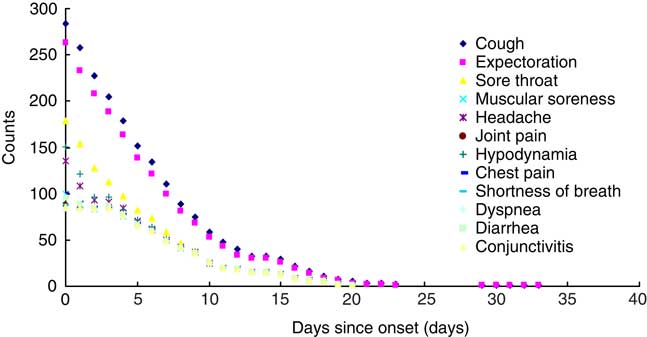
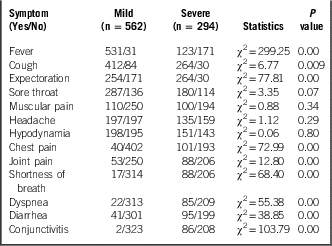
As a viral infection, the most common symptoms were influenza-like illness including fever, cough, and other complaints. Symptom frequencies manifested differently in patients with severe and mild illness. Patients with mild illness showed more obvious influenza-like symptoms such as fever, cough, and expectoration; patients with severe illness more frequently presented “other symptoms” including chest pain, joint pain, shortness of breath, dyspnea, diarrhea, and conjunctivitis (Table 1). For severe cases, the frequencies of clinical symptoms decreased over the course of infection, and most symptoms disappeared 2 weeks after onset (Figure 2).
Symptom Dynamics of Human Adenovirus Serotype 55 Infectious Outbreak From December 20, 2012, to February 25, 2013, in Tianjin, China.

Clinical Manifestations of Human Adenovirus Serotype 55 Infectious Outbreak From December 20, 2012, to February 25, 2013, in Tianjin, China

Laboratory Examination for Severe Cases
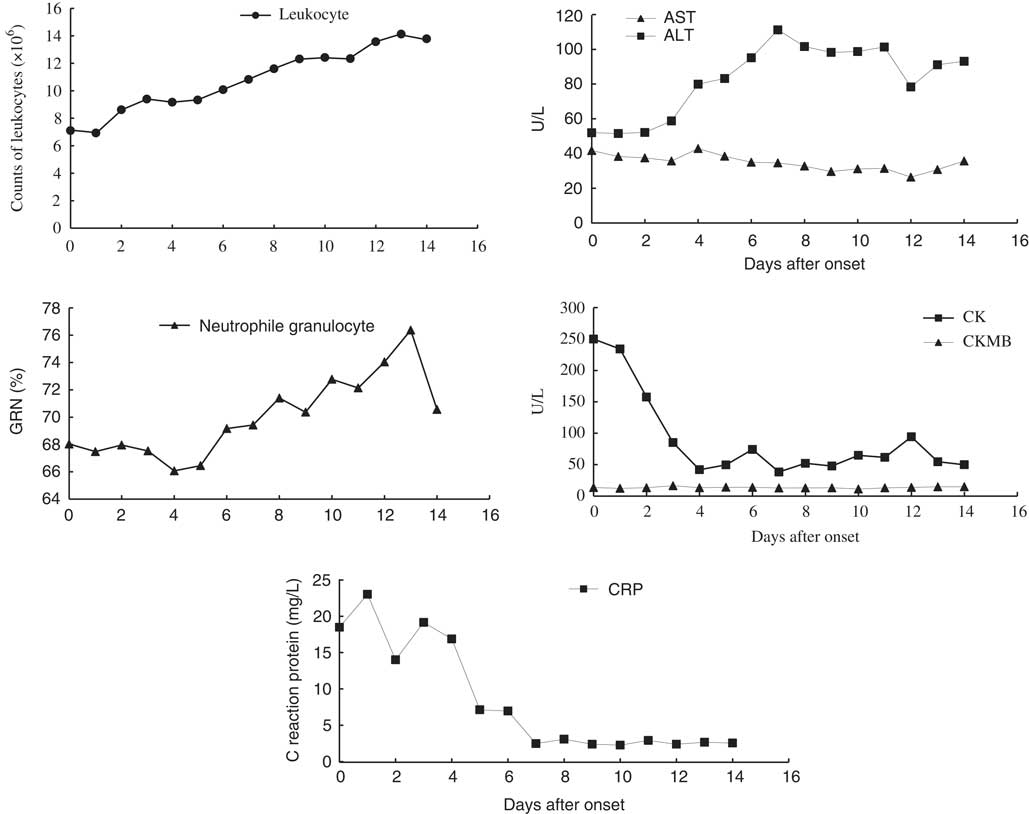
For severe cases, average values of white blood cells (WBCs), percentage of neutrophil granulocytes (GRNs), and C-reactive protein were plotted against the progression of the infection (Figure 3). The numbers of leukocytes increased from the onset day but remained below the normal limit (10×106/L) for the first 6 days. However, the increasing trend, which exceeded the normal limitation, was sustained for the next 7 days and reached its peak on the 13th day. The percentage of GRNs manifested the same dynamics of change as WBC values. On the contrary, C-reactive protein, an acute-phase inflammatory protein, increased (>10 mg/L) in the first 4 days and decreased to normal in the following days.
Clinical Manifestations of Severe Cases of the Human Adenovirus Serotype 55 Infectious Outbreak From December 20, 2012, to February 25, 2013, in Tianjin, China. Abbreviations: ALT, alanine aminotransferase; AST, aspartate transaminase; CK, phosphocreatine kinase; CKMB, CK isoenzyme; CRP, C-reactive protein; GRN, neutrophil granulocyte.

Clinical tests included indexes for liver and heart function (Figure 3). Aspartate transaminase (AST) and alanine aminotransferase (ALT) were used to monitor liver function; the results showed that ALT increased from the onset of infection, reaching its peak on the 7th day. In comparison, AST remained stable. This result implies that HAdVs may cause liver damage in the acute infection period. Phosphocreatine kinase (CK) and CK isoenzyme (CKMB) were used to monitor heart function. The results showed that CK increased in the first 2 days and decreased to the normal level in the following days. This result implies that HAdVs may also cause damage to the heart in the early period.
Discussion
In the United States, HAdV-14p1 has been associated with outbreaks of acute respiratory disease with high rates of illness and death.Reference Kajon, Hang and Hawksworth 6 HAdV-14p1 could be an immune escape mutant that has lost a potential neutralizing epitope, has modified post-internalization steps, or has enhanced binding to host cells through an as-yet-unidentified viral receptor. However, similar outbreak dynamics of HAdV-14 and HAdV-14-11 were observed in Asian countries and the United States. Recently, adenovirus type 21 respiratory strains were isolated from US military trainees,Reference Kajon, Hang and Hawksworth 6 highlighting the occurrence of adenovirus as a substantial concern.
HAdV-55, a recombination type of HAdV-B14 and HAdV-B11, was once incorrectly termed “HAdV-B11-like”; it has since been accepted as a novel type. In phylogeny analyses, HAdV-55 was grouped into a subclade of HAdV-B14 and HAdV-B14a, whereas hexon (loops 1 and 2) was a subclade of HAdV-B11. Many countries, including China, have reported numerous outbreaks of acute respiratory infection caused by HAdV over the last decade.Reference Zhu, Zhang and Xu 7 Among these infections, HAdV-55 is a very uncommon re-emergent pathogen, easily causing outbreaks within large populations such as training bases or schools. This virus was first identified as HAdV-B11a from an outbreak that occurred during a Spanish military training exercise in 1969, with a second appearance during a Turkish military training exercise in 2004.Reference Hierholzer, Pumarola and Rodriguez-Torres 8 , Reference Chmielewicz, Benzler and Pauli 9 Three other outbreaks were recorded in Singapore in 2005 and in China in 2006 and 2011.Reference Kajon, Dickson and Metzgar 10 - Reference Gu, Liu and Li 12 As reported in the present article, the typical epidemic curve showed that the outbreak occurred over the course of approximately 2 months, and a total of 856 cases were diagnosed. HAdV-55 was determined to be the pathogen through a combination of laboratory tests and genome sequencing. Although the exact source of this outbreak could not be traced, the first case, with the onset of symptoms occurring on December 20, 2012, may be the index case, considering the latent period of this virus.Reference Zhu, Zhang and Xu 7 Because the patient was diagnosed as having a common cold and was treated with antibiotics and outpatient supporting therapy, HAdV infection was not considered at first. After the first cases recovered, a drastic temperature decrease and the foggy, hazy weather may have triggered this outbreak. The commonly recognized route of transmission of HAdV is through respiratory droplets and close contact, which leads to rapid and widespread virus dissemination in crowded places;Reference Zhu, Zhang and Xu 7 this type of transmission was also observed in this outbreak. With more cases presenting beginning on January 9, 2013, stringent outbreak control measures were employed. Most of the patients had mild symptoms at the beginning that required outpatient antibiotic treatment and supporting therapy. The outbreak was sustained for 2 months, with the last case appearing on February 16, 2013. On February 25, 2013, outbreak control measures were discontinued. Similar events have been reported in military camps and day care centers in China and other countries.Reference Hierholzer, Pumarola and Rodriguez-Torres 8 - Reference Yang, Zhu and Tang 11
In most cases, if a rare pathogen is identified, clinicians and public health officials evaluating and responding to outbreaks pay close attention to early infections. However, in this outbreak, only the common cold was diagnosed at first, and a small number of severe cases requiring hospitalization were reported. Once the outbreak was under control, hospitalization for severely ill patients along with antibiotic treatment and hormone and supporting therapy became the major methods. In total, 562 mild and 294 severe cases were diagnosed; all patients recovered quickly when they were provided with treatment to address symptoms, and the prognoses were good. The lessons learned from this outbreak include that such events could be halted by interrupting common transmission routes and that pathogens should be determined as early as possible.
The clinical course and the available epidemiologic data were consistent with those described in previous reports on HAdV-associated acute respiratory diseases. Owing to a lack of detailed symptom information, HAdV-55 infection was identified as SARS during an outbreak in Baoding city in the Hebei province of China in 2012. For fear of SARS, continuous surveillance was conducted to investigate the persistence and the dynamics of clinical symptoms after the outbreak. There were differences between mild and severe cases; for example, fever, cough, and expectoration were more frequently observed in mild cases, whereas chest pain, joint pain, shortness of breath, dyspnea, diarrhea, and conjunctivitis were observed more frequently in severe cases. This phenomena could be explained by differences in when medical attention was sought in relation to symptom onset. Patients who presented with mild illness may generally pay more attention to their health and thus sought care quickly after symptom onset. Patients with severe illness may have sought medical attention only once serious symptoms developed from mild symptoms; it is possible that this progression could have been avoided with early medical treatment. Whatever the case, in patients with severe symptoms, most symptoms decreased gradually and finally disappeared 2 weeks after onset.
Laboratory evaluations of WBCs, percentage of GRNs, and C-reactive protein were associated with the inflammatory reaction caused by other viruses.Reference Wei, de Vlas and Yang 13 Compared with SARS coronavirus infection, the change in dynamics of WBCs and percentage of GRNs differs after HAdV-55 infection. Both the dynamics of WBCs and the percentage of GRNs were shorter in HAdV-55 infection. In HAdV-55 infection, the WBCs increased from the day of onset but remained below the normal limit for the first 6 days. However, as the increasing trend continued, the WBCs exceeded the normal limit and remained so for the next 7 days, reaching a peak on the 13th day. These same dynamic changes also manifested in GRNs. C-reactive protein, an acute-phase inflammatory protein with less specificity, increased in the first 4 days and returned to normal in the following days.
Chemical indexes including AST, ALT, CK, and CKMB were used to monitor organ damage due to the viral infection or the treatments. In treating the infection, antibiotics, hormones, and supporting therapies were widely used; therefore, potential damage caused by the treatments should be examined. ALT increased beginning on the 4th day after onset, whereas AST remained relatively stable. CK decreased until the fourth day, and CKMB showed no drastic fluctuations. Overall, although changes occurred, no obvious damaged was observed.
Outbreaks caused by HAdV-55 may pose a new challenge with regard to acute respiratory diseases and may be underreported, especially if the infections are mild or asymptomatic. High population density such as that in training centers or schools may contribute to such outbreaks, and foggy, hazy weather may be a triggering factor. Surveillance of HAdV infections in China should be emphasized. Effective prevention and control measures including interrupting the transmission route, pathogen identification, and timely treatment of cases were very important in stopping the spread of the outbreak.
Acknowledgments
We thank all staff members for collecting the specimens and performing some of the bacterial detection studies. Without their valuable assistance, it would have been impossible to successfully complete this study.
Funding
The study was funded by the National Natural Science Foundation of China (grant no.71473264) and the Affiliated Hospital Foundation of Logistics University of PAP (FYM201409).