Introduction
Practical issues in early detection
Significant advances in the understanding of the molecular bases of Alzheimer's disease (AD) have been made in recent years (Luque and Jaffe, Reference Luque and Jaffe2009; Nimmrich and Ebert, Reference Nimmrich and Ebert2009). These have led to clinical trials using novel therapeutic agents targeting the chemical pathways thought to underlie AD pathophysiology (Rafii and Aisen, Reference Rafii and Aisen2009). Despite demonstrable benefits in pre-clinical AD models (Schenk et al., Reference Schenk1999; Spires-Jones et al., Reference Spires-Jones2009), and even early clinical trials, later phase trials in adults with established AD have not, as yet, shown convincing efficacy (Salloway et al., Reference Salloway2009; Schneider and Sano, Reference Schneider and Sano2009). This has led to re-evaluation of the whole process of drug discovery in AD and clinical trial design (Khachaturian et al., Reference Khachaturian2009). That the early phase trials can have so incorrectly predicted later phase trial results has been a costly and largely unexplained outcome. Consequent debate has raised, amongst other issues, fundamental concerns about the centrality of the causal role of altered amyloid handling in the brain (Kokjohn and Roher, Reference Kokjohn and Roher2009). However, there are alternative methodological reasons for trial agent failure that should also be explored. These include: (i) the necessary inclusion of adults with relatively advanced AD in whom disease-modifying changes may be difficult to measure using conventional cognitive (and functional) outcome measures (Ferris et al., Reference Ferris2006; Doody et al., Reference Doody2009); (ii) the heterogeneity of the underlying pathology of AD which, especially in older adults, is likely to be co-existent with vascular, inflammatory and other secondary changes (Esiri et al., Reference Esiri, Nagy, Smith, Barnetson and Smith1999) possibly reducing efficacy, and (iii) the unexplained relative stability in some placebo-treated groups which may have confounded detection of subtle disease modification (Schneider and Sano, Reference Schneider and Sano2009). Before true lack of efficacy is accepted – and promising therapies discarded – it is our contention that the above issues may be amenable to alternative strategies for trial designs and methodologies. These may be more suitable for demonstrating therapeutic efficacy in prodromal dementia.
Ideally, deployment of Alzheimer's disease-modifying therapies should occur in adults with early AD pathology and minimal or no clinical morbidity. Assuming a progressive continuum of disease pathology and morbidity and using the revised definition of prodromal AD (Dubois et al., Reference Dubois2007; Reference Dubois2010), we can conceptualize early detection of AD using the following stages of disease (Figure 1): (1) presymptomatic AD – a stage before the pathology develops in individuals destined to develop AD (including a minority with monogenic AD); (2) asymptomatic at risk for AD – a stage with pathological changes but without any measureable morbidity or cognitive decline; and (3) prodromal AD – when both pathological changes and measureable cognitive decline or impairment exist.
Stages at which Alzheimer's disease (AD) could theoretically be detected before a clinical diagnosis of dementia by conventional criteria. Before A, adults are normal but at risk of AD prior to the onset of pathological change (A), and asymptomatic until the onset of a decline in cognitive performance (B) consequent to the pathological processes of AD. Prodromal AD includes syndromes secondary to AD pathology prior to sufficient morbidity to satisfy criteria for dementia (C).

Clearly, identification when pre-symptomatic would be optimal since a preventive therapy would be expected to have maximum benefit. At present, only rare at risk individuals from families with AD-associated gene mutations fit this category. In addition, proof of efficacy would probably not lead to a labeling claim for sporadic AD, requiring further primary prevention trials. Use of less deterministic risk factors (e.g. apolipoprotein E4 or TOMM40 haplotype status, history of parental AD or Down's syndrome, or even historical, vascular, exercise or dietary factors (Middleton and Yaffe, Reference Middleton and Yaffe2009; Qiu et al., Reference Qiu, Kivipelto and Strauss2009)) as eligibility criteria for longitudinal primary prevention trials has also been recently advocated (Reiman et al., Reference Reiman, Langbaum and Tariot2010). However, there are significant disadvantages inherent in this approach such as: the potential risk of therapy-related adverse effects for those not destined to progress to AD; failure to include pre-symptomatic individuals without such risk factors; the long duration of trials to determine absence of development of biomarkers of AD; and inability to generalize the findings to all individuals destined to get sporadic AD. Even selection of risk factors may be problematic if their predictive ability is later found to be spurious (Wilson et al., Reference Wilson, Hebert, Scherr, Barnes, Leon and Evans2009), or response to therapy is shown in those without the risk factor (Salloway et al., Reference Salloway2009). Having one or more such risk factors may not necessarily lead to AD, and individuals without currently identified risk factors may also develop AD. Limiting trials to such higher risk groups may unnecessarily restrict future pharmaceutical labeling claims and complicate the selection of trial inclusion criteria. Moreover, it is currently unclear which single or combined risk factors are optimal for enrichment of sample populations for AD pathology. We contend that a screening strategy that includes all at-risk individuals would be preferred.
Given that detection of sporadic AD before pathological changes have commenced is not yet possible for the majority of adults, initial detection whilst asymptomatic might seem the more accessible target group for a screening program. Progress in developing early in-vivo biomarkers for AD has been encouraging with promising candidates including amyloid imaging using PET 11C and 18F tracers (Pike et al., Reference Pike2007; Rowe et al., Reference Rowe2007; Butters et al., Reference Butters2008; Villemagne et al., Reference Villemagne2008), cerebrospinal fluid (CSF) and plasma changes in amyloid and tau species (Gauthier, Reference Gauthier2009; Jagust et al., Reference Jagust2009; Mattsson et al., Reference Mattsson, Blennow and Zetterberg2009; Cosentino et al., Reference Cosentino2010; De Meyer et al., Reference De Meyer2010) and numerous other possible surrogate measures (Hampel et al., Reference Hampel, Broich, Hoessler and Pantel2009). Unfortunately, at present most of these do not appear to be dynamic biomarkers predictive of the age of disease onset and hence of the optimal timing of screening or preventative measures. Such biomarkers are likely to be important ancillary diagnostic and research tools, but they have significant cost and practical limitations as screening instruments for wide-scale deployment. This is especially true where repeated evaluations would be required (Cosentino et al., Reference Cosentino2010; De Meyer et al., Reference De Meyer2010). Hence, despite the potential utility of these biomarkers, screening for asymptomatic patients with AD is also not likely to be a cost-effective public health strategy. However, continuous reappraisal of this conclusion will be required as appropriately sensitive and specific dynamic biomarkers emerge.
It is our contention that the most cost-effective and realistic solution for early detection of AD is screening for incident cognitive decline in the prodromal AD stage. The key is in the reliable detection of cognitive decline (not impairment) as early as possible. Detection of existing impairment based on comparison with various population-based normative data is commonly advocated in all diagnostic fields (cognitive testing, imaging, laboratory markers). Uniformly, it has the disadvantage that individuals can decline considerably before breaching an arbitrarily determined statistical threshold of impairment (e.g. 1.5 or 2 standard deviations below the population mean). Detection of intra-individual decline offers significant advantages (Collie et al., Reference Collie2001) since variability within individuals over time is much smaller than population-based variance (Arndt et al., Reference Arndt, Jorge, Turvey and Robinson2000a; Reference Arndt, Turvey, Coryell, Dawson, Leon and Akiskal2000b), thus allowing subtler change to be appreciated within population-based normative ranges. Serial evaluation would render many diagnostic techniques inappropriate or too expensive. The use of intra-individual cognitive decline is appealing as an initial screening strategy since it could identify individuals at high risk for progression to clinical AD who can subsequently be further evaluated with targeted biomarker studies and participate in disease-modifying trials.
Using cognitive decline as a trigger for further evaluation is a well-accepted practice in dementia assessment, since progressive deterioration is a hallmark of neurodegenerative disease. However, detection of subtle decline has been criticized as difficult to distinguish from “normal” cognitive aging (Petersen et al., Reference Petersen, Smith, Kokmen, Ivnik and Tangalos1992). Cross-sectional studies showing poorer performance on cognitive testing with increasing age are common (e.g. Petersen et al., Reference Petersen, Smith, Kokmen, Ivnik and Tangalos1992; Weintraub et al., Reference Weintraub, Powell and Whitla1994) and are presumably the basis for this wisdom. However, the use of longitudinal studies is more appropriate to investigate whether decline is “normal” with aging. Universal individual decline with advancing age is not detected (Collie et al., Reference Collie2001; Maruff et al., Reference Maruff, Collie, Darby, Weaver-Cargin and McStephen2004; Avidan et al., Reference Avidan2009; Wilson et al., Reference Wilson, Hebert, Scherr, Barnes, Leon and Evans2009; Yaffe et al., Reference Yaffe2009). Instead, trajectories are either: (i) stable or improving which may be explained by practice effects (Salthouse, Reference Salthouse2009), or (ii) declining either from study inception or incident after a period of stability (Christensen et al., Reference Christensen1999; Reference Christensen, Dear, Anstey, Parslow, Sachdev and Jorm2005; De Jager et al., Reference De Jager, Hogervorst, Combrinck and Budge2003; Holtzer et al., Reference Holtzer, Verghese, Wang, Hall and Lipton2008).
Cognitive decline with aging has many possible causes (e.g. chronic conditions causing pain, medication effects, psychological or psychiatric morbidity, systemic or neurological illness). Yet there are still many who do not decline with aging, and who can be termed “healthy aging” individuals. This dichotomy is of practical clinical value since it allows those identified with decline to be referred for medical evaluation and treatment. Whether more subtle changes may occur with “healthy aging” is for future research when it is possible to identify all unhealthy conditions contributing to decline.
Cognitive testing for decline
Optimal measurement of cognitive decline is critical for early detection of prodromal AD. Principles for optimally measuring cognitive change in individuals have already been described (Falleti et al., Reference Falleti, Maruff, Collie and Darby2006; Collie et al., Reference Collie2007; Fredrickson et al., Reference Fredrickson2009). In brief, tests that are designed specifically for detecting change are preferred over those that are primarily designed for evaluating cognitive impairment (Darby and Walsh, Reference Darby and Walsh2005). Ideally, cognitive tests should be brief, engaging, simple to administer and understand, have good psychometric properties for repeated testing (minimal practice, floor or ceiling effects) and use interval outcome measures without range restriction (Morris et al., Reference Morris, Evans, Hebert and Bienias1999). Computerization helps standardize test administration, reaction time measurement and scoring, and can allow game-like paradigms using familiar, non-language-based stimuli. Random stimulus selection and timing to create multiple equivalent alternate forms can also be used. One example of this approach is the CogState brief battery which broadly covers cognitive domains, including information processing, attention, working memory, episodic memory and executive ability. This battery has been validated in serial studies in a wide range of pathophysiological and pathological conditions, showing minimal variability and high reliability under repeated testing, construct and cross-cultural validity, sensitivity to pre-clinical and probable AD and decline in older adults by whom it is well tolerated (Darby et al., Reference Darby, Maruff, Collie and McStephen2002; Falleti et al., Reference Falleti, Maruff, Collie, Darby and McStephen2003; Weaver Cargin et al., Reference Weaver Cargin, Maruff, Collie and Masters2006; Collie et al., Reference Collie2007; Silbert et al., Reference Silbert, Scott, Evered, Lewis and Maruff2007; Maruff, Reference Maruff2008; Fredrickson et al., Reference Fredrickson2009).
The above test battery was developed to detect more rapidly any decline in episodic memory reported within a two year period in ostensibly “healthy” volunteers involved in the Melbourne Ageing Study using a delayed word list recall (DWLR) task (Collie et al., Reference Collie2001). In a group of otherwise well community-dwelling volunteers, computerized testing distinguished cognitively declining individuals within 12 months despite no observable change in the DWLR task scores or clinical features (Maruff et al., Reference Maruff, Collie, Darby, Weaver-Cargin and McStephen2004). In addition, there were variable rates of individual decline in the computerized episodic memory accuracy measure suggesting that the most rapidly declining individuals might be at very high risk of subsequent morbidity. Excess amyloid accumulation on PiB PET scanning was demonstrated several years later in 70% of declining individuals and 17% of those who were stable (Villemagne et al., Reference Villemagne2008). Although still scoring within population-based normative ranges for cognitive test performance, such cohorts of “healthy” volunteers with excess amyloid perform worse on episodic memory measures than those without “positive” amyloid-binding positron emission tomography (PET) scans (Pike et al., Reference Pike2007), and show progressive cognitive decline (Morris et al., Reference Morris2009).
These studies support the contention that detection of intra-individual decline in episodic memory performance in otherwise asymptomatic community-dwelling aging adults may identify those at high risk of AD pathology (Collie et al., Reference Collie2001). Furthermore, the use of intra-individual decline may allow detection of the cognitive effects of AD pathology earlier than is possible using episodic memory impairment on a single testing occasion, i.e. in comparison to age-based normative data. Furthermore, the subtle but measureable cognitive decline combined with AD biomarker studies to confirm the presumed underlying AD pathology, would satisfy the research criteria of Dubois and colleagues for AD (Dubois et al., Reference Dubois2007). These individuals would thus be potential candidates for therapeutic trials aiming to halt the progression of their decline in cognitive performance, biomarker status or both. Demonstration of these dual outcomes would likely satisfy Food and Drug Administration (FDA) criteria for disease modification labeling claims, and allow post-marketing surveillance studies attempting to confirm reduced future conversion to AD (Cummings, Reference Cummings2009).
The improved ability of computerized testing to define and monitor cognitive trajectories rapidly over conventional neuropsychological instruments might offer advantages related to participant selection, trial duration and cost. A recent community screening study using the CogState battery every three months over a year showed cognitive decline on an episodic memory measure in about 10% of participants aged 50 years and over (Fredrickson et al., Reference Fredrickson2009). Further studies in a subset of those adults with decline using amyloid-binding PET imaging (n = 15) has shown approximately 50% to have excess cortical amyloid accumulation, whilst an age-matched control group without cognitive decline (n = 33) have approximately 10% with excess cortical amyloid accumulation (publication in preparation). These figures are similar to those reported using cognitive decline on clinical assessment without computerized measures over 2–12 years (Villemagne et al., Reference Villemagne2008). In addition, the magnitude of individual decline can also be quantified (Maruff, Reference Maruff2008; Maruff et al., Reference Maruff, Collie, Darby, Weaver-Cargin and McStephen2004), with declines over 12 months showing effect sizes of 1.5 or more. This suggests that more frequent testing in future studies might also be able to detect clinically significant effect size deteriorations over shorter intervals (e.g. 6 months). Linear declines in cognitive performance were documented over 12 and 24 months suggesting cognitive decline may provide a predictable measure of rate of decline over sufficient time to conduct clinical trials. Larger studies are required to confirm these findings in diverse communities. However, the results suggest that community screening with similar computerized testing would appear a possible initial enrichment strategy for disease-modifying trial recruitment, and to have the potential to provide outcome measures for such trials over observation periods of less than 12 months.
Methods
Using decline to streamline therapy trials in prodromal AD
Assuming the above results are independently confirmed, it follows that such individuals could be offered participation in disease-modifying therapy trials years before their morbidity is significant. The preservation of cognitive abilities at the time of such early detection would also eliminate many of the ethically challenging issues inherent in obtaining informed consent when enrolling patients with established probable AD (Cummings, Reference Cummings2009). Additionally, disease-mechanism-based therapies focusing on single molecular targets may be more efficacious in prodromal AD, which may more closely resemble trials in animal models (McAlpine et al., Reference McAlpine2009). Furthermore, having a well-documented trajectory for each individual would allow: (i) inclusion of only those with decline; (ii) selection of participants with the most rapid cognitive decline; (iii) pre-trial trajectory mapping (rather than requiring specific trials to include pre-treatment trajectory monitoring phases); and (iv) use of change in each participant's trajectory as a primary cognitive outcome measure presumably obviating failure to progress in placebo-treated cohorts (Schneider and Sano, Reference Schneider and Sano2009). It would be possible to screen large community cohorts of concerned and fully informed volunteers regularly outside of trial recruitment. The development and validation of online computerized testing systems would facilitate such large-scale surveillance, could utilize automated methods for flagging suspected decline, and allow evaluation of cost-effectiveness. From these cohorts, declining individuals could be identified, screened for inclusion criteria, and offered trial participation. If cost-effective testing proves feasible, screening of very large cohorts with many thousands of participants could identify sufficient numbers of participants to manage strict inclusion criteria or high ineligibility rates.
Results
Trial design for prevention or disease-modifying strategies
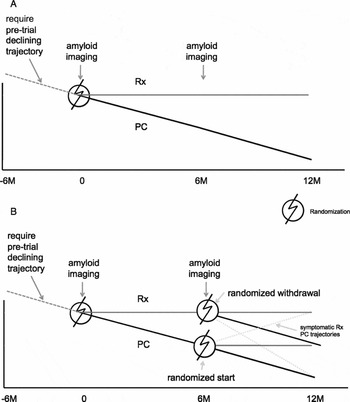
A novel trial design speculation based on these principles is presented in Figure 2. This would form the final phase of a medically supervised community screening program. There are several stages in this design that will be described separately.
A. Putative trial design with inclusion of pre-trial declining participants positive for relevant biomarker (e.g. amyloid imaging for amyloid targeted therapy) then randomized to one or more treatment (Rx) arms or placebo (PC) for sufficient time to demonstrate treatment related reduction in the slope of cognitive decline (e.g. possibly as little as 6 months). The biomarker is repeated at trial end to correlate with cognitive change. B. Optional staggered delayed randomized withdrawal in treated group, and/or start of treatment in placebo-treated group to fulfil FDA disease-modifying criteria (see text). 6M = 6 months; 12M = 12 months.

Pre-trial screening
The first element required is an ongoing medically supervised community screening program using serial evaluations with a sensitive episodic memory task to identify individuals with cognitive decline and define pre-trial trajectories. Volunteers would give informed consent ensuring they are aware that they may be shown to be declining over time, and this may lead to further evaluation and offers of participation in treatment trials (Fredrickson et al., Reference Fredrickson2009). Recruitment (e.g. via media information) would not need strict inclusion or exclusion criteria beyond self-selection and the ability to perform the cognitive testing. It is likely that only motivated volunteers would seek involvement and only those who demonstrate decline over time would move into subsequent phases of the program. Ideally, computerized testing would be self-administered (e.g. home-based), facilitating more frequent testing under familiar conditions and reducing screening program infrastructure costs. Detection of decline would involve evaluation of serial test results using automated analysis techniques (Morris et al., Reference Morris, Evans, Hebert and Bienias1999; Arndt et al., Reference Arndt, Jorge, Turvey and Robinson2000a; Reference Arndt, Turvey, Coryell, Dawson, Leon and Akiskal2000b). Retesting would exclude transient or spurious decline. Persistent impairment in comparison to baseline performance would prompt participant counseling and evaluation in specialized regional centers with suitable expertise in evaluating and monitoring subtle cognitive decline, diagnosing non-AD causes (e.g. systemic, psychiatric or neurological conditions), availability of biomarker technology, and if no causes were evident, consideration of trial participation. Ensuring responsible medical supervision throughout the screening process would be important to avoid patient confusion about diagnosis or potential misdiagnoses. Although biomarker studies may be part of this routine evaluation, this cost might be more reasonably borne by the trial sponsors with specific mechanism-based biomarker requirements. It is envisaged that the rate of decline would be an important inclusion criterion for trial enrolment, and is a critical factor determining the duration of trials. If less than 12 months proves sufficient to document the pre-trial trajectory of participants, then the same period may also be sufficient to determine whether the trial therapy has attenuated the rate of decline. Having well-characterized trial participants available for research inclusion would improve both enrichment and homogeneity of subject pathology, and also reduce cost both by decreasing sample size and trial duration.
Trial inclusion
Participants with pre-trial decline will then need to fulfill trial inclusion and exclusion criteria. Having a large cohort of eligible participants available will accelerate trial recruitment with the time taken for trial screening dependent upon the resources available and procedures required. It will also facilitate recruitment for multiple simultaneous trials. The design depicted in Figure 2 assumes that trialists would be responsible for choosing relevant biomarker studies at trial entry, with amyloid-binding PET imaging and CSF studies likely since they would improve sample homogeneity by excluding those with negative scans or normal for age CSF profiles (De Meyer et al., Reference De Meyer2010). PET amyloid imaging may also be appropriate as an outcome measure to demonstrate clinically correlated change on the biomarker, an FDA requirement for a labeling claim (Cummings, Reference Cummings2009). In some cases, another biomarker considered relevant to treatment mechanism may also be required. Newly identified participants may not have had such biomarker studies, but it is probable that participants with known biomarker status in negative trials may become available for later trials. Those with decline but without identifiable causes or AD biomarkers will require re-consideration of their demonstrable decline in cognitive performance, with many likely to have other psychiatric or pathological diagnoses (such as frontotemporal lobar degeneration), and hence will potentially be available for research studies in these conditions.
Outcome measures
Although the above procedures can be used to recruit a relatively homogeneous cohort of participants with AD pathology for any purpose, the trial design described here assumes that a drug effect can be demonstrated both on the same cognitive measures that characterized their pre-trial slope, and in the same time period. This is clearly a fundamental component of this design, and depends upon the cognitive measure being sensitive to detection of a therapeutic effect and that this can be shown in the time available (Cummings, Reference Cummings2009). Use of repeatable cognitive measures would allow monthly (or more frequent) measurements to increase certainty of slope measurement. The preliminary data from our community screening studies suggest that the task assessing accuracy of episodic memory will be the earliest to decline. Having participants who have declined but are still within the informative range of accuracy values will be an important consideration, as will the definition of more sensitive measures which could be added when decline is identified.
Trial conduct
After the baseline visit, eligible participants would then be randomized to placebo or treatment arms in a double-blind phase, which would last for at least the minimum period required to demonstrate a change in slope. Evaluations could be at monthly or more frequent intervals with repeat biomarker studies at the end of the period. At this time, an adaptive design could utilize analysis of the slopes and biomarkers to determine efficacy. Where clear benefit was demonstrated, the sponsor may have sufficient evidence for a labeling claim. They could also extend the trial with (staggered) delayed randomized double blind withdrawal and/or start designs (see Figure 2B) to satisfy FDA criteria for a disease-modifying effect (Cummings, Reference Cummings2009). In theory, and with rapidly declining participants on outcome measures, the whole trial including extension could be completed in as little as 12–18 months. The use of a placebo arm for a total of about 12 months in randomly chosen participants is likely to remain ethically acceptable in the short term. This is due to the absence of any currently known therapies for arresting early AD pathology, the minimal change in morbidity where a diagnosis of probable AD is still many years away, and beneficial therapies being offered as a further extension to participants. Where benefit is not demonstrated, the sponsor could cease the trial, or continue for longer if they thought the beneficial effect might take longer to be revealed.
Sample size
A sample size of 15 per arm would ensure at least a 90% power level to detect an effect size of 0.6 between treated and control groups, at a test significance level of 0.01. In estimating the size of the required sample, we assumed weak to moderate correlations between observations taken on individuals at six assessment periods. Recruiting 17 participants per arm would account for up to 10% attrition over the treatment period and allow sufficient participants to continue into delayed randomized start (or withdrawal) arms. Hence, for two arms (placebo and one treatment dose) a total of 35 total participants would be sufficient. These are conservative estimates, yet are similar to estimates from proposals using other biomarkers (Dickerson and Sperling, Reference Dickerson and Sperling2005; Thal et al., Reference Thal2006; Schuff et al., Reference Schuff2009).
Trial cost
First, the community screening programs would need to be funded. Experience with large-scale screening programs for cognitive testing in contact sports (Collie et al., Reference Collie, Maruff, Makdissi, McCrory, McStephen and Darby2003) suggests that the development, infrastructure, deployment and ongoing costs could be born commercially, using subscription, pharmaceutical industry or government supported models. Second, the current trial design would offer savings in both sample size and duration over current trials (Cummings, Reference Cummings2009). In addition, having participant trajectories characterized prior to the trial commencing, with large cohorts of willing participants ready for trial participation, would dramatically reduce recruitment periods (slowed only by available assessment resources). Shorter trial duration has the advantage of earlier claim filing and availability of beneficial therapy for patients, increased sales during an extended patent life, and rapid confirmation of an ineffective therapy (which might have already failed larger phase 3 probable AD or MCI trials).
Conclusions
There is currently a world-wide shortage of available patients with probable AD who are willing to participate in trials of putative disease-modifying therapies. It is arguable that treatment of established probable AD could still leave significant morbidity, even if it did cause arrest of progressive deterioration. Detection at the time of AD pathology with minimal morbidity is clearly a worthwhile aim. The approach described here uses an example of a tailored computerized instrument for measuring cognitive decline which predicts the presence of prodromal AD pathology many years prior to significant morbidity. Further community screening studies are required to confirm these promising initial results in larger cohorts, confirm the utility of self-administered testing online and cost-effectiveness of this recruitment strategy. These results raise the possibility of a novel clinical trial design for evaluating disease-modifying therapies in less than 12 months. This trial design could provide correlated efficacy in both cognitive and biomarker outcome measures sufficient for an FDA labeling claim, which would presumably require similar community screening for ascertainment and post-marketing surveillance for further decline or conversion to AD. This approach is also more inclusive than primary prevention trials predicated on specific non-deterministic risk factors for AD, and has the potential to reduce the incidence of new cases of probable AD.
Conflict of interest declaration
Dr D. Darby is a shareholder and employee of CogState Ltd (the entity responsible for commercializing the cognitive testing instruments described in this paper). Dr M. Woodward is the director of a Medical Cognitive Research Unit which conducts pharmaceutical trials but reports no other conflicts of interest. Professor Maruff is a shareholder and employee of CogState Ltd.
Description of authors' roles
Associate Professor Darby conceptualized the paper, designed the cognitive testing approach and contributed to writing the paper. Dr. Brodtmann participated in trial design and contributed to writing the paper. Associate Professor Woodward also helped conceptualize the trial design and contributed to writing the paper. Professor Budge helped conceptualize the approach to trial design and contributed to writing the paper. Prof Maruff contributed to cognitive testing approach development and writing the paper.
Acknowledgments
The authors wish to acknowledge all the participants and their families in the longitudinal studies described in this paper without whom these insights would not have been possible.
Dr Darby and Professor Maruff are employed by CogState Ltd. Acknowledgment of individual funding appears in each published article cited in this paper. No other specific funding was provided to authors to prepare this paper.