


Adolf Hitler, Saddam Hussein, and Idi Amin—these are names synonymous not only with domestic repression but also with international conflict. In fact, the record of international violence committed by such tyrants has fostered the impression that authoritarianism is inexorably linked to war and other international tensions. Policy makers have drawn on this view to recommend democratization and even regime change in the name of international peace.
Yet are all dictatorships equally belligerent? The historical record suggests that some authoritarian regimes have been much less conflict-prone than the headline-grabbing Kims and Husseins of recent history. China after Mao, Tanzania under Nyerere, Kenya under Kenyatta, Mexico under the PRI, and even the former Soviet Union have all been relatively cautious in their decisions to threaten or use military force.Footnote 1 What makes some authoritarian regimes less likely to initiate military conflicts than others? What specific political institutions in dictatorships encourage leaders to initiate military disputes abroad, and why?
Surprisingly little scholarship exists on these important questions. The scant research that has emerged in recent years has made some progress toward answering them by identifying potential correlates of greater conflict initiation in autocracies: for example, the size of the leader's supporting coalition (Bueno de Mesquita et al. Reference Bueno de Mesquita, Smith, Siverson and Morrow2003; Peceny and Butler Reference Peceny and Butler2004; see also Peceny and Beer Reference Peceny and Beer2003; Peceny, Beer, and Sanchez-Terry Reference Peceny, Beer and Sanchez-Terry2002) or whether the regime is led by military officers (Lai and Slater Reference Lai and Slater2006; Sechser Reference Sechser2004). Yet although this scholarship contains important insights, I show in this article that existing theoretical frameworks do not adequately explain patterns of dispute initiation among autocracies. We still have much to learn about why some dictatorships are more likely to initiate military conflicts than others and how their behavior compares to that of democracies.
This article attempts to shed light on the conflict behavior of authoritarian regimes by synthesizing insights from the study of comparative authoritarianism with those on conflict initiation, resulting in a theoretical framework that explains why some dictatorships are more belligerent than others and how their behavior compares to that of democracies. I begin by laying out a simple framework that highlights the factors affecting a leader's decision to initiate conflict. The framework highlights the potential costs of using military force—the costs of defeat, the costs of fighting—as well as the potential benefits. Together, these costs and benefits shape preferences over the use of force and therefore behavior.
The framework draws attention to three questions crucial to understanding why some types of regimes initiate more international military conflicts than others. First, does the leader face a domestic audience able to punish him or her for decisions about international conflict? Some dictatorships do not face powerful domestic audiences, notably “personalist” dictatorships such as North Korea or Iraq under Saddam Hussein, where the leader has eliminated potential rivals and personally controls the state apparatus (Geddes Reference Geddes2003). Contrary to the conventional wisdom, however, nonpersonalist authoritarian leaders typically face powerful domestic audiences composed of regime elites (Weeks Reference Weeks2008). Despite the absence of elections or formally institutionalized procedures for removing leaders, leaders of nonpersonalist autocracies have strong incentives to attend to the preferences of their domestic audience—more so than the bulk of the international relations literature suggests.Footnote 2 The existence or absence of a domestic audience—that is, whether or not the regime is personalistic—is thus a first dimension affecting leaders’ decisions to initiate military conflict.
This leads to the second question: What are the preferences of the domestic audience? In contrast to existing perspectives such as selectorate theory, I argue that even in dictatorships with relatively small winning coalitions, domestic audiences often have strong incentives to punish leaders who behave recklessly or incompetently in international affairs. Autocratic audiences consisting primarily of civilians are scarcely more likely to forgive unnecessary or failed uses of force than democratic domestic audiences made up of ordinary voters. However, autocratic audiences composed primarily of military officers are more likely to view force as necessary and appropriate than audiences consisting mostly of civilians, primarily because of military officers’ particular belief structures regarding the use of military force. The military or civilian background of the domestic audience is therefore a second dimension affecting decisions to start military disputes.
Finally, what behavior can we expect from personalist leaders, who do not face a powerful domestic audience? Given personalist leaders’ supremacy in international and domestic affairs, we must inquire into the preferences and tendencies of these kinds of leaders, rather than of their audiences. I argue that the challenges of attaining and maintaining absolute power mean that personalist regimes tend to “select for” leaders who are particularly drawn to the use of military force as a policy option. Combined with the fact that personalist dictators face few domestic consequences for defeat or for starting fights unwisely, this selection process means that personalists, on average, initiate more military conflicts than nonpersonalist leaders.
After developing these arguments, I carry out an extensive empirical analysis on a new dataset of authoritarian institutions that allows me to test these predictions against the expectations of existing theories. Existing measures of authoritarian institutions either conflate the two dimensions I highlight—personalism and military leadership—or do not measure them accurately. Using my new, finer grained measures, I carry out a battery of statistical analyses that provide strong support for my arguments, but do not match the expectations of other existing theories. The findings have many implications for the study of domestic politics and international conflict, and they also suggest valuable lessons for policy makers and statesmen confronting autocracies abroad.
EXISTING LITERATURE ON DICTATORSHIPS AND INTERNATIONAL CONFLICT
To date, only a handful of studies have explored variation in the conflict behavior of autocracies. A series of early studies by Mark Peceny and colleagues (Peceny and Beer Reference Peceny and Beer2003; Peceny, Beer, and Sanchez-Terry Reference Peceny, Beer and Sanchez-Terry2002; Peceny and Butler Reference Peceny and Butler2004) concluded that personalist dictatorships, in which the leader depends on only a small coterie of supporters, are more likely to initiate conflicts than both democracies and other authoritarian regime types. Peceny and Butler (Reference Peceny and Butler2004) attribute this pattern to Bueno de Mesquita et al.'s (Reference Bueno de Mesquita, Smith, Siverson and Morrow2003) selectorate theory, arguing that personalist regimes are more likely to initiate conflicts than single-party regimes because of their small coalition size.Footnote 3 Selectorate theory posits that when the winning coalition (the group of regime insiders whose support is necessary to sustain the leader in office) is small relative to the selectorate (the group of individuals who have a role in selecting the leader), members of the winning coalition have strong incentives to stay loyal to the leader regardless of his or her performance in providing public goods, such as national security. In contrast, when the winning coalition (w) is large relative to the selectorate (s), or w/s is large, as it is in democracies, members of the winning coalition have greater incentives to evaluate leaders based on public goods provision. These factors combine to imply that large-coalition leaders have incentives to initiate only those military disputes that they are likely to win at low cost, which depresses their rates of dispute initiation.
However, there are problems with using selectorate theory to explain why personalist regimes might be more belligerent than nonpersonalist regimes.Footnote 4 First, selectorate theory assumes that small-coalition regime insiders lack tools to mitigate the uncertainty they face about their likely survival under a new ruler. Instead, selectorate theory assumes that small-w/s regime insiders believe that their survival is inextricably connected to the survival of the incumbent, which drives them to remain loyal even in the face of bad policy. An equally plausible assumption is that these individuals hold their privileged economic, social, or military positions for material or historical reasons that make them very difficult to replace even when a new leader comes to power. Indeed, rational elites would attempt to coordinate to prevent the leader from attaining such great power over their political futures (Magaloni Reference Magaloni2008; Svolik Reference Svolik2009). If elites can succeed in limiting the leader's power of appointment, the probability of surviving under a new leader would not be closely related to w/s.
Many real-world examples support this alternative assumption. Even in relatively small-coalition regimes such as post-Stalin USSR, modern China, and Argentina and Brazil under their military juntas, regime insiders knew that they could jettison an incompetent or reckless leader and survive politically, just as most of the members of Khrushchev's Politburo did after they ousted their premier. In fact, members of the winning coalition often coordinate to establish and maintain norms against arbitrarily dismissing top officials, precisely because such rules help regime insiders credibly constrain the leader in the future. In many dictatorships, therefore, leaders are not insulated by loyalty in the way assumed by selectorate theory, and the conclusion that they do not care greatly about foreign policy outcomes does not necessarily follow. In sum, selectorate theory relies on a key assumption that at best holds only in some authoritarian regimes.
A second potential weakness of selectorate theory is that it assumes that the payoffs and costs from international settlements and wars are public goods, meaning that leaders primarily perceive a benefit to winning if the regime's institutions incentivize them to care about the public welfare. However, this overlooks the fact that leaders may also perceive private benefits to winning, such as economic payoffs or even personal glory. If different types of regimes empower actors with different perceptions of the private benefits of fighting, this could affect the bargaining range and alter the conclusions of selectorate theory.
In contrast to selectorate theory, a second line of argument focuses not on coalition size, but rather on the fact that different authoritarian regimes have different sources of “infrastructural power,” defined as “institutions to help manage elite factionalism and curb mass dissent” (Lai and Slater Reference Lai and Slater2006, 114). This argument is built on two core assumptions. First, it assumes that leaders start international conflicts primarily as a way to deflect attention from domestic troubles. Second, it assumes that military-led regimes have less infrastructural power than party-based regimes. Combining these assumptions implies that military regimes are more likely to use (diversionary) force, because it meets their need for domestic support and legitimacy (117).Footnote 5
However, existing scholarship casts doubt on both of these assumptions. First, diversionary gambles typically only make sense when the leader is highly insecure (Downs and Rocke Reference Downs and Rocke1994). This condition probably does not hold often enough to drive overall levels of dispute initiation, even if it can explain isolated cases. Moreover, potential targets of diversion may deliberately avoid conflict, thus short-circuiting the mechanism (Clark Reference Clark2003; Leeds and Davis Reference Leeds and Davis1997; Smith Reference Smith1996). Perhaps for these reasons, empirical evidence that diversionary motives drive patterns of conflict initiation is at best mixed.Footnote 6
Second, even if diversion is common enough to explain variation in belligerence, it is not clear that infrastructural power would cause military regimes to engage in diversion more frequently than other types of regimes. Democracies and civilian autocracies also suffer the crises of legitimacy that supposedly motivate diversion, particularly in tough economic times. In fact, some argue that because democratic leaders lack other options for stabilizing their rule, diversionary war is most common in democracies (Gelpi Reference Gelpi1997).Footnote 7 Given these issues, it is unsurprising that studies have failed to find evidence that military regimes engage in more diversionary force than civilian regimes. Indeed, recent empirical work on diversion in authoritarian regimes finds that it occurs most frequently in single-party regimes (Pickering and Kisangani Reference Pickering and Kisangani2010).
DOMESTIC INSTITUTIONS AND INTERNATIONAL CONFLICT: A THEORETICAL FRAMEWORK
To build a framework for understanding conflict initiation by dictatorships, I draw on the large literature on how domestic institutions constrain leaders’ decisions to initiate international military disputesFootnote 8 and combine it with new insights into the domestic politics of authoritarian regimes. Constraints can take the form of either ex ante constraints in implementing policy decisions or ex post accountability for a leader's decisions. First, ex ante constraints could prevent leaders from initiating certain policies at all (Reiter and Stam Reference Reiter and Stam2002). However, even in democracies, executives can often circumvent ex ante constraints, particularly for short-term military activities. Many scholars have therefore focused on the second type of constraint: ex post accountability that deters leaders from choosing unpopular or risky policies. I adopt this approach.
Of course, knowing whether leaders can be punished for their decisions is not enough. We must also understand the preferences of the actors who could punish them, thus creating the constraint. Thus we turn our attention to the preferences of the domestic audience, if one exists—the group with the means to punish leaders, for example, by removing them from office. In democracies, domestic audiences are powerful and typically consist of voters or some subset of the electorate. In autocracies, as I argue in greater detail later, audiences often exist as well, though they typically consist of a much smaller group of regime insiders.Footnote 9 When no powerful audience exists, we must focus instead on the individual leader's preferences and perceptions.
It is also important to consider whether and why an audience might actually be motivated to punish or reward a leader for foreign policy decisions. The most plausible argument is that the audience draws inferences about the leader's competence or preferences by comparing the outcome of an international dispute to what would have happened had the leader acted differently, a form of “sophisticated retrospection.”Footnote 10 Most studies of domestic politics and crisis bargaining indicate that if audiences care about competence and the costs of removing leaders are not too great, they will punish leaders for policy failures (however defined) and reward leaders for policy successes.
This leads to the question of how different audiences, or in the absence of an audience, leaders, define success and failure in international politics.Footnote 11 In my framework the leader chooses whether to initiate a military dispute with another state or rather to stick with the status quo. If the leader initiates a dispute, this action leads to some probability of victory or defeat, which results in some division of international goods or resolution of the issue at stake. Each possible outcome entails some combination of costs and benefits, be they material or normative; the question is then how the relevant actors perceive these costs and benefits and hence how they define success and failure.
The framework highlights the various preferences and perceptions that are central to understanding decisions to initiate conflict. First, the relevant actors perceive the costs of fighting, whether or not the country wins the dispute. Audiences and leaders could be averse to using force because it is either materially costly or because it is morally undesirable. For example, drawing on Kant's early insight, many scholars have argued that voters (the audience in democracies) are more sensitive to the material or moral costs of military conflict than are leaders or other elites.
In addition to generic views about force, audiences and leaders could perceive additional costs of defeat in a military challenge. In fact, many scholars have argued that defeat in international disputes is one of the cardinal sins of international politics (Goemans Reference Goemans2000). The costs of defeat could be either direct, in the form of lost military and economic resources, or more indirect. For example, defeat could invite future attacks by revealing military weakness.
Next, actors form views about the value of international goods such as territory, economic rights, or the removal of an external threat, compared to the status quo. On the one hand, holding constant the costs of using military force, some actors are more “greedy” in that they desire more goods.Footnote 12 On the other hand, the attractiveness of sticking with the status quo depends on actors’ assessments of how threatening the international environment is. Leaders or audiences may fear that failure to act today will invite a costly future attack, or they might feel perfectly safe. If actors form an ominous view of maintaining the status quo, they might wish to initiate conflict today even if victory is not assured.Footnote 13 If they find the status quo acceptable, they would be more hesitant to initiate conflict.
The above discussion provides a framework for making predictions about the relative conflict initiation propensities of different kinds of regimes. We must first determine whether the leader faces a powerful domestic audience, or is relatively free of such constraints. When leaders do face strong audiences, we must understand that audience's views about the costs of fighting, the costs of defeat, and the relative benefits of winning, because unhappy audiences will punish leaders who deviate from their preferred policies. In contrast, when leaders are more autonomous, as they are in some dictatorships, we must inquire into their personal preferences and perceptions. For example, holding constant all other factors, actors who view the use of military force as costly would be motivated to initiate fewer military conflicts than other actors. Greedy leaders who desperately wish to attain international goods, fearful leaders who worry about the continuation of the status quo, or leaders facing audiences with those characteristics, would in contrast tend to initiate more disputes. The following section examines how these parameters vary among authoritarian regimes and what this variation means for regime type and constraints on the initiation of international conflict.
AUDIENCES, PREFERENCES, AND AUTHORITARIAN LEADERS’ INITIATION OF CONFLICT
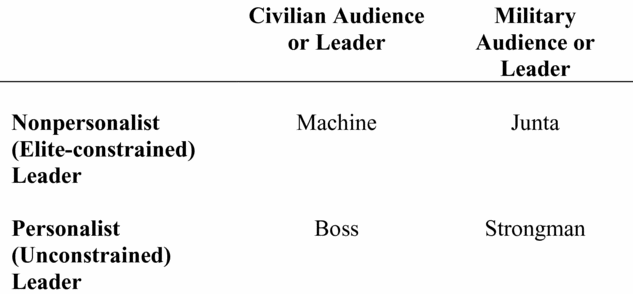
Modern scholarship has identified two dimensions central to understanding the internal logic of authoritarian regimes: whether the regime is led by civilians or the military, and the degree of personal power of the leader (Geddes Reference Geddes2003).Footnote 14 The following discussion shows that the two dimensions of militarism and personalism form natural cleavages when explaining variation in constraints and preferences across dictatorships. Because regimes can have any combination of these two characteristics, the two dimensions combine to form four ideal types of dictatorships, shown in Figure 1.Footnote 15 I adopt Slater's (Reference Slater2003) labels, distinguishing among nonpersonalist civilian regimes (machines), nonpersonalist military regimes (juntas), personalist civilian regimes (bosses), and personalist military regimes (strongmen).Footnote 16
Typology of Authoritarian Regimes
Domestic Audiences: Personalist versus Elite-constrained Dictators
The first question is what types of regimes face a powerful domestic audience that can punish or, at the extreme, remove leaders who do not represent their interests. Scholars have shown empirically that most authoritarian leaders lose power at the hands of government insiders (Svolik Reference Svolik2009). Yet dictatorships vary enormously in the extent to which regime insiders have the opportunity and incentives to oust their leader, giving them influence over policy.
At one end of the spectrum are despotic, sultanistic, or, here, “personalistic” regimes, in which one individual controls the instruments of state such as the military forces, any ruling party, or the state bureaucracy (Chehabi and Linz Reference Chehabi and Linz1998; Geddes Reference Geddes2003; Weber Reference Weber1997). Not only is the leader insulated from free and fair elections but he or she is typically able to appoint friends, relatives, and cronies to important offices. These hand-picked regime insiders have strong incentives to remain loyal to and uncritical of the leader, lest they risk their own political demise (Bratton and Van de Walle Reference Bratton and Van de Walle1994). Therefore a defining feature of personalist regimes such as North Korea under the Kims, Iraq under Saddam Hussein, the Soviet Union under Stalin, Syria under the Assads, and Libya under Gaddafi is that their leaders do not face a strong, organized domestic audience able to exert ex ante or ex post constraints on their policy choices.Footnote 17
This lack of a domestic audience in personalist dictatorships contrasts greatly with the powerful domestic audiences found in nonpersonalist autocracies. Unlike their counterparts in personalist dictatorships, government insiders in nonpersonalist autocracies often have both the will and the means to punish their leader. In nonpersonalist party-based machines such as contemporary China and the post-Stalin Soviet Union, government insiders rise through the ranks based in significant part on merit and seniority, rather than personal or family relationships to the paramount leader. Moreover, in these regimes the leaders cannot typically spy on subordinates and dispose of them if they detect disloyalty. Regime insiders’ loyalty to the incumbent is thus more tenuous; if regime elites do succeed in ousting an incompetent leader, they are likely to survive.
The ability to punish or oust the leader is not limited to single-party regimes. In many military dictatorships—many of which are in Latin America, as well as the former military regimes of Algeria, South Korea, and Thailand—the officer corps and other junta members do not depend on the incumbent for their own political survival. Just as the Argentine junta ousted Galtieri after the Falklands debacle, high-ranking officers in nonpersonalist military dictatorships often punish or even oust the leader for policy failures. Officers in the Argentine military acted as a “constituency to which the junta remained attentive. . . much evidence exists to support the notion that a very real form of political constraint was exercised on Argentina's putative rulers” at the hands of these officers (Arquilla and Rasmussen Reference Arquilla and Moyano Rasmussen2001, 762). In sum, government insiders serve as a powerful domestic audience in nonpersonalist regimes.
Of course, even nonpersonalist dictators tend to be more secure in office than democratic leaders (Frantz Reference Frantz2008), reducing the likelihood of punishment.Footnote 18 Yet this greater likelihood of remaining in power could be offset by the leaders’ fear of their post-ouster fates (Debs and Goemans Reference Debs and Goemans2010; Goemans Reference Goemans2000). Some lucky ousted nonpersonalist dictators (such as Khrushchev) go into a “retirement” of house arrest, but other ex-dictators face physical violence or exile. Thus, even if autocrats are less likely to lose office than democrats, they may fear the possibility of punishment more acutely.
The distinction between severe and nonsevere punishment raises the question whether personalist dictators, although less likely to be punished than nonpersonalist leaders, are more likely to be punished severely. If so, the small threat of the “ultimate punishment” could induce just as much caution in personalist as nonpersonalist leaders (Goemans Reference Goemans2008). Indeed, there is some evidence that personalist leaders are more likely to face severe punishment (such as exile or death) than leaders of machines, who more often face a quiet, if forced, retirement (Debs and Goemans Reference Debs and Goemans2010). Yet, given the historically low probability that personalist leaders will lose office even when their nation is defeated militarily, these fears are unlikely to overwhelm the relative lack of accountability that personalists enjoy. Elsewhere, I show that of the personalistic leaders who lost wars, only 12.5% lost office within two years (Weeks Reference Weeks2009), a much lower rate than both democrats and nonpersonalist dictators, for whom military defeat usually spelled ouster. Importantly, the differences in punishment received by democrats and nonpersonalist dictators were small. Absent a reliable threat of punishment, personalist leaders do not suffer the same extra cost of defeat as do democrats and nonpersonalist dictators and consequently can take greater risks.Footnote 19
Thus, one way to measure the first dimension—whether the leader faces a powerful domestic audience with the ability to punish or depose—is whether or not a regime is ruled by a personalist dictator. Personalist dictators are particularly unlikely to face an effective domestic audience. In contrast, nonpersonalist dictators must reckon with powerful domestic audiences. When combined with the potentially unattractive fate of being deposed, nonpersonalist dictators’ fear of removal at the hands of regime insiders can strongly condition their behavior. The preferences of domestic audiences in nonpersonalistic dictatorships are therefore important.
The Content of Constraints: Audience and Leader Preferences
The second question then is, What are audience preferences concerning the initiation of military conflict? These preferences derive from actors’ evaluations of the relative costs and benefits of using military force, including the costs of fighting, the costs of defeat, and the benefits of winning. I argue that these preferences vary according to the composition of the audience, with important differences between military and civilian regimes. In personalist regimes without an effective domestic audience, I look instead at the preferences of the dictator. The discussion of each of the dictatorial types compares the preferences of the autocratic audience to those of a typical democratic audience (voters).
Peaceful Machines: Elite-constrained Dictatorships with Civilian Audiences. What are the preferences of the civilian elites comprising audiences in nonpersonalist civilian machines? These elites are typically officials in a dominant party, as in contemporary China, though they could also potentially be family members in a nonpersonalistic monarchy, such as Saudi Arabia, or high-level officials in an autocracy with limited multiparty competition. Contrary to the conventional wisdom, I argue later that civilian regime insiders in autocracies are not substantially more enthusiastic about initiating military force, on average, than democratic voters. In addition, selectorate theory's assumption that small-coalition regime insiders are dependent on the leader's survival for their own survival does not usually hold in nonpersonalist autocracies. The relatively small size of the winning coalition in machines therefore does not imply that these elites are bound to the leader by loyalty, overlooking foreign policy failures.
First, many scholars have argued that the perceived costs of fighting are lower for autocratic than for democratic audiences. The most obvious perceived costs are the material costs of fighting to which Kant alludes: Authoritarian elites might be more insulated from the direct costs of war than ordinary citizens. Yet despite the long pedigree of the Kantian argument, there are reasons to doubt it. Except in the most serious conflicts involving mass conscription, most wars involve the mobilization of only a very small proportion of the population. Moreover, democratic governments often adopt policies that minimize the costs of war to their constituents (Valentino, Huth, and Croco Reference Valentino, Huth and Croco2010); the direct personal costs for any individual citizen are therefore likely to be low. In autocracies the direct costs of war may be no lower for elites than for the general population.Footnote 20 In fact enemy governments often target high-level officials in their wartime efforts. For example, the United States used this kind of decapitation strategy in the recent Iraq and Afghanistan wars. Unlike the paramount leader, most audience members do not enjoy personal security details or have access to multiple secret underground bunkers to protect them and their families, much less their land or property.
Of course, other costs of war accrue to citizens off the battlefield, for example disruptions in the economy. Most scholars assume that ordinary citizens are more vulnerable to these economic costs than are wealthier elites, who can absorb a drop in income. However, the logic of authoritarianism actually suggests that only a very narrow circle of the elite would ignore such costs when it comes to evaluating the leader. Elites’ economic interests are likely to be hard hit by a conflict, which can both destroy infrastructure and disrupt trade. In addition, elites cannot simply compensate themselves by taxing the public at a higher rate. As Wintrobe (Reference Wintrobe2000) argues, most autocratic regimes stay in power through a combination of repression and loyalty. Defeat in war damages an important instrument of repression—the military—and taxing the citizens at higher rates to compensate for wartime losses is likely to reduce the regime's other resource, the loyalty of the public. In other words, when resources are destroyed in war, the only way that elites could insulate themselves economically would be to take steps that imperil the regime's stability, and thus their own survival. In sum, it is not clear that autocratic elites are substantially more insulated from the direct or indirect material costs of fighting than are ordinary citizens.
Alternatively, normative or moral concerns could raise the perceived costs of fighting.Footnote 21 Perhaps elites in autocracies are socialized to view military force as a more appropriate way to settle disputes than are leaders or citizens in democracies. Although I return to this issue in the discussion of military officers, there is at best weak evidence that civilian elites in dictatorships are more likely than their democratic counterparts to see war as morally appropriate. Most literature suggests that democracies apply pacific norms only when the opponent is also a democracy; existing research points to dyadic, rather than monadic, beliefs about the appropriateness of using force (Dixon Reference Dixon1994; Maoz and Russett Reference Maoz and Russett1993). Little scholarship demonstrates monadic differences in norms between democracies and autocracies, and in fact many scholars have commented on democracies’ willingness to use force even against innocent civilians (Downes Reference Downes2008). Even when scholars have found monadic differences in the willingness of democracies to refrain from certain practices, such as abusing enemy combatants, they have attributed them to strategic rather than normative factors (Wallace Reference Wallace2010). In sum, there is little existing evidence that civilian autocratic audiences view the costs of fighting as systematically lower than do democratic audiences.
A second possibility is that high-level officials in autocratic regimes are less concerned with the costs of defeat. However, this argument is also flawed. Outright military occupation and immediate regime change aside, defeat in war or even lower level disputes could weaken domestic support for the regime by providing a focal point for citizen discontent. Or defeated soldiers might turn against their own regime, as many Arab soldiers did in the aftermath of a humiliating defeat to Israel in 1948. Given the drastic consequences of regime change, the audience would be wary of a leader who takes what seems to be a foolish or selfish risk in this regard and so might jettison him or her to stave off citizen discontent. Defeat could also reveal or even increase a country's military vulnerability and make it more open to future invasion by hostile neighbors. Because of their greater understanding of international affairs, political and military elites might be especially attuned to the perils of exposing their military weaknesses or losing strategic territory. Unlike the ordinary public, authoritarian elites have their own access to information about the details of the war outcome and are not vulnerable to favorable framing by the leader. The consequences of defeat should therefore loom as large in the minds of autocratic audiences as of democratic audiences.
What about the value of the status quo compared to the value of international goods such as territory, economic rights, or the removal of an external threat? Although I return to this issue in the discussion of military regimes, there are no clear reasons to think that ordinary authoritarian elites are more paranoid or view other states as more threatening than do voters in democracies. The value of the status quo should not therefore be substantially lower for civilian autocratic elites than for democratic audiences. Alternatively, perhaps autocratic audiences are more likely to favor conflict because they have a greater desire for the potential benefits of victory, or “international goods.” The most prominent formulation of this argument is that, because authoritarian elites can keep the spoils rather than sharing them with the population, military conquest may seem more attractive to autocrats than to democrats (Lake Reference Lake1992). Yet the autocratic expansionism argument hinges on whether conquering foreign territory disproportionately benefits elites or the public; if the latter, we might actually expect authoritarian audiences to be better off directly consuming the resources that it would take to successfully conquer foreign territory (Bueno de Mesquita et al. Reference Bueno de Mesquita, Smith, Siverson and Morrow2003), leading to an anti-expansionist bias. Absent evidence that expansion and war disproportionately benefit the elite, this argument would not imply that autocrats start more wars.
In sum, this discussion suggests that civilian authoritarian audiences—even when they are small and not representative of the broader public—tend to view the initiation of military conflict with the same trepidation as democratic audiences. Although these autocratic audiences may approve of using force if the benefits outweigh the material or moral costs, they are no less wary of the possibility of defeat than their democratic counterparts and do not see systematically greater gains from fighting. In turn the fear of ex post punishment induces the leaders of these machines to heed the audience's preferences.
This conclusion is at odds with much of the conventional wisdom: One might expect that it is much easier for a leader to convince a small coalition of elites to forgive him or her for launching a foolish war than it would be to assuage Congress or voters, and that even nonpersonalist autocrats would therefore feel less constrained by the views of their audiences.Footnote 22 However, for the reasons provided earlier, the conventional wisdom underestimates the vulnerability of nonpersonalist autocrats. First, the lonely post-tenure fates of leaders of machines may encourage even greater caution than in democracies, even if the odds of losing office are slightly lower. Second, leaders of machines may find it much more difficult to massage domestic opinion when the audience consists of high-level officials—themselves often active in foreign policy and with no special appetite for force—than a “rationally ignorant” mass public (Downs Reference Downs1957). Even long after the fall of Baghdad, for example, voters had substantial misperceptions about the threat that Iraq had posed (Kull, Ramsay, and Lewis Reference Kull, Ramsay and Lewis2003). Together, these factors combine to produce, on average, no greater incentives for leaders of machines to initiate conflicts than for leaders of democracies.
H1:Machines are no more likely to initiate military conflicts than democracies.
Militant Juntas: Elite-constrained Dictatorships with Military Audiences. Having discussed civilian nonpersonalist machines, I now turn to military juntas in which the leader faces an audience composed primarily of military officers.Footnote 23 Some of the arguments about elite audiences in nonpersonalist civilian autocracies apply to military regimes as well; for example, as in machines, elites in military juntas are not insulated from the costs of defeat. However an important exception exists in regard to the regime's perceived costs of fighting, and the value of the status quo. Military officers have been selected for, and socialized to hold, specific beliefs about the utility and appropriateness of military force as an instrument of politics. Specifically, military officers are more likely than civilians to form ominous views of the status quo, and to view military force as effective and routine.Footnote 24 These views raise the perceived net benefits of winning and lower the perceived costs of using force.
The argument emphasizes military officers’ deeply engrained beliefs about the role of military force in international affairs.Footnote 25 Many scholars have argued that pre-existing beliefs can systematically affect actors’ preferences over actions by defining expectations about, for example, cause and effect or the intentions of other actors.Footnote 26 Pre-existing beliefs are particularly likely to influence perceptions of military action, where cause and effect are so distant that individuals cannot learn from direct experience. To scholars of public opinion, it is unsurprising that there may be systematic differences among individuals in their perceptions of the utility and costs of armed conflict. For example, researchers regularly find that beliefs about the use of force vary by gender and education, even when there is no tangible link to the individual's personal well-being.Footnote 27
As many scholars have argued, the result of military training is to inculcate individuals with systematic beliefs about the necessity, effectiveness, and appropriateness of using military force abroad (Sechser Reference Sechser2004). First, military officers are particularly likely to view the status quo as threatening. In his seminal work on the beliefs of military officers, Huntington (Reference Huntington1957) argues that there is a “military ethic” that “views conflict as a universal pattern throughout nature and sees violence rooted in the permanent biological and psychological nature of men” (64).Footnote 28 Moreover, soldiers base their perceptions of threats on information not about the political intentions of the other state, but on the state's military capabilities: “Human nature being what it is, a stronger state should never be trusted even if it proclaims the friendliest intentions” (66), and soldiers are socialized to “view with alarm the potency and immediacy of the security threats to the state” (66). Because officers are less likely, on average, to feel comfortable with the status quo, they perceive higher net benefits of winning.
Second, military officers view the use of military force as routine, appropriate, and therefore relatively low-cost. Professional officers become so “functionally specialized” (Posen Reference Posen1984, 57) that they “forget that other means can also be used toward the same end” (Snyder Reference Snyder1984, 28). Over time, these tendencies may even harden into offensive doctrines (Posen Reference Posen1984; Snyder Reference Snyder1984).Footnote 29 As Brecher (Reference Brecher1996) puts it, “Violence is normal behavior for the military in power, for the military generally achieves and sustains power through violence and tends to use this technique in all situations of stress, internal or external. They also see violence as legitimate and effective” (220). In officers’ Hobbesian worldview, resort to force is unavoidable and therefore morally acceptable, further reducing its perceived costs. In contrast officers view diplomacy as costly, because it wastes precious time and could allow civilians to meddle in what are properly military matters. In sum, in addition to viewing force as necessary because of the costs of inaction, officers become habituated to the role of force in international politics. Whereas their material costs of fighting may be no lower than for civilian autocratic elites or ordinary citizens, officers’ perceived costs of fighting are lower. Consistent with these arguments, Horowitz and Stam (Reference Horowitz and Stam2011) find cross-national evidence that leaders with military experience are significantly more likely to initiate armed conflict, even when controlling for a host of confounding factors.
A potential counterargument is that military officers’ Hobbesian views are offset by otherwise conservative tendencies.Footnote 30 Although Huntington saw military leaders as prone to exaggerating external threats, he ultimately believed that professional soldiers favor war only rarely, because “war at any time is an intensification of the threats to the military security of the state” (69).Footnote 31 Feaver and Gelpi (Reference Feaver and Gelpi2004) report a similar conclusion in their study of the beliefs of American military officers, and Richard Betts (Reference Betts1977) finds that in the context of Cold War crises, U.S. military officers did not uniformly advocate more aggressive policies than civilian officials.
Importantly, however, these studies do not necessarily imply that officers in military juntas are less aggressive than elites in machines or ordinary citizens. First, they report on military officers in democracies with strong civil-military relations, usually the United States. In contrast, the military officers who rule military dictatorships have shaken off civilian control and declared the military's right to intervene in domestic politics. Even if it were true that military officers in the United States are relatively cautious, military juntas explicitly select for groups of officers who are decidedly not conservative about using force to settle political questions.
Second, even if we do believe that the American experience sheds light on the attitudes and preferences of military officers in dictatorships, the existing empirical evidence does not in fact favor the military conservatism hypothesis. For example, although Betts (Reference Betts1977) is often cited as evidence that military officers are not more hawkish than civilians, his conclusion was actually that military opinion was often divided and that the hawkish military officers rarely influenced U.S. policy. In fact, Betts’ own data showed that during Cold War crises, military officers advocated more hawkish policy positions than civilians 21% of the time, equally hawkish positions 65% of the time, and were less hawkish only 14% of the time (216).Footnote 32 When it came to tactical escalation decisions after an intervention, military officers were never less aggressive than civilians.
Moreover, Feaver and Gelpi's (Reference Feaver and Gelpi2004) surveys of American military and civilian elites suggest that military officers are only more conservative about using force when the mission involves “interventionist” goals such as spreading democracy or protecting human rights. In fact, when it comes to realpolitik questions such as the rise of China or WMD proliferation, military officers display patterns of beliefs consistent with the arguments made here. Military officers in the Feaver and Gelpi surveys were more likely than civilians to perceive external threats stemming from China, nuclear weapons, and the spread of arms; less likely to perceive diplomacy and diplomatic tools as important; and more likely to view the military as an important instrument of foreign policy.Footnote 33 This distinction matters because the United States, as a liberal superpower, is relatively unique among countries in its ability to use force to pursue nonsecurity goals. When it comes to the types of realpolitik security situations that most countries face, the evidence from the United States actually seems to suggest that military officers are more hawkish than civilians.
In sum, due to the background and training of military officers, autocratic audiences composed primarily of military men should tend to be more supportive of using military force than civilian audiences. Military officers’ training leads them to view force as a routine and appropriate policy option, to be wary of diplomacy, and to fear the consequences if they do not act. As a result they perceive increased benefits from using force. Leaders facing such a “constituency” will therefore be more likely to initiate military conflicts than counterparts who face a civilian audience.
H2:Juntas are more likely to initiate military conflicts than machines and democracies.
Personalist Dictators: Ambitious and Unconstrained. Finally, what behavior should we expect from personalist regimes, led by civilian bosses and military strongmen? Since the leaders of these regimes do not face a powerful domestic audience, we must investigate their personal views on the costs and benefits of using force. There are several reasons why we should expect these leaders to be prone to initiating military conflicts. I first discuss the two types of leaders together and then comment on how strongmen may differ from bosses due to their military backgrounds.
First, personalist dictators are, like military officers, particularly likely to view military force as necessary, effective, and hence net less costly than do either democratic voters or civilian officials in nonpersonalist regimes. One reason is that unlike elites in machines, who are typically bureaucrats who have risen through the civilian ranks, many personalist dictators, such as Stalin, Mao, Saddam Hussein, and Idi Amin, attained their personal status through violent means such as revolution, civil war, or a violent coup. These types of leaders have learned that force is an effective and even necessary means of dispute resolution, lowering their perception of its costs (Colgan Reference Colgan2010; Gurr Reference Gurr1988; Horowitz and Stam Reference Horowitz and Stam2011).
Second, these leaders are more likely to desire international goods, or are more “revisionist,” than typical audience members in a democracy, machine, or junta. Personalist regimes select for leaders who are particularly likely to cherish grand international ambitions. One way to think of personalist leaders is as individuals with “tyrannical” personalities who managed, through force and luck, to create domestic political conditions (personalist regimes) that feed this desire to dominate others. Rosen (Reference Rosen2005) draws on classical works by Xenophon and others to argue that tyrants are particularly likely to crave supremacy over others (156–57), and Glad argues that many tyrants are narcissists who attempt to “buttress [their] exalted self-image” by placing themselves above others (Glad Reference Glad2002, 26). Psychological studies of tyrants (i.e., the types of individuals who are particularly likely to become personalist dictators) in turn consistently highlight these leaders’ need for absolute domination and their consequent grandiose ambitions.Footnote 34 One of Saddam Hussein's many aspirations, for example, was to establish a pan-Arab caliphate—with himself, of course, as caliph. As the heir of Nebudchadnezzar and Saladin, it was only natural that Saddam would order the construction of an ostentatious palace in Babylon—with his own initials inscribed on each brick (Woods et al. Reference Woods, Pease, Stout, Murray and Lacey2006). Muammar Gaddafi of Libya notoriously dubbed himself the “King of Kings,” in 2008, gathering together more than 200 African tribal rulers and monarchs and declaring his hope for a single African government over which he would presumably preside.
Although leaders of other regime types may also be prone to visions of empire (Snyder Reference Snyder1991), in personalist dictatorships, the sycophants surrounding the dictator are particularly unwilling to rein in the leader's excessive ambition.Footnote 35 In the Kremlin under Stalin, “There was a clear etiquette: it was deadly to disagree too much. . . . Silence was often a virtue and veterans advised neophytes on how to behave and survive” (Montefiore Reference Montefiore2004, 341). Although even subordinates in democracies may find it difficult to disabuse the leader of unrealistic goals, these tendencies are exacerbated in personalist autocracies, in which the leader is so unusually powerful.
Finally, the costs of defeat will be lower for personalist dictators compared not only to voters in democracies but also to audiences in nonpersonalist dictatorships. Personalist dictators have extraordinary resources at their disposal to protect themselves from harm during wartime, compared to other regime elites. In addition, their ability to disrupt coordination among regime elites means that even if defeat harms others in the regime, personalist leaders do not face the same threat of domestic punishment.
In sum, the internal logic of personalist dictatorships points clearly toward greater conflict initiation by personalist dictators compared to leaders of democracies or machines. First, the path toward becoming a personalist dictator selects for leaders who both have grand international ambitions and who view force as an effective long-term strategy, raising its net benefits and reducing its net costs. Second, personalist dictators are less vulnerable to the costs of defeat than audiences in nonpersonalist regimes. This increases their willingness to initiate disputes that they have only a low likelihood of winning and inflates their overall rate of dispute initiation. The implication for conflict initiation is that strongmen and bosses tend to, on average, initiate more military disputes than more constrained leaders.
H3:Bosses and strongmen are more likely to initiate military conflicts than machines and democracies.
Strongmen: More Belligerent than Bosses or Juntas? A final question is whether the effects of personalism and militarism are additive or redundant. Are personalistic strongmen more likely to initiate conflict than nonpersonalistic juntas? Are strongmen—personalist leaders with a military background who are surrounded by military advisors—more likely to embrace international conflict than (civilian) bosses? I consider each comparison—strongmen vs. juntas, and strongmen vs. bosses—in turn.
First, are strongmen more belligerent than juntas? The argument about juntas was that even though leaders of juntas must please a domestic audience, that audience, consisting of military officers, is more likely than a civilian audience to view force as a sound long-term strategy and to perceive the status quo ominously. These perceptions raise the anticipated net benefits of using force. Like militarism, one of the effects of personalism is that, because of selection, personalist leaders tend to believe that military force is necessary, effective, and superior to diplomacy. However, unlike personalist dictators, leaders of juntas cannot insulate themselves from the costs of defeat. Personalist strongmen should therefore be more likely to initiate conflict than nonpersonalist juntas, although the difference should be smaller than the differences between bosses and machines, where both beliefs and accountability are different.
Second, are strongmen more belligerent than bosses? Given that both are personalist regimes in which the leader faces few consequences from a domestic audience, the question is whether the military background of a strongman would favor the initiation of conflict. Because a substantial proportion of bosses must have a predilection for violence to survive their ascent to power and then keep their job, they will be attracted to violent strategies even if they do not have formal military training. In strongman regimes, the leader's military experience is largely redundant given that all personalist regimes select for highly violent and ambitious leaders. On the margins, we would expect military strongmen to be more belligerent on average than civilian bosses, although the difference is likely smaller than between other regime types. In sum, there are reasons to expect that, although the effects of personalism and militarism are additive, there is some redundancy when both attributes are present.
H4:The effects of personalism and militarism are partially redundant. Strongmen are only somewhat more likely to initiate military conflicts than juntas and only marginally more likely than bosses.
MEASURING AUTHORITARIAN REGIME TYPE
Assessing these four hypotheses requires data that capture to what extent the paramount leader faces a powerful domestic audience, and whether the leader and the audience stem from civilian or military ranks. Previous attempts to measure these concepts, however, suffer from important shortcomings. For example, Lai and Slater (Reference Lai and Slater2006) rely on a combination of the Polity executive constraints (xconst) variable (Marshall and Jaggers Reference Marshall and Jaggers2002) and the Banks Cross-National Time-Series “regime type” variable, which identifies whether the government is controlled by a civilian or military elite (Banks Reference Banks2007).Footnote 36 However, the xconst variable is problematic for measuring political constraints in authoritarian regimes because it focuses on formal institutional constraints and “regular” limitations on the executive's power, explicitly excluding “irregular limitations such as the threat or actuality of coups and assassinations” (Marshall and Jaggers Reference Marshall and Jaggers2002, 23). It overlooks the possibility that the threat of coups, including both military coups and palace coups at the hands of political elites, is more predictable and credible in some regimes than others.Footnote 37
Other scholars have used Geddes’ (Reference Geddes2003) typology, which distinguishes among military, single-party, and personalist regimes. An advantage of this classification is that it does not rely purely on formal institutions. However, the Geddes typology does not distinguish between military personalists (strongmen such as Pinochet or Idi Amin) and civilian personalists (bosses such as Saddam Hussein or North Korea under the Kims), so as Lai and Slater point out, we cannot assess whether personalist regimes are more conflict-prone because they are personalist, led by the military, or both. Moreover, Geddes counts quite personalistic leaders, such as Stalin and Mao, as single-party leaders because of the party institutions that undergird the regime. In contrast, the framework presented here refers to the personal power of the leader, indicating that Stalin and Mao should be considered bosses rather than machines.
A different approach allows me to draw on the strengths of the Geddes data while classifying regimes according to both personalism and military background. As part of her research, Geddes gathered information about a large number of domestic political variables for each regime. Three groups of questions reflected the characteristics of three regime types (personalist, single party, and military); Geddes aggregated the answers from each group of yes/no questions and assigned three regime-type categories based on these subscores. One attractive feature of the raw data is that many of the variables vary within the regime over time, unlike the tripartite regime typologies. For example, the raw data distinguish between the USSR under Stalin, which I code as a “boss,” and the post-Stalin Soviet Union, which I code as a “machine.” Both of these are coded as single-party regimes in the Geddes typology that other scholars have used, but the raw data indicate that, for example, Stalin chose most of the members of the Politburo and that the Politburo acted primarily as a rubber stamp, whereas in the post-Stalin era, neither of these were true.
Because of these advantages, I used the raw Geddes regime-type data to create both independent measures of the two dimensions (personalism and military leadership) and indicator variables for each of the four regime types: machine, junta, strongman, and boss. To measure the personalist dimension, I created an index of eight variables, including whether access to high government office depends on the personal favor of the leader, whether country specialists viewed the politburo or equivalent as a rubber stamp for the leader's decisions, and whether the leader personally controlled the security forces.Footnote 38 To measure the military dimension, I used five questions: whether the leader was a current or former high-ranking military officer,Footnote 39 whether officers hold cabinet positions not related to the armed forces, whether the military high command is consulted primarily about security (as opposed to political) matters, whether most members of the cabinet or politburo-equivalent are civilians, and whether the Banks dataset considers the government to be “military” or “military-civilian.”
I first created indices representing the proportion of “yes” answers.Footnote 40 I then created dummy variables for each of the four regime types, using a cutoff of .5 to classify countries as either personalist or nonpersonalist, or military or civilian, and combining the two dimensions to create four regime types.Footnote 41 For example, I coded a country-year as a strongman if it scored more than .5 on the personalist index and .5 on the military index. Choosing the particular cutoff of .5 did not affect the substantive results, nor did weighting certain important subcomponents of the index more heavily than others or revising the components of the index in reasonable ways. I also show later that the results are similar whether one uses the indices or the categories, and I describe two ways to score democracies on these indices.Footnote 42 I provide additional detail on the construction and distribution of the regime-type variables in the Online Appendix.
Finally, Geddes did not code monarchies, theocracies, or unconsolidated regimes in her research. Although these types of regimes could in principle be coded according to my measures, lacking that data I created additional dummy variables to identify “other” nondemocracies (regimes that have Polity scores of 5 or lower, but no Geddes regime-type data). Figure 2 summarizes the distribution of machines, bosses, juntas, and strongmen for the 1946–99 period and provides examples of each category.
Examples of Authoritarian Regime Type, 1946–1999

EMPIRICAL ANALYSIS: THE PROBABILITY OF INITIATING A MILITARY CONFLICT
The earlier theoretical discussion was monadic in that it focused on the initiating country's domestic institutions, rather than the interactions of different types of polities. Some scholars have tested these arguments using country-years as the unit of analysis (Lai and Slater Reference Lai and Slater2006). However, a country-year set-up makes it difficult to account for salient factors such as the balance of military power, alliance relationships, trading relations, and geographic proximity between the country and potential targets of force; a directed-dyad analysis allows us to control for these factors directly, and so I opted for that approach (Most and Starr Reference Most and Starr1989; Oneal and Tir Reference Oneal and Tir2006).
For the following dyadic analyses, the outcome of interest is whether country A in a directed dyad initiated military conflict against country B during year t. For data on military conflict, I used Maoz's recoded dyadic version (Maoz Reference Maoz2005) of the Militarized Interstate Disputes (MID) dataset, which identifies all “united historical cases in which the threat, display or use of military force short of war by one member state is explicitly directed towards the government, official representatives, official forces, property or territory of another state” (Jones, Bremer, and Singer Reference Jones, Bremer and Singer1996, 168). Following the bulk of the literature, I coded a variable initmid that has a value of 1 if a country initiates a MID against the other state in the dyad (i.e., is the first state to threaten or use military force).
Because the dependent variable is dichotomous, I estimated the models using logistic regression. To correct for temporal dependence, I followed Beck, Katz, and Tucker (Reference Beck, Katz and Tucker1998) and included cubic splines of the number of years since the last time State A initiated a MID against its opponent. In addition to cross-sectional analyses, I also carried out the analyses with fixed effects to correct for the possibility of omitted variables that are specific to directed dyads (Green, Kim, and Yoon Reference Green, Kim and Yoon2001; Schultz Reference Schultz2001). This is analogous to including a separate intercept for each directed dyad; coefficients in these models were estimated based on within-directed-dyad variation in dispute initiation.
Control Variables
The literature suggests a number of control variables that could affect a state's decision to begin military hostilities, including some that could be correlated with the type of domestic political regime.
Capabilities: Many scholars have argued that more powerful states have wider ranging interests than minor powers and therefore initiate military force more frequently. I included several different measures of power, including the raw military capabilities score of each side (cap1 and cap2), the initiator's share of the dyad's total capabilities (initshare), and dummy variables marking whether states in the dyad are major powers: majmaj, majmin, and minmaj, with minmin as the reference category.Footnote 43
Alliances and Geopolitical Interests: Next, I included two measures of alliance similarity, which may serve as a proxy for broader geopolitical interests. First, states that share similar alliances may have fewer competing interests for reasons that have nothing to do with regime type (Gowa Reference Gowa1999). I therefore included a measure of the similarity of the two states’ alliance portfolios (weighted global s-score, s_wt_glo). Second, states that are more strongly allied with the most powerful state in the system may be more satisfied with the status quo, reducing their motivation to fight (Schultz Reference Schultz2001). Third, states may be deterred from initiating a MID against a state that is closely allied with a superpower. I therefore include a weighted measure of the similarity of each state's alliance portfolio with the system leader (s_lead). Footnote 44
Geographic Contiguity: Another important predictor of international conflict is geographic contiguity. Geographically close countries are more likely to have disagreements (such as over the precise location of a border), and it is easier for a county to deploy its military forces against an immediate neighbor. A dummy variable contig marks whether the two states either share a land border or are separated by less than 24 miles of water, and a variable logdist measures the logged distance between the capitals of the two countries (Stinnett et al. Reference Stinnett, Tir, Schafer, Diehl and Gochman2002).
Trade Dependence: Many scholars have argued that trade interdependence can dampen incentives to use military force against a trading partner. For the dyadic analyses, I therefore controlled for trade dependence in the dyad using data by Gleditsch (Reference Gleditsch2002).Footnote 45
Regime Instability: Because domestic turmoil could potentially spill over into a country's international relations (Colgan Reference Colgan2010), I created a new/unstable regime indicator for whether a country has undergone substantial domestic institutional change within the past three years. Including this variable also mitigated the possibility of finding that military regimes (which tend to be shorter lived) are more belligerent because they are typically younger than other regime types.Footnote 46
Side B Regime Type: Finally, I included a variable that measures whether Side B in the dyad is a democracy. This was included not to test hypotheses about target regime type per se, but rather to ensure that the results for democratic Side A states are not due to peaceful clusters of democratic neighbors. In the Online Appendix, I also controlled for the authoritarian regime type of Side B. Importantly, controlling for the regime type of Side B does not affect the significance of the results for the regime type of Side A.
Results
I started the analysis by estimating the models with the regime-type dummy variables. Although less flexible, these results are more straightforward to interpret than the results using the raw indices; as I show later, the two approaches produce the same inferences. These analyses set the base regime-type category for Side A as democracy; we would expect junta, boss, and strongman to have positive and significant coefficients, with strongmen being the most belligerent of all. Machines should not initiate significantly more conflict than democracies according to the arguments.
The results support these predictions. The cross-sectional results are shown in Columns 1 and 2 of Table 1. I begin by estimating an extremely parsimonious model in which the only control variables other than regime type are each side's raw military capabilities and major power status, both of which affect a regime's ability to project power. In these models, as well as the subsequent model that controls for additional covariates, the coefficients on junta, boss, and strongman are positive and significant at the .05 level or greater. Machines, in contrast, are not more likely to initiate conflicts than democracies; indeed in the cross-sectional model controlling for the full set of covariates, machines are slightly less likely to initiate conflicts than democracies, although this result does not hold in all of the analyses. Column 2 indicates that covariates such as trade interdependence and additional measures of power generally perform as expected based on the existing literature (full results available in the Online Appendix).Footnote 47
Directed-dyad Logit Analysis of Dispute Initiation, 1946–1999

+ significant at 10%; *significant at 5%; **significant at 1%.
Robust z statistics in parentheses.
Notes: Democracy is the base category. In addition to the control variables reported in the table, all models include temporal controls (years since last conflict initiation and cubic splines of that variable) and dummy variables marking the combination of major/minor power status in the dyad. Column 2 also includes the following additional variables: Contiguity; Logged Distance between Capitals; Alliance Portfolio Similarity, and each state's Similarity of Alliance Portfolio with the United States. Column 4 does not include these variables as they do not vary substantially over time, making the fixed-effects analysis difficult to estimate. The Online Appendix reports the full tables (showing coefficients for all covariates).
Not only are there significant differences between democracies, on the one hand, and juntas, bosses, and strongmen, on the other hand, but there are also significant differences among authoritarian regime types. Tests of equality between coefficients indicate that juntas, bosses, and strongmen are all statistically different from machines. Moreover, there is evidence for H4: strongman is different from junta at the .04 level in Model 1, and at the .05 level in Model 2 (using two-tailed tests). The coefficient on strongman is larger than the coefficient on boss in both models, although the difference is only significant at the .17 and .23 level using a two-tailed test. Later, I explore the interaction between personalism and militarism in more detail by exploiting the raw data.
The results in the more demanding fixed-effects analysis again strongly support the hypothesis that juntas, bosses, and strongmen are more likely to initiate conflicts than machines and, to a somewhat lesser extent, democracies. Machines, again, are no more belligerent than democracies. The one unexpected result in the fixed-effects models is that the coefficient on strongman is smaller—although not significantly so— than the coefficient on either boss or junta, which contradicts H4. One reason is that the fixed-effects analysis dropped all directed dyads in which Side A never initiated conflict, because there is no variation in the dependent variable within that cross-section. Accordingly, the sample size decreased from 901540 directed dyad-years in the cross-sectional analysis in Column 1 to 29051 directed dyad-years in the fixed-effects analysis in Column 3; some peaceful dyads in which Side A was a boss or junta were also dropped. Another reason is that the fixed-effects analysis identifies coefficients based only on within-directed-dyad variation in the predictor variables; countries only contribute to the regime-type parameter estimates when they change their regime type. The results therefore depend on which countries happened to switch regime type during the sample period; among the countries that did switch regime type and initiated at least one MID, the strongmen are not more belligerent than bosses or juntas. Nonetheless, the positive and significant coefficients on the regime-type variables in the fixed-effects analysis enhance our confidence that the effect of regime type is not due to unmeasured heterogeneity that happens to be correlated with regime type.
Next, I operationalized regime type differently, entering the raw scores on the personalist and military indices rather than dummy variables. A clear advantage of this approach is that it does not force one to define a particular cutoff between “personalist” and “nonpersonalist” or “military” and “civilian.” I entered the indices in two ways. First, in columns 1 (cross-sectional) and 2 (with fixed effects) of Table 2, the sample only included countries where I had enough data to construct the indices for personalism and militarism. This eliminated democracies, for which we do not have data on personalism and only limited data on militarism, and also the autocracies that Geddes did not code. The analysis in the first two columns therefore assesses the effect of personalism and militarism among autocracies. Columns 3 and 4 show the results when we code all democracies as “0” on personalism and code democracies as “0” on all components of the military indicator other than the leader's military background, which is known for democratic leaders through the Cheibub, Gandhi, and Vreeland (Reference Cheibub, Gandhi and Vreeland2010) data. For all of the models, I also include an interaction term between militarism and personalism. This allows us to assess whether the two factors are additive or, as hypothesized, partially redundant.
Directed-dyad Logit Analysis of Dispute Initiation, 1946–1999, Using the Raw Indices

Absolute value of robust z statistics in parentheses.
+ significant at 10%; *significant at 5%; **significant at 1%.
Notes: In addition to the variables listed in the table, all models include temporal controls (years since last conflict initiation and cubic splines of that variable) and major power status of the dyad. Models 1 and 3 also include Contiguity; Logged Distance between Capitals; Side B Democracy; Alliance Portfolio Similarity; and each state's Similarity of Alliance Portfolio with the United States. These latter variables are dropped in the fixed-effects models shown in Columns 2 and 4 because they do not vary significantly over time. The Online Appendix reports the full tables (not omitting any covariates). For the fixed-effects analyses, I drop variables that do not vary significantly over time, such as contiguity, alliance portfolio similarity, and whether the target is a democracy.
The results are consistent with the hypothesis that personalism and militarism are to some extent redundant. To interpret the interaction effects, we must consider both the constitutive terms and the interaction term (Brambor, Clark, and Golder Reference Brambor, Clark and Golder2006). Note that because the indices for personalism and militarism range from 0 to 1, the coefficient on the interaction term is multiplied by an even smaller number; for example, if personalism and militarism are each .25, personalism * militarism is .0625. Figure 3 shows how the marginal effect of a unit change in militarism changes as the level of personalism increases, and vice versa.Footnote 48 The effect of a unit change in personalism on conflict initiation is positive and significant, except when militarism is at its highest values. Similarly, the effect of a unit change in militarism is positive and significant over the entire range of the personalism index. However, the graph also indicates that the effect of personalism decreases as militarism increases, and vice versa. If the two dimensions were perfectly additive, the lines would be flat, indicating that the effect of one dimension does not depend on the value of the other dimension. In contrast, the negative slopes of the lines indicate some redundancy in personalism and militarism, supporting H4.
I also carried out an extensive additional set of robustness checks, reported in the Online Appendix; none overturned the central regime-type findings in the cross-sectional analyses. Although the fixed-effects analyses are slightly less robust, they also hold given most changes:
• Including Side B regime type in the model to ensure that certain regime types were not disproportionately likely to have neighbors that incited more MIDs
• Dropping the Warsaw Pact countries (other than the USSR) from the sample
• Restricting the sample only to dyads that are not allied
• Dropping individual countries, such as the USSR, China, Iraq, and the United States, from the sample, both individually and in various combinations
• Estimating models that control for Polity scores and/or dropping “anocracies” (regimes with Polity scores between -5 and +5) from the sample to ensure that machines are not simply the “most democratic” or participatory of the authoritarians
• Restricting the sample to only minor powers
• Controlling for region in the cross-sectional analyses
• Controlling for civil war: Gleditsch, Salehyan, and Schultz (Reference Gleditsch, Salehyan and Schultz2008) show that states undergoing civil war are significantly more likely to become involved in international conflict as well. I therefore include variables marking whether either Side A or Side B of the dyad was experiencing a civil war in that year.Footnote 49
The Interaction between Personalism and Militarism

Next, what are the substantive effects of these differences in regime type? I used CLARIFY (Tomz, Wittenberg, and King Reference Tomz, Wittenberg and King2003) to estimate the predicted probability of conflict initiation in a hypothetical scenario. Figure 4 shows the predicted probability that a state initiates a MID when all of the covariates are set to the observed values for Iraq vs. Kuwait in 1990 (based off of column 2 of Table 1). It indicates that, even when controlling for all of the covariates, strongmen, juntas, and bosses are more than twice as likely to initiate disputes as machines. Democracies and machines have lower rates of dispute initiation; indeed in this specification, the dispute initiation rates of machines are slightly lower even than those of democracies.
Predicted Percent of the Time That Side A Will Initiate Conflict: Iraq-Kuwait Scenario Varying Iraq's Hypothetical Regime Type

Finally, the findings indicate that the evidence does not support existing arguments about variation in the conflict propensity of dictatorships. First, it does not bear out the expectations of Lai and Slater's (Reference Lai and Slater2006) infrastructural-power theory of conflict. According to their arguments, bosses should be no more conflict-prone than machines, because what matters is not the level of personalism of the regime, but rather whether the regime has a party infrastructure to provide stability and co-opt dissent. With the improved measures of autocratic institutions that I present here—including the improved ability to distinguish juntas from strongmen—their argument is not supported.Footnote 50
Second, the evidence appears inconsistent with selectorate theory. Previous research assessing the ability of selectorate theory to explain conflict among autocracies, such as Peceny and Butler (Reference Peceny and Butler2004), relied on less accurate measures of autocratic institutions; for example, classifying Mao and Stalin as single-party rather than personalist leaders. Earlier research designs also made it difficult to gain a picture of overall patterns of dispute initiation by the initiator's regime type. Although selectorate theory's predictions are usually dyadic (i.e., they take into account the interaction between the regime types of the initiator and target), we would still expect that, averaging across all of the types of dyads, small-coalition regimes should initiate more conflict than large-coalition regimes.Footnote 51 Instead, we find that machines—which have small winning coalitions both in absolute size and relative to the selectorate (w/s)Footnote 52—are no more belligerent and, indeed sometimes less belligerent than democracies, which have much larger coalitions and w/s scores. Moreover, small-coalition bosses do not initiate significantly more conflicts than juntas, which should also have a larger w/s.Footnote 53 Existing theoretical perspectives, in sum, cannot explain the findings.Footnote 54
CONCLUSIONS
This article raises the possibility that conventional views of the relationship between regime type and foreign policy, including the argument that democracies are in general more selective about initiating international conflict than nondemocracies,Footnote 55 are, at best, incomplete and, at worst, wrong. Focusing myopically on the usual dichotomy between democracy and authoritarianism could lead to faulty inferences about the effect of regime type on foreign relations. The combination of better data and theoretical arguments that draw on recent advances in the study of comparative authoritarianism reveals that there are substantial differences in the tendency of different types of authoritarian regimes to initiate international conflicts.
The framework introduced here not only helps us understand how authoritarian regimes vary in their conflict behavior but also opens new avenues for creative theorizing about how domestic institutions affect both preferences and constraints, which combine to affect states’ foreign policy behaviors more generally. The first task is to be more specific about what kinds of domestic constraints matter; here a first question is whether the leader faces any domestic audience that could punish him or her for decisions about international conflict. I argue that, contrary to the conventional wisdom, many authoritarian leaders face powerful domestic audiences composed of regime elites. Like democratic leaders, many autocracies must therefore be attentive to the preferences of these domestic constituents, more so than the existing literature suggests.
This, however, leads to a second question: What are the interests and preferences of that domestic audience in matters of war and peace? I first argue that, contra selectorate theory, even small-coalition audiences such as those in machines have strong incentives to jettison a leader who deviates from their preferred policies. However, audience members’ backgrounds affect their preferences and therefore their conclusions about whether the use of force was warranted. Specifically, the military officers who form the leader's constituency in junta regimes tend to view the world more ominously than their counterparts in civilian nonpersonalist regimes. They fear the consequences of inaction and they view the use of force to settle political matters as business as usual. They thus favor the initiation of international conflict more frequently than their civilian counterparts in machines.
Finally, in personalist regimes in which leaders have eliminated rivals and consolidated power into their own hands, conflict initiation depends on the whims of those paramount leaders. Unfortunately, given the treacherous road to power in a personalist dictatorship, these unconstrained leaders are often precisely the types of individuals who seek out international conflict and can survive defeat, only to repeat the cycle.
In sum, in addition to the central point that differences among authoritarian regimes matter just as much for explaining international conflict as differences between democracies and dictatorships, this article has three theoretical implications. First, it suggests that we cannot simply deduce how leaders will behave by focusing on the presence or absence of “constraints.” Rather, the impact of constraints or accountability depends on the preferences of the audience with the power to impose those constraints.
Second, we should not assume that preferences can be deduced simply from the relative size of the domestic audience or winning coalition. Rather, this article suggests that scholars should focus more on understanding the sources of preferences and how different institutional structures make those preferences salient. For example, my argument suggests that the background experiences of domestic audiences matter by shaping views about the use of force. This approach of blending measurable features of institutions with more sociological or constructivist insights about the sources of foreign policy preferences suggests productive lines of future research.
Third, the analysis suggests a way to integrate “first-image” theories, which focus on the behavior of individuals, with “second-image” theories about the importance of domestic political institutions. For example, I argue that the background experiences of individual leaders may be especially important for understanding behavior when the regime is personalist and the leader faces fewer domestic constraints (Byman and Pollack Reference Byman and Pollack2001). This claim leads to a whole host of propositions that can potentially be tested with new data sources (Horowitz and Stam Reference Horowitz and Stam2011). Scholars of all theoretical orientations would do well to understand what shapes the worldviews and therefore preferences of influential actors in both democratic and authoritarian regimes.
The findings also suggest policy-relevant lessons for diplomacy with dictatorships, painting different pictures of the conflict behavior of machines, juntas, and personalists. For example, China's civilian, elite-constrained government has been the quintessential “machine” for at least the last two decades. The evidence here suggests that, although countries like China repress public participation in politics, they tend to be more cautious than other authoritarian regime types when it comes to international conflict. Like democratic leaders, machines face domestic audiences that are not systematically predisposed toward using force, and can punish the leader for costly or foolish decisions. This could be good news for deterrent strategies, because like democracies, these regimes tend to avoid starting fights that they cannot win. However, this feature also implies that, when machines do resort to military force, their efforts will be intense because their leaders cannot afford failure.
The implications for juntas are somewhat different. If the arguments laid out here are correct, policy makers should consider that military leaders in elite-constrained juntas often use force not because they necessarily desire expansion for its own sake, but because the military officers staffing these governments are socialized to see military force as standard operating procedure, to view powerful countries as inherently hostile, and to fear the costs of compromise. To persuade military dictators that threats are not imminent, diplomats may need to devise ways to assuage such fears. In contrast, strong shows of force will sometimes be necessary to convince military juntas of the high costs of using force.
Personalistic bosses like Kim Jong Il and Saddam Hussein, as well as strongmen like Pinochet, Idi Amin, and Nasser, have also been especially belligerent, although for slightly different reasons. Personalist regimes tend to select for leaders with extreme international ambitions, and because personalist leaders are unusually insulated from the consequences of policy failures, they can act on these preferences and take risky gambles that more constrained leaders would eschew. The findings therefore suggest that one way to deter personalists is to emphasize that conflict may lead to regime change, whereas peace will reduce the likelihood of external interference. Given that personalist dictators are typically surrounded by sycophants who are afraid to communicate unwelcome news, face-to-face meetings may be necessary to ensure that the message is received by the person who matters most.
Finally, understanding what aspects of authoritarianism are most detrimental to peace could help guide policy makers toward promoting reform in cases where democratization seems unlikely. For example, they might make aid conditional on the leader allowing collective, civilian oversight of appointments and security organs (although they should expect stiff resistance from the leader). Indeed, given their leaders' greater sensitivity to the potential downsides of defeat, even juntas may be more desirable than personalist dictatorships on national security grounds. Either way, the evidence here suggests that scholars should pay careful attention to the type of regime most likely to emerge after foreign intervention or regime change, designing interventions and state-building activities to lower the likelihood that belligerent regimes emerge from the rubble.
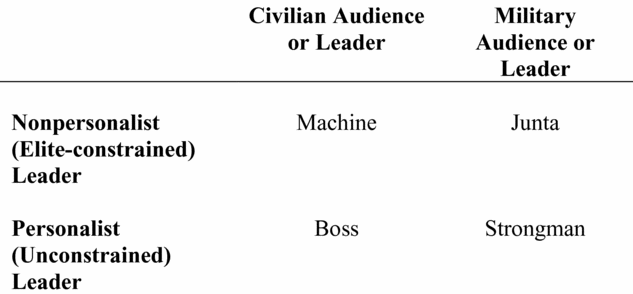
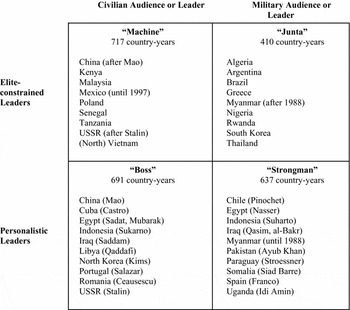
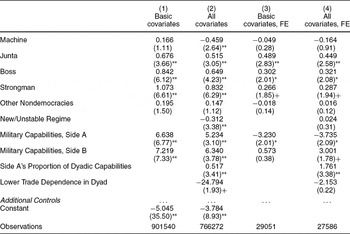
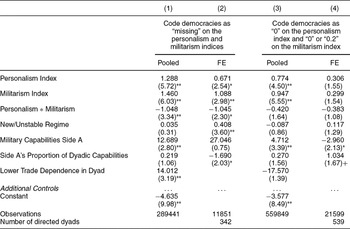
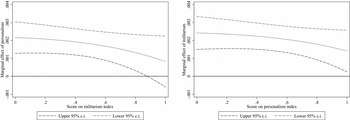
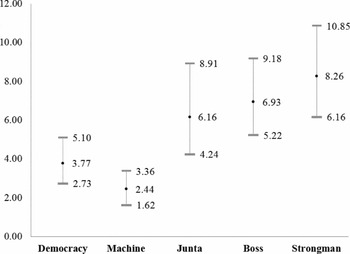



Comments
No Comments have been published for this article.