Suicide is a leading cause of death worldwide (Nock et al. Reference Nock, Borges and Ono2012). Although the suicide rate among Army soldiers has historically been much lower than that in the demographically matched general population, it has increased dramatically over the past decade (Ursano et al. Reference Ursano, Colpe, Heeringa, Kessler, Schoenbaum, Stein and Army2014). As such, there is an urgent need to advance our understanding of suicide among Army soldiers and more generally.
Much of what is known about risk and protective factors for suicide among service members and veterans has been learned by examining the medical and administrative records of those who have died by suicide and comparing them to control participants who have not died by suicide. An important shortcoming of such studies, however, is that they are limited to the use of information maintained by health or government agencies, and thus typically lack information about putative risk factors not appearing in the medical record (e.g. stressful life events, mental disorders, prior suicidal thoughts).
Another valuable source of information about risk and protective factors is studies using the self-reports of people who have engaged in non-lethal suicidal behaviors. Case control studies of suicide attempters have identified risk factors for suicidal behavior (e.g. Beautrais, Reference Beautrais2003; Kessler et al. Reference Kessler, Berglund, Borges, Nock and Wang2005; Nock et al. Reference Nock, Borges and Ono2012), many of which also increase the risk of suicide death (e.g. depression). However, some risk factors for suicide attempt are associated with a lower risk of suicide death (e.g. female gender) (Joo et al. Reference Joo, Wang, Kim, Seo, Jeong, Han and Hong2016; Franklin et al. Reference Franklin, Ribeiro, Fox, Bentley, Kleiman, Huang, Musacchio, Jaroszewski, Chang and Nock2017).
Psychological autopsy studies are designed to systematically provide information about risk and protective factors for suicide, while overcoming the limitations noted above (Hawton et al. Reference Hawton, Appleby, Platt, Foster, Cooper, Malmberg and Simkin1998; Conner et al. Reference Conner, Beautrais, Brent, Conwell, Phillips and Schneider2011; Conner et al. Reference Conner, Beautrais, Brent, Conwell, Phillips and Schneider2012).
In such studies, researchers interview proxy informants well-known to the person who died by suicide shortly after the death, and in case-control versions, with proxy informants well-known to the control participant. As with case-control studies more broadly, the goal is to identify risk and protective factors for suicide death.
Only a handful of psychological autopsy studies have been conducted with military samples, most of which are characterized by the inclusion of small samples (e.g. <40 cases), low response rates, and non-standardized assessment instruments, limiting the inferences that can be drawn from the results of these studies (Farberow et al. Reference Farberow, Kang and Bullman1990; Orbach et al. Reference Orbach, Gilboa-Schechtman, Ofek, Lubin, Mark, Bodner, Cohen and King2007; Dedic & Panic, Reference Dedic and Panic2010). Moreover, many prior psychological autopsy studies have used either no control condition, or have included as controls people who have died from other causes (e.g. accidents, natural death), or people with a psychiatric disorder (Cavanagh et al. Reference Cavanagh, Carson, Sharpe and Lawrie2003). Such designs are limited in that they do not allow for an examination of the factors that predict suicide death above and beyond known sociodemographic factors or above and beyond the prediction of suicide ideation. This last fact is important, as recent studies have shown that many of the presumed risk factors for suicide attempt are actually predictive of suicide ideation, but do not predict the transition from suicide ideation to suicide attempt (Nock et al. Reference Nock, Borges and Ono2012, Reference Nock, Kessler and Franklin2016).
This study examines risk and protective factors for suicide among US Army soldiers using a psychological autopsy conducted as part of the Army Study to Assess Risk and Resilience among Servicemembers (Army STARRS) (Ursano et al. Reference Ursano, Colpe, Heeringa, Kessler, Schoenbaum, Stein and Army2014). We report here on mental disorders and prior history of suicidal behaviors as putative risk factors for suicide death. This study represents the largest and most comprehensive psychological autopsy study of military suicide ever conducted. Moreover, the inclusion of two control conditions, one with soldiers matched on known sociodemographic and Army history risk factors for suicide death using propensity score matching (Pearl, Reference Pearl2009) (an approach not available to researchers conducting earlier psychological autopsy studies); and one with soldiers experiencing recent suicide ideation, provides an opportunity to examine which factors differ between those who think about suicide and those who die by suicide.
Method
Sample
Cases were soldiers in the US Army who died by suicide while on active duty between 1 August 2011–1 November 2013. Soldiers who died by suicide in theaterFootnote † Footnote 1 as well as those serving in the Army Reserve and National Guard were excluded given that such soldiers were excluded from the pool of control soldiers by the design of Army STARRS. We interviewed a next-of-kin (e.g. close family member) and/or first line Army Supervisor for 135 of the 290 eligible suicides during this period (46.6%). The 135 cases did not differ from the 155 excluded suicides on age, sex, race/ethnicity, marital status, number of dependents, rank, education, or age of entry into the Army.
Living control soldiers were selected in two different manners. First, given that the purpose of psychological autopsy studies is to identify psychological and contextual risk factors beyond those easily identified via administrative/health records, a first set of controls was selected to match Army suicide decedents on a wide range of known sociodemographic and Army history variables using propensity score matching (Rosenbaum & Rubin, Reference Rosenbaum and Rubin1983). These controls were drawn from participants in the Army STARRS All Army Study (AAS) (Ursano et al. Reference Ursano, Colpe, Heeringa, Kessler, Schoenbaum, Stein and Army2014), a large (N = 5428) and representative sample of soldiers. These controls were matched to Army suicide decedents from 2004 to 2009 on: year/month person record, sex, age, race/ethnicity, marital status, number of dependents, education, rank, age at Army entry, deployment status (never deployed, previously deployed), number of months since last deployment, number of episodes of continuous service, count of active-duty (full time) months, count of total months in Army, religion, number of times demoted, number of months since last demotion, number of times promoted, number of months since last promotion, Armed Forces Qualification Test score, current or previous stop-loss (involuntary extension of active duty), and number of prior injuries. Second, to increase our ability to identify predictors of suicide death beyond those for suicide ideation, a second set of controls was selected who reported the presence of suicidal ideation in the past 12 months (as self-reported in their responses to the AAS). Controls were selected with replacement from both samples (propensity method and 12 month ideators). Neither group of controls differed from eligible AAS respondents who did not participate on: sex, race/ethnicity, marital status, or age of entry into the Army. However, controls were slightly older, had more dependents, were higher rank, and had higher educational attainment; although these effects were small in magnitude (rs = 0.09–0.18).
Recruitment procedures
Cases
During the study period from January 2012–March 2014, the Army Casualty and Mortuary Affairs Operation Center (CMAOC) contacted 290 families who had lost a soldier to suicide in the past 2–3 months to inquire if they were interested in being contacted by a member of the research team to learn about the study. A total of 101 next-of-kin were identified by CMAOC, although two were ineligible due to a language barrier or being deceased. Of the eligible 99 next-of-kin, 61 (61.6%) completed an interview, 13 (13.1%) refused to participate, and 25 (25.3%) could not be reached/contacted. A total of 213 Supervisors were identified by the Office of the Deputy Under Secretary of the Army (ODUSA). Of those, 59 said that they did not know the decedent and so were deemed ineligible. Of the 154 eligible supervisors, 107 agreed to participate for a consent rate of 69.5%, seven (4.5%) refused to participate and 40 (26.0%) could not be reached/contacted.
Controls
A total of 738 Regular Army Soldiers were identified via our matching procedures and were invited to participate in this study via email or telephone. Of those soldiers 293 (39.7%) completed a screener and identified a next-of-kin and supervisor, 110 (14.9%) refused to participate, and 335 (45.4%) did not respond and could not be reached/contacted. Of those 236 (80.5%) control next-of-kin completed interviews, 17 (5.8%) refused to participate, and 40 (13.7%) could not be reached/contacted or not complete an interview. Of the 293 supervisors identified, 30 said they did not know the identified control and were deemed ineligible. Of the eligible 263 supervisors, 153 (58.2%) completed interviews; 25 (9.5%) refused to participate and 92 (35.0%) could not be reached/located or did not complete an interview. Response rates and survey completion rates were similar for ideator and propensity score matched controls. All study procedures were approved by the Humans Subjects Committees of all collaborating organizations.
Measures
We developed a structured psychological autopsy interview using a measure-development procedure that involved: (a) extensive literature reviews of prior autopsy studies, (b) review of measures used in these prior studies, (c) following recent consensus statements regarding interview content and procedures for autopsy studies (Conner et al. Reference Conner, Beautrais, Brent, Conwell, Phillips and Schneider2011, Reference Conner, Beautrais, Brent, Conwell, Phillips and Schneider2012), (d) to the extent possible, mirroring the assessment of constructs in other components of the Army STARRS study in order to facilitate comparison across study components, and (e) to the extent possible, mirroring the questions asked of family members and supervisors to facilitate comparisons across informants. As is the case in psychological autopsy studies, informants were interviewed about either the deceased (cases) or living (controls) soldiers identified for this study. In total, the interview included 26 sections that assessed a broad range of potential risk and protective factors for suicide (e.g. injuries, life stressors, social/unit support). In this first report of the results from this study, we report on the associations between mental disorders and prior self-injurious behaviors and suicide death. Due to space constraints, other constructs assessed in this study will be reported in subsequent papers.
Mental disorders
We assessed the lifetime and 30-day prevalence of five common internalizing disorders: Major Depressive Disorder (MDD), Bipolar Disorder (Mania), Generalized Anxiety Disorder, Post-Traumatic Stress Disorder (PTSD), and Panic Attacks, as well as four externalizing disorders Alcohol Abuse, Substance Use Disorder, Intermittent Explosive Disorder, and Attention Deficit and Hyperactive Disorder (ADHD). Items were adapted from the Composite International Diagnostic Interview-Screening Scales calibrated to measure several different types of mental health disorders in this population (Kessler et al. Reference Kessler, Calabrese, Farley, Gruber, Jewell, Katon, Keck, Nierenberg, Sampson, Shear, Shillington, Stein, Thase and Wittchen2013a ) as well as a screening version of the PTSD Checklist (Weathers et al. Reference Weathers, Litz, Herman, Huska and Keane1993). A clinical reappraisal study using an earlier version of this measure found good concordance between diagnoses based on this measure and independent clinical diagnoses based on blinded administration of the Structured Clinical Interview for DSM-IV (SCID-IV; AUCs of 0.69–0.79 across diagnoses), and that prevalence estimates generated using this measure were unbiased relative to those from the SCID-IV (Kessler et al. Reference Kessler, Santiago, Colpe, Dempsey, First, Heeringa, Stein, Fullerton, Gruber, Naifeh, Nock, Sampson, Schoenbaum, Zaslavsky and Ursano2013b ).
History of suicidal behavior
History of suicidal behaviors was assessed using a modified version of the Columbia-Suicide Severity Rating Scale (C-SSRS; Posner et al., Reference Posner, Brown, Stanley, Brent, Yershova, Oquendo, Currier, Melvin, Greenhill, Shen and Mann2011). The assessment inquired about lifetime presence, frequency, and recency of both passive and active ideation. Those who endorsed active ideation were also asked about whether the soldier ever reported having a suicide plan, telling others they were thinking of making a suicide attempt, or actually making a prior non-fatal suicide attempt [‘To the best of your knowledge, did (soldier's name) ever make a non-fatal suicide attempt? That is, purposely hurting him/herself with at least some intention to die?’]. Those endorsing either passive or active ideation were asked if the soldier had ever done dangerous things to tempt fate. All respondents were asked about the presence of prior nonsuicidal self-injury [‘To the best of your knowledge, did (soldier's name) ever do something to hurt him/herself on purpose, but without wanting to die? For example, cutting, hitting, or burning him/herself?’]. We also assessed the characteristics of the soldiers’ suicide death using a modified version of the Suicide Intent Scale (Beck et al. Reference Beck, Schuyler, Herman, Beck, Resnik and Lettieri1974).
Interviewer training
Telephone interviews were conducted by trained lay-interviewers from the Survey Research Center in the Institute for Social Research at the University of Michigan. Each professional interviewer completed a General Interviewer Training course as well as refresher courses on a periodic basis during data collection to prevent interviewer drift (Heeringa et al. Reference Heeringa, Gebler, Colpe, Fullerton, Hwang, Kessler, Naifeh, Nock, Sampson, Schoenbaum, Zaslavsky, Stein and Ursano2013).
Weighting procedures
The sample was weighted to adjust for selection bias. Post-stratification weights were developed based on the analysis of the Historical Administrative Data Study (HADS)Footnote 2 Army sample using predictors of suicide found in administrative records and known population information gathered from the Army snapshot data set (a monthly picture of demographic information of all Army soldiers). Cases were adjusted to match the population of all deaths in the Army whereas controls were adjusted to match the AAS population. Because controls were selected using two different criteria: 12 months ideation or propensity score, weights were separately calculated for method of selection. The steps involved in creating post-stratification weights included: (1) using demographic and Army related variables in a forward stepwise regression model to choose important variables predicting participation in the study, (2) modifying weights to reflect the population distribution on the regression variables, (3) trimming large weights, and (4) normalizing the weights to reflect original sample size counts.
Analytic methods
We compared cases and controls on sociodemographic and Army history variables using Wald χ2-tests. ORs and 95% confidence intervals were also estimated. All significant sociodemographic and Army history variables were included as covariates in all subsequent analyses. We used multivariate logistic regression analyses to predict suicide case status (no/yes) entering all mental disorders, and number of disorders present, simultaneously. These analyses were completed separately for lifetime and 30-day diagnoses. Finally, we examined differences between case and controls on prior history of suicidal thoughts and behaviors in a separate series of logistic regression analyses. Coefficients were exponentiated in logistic models to create ORs with 95% confidence intervals. We report findings separately for next-of-kin and supervisor informants because they have access to information about different types of risk factors (e.g. next-of-kin about lifetime risk factors and supervisors about past 30 days) and because of the differing clinical implications of knowledge about risk factors that can be identified by next-of-kin v. Army personnel.
Results
Preliminary analyses
Comparison of cases and controls on sociodemographic and Army history variables revealed few differences for either the next-of-kin or supervisor informant samples (online Supplemental Table S1). We statistically controlled for the few significant differences on sociodemographic and Army history variables in all subsequent analyses.
Lifetime history of mental disorders
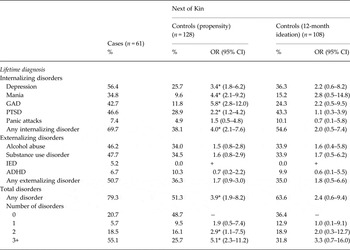
As reported by next-of-kin, soldiers who die by suicide are significantly more likely to have a prior mental disorder (79.3%) than are propensity-score matched control soldiers (51.3%; OR 3.9) (Table 1). Examination of individual disorders reveals that suicide decedents are significantly more likely to have a lifetime history of five of the six internalizing disorders examined; however, there are no significant differences in the rates of any externalizing disorders between cases and propensity matched controls. There also is a dose–response relation between number of prior disorders and odds of suicide death (χ2 = 17.4, p < 0.05).
Next of kin-reported prevalence of lifetime mental disorders and association with suicide death

GAD, generalized anxiety disorder; IED, intermittent explosive disorder; PTSD, post-traumatic stress disorder; ADHD, attention deficit hyperactivity disorder.
−reference; +unstable estimate.
*p < 0.05 (cases v. control).
Comparison of cases to controls with suicide ideation in the past 12 months reveals a different pattern of findings. Specifically, each of the ORs is smaller in magnitude and there are no significant differences in lifetime history of mental disorders between soldiers who die by suicide and those who have experienced recent suicide ideation. This means that although mental disorders are more prevalent among suicide decedents than among controls matched on demographic and Army history variables, they do not differ between soldiers with suicide ideation and those who died by suicide.
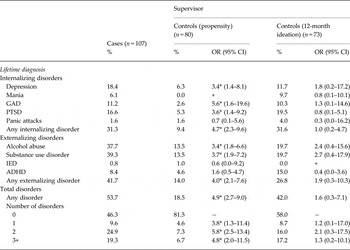
Among supervisor-reported data, the same overall pattern of results is observed, with a few important differences. Army supervisors report substantially lower lifetime rates of mental disorders for both cases and controls; however, like next-of-kin, they report that soldiers dying by suicide are significantly more likely to have a prior mental disorder (53.7%) than propensity matched control soldiers (18.5%; OR 4.9) (Table 2). As with next-of-kin, these results are driven largely by differences in internalizing disorders; however, supervisors also report significantly higher rates of alcohol and substance use disorders among suicide decedents than propensity matched controls (ORs 3.4–3.7). Here too, when suicide decedents are compared with recent suicide ideators, the effects are attenuated and there are no longer any significant differences between cases and ideator controls.
Supervisor-reported prevalence of lifetime mental disorders and association with suicide death

GAD, generalized anxiety disorder; IED, intermittent explosive disorder; PTSD, post-traumatic stress disorder; ADHD, attention deficit hyperactivity disorder.
−reference; +unstable estimate.
*p < 0.05 (cases v. control).
Thirty-day history of mental disorders
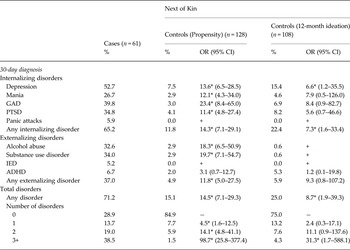
Differences between cases and propensity matched controls are much more pronounced for disorders present in the past 30 days. As reported by next-of-kin, 71.2% of soldiers dying by suicide had a mental disorder in the past 30 days, compared with only 15.1% of propensity match control soldiers (OR 14.5) (Table 3). For cases, the 30-day prevalence of disorders approximates their lifetime history of mental disorders, whereas for propensity matched controls the 30-day prevalence is much lower, yielding significant ORs for every disorder examined (ORs 11.4–23.4) except ADHD (OR 3.1), as well as a strong dose-response relation between number of disorders and odds of suicide death (χ2 = 55.3, p < 0.05).
Next of kin-reported prevalence of mental disorders in the past 30 days and association with suicide death

GAD, generalized anxiety disorder; IED, intermittent explosive disorder; PTSD, post-traumatic stress disorder; ADHD, attention deficit hyperactivity disorder.
−reference; +unstable estimate.
*p < 0.05 (cases v. control).
In the comparison of cases and controls with recent suicide ideation, the rates of 30-day mental disorders are much higher among suicide decedents than among 12-month ideators in most cases (e.g. 71.2% v. 25.0% for any disorder). Although most of these differences are smaller in magnitude than those for propensity matched controls and most are no longer statistically significant (due to lower statistical power), the non-significant effect sizes are relatively large (e.g. OR 5.6–7.9 for internalizing disorders). Several significant effects are observed, with the 30 presence of MDD (OR 6.6), any internalizing disorder (OR 7.3), any disorder (OR 8.7), and the presence of 3+ disorders (OR 31.3) differing between suicide ideators and suicide decedents.
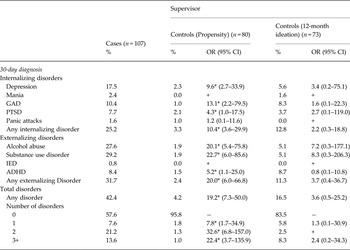
Among supervisor-reported data, this overall pattern of results is observed as well. Army supervisors report substantially lower rates of 30-day disorders for both cases and controls, but like next-of-kin, they report that soldiers dying by suicide are significantly more likely to have a recent mental disorder (42.4%) than are propensity matched control soldiers (4.2%; OR 19.2) (Table 4). As with next-of-kin respondents, results are significant for every disorder except ADHD, although for SUP-reported data, panic disorder also is not significant. In the comparison of suicide decedents and ideator controls, all effects are reduced and none are statistically significant, although some effects are relatively large in magnitude (e.g. ORs 7.2–8.3 for alcohol/substance use disorders).
Supervisor-reported prevalence of mental disorders in the past 30 days and association with suicide death

GAD, generalized anxiety disorder; IED, intermittent explosive disorder; PTSD, post-traumatic stress disorder; ADHD, attention deficit hyperactivity disorder.
−reference; +unstable estimate.
*p < 0.05 (cases v. control).
Prior history of suicidal behavior
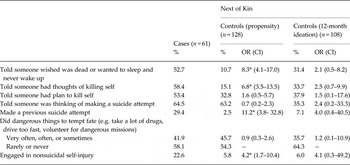
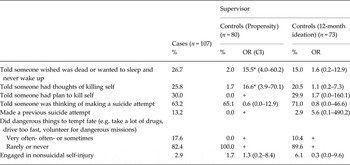
More than half (52.7%/58.4%) of case next-of-kin informants and a quarter (26.7%/25.8%) of case supervisor informants report that the soldier who died by suicide had told at least one person about wanting to be dead/ or having thoughts of killing him/herself, compared with only 10.7%/15.1% and 2.0%/1.7% of propensity matched control informants, respectively (ORs 6.8–16.6). There are no significant differences between cases and ideator controls on these variables (ORs 1.1–2.5) (Tables 5 and 6). Among those who had expressed thoughts of death/suicide to others, there is no increased risk of suicide associated with verbalizing a plan or telling others about thinking about making a suicide attempt. There is also no increased risk of suicide associated with engaging in risky or dangerous behavior across the groups.
Next of kin-reported warning signs and history of suicidal behavior

*p < 0.05 (cases v. control). −reference.
Supervisor-reported warning signs and history of suicidal behavior

*p < 0.05 (cases v. control). −reference; +unstable estimate.
According to next-of-kin, nearly one-third (29.4%) of soldiers who die by suicide had made a prior suicide attempt and nearly one-quarter (22.6%) had engaged in NSSI, compared with only 2.5%/5.8% of propensity-matched controls (ORs 4.2–11.2). There are no significant differences between cases and controls with 12-month suicide ideation on these variables. According to supervisor informants, 13.2% of soldiers who die by suicide had made a prior suicide attempt and 2.9% had engaged in NSSI, rates that did not differ from those for either propensity-matched controls (0.0%/1.7%) or controls with 12-month suicide ideation (2.9%/6.1%).
Characteristics of suicide death
Both next-of-kin and supervisor informants reported that in the majority of cases (58.7%/61.3%) there did not appear to be a great deal of advanced planning or preparation preceding the suicide (e.g. searching for and obtaining method) (online Supplemental Table S2). In the majority of instances (76.8%/84.1%) the decedent did not make any arrangements for what would happen if they died (e.g. making out a will), nor did they write a suicide note (61.6%/70.6%). Most suicide decedents (52.7%/58.8%) also did not contact anyone before, during, or after their fatal attempt, and most (70.9%/59.9%) made their fatal attempt when no one was nearby or in visual contact. On balance, most suicide decedents (59.1%/54.0%) did not take precautions to prevent being discovered during their attempt, and a substantial proportion (43.1%/39.8%) made their attempt in a manner in which intervention was probable. Finally, 45.8%/41.9% of decedents had heard about a suicide or suicide attempt in their local area before their own fatal attempt.
Discussion
There are six key findings from this study. First, most soldiers who die by suicide (79.3%) have a lifetime history of a mental disorder, and such disorders are strong risk factors for suicide death. Second, the presence and accumulation of mental disorders in the past 30 days are especially strong predictors. Third, most suicide decedents tell someone else of their suicidal thoughts prior to death, and approximately one-quarter had engaged in a prior suicide attempt or NSSI. Fourth, in most cases soldiers dying by suicide do not show evidence of overt planning or preparation and do not appear to take active precautions to minimize the likelihood of intervention by others. Fifth, both next-of-kin and supervisor informants identified significant risk factors among suicide decedents, although next-of-kin reported substantially higher rates of mental disorders in all soldiers. Sixth, and perhaps most importantly, most risk factors emerged when comparing suicide decedents to propensity matched controls, but not when comparing suicide decedents to suicide ideators – with the important exception being the presence and accumulation of 30-day mental disorders. Each of these warrants further comment.
The finding that the majority of people who die by suicide have a prior mental disorder is well-documented in the literature (Cavanagh et al. Reference Cavanagh, Carson, Sharpe and Lawrie2003). What is new here are data showing that 30-day mental disorders are especially strong predictors of suicide, with ORs that were several times as large as those for lifetime disorders. A recent meta-analysis of several decades of research on risk factors for suicide death revealed that less than 2% of all such studies have focused on short-term (i.e. 1-month or less) risk factors for suicide death (Franklin et al. Reference Franklin, Ribeiro, Fox, Bentley, Kleiman, Huang, Musacchio, Jaroszewski, Chang and Nock2017). Additional research focusing on short-term risk factors for suicidal behavior is an important priority.
Previously available data from the Department of Defense Suicide Event Report (DoDSER; Gahm et al. Reference Gahm, Reger, Kinn, Luxton, Skopp and Bush2012) suggest that 24.2% of Army soldiers ‘communicate potential for self-harm’ before their death (DoDSER, 2016). Consistent with this, in the current study 25.8% of Army supervisors reported that the deceased soldier had told someone that s/he had thoughts of suicide. New in this study is the finding that a much higher percentage of Army suicide decedents (58.4%) had told their next-of-kin that they were thinking about killing themselves shortly before their death. This finding is consistent with prior psychological autopsy studies examining communications to family members among civilian samples (Robins et al. Reference Robins, Gassner, Kayes, Wilkinson and Murphy1959; Cavanagh et al. Reference Cavanagh, Carson, Sharpe and Lawrie2003) and suggests a potential avenue for suicide prevention among soldiers (e.g. the facilitation of next-of-kin reports to the Army about mental health concerns among soldiers). Also new in this study is the finding that among those who had verbalized thoughts of suicide, there was no increased risk of suicide associated with the verbalization of a suicide plan or intention to act on one's suicidal thoughts. This is surprising as suicide risk assessment guidelines often highlight the importance of suicide planning and intention in denoting elevated risk for suicide death (Jacobs et al. Reference Jacobs, Baldessarini, Conwell, Fawcett, Horton, Meltzer, Pfeffer and Simon2010). Future studies are needed to confirm this finding; however, one take-home message from the current findings are that although most people who die by suicide tell others of their suicidal thoughts, it is difficult to know which such people will v. will not act on their thoughts. In the absence of additional information about factors that increase risk of such action, it would be prudent clinically to take all such verbalizations seriously.
In addition to telling others about their suicidal thoughts, most soldiers who die by suicide appear not to take active precautions to prevent others from stopping their fatal suicide attempt and make their fatal attempt in a way in which intervention by someone was possible. Taken together with the finding that most soldiers tell someone about their suicidal thoughts before dying, these results suggest that there are potential opportunities for suicide prevention in the lead up to fatal suicide attempts.
Perhaps the most important finding from this study is that whereas lifetime mental disorders and prior history of suicidal thoughts and behaviors differed significantly between suicide cases and propensity matched controls, most of those differences were substantially smaller – and in most cases nonsignificant – when comparing suicide cases and those with recent suicide ideation. This means that many of the well-known risk factors for suicide reported in prior psychological autopsy studies are actually predictive of suicide ideation, but not of the transition from suicide ideation to death. This extends findings from prior studies showing that many known risk factors for suicide attempt actually predict suicide ideation, but not the transition from thought to action (Nock et al. Reference Nock, Kessler and Franklin2012, Reference Nock, Kessler and Franklin2016), and highlights the need to identify factors that can predict which people with suicide ideation are at greatest risk for suicide death. Such information is sorely needed for suicide prevention efforts.
The results of this study should be interpreted in light of several important limitations. First, as in all psychological autopsies, these data are based on retrospective report of third-party informants following a known suicide, which may introduce bias in the form of over-reporting of mental disorders among known suicide cases and under-reporting of aspects of soldiers’ psychological experiences that may not be known to third-parties (e.g. the presence of a suicide plan, level of intent to die). Second, although most informants identified by CMAOC (for cases) and soldiers (for controls) agreed to participate and completed the survey (58.2–80.5%), our sample included only about one-third of the population of all suicides during the study period, along with a similar proportion of the target control sample, limiting the representativeness of the final sample. Third, although this is the largest psychological autopsy study of servicemember suicide ever conducted, the sample was relatively small, limiting our power to detect small-to-medium effects or to test the interactions between different risk factors. Fourth, we examined a limited range of potential risk factors in this paper. Future papers will report on tests of other putative risk and protective factors for suicide among soldiers, such as lifetime stressors, military experiences, social support, and others.
Supplementary material
The supplementary material for this article can be found at https://doi.org/10.1017/S0033291717001179.
Acknowledgements
Army STARRS was sponsored by the Department of the Army and funded under cooperative agreement number U01MH087981 with the US Department of Health and Human Services, National Institutes of Health, National Institute of Mental Health (NIH/NIMH). The contents are solely the responsibility of the authors and do not necessarily represent the views of the Department of Health and Human Services, NIMH, the Department of the Army, or the Department of Defense.
Role of the Sponsors
The sponsors specified the topic in the RFP but had no role in the design of the study. However, as a cooperative agreement, collaborating scientists appointed to the project by NIMH and Army liaisons/consultants participated in the refinement of the study protocol originally proposed by Ursano, Kessler, and the other initial Army STARRS collaborators. None of the Army or NIMH collaborators was involved in planning or supervising data analyses for this report, but they did read a draft and offered suggestions for revision. Although a draft of this manuscript was submitted to the Army and NIMH for review and comment prior to submission, this was with the understanding that comments would be no more than advisory. Other than for the above, the funding organization played no role in the design or conduct of the study; collection, management, analysis, or interpretation of the data; preparation, review, approval of the manuscript; or decision to submit the manuscript for publication.
The STARRS-LS Collaborators: The Army STARRS Team consists of Co-Principal Investigators: Robert J. Ursano, M.D. (Uniformed Services University of the Health Sciences) and Murray B. Stein, M.D., M.P.H. (University of California San Diego and VA San Diego Healthcare System). Site Principal Investigators: Steven Heeringa, Ph.D. (University of Michigan) and Ronald C. Kessler, Ph.D. (Harvard Medical School). National Institute of Mental Health (NIMH) collaborating scientists: Lisa J. Colpe, Ph.D., M.P.H. and Michael Schoenbaum, Ph.D. Army liaisons/consultants: COL Steven Cersovsky, M.D., M.P.H. [USAPHC (Provisional)] and Kenneth Cox, M.D., M.P.H. [USAPHC (Provisional)]. Other team members: Pablo A. Aliaga, M.A. (Uniformed Services University of the Health Sciences); COL David M. Benedek, M.D. (Uniformed Services University of the Health Sciences); K. Nikki Benevides, M.A. (Uniformed Services University of the Health Sciences); Paul D. Bliese, Ph.D. (University of South Carolina); Susan Borja, Ph.D. (NIMH); Evelyn J. Bromet, Ph.D. (Stony Brook University School of Medicine); Gregory G. Brown, Ph.D. (University of California San Diego); Laura Campbell-Sills, Ph.D. (University of California San Diego); Catherine L. Dempsey, Ph.D., M.P.H. (Uniformed Services University of the Health Sciences); Carol S. Fullerton, Ph.D. (Uniformed Services University of the Health Sciences); Nancy Gebler, M.A. (University of Michigan); Robert K. Gifford, Ph.D. (Uniformed Services University of the Health Sciences); Stephen E. Gilman, ScD (Harvard School of Public Health); Marjan G. Holloway, Ph.D. (Uniformed Services University of the Health Sciences); Paul E. Hurwitz, M.P.H. (Uniformed Services University of the Health Sciences); Sonia Jain, Ph.D. (University of California San Diego); Tzu-Cheg Kao, Ph.D. (Uniformed Services University of the Health Sciences); Karestan C. Koenen, Ph.D. (Columbia University); Lisa Lewandowski- Romps, Ph.D. (University of Michigan); Holly Herberman Mash, Ph.D. (Uniformed Services University of the Health Sciences); James E. McCarroll, Ph.D., M.P.H. (Uniformed Services University of the Health Sciences); James A. Naifeh, Ph.D. (Uniformed Services University of the Health Sciences); Tsz Hin Hinz Ng, M.P.H. (Uniformed Services University of the Health Sciences); Matthew K. Nock, Ph.D. (Harvard University); Rema Raman, Ph.D. (University of California San Diego); Holly J. Ramsawh, Ph.D. (Uniformed Services University of the Health Sciences); Anthony Joseph Rosellini, Ph.D. (Harvard Medical School); Nancy A. Sampson, B.A. (Harvard Medical School); CDR Patcho Santiago, M.D., M.P.H. (Uniformed Services University of the Health Sciences); Michaelle Scanlon, MBA (NIMH); Jordan W. Smoller, M.D., Sc.D. (Harvard Medical School); Amy Street, Ph.D. (Boston University School of Medicine); Michael L. Thomas, Ph.D. (University of California San Diego); Leming Wang, M.S. (Uniformed Services University of the Health Sciences); Christina L. Wassel, Ph.D. (University of Vermont); Simon Wessely, FMedSci (King's College London); Christina L. Wryter, B.A. (Uniformed Services University of the Health Sciences); Hongyan Wu, M.P.H. (Uniformed Services University of the Health Sciences); LTC Gary H. Wynn, M.D. (Uniformed Services University of the Health Sciences); and Alan M. Zaslavsky, Ph.D. (Harvard Medical School).Additional Information: A complete list of Army STARRS publications can be found at http://www.ARMYSTARRS.org.
Financial Disclosure
In the past 3 years, Dr Kessler received support for his epidemiological studies from Sanofi Aventis, was a consultant for Johnson & Johnson Wellness and Prevention, and served on an advisory board for the Johnson & Johnson Services Inc. Lake Nona Life Project. Kessler is a co-owner of DataStat, Inc., a market research firm that carries out healthcare research. Dr Stein has been a consultant for Healthcare Management Technologies, Janssen Pharmaceuticals, Pfizer, and Tonix Pharmaceuticals. The remaining authors report nothing to disclose.