


Introduction
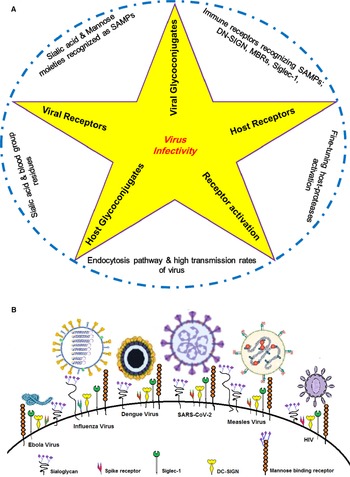
From the literature, it seems that enveloped viruses with high pathogenicity and transmission rate use similar mechanisms for infection and dissemination in the human host. Here, a molecular pentacle consisting of host–viral glycoconjugates (mainly sialic acid and oligo-mannose moieties), host–viral receptors (spike and innate immune receptors; mannose-binding receptors (MBRs), sialic acid-binding immunoglobulin-like lectins (Siglecs), DN-SIGN) and spike activation–cleavage process for these types of viruses is proposed (Fig. 1a). This research topic can be the main focus for finding potential treatment or prevention strategies for these types of viral infections in the future.
Enveloped viruses use similar molecular mechanisms for pathogenesis and transmission. (a) Through a molecular pentacle consisting of host–viral glycoconjugates (mainly sialic acid and oligo-mannose moieties), host–viral receptors (spike and innate immune receptors recognizing SAMPs; MBRs, Siglecs, DN-SIGN), and activation of host proteases viruses achieved high transmission rates and enhances infectivity. (b) Lectin receptors, DC-SIGN, mannose-binding receptors (MBRs) and the sialic acid-binding immunoglobulin-like lectin 1 (Siglec-1) are functioning as attachment receptors whereby recognizing PAMP moieties as SAMPs and enhancing receptor-mediated infection. Clusters of mannose and sialic acid moieties on SARS-CoV-2, HPIAV H1N1, HIV, dengue virus (DENV), measles virus (MV) and Ebola virus (EBOV). Spike proteins target lectin receptors and trigger entry of virus through endocytosis pathway.

Different virus genera may employ various spike proteins and binding receptors for infecting host target cells, but at the same time, those viruses may use similar mechanisms via glycans and recognition receptors to invade the host and avoid or/and deceive the immune responses (Refs Reference Trbojević-Akmačić, Petrović and Lauc1,Reference Bermejo-Jambrina2). In characterising the structural features and pathogenesis of enveloped viruses for recognition and infection of human cells, it has been found that viruses predominantly recognise host sialic acids and histo-blood group antigens (HBGAs) of the mucosal surface. These glycotopes are commonly acting as pathogen decoys since a virus or other glycan-binding organism that reaches a mucosal surface will first encounter mucus-mostly secreted glycoproteins, which are heavily sialylated or HBGA-containing. A molecular mechanism proposed for the high pathogenesis of enveloped viruses is glycan-binding receptors that enable them to bind to multiple host receptors and gift them high infectivity and transmissibility potential, as is proposed for SARS-CoV-2 and H1N1 influenza virus pandemics (Refs Reference Wielgat3,Reference Lübbers, Rodríguez and Van Kooyk4).
In another word, enveloped viruses via their own glycans can infect the host cells severely where the immune system cannot discriminate between the self and non-self glycans. They enter cells through endocytosis while bypassing the endosome pathway and the recognition by innate immune receptors. The endosome is the main site of Toll-like receptor recognition and Major histocompatibility complex (MHC) antigen presentation, which then triggers an innate immune response; therefore, these viruses presumably evolved to bypass the endosome and evade the host's innate immune system. Importantly, several human viruses like SARS-CoV-2, H1N1, Ebola, measles viruses (MVs) and human immunodeficiency virus (HIV) use this simple mechanism to evade the host's innate immune system (Fig. 1b). By bypassing the endosome pathway that stimulates interferon (IFN) genes through the Janus-activated kinase-signal transducer and activator of the secretion of antiviral proteins, viruses can evade the pattern recognition-induced secretion of IFNs (Refs Reference Shirato5,Reference Li6). Severe cases of two pandemics H1N1 and coronavirus disease (COVID)-19 were characterised by an early poor immune response and high inflammatory late reactions. In animal models of SARS disease, young mice developed lethal disease featured by pulmonary oedema, diffuse alveolar damage and an excessive influx of monocytes/macrophages (Mf) accompanied by delayed IFN-α/β response, whereas targeting IFN signalling showed protective effects and better prognosis outcomes (Refs Reference Deng7–Reference Kumar9).
Notable, the similar symptoms and severity of infections by the original and mutated forms of mentioned viruses have been attributed to multiple glycan-receptor binding that easily evades immune-susceptible cells, deceives innate and adaptive immunity, causes systemic spread and the cytokine storm production that is common to severe cases of SARS-CoV-2 and highly pathogenic influenza virus subtypes H1N1, H7N9, H9N2/G1 (Refs Reference Li6,Reference Hattatoğlu and Yıldız8).
Here, this literature survey tries to provide reports reflecting the differences and similarities between the epidemic viruses with pandemic potential involved in the different diseases, whereby may serve as potential therapeutic strategies in the future (Table 1).
Similar viral entry mechanisms and entry receptors are used by major human enveloped viral pathogens

Viral host cell entry is a multistep process involving a number of cellular attachment factors and receptors.
Human glycoconjugates and virus pathogenesis
Different individuals respond to a virus infection differentially. Variability in the pathogenesis of a virus and its infectivity in different individuals can be due to the differences in the receptors that exist between individuals. Likewise, variability in infectivity and transmissibility of different viruses can then be due to differences in their ability to bind to host glycan receptors or cellular glycotopes that vary between species and tissues. For example, SARS-CoV-2 in comparison to SARS-CoV-1 showed more ability in infectivity and transmissibility that has been attributed to its additional compatibility with human mucosa. The glycocalyx and glycan motifs play important roles in virus tendency for a host whereby the initiation of cell adhesion, receptor activation, signal transduction and endocytosis may confer (Refs Reference Trbojević-Akmačić, Petrović and Lauc1,Reference Sukegawa31,Reference Wallace32).
The host's glycocalyx constitutes the first barrier for the virus entry, on one side, and cellular glycotopes are providing the primary attachment site for the virus, on the other side, whereby a subsequent virus-tight binding with its receptor will have happened. For example, gastrointestinal and respiratory viruses identify the mucus layer as a major host-range determinant and barrier for zoonotic transfer (Refs Reference Trbojević-Akmačić, Petrović and Lauc1,Reference Wallace32). To emphasise the role of mucus as the first and primary barrier in viral infection, here is an example of a genetic disease that causes resistance to viral infection. Two siblings with a rare congenital disorder of glycosylation due to mutations in mannosyl oligosaccharide glucosidase were resistant to infections by particular, enveloped viruses. The glycan alteration derived from this disease results in an infection resistance to particular enveloped, glycosylation-dependent viruses such as influenza and HIV, but not to non-enveloped or non-N-glycosylation-dependent viruses such as hepatitis A, adenovirus or vaccine virus (Refs Reference Trbojević-Akmačić, Petrović and Lauc1,Reference Nunes-Santos, Kuehn and Rosenzweig33).
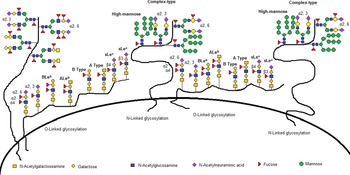
Viruses can interact with both forms of glycans; O-and N-linked glycans that are present in the mucosa (Fig. 2). N-glycans with a common glycan core can be grouped into high-mannose, hybrid and complex-type glycans, as depicted in Figure 1a (Ref. Reference Jansen34). In N-glycosylation, N-acetyl-glucosamine (GlcNAc) in an oligosaccharide binds covalently to the polypeptide chain by an N-glycoside linkage with the amide nitrogen of an asparagine residue in the sequence Asn-X-Ser/Thr (X is any amino acid other than proline). The main type of O-glycosylation in humans is the mucin-type O-glycosylation, which means that N-acetyl-galactosamine (GalNAc) bonds covalently to the oxygen atom of the hydroxyl group of a serine or threonine residue replacing the hydrogen in the hydroxyl group to form an O-ligand glycoprotein by O-glycoside linkage (Fig. 2) (Refs Reference Li6,Reference Wallace32,Reference Watanabe35).
Viruses can interact with both forms of glycans; O- and N-linked glycans that are present in mucosa and glycocalyx. In N-glycosylation, N-acetyl-glucosamine (GlcNAc) in an oligosaccharide binds covalently to the polypeptide chain by an N-glycoside linkage with the amide nitrogen of an asparagine residue in the sequence Asn-X-Ser/Thr (X is any amino acid other than proline). The main type of O-glycosylation in humans is the mucin-type O-glycosylation, which means that N-acetyl-galactosamine (GalNAc) bonds covalently to the oxygen atom of the hydroxyl group of a serine or threonine residues replacing the hydrogen in the hydroxyl group to form an O-ligand glycoprotein by O-glycoside linkage. Biosynthesis of type 1-based HBGAs proceeds by stepwise addition of monosaccharide units from a precursor disaccharide present at the terminus of glycan chains from either O-linked or N-linked glycans of glycoproteins, or glycolipids. The ABH and Lewis histo-blood group antigens and deduced blocking or masking of synthesis of 2,3-sialic acid antigens by preoccupied 1,2-linked fucose by the H fucose-transferase encoded by the FUT 2 gene in humans.

Formation and extension of glycans require the synergistic completion of two types of glycan processing enzymes, one is glycosyltransferase which catalyses the formation of glycoside linkages, and another is glycosidase which catalyses the hydrolysis of glycoside linkages (Fig. 2).
Inflammatory conditions alter the synthesis of glycans whereby tumour necrosis factor (TNF)-α, interleukin (IL)-6 and IL-8 increase the expression of fucosyltransferases (FUT11 and FUT3), sialyltransferases (STs; ST3GAL6 and ST6GAL2) and sulphotransferases (CHST4 and CHST6) involved in the biosynthesis of sialylated and/or sulphated Lewis × epitopes in the human bronchial mucosa. Bronchial mucins exhibit glycosylation alterations, especially increased amounts of the sialyl-Lewisx and 6-sulpho-sialyl-Lewisx terminal structures. A significant increase in sialylation of tracheal mucins is through the increased expression of both fucosyltransferases and α-2,3-STs by normal bronchial mucosal cells. In parallel, the amount of sialyl-Lewis × and 6-sulpho-sialyl-Lewis × epitopes at the periphery of high molecular weight proteins is also increased. These epitopes are preferential receptors for Pseudomonas aeruginosa, the bacteria responsible for the chronic infection of the airway tract and involved in the morbidity and early death of cystic fibrosis patients. Alterations in O- or N-glycan structure stimulate endocytosis and intracellular accumulation of mucins (Refs Reference Bhide and Colley36–Reference Groux-Degroote38).
Human mucosa glycotopes as primary binding sites for viruses
Both O-linked and N-linked glycans are in the mucosal barrier (such as mucins MUC2, MUC5A, MUC5B and MUC17).
The O-linked glycosylation is the main glycan present in mucins. They contain 1–20 sugar residues that exist in both linear and branched structures. The chains are usually terminated by fucose (Fuc), galactose (Gal), GalNAc or sialic acid residues in the peripheral region and form blood group antigens (BGAs) such as A, B, H, Lewis-a (Lea), Lewis-b (Leb), Lewis-x (Lex), Lewis-y (Ley), as well as sialyl-Lea and sialyl-Lex structures. Sulphation of Gal and GlcNAc residues causes further diversification (Fig. 2). The biosynthesis of ABO histo-blood group antigens (ABH) and Lewis Blood group antigens (BGAs) is performed by stepwise addition of monosaccharide units from a precursor disaccharide present at the ends of glycan chains from glycans of O- or N-linked glycoproteins or from glycolipids.
The respiratory mucosal glycan complex is present in gel-forming secretory mucins (MUC5AC and MUC5B), non-gel-forming secretory mucins (MUC7, MUC8, MUC19), multiple globular proteins in MUC5AC/5B networks and secretory vesicles (Refs Reference Wallace32,Reference Linden37).
About half of the total O-linked glycans have been found sialylated and/or sulphated. The diversity of sialylated O-linked glycan structures present on high-molecular-weight human mucins has differential effects on the binding of viruses as has been reported for N-linked glycans. Sialic acid (Sia)-linkage-type, number of N-Acetyllactosamine (LacNAc; CD75) repeats, sulphation, fucosylation and other modifications of the terminal and subterminal residues are known governing binding and affinity of respiratory viruses (Fig. 2) (Ref. Reference Wallace32). The terminal glycotopes vary between species and tissues (Ref. Reference Wang39) and thereby affect host recognition by the virus and binding. Sia-linkage type (α2,3 or α2,6) is the hallmark structural element governing the binding affinity of influenza A viruses (IAVs; α2,3Sia binding by avian viruses; α2,6Sia binding by human and swine viruses). Fucosylation is another abundant modification affecting specific virus-binding affinity. SLeX and/or SLeA are terminal glycotopes (containing fucose) frequently found on O-linked glycans of human mucus and N-glycans of respiratory epithelium (Fig. 2) (Refs Reference Li6,Reference Wallace32,Reference Nunes-Santos, Kuehn and Rosenzweig33,Reference Watanabe35).
Human viruses predominantly recognise three distinct families of glycotopes including Blood group antigens (BGAs) recognised by noroviruses (NoVs) and human rotaviruses (HRVs); sialoglycans recognised by influenza viruses, orthoreoviruses and specific picornaviruses; and glycosaminoglycans recognised by papillomaviruses and parvo-viruses among others (Ref. Reference Shanker40).
GBAs are the main glycotopes on the surface of the gastrointestinal mucosa, which are involved in the binding of viruses and infection of the gastrointestinal tract by them.
BGAs are genetically determined neutral glycans expressed on the surface of intestinal epithelial cells and found in mucosal secretions of individuals. Two BGA families, the ABH and Lewis families, are implicated in binding to viruses (Fig. 2). The antigens producing polymorphic ABH, Lewis and secretor phenotypes can be found on a variety of N- and O-linked glycoproteins. BGA binding occurs by the two leading causes of viral gastroenteritis, NoVs and HRVs through the differential strain-specific HBGA binding. NoVs are non-enveloped positive-sense ssRNA viruses, some of which cause infections in humans along with the evolution of NoVs. The mode of BGA binding is also distinct, with the GI strains primarily binding to the galactose (Gal) of the disaccharide precursor (Fig. 2), and the GII strains binding to the fucose (Fuc) moiety of the BGA (Fig. 2) (Refs Reference Jansen34,Reference Miura41). The distal portion of the spike protein of gastroenteric rotaviruses (RVs) engages sialic acids in binding to cellular receptors, thereby facilitating viral attachment and entry of the virus. However, the major HRVs (P[II]) recognise human HBGAs for attachment, while the sialic acid-dependent RVs variants (P[I]) mainly infect animals but also bind the A antigens of the porcine and bovine mucins. Evolution of RVs variants P[I] is dependent on the A antigen (BGAs) as a possible factor for interspecies transmission of RVs (Ref. Reference Liu42).
Sialic acid linkages as important glycotopes in cell–virus interaction
Sialylated O- and N-glycans play essential roles in the immune system, pathogen recognition and cancer. In the context of virus entry, there are scenarios discussing the role of sialoglycans as ligands recognised by specific receptors expressed in a host or viral membrane. Cell surface sialic acids have many potential pleiotropic effects. First, they give a negative charge to the cell surface and their removal reduces the net charge and hydrophilicity of the cell surface. Second, they can cause charge repulsion between adjacent cell surface molecules. Third, they represent ligands for endogenous immune receptors like Siglecs and selectins. Fourth, sialic acid removal exposes underlying glycans (mostly galactose residues), which can be recognised by other endogenous receptors, such as galectins and the galactose-binding proteins of Mf. Finally, immune suppressor receptors Siglecs (e.g. CD22) preferentially recognise the α2–6-linkages, with less/no affinity for α2–3-linked Sia (Refs Reference Wielgat3,Reference Bhide and Colley36,Reference Varki and Gagneux43). Human cells specifically express an excess amount of α2–6-linked sialic acids and its sialoadhesin receptor/Siglec-1. Studies have found an excess amount of the α2,6-linkage Sia, a preferable human influenza receptor responsible for mild illness but high transmissibility, in the upper respiratory tract. The α2,3-linkage Sia expression, an avian influenza receptor related to fatal disease, is located in the lower parts of the trachea towards the lung, a major target organ for influenza virus replication. The large proportion of the α2,6-linkage Sia may exert selective pressure for the selection of influenza Avian variants with altered receptor preference for this human-type a2,6 receptor, a crucial first step for generating a human pandemic. It is assumed that the dominant 2,6-Sias in the respiratory tracts of modern humans could be a result of human co-evolution in an arms race of our ancient hominid ancestors against the deadly avian IAVs or other 2,3-Sia-binding pathogens (Refs Reference Varki and Gagneux43–Reference Jiang46).
Generally, around 80% of the general population is secretors that mainly express the 2, 6-linked sialic acids in the saliva and in the upper respiratory tracts and ~20% are non-secretors who may also express 2,6-linked sialic acids in the saliva and the upper respiratory tracts but mainly express the 2,3-linked sialic acids in the lower respiratory tracts in human populations (Fig. 2).
Positive secretors naturally block the expression of the 2,3-linked sialic acids at the end of glycans by the preoccupied 1,2-linked fucose. The secretors are naturally resistant to H7N9 IAVs because they mainly express the 2,6-linked sialic acids in the upper respiratory tracts and may not express or express low amounts of the 2,3-linked sialic acids in their lower respiratory tracts.
Negative secretors (absence of 1,2-linked fucose in the glycan chain) mainly express 2,3-linked sialic acids in the respiratory tract; however, the upper part may also express 2,6-linked sialic acids (Refs Reference Li6,Reference Jiang46).
Synthesis of sialylated glycans on proteins and lipids in the secretory pathway is catalysed by 20 Golgi localised STs with distinct substrate and linkage specificity. STs have been reported to sialylated N-glycans, as well as core-1, core-2, core-3 or core-4 O-glycans.
In mammalian cells, they are including the ST6Gal-I and ST6Gal-II, ST3Gal-IV and ST3Gal-VI, and the polysialyltransferases (polySTs), ST8Sia-II and ST8Sia-IV. ST6Gal-I and II add a single Sia in an α2,6-linkage to terminal Gal residues of glycoproteins and glycolipids. An inducible, liver-specific P1 promoter has been found to drive high ST6Gal-I expression during inflammation and the increase in blood-secreted ST6Gal-I.
ST3Gal-IV and ST3Gal-VI add a single Sia in an α2,3-linkage to terminal Gal residues of glycoproteins and glycolipids. Both enzyme groups use the type II lactosamine structure (Galβ1, 4GlcNAc), and are believed to be involved in the synthesis of the sialyl Lewis X (sLeX) determinants on leukocytes as ligands for E-, L- and P-selectins. These ligands are required for leukocyte binding to selectins on endothelial cells, and their slow rolling and tethering before extravasation (Fig. 2).
ST8Sia-II and ST8Sia-IV polymerise long chains of α2, 8-linked Sia that can extend from 8 to over 400 residues at the termini of both N-linked and O-linked glycans. In mammals, polySia is found in the brain and is essential for cell migration and plasticity during nervous system development and to maintain these processes in select areas of the adult brain such as the hippocampus, olfactory bulb and hypothalamus. The polySia play roles in the regeneration and development of damaged neurons and liver and show substrate preferences. For example, the neural cell adhesion molecule (NCAM) can be poly sialylated by both polySTs (Refs Reference Li6,Reference Watanabe35,Reference Bhide and Colley36).
Accordingly, intra-species differences and human sialic acid polymorphism cause annual seasonal epidemics and irregular, unpredictable pandemics of H1N1 and SARS-CoV-2 (Ref. Reference Jiang46). The scenario of the polymorphism of α2,6- and α2,3-linked Sias in human saliva (secretor and non-secretor of human populations, respectively) can explain the principle of H1N1-caused pandemics and cycles of seasonal epidemics. The scenario may apply to other occasional pandemics that are expected to happen in the future by cross-species transmission of zoonotic viruses (Refs Reference Sriwilaijaroen44,Reference Jiang46). Both deadly H1N1 and COVID-19 pandemics are predicted to be first transmitted and adapted from infected wild and domestic animals with wild waterfowl as the natural reservoir, to human hosts. In reports, the pathogenesis of H1N1 and SARS-CoV-2 pandemics have been attributed to respiratory track Sia-linkage types as ligands recognised by viral spikes as specific receptors (Refs Reference Jansen34,Reference Jiang46). All native avian and many animal IAVs prefer binding sialic acids (Sias) linked to galactoses with an α2,3-linkage (Siaα2,3Gal), whereas human-adapted IAVs prefer the α2,6-linkage (Siaα2,6Gal). A dual mutational mechanism of the 1918 H1N1 influenza virus during its evolution for human hosts led to two human H1 subtypes, a human-like H1 D225 subtype and an avian-like H1 225G subtype, each with distinct transmissibility and infectivity. The H1 D225 subtype prefers 2,6-linked Sias abundant in humans saliva and the upper respiratory tracts which have been responsible for the widespread transmission of 1918 H1N1, while the H1 225G subtype binds to 2,3-linked Sias (birds glycotope), preferentially.
The H1 225G subtype infects a small subpopulation, but is responsible for the high fatality of the 1918 H1N1 pandemics, while the H1 D225 subtype shows a high transmissibility rate and infects a large human population. The H1 D225 subtype may be responsible for the widespread nature and mild cases of the 1918 H1N1 pandemic, while the H1 225G subtype is hypothesised to be responsible for the severe pathogenesis and high fatality of the 1918 pandemic. Both subtypes have caused the H1N1 seasonal epidemics and 1918, 1977 and 2009 H1N1 pandemics.
The D225 subtype is well-adapted to humans and causes upper respiratory tract infections and mild illness in the general human population expressing the 2,6-Sias. The 225G subtype mainly causes lower respiratory tract infections and severe pneumonia in the subpopulation with dominant 2,3-Sias in their lower respiratory tracts and is mainly responsible for the observed high fatality rates. H1 225G variants have been detected frequently in the specimens collected from the lower respiratory tracts than in the upper respiratory tracts of fatal cases for example, serious clinical cases with death outcomes of the 2009 H1N1 pandemic. These findings support the idea that the 2009 H1N1 pandemic subtype is a descendent of the D225 subtype of the 1918 pandemic with a newly emerging H1 225G subtype arising de novo in humans and triggered or strengthened the 2009 pandemic with or without an animal inter-mediator (Refs Reference Gagneux45,Reference Jiang46).
Both the widespread but mild epidemic cases that occur in the majority of the human population express 2,6-Sias in the upper respiratory tract. Whereas, the severe cases that occur in the minority of the same human population express specific polymorphisms 2,3-Sias. This scenario could explain why emerging avian viruses cause usually sporadic epidemics with high fatality rates but with limited human transmission likely only involving the small subpopulation with the 2,3-Sias in their saliva (~20%) and lower respiratory tracts, however, they may represent future pandemic risks. The secretors are also resistant to the H5N1 and H7N9 IAVs infection because the saliva-binding profiles of the H5 and H7 subtype correlate with the preference for 2,3-linked sialic acids and non-secretor status (Fig. 2). This process may explain why only some avian viruses have successfully adapted to humans and may become human pandemic threats, such as the H5N1 and H7N9 subtypes. It is also suggested that several SARS-CoV-2 variants in humans prefer binding Sias linked to galactose with an α2,6-linkage (Siaα2,6Gal), however, at least one human-adapted SARS-CoV-2 strain variant exists that prefers the α2,3-linkage (Siaα2,3Gal). Interestingly, both the MERS-CoV strain and H7N9 subtype recognise unmodified sialic acids (Neu5Ac-Sias) with 2,3-glycan linkages and are of animal origins (Fig. 2). This may explain their limited human-to-human transmission and sporadic cases with severe illness and high human fatality rates, which may again be due to recognition of the less common 2,3-linked Sias in lower respiratory tracts that occur in just ~20% of the human population (Refs Reference Varki and Gagneux43–Reference Gagneux45).
Like the 1918 H1N1 pandemic, the deduced new variants of SARS-CoV-2 have existed in humans for some time, and possibly being responsible for several low-level seasonal epidemics before the recent pandemic surfaced in the fall of 2019. On the other hand, the continuation of the COVID-19 pandemic caused by SARS-CoV-2 is very similar to the 1918 H1N1 pandemic and therefore may share a similar principle of a zoonotic source and a cross-species pathway for transmission as occurred in the 1918 H1N1 influenza pandemic that was widespread due to high transmissibility and had a high fatality rate.
Thus, two main variants of SARS-CoV-2 are proposed; one with a gained human-like 2,6-Sia-binding property with high transmissibility responsible for the asymptomatic and mild cases occurring in the majority secretor general population, and the other subtype with an animal 2,3-Sia-binding property and mainly circulating in the small non-secretor subpopulation with dominant 2,3-Sias in their lower respiratory tracts, but that has been responsible for the severe cases and high fatality rate seen in the COVID-19 pandemic. An estimated 2–15-year pre-pandemic period has been predicted for the occurrence of new human pandemic threats that may become a pandemic emergence in the human population (Refs Reference Jansen34,Reference Jiang46).
Age, sex and physiological conditions as important determinant of glycotopes
Both age and sex have been found to affect glycosylation patterns of extracellular moieties in humans. Human ageing causes alterations in mucus glycosylation patterns that affect the extracellular oligosaccharides and glycotopes as well as sialic acid contents. Additionally, chronic inflammation in the body, due to age-related diseases, causes a change in cellular glycosylation patterns, which leads to a change in one's reaction and susceptibility to infectious agents such as SARSs and influenza viruses. Interestingly, inflammation has been reported to induce mucin overexpression, inappropriate expression or abnormal forms of expression (Refs Reference Knežević47,Reference Catera48).
Submandibular gland of mice secrets three mucins with different glycan profiles: age-specific mucin, youth-specific mucin and mucin expressed throughout life. The expression patterns of these mucins change during ageing. Age-specific mucin began to be detected at about 12 months of age with an elevated level of age-specific sialoglycans. Furthermore, the proportion of mucin glycan species expressed throughout life changes during the ageing process. Ageing tends to decrease the proportion of fucosylated glycans and increase the proportion of sialoglycans in the mucins expressed throughout life. Sialoglycans and the negative charge that they bring to mucin molecules increase with ageing which affects mucin polymerisation and the ability to bind various microorganisms. In this way, they putatively alter mucin-facilitated microbial clearance, microbial colonisation and colony formation, and mucin degradation by microorganisms. Salivary mucins are components of the tooth pellicle and play a role in colonising oral bacteria on the tooth pellicle. Streptococcus gordonii, one of the oral streptococci that colonise the tooth surface, binds to sialic acid of mucins via sialic acid-binding adhesion.
Therefore, it is suggested that the cause of the increase in salivary viscosity and oral hygiene deterioration that occurs with age is likely to be a change in sialomucins and mucin functions in addition to a decrease in saliva flow and water evaporation (Ref. Reference Kameyama49).
Ageing also leads to glycome profile change of body stem cells that affects their ability for regeneration. For example, glycan profiles of young and old mice epidermal stem cells are completely different. In old epidermal stem cells, the amount of mannose glycans is decreased, whereas that of α2–3Sia-Gal glycans is increased. The glycan-profile changes are a result of the upregulation of ST, St3gal2 and St6gal1, and mannosidase Man1a genes in old epidermal stem cells. The modification of cell surface glycans by over-expressing these glycogenes leads to a defect in the regenerative ability of epidermal stem cells (Refs Reference Kameyama49,Reference Oinam50).
In humans, the levels of core fucosylated, galactosylated and sialylated biantennary glycans are mainly age dependent. A particularly important change is the increase in the sialylation of digalactosylated glycans which has been found to accompany a decrease in the total level of digalactosylated glycans. This indicated that normal glycoprotein production and their sialylation exceed the maximal capacity of the cell galactosylation machinery where full sialylation is achieved. Age-dependent increases in non-galactosylated glycans and corresponding decreases in digalactosylated glycans have been observed in both males and females. A decrease in digalactosylated patterns of glycans is fulfilled with an increase in their terminal sialylation, instead. Glycosylation changes with ageing are especially evident in females, mostly in association with the transition from pre-menopausal to post-menopausal age, which simply implies the influence of hormonal status since in this life period women usually enter menopause and their hormonal status changes. The most prominent difference in glycan levels in women is between the age groups of 40–49 and 50–59 (Refs Reference Knežević47,Reference Catera48).
Absence of terminal galactose and non-galactosylated moieties in glycans during ageing acts as a switch between the pro- and anti-inflammatory functionality of a glycoprotein such as IgG. Most of the IgG molecules are not sialylated and are pro-inflammatory. Terminal α2,6-sialylation of IgG glycans is anti-inflammatory which decreases the ability of IgG to bind to activating Fc-gamma receptor (FcγRs) and promotes recognition by DC-SIGN, which increases expression of inhibitory FcγRIIB and is anti-inflammatory. The age-associated high-grade inflammation (inflammaging) has been associated with increased plasmatic levels of agalactosylated IgGs terminating with GlcNAc (IgG-G0). In particular, IgG-G0 exerts anti-inflammatory effects. Non-galactosylated glycans steadily increased with age (Refs Reference Catera48,Reference Krištić51). In contrast, a negative correlation for fucosylated glycans is observed with ageing, suggesting roles for forms of fucosylation in the biology of ageing. Both fucose and sialic acid are sugars involved in inflammation and host immune response and tumour metastasis. There have been opposite changes in these glycan traits that may be connected to immunological status, which changes with ageing.
Sex hormones have been found to exhibit opposite inflammatory effects. The level of oestrogen correlates with the sLeX (trisialylated antennary fucosylated) glycan structure (Ref. Reference Nasirikenari52). Oestrogen also induces St6gal1 expression and increases IgG sialylation in mice and patients with rheumatoid arthritis: a potential explanation for the increased risk of rheumatoid arthritis in postmenopausal women. Although it is known that the process of ‘hormonal’ ageing in men exists, only a limited number of men experience the problems of this gradual loss of testosterone. However, menopause, a complete cessation of reproductive ability caused by the shutting down of the female reproductive system, occurs at once and affects the whole female population (Refs Reference Knežević47,Reference Engdahl53).
In a study, highly sialylated N-glycans were characteristically found in semi-supercentenarians (SSCs, long-lived peoples). Thus, the half-life of plasma proteins with highly sialylated N-glycans may be longer than those with less sialylated N-glycans. The high levels of sialylated haptoglobin in SSCs may be simply a sign of extreme ageing. It is known that haptoglobin binds free haemoglobin released from erythrocytes and thereby inhibits its oxidative activity. However, since haptoglobin is thought to play an antioxidant role and protect against the toxic effect of oxidants in plasma, the abundant sialylated haptoglobin with a long plasma half-life may contribute to extreme longevity and healthy ageing through antioxidant activity (Ref. Reference Miura41). Plasma glycans have been mentioned as biomarkers of chronological and biological ageing. There are also alterations in plasma glycosylation patterns that have been associated with ageing (Refs Reference Catera48,Reference Krištić51).
The sialylation pattern of glycans changes during inflammatory conditions, serum α2,3- and α 2,6-sialic acid glycotopes are increased in response to inflammatory signalling, due to the upregulation of α2,3-STs (ST3Gal I and ST3Gal III) and α2,6-STs (ST6Gal VI and ST6Gal I). These enzymes are involved in the synthesis of these Sialo glycotopes on O/N-glycan chains and possibly on gangliosides (Refs Reference Bhide and Colley36,Reference Yasukawa, Sato and Kitajima54).
The ST6Gal-I ST activity is required for prolonged activity of monocyte-derived Mf. ST6Gal-I-mediated receptor sialylation leads to prolonging the activity of select signalling cascades including TNF/nuclear factor kappa B (NFκB), Lipopolysaccharide (LPS)/NFκB and LPS/STAT3 and inflammatory phenotype of monocytic cells. Sialylation of MUC4B glycans by ST6GAL1 is associated with human airway epithelial cell differentiation into type-2 inflammatory cells and IL-13 secretion (Ref. Reference Zhou55).
ST6Gal1 also adds α2,6-linked sialic acids on N-glycans within the Fc domain of IgG that lead to the anti-inflammatory effects, however, a decrease of ST6GAL1 correlates with increased IL-6 secretion by human bronchial epithelial cells (Ref. Reference Krick56). Furthermore, the transformation of fibroblasts into pro-inflammatory cells is associated with decreased levels of α2,6-sialoglycans by ST6Gal1, a process that is TNF-dependent (Ref. Reference Wang39). Increased expression of ST6Gal I extenuate acute inflammation in a mouse model of chronic obstructive pulmonary disease or infection-driven acute lung inflammation, mimicking acute exacerbations experienced by patients (Ref. Reference Nasirikenari52).
Loss of function of ST6Gal1 in the liver leads to decreased sialylation of circulatory glycoproteins and drives spontaneous fatty liver disease and inflammation in mice. The disease is characterised by the buildup of fat droplets in the liver, inflammatory cytokine production and a shift in liver leukocyte phenotype away from anti-inflammatory Kupffer cells and towards pro-inflammatory M1 Mf (Ref. Reference Oswald, Jones and Cobb57).
Viral glycoconjugates in virus pathogenesis
On one side, viral glycoconjugates may have sugar sequences similar to host carbohydrates that can be considered self-associated molecular patterns (SAMPs) and deceive the immune system, by interacting with selected receptors. On the other side, this is a mechanism used by viruses to increase their infectivity and heighten their transmission rates. The selected receptors are mainly human MBRs, DC-SIGN and Siglec (in particular Siglec-1) which are expressed mainly in mucosa and skin Mf and DCs (Refs Reference Trbojević-Akmačić, Petrović and Lauc1–Reference Wielgat3). For instance, pandemic SARS-CoV-2's high transmission rates have been attributed to its binding to these receptors other than Human angiotensin-converting enzyme 2 (hACE2), expressed widely in the lung-resident Mf and DCs. While, SARS-CoV-2 receptor hACE2 expression in the lung and upper airway, thymus, spleen, pancreas, liver, ileum and colon is generally low and mainly restricted to epithelial cells, MBRs, DC-SIGN and Siglec are expressed at a high level, especially in the lung and upper airway cells, which act as alternative receptors and entry routes for SARS-CoV-2. Invasive viruses like Lassa, high pathogenic influenza A viruses (HPIAVs), SARS-CoV-2, HIV and Ebola virus (EBOV) have evolved while expressing similar patterns of host carbohydrates on their surface that include high-mannose, complex and hybrid-type glycan shields with clustering of oligomannose and massively sialylated glycans (Refs Reference Shajahan58–Reference Ramirez Hernandez60).
Viral envelope glycoproteins have also evolved to fine-tune fusion activation of cell membranes in the protease-rich environment of infected cells. Proteolysis at a conserved site is essential for fusion activation of all characterised viral spike (S) proteins, and it can occur at the host membrane or in internal cellular compartments. For instance, trans-membrane proteases furin and Transmembrane serine protease (TMPRSS) process HPIAV H1N1, H9N2, H7N9, SARS-CoV and MERS-CoV S at the cell membrane, whereby orchestrating key events in spatial and temporal activation of fusion to ensure successful viral entry and dissemination into host cells (Refs Reference Deng7–Reference Kumar9,Reference Sukegawa31).
Extensive high-mannose-type and sialylated complex-type glycan shields of viral envelops
Extensive glycosylation of high-mannose and complex-type glycans has been detected in glycan shields of various viral envelopes. Examples of oligomannose-glycosylated viral spike proteins are HIV-1 envelope protein (Env) and SARS-CoV-2 S. The HIV-1 Env exhibits ~60% oligomannose-type glycans. SARS-CoV-2 S protein contains 22 N-glycosylation sites that 17 of them are exclusively with high-mannose and complex-type glycans. For example, a mixture of oligomannose- and sialylated complex-type glycans has been reported at sites N61, N122, N603, N717, N801 and N1074 (Refs Reference Trbojević-Akmačić, Petrović and Lauc1,Reference Watanabe59,Reference Watanabe61).
Molecular analysis has revealed that both complex and oligomannose-type glycans include the majority of N-linked glycans of viral spikes SARS, MERS, Coronavirus-HKU1 (CoV-HKU1), HIV-1 Env36 and Lassa virus glycoprotein complex (LASV GPC). Approximately one-third of SARS-CoV-2 S glycoprotein N-glycans are of oligomannose type making them suitable ligands for MBRs and DC-SIGN, receptors responsible for endocytosis and high transmission rates of viruses. About eight glycosylation sites of SARS-CoV-2 spike protein that interact with receptors DC-SIGN are conserved in SARS-CoV-1 implicating their importance for host receptor binding and virus infection (Refs Reference Trbojević-Akmačić, Petrović and Lauc1,Reference Bhide and Colley36,Reference Watanabe59,Reference Ramirez Hernandez60).
Substantial populations of oligomannose-type glycans highlight the processing of oligomannose clustering in interaction with innate immune receptors on the Mf. The processing of glycans is closely related to the protein structure and glycan density. In SARS-CoV-2 S, a predominant oligomannose-type glycan structure has been evolved across the protein, which is expected to be responsible for interacting with MBRs and DC-SIGN receptors (Refs Reference Ramirez Hernandez60,Reference Watanabe61).
As mentioned, oligomannose and sialylated glycans are recognised by innate immunity and underscored as ‘evasion strong’ in the immune system. This phenomenon of immune evasion by molecular mimicry and glycan shielding has been well characterised across viral glycoproteins, such as SARS-CoV-2, HIV-1 Env, influenza haemagglutinin (HA), EBOV GP1/2, MV hemagglutinin (H protein) and LASV GPC. Some glycosylation sites contribute to the formation of clustering of oligomannose glycans at specific regions of viral glycoproteins that are interacting with endocytic receptors on Mf and DCs (Refs Reference Watanabe59,Reference Watanabe61). Enhancement of SARS-CoV-2, MV and HIV infection has been attributed to oligomannose glycan clustering and their interactions with MBRs and DC-SIGN that are overexpressed in the severe case of virus-infected patients (Refs Reference Trbojević-Akmačić, Petrović and Lauc1,Reference Bhide and Colley36).
In addition to clusters of oligomannose-type glycans, heavily sialylated complex-type glycans have also been identified on SARS-CoV-2 S, HIV-1 Env, LASV GPC and MERS-CoV S proteins that are reminiscent of each other. Intra-species differences in sialoglycans and variations in Siglecs of different tissues from individuals can be associated with the severity of the viral infection and pathogenicity (Refs Reference Zou17,Reference Ramirez Hernandez60,Reference Yang62).
In the context of virus sialoglycans, sialic acid-based pattern recognition is attributed to innate receptors Siglec-1 and DC-SIGN which are widely expressed by Mf and DCs, as the axis in self–non-self discrimination by the innate immune system.
These findings highlight the important role of spike sugars in viral infection, potentially offering new paths to treat virus-related illnesses. In general, molecules designed to interfere with spike-protein interaction and the viral adherence to host cells could be efficient even if the virus changes (Refs Reference Shanker40,Reference Yang62).
Virus use lectin receptors to evade immune system
Here, we try to show lectin receptors, DC-SIGN, mannose receptors and the Siglec 1 functioning as attachment receptors by enhancing spike-mediated infection. They trigger the rearrangement of the spike, promoting cell-to-cell fusion and a lectin-dependent pathway of endocytosis that enhances ACE2-dependent infection by the virus.
DC-SIGN and MR preferentially bind pyranose sugars, in particular mannose. DC-SIGN is bound to fucosylated glycans in addition to high-mannose glycans (Refs Reference Trbojević-Akmačić, Petrović and Lauc1,Reference Hattatoğlu and Yıldız8).
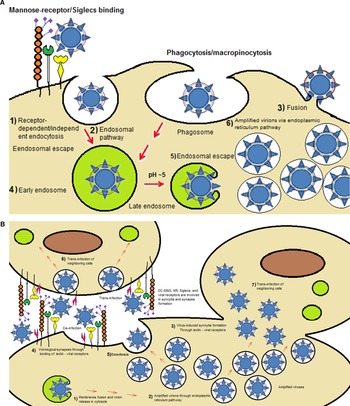
One of the mechanisms for the high transmissibility of viruses is their ability to bind to host receptors via their glycoconjugates. For example, SARS-CoV-2 high transmission rates have been attributed to its binding to receptors other than hACE2, mainly DC-SIGN, liver/lymph node-specific intercellular adhesion molecule-3-grabbing non-integrin (L-SIGN), MBRs and Siglecs (Fig. 3a) (Refs Reference Trbojević-Akmačić, Petrović and Lauc1,Reference Wallace32). In addition to the specificity of a virus spike in binding to its receptor, the varied symptoms and severity of the infection by the original and mutated forms of the virus are correlating to the virus glycoconjugates that bind to the immune receptors and evade the host's innate and adaptive immune response. Studies show conserved glycosylation sites of viral envelope proteins that act as a ligand for lectin immune receptors (LIRs) and cause rapid internalisation of bound viruses through sugar-binding receptors and endocytosis (Refs Reference Trbojević-Akmačić, Petrović and Lauc1,Reference Kumar9). Human H1N1 and SARS-CoV-2 pandemics, and HPIAV subtype H9N2/G1, have been reported to recognise LIRs and bind them tightly whereby leading to the engulfment of the virus and its release in the cell cytoplasm. Several deadly viruses such as SARS-CoV-2, HPIAV H1N1, HIV, dengue virus (DENV), MV and EBOV have been found to target LIRs to evade endocytosis degradation and invade antigen-presenting cells (APCs). Internalisation in this way can help the virus to escape initial immune recognition and clearance while invading the immune system and disseminating it in the body (Table 1) (Refs Reference Trbojević-Akmačić, Petrović and Lauc1,Reference Bermejo-Jambrina2,Reference Ling14). The highly pathogenic nature of these viruses and their genetic variants have been addressed to their interactions with LIRs followed by receptor-mediated endocytosis and membrane fusion whereby bypassing the endosome pathway and proteolysis enzymes for MHC-antigen presentation (Refs Reference Kumar9,Reference Wallace32). This pathogen trick in evading the immune system would lead to a late and inappropriate inflammatory reaction with increasing production of several pro-inflammatory cytokines, such as IL-1α, IL-1β, IL-6, TNF-α and IFNs (Ref. Reference Ling14).
A general mechanism for the high transmissibility and pathogenicity of viruses is through their binding to host sialic acid- and mannose-binding receptors: DC-SIGN, MRs and Siglec-1. Several deadly viruses such as SARS-CoV-2, HPIAV H1N1, HIV, dengue virus (DENV), measles virus (MV) and Ebola virus (EBOV) have been found to target lectin immune receptors (LIR) to evade endocytosis degradation and invade antigen-presenting cells (APCs). Rapid internalisation of the macrophage-bound virus is through sugar-binding receptors and endocytosis whereby virus distribution in the body and transmission to T lymphocytes is facilitated. (a) Enveloped viruses exploit more than one mechanism for cell entry through the endocytosis pathway, based on the cell type: (1) clathrin-mediated, caveolae/raft-dependent, clathrin/caveolin-independent and (2) macropinocytosis/micropinocytosis, and (3) direct entry at the cell membrane (direct fusion). After cell entry, the virus is transferred to (4) early endosomes, (5) late endosomes where pH ~5 and successful infection of the virus requires surmounting the barrier imposed by the cellular membrane, and endosomal escape of viruses, and (6) amplified by endoplasmic reticulum pathway. (b) Enveloped viruses use Siglec-1, MBRs and DC-SIGN binding mechanisms for cis- or trans-infection of macrophages/DCs and lymphocytes. DC-SIGN, MR and Siglec-1 mediate virus attachment and enhance infection. (1) Endosomal escape and (2) endoplasmic reticulum pathway leads to successful infection of viruses and their transmission. Enhancement of virus pathogenesis and its dissemination in multiple organs has been attributed to the formation of (3) syncytia and (4) virological synapses between donor and target cells or (5) exocytosis that lead to (6) and (7) trans-infection of neighbouring cells. MBR, mannose-binding receptors; Siglec-1, sialic acid-binding immunoglobulin type lectin-1.

Through LIR binding, these pathogens exhibit high affinities for a host cell and competently enter the cytoplasm by bypassing the late endosome-degradation process and blocking the early IFN-triggered immune responses. For example, HIV-1 and DENV bind MBRs and Siglec-1 and cause immediate viral uptake whereby suppress type I INFs cascades. This pathway plays a central role in the innate and adaptive defence against viruses and has decisive effects on the outcome of infection. Deadly viruses use an internalisation mechanism to subvert the function of innate immunity and escape antiviral defence and promote infection (Refs Reference Bermejo-Jambrina2,Reference Kumar9).
Tissue Mf and dendritic cells (DCs) are the primary targets of enveloped viruses, where they are internalised and transmitted to further susceptible cells. This transmission is now defined to be dependent on MBR, DC-SIGN and Siglec-1 binding. Rapid internalisation of Mf-bound HIV is through sugar-binding receptors and endocytosis whereby HIV distribution in the body and transmission to T lymphocytes is facilitated (Ref. Reference Nguyen and Hildreth18). DCs and Mf, widely present in lung tissue and respiratory mucosa, express particularly C-type lectin receptors (CLRs) and Siglecs. DCs are localised at mucous and epithelial interfaces (including nasopharyngeal and pulmonary mucosae), whereas Mf are found in the lung alveoli (Refs Reference Trbojević-Akmačić, Petrović and Lauc1–Reference Wielgat3).
Virus internalisation through this mechanism is expected to lead to antigen presentation to T cells but, strikingly, several studies have shown that viruses use specific sugar antigens to invade cells and evade immune responses to protect the virus and promote viral transmission and dissemination. Virus transmission in the context of phagocytic cells can be in cis or in trans, where LIRs function as attachment receptors that facilitate the capture and transmission of infection (Refs Reference Trbojević-Akmačić, Petrović and Lauc1,Reference Bermejo-Jambrina2).
CLRs, important in pattern recognition
CLRs are a large family of pattern recognition receptors (PRRs) involved in the recognition of carbohydrate signatures and induction of adaptive immunity. Amongst others, DC-SIGN (CD209) and mannose receptor (MBR, CD206) have been mostly mentioned in viral infections. Most of the CLRs bind carbohydrate moieties in a calcium-dependent manner using conserved carbohydrate recognition domains (CRDs). Recognition of viral carbohydrate antigens by CRDs leads subsequently to a tailored immune response, depending on the specific CLR and viral antigens (Refs Reference Trbojević-Akmačić, Petrović and Lauc1,Reference Bermejo-Jambrina2).
Glycan signatures present on healthy tissue, inflamed and malignant tissue, or pathogens provide signals for ‘self’ or ‘non-self’ recognition (SAMP/PAMP) by the SAMPs/PAMPs/PRRs axis.
CLRs are expressed widely by mucosa Mf and DCs and play essential roles in viral recognition, internalisation and antigen processing and presentation on MHC class I and II, thereby stimulating antigen-specific T-cell responses and T helper differentiation (Refs Reference Bermejo-Jambrina2,Reference Lübbers, Rodríguez and Van Kooyk4). Mucosa and skin are primary targets for invading viruses and are therefore important sites where adaptive immunity is initiated. DCs and Mf thereby guard these tissues and detect the invading pathogens by PRRs and leading to the initiation of immunity and elimination of the pathogens. Studies have demonstrated that pathogens may exploit CLRs binding and internalisation ability to overcome innate immunity and survive within the host. CLRs and other molecules at the host cell surface are utilised as means to an end, e.g. for transfer to their cell entry receptors that will enable viral and host membranes fusion. For example, HIV uses Siglec-1, MBRs and DC-SIGN for DCs infection (cis-infection) and T cells infection (transinfection). Enhancement of SARS-CoV-1 and 2 infections has been associated with DC-SIGN and L-SIGN involvement (Fig. 3b) (Refs Reference Trbojević-Akmačić, Petrović and Lauc1,Reference Wielgat3,Reference Zou17).
Virus transmission can occur in the context of virus binding to LIRs of DCs and Mf, where LIRs function as attachment receptors that facilitate capture and transmission to other interacting cells. For example, HIV, DENV, hepatitis C virus, Sindbis virus and the West Nile virus use their mannose glycans present on viral envelope glycoprotein to bind to MBRs and invade DCs and transmit to host-susceptible target cells (Refs Reference Bermejo-Jambrina2,Reference Zou17,Reference Bhide and Colley36). Mf and DCs are permissive to virus infection and entry through which they play an important role in viral dissemination by cell–cell contact formations with T cells (Refs Reference Lopez63,Reference Allavena64). DC-specific Intercellular adhesion molecule-3 (ICAM-3) grabbing non-integrin (DC-SIGN; CD209) receptors on Mf and DCs is a permissive receptor for deadly infectious viruses, such as HIV, cytomegalovirus, MV and EBOV (Ref. Reference Izquierdo-Useros65). Notable in the case of SARSs and other respiratory viruses, the expression level of MBRs, DC-SIGN and Siglecs are high in the lung and upper airway cells, especially in Mf and DCs, while hACE2 or other spike receptor expression in the lung and upper airway may be low and be mainly restricted to epithelial cells. In turn, wide expression levels of LIRs in the lung have been reported which leads to virus high transmission rate and an elevated amount of proinflammatory and inflammatory cytokines including IL-6, IL-1 and TNF. Data indicate that glycan-binding receptors act as alternative receptors and entry routes for SARS-CoV-2 and other enveloped viruses (Ref. Reference Trbojević-Akmačić, Petrović and Lauc1).
Mannose-binding receptors as SAMP receptor
Human MBR (CD206) is from C-type lectin family receptors, a 175 kDa single-pass transmembrane glycoprotein, known mainly as Mf or DCs receptor. MBR is widely expressed on the surface of Mf, DCs and endothelial cells. MBR's engagement with glycoconjugates of mucins and cells activates an immune suppressive phenotype in human Mf (alveolar and tumour-associated Mf) and DCs (mucosa) (Refs Reference Allavena64–Reference Miller67). There is evidence that the hierarchy in infectivity of the SARS-CoV-2, influenza viruses are related to their reactivity with MBRs presented in Mf (alveolar and peritoneal Mf) and DCs that are widely present in lung tissue and respiratory mucosa. The role of MBRs in the SARS-CoV-2 and H1N1 pandemic and severe avian H9N2 infections has been found to correlate with poor immune response and high inflammatory reaction (Refs Reference Trbojević-Akmačić, Petrović and Lauc1,Reference Ling14,Reference Nguyen and Hildreth18). MBR is continuously internalised via an endocytic or phagocytic pathway and hence act as a preferred receptor for virus entering into DCs and Mf, whereas other C-lectin receptors such as DC-SIGN is mostly confined to the cell surface and work as an important attachment factor. MBRs constitutively recycle between the plasma membrane and the early endosomal compartment, even in the absence of any ligand. At the steady state, 10–30% of the receptor is found at the cell surface and the remaining 70% is localised intracellularly (Refs Reference Miller67,Reference Gazi and Martinez-Pomares68).
MBRs are expressed widely by mucosa Mf and DCs where they are expected to play roles in discriminating between self and non-self. The MBR is well established to target antigens to early endosomes, but not to lysosomes. Ligand binding to the MBRs even prevents the fusion of phagosomes with lysosomes. Recent studies have demonstrated that active alkalisation of the phagosomes prevents activation of lysosomal proteases so that internalised particulate antigens are rescued from rapid degradation and remained available for exporting from the phagosome into the cytoplasm. Thereby, MBRs function as endocytic and/or phagocytic receptors whereby their interaction with ligands mediates pathogen internalisation and dissemination in the cytoplasm. Additionally, pathogen-MBRs engagement activates an immune suppressive phenotype by APCs which finally leads to the enhancement of infection (Refs Reference Trbojević-Akmačić, Petrović and Lauc1,Reference Bermejo-Jambrina2,Reference Lübbers, Rodríguez and Van Kooyk4). In both Mf and DC, MBR binds specifically to the viral carbohydrate moieties terminating in mannose, fucose and GlcNAc residues and has found an important receptor for enveloped virus entry in human Mf. Studies have demonstrated that pathogens exploit MBR binding and internalisation ability, to overcome innate immunity and survive within the host. MBR interaction by its ligand has been reported to increase IL-10 production and inhibition of IL-12 and defective Th1 differentiation (Refs Reference Ling14,Reference Allavena64,Reference Rajaram66).
MBR contains three types of domains at its extracellular region, an N-terminal cysteine-rich (CR) domain capable of qCa2 + -independent binding to sulphated sugars, a fibronectin type II domain involved in collagen binding, and eight tandemly arranged C-type lectin-like domain (CTLD) responsible for Ca2+-dependent binding to sugars terminated in D-mannose, L-fucose or GlcNAc, that are often found on the surfaces of viruses, bacteria and parasites. MBRs through the CR domain bind and internalise oligosaccharides of blood group Lewisa and Lewisx types. Unlike the CR domain, the CTLD region can bind to ligands of microbial origin, like mannose that is frequently found on the surface of many microorganisms (PRR), while an enhanced number of Mf are recruited to the alveolar space because they are efficient in clearing pathogen. However, it should also be taken into consideration that MBR is not the only receptor with specificity for mannose and there are other receptors sharing a similar pattern of ligand binding with MBR, including DC-SIGN in humans (Ref. Reference Gazi and Martinez-Pomares68).
MBR is widely expressed among different tissues and is heavily glycosylated, where N-glycosylation sites are highly conserved between humans and mice. Notable, N-glycan of mannose receptor showed tissue-specific glycosylation, especially terminal sialylation, which regulated the functional specificities of MR. In the lung, MR exhibited more terminal sialic acids in the α2-3- rather than in the α2-6-configuration. Lack of terminal sialylation reduces the ability of MR to bind and internalise mannosylated carbohydrates without affecting its subcellular localisation. A specialised role for MR in endocytosis, trafficking and cross-presentation of ligands to CD4+ and CD8+ T cells has been proposed (Refs Reference Su69,Reference Martinez-Pomares70).
MBR and DC-SIGN recognise PAMPs as SAMPs and help virus dissemination
Several deadly viruses such as SARS-CoV-2, HPIAV H1N1, HIV, DENV, MV and EBOV target MBRs to evade endocytosis degradation and invade host-susceptible cells. In the liver, MBRs are reported to be key players in the infection and impaired function of resident DCs whereby resulting in the ineffective anti-viral response of hepatitis B virus (HBV)-infected patients and HBV persistence. Human MBRs are expressed on the surface of most tissue Mf, DCs and lymphatic or liver endothelial cells (Refs Reference Trbojević-Akmačić, Petrović and Lauc1,Reference Bermejo-Jambrina2,Reference Nguyen and Hildreth18,Reference Miller67).
MBRs are endocytic receptors that are involved in pathogen binding to professional APCs and cell-to-cell transmission of a pathogen-like Mycobacterium tuberculosis, which induces immune suppressive phenotype. Inhaled M. tuberculosis travels to the lung distal airways where it is internalised by alveolar macrophages (AMs) via MBRs. Then, the host-adapted intracellular pathogen survives and replicates for an extended period before the complete activation of protective innate and adaptive immune responses. MBRs are linked to Peroxisome proliferator-activated receptor (PPAR)γ pathway to downregulate pro-inflammatory gene expression by antagonising the activity of several transcription factors (19) and downregulates IFN-γ-stimulated Inducible nitric oxide synthase (iNOS) production in Mf (Refs Reference Nguyen and Hildreth18,Reference Allavena64,Reference Rajaram66). Studies have correlated viral ligand binding to MBR as a risk factor for severe infection by H1N1 and H9N2 and increasing upregulation of pro-inflammatory cytokines, such as IL-1α, IL-1β, IL-6, TNF-α and IFN-γ. These cytokines are commonly found in the acute-phase response to influenza virus infection and may induce immunity but also cause damage to the host tissue (Refs Reference Ling14,Reference Gazi and Martinez-Pomares68). Influenza virus subtypes H1N1, H9N2 and H3N2 can interact with AMs via MBRs, as major endocytic receptors in the infectious entry of influenza viruses that can lead to virus dissemination in susceptible cells, deleterious inflammatory response and development of severe disease and symptoms. Accordingly, differences in the ability of influenza viruses to infect Mf are depended on their Hemagglutinin (HA) and Neuraminidase (NA) reactivity with MBRs, and Mf/DCs expressing elevated levels of MBRs would be more readily infected (Refs Reference Ling14,Reference Nguyen and Hildreth18,Reference Miller67). DENV, as a deadly pathogen in hot climatic regions, is able to disseminate in the body and infect different cells in multiple organs, via Ca2 + -depended interaction of the CRD of DC-SIGN and CTLD of MBRs with the high mannose oligosaccharides present in the DENV E. It is now well established that DCs and dermal Mf are permissive targets for DENV infection, highly expressed in both DC-SIGN (CD209) and MBRs (CD206). DENV is hijacking human immune cells via the interaction of viral envelope carbohydrates with MBRs and DC-SIGN and causes fatal diseases in humans (Refs Reference Sukegawa31,Reference Miller67).
Hence, both receptors (DC-SIGN and MR) collaborate to mediate DENV entry into its primary targets; monocytes, DCs and Mf. They are also the primary reservoirs of DENV after its dissemination from the skin. DENV was found to replicate in Mf of different organs namely, Kupffer cells in the liver, AMs in the lungs, Mf of lymphoid organs (spleen, lymph node and thymus), dermal Mf, microglial cells and monocytes in peripheral blood (Refs Reference Miller67,Reference Gazi and Martinez-Pomares68). Therefore, DCs and Mf of different organs are permissive populations that can be infected with the invasive virus capable to bind to MBRs, and playing key roles in the viral transmission and distribution in the body. Infected cells reside in tissues that are capable of efficient cell-to-cell viral transmission to uninfected susceptible cells. Similarly, HIV infects DCs and Mf reside in tissues which result in efficient cell-to-cell transmission and infection of susceptible T cells. MBRs cause HIV particles to be accumulated in clusters at the Mf surface which leads to rapid internalisation of HIV. MBR-mediated uptake of HIV induces stabilised Mf–T-cell interactions that lead to a high multiplicity of cell-to-cell transmission of HIV from Mf to CD4+ T cells (Refs Reference Sukegawa31,Reference Lopez63). Infected Mf form stable contacts with target cells via adhesive molecules where prolonged contacts are a prerequisite for efficient viral spread. HIV-MBR binding alters physiological Mf–T-cell interactions to access and restrain large numbers of susceptible, motile T cells, thereby playing an important role in HIV progression. About half of the carbohydrates on HIV gp120 are terminated in oligo-mannose residues, a pattern common to many pathogens. Accordingly, about 60% of the initial association of HIV with Mf is via MBRs. Mf are then able to mediate the transmission of bound HIV to CD4+ T cells, and this transmission is blocked up to 80% by inhibitors of MBR binding (Refs Reference Nguyen and Hildreth18,Reference Sukegawa31,Reference Gazi and Martinez-Pomares68).
A similar mechanism has been suggested for MV dissemination in the human body. Once a highly contagious infectious virus gets onto the mucosa, it infects the epithelial cells in the trachea or bronchi. Herein, mucosa Mf and DCs provide beneficial functions for the virus and support virus replication early after infection, but they also contribute to the infection of other immune cells (Refs Reference Allen71,Reference Singh72). Two models have been proposed for MeV pathogenesis: (1) Initial replication of MeV occurs in respiratory epithelial cells through apical infection with subsequent systemic spread to other cells and tissues; (2) Initial replication of MeV occurs in myeloid cells of the respiratory tract (AMs/DCs) with spread to other tissues and subsequent delivery by infected lymphocytes to the basolateral surface of respiratory epithelial cells for pulmonary infection and virus transmission (Refs Reference Lin23,Reference Singh72). After host entry through mucosal surfaces, the virus disseminates to lymphoid tissues to establish a generalised infection of the immune system. The mechanisms by which the virus spreads among permissive target cells locally during the early stages of transmission, and systemically during subsequent dissemination are known to be through the formation of virological synapses (VSs) during stable contacts between infected and uninfected susceptible target cells. Transmission of MV from DCs to airway epithelial cells is considered to be through cell-to-cell contacts or via VSs as crucial to viral spread late in infection. Cell-to-cell contacts and multiplicity in transmission through this way have been defined as a mechanism for viral dissemination by which the most contagious human respiratory virus is delivered to the airway epithelium. The MV spreads rapidly and efficiently in human airway epithelial cells through this mechanism. This rapid spread is based on cell-to-cell contact rather than on particle release and re-entry. A subset of infected cells forms multinucleated syncytia through viral envelope protein-dependent cell fusion that facilitates cell-to-cell transmission through VSs. The formation of VSs would greatly increase the efficiency of viral transfer, locally. Infected cell circulation through tissues is important for efficient systemic viral spread (Refs Reference Lin23,Reference Singh72,Reference Derakhshani73).
This hypothesis is consistent with the results that MeV infection is initiated by MBRs-mediated infection of myeloid-derived cells which leads to stabilised cell-to-cell contacts with permissive target cells like airway epithelial cells and causes virus transmission and spread in the body. Immune cells within the airways (MV) or mucosa (HIV) are likely the first targets of infection, and these cells traffic the virus to lymph nodes for amplification and subsequent systemic dissemination (Refs Reference Nguyen and Hildreth18,Reference Lin23).
Siglecs recognise PAMP as SAMP
Siglecs are expressed widely by mucosa Mf and DCs which can play roles in viral recognition, internalisation and dissemination (Refs Reference Bermejo-Jambrina2,Reference Lübbers, Rodríguez and Van Kooyk4). Siglecs are self-recognising receptors involved in the recognition of sialoglycan ligands in autologous cells to function as inhibitory receptors and suppress immune activation signals. Sialoglycans are found in all mammalian cells to build the glycocalyx of the cell (Refs Reference Derakhshani73,Reference Läubli and Varki74). Several human-pathogenic bacteria can display sialoglycan-SAMPs on their surface including Neisseria species, Haemophilus influenza, Campylobacter jejuni, certain strains of pathogenic Escherichia coli and group B streptococci, where it is expected to deceive immune responses (Ref. Reference Läubli and Varki74).
Most Siglecs possess an intracellular immunoreceptor tyrosine-based inhibition motif (ITIM) that induces strong inhibitory signalling when Siglecs bind sialic acids (47). Interestingly, both pathogens and tumour cells use an enhanced expression of sialic acids as a mechanism to modify the immune system in their favour, illustrating that the sialic acid–Siglec axis is a key regulator in infection and cancer (Refs Reference Bermejo-Jambrina2,Reference Lübbers, Rodríguez and Van Kooyk4).
Except for resting T cells, most cell types in the human and mouse immune systems express at least one Siglec and others express several. Most Siglecs have one or more cytosolic ITIMs. Classically, receptors with ITIMs function as inhibitory receptors and suppress activation signals. In general, Siglecs show a binding affinity for sialic acids with α2–3(Gal) and α2–6(Gal) linkages that are commonly found as terminal sequences on glycans of glycoproteins and glycolipids of most mammalian cells. Siglecs have an overlapping specificity for such sialosides (sialic-acid-containing glycans) (Refs Reference Lübbers, Rodríguez and Van Kooyk4,Reference Läubli and Varki74).
The human genome contains 14 different Siglecs, which can be divided into two groups based on their genetic homology among mammalian species. The first group is basic in immune function recognising self–non-self and present in all mammals and consists of Siglec-1 (sialoadhesin), Siglec-2 (CD22), Siglec-4 (MAG) and Siglec-15 (48–50). The second group consists of the CD33-related Siglecs that have evolved rapidly and therefore their repertoire differs between species. The CD33-related Siglecs are Siglec-3 (CD33), −5, −6, −7, −8, −9, −10, −11, −14 and −16 (Ref. Reference Lübbers, Rodríguez and Van Kooyk4). This subfamily was named CD33-related Siglecs (or CD33rSiglecs) and was shown to have a variety of Sia-binding properties. Most CD33rSiglecs have intracellular ITIMs or ITIM-like domains that lead upon activation and phosphorylation of the receptors to the recruitment of Src homology-2 (SH2) domain-containing phosphatase (SHP) (SHP1 and SHP2), which then inhibit immune cell activation. CD33rSiglecs are mostly widely expressed on leukocytes. For example, in humans, neutrophils express various CD33rSiglecs including CD33, Siglec-5 and its paired receptor Siglec-14, Siglec-7 and Siglec-9. The CD33rSiglec receptor Siglec-9 on neutrophils keeps these immune cells quiet within the blood that contains high-density sialoglycan ligands on erythrocytes. Human myeloid-derived Mf and DCs are expressing various Siglecs including the conserved Siglec-15 and CD33rSiglecs Siglec-3, Siglec-5/-14, Siglec-7, Siglec-9 and Siglec-10, and in particular Siglec-1. The conserved Siglec-1 (sialoadhesin, CD169) is expressed only on Mf and DCs which is upregulated by type I INFs (Refs Reference Lin23,Reference Derakhshani73,Reference Läubli and Varki74).
Pathogens engaging inhibitory Siglec receptors can escape immune control resulting in more severe infections. Tumour cells can exploit the sialoglycan–Siglec axis in a similar way as pathogens to escape immune control and metastasis. The hypersialylated glycocalyx of tumour cells can engage Siglec receptors on different immune cells and mediate immune escape, cancer progression and metastasis.
Recent studies report human rapid evolution of Siglecs, mechanisms and potential role in triggering endocytosis and in pathogen recognition and clearance. Compared to human closely related primates, grate apps, with a very similar sequence of DNA, humans have a higher expression level of Siglec-1 to prevent hyper-inflammation when confronting various viruses (Refs Reference Gagneux45,Reference Derakhshani73). However, some enveloped viruses have been human-adapted and evolved to use Siglec-1 for infectivity and transmissibility, for example, influenza virus H1N1 and SARS-CoV-2 pandemics and HIV-1. Infective viruses express Sia-bearing glycans on their surfaces to deceive Siglec sensors, to bypass endosome pathways that trigger IFN-induced immune responses. In utilising this mechanism, SARS-CoV-2, HPIAVs and EBOV show similarities to HIV (Refs Reference Trbojević-Akmačić, Petrović and Lauc1,Reference Gupta, Spiropoulou and Rollin24).
Siglec-1 is the main receptor in mucosa responsible for viral capturing by APCs and trans-infection of other susceptible cells. Enveloped viruses, for example, HIV-1 and MV disseminate in the body mainly through this mechanism. Capturing and trans-infection mediated by Siglec-1 is particularly a potent mechanism of viral spread in lymphoid tissues. Siglec-1 expression is induced in inflammatory conditions and is overexpressed in DCs and Mf over severe cases of virus infection (Refs Reference Trbojević-Akmačić, Petrović and Lauc1,Reference Gagneux45,Reference Izquierdo-Useros65).
Human Mf are widely infected with HIV-1, through the interaction of sialic acids on the viral envelope with Siglec-1. The expression of Siglec-1 has been correlated to virus attachment and infectivity. DCs and Mf are essential to combat invading viruses and trigger antiviral responses. Paradoxically, in the case of enveloped viruses, highly expressed Siglecs on DCs and Mf might contribute to viral pathogenesis through trans-infection, a mechanism that promotes viral capture and transmission to target cells. Siglec genes have been identified to be upregulated upon chronic inflammatory conditions and type I INF response (Refs Reference Bermejo-Jambrina2,Reference Gagneux45,Reference Izquierdo-Useros65). Siglec-1 is internalised upon binding to its ligand and thereby can present a pathogen in the cytoplasm of DCs and Mf, those of which contribute to enhanced infection of a host. The case was observed for HIV and the porcine-reproductive and respiratory syndrome virus, which can bind to Siglec-1 to promote trans-infection. SARS-CoV-2 variants widely express sialoglycans on their envelope spike protein which interact with Siglec-1, and make the virus infect DCs and cause trans-infection of other susceptible cells such as hepatocytes in the liver (Refs Reference Shanker40,Reference Knežević47,Reference Catera48). Several viruses utilise the sialic acid–Siglec axis to dampen the immune system in favour of their survival (Refs Reference Trbojević-Akmačić, Petrović and Lauc1,Reference Gagneux45,Reference Catera48).
Trans-infection of susceptible cells by DCs appears to be a particularly potent mechanism of viral transmission in lymphoid tissues in vivo. Cell-associated transfer via the VS is believed to constitute a mode of transmission of the virus, in the interaction between DCs and immune cells (Refs Reference Wielgat3,Reference Catera48,Reference Izquierdo-Useros65).
Viral-spike protein sequential activation in endocytosis pathway
The highly pathogenic nature of SARS-CoV-2 and its recent genetic variants has exhibited that optimising the cleavage site of the S1/S2 junction increases cell–cell fusion and corresponding viral cell–cell spread which can competently bypass or block the cytokine IFN-triggered immune responses of a host cell.
Several groups have identified an insert of SPRRARYS in SARS-CoV-2 S, as four potential cleavage sites for ubiquitous proteases furin (PRRA motif), that causes multi-tissue targeting and high infectivity of SARS-CoV-2. This cleavage site has also been found in highly pathogenic subtypes of influenza viruses, referred to as a ‘polybasic site’ or ‘multibasic site’ (typically a stretch of 6–7 arginine (R) and lysine (K) residues, e.g. RKKRKRYG) that can be cleft by cell membrane ubiquitous proteases like furin, therefore allowing systemic spread based on the ubiquitous expression of the proteases (Refs Reference Kandeel75–Reference Zhang77). The low pathogenic (LP) influenza virus subtypes or CoV strains have a spike with monobasic cleavage S1/S2 site that is activated by late endosomes and tissue-restricted proteases in the respiratory and digestive tracts, whereas cleavage of the multi-basic site by ubiquitous furin proteases allows systemic spread, multiple organ infections and high mortality. Non-tissue restricted activation of virus spike protein allows multi-tissue targeting and high infectivity of the virus where systemic viral spread, multi-organ infections and high mortality occurred (Refs Reference Torre-Fuentes76–Reference Hoffmann, Kleine-Weber and Pöhlmann78).
Cleavage at this site is essential for S-protein-mediated cell–cell fusion and entry into human lung cells and increased cell–cell fusion and virus spread. Corresponding SARS-CoV-2 variants which contain 15–30-bp deletions or point mutations at the S1/S2 junction do not cause severe pathological changes in the lung (Refs Reference Hoffmann, Kleine-Weber and Pöhlmann78,Reference Kleine-Weber79). Likewise, influenza viruses that contain an HA cleavage site with only a single basic amino acid residue are tissue-restricted and have limited spread. Thus, highly pathogenic variants of SARS-CoV-2 and influenza viruses (HPAIV) carry a polybasic cleavage site that is activated at the cell surface, causing cell membrane fusions and virus discrimination between cells. By utilising the cell membrane proteases rather than endosomal cathepsins, viruses enter the cytoplasm easily by bypassing the late endosomes, the main site for receptor recognition or virus degradation. The LPAIVs have HA with a monobasic cleavage site that is activated by late endosomes and tissue-restricted proteases. LPAIVs cause an efficient immune response through the endosomal pathway and mild, if any, clinical signs, while HPAIVs carry a multi-basic cleavage site which is cleaved by ubiquitous furin proteases resulting in the bypassing endosomal pathway, systemic infections and high mortality (Refs Reference Shirato5,Reference Zhang77,Reference Stech80). It is noteworthy that all SARS-CoV-2-related coronaviruses of bats and pangolins and SARS-CoV-1 are reported to harbour a monobasic site that is cleavable by tissue-restricted and endosomal cathepsin proteases, identified as a determinant of zoonotic potential and causes low transmissibility in the host (Refs Reference Xing81,Reference Yeo82).
Highly pathogenic enveloped viruses may enter cells and evade the host's innate immune system by utilising a similar mechanism for spike-protein sequential activation. They may use cell surface ubiquitous non-tissue restricted enzymes, in broad tissues which result in very broad, not-restricted organ tropism (Refs Reference Shirato5,Reference Stech80). Thus, the cell-fusion activation function of the SARS-CoV-2 S and influenza virus HA proteins by cell membrane ubiquities, not tissue-restricted enzymes is required for syncytium formation and virus rapid spread in human lung cells, as well as, other susceptible tissues (Refs Reference Torre-Fuentes76,Reference Kleine-Weber79). Finally, host variations in the expression of these ubiquities proteases for priming and activating the spike and as the major cellular entry point, could influence the entry of respiratory viruses into the host cells and thus affect the transmissibility and even severity of the disease (Ref. Reference Jiang46).
Highly pathogenic influenza viruses containing the polybasic cleavage site require minimal host adaptation to obtain a highly pathogenic disease phenotype in human and can cause severe disease (case fatality rate of ~40%). The virus to adapt to a new host has the potential to rapidly acquire mutations that may enhance their risk to infect and transmit easily to humans or other animal species (Refs Reference Jiang46,Reference Yeo82,Reference Chan83).
Clinical features of viral infections related to glycan receptors
The COVID-19 pandemic caused by SARS-CoV-2 showed some similarities in its pathogenesis and clinical features to other enveloped viruses like H1N1, H7H9, HIV, EBOV, SARS-CoV and MERS-CoV. Massive infection, lymphopenia, thrombocytopenia and anaemia are common complications of severe cases of SARS-CoV-2, H1N1, HIV, DENV, H7N9 and CoVe infections, which predict the patient's severity and the deceased outcome of critically ill patients (Refs Reference Deng7–Reference Kumar9).
The clinical features of hospitalised SARS-CoV-2, H7N9 and H1N1 patients include a long duration of hospitalisation and a complication rate. Pandemic H1N1 and SARS-CoV-2 caused massive human infection and high transmissibility in 2009 and 2019, respectively, and currently circulates worldwide.
As a possible risk factor, COVID-19 patients exhibited comorbidity of chronic heart disease, diabetes mellitus and hypertension, which might be associated with highly expressed ACE2 in the heart, lung and vasculature system in these disorders. Relative to virus receptor expression with age, the median age of infection was reported to be 65 years (range 32–96), for SARS-CoV-2 patients while it was observed to be 58 years (range 18–83) for influenza patients that can be attributed to sialic acids of glycocalyx (Refs Reference Ling14,Reference Allavena64,Reference Rajaram66).
SARS-CoV-2 viral RNA has been detected in the serum, urine and faeces of COVID-19 pandemic patients, which represents the possibility of viral replication occurring outside of the respiratory tract, in other organs, due to the expression of ACE2 in other parts of the body and its high spread rate. Relative to viral receptor expression and its binding, sore throat, tearing, sneezing, sputum, dyspnoea and vomiting have been more frequently described in the influenza groups than in COVID-19. Gastrointestinal symptoms are one of the factors that can help distinguish COVID-19 patients from other acute respiratory illnesses in the ambulatory population. COVID-19 pandemic patients had a worse prognosis, that is, an increase in the use of mechanical ventilation, longer hospital and intensive care unit duration and higher mortality (Refs Reference Deng7,Reference Hattatoğlu and Yıldız8).
Widespread distribution and transmissibility characteristics of SARS-CoV-2 and H1N1 have been attributed to the location of their receptors in the respiratory tract and the body. For example, the LP influenza virus H1N1/D225 subtype of the 1918 pandemic and CoVs including 229E-CoV, OC43-CoV, NL63-CoV and HKU-CoV causes infection of the upper respiratory tract which is manifested by the seasonal epidemics and mild and cold-like symptoms. In contrast, highly pathogenic influenza virus H1N1/225G and H7N9 subtypes and MERS-CoV, SARS-CoV and variants of SARS-CoV-2 with low transmissibility cause infection of the lower respiratory tract with atypical pneumonia and the high rate of mortality. Commonly glycan receptors and their binding can influence influenza H1N1 infection and the epidemics to occur seasonally, and show high transmissibility and mild symptoms (Refs Reference Deng7,Reference Jiang46).
Through glycan binding, avian IAV subtypes H5N1, H7N9 and H9N2 (H9N2/G1) have successfully adapted to humans and may become the next human pandemic threat. For infectivity and transmissibility, they should engage a large human population with specific dominant glycans in their upper respiratory tracts responsible for the high transmissibility and widespread nature and a small subset of the human population with other dominant glycans in the lower respiratory tracts that were responsible for the severe cases and high fatality rates of pandemics (Refs Reference Jiang46,Reference Allavena64,Reference Rajaram66).
Severe cases of H1N1 and COVID-19 exhibited similar patterns of lymphopenia, neutrophilia, thrombocytopenia and anaemia. In patients, viral load correlates inversely with platelet and red blood cell (RBC) counts during the acute infection phase. In animal models, the platelet count decreases with the degree of virus pathogenicity varying from 0% in animals infected with the influenza A/H3N2 virus, to 22% in those with the pandemic influenza A/H1N1 virus, up to 62% in animals with a highly pathogenic A/H5N1 virus infection. Findings from clinical reports and animal-model influenza virus infection have led to a proposed mechanism (Refs Reference Deng7,Reference Hattatoğlu and Yıldız8,Reference Jansen34).
Glycan receptors and mechanisms for cytopenia
Following pathological changes in lungs and lethal pneumonia, in SARSs, MERS, H7N9 and H1N1 infections, an excessive immune response described as a ‘cytokine storm’ has been observed in patients. The clinical and experimental observations represent very low serum levels of anti-inflammatory IL-10 but high levels of pro-inflammatory cytokines and chemokines, e.g. IL-1, IL-6, TNF-α, IL-12, CCL2, CXCL10 and CXCL9, in comparison to patients with the mild disease (Refs Reference Wielgat3,Reference Jiang46). A mechanism for lymphopenia has been attributed to excessive cytokine production and severe inflammatory response that stimulate the apoptosis of T lymphocytes. In COVID-19 pneumonia, an increased level of pro-inflammatory cytokines, such as IL-1, TNF-α and IL-6, is closely correlated with T lymphopenia, disease severity and poor prognosis. The second mechanism has been attributed to the direct targeting of immune susceptible cells by the virus. HIV, SARS-CoV-2 and EBOV, for instance, use this mechanism to spread in the body (Refs Reference Chan83–Reference Kantri85). EBOV causes severe infection and often fatal disease in humans characterised by high levels of inflammatory cytokines that result in a septic shock and multi-organ failure. Similar to SARS-CoV-2, it was shown that the EBOV can enter and replicate in a variety of cell types including Mf, epithelial cells, endothelial cells, lymphocytes and hepatocytes, and rapidly spreads in the vital organs of the body. Poor immune response and lymphopenia are among the hallmark features of EBOV infection due to the massive death of Mf, CD4 and CD8 T-cell sub-populations of human PBMCs. On day 8 following infection, the EBOV induces death signals in Mf and lymphocytes and 30–40% of the CD4 and CD8 T cells are dead (Refs Reference Gupta, Spiropoulou and Rollin24,Reference Rahman84). Reports on samples collected from Ebola patients have confirmed these reports and have shown a decrease in the total number of peripheral blood mononuclear cells (PBMCs). Similar to SARS-CoV-2, Ebola patients' PBMCs show a lack of anti-viral immune response during infection. This observation may help to explain why fatal cases do not have anti-Ebola antibodies at death and survivors have a delay in the production of anti-Ebola IgG (Ref. Reference Gupta, Spiropoulou and Rollin24).
Even though the human Mf and T cells express a very low level of ACE2, the SARS-CoV-2 has been proven to utilise endocytosis receptors to be internalised and enter the cytoplasm of the immune cells. Like SARS-CoV-2, H7N9 and H1N1 subtypes might cause apoptosis of various cell populations through direct targeting. One of the causes of early poor immunity of the host may be virus-mediated apoptosis of Mf and lymphocytes (Refs Reference Gupta, Spiropoulou and Rollin24,Reference Rahman84).
The third mechanism can be through the highly expressed sialoglycans on the extracellular domains of immune cells (Ref. Reference Araya86). Surface sialoglycans play as decoy/recognition receptors for pathogens to attract and bind them. The heavily sialoglycosylated glycans on the extracellular domain are important to pathogen recognition and loading of host cells. In RBC, for example, sia moieties of glycophorins (GPA, GPB and GPC) play a crucial role in the recognition and invasion of RBC by parasites (i.e. Plasmodium falciparum). RBC deficient in any of the sialoglycophorins resists infection by merozoites to varying degrees. Here sialic acid residues of glycans on RBC and platelets represent chasing interactions for parasites, where consequently, pathogen-loaded RBC is cleared by Mf in the spleen and liver. The thrombocytopenia and anaemia observed in severe cases of H1N1/SARS-CoV-2 are partly due to the cell destruction and partly due to the masking or removal of sialic acids by the virus or its neuraminidase. Thereby, the heavily sialoglycosylated extracellular domains of RBCs and platelets are very important decoy/recognition receptors for pathogens to attract and loading. By this mechanism, viruses invade sialoglycosylated mucosa and enter the body. The target cells lead to destruction whereby lymphopenia, anaemia and thrombocytopenia would be the results (Refs Reference Lempp10,Reference Pretini87,Reference Meesmann88). In comparison to infected elderly patients, lymphopenia was less common in COVID-19 children infection, due to lower expression of sialoglycans and receptors on the surface of the immune cells of children. In elderly patients, where there is a higher mortality rate, lymphopenia occurs more frequently, especially in severe cases (Refs Reference Chan83–Reference Kantri85).
Concluding remarks
• Several pathogens use similar mechanisms to dampen the immune system in favour of their survival.
• Similar mechanisms are utilised by enveloped viruses for the high rate of infectivity and transmissibility.
• Enveloped viruses can infect the human host through general receptors that lead to similarity in symptoms and clinical features (Table 1).
• In addition to the specificity of a virus for binding to a specific receptor, variability in symptoms and severity of the infection by the original and mutated forms of a virus is addressed to glycan receptors.
• The highly pathogenic nature of viruses and genetic variants is due to the high binding affinities of these pathogens for a variety of host cells and receptors, where they competently bypass or block the cytokine (IFN)-triggered immune responses of the host.
• Virus hijacks host immune receptors and evade the host immune system simply. It interacts with host immune receptors via its glycotopes such as sialic acid and mannose moieties of glycoconjugates.
• The host immune receptors that recognise these moieties (PAMPs) as SAMPs include host Siglec-1, MBR and DC-SIGN.
• By binding to SAMP receptors, the virus simply enters the cell through endocytosis and is amplified by the cell endoplasmic reticulum pathway.
• Consequently, the virus modulates the host immune system activity in favour of its survival and dissemination, hypothetically immune suppression.
• SAMP receptors are mainly expressed by DCs and Mf localised at mucous present in skin, lung and epithelial interfaces. They act as the primary participants in cis-infection and trans-infection of virus-susceptible cells.
• Via glycotope receptors, highly pathogenic viruses invade host multiple organs and lead to systemic infection.
• Collectively, these findings identify a lectin-dependent pathway that enhances receptor-dependent infection by enveloped viruses and reveals distinct mechanisms of evading and suppressing the immune system (Refs Reference Lempp10–Reference Pourrajab12).
• Finally, for the therapeutic purposes or prevention of viral infection, we should find general glycomimetic ligands or lectins that block the virus interaction with lectin receptors (Refs Reference Pourrajab12,Reference Manti13,Reference Sarkar89).
• For the prognosis role, we should consider individual glycotopes and lectin-receptors affected by sex, age and physiological conditions (Refs Reference Nasirikenari52,Reference Oswald, Jones and Cobb57–Reference Watanabe61).