Introduction
According to the World Health Organisation (WHO), obesity rates have doubled since 1980, and obesity is now a major public health issue in both developed and developing nations. 1 Although there are many factors contributing to this obesity epidemic, one of the major driving forces has been the increased availability and consumption of high-fat, high-sugar foods (‘palatable’ or ‘junk foods’) over this time. 1 – Reference Vicennati, Pasqui and Cavazza 3 It is also clear, however, that some individuals are more likely to overindulge in these high-fat/high-sugar foods than others, and human studies have consistently reported that overweight and obese individuals exhibit a higher preference for these palatable foods compared with lean individuals.Reference Vicennati, Pasqui and Cavazza 3 – Reference Pasquet, Frelut and Simmen 6 Given the importance of an increased preference for high-fat, high-sugar foods for an individual's susceptibility to obesity in a society where these foods are readily available, understanding the biological mechanisms that underlie an increased preference for palatable foods has become an important area of research.
Although these mechanisms are still poorly understood, there is growing evidence to suggest that food preferences can have their origins early in life, and studies in both rodents and humans have reported associations between exposure to excess fat and/or sugar before birth or in early infancy and an increased preference for palatable foods in the offspring during postnatal life.Reference Bayol, Simbi and Bertrand 7 – Reference Brion, Ness and Rogers 8 One of the proposed mechanisms for the programming of food preferences involves the mesolimbic reward system in the brain, which includes the nucleus accumbens (NAc) in the forebrain and ventral tegmental area (VTA) in the midbrain. These brain areas have been shown to be altered following acute and chronic high-fat, high-sugar intake in adult rodents, in a way analogous to drugs of abuse.Reference Johnson and Kenny 9 – Reference Wang, Volkow and Logan 11 This suggests that the propensity of an individual to overconsume palatable foods could be a result of altered function of these central reward systems following exposure to an inappropriate nutrient supply before birth and in early postnatal life.
This review will explore the programming of food choices in the offspring, with a particular focus on maternal overnutrition and recent studies that have attempted to determine the underlying mechanisms involved, and will present a summary of our current understanding of the critical periods in the development of the reward circuitry during which permanent alterations in the function of this pathway could be established.
Palatable food intake and the mesolimbic reward system
It is now well-recognized that the drive to consume energy dense, nutrient poor junk foods in excess of caloric requirements has a biological basis, and that these foods have the capacity to activate central reward pathways in the brain in a similar manner to alcohol and drugs of abuse.Reference Volkow, Wang and Fowler 12 – Reference Volkow and Wise 13 The key systems involved in mediating this effect are the dopaminergic and opioid signalling systems within the mesolimbic reward system.
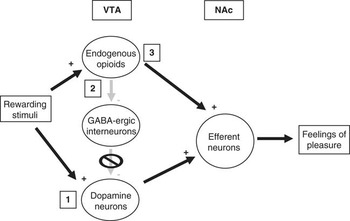
The activation of dopamine and opioid signalling begins in the VTA, in which the cell bodies of dopaminergic neurons are located. Rewarding stimuli activate the reward system by binding to specific receptors located on dopamine neurons in the VTA. Activation of these systems by rewarding stimuli also promotes the release of endogenous opioids, which block the release of gamma-aminobutyric acid (GABA) from interneurons in the VTA that normally inhibit dopamine release.Reference Nestler 14 The inhibition of GABA release by opioids disinhibits dopaminergic neurons and leads to an increase in dopamine synthesis in the VTA. These dopaminergic neurons project to the NAc where dopamine is released.Reference Nestler 14 Termination of dopamine signalling occurs through active reuptake of dopamine by dopamine active transporters (DAT).Reference Gainetdinov, Jones and Fumagalli 15 Opioids also bind directly to their receptors located within the NAc to potentiate reward signalling in this region of the mesolimbic system. Both the direct and indirect actions of opioids, together with the activation of dopamine neurons, create the pleasurable feeling or ‘high’ associated with the consumption of palatable foods, which is considered to be responsible for driving the excess consumption of palatable, high-fat, high-sugar foods compared with non-palatable foods (Fig. 1).
Simplified version of the activation of the mesolimbic reward system. (1) A rewarding stimulus such as drugs and palatable foods can stimulate the dopamine neurons at the VTA, resulting in the release of dopamine at the NAc. (2) The rewarding stimulus can activate the release of endogenous opioids at the VTA, which inhibits GABA-ergic interneurons. GABA normally inhibits dopamine release. Therefore, this inhibition of GABA release disinhibits dopamine neurons resulting in increased dopamine release at the NAc. (3) Opioids can also bind to their receptors located at the NAc. The activation of efferent target neurons at the NAc through (1), (2) and (3) creates the pleasurable feeling associated with the rewarding stimuli. Black and grey arrows indicate neuronal activation and inhibition respectively. Neurons are represented in the circles. VTA, ventral tegmental area; NAc, nucleus accumbens; GABA, gamma-aminobutyric acid.

The apparent difficulty that some individuals experience in resisting junk foods has raised the question of what determines the susceptibility to overindulging in high-fat/high-sugar foods in an individual, and whether differences within the mesolimbic reward system play a role. Although this is still not fully understood, there is now evidence that food preferences can be programmed very early in life and are determined, at least in part, by nutritional exposures that occur before birth and in early infancy.
Programming of food preferences
A world-wide series of epidemiological and experimental animal studies have demonstrated that exposure to either an inappropriately low or inappropriately high supply of nutrients in utero is associated with an increased risk of obesity later in life.Reference Boney, Verma and Tucker 16 – Reference Bayol, Farrington and Stickland 19 Although early studies in the field of developmental programming focused primarily on the long-term health impacts of exposure to a reduced nutrient supply before birth, the increase in the prevalence of overweight, obesity and diabetes during pregnancy has led to an increased focus on the effects of being exposed to an elevated supply of nutrients before birth on metabolic health of the offspring. In humans, clinical and epidemiological studies have consistently demonstrated that infants born to women who are overweight/obese and/or diabetic during pregnancy are heavier at birth and have an elevated risk of developing obesity and type 2 diabetes in childhood and adulthood.Reference Boney, Verma and Tucker 16 , Reference Ehrenberg, Mercer and Catalano 20 – Reference Sobngwi, Boudou and Mauvais-Jarvis 21 The role of maternal overnutrition in the programming of obesity is supported by work in a number of animal models (see Li and VickersReference Li, Sloboda and Vickers 22 ) and these studies have begun to elucidate the mechanisms underlying this association.
These investigations have demonstrated that perinatal exposure to an increased nutrient supply is associated with altered food intake in the offspring. In rodents, feeding dams a high-fat, high-sugar diet during pregnancy and lactation results in altered development of the central neural network for appetite regulation in the offspring, and this is associated with persistent hyperphagia and increased body weight and fat mass throughout life.Reference Chang, Gaysinskaya and Karatayev 23 – Reference Kirk, Samuelsson and Argenton 25 Importantly, the hyperphagia in these programmed offspring is greatly exaggerated when the animals are exposed to a palatable diet after weaning.Reference Kirk, Samuelsson and Argenton 25 – Reference Page, Malik and Ripple 26 These observations suggested that perinatal exposure to highly palatable diets had the potential to shift not only the set point for appetite regulation, but also to increase the propensity of the offspring to overindulge in palatable foods in postnatal life.
A number of studies have set out to specifically test the impact of early life nutrition on food choices in the offspring and have provided direct evidence for the early programming of food preferences. Bayol et al.Reference Bayol, Farrington and Stickland 19 provided dams with a cafeteria diet consisting of a range of palatable foods during pregnancy and/or lactation, and demonstrated that offspring of ‘junk food’ fed dams consumed significantly more calories from junk food when given free access to a junk food diet after weaning when compared with offspring of dams fed a control diet. In our laboratory, we also found that offspring born to dams fed a cafeteria diet during pregnancy and lactation consumed more fat, but not more carbohydrate, compared with offspring from control dams when given free access to both a cafeteria diet and standard rat chow, and that this effect persisted from weaning until at least 3 months of age.Reference Ong and Muhlhausler 27 Importantly, Vucetic et al.Reference Vucetic, Kimmel and Totoki 28 have reported an increased preference for fat and sugar in the offspring of high-fat fed dams even when they were weaned on a standard (low-fat) rat chow until adulthood. These results point to a persistent effect of early exposure to a palatable diet on the regulation of food preferences that is not easily reversed by nutritional interventions applied later in life.
To date, there have been limited attempts to investigate the relationship between perinatal nutritional exposures and patterns of dietary intake in later life in humans, largely because of the difficulty of obtaining reliable food intake data in human populations and of disentangling the biological influences of maternal diet during pregnancy with the maternal influence on postnatal feeding behaviour (social effects). Nevertheless, a study in the United Kingdom looking at 428 children of obese and lean parents have shown that offspring of obese parents have a higher preference for high-fat foods and less for vegetables at 4–5 years of age.Reference Wardle, Guthrie and Sanderson 29 Moreover, Brion et al. demonstrated that increased intake of fat, protein or carbohydrate during pregnancy was directly correlated with increased intake of the same macronutrient by the child at 10 years of age. This provided evidence to support the existence of a relationship between the macronutrient intake of women during pregnancy and the subsequent food preferences of their children. Importantly, paternal diet and maternal postnatal diet were only weakly correlated with offspring food intake,Reference Brion, Ness and Rogers 8 thus highlighting the importance of maternal diet during pregnancy in the programming of food preferences.
If we accept that food preferences can be programmed by the perinatal nutritional experience, it is then important to establish whether there are specific windows in development during which this programming is most likely to occur. To date, however, the critical windows for the programming of food preferences remain unclear, and determining this is complicated by the fact that our knowledge of the development of the central reward pathway remains incomplete. The results of studies by Teegarden et al., however, demonstrated that mice exposed to a high-fat diet only during the first week after weaning exhibited a preference for high-fat foods in adult life. This suggests, therefore, that the critical window for the programming of food preferences may extend well after birth, at least in rodents.Reference Teegarden, Scott and Bale 30 Whether it is possible to reverse the effects of perinatal exposure to a highly palatable diet on later food preferences by interventions applied after birth also remains an important question, and one which is of particular importance in designing potential strategies for reversing the long-term effects of perinatal exposure to palatable foods in human infants.
Development of the reward circuitry
Investigations into the mechanisms through which a maternal junk food diet leads to the preference for junk food in the offspring have focused on the effects on development of the mesolimbic reward system in rodent models. Even though brain development persists after birth in the rodent, which differs from human infants where brain development is largely complete at birth, these models have provided valuable information on the development of the various neuronal network/systems in the brain, including the mesolimbic reward system.
The dopamine system
Rodent
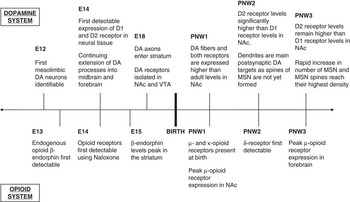
The development of the dopamine system in the rat begins during embryonic life but is not complete until approximately the 3rd postnatal week and the system is thought to be highly plastic throughout this time.Reference Antonopoulos, Dori and Dinopoulos 31 The first mesolimbic dopamine neurons can be identified in the rat brain as early as embryonic day 12,Reference Smidt and Burbach 32 and by embryonic day 17 and 18, large dopamine axon bundles have begun to enter the striatum, which includes the NAc, to form a complex network of fibres. Although dopamine axons are established in foetal life, this innervation is not complete until after the 3rd week of postnatal life.Reference Van den Heuvel and Pasterkamp 33 At birth, dopamine fibres in the NAc are present at a higher density than in adult rodents.Reference Antonopoulos, Dori and Dinopoulos 31 During the first 2 weeks after birth, the main postsynaptic targets of dopamine neurons are dendrites.Reference Antonopoulos, Dori and Dinopoulos 31 In the 3rd week of postnatal life, the number of medium spiny neurons, which are the main neurons found in the NAc, rapidly increases and spine density peaks,Reference Tepper, Sharpe and Koós 34 allowing more synaptic connections to be made. By the end of the 3rd week, dopamine neuron organization is much like that observed in the adult rat (Fig. 2).Reference Antonopoulos, Dori and Dinopoulos 31
Ontogeny of dopamine and opioid systems. Timeline depicting the development of the dopamine (top) and opioid (bottom) systems within the mesolimbic reward system throughout prenatal and the first 3 weeks of postnatal life in the rodent. By the end of postnatal week 3, dopamine and opioid systems are similar to that of an adult. DA, dopamine; E, embryonic day; NAc, nucleus accumbens; MSN, medium spiny neuron; PNW, postnatal week; VTA, ventral tegmental area. See text for references.

Dopamine receptors are also present before birth in the rat, with the development of the dopamine receptor system in this model continuing into early neonatal life. Using in situ hybridization, Schambra et al.Reference Schambra, Duncan and Breese 35 showed that dopamine receptor D1 and, at a lower level, dopamine receptor D2 were both present in neural tissues of the foetal rat as early as gestational day 14. From day 7 to 21 of postnatal life, D2 is expressed at significantly higher levels than the D1 in the NAc and the level of expression of the two receptors equalizes during the 4th week after birth (Fig. 2).Reference Tarazi and Baldessarini 36 The different ontogeny of development of the respective dopamine receptors is thought to be due to differences in the factors driving the expression of these two receptors during development, with expression of D1 being driven predominantly by dopamine levels, while dopamine seems to play only a limited role in the development of D2.Reference Tarazi and Baldessarini 36
Human
There are few studies, which have investigated the ontogeny of the dopamine system in humans, since these studies rely largely on tissues from medical terminations and are difficult to obtain. It has been established, however, that the development of the dopamine pathway in the foetus begins as early as 6–8 weeks gestationReference Herlenius and Lagercrantz 37 and the foetal striatum exhibits immunoreactivity for tyrosine hydroxylase (the rate-limiting enzyme in dopamine synthesis) and messenger ribonucleic acid (mRNA) expression of the D1 dopamine receptor by as early as 12 weeks gestation.Reference Brana, Charron and Aubert 38 , Reference Brana, Aubert and Charron 39 By 21 weeks gestation, the D2 dopamine receptor can also be detected in the striatum, with peak expression being reached 1 month after birth and remaining higher than adult levels until 9–10 years of age.Reference Meng, Ozawa and Itoh 40 The DAT is present in the striatum by 32 weeks gestation,Reference Meng, Ozawa and Itoh 40 raising the possibility that dopamine signalling may already be functional at this stage of development.
The opioid system
Rodent
Similar to the dopamine system, components of the opioid system can be detected early in embryonic development in rodents, but opioid signalling is not fully mature until well after birth. The endogenous opioids, including proopiomelanocortin products, proenkephalin products and prodynorphin products are all present at low levels before birth in the rat brain and increase in concentration with age, generally reaching peak concentrations by the 4th postnatal week.Reference McDowell and Kitchen 41 In line with the increase in the abundance of opioid peptides, opioid receptor binding increases with age to peak at around the 3rd to 4th postnatal week.
An elegant study by Spain et al., using specific radiolabelled ligands for each opioid receptor subtype (μ, κ, δ), has demonstrated that the different receptor subtypes each have distinct profiles of expression in the brain during development. The μ-opioid receptor, which is the main receptor subtype involved in the activation of the reward system following the intake of palatable foods, shows an initial decrease in binding during the first 4 days after birth, followed by a steady increase and peaks at postnatal day 21 (Fig. 2).Reference Spain, Roth and Coscia 42 Although the κ-opioid receptor is also present at birth, it exhibits a much slower increase in binding, with only a two-fold increase by the 4th postnatal week. Unlike the other two opioid receptors, the δ-opioid receptor was not detected at birth and only appeared in the 2nd week, followed by a rapid increase in expression until the 4th week after birth. This study is, however, limited by the fact that it did not look at specific brain regions.Reference Spain, Roth and Coscia 42 Interestingly, a related study looking at μ-opioid receptor ontogeny specifically in the NAc showed a peak in binding during the first 4 days after birth, followed by a steady decrease,Reference Kornblum, Hurlbut and Leslie 43 which is in complete opposition to the forebrain findings presented by Spain et al., suggesting that the development of the opioid system is region-specific. This binding pattern in the NAc is however, of particular interest given the importance of the NAc in reward behaviours.
Human
As is the case for the dopamine system, studies on the development of the opioid system in the human are limited. Opioid system development appears to begin slightly after that of the dopamine system, however much like dopamine, the endogenous opioid, β-endorphin, has been detected early in gestation, and is thought to play a role in regulating foetal growth.Reference Herlenius and Lagercrantz 37 By 12 weeks gestation, expression of another endogenous opioid, enkephalin, has been detected in the foetal striatum.Reference Brana, Charron and Aubert 38 The development of opioid receptors appears to occur well after the detection of endogenous opioids, with specific binding to the μ- and κ-opioid receptors occurring at 20 weeks gestation, followed by the appearance of the δ-opioid receptor.Reference Magnan and Tiberi 44
The influence of maternal diet on reward circuitry development
The link between perinatal exposure to highly palatable diets and the increased preference for fat and/or sugar in the offspring has opened the question of the biological mechanism, which underlies this association. The central pathways that control motivation and reward are an obvious target for the programming of food preference, and indeed several recent studies have provided evidence that a number of key components of this system are altered in juvenile and adult offspring exposed to a high-fat/high-sugar diet before birth. Naef et al.Reference Naef, Moquin and Dal Bo 45 reported that the offspring of mothers fed a high-fat diet during the last week of gestation and during lactation had reduced dopamine release in the NAc in response to a drug stimulus and decreased expression of the D2 receptor in the VTA in adulthood, implicating altered dopamine signalling in the offspring. On the other hand, Vucetic et al.Reference Vucetic, Kimmel and Totoki 28 reported that a maternal high-fat diet during pregnancy and lactation was associated with an increased expression of the μ-opioid receptor and DAT, decreased expression of D1, D2 and dopamine- and cAMP-regulated neuronal phosphoprotein (DARPP-32) in the NAc, suggesting that both the opioid and dopamine systems are affected by exposure to a highly palatable diet during foetal and early postnatal development.
We have also recently carried out studies in our own laboratory in order to determine the effect of maternal junk food feeding on the expression of key components of the reward circuitry in the offspring after exposure to a junk food diet at weaning. Gene expression of the key components of the dopamine and opioid signalling systems was determined at 6 weeks (juvenile) and 3 months (adult) of age.Reference Ong and Muhlhausler 27 An increase in μ-opioid receptor expression and a reduction in DAT expression were observed in the NAc of 6-week-old offspring of junk food fed dams. These results have led us to speculate that the increase in the expression of opioid receptors in the NAc of the offspring is the primary event through which maternal high-fat/high-sugar feeding drives the increased preference for fat in these offspring after birth. Interestingly, although not surprisingly, the changes in mRNA expression of μ-opioid receptor and DAT observed at 6 weeks of age were completely reversed at 3 months of age, suggesting that there was a premature desensitization of the reward system compared with the control offspring which were also weaned onto junk food, an effect which would be expected to be associated with further increases in fat intake during adulthood.Reference Ong and Muhlhausler 27
In addition to the underlying molecular pathway, there are also conflicting opinions as to whether it is maternal overnutrition during pregnancy or the lactation/neonatal period that more important for neuronal development. Bayol et al.Reference Bayol, Farrington and Stickland 19 found that offspring exposed to a junk food diet during the suckling period consumed significantly more junk foods when they were weaned onto a junk food diet, compared with offspring exposed to a control diet during the suckling period. This highlights the sensitivity of the lactation period to nutritional excess and its contribution to the programming of increased energy intake and adult obesity. This is in contrast to a study conducted in Leibowitz's laboratory, in which offspring of rat dams exposed to a high-fat diet during pregnancy, but not lactation, exhibited an increased expression of the endogenous opioid enkephalin in the hypothalamus at postnatal day 15, in conjunction with an increased preference for fat at postnatal day 50–60, whereas those exposed to a control diet in utero and a high-fat diet during lactation exhibited no such effects, suggesting that the prenatal period played the more important role in determining food preferences.Reference Chang, Gaysinskaya and Karatayev 23 These contrasting reports, together with the relatively small number of studies conducted in this field, create a need for further investigation into the mechanisms and critical windows for the programming of food preferences.
Mechanisms for alterations of neonatal reward systems
Emerging evidence has supported the hypothesis that being exposed to a high-fat, high-sugar environment before birth and/or during early life can lead to alterations within the mesolimbic reward system, resulting in an increased preference towards these foods after birth. The exact mechanistic causes of these changes are, however, much less clear. One suggestion has been that tastes from the maternal diet are transmitted to the foetus/neonate via the amniotic fluid and breast milk and influence the development of taste receptors such that the offspring develop an increased preference for these flavours after weaning. The transmission of flavours, in particular strong flavours such as garlic, to the amniotic fluid and breast milk has been demonstrated in an elegant series of studies by Beauchamp and Mennella,Reference Beauchamp and Mennella 46 which have provided evidence that neonates exposed to these specific flavours before birth exhibited an increased preference for the same flavour after weaning. However, the programming of food preferences by exposure to specific tastes during the perinatal period is not supported by all studies. In work conducted by our laboratory, for example, we reported that the selection of junk foods favoured by the offspring of junk food fed dams was distinct from those favoured by the dam during pregnancy and lactation, suggesting that the programming of food preferences was macronutrient-specific and not related to taste.Reference Ong and Muhlhausler 27 Therefore, further studies are required in order to clarify the role of taste in the programming of food preferences.
Another important, and as yet unanswered, question is whether there are distinct roles of specific macronutrients in the maternal diet, in particular fat and sugar, in the programming of food preferences in the offspring. Teegarden et al.Reference Teegarden, Scott and Bale 30 previously demonstrated that weanlings given 10 days exposure to a high-fat diet had an increased preference for these foods as adults, but the same effect was not observed for those offspring provided with a high-carbohydrate diet during this same period. Given the contradicting and limited evidence available, it has been proposed that the effects of maternal palatable diets on the reward system are likely to be mediated indirectly through hormones such as leptin, insulin and ghrelin, as well as neuropeptides including orexins, GABA, serotonin and endogenous opioids, which have all been shown to play a role in reward in adult rodents (see Erlanson-AlbertssonReference Erlanson-Albertsson 47 ). Since leptin, insulin and endogenous opioids have been implicated in the development of neural systems including the central appetite regulating network, they will be the focus of the remainder of the current review.
Leptin
Leptin in the adult has a key role in energy homeostasis, acting in large part through the hypothalamic appetite regulating system, to inhibit appetite (see Ahima and FlierReference Ahima and Flier 48 and Woods et al.Reference Woods, Seeley and Porte 49 ). Importantly, leptin's anorexigenic effects have been shown to be partially mediated by regulation of reward systems. Leptin receptors co-localize with dopaminergic neurons in the VTAReference Figlewicz, Evans and Murphy 50 – Reference Hommel, Trinko and Sears 51 and, in rodents, leptin infusion directly into the VTA suppresses food intakeReference Hommel, Trinko and Sears 51 while peripheral leptin administration completely inhibits high-fat food conditioned place preference.Reference Figlewicz, Bennett and Evans 52 In the foetus and neonate, leptin is thought to play a greater role in the development of neural systems than in the regulation of appetite or reward, since leptin administration to rat pups during the first 9–10 days after birth has no effect on food intake.Reference Proulx, Richard and Walker 53 The timing of this apparent insensitivity to the actions of leptin coincides with a distinct surge in circulating leptin levels, which occurs between 7 and 10 days in rodents.Reference Ahima, Prabakaran and Flier 54 Interestingly, the leptin surge has been shown to be exaggerated in both its magnitude and duration in offspring of dams fed a high-fat diet during pregnancy and lactation, and this is thought to contribute to the hyperphagia observed in these offspring later in life.Reference Kirk, Samuelsson and Argenton 25
The role of leptin as a neurotropic signal in the central neural network for appetite regulation has been elegantly demonstrated by the work of Bouret et al., in which leptin deficient mice (Lepob/Lepob) were shown to have a reduced density of neural projections within the appetite regulating system, and that this deficit could be completely reversed by administration of leptin to these mice during the neonatal period (i.e. the principal period of neuronal development). Importantly, administering leptin in adult Lepob/Lepob mice (after neuronal development was completed) had no effect on neuronal density or appetite in these animals.Reference Bouret, Draper and Simerly 55 The similar regulatory functions leptin plays in both the reward and appetite circuitries of adults has led to the suggestion that leptin may have a developmental role in reward pathways. This is supported by studies showing that Lepob/Lepob mice have reduced dopamine release upon electrical stimulation of dopaminergic cells, possibly due to a deficiency in somatodendritic dopamine stores in the VTA of these mice.Reference Roseberry, Painter and Mark 56 Moreover, a study conducted by Sánchez et al.Reference Sánchez, Priego and Palou 57 showed that rat offspring treated with leptin during the lactation period exhibited a lower preference for fat in adulthood. This provides support for the suggestion that exposure to high or low leptin concentrations early in life can alter subsequent food preferences in the offspring.
In addition to acting directly on the mesolimbic reward system, leptin may also act through indirect mechanisms, including its regulation of lateral hypothalamic orexin neurons, to impact foods choices of offspring after birth. In adults, orexin neurons input directly into the VTA and the NAc shellReference Zheng, Corkern and Stoyanova 58 – Reference Korotkova, Sergeeva and Eriksson 60 and it has been shown that orexin activity in the VTA is needed to mediate the preference for high-fat food caused by opioid receptor activation.Reference Zheng, Patterson and Berthoud 61 Consequently, Kelley et al.Reference Kelley, Baldo and Pratt 62 proposed an integrated hypothalamic–thalamic–striatal model for the regulation of food reward and it is possible that the development of these connections could be altered by exposure to an excess supply of palatable foods in early life. A study by Beck et al.Reference Beck, Kozak and Moar 63 demonstrated that the offspring of mothers who consumed a high-fat diet throughout pregnancy and lactation had an increased preference for fat and an increased expression of orexin mRNA in the lateral hypothalamus compared with control animals at weaning and that this expression was inversely proportional to circulating leptin concentrations in these animals. Therefore, the actions of leptin, both direct and indirect, appear to play an important role in the development of the reward circuitry and in influencing the food choices in the offspring after birth.
Insulin
Insulin plays an important role in the maturation of neurons within the central nervous systemReference Recio-Pinto, Rechler and Ishii 64 and insulin receptors are expressed on neurons and astrocytes during early neuronal development.Reference Baron-Van Evercooren, Olichon-Berthe and Kowalski 65 Similar to leptin, perinatal hyperinsulinaemia is associated with impaired organization of the hypothalamic appetite regulatory network, which can lead to hyperphagia and the development of obesity later in life.Reference Harder, Plagemann and Rohde 66 – Reference Plagemann, Harder and Janert 67 The connection between insulin and the development of the mesolimbic reward system is however, less well-defined. Nevertheless, in adult rodents, insulin receptors are found to co-localize with dopaminergic neurons in the VTA,Reference Figlewicz, Evans and Murphy 50 indicating a potential role of insulin in modulating dopamine activity within the mesolimbic reward pathway. Indeed, insulin has been shown to increase the expression and activity of DATReference Patterson, Brot and Zavosh 68 and hypoinsulinaemia induced by drugs or fasting reduces dopamine clearance in the striatum,Reference Owens, Sevak and Galici 69 – Reference Sevak, Koek and Owens 70 which is associated with impaired insulin signalling and decreased DAT function.Reference Owens, Sevak and Galici 69 , Reference Zhen, Reith and Carr 71 – Reference Speed, Saunders and Davis 72 The role of insulin in mediating dopamine function and reward is consistent with the observation that insulin administration decreases sucrose self-administrationReference Figlewicz, Bennett and Naleid 73 and conditioned place preference to high-fat foods in rats.Reference Figlewicz, Bennett and Evans 52 Maternal obesity and overnutrition are associated with increased maternal and foetal glucose and insulin concentrations.Reference Li, Sloboda and Vickers 22 Therefore, given the role of insulin in neuronal maturation and organization of the hypothalamic pathways, as well as its role in the regulation of food reward, it is possible that perinatal hyperinsulinaemia could alter the development of the mesolimbic reward system in the offspring and therefore result in an increased preference for palatable foods later in life. However, the role of insulin in the programming of food preferences remains to be demonstrated experimentally.
Endogenous opioids
It has been previously established that exposure to morphine in utero can alter the reward circuitry of foetus and offspring, raising the possibility that increases in endogenous opioids could have similar effects.Reference Vathy, Slamberova and Rimanoczy 74 Prenatal and early neonatal exposure to morphine have been demonstrated to result in decreases in μ-opioid receptor expression in early lifeReference Tempel, Habas and Paredes 75 – Reference Kirby and Aronstam 76 and increased μ-opioid receptor expression in adult life.Reference Handelmann and Quirion 77 – Reference Vathy, Slamberová and Rimanóczy 78 Previous studies have shown, however, that the effects of endogenous and exogenous opioids may not always be the sameReference Burford, Tolbert and Sadee 79 – Reference Keith, Murray and Zaki 80 and therefore whether these effects can be replicated through increased exposure to endogenous opioids remains to be determined. Increases in endogenous opioids, particularly met-enkephalin have been observed in the NAc of rats consuming a high-fat dietReference Chang, Karatayev and Barson 81 and, since opioids readily cross the placenta,Reference Chandorkar, Ampasavate and Stobaugh 82 increases in maternal met-enkephalin would be expected to result in increased concentrations of met-enkephalin in the foetal circulation. Indeed, the offspring of mothers fed on a high-fat diet have been shown to have an increased abundance of met-enkephalin 15 days after birth.Reference Chang, Gaysinskaya and Karatayev 23 The idea that increases in neonatal enkephalin may program changes in reward circuitry development are supported by studies looking at the reward associated behaviours of adults administered met-enkephalin in early life. Kastin et al.Reference Kastin, Kostrzewa and Schally 83 demonstrated that adult rats administered met-enkephalin in the first week of life had improved maze performance for a food reward when compared with control animals. Similarly, administration of met-enkephalin together with exposure to an odour stimulus in utero led to increased preference for the same odour at 16 days of age.Reference Stickrod, Kimble and Smotherman 84 These studies suggest a possible role for met-enkephalin in programming the developing reward circuitries of the offspring of mothers fed a palatable diet during pregnancy and lactation.
Summary and perspectives
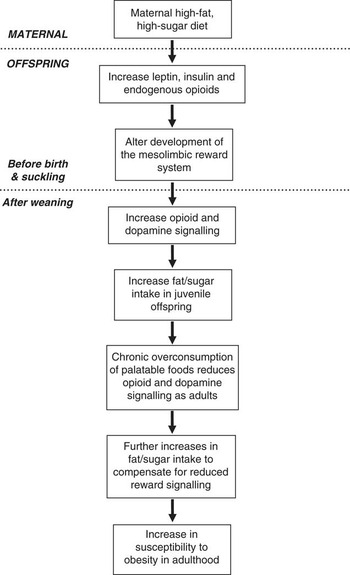
The concept that appetite can be permanently altered by exposure to an inappropriate supply of nutrients before birth has been established across a number of species. More recently, a number of studies have shown that not only overall food intake but also an individual's preference for specific foods/macronutrients can be influenced by the nutritional environment experienced before birth and early in life. A summary of the current hypothesis for the programming of food preferences is shown in Figure 3. The ability of perinatal exposure to an increased supply of fat and/or sugar to program an increased preference for palatable foods in the offspring is of particular relevance given the ready availability of these foods in modern society, and the fact that excess consumption of these foods is a major contributor to weight gain, obesity and its associated metabolic disorders. At present, our understanding of the biological/molecular mechanisms that underlie the programming of food preferences is limited, and further studies are required. Although this review has highlighted several possible mechanisms for the programming of food preferences, this list is not exhaustive and further research is expected to provide insights into alternate biological pathways. By way of example, a recent study has indicated a role for epigenetics in the maternal high-fat diet programming of food preferences.Reference Vucetic, Kimmel and Totoki 28 Given that consumption of high-fat diet is associated with epigenetic modification of the dopamine and opioid signalling systems within the mesolimbic reward pathway in adults,Reference Vucetic, Carlin and Totoki 85 – Reference Vucetic, Kimmel and Reyes 86 it is possible that this may also be one of the mechanisms through which food preferences are programmed before birth and in early life.
Current hypothesis for the early origins of a taste for fat/sugar. A maternal high-fat, high-sugar diet during pregnancy and lactation can lead to an increase in levels of leptin, insulin and endogenous opioids in the offspring either through the transfer of these peptides across the placenta or breast milk, or both. The elevated leptin, insulin and opioid levels in the offspring are postulated to alter the development of the mesolimbic reward system, during its critical windows of development, when the neuronal connections are actively developing. This can result in permanent alterations in opioid and dopamine signalling, which is associated with the increased preference for fat/sugar throughout life. This continuous consumption of high-fat, high-sugar foods can eventually lead to the onset of obesity later in life.

Although rodents provide a convenient model for delineating these mechanisms, the extent to which these will reflect the situation in humans is still unclear, and further studies mapping the development of the reward pathways in rodents and humans (and potentially other species) are required in order to be able to extrapolate the results of small animal studies into the clinical setting. Furthermore, virtually all studies to date which have focused on the reward pathway, be it in relation to its function in adults, development or response to prenatal nutritional alterations, have been carried out in males, and preliminary data from our own laboratory has shown that there are clear differences between males and females in their response to a junk food diet in adulthood and to exposure to a high-fat diet in utero.
There is still a great opportunity for studies in this field, and identifying strategies for intervention to block or inhibit the early programming of an increased preference for fat/sugar has the potential to offer a novel and effective means of curtailing the obesity epidemic.
Acknowledgements
B.M. is supported by a Career Development Award from the National Health and Medical Research Council of Australia. Z.O. is supported by a President's Scholarship from the University of South Australia. J.G. is supported by an Australian Postgraduate Award. The authors would also like to thank John Carragher for editorial assistance.