If humans evolved adaptive flexibility in religiosity and family focus depending on pathogen prevalence in their local geographic area, time allocation studies should show that religious individuals choose isolation from outsiders, and as a consequence experience fewer communicable illnesses than less-religious individuals in the same location. The group or regional differences found by Fincher & Thornhill (F&T) must represent aggregated differences in individuals’ behaviour.
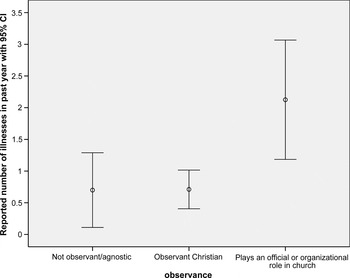
As tests of whether reduced contact with outsiders is an aspect of religiosity, and whether religious individuals experience fewer illnesses as a result, I analyzed interview-based data from anthropological fieldwork carried out in 1997 in Cayo, Western Belize, on 56 men in two Mayan villages in which many individuals had in the past decade converted to one of two evangelical faiths (Pentecostalism and a Baptist church), usually from Catholicism. In addition, a significant minority of villagers had lapsed in religious observance, and a few stated that they were agnostic. Information on reported illness in the year prior to interview was used to construct a variable consisting of the number of illnesses experienced in the past year that completely stopped the man from doing his normal daily activity for one or more days. This included acute illness (most commonly flu-like illness, but sometimes dengue fever or malaria), and chronic conditions that periodically became acute (for example, one man had a chronic ear infection that flared up regularly to the point of incapacitating pain). It was not possible to separate zoonotic versus non-zoonotic diseases, as no definitive medical diagnosis was made in almost all cases. Analysis of these self-reported illness data on the religiously observant versus non-observant did not yield a significant difference between the two groups (t-test: t=0.7, p=0.25). However, eight of the men in the sample were religious officials, including ministers, elders, and assistants. These eight men reported significantly more illness than either observant or non-observant/agnostic individuals (see Fig. 1).
Figure 1.
Taking an active role in the church was associated with more reported illnesses in the past year. In an ANOVA analysis, the difference between groups was statistically significant at p<0.01. This difference may be because church officials and staff have very active roles in the community, and are likely to come into direct contact with very sick individuals via their pastoral activities.
Time-use data on the men's weekend time allocation (consisting of a total of 1,344 hourly blocks for the sample of 56 men: for detailed methods, see Waynforth Reference Waynforth1999), showed that increased religious observance (categorized as in Fig. 1 above) was associated with less time spent with immediate family (Analysis of Variance [ANOVA]: F=18.9, p<0.01, n=56). The reasons why this was the case are not obvious: Religiously observant men appeared to spend their time across a wider range of activities rather than engaging in any single activity, more than non-observant men. Religiosity was not significantly associated with increased time spent with biological relatives other than immediate family (ANOVA: F=1.28, p<0.25, n=56). Instead, being family-focused in this Mayan community may be related to resource acquisition rather than pathogen avoidance: The Maya often practice a family-based approach to farming in which the entire family, including young children, contribute to the family's economic output (e.g., see Kramer Reference Kramer2005). In support of this alternative explanation, time spent with family was strongly positively associated with being a farmer (for farmers vs. non-farming families, t-test: t=−3.45, p<0.001): Those who worked paid jobs, for example in the logging or tourist industries, spent much less weekend time with their nuclear family. This raises the prospect that family-oriented time allocation may increase fitness through resource acquisition efficiency for farming families in this population, rather than being a parasite-avoidance strategy.
Church roles for the Christian officials/organizers in the sample included direct contact with parishioners both at church services and in the community, movement outside of their village, and regular contact with sick individuals. For this reason, F&T's argument may not hold for Christianity in developing nations: Rather than forming small self-contained sects that would reduce the chances of contracting parasitic infections from the wider population, evangelical Christian ministers and church officials may often have increased social contact and exposure to parasitic disease, and may spread infection to parishioners during epidemics. In the relatively pathogen-prevalent Mayan village context, this cost of religion may be offset by advantages, both in terms of political influence for church officials, and in terms of the benefits of out-group innovation and trade opportunities. Second, the Mayan communities in Belize have experienced repeated influxes of newcomers over the past 150 years or more, from whom it was and is presently not possible to maintain total separation. Globally, many isolated societies cannot repel outsiders, and therefore cannot avoid contact with their pathogens: no degree of religiously-induced xenophobia will stop powerful colonial invaders. Third, other aspects of the behavioural immune system may prevent parasitic disease without carrying costs of cultural isolation: Disgust at disease symptoms results in stigmatization and avoidance of diseased individuals (see Kurzban & Leary Reference Kurzban and Leary2001). This mechanism would afford less costly protection from communicable diseases, except in cases where asymptomatic individuals are vectors, and for zoonotic infections.
In sum, key questions about the parasite-stress theory of sociality remain unanswered: Does it work? And if it does, how important is it for understanding human sociality? The Belizean Mayan data analyzed here did not suggest that religious individuals have time-allocation or activity patterns that reduce contact with the outside world. If religious individuals do not have significantly less contact with the outside world, then the measures of religiosity at a regional or national level analysed by F&T do not reliably indicate degree of out-group contact. Assuming that religiosity does reduce out-group contact, other evolutionary pressures must simultaneously contribute to selection for religion; for example, via costly signalling–based cooperative benefits (e.g., Sosis Reference Sosis2003). Similarly, placing high value on close family ties may be an adaptive flexible response to the benefits of cooperative breeding in a particular environment. The relative importance of lowered parasite-stress compared with other advantages of in-group favoritism needs to be addressed.





 You have
Access
If humans evolved adaptive flexibility in religiosity and family focus depending on pathogen prevalence in their local geographic area, time allocation studies should show that religious individuals choose isolation from outsiders, and as a consequence experience fewer communicable illnesses than less-religious individuals in the same location. The group or regional differences found by Fincher & Thornhill (F&T) must represent aggregated differences in individuals’ behaviour.
As tests of whether reduced contact with outsiders is an aspect of religiosity, and whether religious individuals experience fewer illnesses as a result, I analyzed interview-based data from anthropological fieldwork carried out in 1997 in Cayo, Western Belize, on 56 men in two Mayan villages in which many individuals had in the past decade converted to one of two evangelical faiths (Pentecostalism and a Baptist church), usually from Catholicism. In addition, a significant minority of villagers had lapsed in religious observance, and a few stated that they were agnostic. Information on reported illness in the year prior to interview was used to construct a variable consisting of the number of illnesses experienced in the past year that completely stopped the man from doing his normal daily activity for one or more days. This included acute illness (most commonly flu-like illness, but sometimes dengue fever or malaria), and chronic conditions that periodically became acute (for example, one man had a chronic ear infection that flared up regularly to the point of incapacitating pain). It was not possible to separate zoonotic versus non-zoonotic diseases, as no definitive medical diagnosis was made in almost all cases. Analysis of these self-reported illness data on the religiously observant versus non-observant did not yield a significant difference between the two groups (t-test: t=0.7, p=0.25). However, eight of the men in the sample were religious officials, including ministers, elders, and assistants. These eight men reported significantly more illness than either observant or non-observant/agnostic individuals (see Fig. 1).
Taking an active role in the church was associated with more reported illnesses in the past year. In an ANOVA analysis, the difference between groups was statistically significant at p<0.01. This difference may be because church officials and staff have very active roles in the community, and are likely to come into direct contact with very sick individuals via their pastoral activities.
Time-use data on the men's weekend time allocation (consisting of a total of 1,344 hourly blocks for the sample of 56 men: for detailed methods, see Waynforth Reference Waynforth1999), showed that increased religious observance (categorized as in Fig. 1 above) was associated with less time spent with immediate family (Analysis of Variance [ANOVA]: F=18.9, p<0.01, n=56). The reasons why this was the case are not obvious: Religiously observant men appeared to spend their time across a wider range of activities rather than engaging in any single activity, more than non-observant men. Religiosity was not significantly associated with increased time spent with biological relatives other than immediate family (ANOVA: F=1.28, p<0.25, n=56). Instead, being family-focused in this Mayan community may be related to resource acquisition rather than pathogen avoidance: The Maya often practice a family-based approach to farming in which the entire family, including young children, contribute to the family's economic output (e.g., see Kramer Reference Kramer2005). In support of this alternative explanation, time spent with family was strongly positively associated with being a farmer (for farmers vs. non-farming families, t-test: t=−3.45, p<0.001): Those who worked paid jobs, for example in the logging or tourist industries, spent much less weekend time with their nuclear family. This raises the prospect that family-oriented time allocation may increase fitness through resource acquisition efficiency for farming families in this population, rather than being a parasite-avoidance strategy.
Church roles for the Christian officials/organizers in the sample included direct contact with parishioners both at church services and in the community, movement outside of their village, and regular contact with sick individuals. For this reason, F&T's argument may not hold for Christianity in developing nations: Rather than forming small self-contained sects that would reduce the chances of contracting parasitic infections from the wider population, evangelical Christian ministers and church officials may often have increased social contact and exposure to parasitic disease, and may spread infection to parishioners during epidemics. In the relatively pathogen-prevalent Mayan village context, this cost of religion may be offset by advantages, both in terms of political influence for church officials, and in terms of the benefits of out-group innovation and trade opportunities. Second, the Mayan communities in Belize have experienced repeated influxes of newcomers over the past 150 years or more, from whom it was and is presently not possible to maintain total separation. Globally, many isolated societies cannot repel outsiders, and therefore cannot avoid contact with their pathogens: no degree of religiously-induced xenophobia will stop powerful colonial invaders. Third, other aspects of the behavioural immune system may prevent parasitic disease without carrying costs of cultural isolation: Disgust at disease symptoms results in stigmatization and avoidance of diseased individuals (see Kurzban & Leary Reference Kurzban and Leary2001). This mechanism would afford less costly protection from communicable diseases, except in cases where asymptomatic individuals are vectors, and for zoonotic infections.
In sum, key questions about the parasite-stress theory of sociality remain unanswered: Does it work? And if it does, how important is it for understanding human sociality? The Belizean Mayan data analyzed here did not suggest that religious individuals have time-allocation or activity patterns that reduce contact with the outside world. If religious individuals do not have significantly less contact with the outside world, then the measures of religiosity at a regional or national level analysed by F&T do not reliably indicate degree of out-group contact. Assuming that religiosity does reduce out-group contact, other evolutionary pressures must simultaneously contribute to selection for religion; for example, via costly signalling–based cooperative benefits (e.g., Sosis Reference Sosis2003). Similarly, placing high value on close family ties may be an adaptive flexible response to the benefits of cooperative breeding in a particular environment. The relative importance of lowered parasite-stress compared with other advantages of in-group favoritism needs to be addressed.