Introduction
Co-occurring related teleost species often display different life history strategies, including reproduction characteristics such as location and time of spawning, and size and age at maturity (Roff, Reference Roff1991; Gray et al., Reference Gray, Barnes, van der Meulen, Kendall, Ochwada-Doyle and Robbins2014; Taylor & Choat, Reference Taylor and Choat2014; Hu et al., Reference Hu, Ye, Lu, Du, Chen, Chou and Yang2015). Such differential traits can assist resource partitioning and influence structuring and coexistence of ichthyofaunal assemblages (Ross, Reference Ross1986; Roff, Reference Roff1991; Wellenreuther & Clements, Reference Wellenreuther and Clements2007). Knowledge of variation in reproductive strategies among related species is fundamental to understanding and projecting impacts of anthropogenic activities and perturbations, such as fishing and climate change, on assemblages and ecosystems, and facilitating appropriate conservation and harvest management strategies (Rochet, Reference Rochet2000; Jakobsen et al., Reference Jakobsen, Fogarty, Megrey and Moksness2009; McPhie & Campana, Reference McPhie and Campana2009; Morgan et al., Reference Morgan, Murua, Kraus, Lambert, Marteinsdottir, Marshall, O'Brien and Tomkiewicz2009; Hobday et al., Reference Hobday, Smith, Stobutzki, Bulman, Daley, Dambacher, Deng, Dowdney, Fuller, Furlani and Griffiths2011).
The teleost family Platycephalidae, commonly known as flathead, consists of more than 80 species from 18 genera, most of which occur in the Indian and Pacific Oceans, although a few species inhabit the Atlantic Ocean and Mediterranean Sea (Imamura, Reference Imamura1996; Nelson et al., Reference Nelson, Grande and Wilson2016). Flathead are typically dorso-ventrally compressed, well camouflaged, benthic ambush predators morphologically adapted at burying or remaining partially buried in unconsolidated soft sediment environments across estuarine and continental shelf and upper slope waters (Douglas & Lanzing, Reference Douglas and Lanzing1981; Barnes et al., Reference Barnes, Leclerc, Gray and Williamson2011a; Coulson et al., Reference Coulson, Platell, Clarke and Potter2015). Many flathead species feature in commercial, recreational and traditional fisheries (Bawazeer, Reference Bawazeer1989; Gray et al., Reference Gray, Gale, Stringfellow and Raines2002; Sabrah et al., Reference Sabrah, Amin and El Sayed2015; Schnierer & Egan, Reference Schnierer and Egan2016; Gray & Kennelly, Reference Gray and Kennelly2018; Akita & Tachihara, Reference Akita and Tachihara2019). Consequently, the life history characteristics of several harvested species have been studied, and inter-specific similarities and differences in species demographic characteristics within the family have been identified (Barnes et al., Reference Barnes, Gray and Williamson2011b; Coulson et al., Reference Coulson, Hall and Potter2017).
In Australia, over 52 flathead species from 15 genera have been recorded, with the continental shelf waters of eastern Australia being represented by at least 38 species (Bray, Reference Bray2020). Despite such diversity, the life history characteristics of only a small number of species have been examined. For example, published information on the reproductive biology of east Australian flathead is limited to only three harvested species; Platycephalus richardsoni (Colefax, Reference Colefax1938; Fairbridge, Reference Fairbridge1951), P. bassensis (Jordan, Reference Jordan2001; Bani & Moltschaniwskyj, Reference Bani and Moltschaniwskyj2008) and P. fuscus (Gray & Barnes, Reference Gray and Barnes2015). Whilst this is primarily a legacy of a historical focus on species targeted in commercial fisheries, recent advances in ecosystem-based fisheries management have driven greater emphasis on examining the biological characteristics of all species, including bycatch and discard species, that interact with all fishing sectors (Hobday et al., Reference Hobday, Smith, Stobutzki, Bulman, Daley, Dambacher, Deng, Dowdney, Fuller, Furlani and Griffiths2011).
This study redresses the lack of reproductive data for two east Australian endemic flathead species that interact with regional fisheries in different ways; the freespine flathead Ratabulus diversidens, which although not specifically targeted is widely harvested as a byproduct species in commercial and recreational fisheries (Macbeth et al., Reference Macbeth, Millar, Johnson, Gray, Keech and Collins2012), and the mud flathead Ambiserrula jugosa, which is mostly discarded across fisheries because of its small size (Broadhurst et al., Reference Broadhurst, Kennelly and Gray2002; Gray & Kennelly, Reference Gray and Kennelly2018). Both species are distributed across tropical and temperate waters; R. diversidens between latitudes ~19.25°S and 37.85°S, and A. jugosa between ~14.15°S and 35.05°S (Bray, Reference Bray2020). However, R. diversidens has a broader depth distribution (20–350 m) than A. jugosa (5–100 m) (Bray, Reference Bray2020), and it also attains a larger maximum total length and longevity (45 cm and 13 years) compared with A. jugosa (22 cm and 4 years) (Barnes et al., Reference Barnes, Gray and Williamson2011b).
This study specifically examined and compared length and age at sexual maturity, seasonality and depth associations of reproductive activity, and mode of oocyte development and spawning of R. diversidens and A. jugosa over inner continental shelf waters of south-eastern Australia. The data obtained not only contribute to the at present, data-poor, international knowledge-base of platycephalid biology, but provide further insights into life history variation among co-occurring related teleosts, and new information for fisheries management consideration.
Materials and methods
Sample collection
Samples of R. diversidens and A. jugosa were collected as part of a fishery-independent survey of demersal ichthyofauna occurring on prawn trawl grounds on the inner continental shelf of New South Wales, Australia. Sampling was done over unconsolidated soft substrata in three discrete depth strata (shallow: 15–30 m; intermediate: 31–60 m; and deep: 61–90 m), across two transects perpendicular and adjacent to the ports of Yamba (~29.43°S 153.35°E) and Newcastle (~32.93°S 151.75°E). This region is a recognized climate-change hotspot characterized by a dynamic oceanography dominated by the southward flowing East Australian Current and associated eddies (Suthers et al., Reference Suthers, Young, Baird, Roughan, Everett, Brassington, Byrne, Condie, Hartog, Hassler, Hobday, Holbrook, Malcolm, Oke, Thompson and Ridgway2011; Frusher et al., Reference Frusher, Hobday, Jennings, Creighton, D'Silva, Haward, Holbrook, Nursey-Bray, Pecl and van Putten2014; Oke et al., Reference Oke, Roughan, Cetina-Heredia, Pilo, Ridgway, Rykova, Archer, Coleman, Kerry, Rocha, Schaeffer and Vitarelli2019). Sampling was done at night within one week of each full moon (i.e. every four weeks) between November 2005 and November 2007 at Yamba, and October 2006 and November 2007 at Newcastle. As a consequence of sampling every four weeks, two sampling times occurred in July 2007. The trawl gear consisted of a triple net configuration with each net having a headline length of 10.8 m and 42 mm mesh throughout the body and codend. Each standardized tow had a bottom duration of 1 h. Catches were immediately sorted and for each tow the total weight of each species was determined (nearest 100 g), and all individuals of both species were retained, euthanized in an ice slurry, placed into sealed plastic containers and transported to the laboratory for biological examination.
In the laboratory, each retained individual was measured (total length – TL, nearest 0.1 cm) and weighed (body weight – BW, nearest 0.1 g), and up to 30 randomly selected individuals of each species from each depth/transect/location were also sexed (presence of ovaries or testes), and had their gonad weighed (GW, nearest 0.01 g). The gonadosomatic index (GSI) was then calculated for each individual: GSI = (GW/BW) × 100. The reproductive stage of each of these individuals was determined by macroscopic examination and classification of reproductive tissue assigned using the criteria listed in Table 1. Individuals that had gonads classified Stage I and II were deemed immature, whereas those with gonads Stage III and above were deemed mature and capable of spawning. During each month of sampling, a random selection of ovaries from each reproductive stage of each species were collected and placed in a solution of 10% formalin, 5% glacial acetic acid, 1% anhydrous calcium chloride and 84% fresh water (FAACC) for a period of up to one month before being transferred into a 70% alcohol solution for storage.
Criteria for the macroscopic classification of female and male Ratabulus diversidens and Ambiserrula jugosa gonads

Adapted from Scott & Pankhurst (Reference Scott and Pankhurst1992).
Length and age at maturity
The length (L50) and age (A50) at which 50% of the male and female population were considered mature was estimated by fitting a logistic model (P L = 1/[1 + e (a+bL)]) using non-linear least squares techniques for individuals in one cm length classes and yearly age classes, where P L is the proportion of immature (stage I and II) and mature (stage III and above) individuals in each length and age class, and a and b are constants estimated using generalized linear modelling from the binomial family. Each L50 and A50 were estimated from the parameters a and b using the logistic equation (L50 and A50 = −a/b) and derived for females and males of each species at each location during the identified periods of peak reproduction when more than 100 individuals were examined. Separate estimates of L50 and A50 were determined for samples collected in each year at Yamba. The age of fish were determined by interpreting sectioned sagittal otoliths (Barnes et al., Reference Barnes, Gray and Williamson2011b). Differences between sex, location and year in the estimated L50 and A50 values for each species were examined using two-sampled Z tests with an alpha level of 0.05, as described by Gunderson (Reference Gunderson1977).
Spawning period and depth
The timing and duration of the spawning period for each species was assessed for each sex at each location by examining temporal changes in GSI (for individuals ≥L 50) and the proportion of each macroscopic gonad stage present. Months of high GSI values and proportions of reproductively mature individuals were considered periods of peak reproductive activity for each sex of each species. The number and proportion of mature individuals of each species across depth strata at each location were also determined for each month and summed across all months.
Mode of spawning and batch fecundity
Histological processing of preserved tissue from a selection of stage II, III and IV ovaries of each species that were sampled during the spawning season were conducted using automated tissue processors following the procedures detailed in Hughes et al. (Reference Hughes, Stewart, Kendall and Gray2008) and Walsh et al. (Reference Walsh, Gray, West and Williams2011). Each preserved ovary was blotted dry and weighed to 0.1 mg. A sub-sample from each stage ovary was removed, reweighed to 0.1 mg and placed in a sample jar containing a 70% ethanol solution. Each sub-sample was then placed in an ultrasonic cleaner (Unisonics Model FXP4) for a period of ~40 min to dislodge individual oocytes from surrounding preserved connective tissue (Barnes et al., Reference Barnes, van der Meulen, Orchard and Gray2013). Oocytes from each sub-sample were then pipetted into a Petri dish containing a 70% ethanol solution which was then placed on the scanning plate of a Canon colour scanner (CanoScan 8600F), covered with a blackened cardboard lid and an image taken at 1200 dpi resolution. The size frequency distribution of oocytes of individuals of each species with stage III and IV ovaries was determined by measuring the diameter of oocytes present from five randomly selected ovaries.
To accurately measure individual oocytes for each species, scanned images were opened in Image J (Version 1.381), converted to 8-bit and brightness/contrast levels set at species-specific predetermined values. A ‘watershed’ function was then applied to each image to separate any oocytes that may have been in contact with one another. The image was then intensively scrutinized and any non-oocytes debris removed. The number and diameter of oocytes in each sample was then recorded. Frequency plots of oocyte diameter size from each developmental stage for each species were constructed and examined.
The asynchronous oocyte development indicated that each species displayed indeterminate fecundity. The largest size class of oocytes (vitellogenic, >0.3 mm) in mature, pre-spawning stage III fishes were considered suitable for estimating potential batch fecundity (Hunter et al., 1985). The ovaries of 14 R. diversidens and 10 A. jugosa were used to estimate potential batch fecundity. For each individual sampled the number of oocytes present was calculated using the same methodologies describe above for investigating oocyte size frequency distributions. Potential batch fecundity was then estimated gravimetrically by scaling the number of oocytes present within the weighed ovarian subsample to the total preserved weight of the ovary.
The parameters for the potential batch fecundity to total length relationship (F PB = aTLb, where F PB = potential batch fecundity, TL = total length (cm), a and b are constants) for each species at each location were estimated by back transforming parameter estimates derived from linear regression analysis conducted using the log transformed equation. The F b to TL relationship was calculated to determine the reproductive investment into potential batch fecundity for each species.
Results
Sample composition
A total of 648 R. diversidens were caught at Yamba (3 shallow, 53 intermediate, 592 deep) and 407 at Newcastle (4 shallow, 1 intermediate, 402 deep), whereas 697 A. jugosa were sampled at Yamba (281 shallow, 401 intermediate, 15 deep) and 7 at Newcastle (6 shallow and 1 intermediate). The 7 Newcastle caught A. jugosa were not included in any analyses.
There was no significant difference in the overall ratio of male to female R. diversidens sampled at Yamba (1.11:1, χ2 = 1.53, P = 0.217), or for individuals <20 cm TL (1:1, χ2 = 0, P = 1) or ≥20 cm TL (1.15:1, χ2 = 2.22, P = 0.136). Overall, the sex ratio was significantly skewed to females at Newcastle (1:1.33, χ2 = 10.51, P = 0.0011), and this was also true for individuals ≥20 cm TL (1:4.69, χ2 = 31.14, P < 0.0001), but not for those < 20 cm TL (1:1.12, χ2 = 1.58, P = 0.209). For A. jugosa the overall male to female sex ratio was significantly skewed to females (1:1.27, χ2 = 10.66, P = 0.0011) and also for individuals ≥15 cm TL (1:2.16, χ2 = 21.29, P < 0.0001), but for individuals <15 cm TL the sex ratio did not differ significantly (1:1.11, χ2 = 1.76, P = 0.185).
Length and age at maturity
The smallest observed mature female and male R. diversidens was 19.7 and 11.4 cm TL, respectively, and 14.5 and 10.0 cm TL for A. jugosa, respectively. The youngest observed mature female and male R. diversidens were both 1 year old, and for A. jugosa these were 2 and 1 years old, respectively.
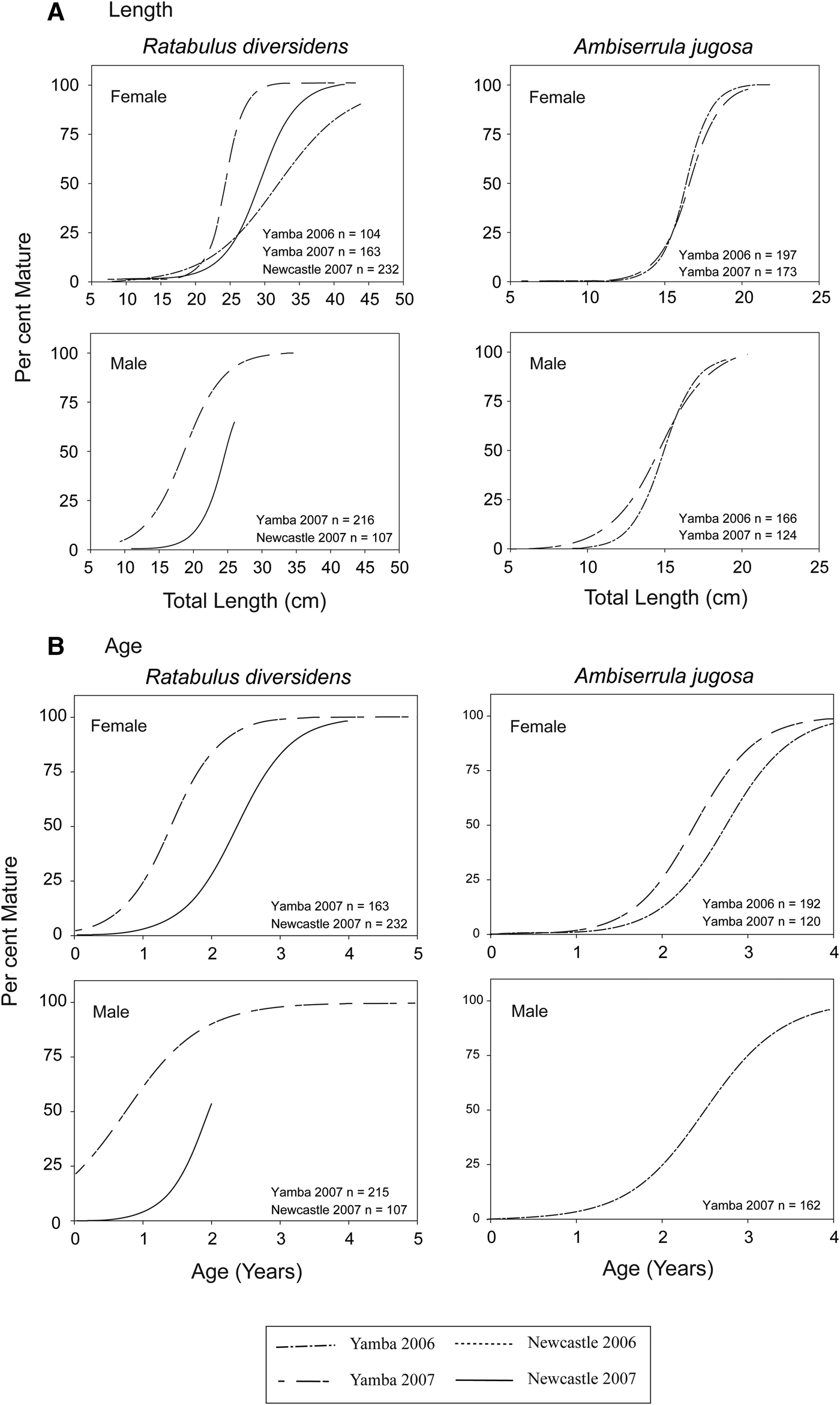
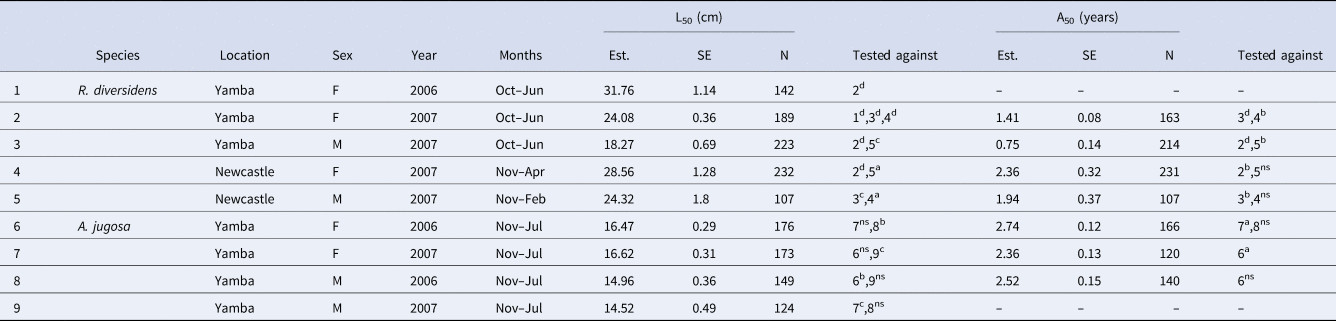
There was significant variation in the estimated L50 for female and male R. diversidens between years and locations (Figure 1, Table 2). At Yamba, the female L50 was significantly greater (P < 0.05) in 2006 (31.8 cm TL) than in 2007 (24.1 cm TL). The 2007 female L50 was significantly greater than males at both locations. Both the estimated L50 and A50 for female and male R. diversidens were significantly larger and older respectively, at Newcastle than at Yamba in 2007 (P < 0.0001).
The logistic relationship between (A) total length and (B) estimated age and the percent of mature female and male Ratabulus diversidens at Yamba and Newcastle, and Ambiserrula jugosa at Yamba.

Length (L50) and age (A50) at maturity estimates (+SE) for female and male Ratabulus diversidens and Ambiserrula jugosa across locations and years where more than 100 observations were recorded

Summary of P-value from the two-sample Z tests between appropriate L50 and A50 values are given; a<0.05, b<0.01, c<0.001, d<0.0001, ns>0.05. Months equate to data used in each analysis, F = female, M = male, Est. = L50 and A50 estimate, SE = standard error, N = number of individuals
There were no significant differences between years for the estimated L50 for female (16.6 and 16.5 cm TL) and male (15.0 and 14.5 cm TL) A. jugosa; however, the L50 for females was significantly greater than males across both years (Figure 1, Table 2). In contrast, the estimated A 50 for females significantly differed (P < 0.001) between years at Yamba (2.7 and 2.4 years), but the 2006 female estimate (2.7 years) did not differ to male estimate for 2006 (2.5 years).
Spawning period and depth
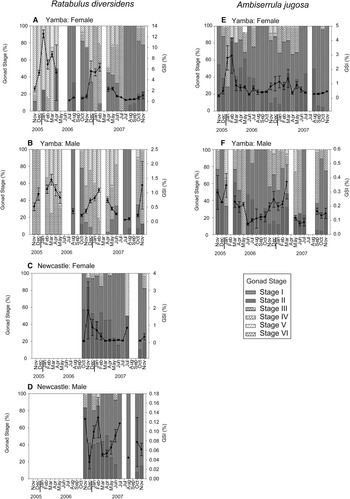
Mature female and male R. diversidens were present across most months at Yamba, the exceptions being between July and September for females, and July and August for males (Figure 2). Elevated mean GSIs were particularly evident between December and March for females, and between November and May for males. No such patterns were evident at Newcastle where the few mature individuals sampled occurred only between November and April and in July (Figure 2). At Yamba, 170 R. diversidens with gonads classified as stage IV and V were sampled in the deep compared with 2 in the intermediate and none in the shallow depth strata, whereas at Newcastle only 3 were sampled and these occurred in the deep strata.
Monthly mean gonadosomatic indices (GSI) (±1 SE) and the proportions of each macroscopic gonad classification observed for female and male Ratabulus diversidens at Yamba and Newcastle, and Ambiserrula jugosa at Yamba.

Few mature female A. jugosa were sampled, but mature females and males were most prevalent between November and May across both years, and also in July 2006 (Figure 2). Elevated GSIs were evident for males across these periods, and for females in January and February in 2006 and November 2006 to May 2007. Only 13 A. jugosa with gonads classified as stage IV and V were sampled; 4 in the shallow and 9 in the intermediate depth strata at Yamba.
Mode of spawning and batch fecundity
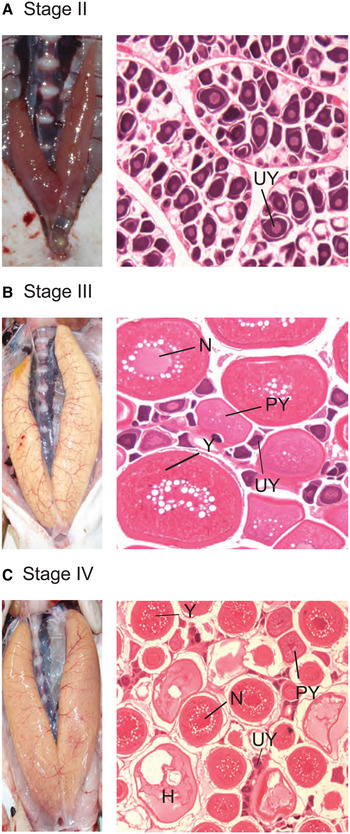
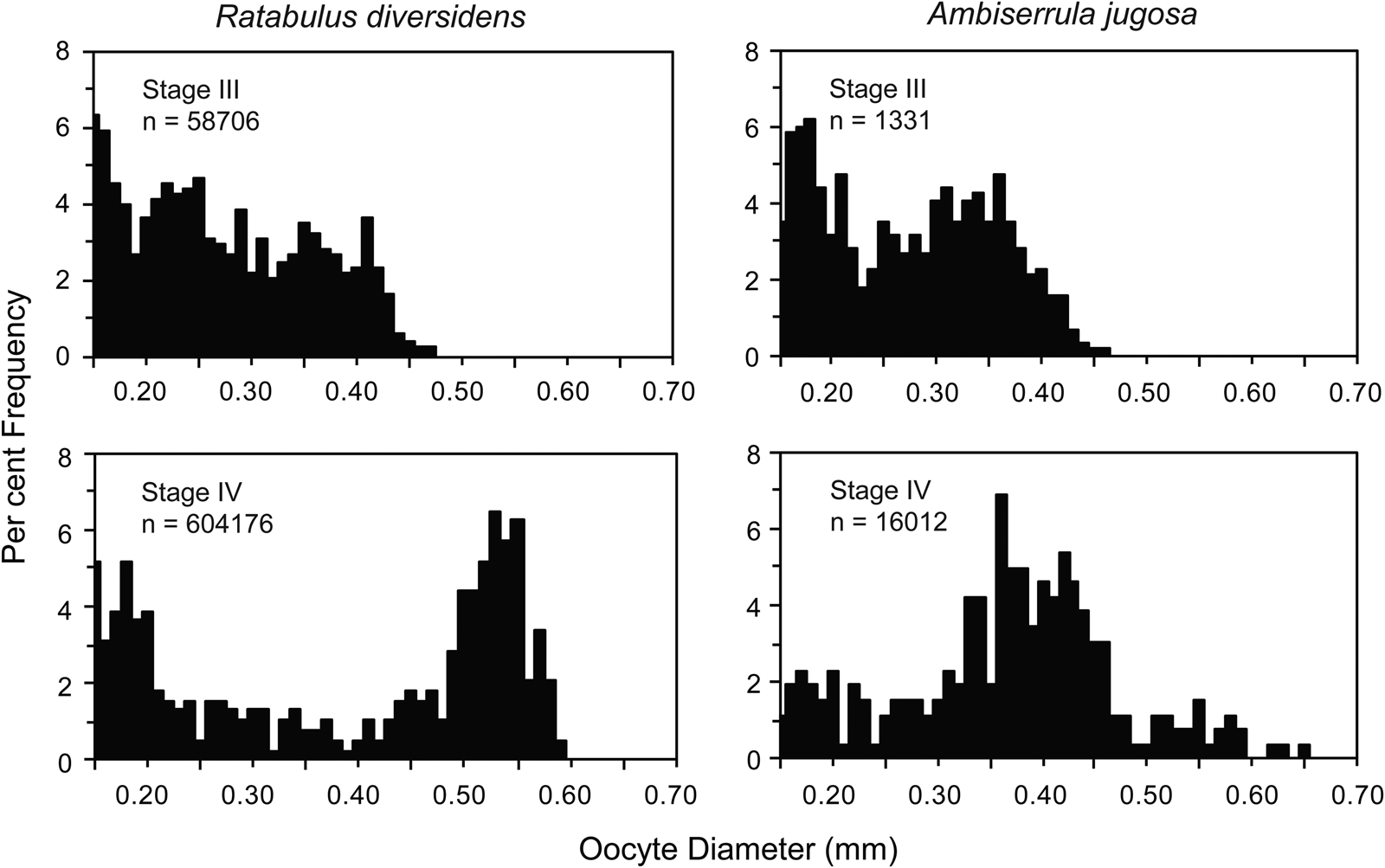
Both species displayed an asynchronous mode of oocyte development; stage II immature ovaries contained unyolked oocytes, while stage III ovaries contained a mixture of unyolked ooctyes, partially yolked oocytes and some oocytes that were in an advanced stage of yolk development. Stage IV ovaries contained hydrated oocytes in addition to oocytes in each of the previous stages of development (Figure 3). For both species, the diameter of the largest oocyte cohort observed in stage III ovaries ranged approximately between 0.35 and 0.45 mm, whereas in stage IV ovaries they ranged between 0.50 and 0.60 mm (Figure 4). Both species therefore had indeterminate fecundity and were considered potentially capable of spawning more than once within each defined spawning period.
Representative examples of the macroscopic staging and microscopic structures for Ratabulus diversidens ovarian tissue. (a) Stage II immature ovary, containing developing oocytes in unyolked (UY) stages; (b) stage III mature ovary, containing unyolked (UY), partially yolked (PY) and oocytes in advanced yolk stage (Y). Neculeoli (N) are visible within some oocytes; (C) stage IV mature ovary, containing ooctyes in all previous stages of development as well as hydrated oocytes (H) that will in the near future be ovulated and travel down the oviduct before being released from the genital pore.

Size frequency distribution and number (n) of oocytes measured ≥0.15 mm within representative stage III and stage IV ovaries of Ratabulus diversidens and Ambiserrula jugosa.

The gradient of the relationship between potential batch fecundity and TL did not vary significantly between locations for R. diversidens (df = 1, MS = 0.03, F 1,10 = 0.15, P = 0.71). Within the length range of individuals sampled, estimated batch fecundity for R. diversidens ranged between 61,700 and 450,094 eggs for individuals 24.4–41.2 cm TL, and likewise between 12,313 and 142,332 eggs for A. jugosa of 15.4–20.5 cm TL. Potential batch fecundity was significantly correlated with TL for R. diversidens (N = 14, r 2 = 0.29, P = 0.046), but not A. jugosa (N = 10, r 2 = 0.312, P = 0.093). The back calculated parameter estimates of relationships between potential batch fecundity and TL were: a = 828.57, b = 1.58 for R. diversidens, and a = 0.104, b = 4.39 for A. jugosa. The frequency and number of actual spawning events by an individual throughout each spawning season could not be determined. Thus, the total number of eggs that each individual produced in a spawning season (i.e. total fecundity) could not be estimated.
Discussion
Maturity
Males of R. diversidens and A. jugosa matured at a smaller length and earlier age than females; a common trait among platycephalids (e.g. Platycephalus speculator: Hyndes et al., Reference Hyndes, Neira and Potter1992; P. bassensis: Bani & Moltschaniwskyj, Reference Bani and Moltschaniwskyj2008; P. fuscus: Gray & Barnes, Reference Gray and Barnes2015) and other teleosts (Sciaenidae: Silberschneider et al., Reference Silberschneider, Gray and Stewart2009: Sillaginidae: Kendall & Gray, Reference Kendall and Gray2009; Gray et al., Reference Gray, Barnes, van der Meulen, Kendall, Ochwada-Doyle and Robbins2014; Percichthyidae: Walsh et al., Reference Walsh, Gray, West and Williams2011; Gerreidae: Gray, Reference Gray2019). Such disparity in maturation schedules between sexes is most likely the result of sex-specific trade-offs between maximizing reproductive success in response to predation and lifetime reproductive output (Roff, Reference Roff1992; Morita et al., Reference Morita, Morita, Fukuwaka and Matsuda2005). Delaying female maturation can increase batch fecundity (e.g. R. diversidens) and oocyte viability through the provision of additional resources and ultimately enhanced larval survival (Parker, Reference Parker1992; Marteinsdottir & Steinarsson, Reference Marteinsdottir and Steinarsson1998; Berkeley et al., Reference Berkeley, Chapman and Sogard2004).
Female and male R. diversidens were smaller and younger at maturation at Yamba compared with Newcastle. This was not attributable to intra-specific variations in growth rates, which were comparable between locations (Barnes et al., Reference Barnes, Gray and Williamson2011b), but accords with the temperature-size rule which predicts that ectotherms mature at larger and older sizes with increasing latitude (i.e. decreasing temperature) (Atkinson, Reference Atkinson1994; Arendt, Reference Arendt2011). Nevertheless, sampling across a species' entire geographic range (as opposed to the narrow range sampled here) is required to fully test this hypothesis. Spatial plasticity in length and age at maturity is common among teleosts (Morgan & Bowering, Reference Morgan and Bowering1997; Lassalle et al., Reference Lassalle, Trancart, Lambert and Rochard2008; Silberschneider et al., Reference Silberschneider, Gray and Stewart2009; Sala-Bozano & Mariani, Reference Sala-Bozano and Mariani2011), and is often a response to differential levels of mortality, including fishing-induced mortality (Stearns, Reference Stearns1992; Jorgensen et al., Reference Jorgensen, Enberg, Dunlop, Arlinghaus, Boukal, Brander, Ernande, Gardmark, Johnston, Matsumura, Pardoe, Raab, Silva, Vainikka, Dieckmann, Heino and Rijnsdorp2007; Enberg et al., Reference Enberg, Jorgensen, Dunlop, Heino and Dieckmann2009; Sharpe & Hendry, Reference Sharpe and Hendry2009; Hsieh et al., Reference Hsieh, Yamauchi, Nakazawa and Wang2010). Commercial demersal trawling effort is greater at Yamba compared with Newcastle, however further investigation is needed to determine whether fishing is attributable to location differences in maturation observed here.
Most species of platycephalids studied are gonochoristic (Coulson et al., Reference Coulson, Hall and Potter2017), and based on the histological evidence observed here, this is also true for R. diversidens and A. jugosa. Nevertheless, some species are protandrous hermaphrodites (Inegocia meerdervoorti: Okada, Reference Okada1968; Onigocia macrolepis: Fujii, Reference Fujii1970; Inegocia japonica: Fujii, Reference Fujii1971; Shinomiya et al., Reference Shinomiya, Yamada and Sunobe2003; Thysanophrys celebica: Sunobe et al., Reference Sunobe, Sakaida and Kuwamura2016). The observed skewed sex ratios favouring females particularly in larger length groups of both species was most likely a result of sexually dimorphic growth trajectories and greater maximum lengths attained by females (Barnes et al., Reference Barnes, Gray and Williamson2011b), as observed in other gonochoristic platycephalids (Gray & Barnes, Reference Gray and Barnes2015; Sabrah et al., Reference Sabrah, Amin and El Sayed2015; Coulson et al., Reference Coulson, Hall and Potter2017; Akita & Tachihara, Reference Akita and Tachihara2019).
Spawning
Both R. diversidens and A. jugosa displayed extended periods of reproductive activity primarily between the austral spring and autumn, with evidence of some straggling activity outside this main period. The spring onset of increasing water temperatures and photoperiod could potentially trigger initial reproductive development and spawning in these species. This prolonged (non-winter) timing of spawning is concordant with other platycephalids (Bawazeer, Reference Bawazeer1989; Hyndes et al., Reference Hyndes, Neira and Potter1992; Gray & Barnes, Reference Gray and Barnes2015; Coulson et al., Reference Coulson, Hall and Potter2017; Akita & Tachihara, Reference Akita and Tachihara2019) and several other regional teleost species (Sillaginidae: Gray et al., Reference Gray, Barnes, van der Meulen, Kendall, Ochwada-Doyle and Robbins2014; Gerreidae: Gray, Reference Gray2019).
There was some evidence of depth separation of spawning activity between the two species, with R. diversidens in spawning condition occurring only in the deepest offshore depth strata (and potentially deeper waters) and A. jugosa in the shallower depths. Whilst this pattern generally reflects the global differential depth distributions between species, it provides a level of reproductive isolation between species (Wellenreuther & Clements, Reference Wellenreuther and Clements2007; Mercier & Hamel, Reference Mercier and Hamel2010). Moreover, estimation of reproductive investment (i.e. ratio of gonad weight to body weight) of each species suggested that A. jugosa may spawn in pairs and R. diversidens in small and discrete groups (Sadovy, Reference Sadovy, Polunin and Roberts1996). Spawning in pairs or discrete species-specific groups may facilitate fine-scale spatial and temporal partitioning of reproductive activities, further enhancing reproductive isolation between sympatric species (Colin & Bell, Reference Colin and Bell1991).
The asynchronous pattern of oocyte development of both species indicated they have indeterminate fecundity and are likely to spawn multiple times throughout each extended spawning period (Sadovy, Reference Sadovy, Polunin and Roberts1996; Pavlov et al., Reference Pavlov, Emel'yanova, Novikov, Jakobsen, Fogarty, Megrey and Moksness2009). These findings are consistent with other platycephalid species from a variety of habitats (e.g. P. speculator: Hyndes et al., Reference Hyndes, Neira and Potter1992; P. bassensis: Jordan, Reference Jordan2001; P. fuscus: Gray & Barnes, Reference Gray and Barnes2015), supporting the paradigm that flathead are multiple spawners (Coulson et al., Reference Coulson, Hall and Potter2017), as are many marine teleosts (e.g. Sillaginidae: Gray et al., Reference Gray, Barnes, van der Meulen, Kendall, Ochwada-Doyle and Robbins2014). Having an extended period of reproductive activity and ability to spawn multiple times increases the probability of successful reproduction during times of favourable oceanic conditions for optimal larval dispersal and survival (Lambert & Ware, Reference Lambert and Ware1984; McBride et al., Reference McBride, Somarakis, Fitzhugh, Albert, Yaragina, Wuenschel, Alonso-Fernández and Basilone2015; Schilling et al., Reference Schilling, Everett, Smith, Stewart, Hughes, Roughan, Kerry and Suthers2020). Not only is this a key evolutionary tactic to ensure that a portion of the annual reproductive investment survives (Roff, Reference Roff1984), but also a mechanism for maintenance of genetic connectivity among widely distributed populations along coastlines dominated by boundary currents.
Fishery management implications and research priorities
Neither R. diversidens or A. jugosa are subject to species-specific minimum legal length (MLL) restrictions, but rather general restrictions applied across unspecified platycephalid species that range from 27–30 cm TL depending on state jurisdiction. Both species attain maturation at a TL smaller than these restrictions, thus providing some potential resource protection. However, large numbers of both species (especially A. jugosa) are potentially discarded across commercial and recreational fisheries throughout their distributions (Macbeth et al., Reference Macbeth, Millar, Johnson, Gray, Keech and Collins2012; Gray & Kennelly, Reference Gray and Kennelly2018). Discard mortality levels are not known for either species, but could be high especially for those taken from deeper depths (Lyle et al., Reference Lyle, Moltschaniwskyj, Morton, Brown and Mayer2007). Reducing interactions with fishing gears through gear modifications that minimize retention of small individuals as well as developing better on-vessel sorting and handling techniques that promote discard survival are ongoing research and management activities that could increase protection of both species (Lyle et al., Reference Lyle, Moltschaniwskyj, Morton, Brown and Mayer2007; Graham et al., Reference Graham, Broadhurst and Millar2009; Macbeth et al., Reference Macbeth, Millar, Johnson, Gray, Keech and Collins2012).
This study, together with age-based data detailed in Barnes et al. (Reference Barnes, Gray and Williamson2011b), provides new and relevant biological information for R. diversidens and A. jugosa for incorporation in species- and ecosystem-based impact assessments of fishing and climate change (Hobday et al., Reference Hobday, Smith, Stobutzki, Bulman, Daley, Dambacher, Deng, Dowdney, Fuller, Furlani and Griffiths2011). Nevertheless, the data presented here are for populations located towards the southern distribution limits of each species. Complementary studies that encompass populations in the north and central regions of each species distribution, and across areas subject to different levels of fishing activity, are required to ascertain flexibility in life history characteristics and fishery impacts for holistic species assessments.
Acknowledgements
This study was funded by the NSW Government and Macquarie University, and was conducted in accordance with the NSW Government DPI Animal Care and Ethics approval 2005/11. We thank vessel skippers Don Anderson and Bruce Korner for their expertise and logistic advice concerning sampling. We acknowledge the expert technical assistance and scientific advice provided by previous NSW DPI colleagues including Damien Young, Dylan van der Meulen, Caitlin Kesby, Justin McKinnon, Martin Jackson, Ben Kendall, Adam Welfare, William Robbins, James Craig, Matt Ives, Julian Hughes, John Stewart and Leeanne Raines, and thank Karina Hall, Julian Hughes, Steven Montgomery and John Stewart for their constructive comments on the study outcomes and/or draft manuscript.