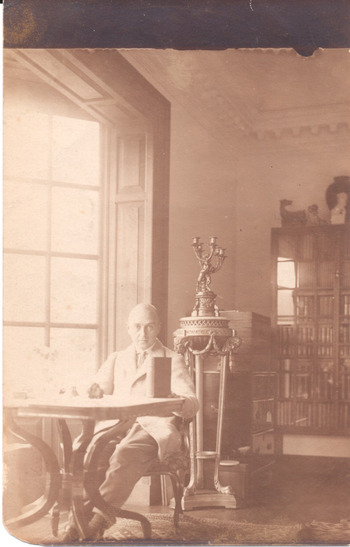
I lived with [Herbert Charles (“Jerome”)] Pollitt as his wife for some six months and he made a poet out of me.
Aleister Crowley, The Spirit of Solitude (1929)Footnote 112.1 am. Getting ready to sleep. I note that Freud's Three Essays on Sex. Now I admit that “perversions” (especially coprophilia, etc.) in normal healthy people are idealizations (purifications) of the sexual instinct. I have long ago seen this, and even elaborated a technique—see my Magical Records [19]20–1. He also justifies me in presuming hysteria—a pathological weakness—in all people who refuse to analyse the sexual problem.
Aleister Crowley, May 25, 1923, The Magical Diaries of Aleister Crowley 1923 Footnote 2One of the most striking aspects of the occultist Aleister Crowley's voluminous fin de siècle poetry is the scale on which its brazen eroticism looks at once unmatched in its outrageousness and deplorable in its ineptitude. A perfect instance is “With Dog and Dame” (subtitled, with more than a measure of calculated irony, “An October Idyll”), in which the male speaker voices his present-moment participation in an intimate three-way involving himself, his mistress, and his male Great Dane. “I yield to him,” he says of the dog, “his ravening teeth / Cling hard to her—he buries him / Insane and furious in the sheath / She opens for him.”Footnote 3 This stark description, which leaves little to the imagination, gives way to a type of Keatsian pastoral that, at first glance, appears patently absurd: “’Tis Autumn. The belated dove / Calls through the beeches, that bestir / Themselves to kiss the skies above” (97). No sooner do we read about the slumberous joy that follows upon their lovemaking—“Ah I will kiss with him and her” (97)—than one is left wondering whether the evident clash in tone between the cooing doves and the “ravening teeth” is designed to humor us or is simply the result of Crowley's ham-fistedness. Even if it intends to make a bizarre joke, this sortie into bestiality remains somewhat lackluster in its aspiration to champion a sexual act whose representation was proscribed (along with sodomy) in the Offences against the Person Act 1861.Footnote 4
The volume in which “With Dog and Dame” debuted is the bluntly titled White Stains, which the maverick Leonard Smithers—the onetime publisher of clandestine erotica—issued in 1898. As I reveal here, Crowley's hard-to-gauge manner of celebrating outlawed desires in this idyll compares with many of the other lyrical ejaculations that erupt, with such forthrightness, from the book's pages. The critical challenge, as one might predict, lies in deciding whether criticism should stay almost as quiet as it has been on Crowley's unabashed (since all-too-voluble) decadence. Crowley never ceased taking opportunities to plunge a sensuous English poetic tradition that stemmed from John Keats and flourished during the aesthetic movement into the otherwise unspeakable world of pornography. He wrote at greater length and with greater unevenness than any of his decadent peers, especially those—such as Arthur Symons, Ernest Dowson, and Vincent O'Sullivan—who belonged to Smithers's stable. As Dionysious Psilopoulos reminds us, in 1898 alone—when the twenty-two-year-old Crowley both was initiated into the Hermetic Order of the Golden Dawn and began his unstinting career as a poet while an undergraduate at Trinity College Cambridge—the independently wealthy author, at his own expense, published no fewer than six collections of verse in addition to White Stains.Footnote 5 These poems mark the origins of Crowley's eventual understanding (as Tobias Churton puts it) that “the sex instinct is linked to the divine ecstasy that may be obtained through meditative practices.”Footnote 6 As time went by, Crowley devised intricate rituals for insubordinate sexual acts—ones that we would these days commonly class with BDSM—as spiritual forms that engaged in a magick that had the capacity to cleanse, ennoble, and redeem. “Crowley,” as Hugh B. Urban has pointed out, “used the spelling magick to distinguish his art—the art of changing nature in accordance with one's Will—from vulgar understandings of the term” (289). Since magick took various forms in fin de siècle occulture, Crowley's commitment to this art belonged to a much larger movement that flourished during the same era as decadence.
What is equally noticeable about Crowley's prolific output during the late 1890s is that he often paid close attention to the material properties of the volumes in which he collected his poetry. Similar to most of the publications that he issued before having to write for profit in the 1920s, these volumes were sometimes fastidious in their design and execution. A good example is the privately issued Jephthah: A Tragedy (1898), a slim volume that came out in a finely printed edition of twenty-five copies from the Chiswick Press. In line with many contemporaries of the time, such as the artist Charles Ricketts who co-ran the Vale Press and the publisher John Lane at The Bodley Head, Crowley understood that the material artifact which contained his poetry should appear as an artwork in its own right. Timothy d'Arch Smith has shown, through great attention to bibliographical detail, that, when Crowley's alternative spiritual knowledge developed rapidly after the turn of the twentieth century, the poet built on his early interest in the material properties of books by focusing on his publications as talismans. “The book, like the talisman,” Smith writes of Crowley's evolving spiritual thought, “was born into the world to propagate the Great Work.”Footnote 7 For this reason, the “manufacture of a talisman demanded astrological calculations,” ones that we can witness on many of the title pages of his later volumes.
The broader point that arises from Smith's informative observations is that Crowley, no matter how subpar we might find his scandalous early poetry, was scrupulous apropos the material printed book as an artifact to be respected in its own right. For this reason, Crowley was very much the offspring of avant-garde 1890s culture. More specifically, his early poetic writings emerge from literary sources that intriguingly intertwine the works of Algernon Charles Swinburne, Aubrey Beardsley, and Richard Burton within the queer milieu of fin de siècle Cambridge. Particularly significant was Crowley's brief but intense intimacy during late 1897 through the spring of 1898 with Herbert Charles (“Jerome”) Pollitt: an aesthete, art collector, and drag artist whose cultural tastes and theatrical performances made him a legend at the university, from which he graduated in 1892. Pollitt, as Richard Kaczynski acknowledges, was “the first intimate friend in AC's sheltered life.”Footnote 8 To Crowley, who had been raised in the austere universe of the Plymouth Brethren, Pollitt provided access to a previously unknown decadent cultural world suffused with erotic insubordination. Crowley's fin de siècle poems bear testimony to the impact that this encounter had upon an undergraduate bridling against the religious constraints of his upbringing. “[Pollitt's] influence,” Crowley recalled in 1929, “initiated me in certain important respects. He was a close friend of Beardsley's and introduced me to the French and English renaissance.”Footnote 9 Critics concur that the dedicatory poem in Crowley's first volume, Aceldama: A Place to Bury Strangers In (1898), addresses the aesthete, collector, and performer who did much to shape his prolific output during his final year at the university; in the closing tercet, the lyric poet begs his male lover: “Take me, and with thine infamies / Mingle my shame, and on my breast / Let thy desire achieve the rest.”Footnote 10
If Crowley's poetic productivity from this period has any claim upon our understanding of 1890s decadence, it is because it arose to a large degree from the cultural world of Cambridge that made a still-underrated contribution to the development of the movement. In this respect, Pollitt stood as a central link between the social life of the colleges and the metropolitan artistic networks that had recently generated the joint editors Henry Harland and Aubrey Beardsley's at times sexually provocative quarterly, The Yellow Book, in 1894. Toward the close of the 1890s, Crowley's passions largely involved honoring and exaggerating the inspiring erotic excesses that he discovered in Swinburne's volumes from the 1860s and 1870s. His unswerving dedication to Swinburne in part stemmed from his intimacy with Pollitt. But the affair between the two men, as his memoirs insist, also introduced him to “the actual atmosphere of current aesthetic ideas,” ones that connected with “the work of Whistler, Rops, and Beardsley in art, and that of the so-called Decadents in literature” (Confessions, 148). Beardsley, who alluded to Crowley as the “Cambridge bard” and for whom he designed a bookplate, enabled the young poet to see ways of elaborating the sexual risks that Swinburne had taken decades before.Footnote 11 More to the point, Crowley's introduction to Pollitt's artistic practices and tastes endured in his later Orientalist poetry, which appeared several years after this exceptional figure had imbibed the wisdom of the spirit Aiwiss in Cairo: an experience that in turn shaped Crowley's spiritual philosophy of Thelema (“Do as thou will”). Yet the magnitude of Crowley's desire to disinhibit the attitude of modern poetry toward erotic daring was not always adept in its approach. The discussion that follows addresses these two phases of Crowley's fin de siècle before concluding with his later poetic reflections on the enduring significance of his foundational queer affair.
1. “The Decay of the Spirit of Poetry in England”: Crowley's Swinburne and Decadent Eroticism
Crowley's busy poetic fin de siècle immediately draws our attention to the different methods he undertook in producing works that would stand as the ultimate in decadent eroticism. To begin with, his limited editions show that he had in mind an elite group of collectors who would appreciate the various aesthetic and decadent sources that energized his bold forays into spiritual beliefs and sexual practices, ones that flew in the face of orthodoxy and decency. Still, Crowley was not averse to parting with funds to ensure that his more acceptable poetry might reveal to the public that he had rightly taken on the mantle as Swinburne's leading heir. Never unconfident regarding his literary gifts, Crowley soon sought public recognition by placing the substantially augmented Jephthah, and Other Mysteries: Lyrical and Dramatic with the well-respected commercial house of Kegan Paul, Trench, Trübner, & Co. in 1899, again using his own funds. This much larger and plain-looking volume opens with effusive stanzas dedicated to his poetic master, in hopes that his own lines will complement, if not fuse with, those of his idol. As Crowley's ardent speaker observes, in Poems and Ballads (1866) and Songs before Sunrise (1871), Swinburne had expressed a sacrilegious “fury” that “smote the Galilean” and voiced powerful support for the Risorgimento, whose insurgency meant that “crested Man / Leap[ed] sword in hand upon the Vatican.”Footnote 12 Crowley clearly had in mind Swinburne's references to the “pale Galilean” in the pagan “Hymn to Proserpine,” where the speaker deplores the proclamation of Christianity in Rome in 310 ad: “the world has grown grey from thy breath.”Footnote 13 The same is true of the sentiments expressed in “Mater Dolorosa.” In this paean to the lady of sorrows, which takes its epigraph from Victor Hugo's antimonarchist novel Les Misérables (1862), Swinburne's poetic voice bewails the fact that the younger generation of Italians live “in fief of an emperor” (Louis-Napoléon III), just as their souls remain equally beholden to “a Pope” (Pius IX).Footnote 14 “Yea, with thy whirling clouds of fiery light[,]” Crowley's poet implores the now very well-established Swinburne, “Involve my music, gyring fuller and faster.”Footnote 15
As these fervid lines make plain, at this juncture Crowley's self-appointed task was to take Swinburne's defiance of religious and political institutions to further extremes by carrying on a long-standing radical tradition. Everywhere in his early verse, Crowley both emulates and honors this poetic precursor. In Jephthah, and Other Mysteries, he praises Swinburne's ability to blend his poetry with “the soul of Æschylus,” entwine his song with the music of Sappho, and merge his verse with Shakespeare's bardic spirit.Footnote 16 As he goes on to acknowledge Swinburne as an inheritor of Dante, Milton, Shelley, and Hugo, there is no question that Crowley wishes to insert himself as the chief legatee of this intrepid lineage. Even in these commercial volumes, however, his tendency toward outspokenness could and did offend. Some of the reviews proved damning. Especially crushing was the commentary in the Pall Mall Gazette, which took umbrage at the two deprecatory sonnets that attack “the author of the phrase: ‘I am not a gentleman and have no friends.’”Footnote 17 Faced with Crowley's “frothy vituperation,” the critic cannot comprehend why the poet is not satisfied to limit his contempt to the fact that “[t]he sunshine is sickened with leprous moisture” of the reviled individual's “veins.”Footnote 18 Instead, “Mr. Crowley's quiver is by no means exhausted; his enemy has a carrion soul; he is caressed by Hell's worms; he is a coward, a liar, a monster, a goat, a swine, a snake.” “It is,” this critic continues, “scarcely necessary for us to add that the sonnets are so bad that the person to whom they are addressed need not trouble himself to search for any rejoinder.” The Saturday Review was equally taken aback by this “astounding virulence.” But then, in the Saturday's eyes, Crowley served as an example of the “producers of grotesque doggerel” whose degraded work signaled “[t]he decay of the spirit of poetry in England.”Footnote 19 If one point emerges from these commentaries, it is that Crowley had little sense of restraint or subtlety.
The charge of doggerel could easily be placed against much of White Stains, which Smithers arranged to be printed in Amsterdam in order to circumvent any incensed responses from English typesetters. The volume, which Beardsley at one point seemed to have an interest in decorating, was aimed at an exclusive collectors’ market and sold few copies before the remaining ones, in a print run of one hundred, were destroyed when H. M. Customs impounded them from a consignment of Crowley's property in 1924.Footnote 20 Given the assemblage of defiant male sexual acts and yearnings that repeat in the contents, including drinking an Arab male's urine and ingesting the same individual's excrement, Crowley chose—just as he had done in Aceldama—not to publish White Stains under his own identity. Instead, he furnished a preface for the collection, in which he states that the poems originally flowed from the pen of one George Archibald Bishop: a personal jab at his abominated maternal uncle Tom Bond Bishop, who sought to regulate the adolescent Crowley's adherence to the tenets of the Plymouth Brethren after the poet's father died in 1887. This imaginary gentleman, we are told, perished in Paris during the Commune, when a fire burnt to the ground the asylum to which he had recently been committed. The reasons for Bishop's incarceration, as the poems serve to demonstrate, was that he had degenerated into a raving erotomaniac, one who had been foaming at the mouth, consuming absinthe, and suffering from satyriasis. Just to ensure that Bishop's tumultuous passions attain the apogee of decadence, Crowley alerts us to the ways in which the collection marks “a progression of diabolism” (White Stains, 9–10). Here the “neuropath” is initially “carried into the outer current of the great vortex of Sin” before “he is flung headlong into the Sadism, Necrophilia, all the maddest, fiercest vices that the mind of fiends ever brought up from the pit” (10).
In his Confessions from the 1920s, Crowley ventures that his impulse to elaborate such perversions stemmed from his dissatisfaction with Richard von Krafft-Ebing's much-reprinted Psychopathia Sexualis (1886). “The professor,” Crowley writes of the Austro-German sexologist, “tries to prove that the sexual aberrations are the result of disease” (Confessions, 139). Since Crowley could not concur, he resolved “that the acts were merely magical affirmations of perfectly intelligible points of view.” “I wrote the book,” he goes on to say somewhat disingenuously, “in utmost seriousness and in all innocence.” Assuredly, there is no question that Crowley is evoking Krafft-Ebing's discussion of sexual pathology. “An abnormally strong sexual instinct,” Krafft-Ebing writes, “is frequently accompanied by a neuropathic constitution; and such individuals pass a great part of their lives heavily burdened with the weight of this constitutional anomaly of their sexual life.”Footnote 21 On this view, neuropaths—a term coined in the 1880s to define persons susceptible to nervous illness—suffered from sexually excessive conditions, which are documented at length in Krafft-Ebing's case studies. Particularly striking in Krafft-Ebing's compilation of the erotic malaise is the case of a thirty-three-year-old male servant who sought a cure for his paranoia and his “neurasthenia sexualis.”Footnote 22 “Mother,” we learn, “was neuropathic; father died of a spinal disease,” which is implicitly syphilis. His “intense sexual desire” in adolescence led to “masturbation . . . faute de mieux [for want of better], pederasty; occasionally, sodomitic indulgences.” After this individual's wife died, he on occasion resorted to “lingua canis [a dog's tongue] to induce ejaculation.” “At times,” we discover, he endured “priapism approaching satyriasis.”
With such passages in mind, Crowley's overstated preface looks very much like an exercise at not only reversing the disease-laden discourse of Psychopathia Sexualis; his comments on George Bishop as a neuropathic case study also make Krafft-Ebing's tome sound risible. The preface reminds us of what Alex Owen sees as Crowley's signature approach to writing about sexual excess. White Stains, like the equally obscene Scented Garden of Abdullah the Satirist of Shiraz (1910) that Owen discusses, is “both spoof and serious, learned in its own way while designed to amuse.”Footnote 23 For this reason, the tone of Crowley's poems that follow can prove somewhat ambiguous in its erotic boldness, since these verses rhetorically veer from poking fun at Krafft-Ebing's sexology to relishing a Swinburnean orgiastic frenzy. The contents knowingly evoke Swinburne as the master of this “progression of diabolism.” In the sonnet titled “With a Copy of ‘Poems and Ballads,’” for example, the speaker addresses, in somewhat cryptic French, “Bon Pantagruel”: one of the giants in François Rabelais's grotesque fifteenth-century fictional assault on religious oppression. “[J]e t'offre ces lyriques,” the poetic voice declares, “Vu que tu aimes, comme moi, ces mots / Des roideurs sadiques d'un grand jambot, / Des sacrées lysses de l'amour saphique” (I offer you these lyrics, / Since you, as I do, like these words / About the sadistic stiffnesses of a giant ham, / And the sacred lice of Sapphic love) (21).Footnote 24 The vulgar penile reference, which appears to have been lifted from the Parisian poet François Villon's Testament (1461), is in keeping with Rabelais's novel, although the relevance of the allusion to the revered Poems and Ballads proves hard to construe. (Swinburne's collection, which in several places surges with outlandish passions, contains no such vulgarities.) At the same time, Sapphic desire is a well-known aspect of Swinburne's 1866 volume, especially in “Anactoria,” the monologue where Sappho expresses her ardent desire for a younger woman: “Thy / . . . / . . . flower-sweet fingers, good to bruise or bite / Of honeycomb or the inmost honey-cells” (69). Meanwhile, it remains unclear whether this tribute to Poems and Ballads (and, by extension, to Rabelais) is supposed to be an absurd mirroring of the neuropathic Bishop's frenzied sexual tastes. Maybe these lines aim to lay bare the obscenity that implicitly lurks within Swinburne's poetic eroticism.
More measured is the poem that follows. The title of Crowley's “Ad Lydiam, ut Secum a Marito Fugerit” (To Lydia, to Stay with the One Who Escapes from Her Husband) is styled on Horace's sensual thirteenth ode (“Cum tu, Lydiam, Telephi / cervicem roseam / . . . laudas”) (When you, Lydia / praise Telephus's rosy neck). In this work, the male speaker urges Lydia to commit the crime of adultery: “Forget thy husband, and the cruel wreck / Of thy dear life on Wedlock's piteous sands” (24). By the final stanza, it is clear that he has triumphed: “I know thine answer by these amorous hands / That touch me thus to tempt me . . . / . . . / Thy heart clings to me in a perfect ‘Yes!’” (25). Like many of Crowley's verses, these lines express their scandalous desires in a rather heavy-handed way.
This type of classical apparatus recurs in the next poem, “Contra Conjugium T. B. B.” (Against Marriage T. B. B.): a title that of course links marriage with sexual union. On this occasion, the Latin text frames not George Bishop's passions but involves instead a personal polemic against Crowley's despised maternal uncle (“T. B. B.”). In his memoirs, Crowley is characteristically hyperbolic about the relative who “devoted the whole of his spare time to the propagation of the extraordinarily narrow, ignorant, and bigoted Evangelicalism in which he believed”: “To the lachrymal glands of a crocodile he added the bowels of compassion of a cast-iron rhinoceros” (54). The Latin made-up epigraph takes this member of the Plymouth Brethren's abomination of the organized church to the furthest extremes: “Anathema foederis nefandi, jugeris immondi, flagitii contra Amorem, contra Naturam, contra Deum, in saecula praesit Amen! Cum comminatione pastorum improborum, Ecclesiae malae, qui tales nuptias benedicunt” (An accursed individual's evil covenant, everywhere unclean, a crime against Love, against Nature, against God, presiding over the ages. Amen! With the threat of vicious pastors, the malevolent church, which blesses such marriages). In its twenty-nine five-line stanzas, the poem presents a high-church marriage service where the choir's “chant rolls through the darkened aisle” (White Stains, 26). Here, once a smiling “priest prepares” to begin the wedding ceremony, he is confronted by an unexpected force that suddenly berates him. “I am the Lord,” the disembodied entity exclaims before proceeding to tell the priest: “Thou hast despised my laws” (26). From this point onward, the retributive godhead scorns the priest whose implied celibacy makes the ecclesiastic into a “barren rock” (27). “Cold Chastity,” the Lord says reproachfully, “Father and child of Impotence.” Since the church, the godhead adds, has mistakenly set Chastity “on high,” the time has come for her to leave her “foul shrine” and avenge the faithful (28).
Such sentiments remind one of the pagan daring that features strongly in Poems and Ballads. In “Hymn to Proserpine,” Swinburne's poetic voice rebukes Jesus Christ for striving to drain sensual and artistic energy from the world: “Wilt thou yet take all, Galilean? But these thou shalt not take, / The laurel, the palms and the pæan, the breast of the nymphs in the brake” (78). Elsewhere in his 1866 collection, Swinburne pays scandalous homage to the rampant desires of pre-Christian Rome. In “Faustine,” his speaker praises Annia Galeria Faustina (Faustina the Elder), whose licentiousness was a controversial (and, most likely, unwarranted) topic in both Cassius Dio's Roman History and the anonymous Historia Augusta. “You could do all things but be good / Or chaste of mien” (124). In Crowley's poem, however, it is no longer a “pale Galilean” but a fire-and-brimstone one that harangues the Christian church for rejecting natural sexual impulses: “A gospel marred, a bastard creed, / A dogma out of hell ye teach!” (30). By this account, the Lord wants to return Christianity to the pagan roots that it has long repudiated. The larger irony is that Tom Bond Bishop, as a member of the Plymouth Brethren, would never step inside a church for fear that he might hear the words of Satan springing forth from the pulpit. Crowley's speaker certainly agrees with “T. B. B.” that the priest is “Satan's perjured slave” (32). But he also makes it plain that the priest “in hell shall flame” because the man of the church is perpetuating “the barren age's fruitless shame”: a disavowal of the erotic union that should be consecrated in marriage (32). This was, it goes without saying, scarcely a stance that a hardened Evangelical such as “T. B. B.” would maintain.
As White Stains proceeds (in the words of the preface) to George Bishop's “general exaltation of Priapism at the expense, in particular, of Christianity” (10), the sexual acts that fascinate the fictional neuropath become increasingly barefaced in their transgressive yearnings. In “Ode to Venus Callipyge,” for example, the bacchanalian chorus cries out to the Aphrodite renowned for her exquisite backside: “Daughter of Lust by the foam of the sea! / Mother of flame! Sister of shame!” (50). The language echoes many parts of Poems and Ballads, especially “A Ballad of Life,” where three male figures—Fear, Shame, and Lust—have revealed to the speaker the real meanings behind their names. “Fear” declared that he was “Pity that was dead” (10). Thereafter, “Shame said: I am Sorrow comforted. / And Lust said: I am Love” (3).
Once Crowley repeats the feverish chorus's exclamations, the volume takes a somewhat different turn in “Volupté”: another of several French-language poems, with this one serving as an entrée to the “désirs lubriques” (lubricious desires) that inspire the male speaker's longing to be fellated by a woman: “Tu suces et couvres dans la bouche / De l'amour le pouce phallique” (You suck and take into the mouth / The love of the phallic thumb) (55). To lighten the tone, Crowley's voluptuary toys with a neologism that produces a mischievous internal rhyme in this opening profession of desire: “Clitoridette, m'amourette” (petite clitoris, my passing fancy). Less inventive are several of the lines that follow: “Les seins je baise, que j'adore, / Tous les secrets de ton boudoir” (The breasts I fuck, which I adore, / All the secrets of your boudoir). Such inconsistencies in the writing certainly bear out Crowley's close friend Louis Marlow's opinion: “His poetry,” Marlow recalled in 1953, “could be very bad as well as very good. He could write mere imitative pieces, he could write superbly, with an exultant vigour entirely his own, but he never seemed to know whether he was doing one or the other.”Footnote 25
For this reason, it can prove difficult to discern whether the more outrageous poems that appear toward the end of White Stains are celebrating the hydraulic force of insubordinate desires or deliberately rendering the excesses of such longings a mite absurd. This is the case with “A Ballad of Passive Pederasty,” which takes the form of a ballade supreme. The ballade was one of numerous formes fixes revived from earlier poets such as Villon that enjoyed popularity after Edmund Gosse published his “Plea for Certain Exotic Form of Verse” in an 1877 issue of Cornhill. Swinburne, who had provided Gosse with a model for rejuvenating the form, adopted the more elaborate ballade supreme in “A Ballad of François Villon,” where his speaker upholds the greatness of the Parisian writer: “A harlot was thy nurse, a God thy sire; / Shame soiled thy song, and song assoiled thy shame.”Footnote 26 Amid this dialectic, Swinburne's poem repeats its praise for a poetic icon filled with compelling contradictions that mix the poet's illegitimacy with his inspirational divinity: “Villon, our sad bad glad mad brother's name.”Footnote 27
Crowley seizes upon his precursor's adoption of the ballade so that it can serve as a vehicle for extolling the pleasures of a man receiving a penis inside his anus. He echoes the refrain of Swinburne's 1866 “A Ballad of Burdens” (“This is the end of every man's desire”),Footnote 28 and then impudently launches into lines that relish a different “end” as the site of ultimate pleasure: “Of man's delight and man's desire / In one thing there is no weariness” (White Stains, 67). The moment we reach the refrain, we discover the male homoerotic nature of this “end”: “A strong man's love is my delight!” (67). Just in case we have not caught the pun, in the second stanza Crowley's balladeer proceeds to clarify the superiority of his lovemaking through a misogynistic sally. “Free women,” he says, “cast a lustful eye / On my gigantic charms” (67). Such women, he adds, “vainly proffer cunt and cheek; / Then, angry, they miscall me weak, / Till one, divining me aright, / Points to her buttocks, whispers ‘Greek’!” (67). Moreover, “To feel him force me like a maid” (a phrase that conjures rape) proves altogether more stimulating than penetrating younger “Boys,” who remain puzzled why the poet should “refuse / To feel their buttocks on the sly, / And kiss their genitals” (68). It is here that we find what is arguably most revealing about Crowley's poetic decadence: a demonstrative assertion of the joys that stem from opening a man's body to a dominant male. Here the poet occupies a sexually labile position, in which he ultimately identifies with such intimacy not only “like a maid” who has been ravished but also a wife who demands her spouse to perform his sexual services both on demand and at length, as we see in the envoi: “Husband, come early to my bed, / And stay beyond the dawn of light / In mighty deeds of lustihead” (69). Crowley's “Ballad” therefore is at once an homage to the established poet Swinburne and a humorous elaboration of queer male desires that never surface explicitly in Poems and Ballads.
This particular point is stated plainly in “Suggested Additional Stanzas for ‘A Ballad of Burdens,’” which once again plays the sexual “end” of “every man's desire.” On this occasion, Crowley's poetic voice sings of “The burden of caught clap”: the vulgar term for gonorrhea. Here the speaker apostrophizes the “venomous sap that hath a sting” when it shoots from the “cock crooked and consumed of fire” (67). Perhaps the point is to drive home the belief that, if there is any reason to speak of sexual diseases in this world, it should relate not to the pathologies that overwhelm Krafft-Ebing's prose but the sexually transmitted ones that cause such pain. Equally difficult to treat, it appears, is either erectile dysfunction or postcoital tristesse, which features in the second of these two “Suggested Additional Stanzas.” In this poem, we face “The burden of bought boys”: young sex workers whose “cocks stand at an amorous word,” since it is their business to perform sexually in return for payment (72). It remains, however, impossible for the poet to maintain his tumescence: “how wearily one lies / Cursing the lusts that fail, the deeds that tire” (72). On this occasion, desire—no matter how great the resources that give access to sexual services—suffers the most demoralizing destiny: exhaustion, if not boredom. At such moments, White Stains casts some skepticism on the euphoria linked with the otherwise outlawed passions that it ostensibly seeks to commend.
The immense scale of sexual ennui is elaborated at fatiguing length in “Ἅβυσμος” (The Abysm), in which the necrophiliac speaker exclaims how he has “drained . . . the liquor's lees” from the syphilitic female corpse of a demoniacal “serpent” who had been his “whore” (111). For more than 150 lines, the poetic voice cannot restrain apostrophizing about the perverse ecstasy that arises from this convulsive experience: “God! I am reeling brain and body! I swound! / The floor heaves up! / The worms devour my breast!” (117). “This is the abyss,” he exclaims at the end, as if—by this terminal point—he might be anywhere else (118). This poem, which gestures indirectly at the male servant who eroticizes the sickened corpse of a once-noble dame in Swinburne's “The Leper,” serves as Crowley's last word on the inevitable mortification of socially proscribed desires in White Stains. Such eroticism, as we can see, has to endure an insufferable death.
2. “I Wish I Could Look as If Aubrey Beardsley Had Drawn Me”: Crowley, Pollitt, and Queer Cambridge
How, then, might Pollitt's cultural universe have informed George Bishop's neuropathic death-agony, which Crowley elaborated, with a reckless number of exclamation marks, in White Stains? In many ways, this largely forgotten celebrity from fin de siècle Cambridge would hardly appear to be an enlivening source of inspiration for Crowley's decisive interest in transforming Swinburne's insurgent poetry into verses that point the way toward erotic magick. Even though Crowley acknowledged Pollitt's influence thirty years after their intimacy had come to an end, his judgment of this former lover also proved deeply negative:
The relation between us was that ideal intimacy which the Greeks considered the greatest glory of manhood and the most precious prize of life. It says much for the moral state of England that such ideas are connected in the minds of practically every one with physical passion. . . . His outlook on life was desperate, very much like that of Des Esseintes. He suffered like Tintagiles. He could not accept any of the usual palliatives and narcotics; he had no creative genius. (Confessions, 143)
Pollitt's problem, it seems, was that he had become an archetypal embattled decadent protagonist: the exhausted collector Des Esseintes of J.-K. Huysmans's 1884 novel À Rebours and the murdered protagonist of Maurice Maeterlinck's 1894 play The Death of Tintagiles. To be sure, once they had parted company, Pollitt's career as a decadent came to an end. (He later undertook unsuccessful medical training before serving in World War I, and then lived on his private income for the rest of his days.) Then again, in the ensuing paragraphs Crowley also admits that their sexual union transported him to a higher plane and that the legacy of his affair with Pollitt could not be eradicated: “he was the only person with whom I had ever enjoyed truly spiritual intercourse” (Confessions, 148).
The strongest insights that we have into Pollitt's fame as a gender-transgressive aesthete with decadent tastes emerge in E. F. Benson's 1896 novel of Cambridge undergraduate life, The Babe, B.A., which in many ways amounts to a roman à clef about Pollitt's career at the university. In an early passage about the Babe's extraordinary social life, the narrator describes the artworks and books arranged in the young man's rooms. For those in the know, these were Pollitt's quarters at Trinity College:
Several of Mr. Aubrey Beardsley's illustrations from the Yellow Book, clustering round a large photograph of Botticelli's Primavera, which the Babe had never seen, hung above one of the broken sofas, and in the bookcase several numbers of the Yellow Book, which the Babe declared bitterly had turned grey in a single night, since the former artist had ceased to draw for it, were ranged side by side with Butler's Analogies, Mr. Sponge's Sporting Tour, and Miss Marie Corelli's Barabbas.Footnote 29
This important extract certainly throws amusing light on the way the Babe's student life engages with a very divergent group of cultural artifacts. Here the stern theological directives of Bishop Butler's Analogy of Religion (1736), which still had a role in the undergraduate curriculum, consort with a photograph of Botticelli's sensuous masterpiece housed at the Uffizi. The quattrocento painter's Primavera, which commanded the attention of fin de siècle aesthetes such as Herbert Horne, in turn provides an amusing contrast with Marie Corelli's exorbitant biblical romance from 1893 and Robert Smith Surtees's rib-tickling fox-hunting tales from 1853. It is, however, the references to The Yellow Book that matter, since they remind us of two decisive incidents that ensured that Harland's quarterly—where Beardsley initially served as art editor—earned increasingly unwelcome notoriety.
No sooner had John Lane brought out the first issue of the journal than it caused upheavals in the press. The Sketch, which conducted an interview with Harland about the aims of the quarterly, reproduced the twenty-one-year-old Beardsley's striking cover image of a buxom female partygoer at a bal masqué enjoying the revels, while a demonic male figure leers at her from behind. To the Speaker, Beardsley's distinctive grotesquerie, which features a high-contrast black-and-white execution of sexualized figures, certainly exuded cleverness; but Beardsley's work at the same time struck the critic as “monstrous—an epithet which also fits his artistic impudence and his affectation.”Footnote 30 A year later, when Oscar Wilde was arrested at the Cadogan Hotel on Sloane Street on charges relating to gross indecency, the publicity exposing his affairs with younger men confirmed suspicions that he was a sexually scandalous figure. The Irish writer was said to have exited the hotel with a copy of The Yellow Book under his arm. This observation, although few knew it at the time, turned out to be untrue. Word spread quickly in the press, the infamy of The Yellow Book increased, and stones reportedly rained on the premises of the Bodley Head bookshop on Vigo Street, where John Lane was based. The patriotic poet William Watson spearheaded a campaign, with the backing of the antisuffragist Mary Augusta Ward, to sack Beardsley as the art editor of The Yellow Book and suppress Wilde's name in the publisher's catalog. Lane obliged. Even though volume 5 of the periodical had been sent to the binders, Beardsley's contributions (along with any traces of Wilde's name) were duly eliminated. As the indignant Leeds Times put it, “What Wilde did in morals Aubrey Beardsley did in art.”Footnote 31 This turn of events brought about a decisive shift in the tenor of The Yellow Book. No wonder that, for the Babe, the journal has been drained of color. For his part, Beardsley took Benson's allusions to his own work with a sense of wry humor. As Beardsley told Smithers, two years after Smithers had taken over from Lane as his publisher, The Babe “contains three immortal references to your humble servant. There will be a statue yet.”Footnote 32
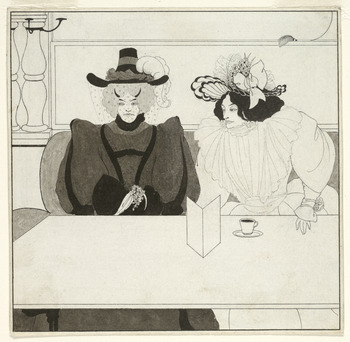
Yet there is an additional aspect to the allusion to Beardsley's drawings in The Babe that illuminates the close ties between Pollitt and the controversial artist. Sometime after the Wilde debacle Pollitt acquired one of the drawings that Beardsley had in press for the April 1895 issue of The Yellow Book. The work in question, Black Coffee, presents two well-dressed women seated next to each other at a café table, upon which a small cup of coffee rests (fig. 1). Both figures display Beardsley's hallmark style, with one of the women implicitly donning devil's horns—although it is a symmetrical parting in her coiffure that evokes such protuberances. In the meantime, her companion leans slightly to one side to peer at the other's upper body, while she also reaches her unseen hand into her partner's lap. Linda Gertner Zatlin suggests that the title of the drawing alludes, by way of sexual slang, to lesbian desire. “Emphasising the absence of cream (a slang term for seminal fluid),” Zatlin asserts, “the title of this drawing punningly alludes to a Sapphic encounter.”Footnote 33 Even more boldly, Zatlin claims that the beverage sans cream enjoyed a further lurid sexual connotation that we can see in the uncensored version of Under the Hill, Beardsley's adaptation of the Tannhäuser legend. “Beardsley,” she writes, “appears to suggest an analogy between black coffee and the object of the coprophiliac's desire.”Footnote 34
Aubrey Beardsley, Black Coffee, ca. February 1895. Pen, brush, india ink, and gray wash over traces of pencil on heavy white wove paper, 6 1/8 x 6 1/4 inches. Reproduced by permission of Harvard Art Museums / Fogg Museum, Cambridge, Massachusetts.

In April 1895 Black Coffee was exhibited at the New English Art Club. As so many of Beardsley's works had done ever since he came into the public eye three years before, the drawing managed to incite barbed responses in the press. The most indignant reaction, somewhat predictably, sprang from Harry Quilter in the Contemporary Review. Quilter, who built a reputation for his moralistic posturing, observes that no matter how “unnatural, extravagant, and morbid are the stories and poems of the modern decadence” (he has several of John Lane's stable of writers in mind), “there is not one of them which is more perverted in what it says and suggests than [Beardsley's] grotesques, in which the types of manhood and womanhood are, as it were, mingled together, and result in a monstrous sexless amalgam, miserable, morbid, dreary, and unnatural.”Footnote 35 Directly relevant to this estimation are Beardsley's depictions of individuals that he finds in a “certain café.” “It is, methinks,” Quilter quips, “that the address of that café should not be made public . . . a whiff of grape-shot would do the whole establishment good.”
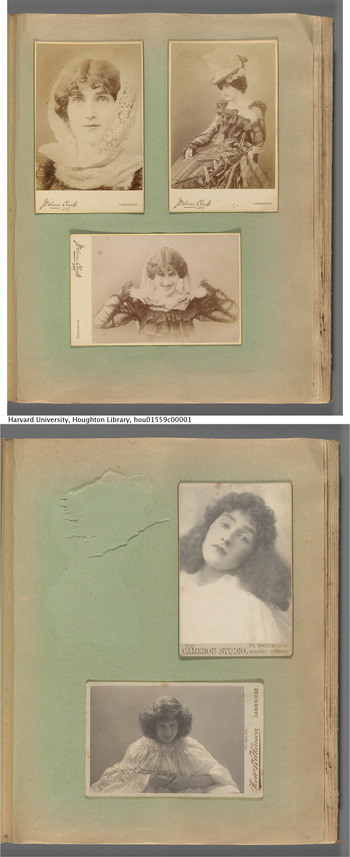
The Cambridge aesthete's relations with Beardsley went beyond the matter of purchasing Black Coffee, along with another thirty-six of the artist's works, including the two obscene depictions of the sexually ambiguous Bathyllus that inflamed some reviewers when they appeared in the volume of Fifty Drawings that Smithers issued in 1897. Beardsley's and Pollitt's names had on occasion appeared close together in public. In 1894 the well-known photographer Frederick H. Evans created portraits of both men. One of the most famous photographs of Beardsley, which is often referred to as the “Gargoyle” portrait, appeared at the Photographic Salon in the Dudley Gallery in November that year. The same exhibition featured a portrait of Pollitt in his drag persona Diane de Rougy: his homage to Liane de Pougy who starred at the Folies Bergère. The photograph in question was by Frederick Hollyer, who was famous for his reproductions of the Hans Holbein paintings held in the Royal Collection and the works of modern artists such as Simeon Solomon and Edward Burne-Jones. Pollitt's skirt-dancing, which he modeled on the serpentine dance that American Loïe Fuller had made famous in Paris, also appears in The Babe. Just before Benson's narrator mentions Beardsley's name, we learn that the Babe has “danced a skirt-dance in a sheet and a night-gown.”Footnote 36 This episode drew on Pollitt's presence in Footlights, which received acclaim in the press. In late 1895 the Cambridge Review remarked of his performance: “the wonders of his dancing have been photographed everywhere, and sung in French poetry, so that eulogy is unnecessary.”Footnote 37 Although it has not been possible to locate Hollyer's portrait of Pollitt, figures 2 and 3 present a selection of photographs, all of them taken at studios in Cambridge, that give a clear sense of the drag artist's style of female impersonation. Once we study these images of Pollitt's hyperbolic femininity, it becomes possible to appreciate why the Babe exclaims: “I wish I could look as if Aubrey Beardsley had drawn me.”Footnote 38 As it turned out, Beardsley appears not to have used Pollitt for a model, although he appreciated several “really magnificent” photographs of the young patron.Footnote 39 Beardsley expressed delight, however, when he learned that a portrait of Pollitt “was being added to the gallery of the Butterfly”: a reference to the American artist James Whistler, whose prints Pollitt had also been collecting.Footnote 40
Pages from Herbert Charles (“Jerome”) Pollitt photograph albums. Houghton Library, MS Thr 447. Reproduced by permission of Harvard Libraries. It has not been possible to identify the Footlights performances that relate to these studio portraits taken in Cambridge.

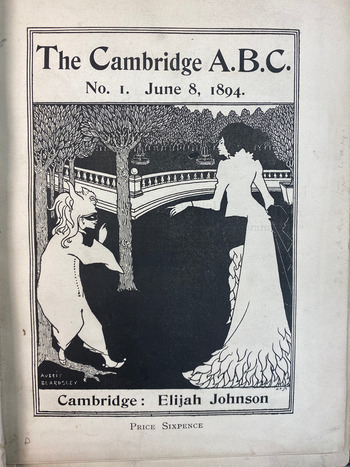
The second public connection between Beardsley and Pollitt occurred two months after Beardsley had been fired as art editor of The Yellow Book. A rather similar-looking journal called the Cambridge A.B.C. materialized in the university town. Even though the periodical, which lasted for just four issues, is mostly filled with in-house Cambridge jokes, it was Beardsley who furnished the cover (fig. 4). One of the undergraduate editors, Maurice Baring—the “B” who worked together with Richard Austen Leigh (“A”) and Hubert Warre Cornish (“C”)—approached Beardsley for a design. The cost was ten guineas. To Zatlin, the depicted encounter between the childlike Pierrot and the tall woman involves not only learning the ABC's but also grasping the basics of sex education. Imported from the commedia dell'arte, the diminutive Pierrot embodies unfulfilled sexual longing. Since he wears an owl-cap, he appears through his finger-pointing to be imparting wisdom to the towering woman who might, given her own hand gesture, be rebuking him. However we might choose to interpret their interaction, the eroticism that we find here subverts the generational conventions that are supposed to exist between teacher and pupil. “Beardsley,” Zatlin suggests, “puns on the ABC of the title: the Pierrot's extreme youth and seemingly furtive gesture insinuate that learning . . . one's ABC is necessary if one is to master reading and the pleasures of sex.”Footnote 41 Inside the pages were the French quatrains to which the Cambridge Review later alluded:
Loïe Fuller ta sœur, qui tourne sur les planches
Varicolore et multiforme en robes blanches
Sous ses voiles mouvants charme l’œil qui devine
La femme ennuagée et toujours serpentine.
Or tu l'as dépassée; et ta grâce nous berce
En une volupté profonde—et plus perverse—
Inquiétant mystère, où nous nous laissons prendre . . .
Androgyne troublant . . . ou troublante gynandre? . . . .Footnote 42
Aubrey Beardsley, The Cambridge A.B.C., April–early May 1894 (Cambridge: Elijah Johnson, 1894). Clark Library, PR6003.A67 C1*. Reproduced by permission of the William Andrews Clark Memorial Library, University of California, Los Angeles.

The fact that this tribute appeared in French is of course in keeping with the illustrious cultural world of the Folies Bergère. At the same time, the French language strengthens—just as it does in White Stains—the lyrical voicing of subversive erotic desires and dissident styles of gender presentation that would most likely sound stilted in English. The verses reveal that Pollitt enshrines a profound voluptuousness whose overwhelming perversity amounts to a disquieting mystery. In the final line, there is considerable disturbance when the poetic voice attempts to make the sex of Pollitt's performance intelligible. It remains impossible to tell whether femininity is enfolded within masculinity or vice versa.
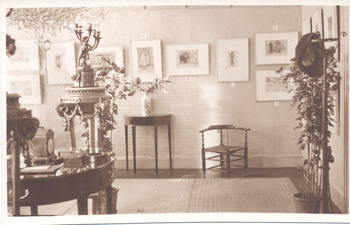
Pollitt's celebrity disappeared when he departed from Cambridge. Several events conspired to bring this phase of his career to an end. His second term as president of Footlights concluded in 1897. In March 1898 Beardsley died from tuberculosis in Menton. By the time White Stains appeared, Pollitt's affair with Crowley was over. To be sure, he struck up a correspondence with Wilde when the exiled author resided in Paris, and Wilde clearly enjoyed Pollitt's overtures. “You ask me,” Wilde wrote, “if I am writing.”Footnote 43 “I should like,” he added, “a photograph of you.” Pollitt sent along several portraits, including one by Hollyer, which struck Wilde, who relished the incongruity, to “be like the portrait of an Oxford Dean—troubled and affected and ineffectual: not a bit like you.”Footnote 44 Wilde's letter concludes with an open invitation to visit him and to avoid Smithers because of the unreliable publisher's “manner of living.”Footnote 45 A few weeks later, Wilde is still eager to meet Pollitt, though whether they saw each other in person remains unknown. This is, however, one of the last ventures that Pollitt undertook in the decadent universe before retiring to his home, the Green Window, near Kendal in Westmorland. It was there that in 1910 he held an exhibition of his Whistler drawings (figs. 5 and 6). Three years earlier, he had put his fine collection of Beardsley's works on display at the Galerie Shirleys in Paris; he also contributed an essay to the exhibition catalog. As David Low points out, when it became available in 1944, Pollitt's “marvellous collection” of fin de siècle art and literature was one of the greatest of its kind.Footnote 46
Photograph of an exhibition of prints by James Whistler, the Green Window, near Kendal, Westmorland, 1910. Reproduced by permission of the Mark Samuels Lasner Collection, University of Delaware.

Portrait of Herbert Charles (“Jerome”) Pollitt, the Green Window, near Kendal, Westmorland, 1910. Reproduced by permission of the Mark Samuels Lasner Collection, University of Delaware.

While Pollitt quickly vanished from the public eye, Crowley's career enjoyed ever-greater notoriety, as he traveled around the globe engaging in many astounding spiritual and physical exploits. In 1902 he attempted to climb K2, only to turn back at twenty thousand feet. Three years later, Crowley made his controversial ascent of Kangchenjunga, where his headstrong behavior was largely responsible for the deaths of several other climbers. By 1904, in the first of many experiences involving his reception of wisdom from a higher power, he recorded the Liber Legis (The Book of the Law) from Aiwiss. Two years afterward, Crowley founded with George Cecil Jones the magical order A∴A∴ . Once we turn to his first novel, The Diary of a Drug Fiend (1922), we learn more about this period through the thinly veiled autobiographical narrator, who claims that “[h]eroin and cocaine enable one to attain a high degree of concentration artificially.”Footnote 47 Here Crowley's storyteller recalls that ever since the pivotal year 1898, he has “striven to identify Magick” with his name.Footnote 48 “Magick,” he says, provides “the link between Spirit and Matter, which explains why modern science had neglected it.” Arguably, the most significant work that spurred his evolving fascination with this realm was occultist Arthur Edward Waite's The Book of Black Magic and of Pacts (1898), which he purchased, several months into his relationship with Pollitt, at the Deighton Bell bookshop in Cambridge.
Correspondence with Waite led to further contacts that expanded Crowley's fascination with forbidden desires. Crucial in this respect were the writings of Richard Francis Burton, whose earliest edition of The Book of a Thousand Nights and a Night (1885–86) had generated controversy because of its “frequently coarse” language and the pederasty he identified (in the detailed “Terminal Essay” that he printed in this edition) with the Sotadic Zone: a geographical region that, in Burton's view, “covers the whole of Asia Minor and Mesopotamia now occupied by the ‘unspeakable Turk,’ a race of born pederasts.”Footnote 49 Equally influential was Burton's translation of The Perfumed Garden (1886), based on the fifteenth-century heteroerotic manual by Muhammad ibn Muhammad al-Nefzawi. Smithers and Nichols circulated this title under their clandestine Cosmopoli imprint. By 1905, Crowley emulated Burton by devising his own Scented Garden, though on this occasion one routed through the discussion of sexual intercourse between males in the “Terminal Essay.” The volume, which claims to be edited by “The Late Major Lutiy and Another,” comes equipped with a fabricated scholarly “Introduction” that passes off the imaginary Abdullah el Haji as a plausible Persian erotic poet who thrived ca. 1600. Together with his unnamed coeditor, Alain Lutiy—a pseudonym that evokes this gentleman as “the one who has the eye of the sodomite”—supplies detailed annotations on the forty-two ghazals in poetry and prose that follow, each one celebrating sodomy. In the meantime, Crowley inserts a prefatory essay entitled “Πɛρὶ τῆς Παιδɛραστɛὶας” (About Pederasty) by one Revd. P. D. Carey: a pagan heretic who declares that “in the rites of sodomy duly done, even more than in the rites of heterosexual passion, lies the great secret of the Universe, the Key of the Garden of God.”Footnote 50 There is no reason to doubt, amid all the strenuous spoofing, that Crowley believed this to be true. At any rate, he went to great lengths in perfecting the production and circulation of the volume. “The typesetting and printing,” Martin P. Starr observes, “was entrusted to the Parisian scholar-printer Phillippe Renouard. . . . Renouard employed Elzevir type for the body of the book; the setting of the Persian is of high caliber.”Footnote 51 Moreover, as Starr also shows, to Crowley the volume aimed to do more than outrage moralistic aversion to sex between men: “Serious. A Practical Joke, yet with the object of presenting mystical truths in the Oriental style, so as to deceive experts.”Footnote 52 Crowley arranged for copies of this limited edition of two hundred to be sold through Arthur Probsthain, the company that remains one of the most prominent vendors of titles relating to Asia and Africa.
Arguably the greatest experience of sodomy for Crowley, who enjoyed sexual contact with both men and women at different stages of his career, occurred through his relationship with Pollitt at Cambridge. In the final two faux-ghazals, he presents verses that constitute acrostics of both his onetime lover's and his own name. Pollitt's full name reads from top to bottom, while Crowley's reads from the bottom up. The positioning speaks appropriately to the nature of their intimacy. The penultimate poem, “The Riddle,” focuses on the euphoric richness that results from anal penetration. “Crimson, o lover,” Abdullah declares in the voice of the older El-Qahar to his fifteen-year-old boyfriend Habib, “was our love, and crimson streams the sunset past” (133). Within several lines, it becomes clear that El-Qahar is on the brink of consummating his desire with Habib once more: “Rampant within thy podex take this member, stiffer than a mast” (134). At the same time, “The Riddle” is unusual in this series of factitious ghazals because it reminds us that El-Qahar's supreme desire is to be penetrated. “It is,” El-Qahar declares to his lover, “that thou are near” (135). The time has come for Habib to allow the older man to bottom for the younger male: “To glut thine almond member in the podex of thine El-Qahar” (135). “For the first time,” Joseph Allen Boone observes of The Scented Garden, “we learn that this conqueror, hitherto all cock swagger, also has a podex.”Footnote 53 And what is more, El-Qahar's podex—an academic term that is overused to such a degree that its jokiness wears a mite thin throughout the volume—conceivably resonates as the most pleasurable location that Crowley associates with decadent eroticism.
No matter how burlesque such lines may appear in “The Riddle,” they take special pains to inscribe Pollitt's legacy both orthographically and physically. Here the memory of a former boyfriend underwrites the homoerotic audacity of a work that belongs to Crowley's commitment to liberating desire, in ways—as his Magical Diaries of 1923 disclose—that spurred his interest in Sigmund Freud's sexual modernity. As I hope to have suggested, Pollitt's presence did much to direct Crowley toward an extreme form of eroticized decadence, one that is exceptionally uneven in quality, alternately satirical and serious in tone, and formidably impudent in its queerness. And Pollitt exerted this remarkable influence because he was very much a part of the bohemian fin de siècle culture that embraced not only Huysmans, Maeterlinck, and the Folies Bergère but also Swinburne, Beardsley, Wilde, and Burton.