What led to the development of modern capitalism? What caused the Industrial Revolution? These are two famous questions that historians of early modern and modern Europe are always challenged to address and will most certainly never be able to answer in any definitive and comprehensive way. Whether we consider this to be the consequence of dealing with great social complexity or to be the torment of Sisyphus inflicted on social and economic historians, most attempts to combine these two issues have proved to be a constant pitfall in the literature and, with the discrediting of Weberian psychological analysis (in particular the economic effects of predestination) and Marxian economic determinism, have provoked a disappointing segmentation of the field between economic historians and religious and cultural scholars. This segmentation is seen in the growing disjunction between the realms of what used to be called ideology and economic structure.
This review does not pretend to solve the eternal riddle of the opposition between cultural and economic causes of the Industrial Revolution. However, it looks at a recent flourishing of macro-theories (de Vries, McCloskey, Mokyr, Muldrew) that try to tie the two terms together into one single narrative related to the emergence of the longue-durée of industrious behaviours and industriousness discourses in Europe.Footnote 1 The main point of this review is that chronological discrepancies over the origins and evolution of industriousness are far from being insignificant as they reveal completely different understandings of the nature of industriousness and of the relationship between practices and discourses in history. The following pages will thus assess the competing chronologies in the historiography and try to establish, as firmly as possible, the timing of the emergence of the ‘industriousness discourse’. I will start by explaining why literary evidence of industriousness is crucial for these authors, and go on to show that there is not just one discourse but several competing understandings of ‘industriousness’ whose chronologies are intertwined and constantly reinforcing each other.
I
The most influential account is probably the concept of the ‘industrious revolution’ put forward by Jan de Vries.Footnote 2 In his most recent book, which will be the main focus of this review, he argues that the chronology of the Industrial Revolution should be pulled back to the seventeenth century to take into account the rising tide of consumerism, embodied by a general desire for new commodities, which started at this time in Holland and England. His main argument is that during the first half of the seventeenth century the diffusion of durable and exotic goods created new desires which households could only fulfil by increasing their income. Ceteris paribus, as economists like to say (i.e. with a constant relative price between labour and commodities), this could only take three forms: labour intensification (working harder and more consistently), labour prolongation (working longer), and/or labour amplification (increasing participation in the labour market). Taken together, these composed the practical manifestation of de Vries's industrious revolution.
Unsurprisingly, the book has reactivated very entrenched oppositions in the field. However, among the many critical reactions – albeit mostly justified – none seems to have looked at what are the really problematic elements at both ends of de Vries's intellectual edifice: the origin of these new desires and how the new economic mentalités were actually diffused. Historians have linked the emergence of industrious behaviour and industriousness discourses to a great variety of causes but, notwithstanding the nature of the arguments, all these analyses are confronted with a similar technical (not to say conceptual) problem: they have to explain how ideas were able to transform economic practices in the first place.
Although de Vries draws upon the consumer revolution literature, he rejects the classic, and indeed flawed, model of social emulation which posits that consumption patterns, i.e. tastes or desires, are communicated by imitation from one group to another, generally mimicking established social relations. Consequently, he comes up with a much more general solution: he links the spread of industriousness to the emergence of ‘man as a “desiring subject” whose subjectivity is shaped by “desire” as a fundamental aspect of the self’ and who, in turn, given this new psychological framework, could contribute to creating
a society in which new forms of material culture spread broadly through society and transformed the practice and experience of consumption … on a so enduring basis … [that] … the potential to purchase luxuries and novelties extended well beyond a small, traditional elite and where the acquired goods served to fashion material cultures that cannot be understood simply in terms of emulation.Footnote 3
However, by turning the Frankfurt School's critical take on consumption on its head, de Vries only pushes the problem further back, for it remains to be understood how this new ‘mode of subjectivity’ and these new desires appeared during the first decades of the seventeenth century and not several centuries before. Thus, he does not greatly differ from Marx's own psychological analysis of industriousness as a natural quality of labourers caused by the illusory desire for money. For Marx, however, it was the generalization of wage labour that created the material conditions in which the opposition between industriousness and idleness (i.e. the destruction of traditional leisure time) could appear as a natural property of this new ‘species’.Footnote 4 Contrary to Marx, de Vries seems to be left without any obvious and immediate historical explanation of the advent of consumer subjectivity; on the one hand, he pretends to reject economic determinism (either Marxian, i.e. the idea that economic relations determined people's aspirations, or the consumer choice theory of microeconomics) and, on the other, he equally dismisses the model of social emulation of taste. Thus, if new desires are neither the result of deterministic environmental conditions (whatever these might be: economic, social, cultural), nor the result of imitation and civilizational process, they would have to result from a concomitant interpersonal psychological transformation, i.e. a Weberian-type of evolution.
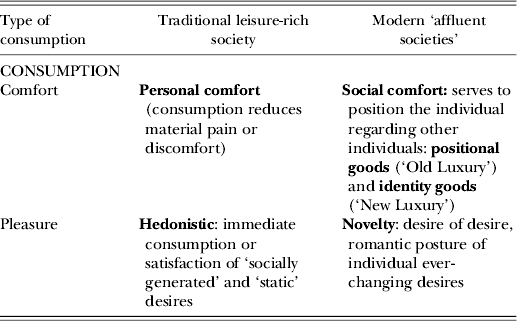
In fact, de Vries surreptitiously brings back part of the old historical determinism onto the main stage through his theoretical decomposition of the structure of consumers’ desires into categories of pleasure and comfort and ‘Old’ versus ‘New Luxury’ (see Table 1). He argues that ‘in the course of the seventeenth century [the latter] emerged in a sufficiently developed form to present an alternative to the Old Luxury that had lived in symbiotic tension with the leisure-rich society for many centuries’.Footnote 5 The desire for these new goods ‘can be best understood by linking fashion and taste … to, for a lack of a better word, modernity’.Footnote 6
De Vries's analysis of consumption

The intellectual cost of rejecting emulation or diffusionist models is thus greater than it first seems. As it implies, relying on a theory of human subjectivity, de Vries's crucial assumption is based on very few evidential bases and is exposed to the same criticisms (of subjectivity) that were formulated against Max Weber.Footnote 7 Furthermore, there is a double chronological problem here: his industrious revolution happens either too early for the real diffusion of luxury goods among labourers or too late, hence losing their novelty, as they had been consumed by the wealthiest for at least several decades.
Well aware of this lack of reliable evidence, de Vries operates his final twist by anchoring his narrative and especially its chronology to the ‘vast body of moral debate, philosophical speculation, and political economic theorizing’ produced by contemporary observers. In consequence, the temporality of the industrious-consumer revolution is to be based on this literary evidence: the ‘industriousness discourse’.Footnote 8 To be sure, de Vries does not think that literature caused the industrious revolution, but because he does not have a credible model of cultural diffusion which could explain how and when these new desires spread among the population, these literary changes in the meaning of luxury and industriousness are his only proofs of a sudden valorization of consumption.
The same conclusion applies to McCloskey's understanding of the relationship between ‘bourgeois dignity’ (i.e. merchants’ talk, inventors’ sociability and a cultural revaluation of commerce and invention) and the Industrial Revolution. Trying hard to keep determinism at arm's length, she argues that
the initiating change was not psychological (as for example Max Weber claimed in 1905, and Robert Lucas in 2002), nor economic (as Karl Marx and Friedrich Engels claimed in 1848, and Douglass North in 1990), but sociological and historical and political. That is, around 1600 on a big scale in pioneering Holland, and then around 1700 on a bigger scale, and permanently, in innovating Britain, some of the elite began to re-evaluate the town and its vulgar and corrosive creativity.Footnote 9
One could thus imagine that, given the importance of urbanization in this narrative, she would carry on to look at what defined urbanity in Britain and how this early eighteenth-century commercial revaluation was then diffused to larger circles of the population.Footnote 10 Instead, she evades the question altogether by suddenly turning back to anthropology.
The market economy, [she argues,] contrary to what you might have heard, has existed since the caves. The anthropologist Jack Goody declares that ‘trade was essential to the growth of human life from the earliest times, including the institution of the market in the rise of some specialized individuals (later merchants)’.
This being a proof that ‘there is no change in human nature from olden to modern times, and [that] the attribution of a novel “rationality” to a society capable of world wars and modern sports seems at least strange’.Footnote 11 Happily for all of us, ‘toward 1800 many Northwestern Europeans, and toward 1900 other Europeans, and then toward 2000 many ordinary peoples elsewhere, came to accept the outcome of the market with more or less good grace’.Footnote 12
Although the story started as a sociological revolution, when one scratches the rhetorical surface it rapidly ends up solely relying upon a teleological narrative of individual acceptance; that is, the neoclassical model of allocation of preferences disguised under an ahistorical and pseudo-Christian psychological conception of mercantile dignity: ‘Among the seven principal virtues, faith is the virtue of backward looking, of having an identity. Keep the faith. Dignity encourages faith. You are dignified in standing, in being who you most truly are, and have been.’ Following Liah Greenfeld'sFootnote 13 (and Douglass North's) stance on national dignity, McCloskey shamelessly transposes this economic psychologism into an international model of diffusion:
during the 17th century the success of commercial Holland stuck in the craw of English people, the way the recent success of innovative Hong Kong and Taiwan stuck in the craw of mainland Chinese people, and inspired them to imitate. That chainlike causation of successive Bourgeois Revaluations is similar to the causation of nationalism in reaction to conquering nationalisms, English to French, or English to Indian.Footnote 14
Had McCloskey looked at what cultural and social historians have to say today about interactions between individuals, social groups, and institutions (norms, beliefs, and concrete institutions like the state), she would probably not have succumbed so easily to the chimera of a liberal, laissez-faire, free-traders’ seventeenth century, which, as argued recently by Ashworth, neglects, among many other things, the entire mercantilist aspect of European commercial policies.Footnote 15
One could argue that it is unnecessary to be so punctilious about philosophical origins and that what really matters for historians is that by 1750 industriousness did exist, either in print or in thoughts, as McCloskey would put it, the rest being only a problem of chronology. This counter-argument would have some credibility were these authors clear-cut unabashed neoclassic economists who thought that people always wanted to be capitalists anyway – the only question that would then remain is why they could not achieve it earlier in history. On the contrary, McCloskey insists on the rhetorical dimension behind economic choices: ‘language is crucial’ she says because ‘habits of the mind are habits of the lip.’Footnote 16 Consequently, the first trace of this change is to be found, as for de Vries, in literary occurrences of this new ‘talk’.
All would be for the best, but both de Vries and McCloskey constantly waver between the notion that literary evidence can demonstrate a gradual shift toward industriousness and the contradictory claim that they are not bound by this chronology as, under the disputable claim that ‘theory followed practice’, they assume that texts are only a belated transcription or reflection of previous mutations in popular thought, which, as we have seen, they cannot prove but for these literary occurrences.
II
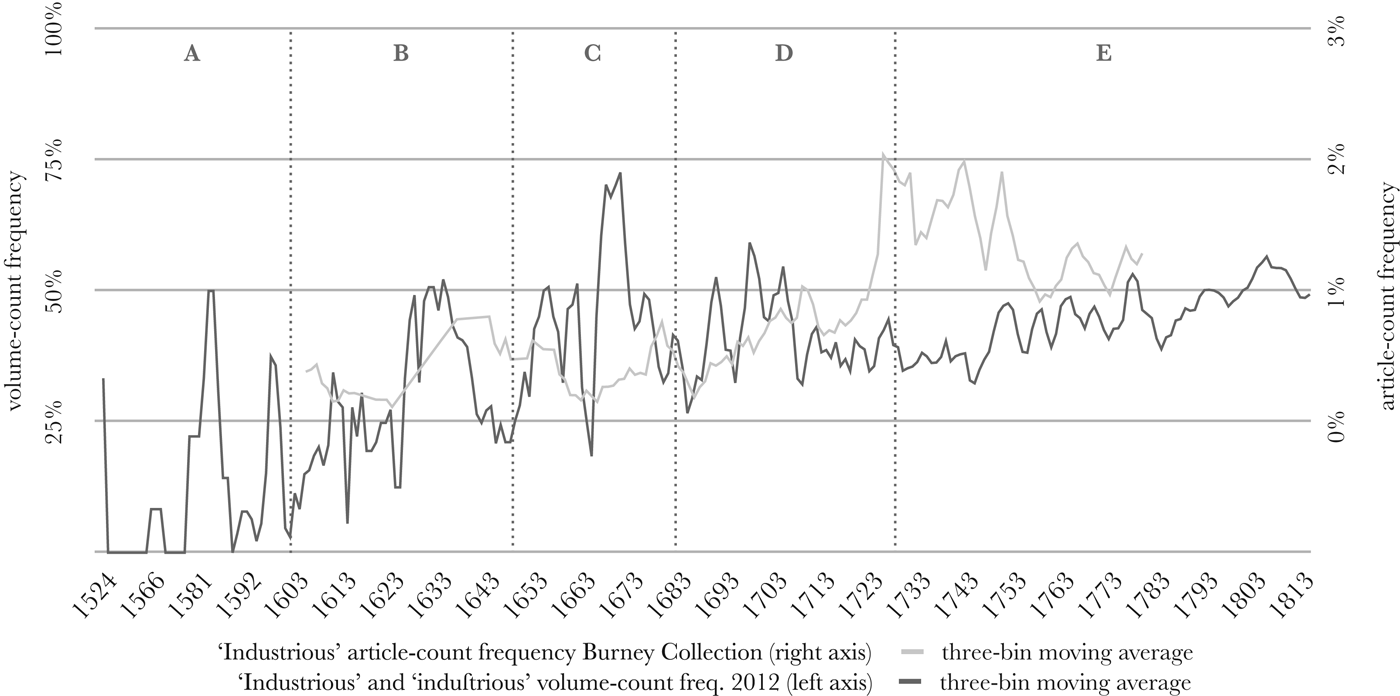
The main quantitative sources I shall use to assess the chronology of the diffusion of the industriousness discourse are the Google Ngram database developed by a group of Harvard researchers led by Jean-Baptiste Michel and a subset of the Early English Book Online (EEBO).Footnote 17 The former was published in 2009 and revised in 2012; the 2009 version contained a corpus of 5,195,769 digitized books; that is to say, roughly 4 per cent of all the books ever published from the early sixteenth century to the present while the increased 2012 version reaches almost 6 per cent. Given the geographical focus of this article, I have further limited the corpus to books published in Britain. To be sure, this sample is not exempt from selection biases. Google has ‘only’ digitized books from the collections of public libraries: collections which represent what librarians have deemed interesting or significant enough to be bought rather than all cultural production. Although this could constitute a major pitfall for controversial issues or topics such as sexuality, deviant behaviours or anything which might have been censured, it should not carry too much weight in the present case. If anything, moral, religious, and economic discourses about industriousness would rather be over-represented. Yet, to control for this bias in book selection I have compiled a secondary database listing all the occurrences of ‘industrious’ vocables in seventeenth- and eighteenth-centuries newspapers from the the Burney Collection held at the British Library (see Fig. 2.2).
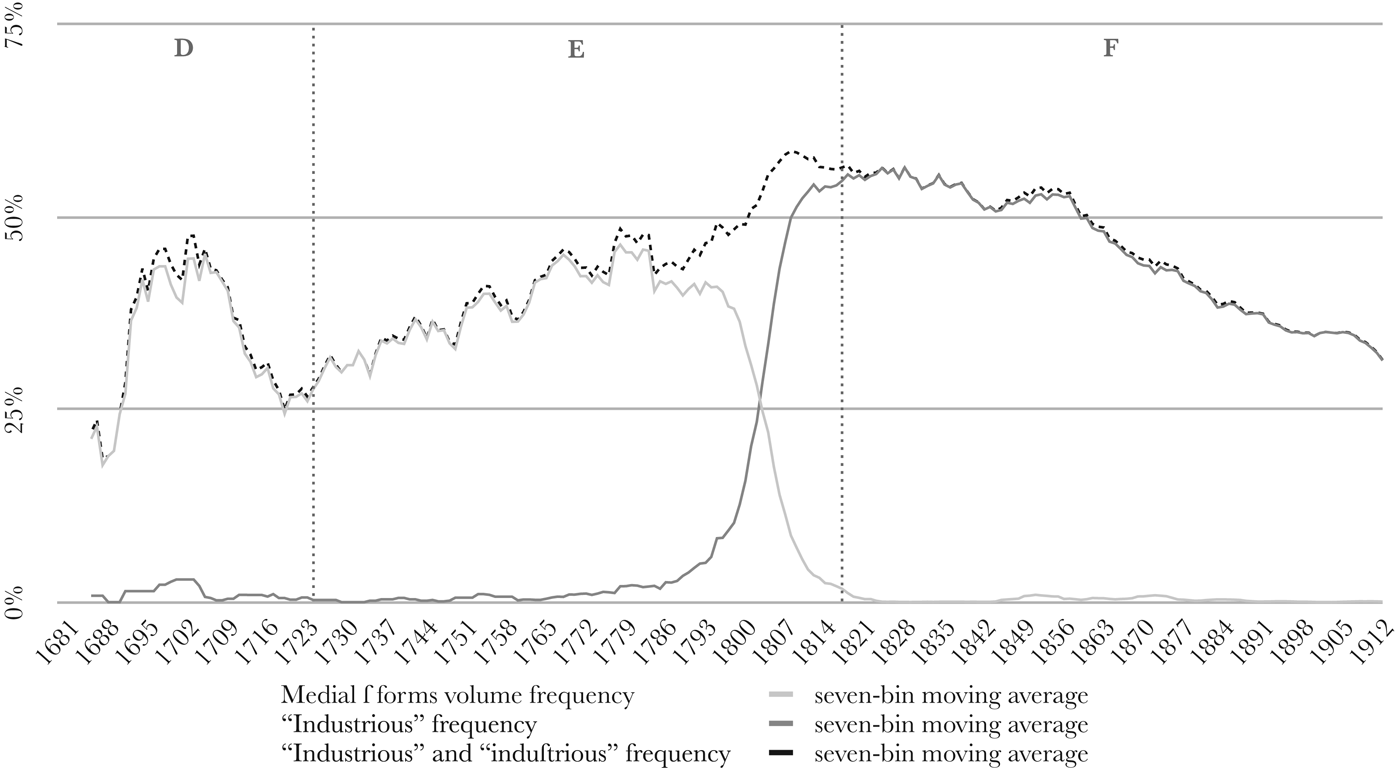
The second potential problem is the inclusion of the medial ſ form in older publications, together with other OCR-related (optical character recognition) issues in general. As the work by Michel et al. convincingly addresses this technical issue, I shall consider their result reliable enough.Footnote 18 The third problem is related to the limited amount of data available before 1701: any occurrence of a word tends to create a giant spike that makes relative frequency analysis less significant compared to later periods. The subset of the 2012 database I have used includes only 1,850 books for the period from 1524 to 1700, which represents, if we take the EEBO corpus as a reference, only 1.5 per cent of all the books published in English between these dates.Footnote 19 Thus, in order to limit the effect of this distortion I have added to the Ngram corpus my own database including more than 200 books (not included in the original Ngram catalogue) published between 1543 and 1700 from the digital collections of the Open Library (Fig. 8).Footnote 20 I have also been able to apply the same frequency analysis to more than 50,000 fully searchable records from the EEBO-TCP corpus (Fig. 1.3).Footnote 21 Despite their imperfections, the combination of these different samples allows me to confirm the significance and robustness of my results.
‘Industrious’ vs. ‘induſtrious’ relative frequencies (2009 Ngram database).
‘Industrious’ and derivatives relative frequency (2009 and 2012 databases).
‘Industrious’ relative frequency (EEBO TCP database).
Percentage of books/volumes containing ‘industrious’ and spelling variants (2009 Ngram databases).
Proportion of volumes/newspaper articles containing “industrious” and spelling variants (2012 Ngram database and Burney Collection of Newspapers).
Number of volumes containing ‘industrious’ and spelling variants (2009 Ngram database).
‘Industrious’ vs. ‘idleness’ relative frequencies (2012 Ngram database).
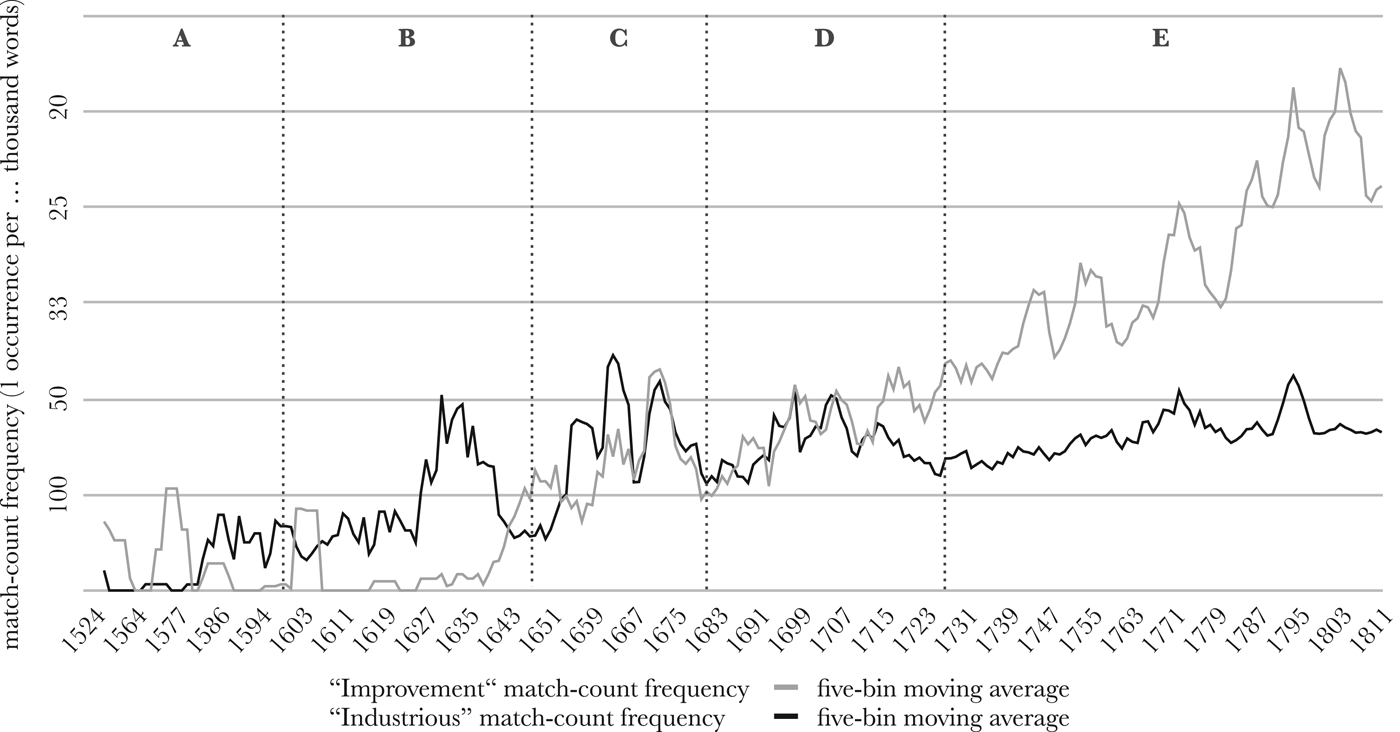
‘Industrious’ vs. ‘improvement’ relative frequencies (2012 Ngram database).
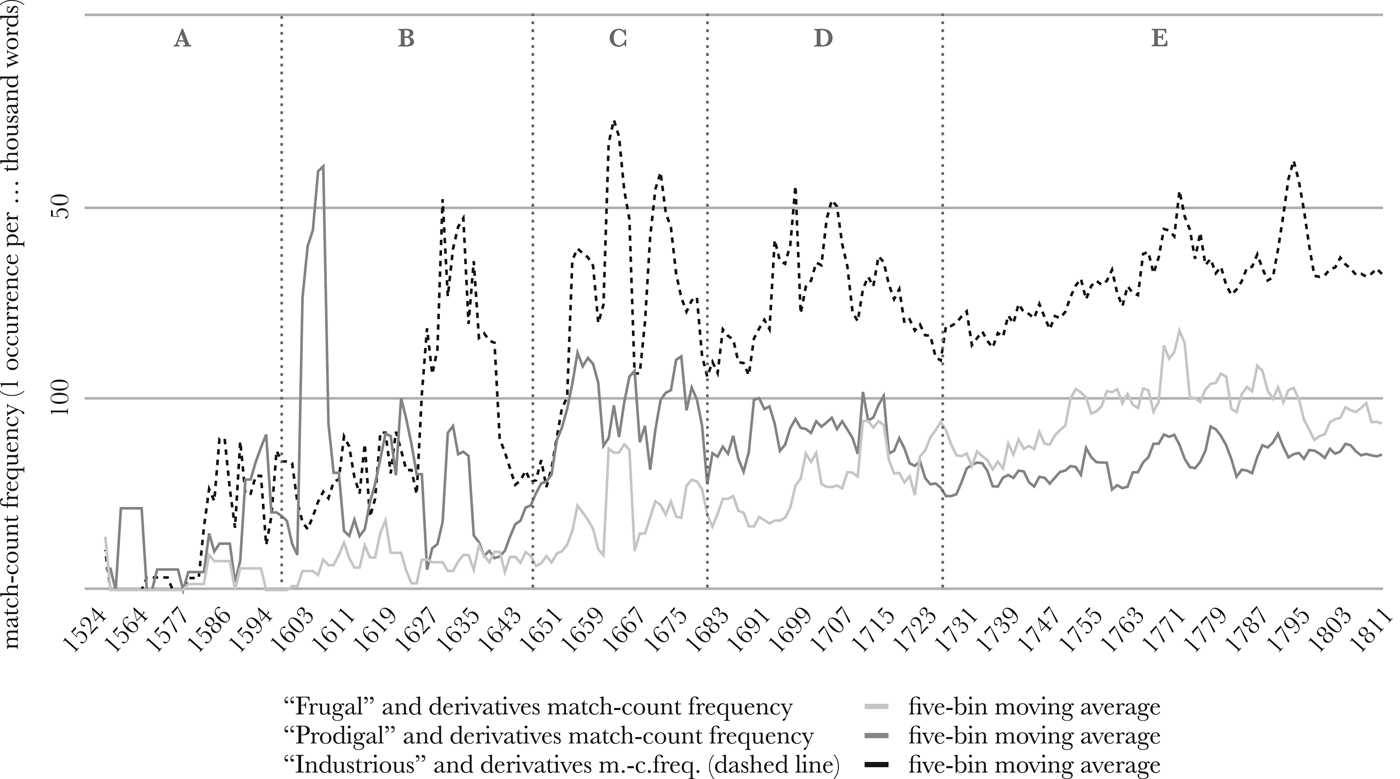
‘Frugal’, ‘prodigal’, and ‘industrious’ relative frequencies (Ngram 2012 database).
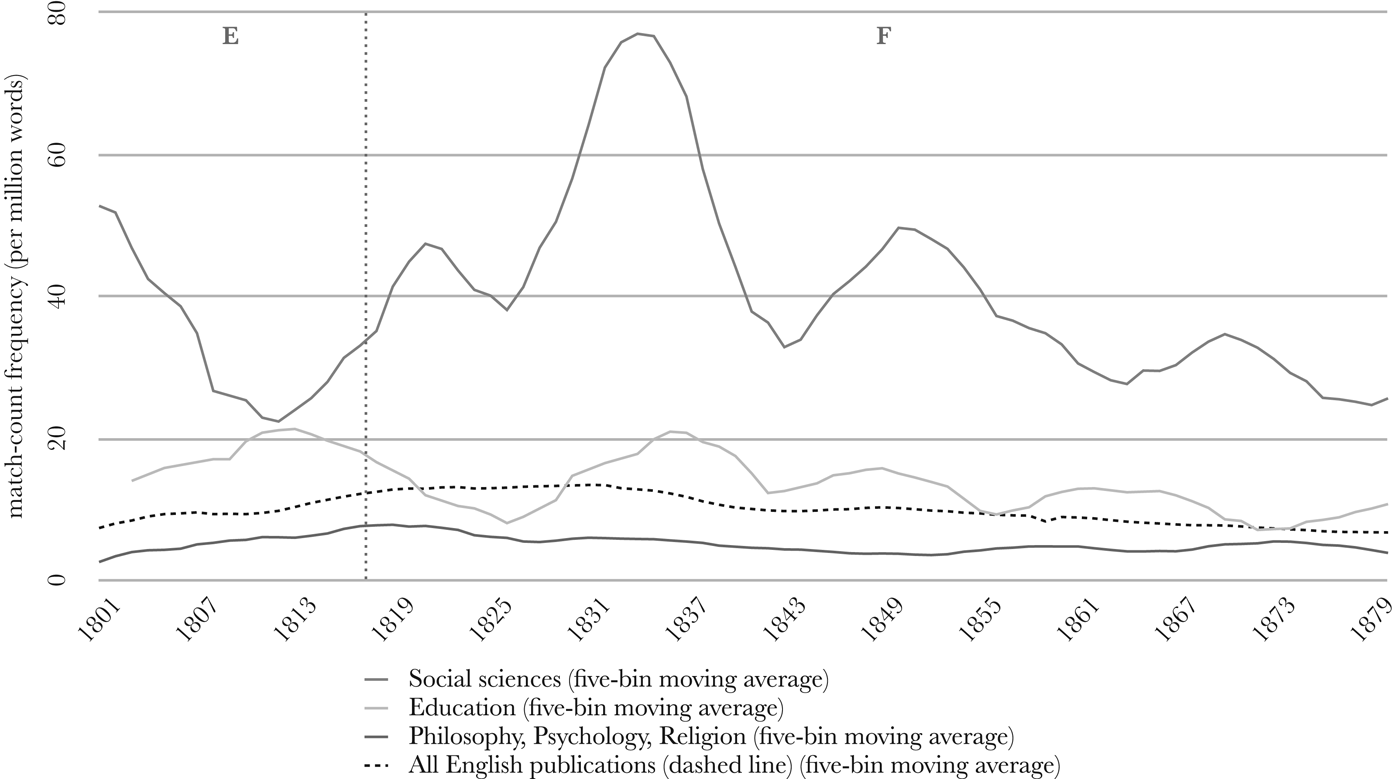
‘Industrious’ frequency by subject groups (Open Library database).
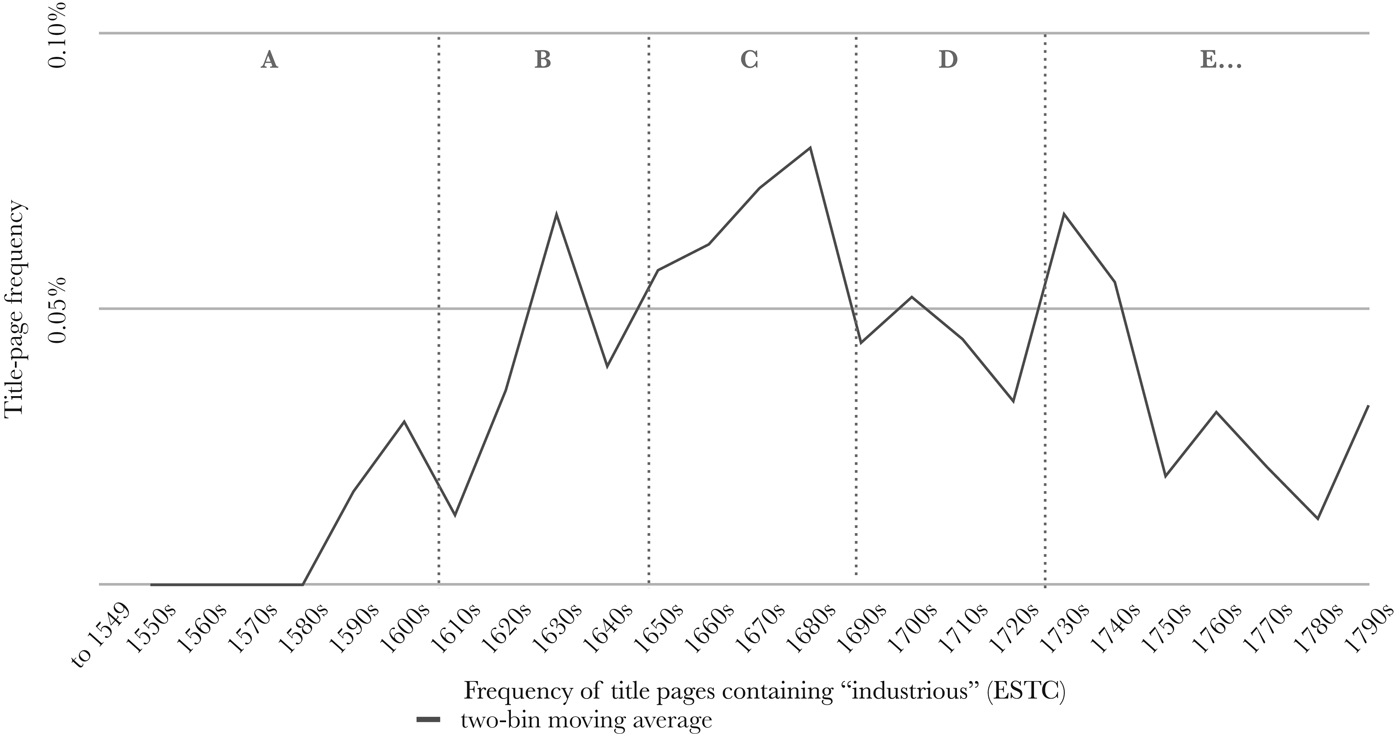
‘Industrious’ frequency in the ESTC database.
‘Industrious’ relative frequency (sample of the Open Library database).
Another issue related to the reliability of older frequency data is the long overlap of scribal and printed material throughout the sixteenth and early seventeenth centuries. There is unfortunately no simple quantitative solution to this problem, but given that manuscripts were relatively well distributed across the publication scope, we can assume that it only reduces the size of the sample but does not radically modify the results.
Finally, there is also a fundamental problem with publications in the steam-press era (i.e. roughly after 1830). By allowing very large editions to be printed, it radically expanded the circulation and diffusion of some works, and the gap between these widely diffused books and other publications dramatically increased during the second half of the nineteenth century. Thus, in order to reflect the diffusion of each book after 1830, occurrences should be weighted according to the size of editions. This is unfortunately impossible, mainly because such records do not exist.Footnote 22 Another conceivable option would be to try to weight each record by the number of libraries currently holding the volume. Needless to say, this would be unreliable, very hard to systematize, and probably fraught with the same initial bias. Furthermore, this is what to a certain extent the Ngram database indirectly does as it is essentially a reflection of university libraries’ collections. Digitized books were therefore deemed interesting enough or significant enough to be bought. This does not fully counter the artificial cultural levelling-up of these occurrences, but it does, perhaps, slightly moderate its effect.
Moreover, this short overview does not pretend to determine the importance of individual texts or authors, for, as Peter Mandler has argued, although ‘the question of “representativeness” or “influence” can be resolved in a simplistic way, by counting editions or measuring circulation or even by monitoring references in literary reviews … texts gain power not only from the breadth of their circulation but also by the imaginative work they do’.Footnote 23 Following Mandler's Kantian terminology, my application of quantitative analysis to texts only intends to extend, as exhaustively as possible, this ‘phenomenal’ approach to literary diffusion and chronology.
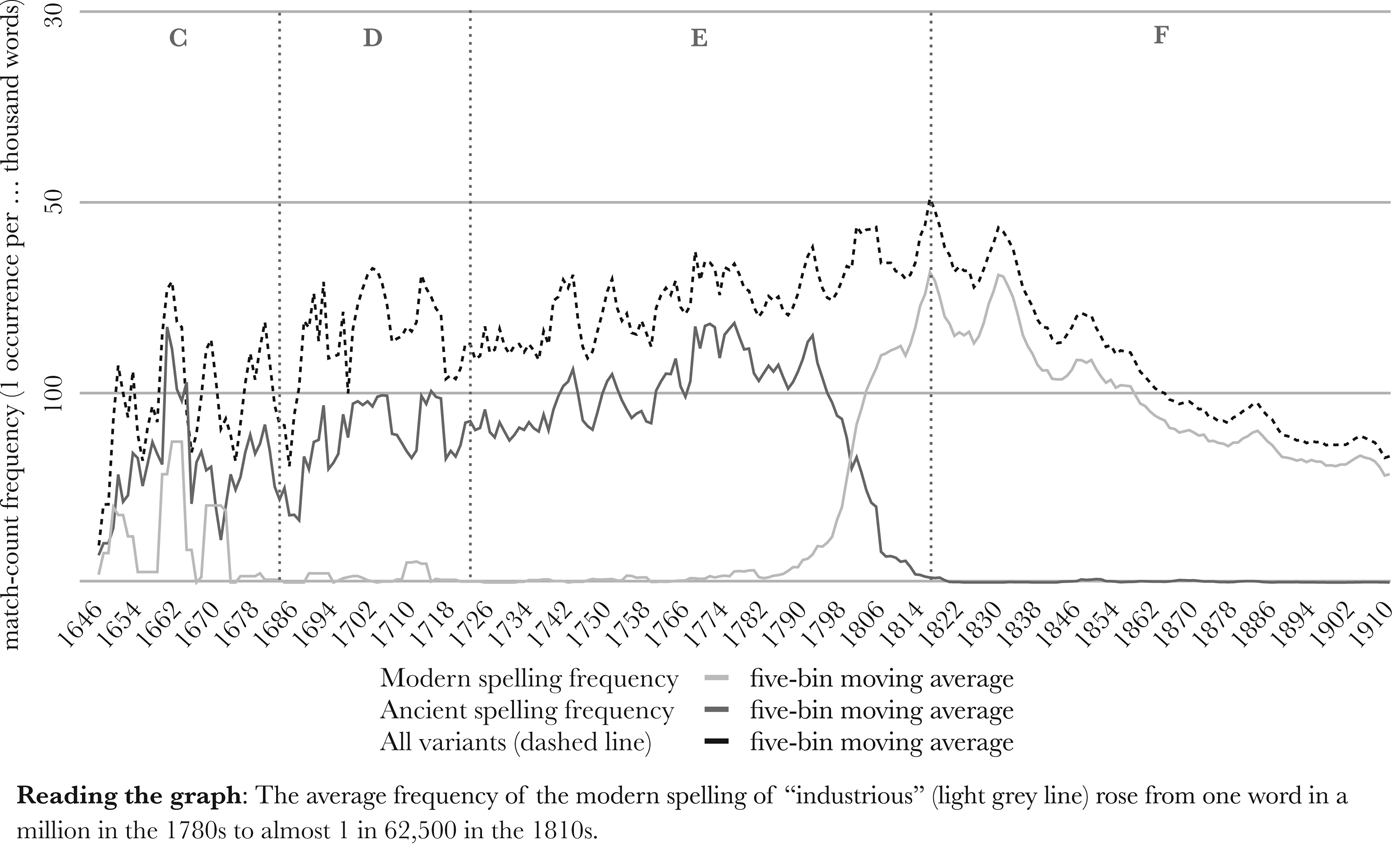
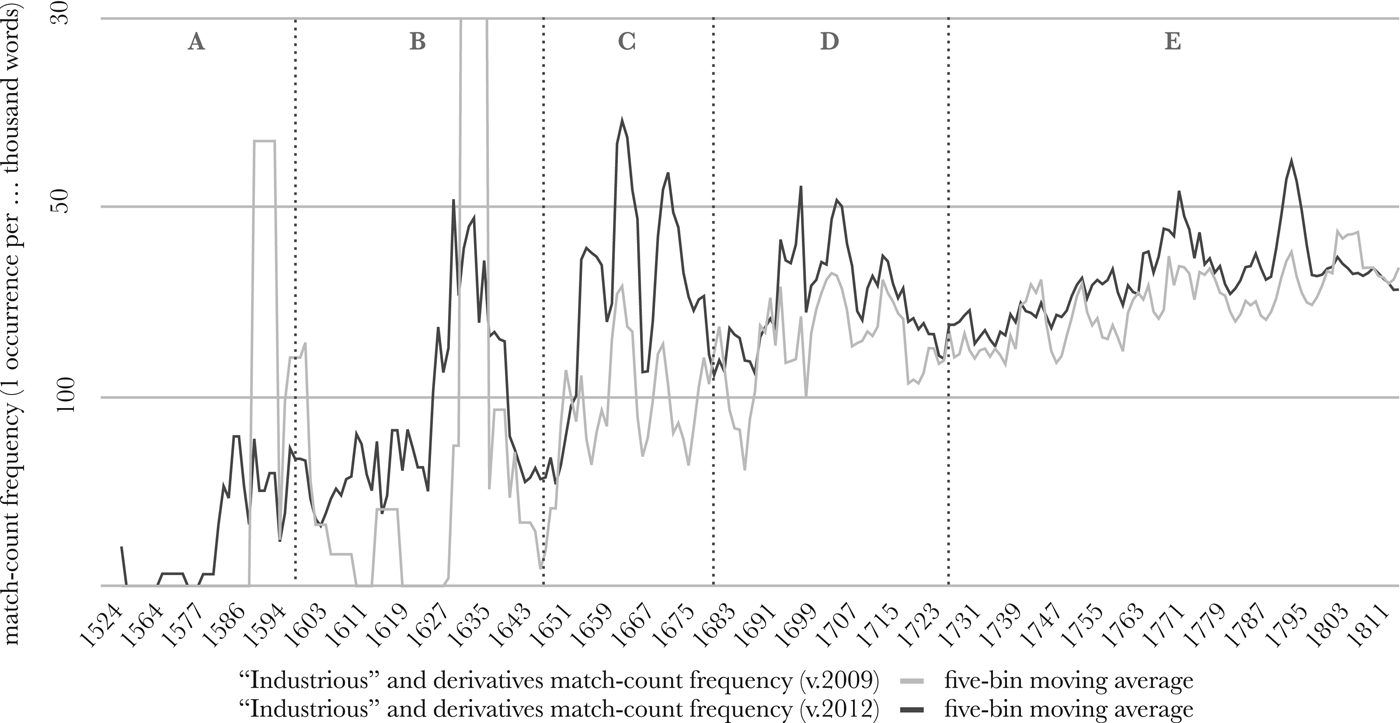
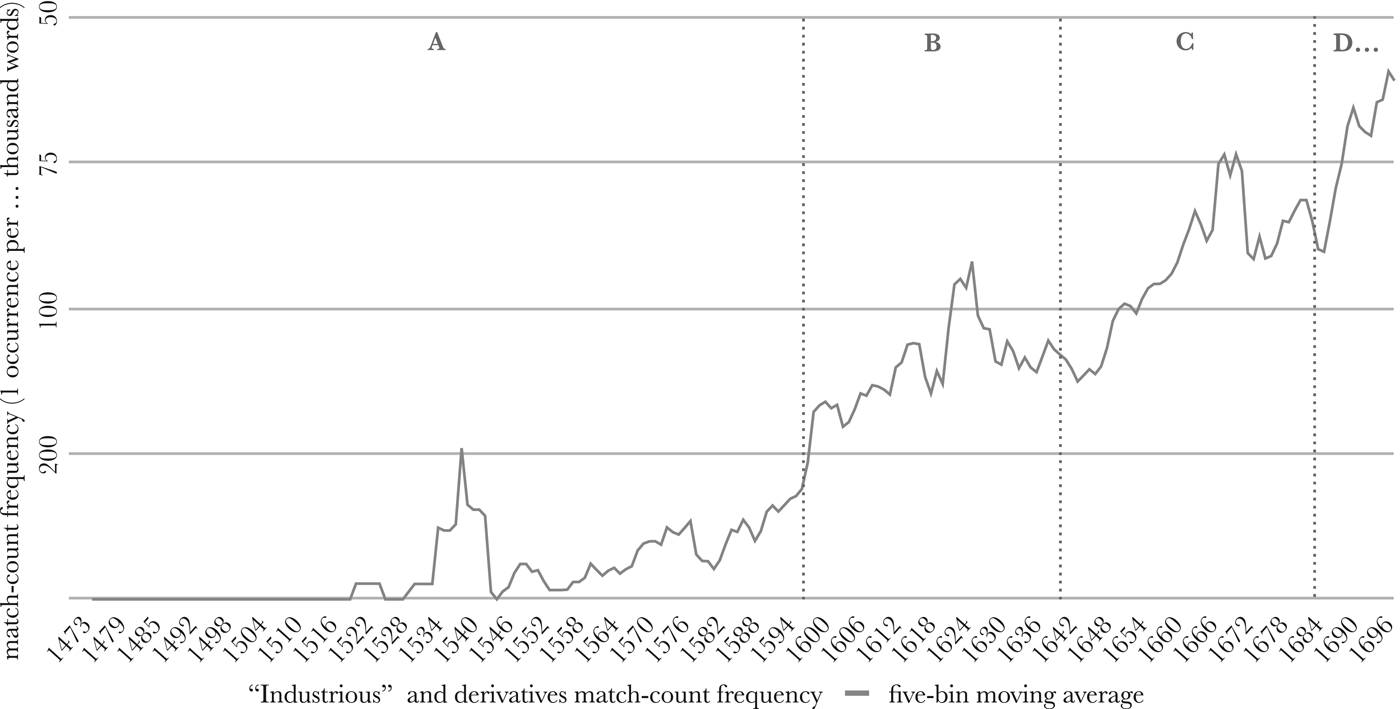
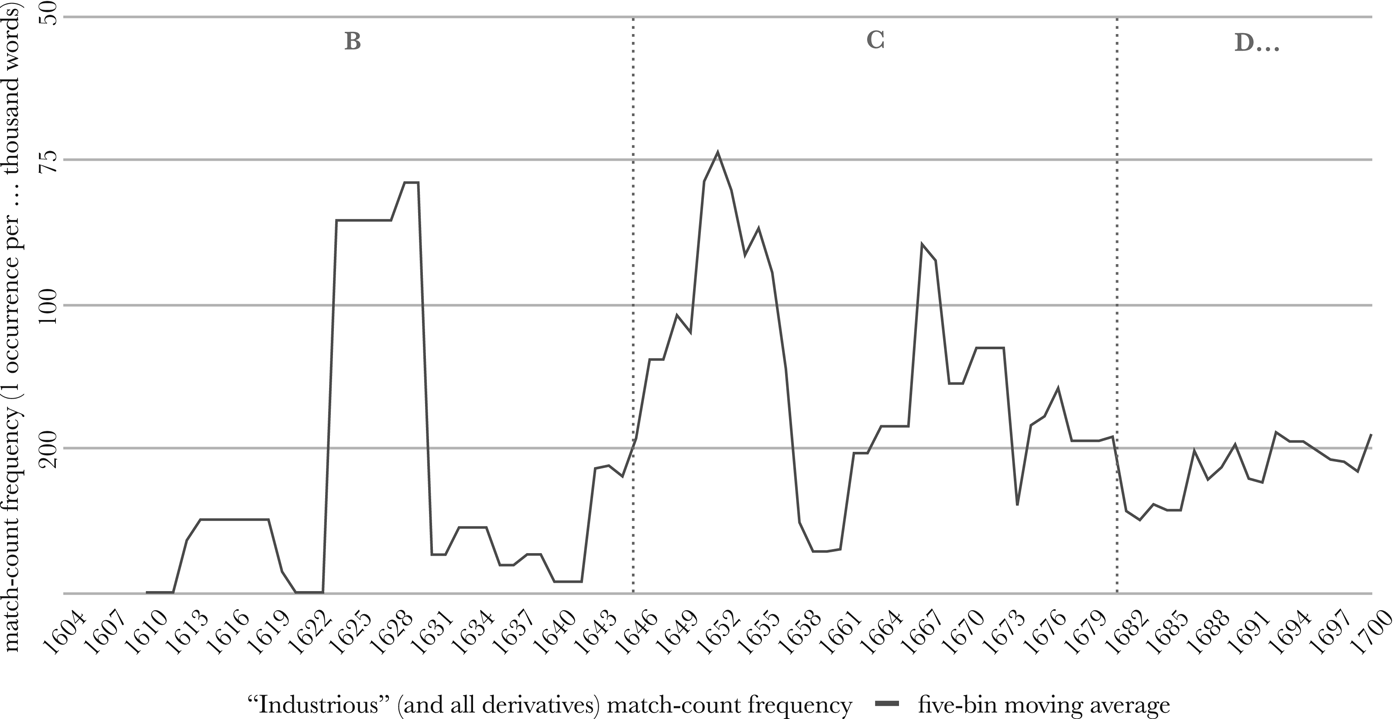
Despite all these caveats, a simple statistical analysis shows that there is a clear subdivision of ‘industriousness’ discourses into six periods (labelled A to F in Figs. 1 to 8 below). Before the last decade of the sixteenth century very few volumes in the database include the word ‘industrious’ or any of its derivatives – including spelling variants and medial ſ forms, and its frequency also remains extremely low, under 0.0002 per cent, which means that it represents less than one word out of 500,000 (Fig. 1.3). Books which do contain it, like the 1533 translation of Erasmus's De contemptu mundi by the Austin canon Thomas Paynell, use it either as a moral quality, synonymous with ‘laborious’, or negatively as a synonym of harmful and mischievous (in its seventeenth-century meaning).Footnote 24 Furthermore, it is difficult to find any significant religious divide regarding sixteenth-century usages of the term ‘industrie’ and its derivatives: in this matter, Elizabethan churchmen and authors such as John Foxe and Richard Mulcaster did not differ from the definition given by a devout Catholic like Thomas Blount in his Glossographia, or, A dictionary interpreting all such hard words, of whatsoever language, now used in our refined English tongue, or a puritan like Robert Cawdrey in his Table alphabeticall.Footnote 25 The relatively high frequency of ‘industrious-family’ words during the late sixteenth century observable in Fig. 1.2 is an artefact caused by nineteenth- and twentieth-century reissues, which are artificially matched with their date of first publication by the OCR programme, hence creating these sudden and unrealistic spikes.Footnote 26 As very few publications used the old spelling after the 1790s – Fig. 1.1 clearly shows this typographical transition – the difference between the light grey line (for modern spelling) and the dark grey line (for ancient spelling) in this chart allows us, nevertheless, to distinguish easily between the two phenomena, and also shows the extent to which some books might have been counted twice. The same applies to the two peaks in 1590–1605 and 1630–1640 as can be observed in Fig. 1.2 – the dark grey line (for the spelling-adjusted 2012 corpus) shows that there was no real surge in interest in the former period while the latter witnessed the first significant (and detectable) rise in use of the word ‘industrious’. The light grey line illustrates, instead, a retrospective interest in these publications exemplified by their reissues and acquisition by libraries during the nineteenth and twentieth centuries. This disproportionate weight is also, I think, a sign of a long-lasting academic fascination with early English political economy, in which many historians, sociologists, and economists tried to locate the origins of a range of things from economic modernity to capitalism. These books, which were republished and bought by libraries after 1800, were also disproportionately interested in ‘industriousness’. This is shown by the fact that while the average frequency of the modern spelling of the word industrious surges (Fig. 1.2), the average frequency of books using it at least once is not much higher than those using the old spelling (Fig. 2.1); hence, the books in question must contain many more occurrences of the term.
This argument should not, however, hide the renewed appeal of ‘industriousness’ in the first decades of the seventeenth century. The term ‘renewed’ can be misleading, though, and I want to argue here that rather than a resurgence of previous moral understandings of ‘industrie’ it was the addition of a new layer linked to commercial enterprise, much earlier than de Vries thought, starting around 1600 (see Figs. 1.2, 1.3, and 8), essentially through the work of early British mercantilists, which underpinned the religious reformulation of ‘industriousness’ characteristic of Weber's analysis of predestination.Footnote 27 The writers in question were mostly merchants, either trying to justify trade monopolies and often linked to the East India and Virginia Companies, or seeking royal protection from imports of foreign goods. Thus, it was rhetorically convenient to establish a parallel between the common religious attack on sloth – generally using the new 1611 King James Bible translation of Prov. 15.19: ‘The way of the slouthfull man is as an hedge of thornes: but the way of the righteous is made plaine’ – and a model of social organization in which industriousness would contribute to the wealth of the nation and, by extension, to the glory of its sovereign.Footnote 28 This proto-‘national economy’ argument took shape in the early seventeenth century and the correspondence between microcosmic (individual) and macrocosmic (social) qualities relied on a twofold comparison: first, a series of zoological metaphors and anthropomorphisms attributing industrious virtues to animals such as ants or bees, and, second, the definition of the Dutch as paragons of industriousness, wealth, and power.Footnote 29 Although the former comparison had existed at least since antiquityFootnote 30 – it was Charles Butler's The feminine monarchie, or the historie of bees, published in 1609, which gave bees their formal credentials as the industrious mascot of British political economy. Six years after the publication of Butler's Historie of bees, the politician, diplomat, and merchant Sir Duddley Digges went a step further in his defence of the East India and the Virginia Companies by associating merchant adventurers with busy bees, which ‘from furthest parts abroad, … fetch and bring the hony to the Hive, laborious Bees, they clothe and feede the poore, and give the willing man imployment to gain with them, and with the Common wealth, the honour and the riches’.Footnote 31 This clearly shows that the rhetoric of the civilizational value of trade, or ‘Sweet Traficke’, did not emerge in England in either the 1690s (de Vries) or the 1700s (McCloskey) but seventy-five or eighty years earlier. Similarly, if one accepts de Vries's argument for the pre-eminence of political economy (theory of commerce) in the diffusion of the social acceptability of consumption, the origin of this would also be found in the decade from 1615 to 1625. Digges himself, for example, answered the objection that these imported
commodities [were] unnecessary … In strict terms of need, our Land that flows with foode … may Bee, without all other Nations, but to Bee Well, to flourish and grow rich, we must find vent for our abundance, and seeke to adorne us out of others superfluities.Footnote 32
It is true that the mercantilist controversy of the 1620s feverishly disputed the claim that imports of exotic goods were beneficial to England but they did not reject the economic interpretation of industriousness. Thomas Mun preferred a combination of frugality and industriousness which would improve the balance of trade: ‘wherefore, industry to encrease, and frugalitie to maintaine, are the true watchmen of a kingdomes treasury; even when, the force and feare of Princes prohibitions cannot possibly retaine the same’.Footnote 33 In the context of the trade depression of the 1610s, industriousness was not only opposed to prodigality (aimed at the upper crust of consumers, who could afford luxury goods) but also to popular idleness. Another merchant polemist, Edward Misselden, defending Mun against the attacks of Gerard de Malynes, explained that ‘the causes of our under-ballance of Trade, might be contracted in two words … Poverty, alas, and Prodigality … there were never more people, never less employment: never more Idleness, never so much Excess!’.Footnote 34 Mun himself echoed this formulation in his subsequent pamphlet England's treasure by forraign trade in the 1630s, in which he defends the morality of personal enrichment when it benefits the nation as a whole, especially by providing employment to the poor. Labour is a commodity that should be employed, not wasted, says he, and ‘there is more honor and profit in an Industrious life, than in a great inheritance, which wasteth for want of vertue’.Footnote 35
As mentioned previously, the second noticeable fact about the emergence of the industrious discourse in the early seventeenth century was its close association with the Dutch. It is no exaggeration to say that the word industrious had by then become their Homeric epithet in England. It started in the economic literature of the 1610s, through to Malynes, Mun and Misselden in the 1620s and becomes a general image in the 1640s. What was so different about Holland from the vantage point of these writers? They were struck not so much by the diligence and industry of its merchants but rather by the general activity and participation of the entire society in the pursuit of wealth and power. In a surprising attempt at national psychology Robert Burton claimed that
our land is fertile we may not deny, full of all, good things, and why doth it not then abound with cities, as well as Italy, France, Germany, the Low countries; because their policy hath been otherwise, and we are not so thrifty, circumspect, industrious, Idlenesse is the malus Genius of our nation.Footnote 36
This correspondence between the revaluation of economic individual virtues and rising national political economy is a significant marker of the commercial turn in industriousness discourse during the first half of the seventeenth century (period B), as diagnosed in the 1620s by Gerard de Malynes: ‘I thought good to remember this for our posteritie, for there may come a time that industrious men shall be more regarded.’Footnote 37
This seems at a first glance to reinforce de Vries's and McCloskey's revaluations of the ‘commercial talk’ type of argument. I would like, however, to point out three necessary nuances. First, this commercial redefinition of industriousness happened earlier than both authors are ready to acknowledge, even regarding popular behaviour. Hence, it mostly rules out the causation de Vries attributes to Jansenist thought, which derives from his emphasis on the influence of Bayle and Nicole on Mandeville.Footnote 38 In 1609, for example, an anonymous author had, quite astonishingly, already diagnosed that
Ingratefull and hard hearted are many of our age, respecting none but such as profite and pleasure them at the instant: industrious, therefore, ought you be to get your master's favour; and having gotten it, circumspect to keepe the same … for hee that might doe well and would not, when hee wanteth shall be unpittied, and when you become old, and poore too, then shall you be spurned with the heele of disdaine by every foote-boy; rejected as an old woman which spent her youth wantonly; then shall you heare of your olde vagaries, your former follies shal be laide in your dish: if in your jollity you wronged any, they will wait for revenge in the time of your want and weakenesse: when the lion was olde and toothlesse the asse revenged an inveterate injurie he had sustained long before: but now you are in place, if you demeane yourselfe honestly now you are young, preserve that you get carefully: now you are in service, performe it faithfully: you may hereafter purchase much comfort, goods, and credit.Footnote 39
Second, rather than a diffusion from Holland to England, this seems to indicate that this discourse was a genuinely British syncretism, a point that would have become self-evident had these authors also considered competing early seventeenth-century formulations of ‘industriousness’ in the Netherlands, France, and Spain. In brief, what made England so special in the 1610s was not the intellectual and religious genealogy of industriousness, but the situation of those merchants and polemists engaging in a public debate over commercial and economic policies. The condemnation of idleness, often associated with monasticism and considered a source of moral and physiological disorders, was already a trope of Elizabethan Calvinist and puritan discourses.Footnote 40 Thus, what is noticeable in Henry Montagu's claim, that ‘were a calling but to keepe a man from idlenesse, it were a goodnesse: for the industrious man is seldome at leisure to sinne; whereas the idle man hath neither leisure nor power to avoid sinne. Industry in any calling makes a man capable of better imployment, whereas Idles are fit for nothing but temptations’, is not the fact that he was a Calvinist but, rather, that he was a government official interested in commercial policy and had previously been a director of the Virginia Company.Footnote 41 In sum, although religion was still the rhetorical substratum it was not the prime mover of this intellectual transformation in which merchants – of all denominations – participated. A telling example of this commercial reformulation of the ‘classic’ moral discourse about industriousness is the 1640 Sermon of buying and keeping the truth by the lifelong minister of Epping, Jeremiah Dyke:
The seller sets one price, and the buyer offers another, but if the buyer offer too low a price, hee must rife and come to the sellers price if hee will have his commodity. It is not enough then if wee will buy the truth to offer a price, and give a price, but wee must give Gods price, that is, the full price. Now Gods price, the full price is this, it stands in these two things: First, in an industrious, painefull, serious use of meanes. The use of meanes is a price, but the full price is the serious industrious use of the means, the using of the meanes with all our might. Then shall wee know if we follow on to know the Lord. Many pray, heare, reade, &c. and yet buy not the truth, nor get knowledge, nor grace.Footnote 42
The third necessary nuance to de Vries's and McCloskey's narrative starts as a methodological point but exposes a crucial factual mistake. It is linked to the quasi-teleological nature of the argument and especially the illusory quest for the origins of industriousness and economic modernity. In terms of causal analysis, both rely on the twofold questionable assumption that there was a historical disruption (located at this mythical radix) followed by a real continuity in perceptions, usages, and representations. Even if there was a transformation in the meaning of industriousness and in the perception of luxury and consumption in the early seventeenth century, nothing proves that this was at the root of changes in the early eighteenth century. The commercial reformulation of the luxury debate, which is at the heart of de Vries's analysis, was not linear either, and as it was composed of several divergent moral, aesthetic, and commercial strands, it would be dangerously reductive to pick one of these competing discourses to explain developments happening a century later.Footnote 43 It is particularly unfortunate to look for or project twenty-first-century economic psychology onto these texts as it creates a chronological dichotomy, which neither reflects what people thought at the time, nor successfully explains subsequent evolutions in popular representations of the economy.
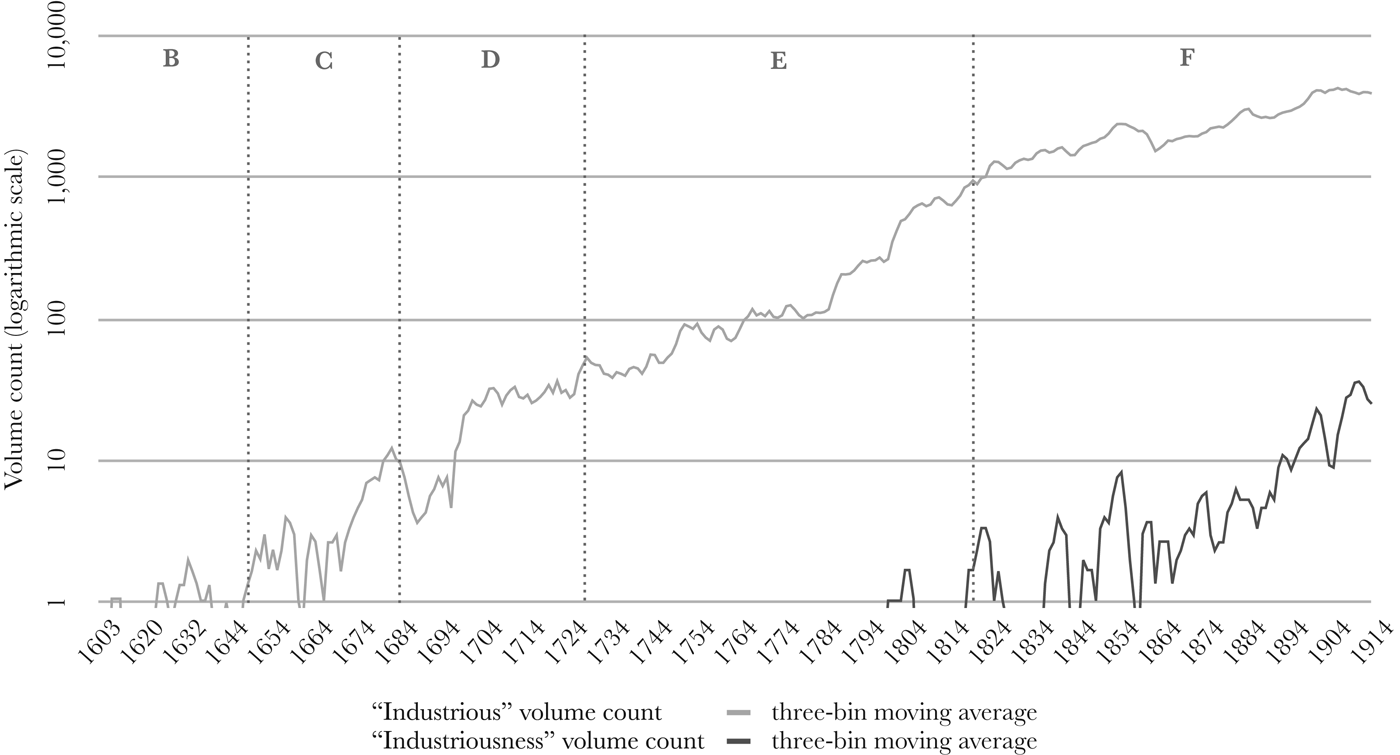
As the charts below show, there was a clear disruption in the usage of industriousness during the years of the Civil War in terms of both relative usage frequency (Fig. 1.2) and the relative number of books (Fig. 2.2). The same level of frequency was only reached again in the 1660s. Furthermore, this interruption does not seem to be a direct effect of reduced publications due to the war as the absolute value of the number of books remains roughly constant (Fig. 3). Instead, it is the consequence of both a contemporaneous decline in interest and an ex post facto selection bias due to librarians shifting their attention to other matters, such as the Civil War. All this indicates that the commercial discourse of industriousness did not disappear but did not prosper either. By following Phil Withington's method, one can also corroborate this relative momentary decline by looking at the frequency of the word ‘industrious’ in books included in the ESTC Title-Pages catalogue (Fig. 7).Footnote 44
In addition, the importance given to commercial ‘industriousness’ by McCloskey and de Vries also partially derives from a selective use of textual evidence, focusing mostly on commercial treatises, which overlooks other types of religious, literary, and educational texts. The latter category is the most conspicuous negligence. John Sommerville, in particular, has shown that there was a ‘disjunctive tradition’ in puritan children's literature in the late sixteenth and early seventeenth centuries: on the one hand, the courtesy (humanist) strand, aiming to foster good behaviour, and, on the other, the religious rejection and appeal to children's vocations and piety. This split was caused by a more secular approach to childhood, which appeared in the 1590s and used the rhetoric of a ‘youthful nationalism’ fuelled by the wars with Spain. One of the most telling examples of this new educational moment was the parable of the two apprentices, which appeared for the first time in English in the famous play Eastward ho by Chapman, Jonson, and Marston in 1605. This embodied the new theme of adult-age (i.e. worldly) reward, transposed from the classic account of Christian post-mortem recognition and adapted to the seventeenth-century work environment.Footnote 45 ‘This new language for children made its way to seventeenth-century puritans’ books which were … almost the only ones available’Footnote 46 and by the end of the century Anglican writers fearing atheism also started to write children's books from a semi-Pelagian perspective, claiming that good moral habits were the basis of religion. Although they still strongly condemned the ‘desires of the riches’, i.e. luxury consumption, they were now using the language of earthly rewards (‘be rich’), of which the apprentice marrying his master's daughter was becoming the tutelary figure.Footnote 47
This also shows that there is no simple conjunction between early industriousness discourses and rejection of consumption, as argued by de Vries. Furthermore, the seventeenth-century moral commitment to industry was also often opposed to spending and luxury too, and the industriousness literature did not necessarily embrace ‘new consumption’ after the end of the seventeenth century. As argued by Hont, the landmark of the so-called demoralization of luxury, Mandeville's fable, ‘was not an encomium of luxury as such, but a defence of the English economic and political regime created by the Glorious revolution, and its foreign policy, against a Jacobite counter-revolution’ that promised to ban luxury and reform society.Footnote 48 It is true that Mandeville contributed to shift the focus of the debate by redefining the meaning of luxury as a historical notion which ‘instead of being a slippery slope of corruption, [embodied human civilization and] the ascent of mankind from animal-like poverty to modern welfare’.Footnote 49 Yet, influential as this reformulation was, it remained bitterly contested.Footnote 50 It is hard to find reliable quantitative evidence showing the relative evolution of these two strands during the eighteenth century. As Mandeville vehemently opposed the economic consequences of ‘frugality’ and ‘prodigality’, however, it is possible to assess their importance by looking at the frequency of these terms and their most common derivatives.Footnote 51Fig. 5 clearly shows that before the eighteenth century, ‘prodigal’ vocables were more frequently used than ‘frugal’ ones (on average 1.45 times more before 1725), whereas from the mid-1720s until the mid-1820s ‘frugal’ became more frequent than ‘prodigal’ (on average 1.23 times more frequent between 1725 and 1825), and the relationship reverted to its initial state after this date. This seems to indicate that the older discourse on industriousness remained very popular throughout the eighteenth century, but it also points at the temporary redefinition of the meaning of ‘prodigality’ (briefly associated positively with ‘industriousness’ during the eighteenth century) as an effect of the ‘Mandevillian turn.’ The evolution of the two frequency series represented in Fig. 5 illustrates this point, too. Whereas, before 1710 and after 1810 ‘prodigal’ and ‘industrious’ were barely related, during the eighteenth century the two series clearly move together much more closely than ever before, or after. In more technical terms, only in this sub-period are the two series cointegrated.Footnote 52
Second, according to Mandeville, there is no immediate relationship between the traditional meaning of luxury (hedonism) and industriousness. Desire could not be the real engine of the sort of continuous material progress he called luxury, for all worldly pleasures could eventually be satiated. On the contrary, he saw industriousness, fuelled by pride, as the antidote to the inherent cyclicality of self-gratification rather than a consequence of the desire for new consumer goods.
Finally, the simplistic conception that a discourse – notwithstanding the label of ‘influental’ retrospectively bestowed upon it by twentieth-century commentators – could have casually replaced another neglects the entire social and spatial dimension inherent to the circulation and diffusion of these ideas. A telling example of the complexity of these mechanisms is the English translation of Psalm 104:23. Coverdale's first translation in 1535 reads ‘Then goeth man forth to his worke, and to till his londe untill the evenynge’, which was only slightly modified in 1552 (‘Man goeth forth to his work, and to his labour, until the evening’) before being included in the Book of Common Prayer. In 1637, however, King Charles commissioned the archbishop of Canterbury, William Laud, to draw up an Anglican prayer book for the Church of Scotland, in which the verse became: ‘Industrious Man drawn forth with Cares, doth then his Work begin, and plies his guiltless Husbandry, till Night doth call him in.’ Although this prayer book was never fully accepted by the Church of Scotland, it was adopted after 1688 by Scottish Episcopalians and, hence, was widely used throughout the eighteenth century. This shows both that ‘hard-working’ was already a common meaning of industrious in the 1630s and that the temporal and spatial diffusion of its usage was not as linear as McCloskey claims. She gives the example of the word ‘honest’, which, says she, chiefly meant noble in the seventeenth century but came to be understood a century later as ‘dignified as an ordinary person’ and ‘truth-telling’; that is to say, ‘reliable in a bourgeois way for making deals’.Footnote 53 Taking the same example, however, Muldrew shows that the meaning of economic reliability already existed in the seventeenth century, and the same point was also forcefully made by Jennifer Richards who explained that by the end of the second half of the sixteenth century ‘the definition of “honesty” as truth-telling and thrifty self management [was already] established’.Footnote 54
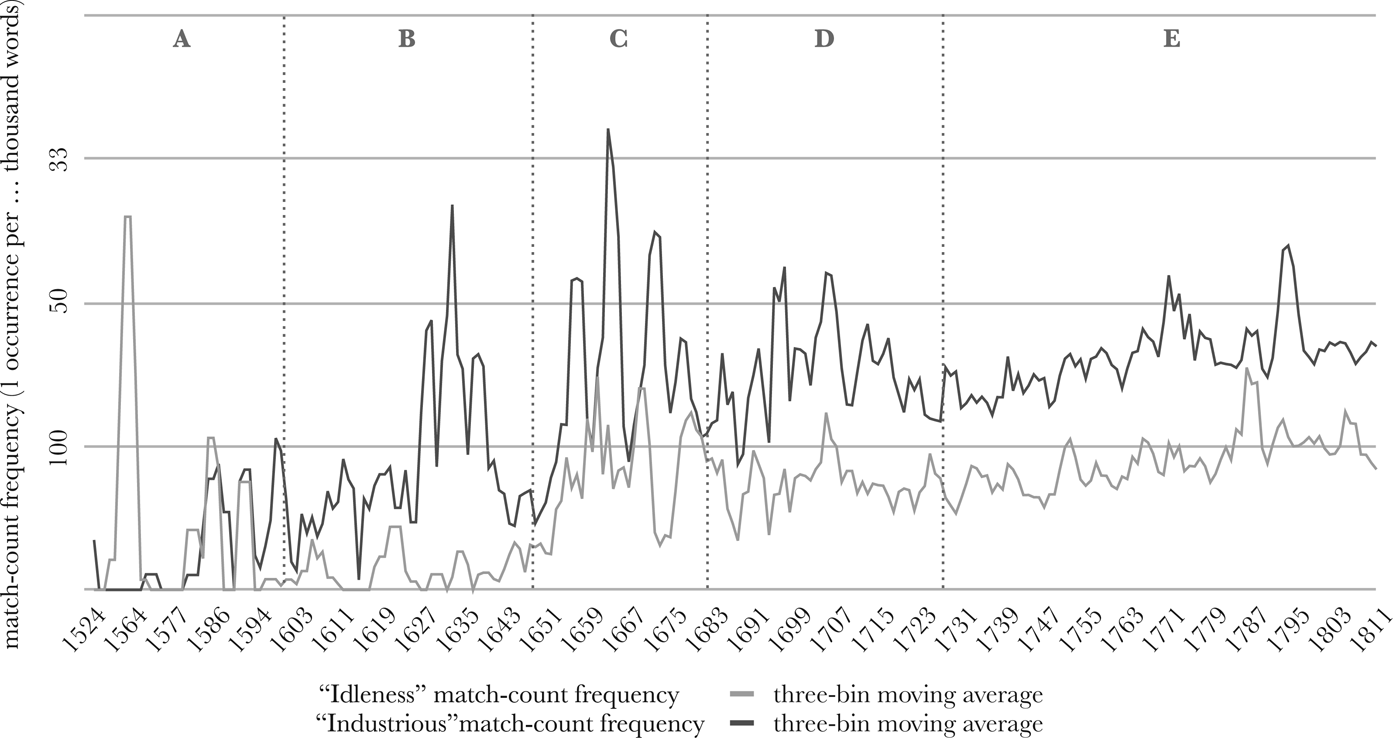
This leads us now to considering the second chronological hinge, which was put forward by Muldrew in his most recent book. He argues that discourses about institutions together with ‘the perception of the social structure to differentiate between labouring poor and idle existed after 1550’ but that a true discourse of ‘industriousness’ appeared only during the Commonwealth period, especially among members of the so-called Hartlib circle.Footnote 55 Plotting the evolution of the frequencies of ‘industrious’ and ‘idleness’ (Fig. 4.1) reveals a clear correlation between the words. Although this representation is far from faultless, the visual pairing of the two terms, corroborated by the data obtained from the ESTC Title-Pages catalogue (Fig. 7) and the Open Library-Bookworm analysis (Fig. 8), indicate a real overall change in the nature of industriousness discourses during these years and the diffusion of a new association between industriousness, labour, and poor relief.
Samuel Hartlib did not himself extensively contribute to the development of the industrious discourse but, by stitching up together all the pieces inherited from previous periods, he nevertheless played a pivotal role in the diffusion and extension of industriousness to new realms. By uniting a large circle of correspondents and publishing their writings, he combined the strands of Utopian writing, educational (religious and moral) literature, early statistical publications, and political economy. His Reformed commonwealth of bees, published in 1655, is a telling metaphor about this duality, encompassing social, political, and cognitive organization and reflects the variety of contributions during these thirty-five years. What qualitative analysis shows is that during this period the industriousness discourse was being imported into many different types of publications. The most relevant to our analysis is the social and moral translation of the proto-national economy argument (to put it simply: ‘commerce provides employment and creates welfare’). This was developed in the previous period and continued to be used by authors such as Henry Parker, in his defence of merchant adventurer privileges against Leveller attacks in the 1640s, Walther Blith (1649), Thomas Papillon (1677), William Petyt (1680 and 1683), and Samuel Fortrey.Footnote 56 As Petyt explained, a logical consequence of this ‘common good’ version of the industriousness argument was that fostering industrious behaviour was to be incumbent upon the whole community and its institutions.Footnote 57
Therefore, together with Petyt, a group of statisticians undertook the daunting task of establishing the extent and consequences of the need to promote industriousness. One of the most telling examples of this endeavour was Petyt's friend John Graunt, who advised against the perverse moral effects of subsidized employment for the poor in his Natural and political observations … upon the bills of mortality and suggested instead that only ‘beggars should be kept and fitted for work’.Footnote 58 This strand of statistical discourse about industriousness was often quite sympathetic toward the Anglican anti-ascetic and material virtues analysed previously, for it saw individuals as naturally inclined to pursue their own interests but corrupted by either an excess of pleasure or an absence of dedication (industriousness), which, thence, should be inculcated in them. They agreed with the teaching of clergymen like Richard Allestree, who claimed that ‘our honest industry and labour is the means by which God ordinarily gives us the necessaries of this life; and therefore we must by no means neglect that: “He that will not labour, let him not eat, says the Apostle”’, quoting 2 Thess. 3.10.Footnote 59 This premise was made even more explicit by commercial writers like Blith, who thought that ‘all men are thirsty enough after profit and increase, yet few studiously industrious in this designe’.Footnote 60 John Houghton, a pharmacist and tradesman dealing with exotic products such as coffee, chocolate, and spices but also the first and most famous practitioner of Hartlib's precepts regarding the centralization and diffusion of market information, also considered the psychological preconditions of this economic emulation:
our height puts us all upon an industry; industry makes every one strive to excel his fellow, and by their ignorance of one anothers quantities, make more than our markets will presently take off; which puts them to a new industry to find a foreign Vent, and then they must make more for that market; but still having some over-plus they stretch their wits farther, and are never satisfied till they ingross the trade of the Universe.Footnote 61
Although it is when looking at these pre-Mandevillian discourses about consumption and industriousness that Jan de Vries's analysis seems the most convincing, I would suggest that his insistence on market-oriented and ‘utility-maximising’ economic activity constitutes a misreading of the individual psychological premise as used in these texts, which he too easily equates with the neoclassic economic axiom that informs his model of consumption. It is not only very reductive to argue that ‘the century-long debate on luxury … can be said to culminate in the work of Adam Smith’, but, without retrospective blinkers, it becomes obvious that the moral principle at the root of this new discourse on industriousness was not the pursuit of individual gratification (immediate or future) or, as Weber argued, the confirmation of divine grace, but a duty to improve the community.Footnote 62 This is what John Sommerville also concluded in the first systematic quantitative analysis of puritan publications between 1660 and 1711, noting that ‘the [Anglican] works which placed most emphasis on industry within one's vocation were those which saw religion in terms of man's duties and self-denial rather than of God's grace’.Footnote 63
Thus, after 1650, this ‘anti-puritan work ethic’ was rather linked to what Paul Slack and Muldrew have described as a shift from a discourse stressing the need for reform to an emphasis on (moral and economic) improvement, based on what these writers perceived as unmistakable economic betterment during the second half of the seventeenth century.Footnote 64Fig. 4.2 clearly shows the emergence of this ‘improvement’ literature in period C with the frequency of ‘improvement’ going up from 1 word in 1,000,000 in the 1630s to 1 in 40,000 by the 1670s, and its close correlation with the ‘industrious’ literature that lasted until the first decade of the eighteenth century, when the new self-interested consumption literature exemplified by Mandeville began to circulate. Between 1640 and 1710, the two time series are indeed strongly cointegrated, whereas they are not anymore in the subsequent period.Footnote 65
That material conditions were improving and ‘that the Power and Wealth of England has increased these last forty years’ had become so conspicuous that an author like Petty did not feel it necessary to demonstrate it, leaving ‘to the consideration of all observers whether the Splendor of Coaches, Equipages and Household Furniture have not increased since that time’.Footnote 66 This perception of material improvement also went hand-in-hand with a deep and progressive movement of adaptation to the material world of luxury (rather than a sudden demoralization) which had been gaining ground since late Jacobean times.Footnote 67 Tellingly, whereas in previous periods epithets such as ‘industrious’ and ‘diligent’ were chiefly reserved for Dutchmen, they were now happily applied to the ‘brave, industrious, free-born English man’ too.Footnote 68
Also, these contemporary perceptions are corroborated by recent reconstructions of real wages and GDP per capita levels. Goldstone's figures, together with more recent contributions by Allen and Clark, have stressed the upturn in English real wages during the second half of the seventeenth century, following more than 150 years of decline.Footnote 69 Similarly, Broadberry has calculated that GDP per capita grew by 27.2 per cent in England during the second half of the seventeenth century while it had only increased by 1.4 per cent over the entire previous century.Footnote 70 It is true that Maddison has a more optimistic perception of sixteenth-century GDP growth, leading him to stress the continuity between 1500 and 1800, but the gradualist turn in the historiography of the Industrial Revolution, together with our knowledge of demographic history, nevertheless tends to favour Broadberry's and van Zanden's figures.Footnote 71
Although these figures show general economic betterment, it is worth noting that until the 1680s the industriousness discourse was mostly aimed at a select group of wealthy individuals who could afford not to work. After this date, however, the effect of rising wages which, as many early modern historians have argued,Footnote 72 had been reinforced by two decades of negative population growth after 1650,Footnote 73 caused alarm among many landowners, popular journalists, and economic observers.Footnote 74 The main problem for them was that such a high level of wages did not allow them to discriminate ‘naturally’ between industrious and lazy labourers, as the former could work less and enjoy as much or even more leisure, while the latter were not encouraged to work hard because of common land and overly generous Poor Law provisions. This has come to be known among economic historians as the hypothesis of a backward bending slope of labour demand. However tempting it might be to read back microeconomic models through these comments, it is crucial to note with Muldrew (and against Hatcher) that ‘the idea of leisure preference being a general attribute of labourers is really something which comes from negative comments by observers like Defoe and cannot be generalized to the labouring population as a whole’.Footnote 75
These negative comments contributed to the entanglement of industrious and luxury discourses. Thus, after 1680, religious, moral, and economic fulminations against popular luxury consumption became (anew) a key element of industriousness discourses but this time linked to the issue of the cost of poor relief. The previous pragmatic toleration of luxury linked to the general interest literature was replaced with a reactivation of theories of social discrimination relating to consumption (i.e. sumptuary laws or, as Sir Josiah Child elegantly put it, ‘protection against the vice of luxury’)Footnote 76 and mercantilist condemnations of imported goods. Even Nicholas Barbon, who is presented by Slack and de Vries as the paragon of this new general attitude toward consumption, argues that in an ideal society the poor should produce and the rich consume.Footnote 77 The tolerability of consumption, even for a nation as a whole, thus depended upon economic and social status. This twofold extension meant that the idea of general interest became subordinated on the one hand to an individual's economic role as determined by social status, and on the other hand to the need for national industries to emulate and overtake foreign productions. The industriousness argument was thus split between those who argued for popular moral education linked to increased sensibility towards the cost of the poor or, like the Societies for the Reformation of Manners in the 1690s, for a religious crusade against vice and those who favoured a political economy version which used ‘industrious’ as the quality of a thriving and competitive nation.Footnote 78 The former tended to insist on moral reformation – aimed mostly at the poor – and the rejection of luxury following the common assumption that all vices were connected (i.e. idleness and excessive consumption necessarily led to crime, sexual promiscuity, and whoredom); the latter on liberty, emulation, and improvement, using such popular heavyweights as Defoe, Mandeville, and those writing under the pen name Cato, who were all extremely suspicious about both the methods and effectiveness of reformation societies, which, they thought, often had the unintended effect of perpetuating vice rather than eliminating it.Footnote 79
However, despite the fame of these polemists, there is no doubt that in the two last decades of the seventeenth century the rigorous morality of the first strand largely dominated the publication scene and the consequence was that for the majority of the people, to whom the conjunction between the pursuit of private interest and the common good had simply never been applicable, luxury consumption was now even more vehemently negated and industriousness even more prescribed by these authors. Slack detected the same rhetorical decoupling in the new ‘criticism of workhouse functioning that opened the door to the disconnection between private interest and public good’; stressing that even charity could miscarry and have perverse social and economic effects. Against these critics of the workhouse, the discourse of the reform of manners was reactivated: restoring frugality by educating ‘a virtuous and laborious generation’.Footnote 80 This was one of the main elements of the pamphlets and economic treatises addressing this moral shortfall after the 1680s; stressing industriousness as a social value linked to the economic and psychological cost of poor relief.Footnote 81 Child's Discourse about trade, begun as a pamphlet in 1668 and then extended into a book in the 1690s, reflects this duality between moral and economic arguments. In order to reject the view that high interest rates could work as a sumptuary law he argues that ‘Luxury and Prodigality are as well prejudicial to Kingdoms as to private families … but … nothing hath or will incline this or any other Nation more to Thriftiness and good Husbandry, … than abatement of Interest.’Footnote 82
Regarding labourers, he adopts a strongly moralizing discourse underpinned by both the macroeconomic and social costs (labour disincentive) of poor relief. Despite having an opposing premise, advocates of free trade reveal the same tension. The political economist Charles Davenant observed that England had become richer and more prosperous thanks to its imitation and substitution of foreign goods imports but opposed the Mandevillian approach in the luxury debate, emphasizing that he is ‘very far from adhering to the old Notion, that Luxury and some Excess, may be profitable’. It is interesting to note that one might have expected here the ‘new’ rather than the ‘old’ notion, but Davenant, like many of his contemporaries, was aware of the long pre-Mandevillian intellectual filiation of seventeenth-century revaluation of luxury. He concedes nevertheless that ‘it is not impossible, but that our Industry would be less active if it were not awaken'd and incited by some irregular Appetites … A rich Soil is apt to make a People lazy, and peradventure we should not be so stirring and inventive, but for our Inclination to Foreign Vanities.’Footnote 83 The industriousness of the nation must be matched by the painful application of labourers. In another pamphlet published a year later, Davenant refers to Gregory King's work to argue that ‘the Industry of not half the People maintains in some degree the other part … to what pitch of Wealth and Greatness might we not be brought … if all the Members of the Body Politick were render'd useful to it’.Footnote 84
During and after the 1720s, the relationship between these two discourses was inverted, as values of (self)-improvement, emulation, and reasonable consumption became the dominant elements in the industriousness discourse. This is what de Vries understands (in a rather reductive way) as the industriousness discourse, i.e. combining the toleration of luxury and moral education as keys to success for both individuals and nations. To be fair, the increasing prevalence of these ideas in print – measurable by the steady increase in the relative occurrences of these words in the century after 1720 (Fig. 2.1) in very large numbers of books produced after 1701 (see Fig. 3) – shows a real and statistically significant quantitative diffusion in these years. It will not come as a surprise, however, that, as in the period before the 1720s, industriousness discourses were mostly aimed at an educated elite, whereas after this date they were largely used by publicists such as Defoe, Hogarth, and Franklin, who were all prone to encouraging a more economically engaged social morality.Footnote 85 Hogarth's series of paintings and prints such as A harlot's progress (1731), A rake's progress (1735), and Industry and idleness (1747) are telling example of this new combination focusing on popular attitudes to luxury and industriousness.
De Vries rightly notes that Defoe seems to be even more extreme than Mandeville by celebrating the aggregated economic effects of ‘the exorbitances [not only of the wealthy but] of the poor and the middling sort’ too.Footnote 86 Defoe seems to start by accepting the basis of the Mandevillian analysis, stating that ‘reforming our vices would ruin the nation’. Yet, like many English critics of Mandeville, such as Shaftesbury, Berkeley, and Hutcheson, Defoe believed in the possible existence of an ‘honest hive’ based on the restoration of the lost balance in ‘man's natural “oeconomy”’, that is to say on the education and restriction of excessive passions.Footnote 87 Defoe associated industriousness (morality) and luxury (hedonism) as the two inseparable components of active social morality, arguing that the true virtue for an industrious individual is not rejecting pleasure-seeking activities and consumption altogether but achieving the right balance between the time and place for religion, leisure, bodily necessities, and business. Hence, Defoe criticizes both shopkeepers ‘with their long wiggs and swords rather than with aprons on’ and those ‘sermon-hunters’ who neglect their business.Footnote 88 William Hogarth's Harlot's progress and Rake's progress both argued in favour of a similar notion of honest consumption as opposed to covetousness, avarice, luxury, and fashion. Franklin summarized this new take on industriousness by asking whether ‘to a certain Man, idle Diversions have nothing in them that is tempting, and therefore he never relaxes his Application to Business for their Sake; is he not an Industrious Man? Or has he not the Virtue of Industry?’Footnote 89
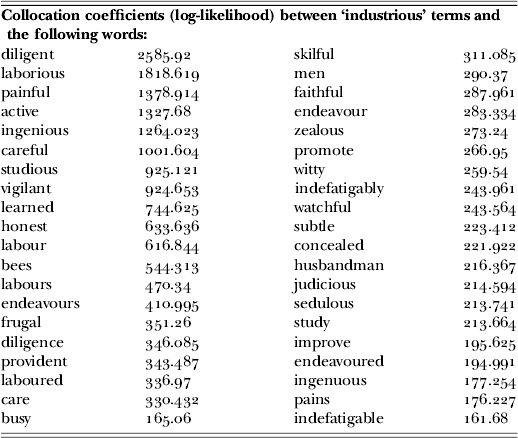
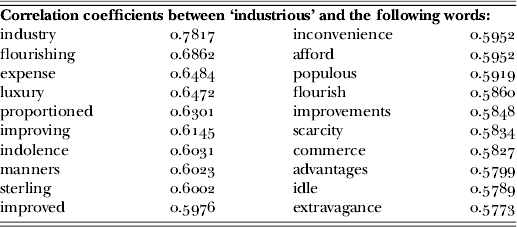
As the quantitative analysis seems to indicate, Franklin et al. are indeed the real heroes of this story as they coincide with the heyday (i.e. the maximal diffusion) of the industriousness discourse between the 1720s and the 1810s. A rapid overview of the words most frequently associated (or, more accurately, correlated) to ‘industrious’ between 1700 and 1899 corroborates this point too. Out of twenty, ten are related to economic improvement, six to thrift and four to idleness, whereas over the two preceding centuries out of the forty most frequent collocates, seventeen indicate a moral quality, sixteen hard work, two are related to the notion of betterment and only one to idleness (see Tables 2.1 and 2.2 below). Despite this apparent unanimity, one should not be dazzled by the quasi-feverish devotion to late eighteenth-century discourses about industriousness; the emphasis placed by historians and commentators upon industriousness also derives from its simultaneous consecration as a cliché of social sciences writing. An analysis of the data available through the Open Library (Fig. 6) shows that from the late 1790s onwards the relative frequency of the industrious discourse became almost five times higher in books classified by the Open Library as belonging to the ‘social sciences’ than in other British publications, even educational and (unsurprisingly) religious literature.Footnote 90 The invention and perpetuation of an academic ‘industriousness discourse’, which progressively came to dominate previous meanings, was thus certainly the result of the increasing necessity to explain contemporary economic and social transformations that a century later would be called Industrial Revolution.
Top forty (meaningful) collocates of ‘industrious’ terms in the EEBO database, 1580–1720
Note: Collocations determined through the CQPweb interface. For reference see A. Hardie, ‘CQPweb – combining power, flexibility and usability in a corpus analysis tool’, International Journal of Corpus Linguistics, 17 (2012), pp. 380–409.
Top twenty (meaningful) words correlated to ‘industrious’ in the (English 2009) Ngram database, 1700–1899
Note: Correlations determined through the correlation tool developed in SEASR/Meandre by L. Auvil and B. Capitanu, modelled on prototypes developed by T. Underwood and R. Heuser.
After 1810, moreover, the rate of circulation started showing the first signs of relative decline as, although the number of books using the word remained almost steady (Figs. 3 and 6), the total number of publications rocketed, hence progressively lowering the frequency of the term (Fig. 1.2). Thus, it is fair to conclude that ‘industrious’ was predominantly an eighteenth-century vocable. The opposite is true for ‘industriousness’: although the frequency of words derived from ‘industrious’ was divided by fifteen between 1830 and 2000 within an ever-increasing number of publications, the frequency of ‘industriousness’ was multiplied by twenty between 1900 and 1990. This inverted relationship between the fates of the two words further illustrates the spurt of academic interest in the conceptualization of ‘industriousness’ and its relationship to the economic transformations of the previous two centuries. This also explains the crystallization of the meaning of ‘industrious’ (i.e. the reduction of the polysemy and multiplicity of the many industrious discourses to the unequivocal singularity of the industrious discourse) during the latter period. This is illustrated by the progressive convergence between the usages of ‘industriousness’ and ‘idleness’ after 1820.
To conclude, the causation between industrious discourses and changes in economic behaviours does not appear as obvious as de Vries and McCloskey would like. The chronology tells a rather different story: these discourses existed long before the advent of modern consumerism and their diffusion did not become really significant until much later, when the Industrial Revolution was already happening. Furthermore, this review has shown that the analyses of both authors were marred by a mistaken conception of continuity in discourses from the seventeenth to the nineteenth centuries. I hope that it is sufficiently clear now that this cannot, however, replace a more attentive study of the values and norms diffused through this heterogeneous body of texts. In brief, there was not before the very end of the eighteenth century a single discourse about industriousness, but many – diverging and competing for the attention of different audiences.
It is true that these different types of discussion of industriousness often crystallized around debates regarding the valorization of increased luxury consumption, especially in the mid-eighteenth century, but I hope to have shown that this association was neither an inevitable development of earlier conceptions of industriousness – especially in the field of political economy – nor was it really dominant in late eighteenth-century uses of the term. Older versions of ‘industriousness’ clearly remained influential throughout the century, and the mythical syncretism between economic theory and ‘industrious’ discourse posited by the likes of de Vries was, in fact, much more a phenomenon of the late nineteenth and twentieth centuries, which appeared alongside the need to theorize the origins of indsutrialization.
Yet, as clearly shown by Muldrew, the Interregnum was a key moment in the synthesis of this discourse as it laid the intellectual foundations of a paradigm of economic rationality embodied in and channelled through official institutions and economic policies. This intellectual model has unfortunately become the unquestioned premise of many economists’ and economic historians’ accounts of an industriousness shift accompanying the advent of (economic) modernity. I hope the chronology sketched in this article will provide a strong rejoinder to this misleading anachronism.
Finally, although previous generations of scholars – who had mostly based their accounts of the advent of modernity on economic (Marxian), or psychological and religious (Weberian) determinismsFootnote 91 – could make do without a model of social diffusion, this review illustrates the problem encountered by all new putative explanations of changing patterns of consumption or industriousness that aim at stressing individual agency and rejecting neoclassic economic rationality. Whereas the Marxian determinism argues that cultural shifts only reflect changes in modes of production or, by extension, real prices series, and the Weberian posits an immediate behavioural transformation linked to self-fulfilling individual drives – for example Calvanism is, for Weber, inherently linked to the development of a capitalistic ethos, and once this correlation is established the problem is relegated to the safer shore of religious sociology, everything falling in-between now has to come up with its own answer to the thorny question of the diffusion and social distribution of these new economic values.Footnote 92 And, as such simple overarching methodological frameworks are just not available any more in the historical toolbox, the authors, whose works have been examined in this review, will not be able to avoid clarifying the theoretical model of cultural and social diffusion (i.e. both of ideas and goods) that underpins their narrative.