In early lactation, when the energy demand for milk production exceeds the energy intake from feed, dairy cows enter a physiological state of energy deficiency. To compensate for this negative energy balance, body energy resources are mobilised (Bauman & Currie, Reference Bauman and Currie1980; Friggens & Newbold, Reference Friggens and Newbold2007). To assess the energy availability of cows it is crucial to measure the individual feed intake. On farm, the recording of feed intake is time consuming and expensive and, therefore, almost impossible to perform as a standard method. Therefore, alternative indicators are used to assess energy utilisation of a cow. Current indicators are milk yield and composition, body condition score, back fat thickness, and parameters from body fluids like blood, urine or milk. While information on milk yield and composition can be produced daily from new milking systems or monthly from milk performance tests, automatic systems to repeatedly score body condition and back fat thickness have not yet reached the production system. In addition, these parameters are subject to many individual and time-of-day fluctuations including amount and time of feed intake, diet composition, lactation stage, age and breed. Therefore, reliable and easy to measure biomarkers for energy utilisation are difficult to identify, but highly desired by farmers, breeders, and veterinarians.
Since the composition of hair is not influenced by diurnal and daily fluctuation, hair is a robust material to analyse biomarkers. Whilst the collection of hair samples is easy, some other factors have to be considered if hair is to be used as a source of body material for analysis. The structure and composition of hair can be affected by environmental influences such as diet (Duill, Reference Duill1924; Bianca et al. Reference Bianca, Wegmann-Bosshardt and Näf1974), season (Dowling, Reference Dowling1959) and pigmentation (Selahattin, Reference Selahattin1931). The effect of nutrition on hair has been repeatedly shown in sheep (Qureshi et al. Reference Qureshi, Khan, Shafique, Sabir and Ahmed2013). In addition, studies of human hair provide evidence that metabolites in the hair can be damaged by strong UV light (Ji et al. Reference Ji, Park, Lee, Kim, Pi, Jin and Lee2013). Furthermore, the amount of lipids decreases towards the distal end of the hair (Masukawa et al. Reference Masukawa, Tsujimura and Imokawa2005). Due to technological developments, sensitive technical instruments are available to measure small amounts of fatty acids. This also allows hair analyses and makes them interesting to study the metabolism of individual cows.
In ruminants, the short-chain fatty acids acetate, propionate and butyrate, which originate mainly from the rumen metabolism, are used for de novo fatty acid synthesis primarily in the adipose tissue and the lactating mammary gland. Malonyl-CoA is gradually accumulated and decarboxylated through fatty acid synthase (Bergen & Mersmann, Reference Bergen and Mersmann2005). Thus, the de novo fatty acids are synthesised to a maximum chain length of 16 carbons and are used as precursors of hormones and for energy storage in depots. Only in periods of positive energy balance, when an excess of energy and acetyl-CoA is present, can malonyl-CoA be synthesised and de novo fatty acid synthesis performed, which can then be detected in the whole body. In the stage of negative energy balance, when the mammary gland is preferentially supplied with energy and nutrients for milk fat production, energy supply for fatty acid synthesis in adipose tissues is reduced and de novo fatty acids are scarcely stored in the body. Recent investigations have reported relationships between hair components and the metabolism of cows (Möller et al. Reference Möller, Nürnberg, Schmitt and Brockmann2013; Burnett et al. Reference Burnett, Madureira, Silper, Tahmasbi, Nadalin, Veira and Cerri2015). These results suggest that hair composition is connected to metabolism, and hair composition could robustly reflect the metabolic status of a cow over the previous 1–3 weeks (Gaillard et al. Reference Gaillard, Balland, Doucet and Pepin1997; Vanhaecke et al. Reference Vanhaecke, Antignac, Courtheyn, Le Bizec and De Brabander2011). In our previous study, we provided first evidence for a relationship between the content of C12:0 in the hair, the interval from calving to first insemination (r = −0.32, P < 0.05) and protein yield during the first 100 d in milk (r = 0.34, P < 0.05). Cows with a short interval from calving to conception (<120 d) and high milk protein yield (⩾98 kg) had higher percentages of de novo hair fatty acids, especially C12:0 (Möller et al. Reference Möller, Nürnberg, Schmitt and Brockmann2013). The findings for C14:0 showed the same direction of effect, but differences were not significant.
With respect to fertility and milk protein production, the content of C12:0 in the hair could distinguish robust from less robust cows. From these findings, we expected that differences in energy availability in early lactation could be detected by differences in the hair fatty acid profiles. Our hypothesis was that cows with high energy availability have higher contents of C12:0 fatty acids in hair than cows with low energy availability. To proof our hypothesis, we examined the relationship between de novo synthesised hair fatty acid C12:0, C14:0 and C16:0 and the energy intake from feed, the energy requirements for maintenance and milk production, the energy balance and the energy utilisation during early lactation.
Material & methods
Animals and measurements
All cows were housed and cared for according to the German animal welfare act (Tierschutzgesetz, 2006).
The study was carried out with 11 first parity German Holstein cows that calved between January and March 2011 on an experimental station. The average body weight at calving was 558 ± 27 kg. After 9 ± 5.6 d (mean ± sd) post partum (p.p.), cows were kept in a free-stall barn equipped with individual electronic feeding systems (Landtechnik Weihenstephan, Germany). Cows were fed ad libitum, diets were freshly prepared and filled in storage containers once a day. The total mixed ration until week 8 p.p. was composed of 41% corn silage, 12% grass silage, 10% lucerne silage, 1.3% straw, 23% by-products, 12% mixed feed, and 0.6% supplemented fat of dry matter (online Supplementary Table S1). On average, the diet contained 7.2 MJ NEL kg−1. During the experimental period, chemical analyses of silages were performed once a month, whereas the other diet components were analysed once per study. Feed samples of the diet were analysed in a specialised laboratory and energy content of the diet was estimated according to the Society of Nutrition and Physiology (GfE, 2001; 2004). The dry matter contents of silages were measured twice a week. The cows were milked thrice a day. Milk composition was recorded monthly within national milk performance tests. The first two test-days were on day 19 ± 6.6 and 49 ± 8.0 p.p. The milk performance of the first 100 d of lactation was high with an average of 3,537 ± 529 kg (mean ± sd) and showed a large variability. Fresh matter intake and daily milk yield on the first days p.p. (6.8 ± 4.1 d; 2.8 ± 1.5 d, respectively), as well as missing values were imputed using a non-linear model. Body weight and back fat thickness were used as body condition traits. Both traits were measured together directly after the morning milking the day after calving and lactation weeks 2, 4, and 8. Back fat thickness was measured by ultrasound (Physia H 120, Physia GmbH, Neu-Isenburg, Germany) at an imaginary line between tuber coxae and tuber ischiadicum, approximately a palm cranial of tuber ischiadicum (Schröder & Staufenbiel, Reference Schröder and Staufenbiel2006). The interval of calving to first insemination was 85 ± 16 d. The interval from calving to conception was 101 ± 23 d. During the first 8 weeks of lactation, none of the cows was medicated against reproduction or metabolic diseases.
Hair analyses
Two consecutive hair samples per animal were taken in lactation weeks 6 (39 ± 3.2 d p.p.; n = 10) and 8 (52 ± 2.4 d p.p.; n = 11) from the right ventral side of the foreleg. Since the hair growth rate is only 0.69 – 1.06 mm per day (Schwertl et al. Reference Schwertl, Auerswald and Schnyder2003), consecutive hair samples had to be taken each time from neighbouring skin areas.
The methods used for integral lipid extraction, esterification and detection of the hair fatty acid profile have previously been described in detail (Möller et al. Reference Möller, Nürnberg, Schmitt and Brockmann2013). The fatty acid profile of total lipids was determined by capillary gas chromatograph using a CP SIL 88 capillary column (100 m × 0.25 mm, Chrompack-Varian, USA) installed in a gas chromatograph Clarus 680 equipped with flame-ionisation detector and split injection (Perkin Elmer Instruments, Shelton, USA). For the quantification of fatty acids, C19:0 was used as an internal standard. For the calibration procedure we used a reference standard mixture for 37 fatty acid methyl ester (FAME) with 4 and 24 carbons (‘F.A.M.E. MIX C4-C24’, Sigma-Aldrich, Taufkirchen, Germany), the methyl ester of C18:1cis-11, C22:5n-3, C18:2cis-9, trans-11 (Matreya, PA, USA), C22:4n-6 (Sigma-Aldrich, Taufkirchen, Germany) and C18:4n-3 (Larodan, Solna, Sweden). We were able to detect the following fatty acids with a repeatability between 0.6 for low concentrated fatty acids (<1%) and 0.98 (Nürnberg et al. Reference Nürnberg, Dannenberger, Ender and Nürnberg2007; Dance et al. Reference Dance, Doran, Hallett, Dannenberger, Nürnberg and Nürnberg2010): C10:0, C12:0, C13:0, C14:0, C15:0, C15:1, C16:0, C16:1, C17:0, C18:0, C18:1trans-11, C18: 1cis-9, C18:1cis-11, C18:2n-6, C18:3n-3, C20:0, C20:1, C21:0, C22:0, C22:4, C22:5n-3 and C24:0.
Parameters of energy balance
Individual feed intake and milk yield were measured. Milk fat and protein percentages were taken from the first two test-days according to the national standard method (ADR, 2001). A linear relationship was assumed to calculate changes of body weight and back fat thickness between two consecutive measurements. Daily energy intake from feed was calculated as the product of daily dry matter intake and energy content of the diet. Energy requirement for maintenance and milk production were calculated according to national standards (GfE, 2001):
Energy requirement for maintenance, MJ NEL/day = 0.293 * body weight0.75 [kg].
Energy requirement for milk production, MJ NEL/day = (0.38 * fat content [%] + 0.21 * protein content [%] + 0.95) * milk yield [kg].
Energy balance was calculated as the difference between energy intake from feed and energy requirement for maintenance and milk production. Since cows mobilise body fat to compensate for the extent of a negative energy balance at the beginning of lactation, energy utilisation was used to describe energy availability including energy mobilisation as an additional parameter. Energy utilisation was calculated as the difference between the sum of energy intake from feed and energy from the mobilisation of back fat on the one hand and the energy requirements for maintenance and milk production on the other hand. Energy mobilisation from back fat was calculated on the basis of the change of measured back fat thickness. A change of 1 mm back fat thickness is considered to be equal to 4.7 kg of body fat (Wiedemann, Reference Wiedemann1990; Klawuhn, Reference Klawuhn1992; Rieckhoff, Reference Rieckhoff1992), and the energy content of 1 kg body fat is equal to 39 MJ (GfE, 1995). Since the hair samples from weeks 6 and 8 reflect the metabolic status 1 to 3 week earlier, parameters of energy balance, body weight and back fat thickness were calculated as daily averages in weeks 1 and 2, in weeks 3 and 4 and in weeks 5 and 6, respectively.
Statistical analyses
The statistical software SAS 9.1 (SAS Institute Inc., Cary, NC, USA) was used for data analyses. All statistical tests used a significance threshold of P ⩽ 0.05. Tendencies were defined with 0.05 < P < 0.1. To identify changes of parameters of energy balance, subsequent weeks of parameters were compared with a two-tailed t-test for dependent datasets.
Since the sample size was small (n = 11), Spearman's rank correlation coefficients and corresponding confidence intervals were calculated to assess the relationship between the parameters of energy balance, body weight, back fat thickness, and hair fatty acids. The confidence intervals for significant correlation coefficients were calculated using Fisher transformation. Since the hair mirrors the metabolism of the previous 1 to 3 weeks, we analysed the correlation between the hair fatty acid profile at 6 and 8 weeks and parameters of energy availability in the time window of lactation weeks 3 and 4 and weeks 5 and 6, respectively.
To evaluate the relationship between the hair fatty acid profile and energy availability in the first weeks after calving, we classified cows based on their average energy utilisation during the lactation period between weeks 1 and 6. Based on the median of energy utilisation, all cows were classified according to their energy utilisation between weeks 1 and 6 into two distinct groups higher (n = 6) or lower (n = 5) than the median. Consequently, the energy utilisation was significantly different between the two groups (P = 0.023). Although the classification analysis reduces the number of cows per group, classification allows a closer look at a specific parameter, even if the sample size is small. Parameters of energy balance, body weight, back fat thickness from the first six weeks of lactation, and de novo hair fatty acids in weeks 6 and 8 were compared between the two groups using repeated measurement analysis of variances depending on the time-point of hair sampling.
Results
Energy availability of cows
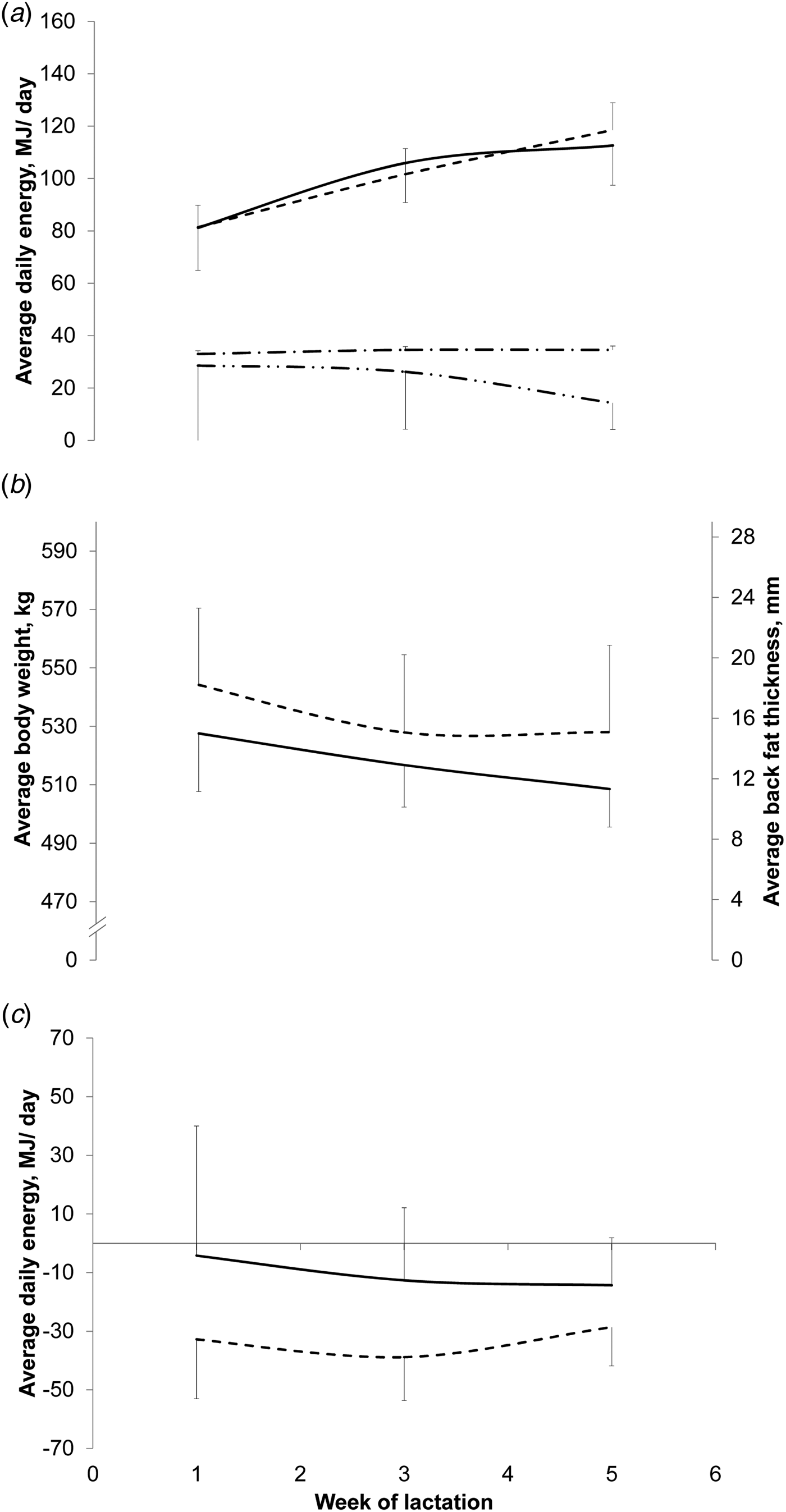
The daily energy intake from feed in weeks 1 and 2 of lactation was 81 ± 8.3 MJ NEL, and increased to 110 ± 9.8 MJ NEL in weeks 5 and 6 (P < 0.001). The estimated energy amount mobilised from back fat in weeks 1 and 2 provided 29 ± 37.9 MJ per day, which was almost equal to the energy requirement for maintenance. Thereafter, energy mobilisation decreased to 14 ± 10.1 MJ in weeks 5 and 6 (Fig. 1a). Back fat thickness decreased continuously from 15 ± 3.8 mm to 11 ± 2.5 mm from the beginning of the lactation until the end of the study (time effect: P = 0.024, Fig. 1b). The body weight decreased from 544 ± 26 to 528 ± 27 kg between calving and weeks 3 and 4 and remained constant until the end of the study. The energy requirement for maintenance was between 32 and 33 MJ per day and remained constant over time. The daily energy requirement for daily milk production was 81 ± 16.2 MJ in weeks 1 and 2 and increased rapidly to 95 ± 9.1 MJ in weeks 3 and 4, and 111 ± 9.8 MJ in weeks 5 and 6 (P = 0.002). Due to the greater energy requirement for maintenance and milk production compared to the energy intake from feed in the first weeks of lactation, the calculated energy balance started with −33 ± 20.3 MJ in weeks 1 and 2 and further decreased to the nadir of −36 ± 13.8 MJ in weeks 3 and 4. An improvement of the energy balance to −27 ± 12.4 MJ was observed in weeks 5 and 6 (Fig. 1c).
Development of (a) energy intake from feed (- - -), energy requirement for milk production (─) and maintenance (─ · ─), and energy mobilisation from back fat (─ · · ─), (b) body weight (- - -) and back fat thickness (─), (c) energy balance as difference between energy intake from feed and combined requirements for maintenance and milk production (- - -), and energy utilisation as the difference between the sum of energy intake from feed and energy mobilisation from back fat, and the energy requirements for maintenance and milk production (─) of all cows during the lactation period between weeks 1 and 6. Number of cows = 11.

Energy utilisation as the difference between the sum of energy intake from feed and energy mobilisation from back fat on the one hand, and the energy required for maintenance and milk production on the other hand, started with the highest value of −4 ± 44.2 MJ in weeks 1 and 2, when the required energy was almost completely covered by feed intake and energy mobilisation. Afterwards, the energy utilisation decreased to −12 ± 23.1 MJ until weeks 3 and 4, and remained on this level until the end of the study.
To find a relationship between energy resources and energy requirements, we analysed the correlation between these traits. Positive correlations were found between energy intake from feed and energy requirements for maintenance in weeks 3 and 4 (r = 0.76, P < 0.009, CI (0.12–0.91)). Positive correlations between energy mobilisation from back fat and energy utilisation were found between lactation weeks 1 and 2 as well as 3 and 4 (0.79 < r < 0.92, P < 0.016, CI (0.36–0.98)). Energy utilisation was positively correlated with energy balance in weeks 5 and 6 (r = 0.70, P = 0.017, CI (0.17–0.92)). Further, positive correlations were found between body weight and back fat thickness in weeks 3 and 4 (r = 0.72, P = 0.012, CI (0.16–0.92)), and between body weight and energy intake from feed in weeks 3 and 4 as well as in weeks 5 and 6 (0.76 < r < 0.80, P < 0.007, CI (0.38–0.98)). Negative correlations were found between energy balance and energy requirement for milk production from week 1 to 6 (−0.91 < r < −0.72, P < 0.008, CI (−0.97; −0.21)). Back fat thickness showed no relationship either to energy intake from feed or to energy balance (data not shown).
Composition of hair fatty acids
The fat content across all hair samples ranged from 0.77 to 1.81% (average: 1.25 ± 0.3%). The average fat content of hair in lactation weeks 6 and 8 ranged from 1.16 ± 0.25% to 1.34 ± 0.32%. Saturated fatty acids represented the largest proportion of hair lipids with 79 ± 7.8%. The highest proportion of saturated fatty acids was contributed by C14:0 (week 6: 27 ± 9.0%; week 8: 22 ± 7.4%), followed by C16:0 (week 6: 19 ± 4.6%; week 8: 21 ± 2.8%), with C14:0 showing a larger variation than C16:0. Lactation week 6 showed the greatest variation of all de novo synthesised fatty acids. We also detected the medium chain fatty acid C10:0 (4.2 ± 3.1%).
Monounsaturated fatty acids and polyunsaturated fatty acids represented 15 ± 5.5% and 6 ± 3.1%, respectively. The highest proportion of monounsaturated fatty acids was detected for C18:1cis-9 (9.3 ± 5.3%). Among polyunsaturated fatty acids, the essential fatty acids C18:2n-6 and C18:3n-3 had proportions of 4.4 ± 2.5% and 0.8 ± 0.6%, respectively. The hair lipids contained six times as many n-6 (5.0 ± 2.4%) than n-3 (1.1 ± 0.9%) fatty acids (online Supplementary Table S2).
Relationship between hair fatty acids and energy availability
In the following, we consider particularly the de novo synthesised fatty acids C12:0, C14:0 and C16:0 because these fatty acids depend on energy availability in body metabolism.
Positive correlations for de novo fatty acids in week 8 were found between C12:0 and energy intake in the time window of lactation weeks 5 and 6 (r = 0.65, P = 0.032, CI (0.07–0.90)) as well as between C14:0 and energy intake in the time window of lactation weeks 5 and 6 (r = 0.62, P = 0.043, CI (0.03–0.89)). Negative correlations were calculated between C16:0 in week 8 and energy intake in the time window of lactation weeks 5 and 6 (r = −0.66, P = 0.026, CI (−0.90; − 0.11)) and energy balance in the time window of lactation weeks 5 and 6 (r = −0.65, P = 0.032, CI (− 0.90; −0.07), Table 1). In the current study, we did not find significant correlation coefficients between energy mobilisation and either C16:0 or C18:1cis-9 in hair.
Spearman's correlation coefficients (r), P-values (P) and confidence intervals (CI) between the relative fatty acid content (%) of C12:0, C14:0 and C16:0 in hair lipids at week 8 and energy intake from feed, energy balance and body weight changes in the time window of lactation weeks 5 and 6 (n = 11)

Classification based on energy utilisation
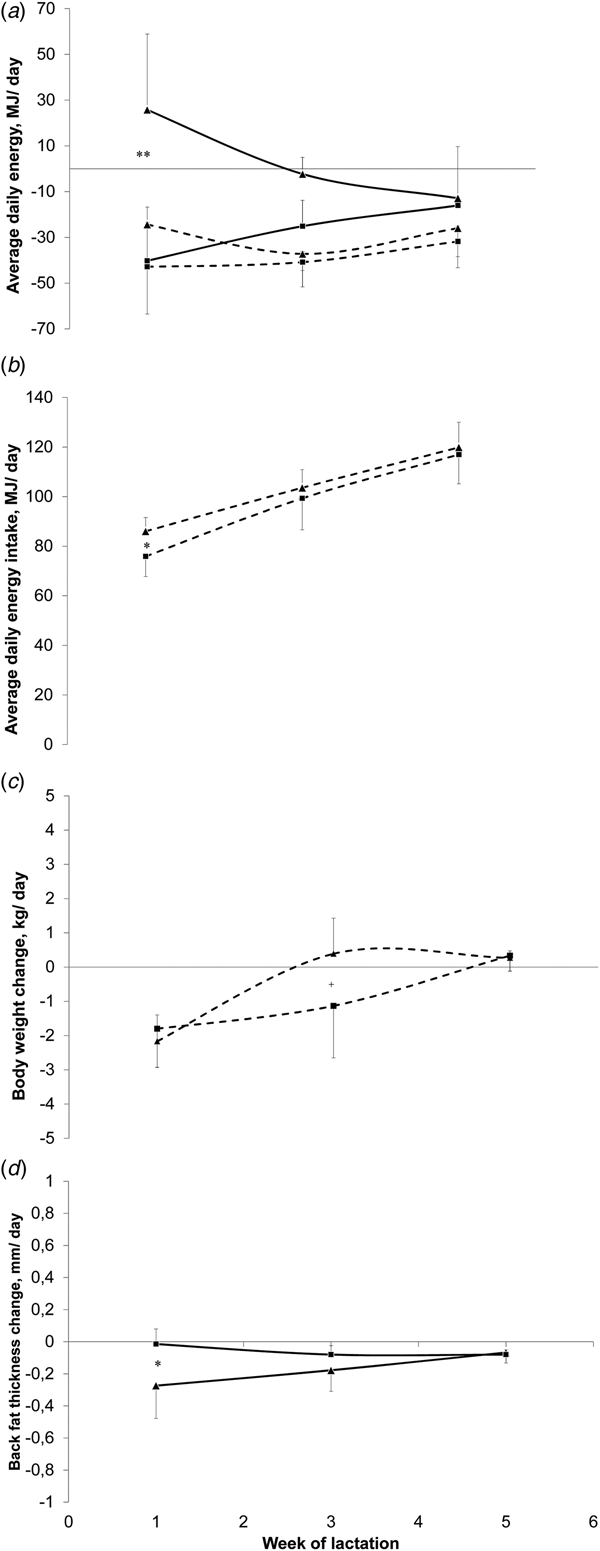
To confirm the relationship between energy availability and de novo synthesised fatty acids, we classified cows into high (n = 6) and low (n = 5) energy utilising animals based on the mean energy utilisation between lactation weeks 1 and 6. The groups differed significantly in energy utilisation, for which they were classified (P = 0.023, Fig. 2a), however, the energy balance was the same in both groups. The milk performance of the first 100 days of lactation was 3296 ± 461 kg and 3422 ± 216 kg for cows in the groups of high- or low-energy utilisation, respectively. Cows with high-energy utilisation had a higher energy intake from feed (P = 0.049, Fig. 2b) and higher back fat thickness changes in weeks 1 and 2 (P < 0.05, Fig. 2d).
(a) Energy balance as the difference between energy intake from feed and requirement for maintenance and milk production (- - -), and energy utilisation as the difference between the sum of energy intake from feed and energy mobilisation from back fat, and the energy requirements for maintenance and milk production (–), (b) energy intake from feed (- - -), (c) body weight (- - -) and (d) back fat thickness changes (–) of cows with high (▴; n = 6) and low energy utilisation (■; n = 5) during lactation period between weeks 1 and 6. Group difference of energy utilisation P = 0.023, group difference of energy intake from feed P = 0.049. ** Means differ between groups at P < 0.01, * means differ between groups at P < 0.05, + means differ between groups at P < 0.1.

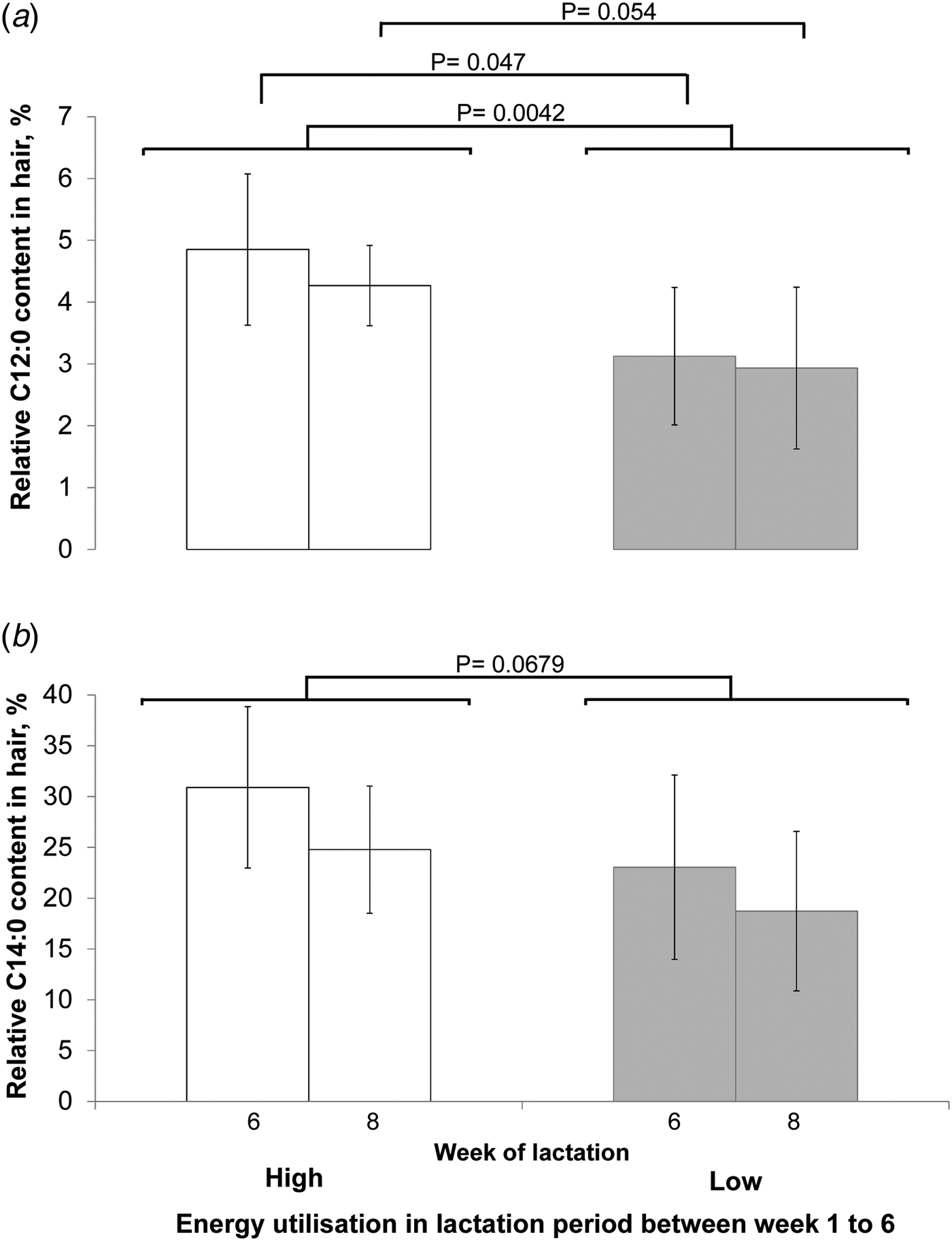
Higher energy intake from feed and high-energy utilisation between lactation weeks 1 and 6 were mirrored in higher proportions of C12:0 and C14:0 in hair lipids in weeks 6 and 8 of lactation. The differences of hair fatty acids in weeks 6 and 8 confirmed positive correlations between energy availability and the de novo synthesised fatty acids C12:0 and C14:0 (Fig. 3a and b). The two animal groups that differed with respect to high- and low-energy utilisation did not differ in their contents of C16:0 in hair, but cows in the group of high-energy utilisation had numerically lower contents of C18:1cis-9 in hair compared to the other group (week 8, 1.8% vs. 2.4%, not significant).
(a) Relative C12:0 and (b) C14:0 content in hair lipid in week 6 and week 8 of cows with high (n = 6) and low (n = 5) energy utilisation in the lactation period between weeks 1 and 6.

Discussion
Our previous study showed that cows with a short interval from calving to conception (<120 d) and high milk protein yield (⩾98 kg) had higher C12:0 contents in their hair in week 8 of lactation compared to cows that did not have such performance. Therefore, the goal of the current pilot study was to test whether the better energy availability in early lactation is responsible for the higher C12:0 contents in hair. Although our study comprised only a small number of individuals and more comprehensive studies are necessary, we could show that C12:0 in the hair is also an indicator of energy availability in lactating primiparous cows in the first weeks of lactation.
Since hair reflects the metabolic status of the previous two to three weeks, this medium is not influenced by diurnal and daily fluctuations. Fatty acid profiles of body tissues offer the chance to assess the metabolic status of an individual in its whole, since fatty acids are not only part of the energy metabolism but also an important source in the hormone synthesis pathways.
C12:0 as well as C14:0 and in part C16:0 belong to the fatty acids that are newly synthesised in ruminants from acetate, propionate and butyrate that are produced by the rumen microbiota. The fatty acids in the hair originate from the diet, from de novo synthesis using short-chain fatty acids, from the rumen fermentation, and from the mobilisation of fatty acids from fat storage depots. Albeit the diet also contains little amounts of C12:0, differences of this fatty acid were identified in hair and indicate energy availability at the beginning of lactation in primiparous cows. In periods of negative energy balance, where fatty acid synthesis receives a very low priority, de novo fatty acids are scarcely stored in the body. In periods of positive energy balance, metabolites of the energy metabolism, like de novo synthesised fatty acids, can be found in the entire body. For this reason, we expected that cows with high amounts of de novo synthesised fatty acids in hair have a better energy utilisation, and thus, are healthier and more efficient with respect to energy expenditure compared to cows with less amounts of de novo synthesised fatty acids in hair (Möller et al. Reference Möller, Nürnberg, Schmitt and Brockmann2013).
In this study, the fat content of hair of week 8 was higher compared to the previous study (1.3 vs. 0.9%, P < 0.01; Möller et al. Reference Möller, Nürnberg, Schmitt and Brockmann2013). The hair fat contents measured in our study are in the range of hair fat contents reported for cattle and sheep (Washburn et al. Reference Washburn, Gilmore and Fechheimer1958; Wertz & Downing, Reference Wertz and Downing1989). Comparing the fatty acid profiles obtained in this study with our previous study, we found similar contents of saturated fatty acids (79% vs. 74%; P = 0.53) and lower contents of polyunsaturated fatty acids in the current study (6% vs. 10%, P = 0.05; Möller et al. Reference Möller, Nürnberg, Schmitt and Brockmann2013). The C12:0 content in hair was 1.8 times higher than in our previous study (3.7% vs. 2.1%, P = 0.001; Möller et al. Reference Möller, Nürnberg, Schmitt and Brockmann2013). This could at least in part result from differences of the energy concentration of the total mixed rations in the two studies (7.2 MJ NEL vs. 6.9 MJ NEL) and suggested the diet composition as influencing factor on the fatty acid profile. The higher energy availability in this experiment accounted for the higher de novo fatty acid synthesis.
Among the environmental factors, feed composition affects the metabolism in the body and as such it also affects the fatty acid amount and composition that is stored in hair. Therefore, cows calving within a short period were chosen and the diet composition was the same across the whole experimental period. Since long term acting additional environmental factors like strong UV light during the summer can also affect the composition of hair lipids (Ji et al. Reference Ji, Park, Lee, Kim, Pi, Jin and Lee2013), hair of all animals was collected under the same condition and a standardised protocol. All cows were of the same breed and had the same hair type. Since environmental effects as well as endogenous factors (hair structure, colour and moulting) could affect the fatty acid profile of hair, such factors have to be recorded and, if significant, be considered in the data analysis.
The hair samples that were collected in weeks 6 and 8 of lactating cows reflect the metabolic states in lactation weeks 3 to 4 and 5 to 6, respectively. Both time points of hair sampling cover the period of highest increase in milk production, lowest feed intake, and highest mobilisation of energy resources. Only after week 6, first parity cows reach a positive energy balance (Coffey et al. Reference Coffey, Slmm and Brotherstone2002, von Leesen et al. Reference von Leesen, Tetens, Stamer, Junge, Thaller and Krattenmacher2014). Therefore, we could expect a negative energy balance for most of the time in our study. In fact, the calculated energy balance was negative over the whole experimental period. In addition to the calculated negative energy balance, the reduction of back fat thickness between calving and lactation week 6 of our cows indicates the expected lipolysis of the adipose tissue in the period of negative energy balance at the beginning of lactation. In our study, the mobilisation of body reserves compensated at least partially the energy deficit during the experimental period, so that the calculated energy utilisation was negative. Nevertheless, cows were still able to synthesise fatty acids and to store them in the hair.
Furthermore, our data show that cows with a better energy balance had a higher energy intake which is in concordance with other studies (Butler & Smith, Reference Butler and Smith1989; Patton et al. Reference Patton, Kenny, McNamara, Mee, O'Mara, Diskin and Murphy2007). Even with the small sample size, the given correlation coefficients were in concordance with other studies, which shows that the correlations mirrors correct relationships. The correlation coefficients between energy intake and body weight for the weeks 2 and 3 and 4 and 5 (0.76 < r < 0.78), for example, are consistent with those given by Spurlock et al. (Reference Spurlock, Dekkers, Fernando, Koltes and Wolc2012), who found genetic correlations of r = 0.74 and r = 0.50 between dry matter intake and body weight in the first and second month of lactation, respectively. The correlation coefficient between body weight and back fat thickness in our study (r = 0.69) was slightly higher than that reported by Spurlock et al. (0.52 < r < 0.61). Furthermore, the correlation coefficients found in our study between energy requirement for milk production and energy balance (−0.91 < r < −0.72) are consistent with other studies at the beginning of lactation (−0.52 < r < −0.20) (Huttmann et al. Reference Huttmann, Stamer, Junge, Thaller and Kalm2009; Buttchereit et al. Reference Buttchereit, Stamer, Junge and Thaller2011). Even if the confidence intervals of our reported correlation coefficients are wide, the data reflect that our animals fit into an average population.
Cows with a higher energy utilisation showed not only higher energy intake from feed but rather higher proportions of C12:0 and C14:0 in hair. If feed intake could not be measured, higher proportions of de novo synthesised fatty acids in hair indicate higher availability of energy and metabolites in metabolism. Even if the energy utilisation is balanced, the reduction of back fat thickness indicates catabolic processes like lipolysis, whereas de novo fatty acids in hair reflect anabolic processes like fatty acid synthesis in the body and indicate energy partitioning towards metabolic processes (Danowski et al. Reference Danowski, Gross, Gellrich, Petri, Van Dorland, Bruckmaier, Reichenbach, Zimmer, Meyer, Schwarz and Kliem2013). Therefore, the C12:0 content in the hair could reflect the robustness of lactating cows, defined as the ability of an animal to minimise the extent and length of negative energy balance (Berry et al. Reference Berry, McParland, Bastin, Wall, Gengler and Soyeurt2013), more reliably. Additionally, the hair fatty acid profile constitutes a direct biological indicator for energy availability that is easily to sample and store. In contrast, the usage of calculations of energy utilisation carries possible errors, because of missing consideration of individual parameters in the calculation of energy intake like selective eating or digestibility of nutrients on the one hand (Kertz, Reference Kertz1998), and accuracy of measurement of back fat thickness on the other hand (Daetz, Reference Daetz2009). A significant relationship between reduction of back fat thickness and energy intake could not be observed since high mobilisation of body fat reduced feed intake and causes metabolic stress (Gross et al. Reference Gross, van Dorland, Bruckmaier and Schwarz2011b; Weber et al. Reference Weber, Hametner, Tuchscherer, Losand, Kanitz, Otten, Singh, Bruckmaier, Becker, Kanitz and Hammon2013). But, cows with low energy intake from feed had higher contents of C16:0 in their hair. In the classification analysis, we could not find a difference between C16:0 contents of cows with high- and low-energy utilisation, whereas C18:1cis-9 was lower in cows with high-energy utilisation. While C16:0 and C18:1cis-9 in milk were identified as indicators for an excess of non-esterified fatty acids from fat mobilisation in the body (Gross et al. Reference Gross, van Dorland, Bruckmaier and Schwarz2011a; Overton et al. Reference Overton, McArt and Nydam2017), we did not find such a relationship neither for C16:0 nor for C18:1cis-9 in hair, which are the main non-esterified fatty acids. For a better understanding of the regulation of fat mobilisation and the fatty acid metabolism during early lactation, further investigations should include measurements of non-esterified fatty acids in the blood in addition to the fatty acid profile in hair.
Conclusion
The results provide for the first time evidence that de novo fatty acids in hair fat, especially C12:0, can be used as a marker to assess energy utilisation which is independent from the mobilisation of energy resources and which mirrors the ability of the body to synthesise fatty acids de novo from energy in metabolism. In conclusion, hair fatty acids could be used as a non-invasive biomarker to evaluate the metabolic status of an individual or an entire herd independently of daytime and short-term animal response. Hair fatty acids, in particular C12:0, were related not only to energy intake from feed but also to energy utilisation. Independently of the level of energy supply, high proportions of de novo synthesised fatty acids in hair indicate high energy availability. Since in this pilot study only a few animals were examined, wide confidence intervals for correlation coefficients between hair fatty acids and parameters of energy availability were found. Therefore, validating studies in larger datasets and in different breeds have to be performed to reliably describe the relationships.
Supplementary material
The supplementary material for this article can be found at https://doi.org/10.1017/S0022029918000791
Acknowledgements
The authors thank the LLFG Zentrum für Tierhaltung und Technik Iden for the animal experiment. We thank Maria Dahm and Birgit Jentz from Leibniz Institute for Farm Animal Biology (FBN) for help with fatty acid extraction and gas chromatography. The project is supported by the German Government's Special Purpose Fund held at Landwirtschaftliche Rentenbank (Project number: 807 799).
Financial support
None.