INTRODUCTION
In remote communities, individual households are often the principal agents of environmental change (Angelsen & Kaimowitz Reference Angelsen and Kaimowitz1999; Gbetnekom Reference Gbetnekom2005). Household actions such as expanding or reducing agricultural lands, changing herd grazing patterns and increasing or decreasing fishing effort can directly influence the conservation of natural resources. As many remote communities become increasingly connected to urban centres through transportation infrastructure, it is important to understand how connection will affect household behaviours and subsequently the natural resource base on which many rural communities depend.
Road construction is a chief development objective amongst lesser-developed countries as a means of reducing poverty and providing essential services (Gibson & Rozelle Reference Gibson and Rozelle2003; Leinbach Reference Leinbach, Leclerc and Hall2007). However, the effects of road building on household actions and the environment, and especially the pathways through which these effects occur, are complex. Studies examining the impact of roads on natural resources do not always distinguish between direct environmental effects (such as constraining wildlife movement) and indirect environmental effects (for example influences on household farming behaviour), although the indirect effects are often more severe (Angelsen & Kaimowitz Reference Angelsen and Kaimowitz1999; Lambin et al. Reference Lambin, Geist and Lepers2003). Indirect pathways that influence household decisions include providing access to markets, encouraging human migration and promoting an influx of new technologies to previously unconnected regions (Xu et al. Reference Xu, Fox, Melick, Fujita, Jintrawet, Jie, Thomas and Weyerhaeuser2006; Kramer et al. Reference Kramer, Urquhart and Schmitt2009). A better understanding of these pathways could provide a framework for addressing what is often perceived as a classic environment versus development debate surrounding road construction.
There is much uncertainty surrounding the effects of market access on household behaviour. Often, infrastructure development reduces transportation times and costs to remote communities and provides greater access to external markets (Nelson & Hellerstein Reference Nelson and Hellerstein1997; Edmonds Reference Edmonds2002). However, road development does not universally lead to increased exports for rural residents. Access to rural areas may increase imports of some goods in lieu of or in addition to exports, with each scenario leading to different household decisions (Shriar Reference Shriar2006; Leinbach Reference Leinbach, Leclerc and Hall2007). Access to new markets often changes prices for natural resource goods along with household behaviours; the direction and magnitude of change is variable and dependent on the specific commodity and the ecological, economic and social context (Baltenweck & Staal Reference Baltenweck and Staal2007).
Depending on how new infrastructure affects market access and price, households will respond in ways that may be environmentally harmful or beneficial. For example, increased proximity to markets has been associated with increased fishing pressure, lower fish biomass and catches of lower trophic level species (Cinner & McClanahan Reference Cinner and McClanahan2006; Brewer et al. Reference Brewer, Cinner, Green and Pandolfi2009). In West Africa, new roads increased imports of wheat to rural communities, which lessened incentives for farmers to grow alternative subsistence crops such as millet, ultimately leading to expanded cotton cultivation (Wagner Reference Wagner1986). Decreased transport costs for rural villages in Indonesia have led to the growth of rubber monocultures (Miyamoto Reference Miyamoto2006). There may also be tradeoffs between different types of natural resources when isolated areas become connected to markets. In studies of Miskito communities in Honduras, Dodds (Reference Dodds1998) noted that increasing access to markets increased lobster exploitation while decreasing agricultural land clearance due to livelihood substitution. Improved transport can also open local markets for previously unexploited species, often with little warning to managers and severe consequences for these species (Berkes et al. Reference Berkes, Hughes, Steneck, Wilson, Bellwood, Crona, Folke, Gunderson, Leslie, Norberg, Nystrom, Olsson, Osterblom, Scheffer and Worm2006).
Increased prices for agricultural products and/or lower prices for agricultural inputs often lead to forest clearing and agricultural expansion amongst farming households (Jacoby Reference Jacoby2000; Gbetnekom Reference Gbetnekom2005). Similarly, price increases for marine products can shift fishers’ attentions to more profitable species (Salas et al. Reference Salas, Sumaila and Pitcher2004). These shifts may have ecological consequences if species yields increase relative to their local abundance. A better understanding of the complex relationships between market access, price changes and environmental effects could provide insights which may mitigate negative environmental outcomes where road development is a priority.
This study focuses on the household behavioural effects of increased market access in communities on the Nicaraguan Atlantic coast and their corresponding implications for lagoon fisheries and rainforests. We address: (1) changes in imports, exports and prices for natural resource goods in coastal communities following new infrastructure connection; and (2) corresponding changes in household behaviour. We examine each of these issues for the fishing and farming sectors, while accounting for temporal and spatial variation in market access.
Most studies that explore the relationship between market access and fishing and farming practices focus on single communities. Others have selected areas where roads have been thought to already have had an effect, ignoring the counter factual which in turn undermines claims of causality. We address these issues by accounting for both spatial and temporal variation; we examine several communities varying in degree of isolation both before and after road completion. As multiple occupations are common in coastal communities (Alison & Ellis Reference Alison and Ellis2001), including analyses of both fishing and farming trends is essential from both a livelihoods and an environmental standpoint. In addition, since context is important in understanding the effects of market access, we consider the study area an important place in which to continue long-term research on decreasing remoteness and environmental change.
Study area
The Atlantic coast of Nicaragua is well known for its geographical and cultural isolation from the rest of Central America. The environmental importance of the region, the historic isolation of Atlantic coastal communities and their reliance on natural resources make this region particularly well suited to examining the extent and environmental consequences of market integration due to recent road development.
The area known as the Atlantic Coast of Nicaragua encompasses about 50% of the land area of Nicaragua, from the central mountain regions eastward to the Caribbean Sea (Sollis Reference Sollis1989). The Atlantic coastal region is lower in elevation and tends to be warmer and wetter than the western half of the country; it is also rich in natural resources and includes varied terrestrial ecosystems (mangrove forests, pine savannahs and tropical lowland rainforest) and marine ecosystems (lagoons/estuaries, reefs and turtlegrass flats), all of which contribute to the region's high biodiversity (Weaver et al. Reference Weaver, Lombardo and Martinez-Sanchez2003). These ecosystems are commercially as well as ecologically important, with marine environments housing fish, shrimp and spiny lobster (Panulirus argus). The Pearl Keys, a series of small islands east of the Pearl Lagoon estuary, host nesting populations of hawksbill turtles (Eretmochelys imbricata). Owing in part to the historical isolation of the coastal communities, many of these natural resources remain relatively intact (Jameson et al. Reference Jameson, Trott, Marshall, Childress and Sheppard2000), although local community leaders claim fish and wild animal populations are declining (Hostetler Reference Hostetler, Christie, Bradford, Garth, Gonzalez, Hostetler, Morales, Rigby, Simmons, Tinkham, Vega, Vernooy and White2000).
In addition to geographical barriers, the eastern and western parts of Nicaragua are culturally distinct, with most indigenous and English-speaking Creole communities located on the Atlantic coast and the majority Spanish-speaking ‘Mestizo’ populations located in the western cities (Sollis Reference Sollis1989). There are six principal ethnic groups that populate the Atlantic coast, namely Miskitu, Sumu, Rama, Garífuna, Creole and Mestizo. In 1987, an autonomy statute increased political participation of indigenous and Creole people and divided the Atlantic coast into two semi-autonomous regions, the Región Autónoma Atlántica del Norte (RAAN) and the Región Autónoma Atlántica del Sur (RAAS). This has also led to substantial re-organization of the governance structure in these areas.
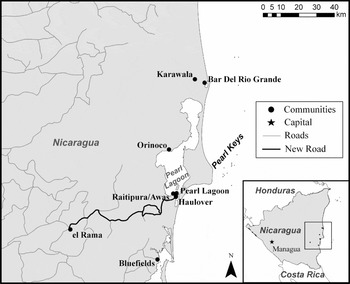
This study focuses on a subset of RAAS communities within the Pearl Lagoon and the Desembocadura de la Cruz de RioGrande municipios (provinces), which vary in distance from a newly completed road running from the riverport city of el Rama to the town of Pearl Lagoon (Fig. 1). Construction of the trans-isthmian highway connecting Pearl Lagoon to Managua began in 2005 and was completed in autumn 2007. Portions of the road were first passable during the previous dry season (January–April 2007), but road transport was infrequent until the completion of the final segments. Future regional development plans include further road projects and the construction of a deep-water port.
Map of study communities and road infrastructure.

During the past two decades, most commercial activity in the RAAS has been centred around the regional capital of Bluefields, which is connected by river networks to the town of el Rama and then by roads to the western half of the country. Residents of the coastal communities make a living mainly from fishing, farming, wage labour and small-scale commercial activity, often participating in several of these activities. Most artisanal fishers on the coast are multi-species fishers, and fishing effort depends on the time of year, abundance of the target organism and access to gear, among other factors. Many fisheries products, such as lagoon fish and white shrimp (Litopenaeus schmitti), have historically travelled through middlemen to processing plants in Bluefields or have been sold for local consumption. The exception is spiny lobster, which are sold to companies based in the east via lobster-buying middlemen on the Pearl Keys. Agriculture in the Pearl Lagoon basin is practised both for subsistence and small-scale commercial purposes, with most produce sold in Pearl Lagoon (IREMADES [Instituto de Recoursos Naturales, Medio Ambiente, y Desarollo Sostenible] & URUCCAN [Universidad de las Regiones Autónomas de la Costa Caribe Nicaragüense] 2007). Most farms are multi-species agroforestry systems, with a variety of root crops (such as cassava and dachin), basic grains (corn) and tree crops (for example coconut, plantain and oranges) grown on the same farm.
Road connection between the city of el Rama and the town of Pearl Lagoon could dramatically increase market access for fisheries and agricultural products, especially where products have been previously shipped through Bluefields and along the lengthy river-bus routes to Managua. Improved market access and associated household decisions may have profound implications for coastal residents’ natural resource base.
METHODS
Community selection and sampling
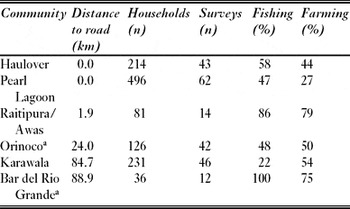
Six communities (Table 1) falling along a continuum of proximity to markets were selected for the study, namely Pearl Lagoon, Haulover, Raitipura/Awas, Orinoco, Karawala and Bar del Rio Grande. Pearl Lagoon, Haulover and Raitipura/Awas were newly connected by road to the capital of Managua during the time period of the study. The northern communities of Orinoco and Karawala/Bar del Rio Grande are located approximately 40 minutes (24 km) and 2.5 hours (85 km), respectively, by high-speed boat from the new road. These times are considerably longer for larger transportation and shipping boats (Fig. 1).
Study community characteristics (Ministerio de Salud, RAAS 2006; IREMADES & URUCCAN 2007). Fishing and farming refer to the percentage of surveyed households engaged in each activity, by community. Distances to road were measured in 2008, after road completion. aCommunities sampled only in 2008.

To examine temporal variation, we collected data during two field seasons, namely June–August 2007 (before the road into Pearl Lagoon was fully completed or frequently travelled, but after it was functionally passable during dry weather) and May–August 2008 (after the road had been established in Pearl Lagoon for eight months). We only visited the communities of Orinoco and Bar del Rio Grande in 2008. Community selection was not random; criteria used to select communities included similarities in size and economic activities employed, as well as varying access to the new road.
We used household surveys to compare fishing and farming activities within and between communities (Appendix 1, see Supplementary material at URL http://www.ncl.ac.uk/icef/EC_Supplement.htm). We questioned households about prices received for natural resource goods, sales outlets and how specific fisheries and agricultural products ranked as contributors to household income. We also collected data on household practices, including land cultivation and fishing investments in time and gear. Although we did not measure environmental change directly, we anticipated that such investments have environmental consequences via increasing land clearance or shifting fishing effort from one species to another. To capture variation between years, as opposed to variation among households within a community, we interviewed the same households in 2007 and 2008. We developed and pre-tested surveys during the 2007 field season. In total, we surveyed 165 households in 2007 and 223 in 2008.
Depending on the community, we employed either random or systematic sampling. We assumed variance from both sampling methods to be the same (Henry Reference Henry1990). In Pearl Lagoon and Raitipura/Awas, we used a census of adult residents from a 2006 community socioeconomic study (IREMADES & URUCCAN 2007) to randomly select sample households. We rejected selected respondents if they were no longer living in Pearl Lagoon, if they were living in the same household as another survey respondent or if, after repeated attempts, we did not find the person. For communities with no existing census (Haulover, Orinoco, Karawala and Bar del Rio Grande), we used a systematic sampling scheme where surveys were conducted with every nth house determined by dividing the number of households in a community by the desired number of surveys (Cinner Reference Cinner2005). The number of surveys per community ranged from 12 to 62, depending on the population of the community.
Kristen Schmitt conducted the surveys, assisted by two trained research assistants from the coastal communities. Surveys were completed with any selected adult member with knowledge of the economic activities of that household. More than one person was permitted to answer survey questions when the interviewee had limited knowledge and another member of the household could provide more detail on fishing and farming-specific questions. Owing to the low proportion of fishing and farming households in Pearl Lagoon, it was necessary to sample more fishers and farmers than a random sample yielded. Using the 2006 socioeconomic study, individuals were randomly selected from all those who listed fishing or farming as an occupation. In addition, separate surveys were conducted with business owners who worked as middlemen for fisheries transactions (known as acopiadores).
The provincial government office provided data on fisheries sales, which we used to assess changes in the volume of products travelling via different market pathways (data collected by X. Gordon, Alcaldia Municipal, Laguna de Perlas, 2007, 2008).
Analysis
Our analyses focused on spatial and temporal changes in market outlets, price and household fishing and agricultural practices in our study communities. Analyses were all performed in R (R Development Core Team 2008), and results were considered significant at the p = 0.10 level.
Fisheries: market outlets, temporal variation
We considered changes in principal sales outlets for white shrimp (Litopenaeus schmitti) and high-quality fish (intended for sales rather than home consumption) between 2007 and 2008 using Pearson's chi-squared test. We predicted that fishers would shift their selling to buyers using road transportation due to increased buyer availability and price incentives. We examined records of fisheries receipts from 2007 and 2008 for exports of newly exploited fisheries products and for shifts in how common commercial products (such as shrimp), were leaving the community. We supplemented these receipts with data on fishing activities from our household surveys.
Fisheries: price, spatial variation
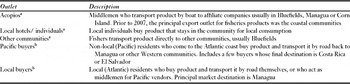
We examined the effect of households’ proximity to road and primary (most frequently used) and secondary market outlets on the price received for shrimp and high-quality fish using a general linear model. Although many factors could potentially contribute to price differences, we focused on these descriptors to explore market access and its relationship to price change. We predicted that prices received by fishers would be greater for communities with greater road access and therefore access to markets with greater demand (Baltenweck & Staal Reference Baltenweck and Staal2007). We also predicted that preferentially selling to buyers using road transport would increase prices received for products, since these buyers incurred lower transport costs. We performed separate regressions for both fish and shrimp for 2007 and 2008 to avoid using non-independent samples (i.e. the same households) in the same model. Strong markets for each product exist in the capital Managua. We adopted distance to the road as a good proxy for market access since time-to-market on the coast was highly correlated with distance. We controlled for distance in the linear model while assessing the effects of individual market outlets, since distance influenced the prevalence of outlets, such as Pacific buyers (Table 2). Diagnostic plots from the shrimp price models showed no evidence of heteroscedasticity and residuals were approximately normally distributed. Diagnostics for the fish price models were also acceptable after we removed one point of undue influence (Cook's distance > 0.5).
Principal market outlets for fisheries products, as reported by fishers in the Pearl Lagoon basin. aOutlets are independent of the new road. bOutlets are dependent on road.

Fisheries: price, temporal variation
We assessed differences in the mean price of white shrimp between 2007 and 2008 using paired data (i.e. same households) with Wilcoxan signed rank-sum tests, owing to the non-normal distribution of data. We examined the variation in the price distribution of shrimp for each year using an F test for variance.
Fisheries: household practices, spatial and temporal variation
We investigated variation in the ownership of fishing gear owing to distance to road using a series of general linear models for each gear type. We examined differences in the type and amount of fishing gear owned by the same household in 2007 and 2008 using paired t-tests. We checked survey data on relative time spent fishing in 2008 compared to 2007 for trends.
Agriculture: market outlets, temporal variation
We collected data on the number of households using agricultural goods for household consumption, local sales and export to other communities to observe temporal trends.
Agriculture: price, spatial and temporal variation
We examined the effect of distance to road on agricultural prices using general linear models similar to those described for fisheries prices and assessed changes in price from 2007–2008 using paired t-tests.
Agriculture: household practices, spatial variation
We examined the effect of distance to road on intensity of land use (ratio of land farmed/owned) using a general linear model. We used other agricultural statistics as baseline data.
RESULTS
Fisheries
Market outlets: temporal variation
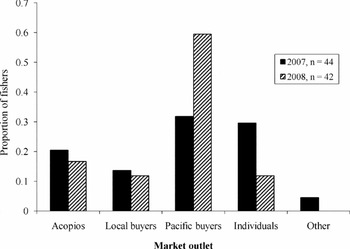
Among the six communities (Table 1), 47% (n = 78) of households interviewed in 2007 and 50% (n = 112) in 2008 were engaged in fishing as an income earning activity. Within the fisheries sector, the white shrimp (L. schmitti) market showed the most substantial changes in market flow. High-quality fish markets showed minor changes that will not be presented here. In 2008, the proportion of fishers selling shrimp primarily to Pacific buyers increased from 32% in 2007 to 60% in 2008, while those selling primarily to local individuals decreased from 30% in 2007 to 12% in 2008 (Pearson's chi squared test, χ2 = 6.99, df = 3, p = 0.07; Fig. 2).
Principal market outlets for white shrimp (L. schmitti) among survey respondents in the communities with new road access (Pearl Lagoon, Haulover and Raitipura/Awas). More shrimp went to Pacific buyers in 2008, as opposed to staying in the community.

In addition to changes in the shrimp market, new or re-emerging markets for fisheries products were evident (Table 3). One example is the market for Blue crab (Callinectes sapidus). Although crab was exploited in the area prior to a processing plant closure in 2002, only two fishers in our road-accessible communities reported selling crab in 2007, each selling to local markets. In 2008, 18 fishers among the road accessible communities sold crab; 39% of these sold to vendors with road transport (Table 3).
Emerging markets for seafood products within Pearl Lagoon, Haulover and Raitipura/Awas. Percentages represent the portion of total product transported through each avenue (acopio = MarCaribe acopio) during 2007 and 2008. 1Data taken from receipts collected by fisheries inspector. 2Data taken from surveys with fishers.

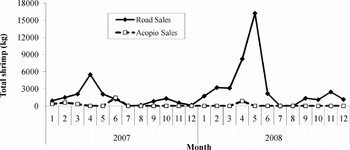
Looking at aggregate data from sales receipts collected in Pearl Lagoon, we saw an obvious change in the method by which shrimp left the community and in the volume of exported product (40 750 kg in 2008 versus 16 131 kg in 2007; Fig. 3). Since the road was not passable before 2007, all shrimp sales via road represent a shift in export flow. Fish sales were still conducted primarily through the acopios (seafood collection facilities), however receipts showed that fish sales by road were also beginning to increase.
Weight (kg) of shrimp (mostly L. schmitti) sold each month in Pearl Lagoon in 2007 and 2008. The dotted line represents acopios sales and the solid line represents road-transported shrimp. Peak shrimp season is January–May (data collected by X. Gordon, Alcaldia Municipal, Laguna de Perlas, 2007, 2008).

Price: spatial variation
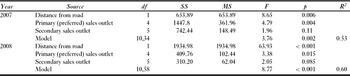
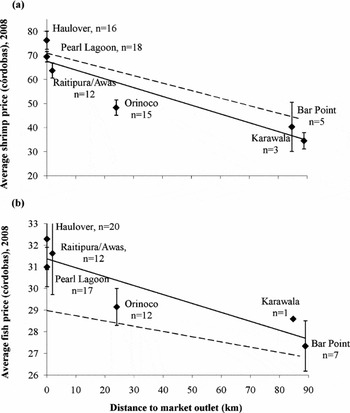
Our general linear model describing the price received for shrimp explained 53% of the variation in the 2007 shrimp price and 60% of the variation in 2008 (Table 4). The average price that fishers received per kilogram of shrimp amongst all surveyed communities was 69.5 ± 24.4 córdobas in 2007 and 61.6 ± 17.7 córdobas in 2008 (US$ 1 = 19.4 córdobas, July 2008). As distance from the road increased by one kilometre, the average price that fishers received for shrimp decreased by 0.26 ± 0.13 córdobas kg−1 in 2007 and 0.40 ± 0.07 córdobas kg−1 in 2008 (Fig. 4a). A comparison of prices for 2007 and 2008 suggests that as market access increased over time, this relationship became slightly stronger, though not significantly so (Fig. 4a). The negative distance-price relationship also holds for high-quality fish, however the relationship, although significant, is not as strong as that for shrimp. Fish price decreased by 0.026 ± 0.013 córdobas kg−1 km−1 from road in 2007 and 0.04 ± 0.02 córdobas kg−1 km−1 in 2008; distance combined with primary market outlet explains a smaller amount of variation in fish price (R2 = 0.23, Fig. 4b).
General linear model results explaining variation in shrimp prices. For each km closer to the road, prices increased by 0.26 ± 0.13 córdobas kg−1 in 2007 and 0.40 ± 0.07 córdobas kg−1 in 2008.

Average price per kg that fishers received in 2008 for (a) white shrimp (L. schmitti) and (b) high-quality fish decreased in communities further from the road (solid line = 2008; dotted line = 2007 equivalent).

Although distance was the most important predictor of average shrimp price, household choice of market outlet also had a significant influence (Table 4). Primary (most frequently used) market outlet was a significant predictor of price for both years. Two specific market outlets (Table 2) contributed to the overall significance of primary market in our model. In both years, fishers selling locally to individuals, when compared to a reference category of Pacific buyers, received a lower price per kilogram of shrimp (2007: β = −35.6 ± 8.1 córdobas, t = −4.3, p <0.001 and 2008: β = −12.7 ± 6.9 córdobas, t = −1.82, p = 0.07). As hypothesized, in 2008, fishers were receiving less per kilogram of shrimp from local acopios than from Pacific buyers, (β = −9.4 ± 4.3 córdobas, t = −2.17, p = 0.03). Choice of primary market outlet also had a significant effect on fish prices; fishers selling to road exporters received higher prices per kg both from local vendors (β = 8.8 ± 2.6 córdobas, t = 3.4, p = 0.001) and Pacific buyers (β = 3.6 ± 1.7 córdobas, t = 2.17, p = 0.03) when compared with local acopios. The price effects of specific sales outlets in our model reflect the influence of the road itself, since outlets such as Pacific buyers are a direct consequence of the road (Table 2).
Price: temporal variation
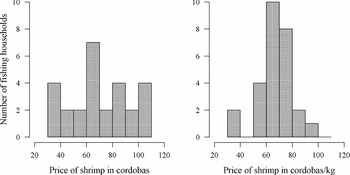
Comparing the same households between 2007 and 2008 in all communities, the mean price received by fishers per kilogram of shrimp was unchanged (mean 2007 = 68.6 córdobas kg−1, mean 2008 = 66.9 córdobas kg−1; Wilcoxan signed rank sum test, V = 108.5, p = 0.38). However, the variance in the average price received decreased between years (variance test, F26, 26 = 3.15, p = 0.005; Fig. 5a, b). The coefficient of variation in price received from Pacific buyers as the primary market outlet was 17%, compared with 33% for acopios, 29% for local buyers and 27% for individuals.
Variance in average price received per kg of shrimp in (a) 2007 and (b) 2008. The same households were questioned in both years (n = 27).

Household behaviour: spatial and temporal variation
Changes in market flow and pricing did not result in significant changes in fisher gear investments. Distance from road was a poor predictor of the amount of gear possessed by a household in 2008. The number of shrimping cast nets owned per household decreased with distance from road and was the only gear type that showed a significant relationship with distance (β = −0.01 ± 0.003, t = −2.94, p = 0.004), however distance only explained 10% of the variation in cast nets per household (F1, 81, p = 0.004). Fishers reported owning 11% more boats and 42% more lobster traps in 2008 compared with 2007, showing a general increase in gear investment (boats: t = 1.75, df = 82, p = 0.08, traps: t = 2.27, df = 87, p = 0.025). If we restrict the 2007–2008 comparison to road-accessible communities where we might expect higher fish and shrimp prices to spark higher investments in gear, the amount of boats owned does not change (t = −0.37, df = 30, p = 0.71). Gill net ownership decreased by 19% between 2007 and 2008 (t = −2.27, df = 87, p = 0.03), reportedly owing to theft. There were no clear trends in time allocated to fishing effort between 2007 and 2008 (Appendix 2, see Supplementary material at URL http://www.ncl.ac.uk/icef/EC_Supplement.htm).
Agriculture
Market outlets: temporal variation
Among surveyed households, 34% (n = 56) were engaged in farming in 2007 and 47% (n = 104) in 2008 (including four households from Pearl Lagoon specifically selected for farming activity). Though farming is not considered a lucrative profession in Atlantic coastal communities, 16.4% (n = 27) of households interviewed in 2007 and 17% (n = 38) in 2008 considered farming their most important source of income.
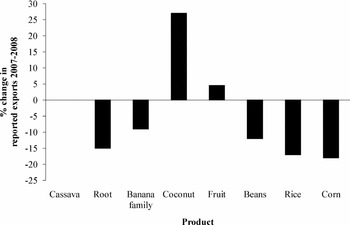
The percentage of households allocating produce to specific final destinations (household consumption, local markets and export markets) underwent minor changes between 2007 and 2008. In general, there was an increase in the percentage of farmers selling produce locally in 2008 (Appendix 3, see Supplementary material at URL http://www.ncl.ac.uk/icef/EC_Supplement.htm). Coconut was the only product that was increasingly exported when the same households were compared between years (Fig. 6). Households exporting other products, such as rice, beans and corn, declined between 2007 and 2008.
Relative change in % of farmers who sold product to an export market (often in conjunction with local markets and home consumption) in 2008 compared to 2007. Coconut sales show a strong increase owing to a single buyer from Managua.

Price: spatial and temporal variation
Agricultural prices showed different patterns of spatial variation (i.e. positive, negative and no relationship with distance) depending on the crop. For example in 2008, coconut price increased with distance from the road, (0.02 ± 0.01 córdobas unit−1 km−1, R2 = 0.52, p < 0.001) cassava price decreased (−0.02 ± 0.009 córdobas kg−1 km−1, R2 = 0.1, p = 0.04) and beans showed no significant relationship (−0.02 ± 0.04 córdobas kg−1 km−1, R2 = 0.04, p = 0.38). All of these products are common components of local diets. There was an increase in food prices between 2007 and 2008 for all agricultural products except for coconut, likely related to global increases in food prices at this time.
Household behaviour: spatial and temporal variation
Household farming decisions can include allocation of land use, land clearance decisions and choice of inputs. Fifty-eight per cent of farming households (n = 60) inherited their land from a parent or family member and 41% of households (n = 43) reported having to clear new land for their farm. Clearing new land for farms was more common in communities further from the road. In Karawala, Orinoco and Bar del Rio Grande, 58% of respondents reported having cleared new land for their farms as opposed to 23% in our road-accessible communities. As of 2008, the ratio of land cultivated to total land owned or used, a proxy for the intensity of land use, showed no relationship with distance from the road (R2 = 0.02, F1,77 = 1.044, p = 0.23). This ratio ranged from an average of 0.23 cultivated/owned hectares in Karawala to 0.75 in Bar del Rio Grande.
Of the 104 farming households interviewed in 2008, 8.7% (n = 9) reported using pesticides or chemical fertilizers, and 3.9% (n = 4) reported using mechanized equipment, all chainsaws, suggesting relatively low-intensity farming. No clear spatial patterns were observed for farm input use. Sixty-seven per cent of households (n = 70) reported engaging in crop rotation, with some land left fallow for a period of time. The average length of fallow practised in households who reported a specific time period was 2.85 years. As of 2008, just 9.6% of farmers ranked cattle as one of their most important agricultural products, and most farmers had a low density of cattle given their farm size (between 0.25 and 0.58 cows ha−1 of pasture land).
DISCUSSION
Fisheries
Market outlets and price
As noted earlier, although the road became seasonally passable before our first field season, local residents reported limited vehicular traffic before its full completion. Thus, we have some confidence framing our observations as occurring pre- and post-road completion. Analysing these trends may help to clarify complex and indirect pathways by which roads impact the environment, although further study will be needed to confirm many of our results.
As anticipated, more direct access to large markets for seafood in the capital and western Nicaragua changed market dynamics on the Atlantic coast by increasing the number of market outlets and buyers available to fishers. Many fishers altered where they were selling their product in response to incentives that may have included price and convenience (Fig. 2). The road was used increasingly for seafood exports, however in our one year of study there were some surprising increases in the overall export volume of some products, such as white shrimp (L. schmitti). The volume of shrimp exported by road in 2008 greatly exceeded that during 2007, while sales via local acopios decreased only slightly in 2008, suggesting that product leaving by road is not simply replacing product sold through the acopios (Fig. 3). The total amount of shrimp exported from the community may be greater than these numbers imply, as underreporting to avoid a 1% tax on catch value is allegedly common in the road transport permit system (X. Gordon, Alcaldia Municipal, Laguna de Perlas, personal communication 2008). Our data suggest that these short-term increases in shrimp export are not owing to increasing use of more efficient gear or an overall increase in current fishers’ time spent fishing. Instead, new fishers may be entering the market (from inside or outside the community), or a small number of fishers could be spending substantially more time exploiting shrimp. Additionally, interviews suggested that decreased local consumption of shrimp and decreased spoilage/waste may be related to increased exports. The majority of fishers in both Orinoco and Pearl Lagoon also indicated that 2008 was a good year for shrimp compared to 2007, so export increases may be partially explained by natural cycles.
Given commonly sold species in the larger more accessible town of Bluefields, we expected that markets for species such as blue crab (Callinectes sapidus) and oyster may emerge with increasing market access, changing incentives for fishing these species. We saw some evidence of this for blue crab, which was rarely sold in our study communities in 2007, but rather fished for home consumption. Plans are currently in progress to re-open a local crab processing plant which ended operations in 2002. This re-opening is linked to the new ability to rapidly transport refrigerated product to Managua (D. Taylor, MarCaribe, personal communication 2008). We also noted increases in 2008 for overall exports of sea cucumber (Holothuria mexicana and other species) and ray (Dasyatis guttata and other species) (Table 3). Long-term monitoring may clarify whether the new road or increasing national demand drove these increases. Epinephelus itjara represents a critically endangered species (IUCN [World Conservation Union] 2008) and may be informative in observing environmental impacts of new markets (Table 3).
Better access to seafood markets among newly road-accessible communities probably influenced prices for these products, given the positive relationships between market proximity and prices received for shrimp and high quality fish (Fig. 4a, b). For all of the study communities, distance to road is equivalent, relatively, to distance to Bluefields, the largest market in the RAAS, located south of the study communities (Fig. 1). It is possible that this market, as opposed to the road itself, could be driving the price-distance relationship. Future monitoring of changes in the magnitude of the price-distance relationship should clarify if the road is a causal factor. Given the similarities between our study communities in size and economic activities, market proximity is the most likely explanation for this relationship.
In addition to market proximity, household decisions to use specific sales outlets also influenced prices received for fisheries goods. Sales to local markets were less profitable for fishers and consequently fishers’ preferences shifted away from local sales outlets (Fig. 2). There was also a difference in price between specific types of export markets; in 2008, fishers generally received less money for shrimp and fish from local acopios than from Pacific buyers, most likely owing to higher transport costs for acopios. This price difference contributes to the overall effect of primary sales outlet on fish and shrimp prices in our models, and demonstrates a price increase related directly to road transport.
The permanency and consistency of these price trends for all fishers are unclear. In 2008, individual fishers in the Pearl Lagoon area reported receiving both higher and lower prices from Pacific buyers. However, for white shrimp, fishers received more consistent prices in 2008 than in 2007 (Fig. 5a, b). Price stabilization is expected in maturing markets, and is particularly important from a livelihoods perspective, as wages from small-scale fisheries are inherently variable (Allison & Ellis Reference Alison and Ellis2001). In 2008, the coefficient of variation in price received from Pacific buyers was less than for all other market outlets. There were other advantages in selling directly to Pacific buyers, including increased availability of buyers at all hours and a decreased risk of spoilage because of buyers’ access to ice and coolers. All of these factors serve to decrease risks for individual fishers and help to explain the shift in primary sales outlets towards Pacific buyers. In spite these factors, fishers may continue to sell to acopios because of specific types of credit they provide; acopios will often lend fuel, gear and occasionally money to fishers in return for a guaranteed opportunity to buy their catch. This type of lending depends heavily on the individual relationships between the fisher and the acopio.
Household practices
We expected that increased market access and/or price may affect household fishing practices, which could translate directly to environmental change by increasing or decreasing species yields relative to abundance. As most fishers are involved in more than one fishery, changes in gear ownership could indicate shifting effort from one fishery to another. In our study however, changes in gear or time investments were not apparent among fishers on the Atlantic coast. Investments of time or equipment may lag behind increased profits or perceived importance of species, especially amongst risk-averse individuals or households (Scott Reference Scott1976). A lack of access to the credit required to purchase more gear may have the same effect. During interviews, fishers often cited the need for gear as a limiting factor in increasing their fishing time.
Environmental implications
Although, in our study, communities’ market changes were evident, we did not observe behavioural changes and therefore the environmental implications of the road remain uncertain. We anticipate that enhanced market access will translate to future changes in fisher practices, including an increase in the exploitation of more lucrative or high-demand species (Brewer et al. Reference Brewer, Cinner, Green and Pandolfi2009). There is an abundance of anecdotal information on declining finfish populations in Pearl Lagoon dating back to the late 1990s, as noted by smaller catch sizes and fisher reports of increased effort, gear and travel distance required for catching the same amount of product (Hostetler Reference Hostetler, Christie, Bradford, Garth, Gonzalez, Hostetler, Morales, Rigby, Simmons, Tinkham, Vega, Vernooy and White2000, A. Downs, personal communication 2008). However, biological data from Pearl Lagoon is patchy, and accurate abundance of most organisms is unknown. Few current stock assessments or maximum sustainable yield estimates exist; it is possible that some fisheries could sustain increases in exploitation. Studies of white shrimp (L. schmitti) fished in the western Atlantic with a combination of industrial trawling and artisanal fishing showed no firm evidence of biological overexploitation of L. schmitti populations as of 2000 (FIRMS [Fisheries Resources Monitoring System] 2005). Increases in shrimp exports and buyers may potentially provide livelihood improvements while causing little danger to shrimp populations or associated food webs in the lagoon, however a recent study indicated concern over increasing shrimp scarcity in Pearl Lagoon (Gonzales-Colindres Reference Gonzalez-Colindres2006). Blue crab (C. sapidus) were more heavily exploited before 2002 when the local crab processing plant was functional, and may also be able to sustain increases in 2008 levels of exploitation.
The shifting patterns we observed in market flow could potentially benefit currently overexploited species. If the shrimp market becomes more profitable due to improved market access, some of the fishing effort in the area could shift towards shrimp and away from heavily exploited fish or lobster species (Appendix 4, see Supplementary material at URL http://www.ncl.ac.uk/icef/EC_Supplement.htm). However, seasonality of the fisheries may preclude replacing finfishing with shrimp fishing.
Agriculture
Market outlets and price
Agricultural product trends differed from those observed for seafood. As of 2008, there was no consistent evidence of shifting export markets for agricultural goods and no clear relationship between product price and distance to market. Rather than increasing exports, the road has provided a route for imported agricultural goods and meats from the Pacific, a trend seen elsewhere in the developing world (Shriar Reference Shriar2006; Leinbach Reference Leinbach, Leclerc and Hall2007). Only coconut exports from the Atlantic coast increased, owing to the presence of one buyer from Managua (Fig. 6). There was a general decrease in the number of households selling other products, such as basic grains, to export markets. This could be due to higher food prices in 2008, which may have provided incentives to use more crops for household or local consumption rather than commercial sales (Fafchamps Reference Fafchamps1992). Heavy rains in the northern communities also destroyed much of the rice crop in 2008. Finally, transport costs are perhaps still too high to make the export of agricultural goods profitable, and local prices offered for produce are usually higher than prices offered from Pacific consumers. Difficulty in establishing the proportion of the household's agricultural produce going for export versus local consumption may also be disguising some patterns of change.
Household practices
Although we did not observe changes in market structure and price in the agricultural sector, such changes may occur in the future, influencing behaviour and environmental outcomes. Increased road access may be expected to promote forest clearance through better incentives for agricultural expansion (Pfaff et al. Reference Pfaff, Robalino, Walker, Aldrich, Caldas, Reis, Perz, Bohrer, Arima, Laurance and Kirby2007). However we observed higher, land clearance for initial farm setup in the more remote communities in our study area. This is likely due to the higher availability of forested land in the more remote northern areas and the availability of a higher proportion of previously disturbed land to the south, necessitating less new clearing. We found no relationship between distance to market and the ratio of land farmed to owned, an indication of land-use intensity in a system where crop rotation is traditional (Dodds Reference Dodds1998). Other indications of low-intensity land-use practices amongst all study communities in 2008 include low numbers of cattle farmers (a profitable product often leading to substantial land clearance), low cattle density, few agricultural inputs and frequent use of a fallow system. Although there are strong correlations in the literature between road building, forest clearance for agriculture and farming intensity (Pfaff et al. Reference Pfaff, Robalino, Walker, Aldrich, Caldas, Reis, Perz, Bohrer, Arima, Laurance and Kirby2007), these relationships may at times be driven by a pathway other than market access, for example immigration to previously remote areas. Community leaders expressed persistent concern over Mestizo settlements encroaching from the west, so future study may reveal clarification of the effect of market access versus immigration on forests.
CONCLUSIONS
The effects of roads on market access and price are often uncertain and therefore limit full understanding of the influences of road development on household behaviour and natural resource use. Our research profiles changing market dynamics and price-access relationships in previously remote communities on Nicaragua's Atlantic coast and provides a baseline for future studies on market access and household behaviour in this socioecological system. Substantial biological monitoring is needed to determine the environmental consequences of market access and the sustainable use of local fisheries and rainforests. Observed changes in fisheries exports and targeted organisms could be expected to affect species populations, however reliable estimates of organism abundance are needed to draw conclusions. Roadways also open potential routes for the transport of prohibited fisheries goods, such as undersized shrimp and lobster. Conversations with fisheries officials suggest that this is likely to become a problem in Pearl Lagoon without increased enforcement, making further monitoring of these trends vital.
Although we did not observe substantial short-term changes to agricultural markets and prices with increased access, such changes have been reported by other studies. On-going monitoring of farming practices that have environmental impacts is critical as market connections to the Atlantic coast of Nicaragua increase. Environmental consequences of changing farming practices in this region could include increased deforestation, increased chemical inputs, less emphasis on agroforestry/tree-cropping and increased soil erosion (Wagner Reference Wagner1986). Increased immigration to the area may cause land cover changes without corresponding changes in local household farming practices. While here we often discuss fisheries and agriculture separately for clarity, many households regularly engage in both activities. Changes in one sector are therefore likely to impact resource use in the other sector.
Since many rural communities, development organizations and governments are now promoting better connection and access to markets (Blöndal Reference Blöndal2007), understanding how to avoid the development-environment conflict is important. With a fuller appreciation of how market connection influences household behaviour on Nicaragua's Atlantic coast, planning measures such as pre- and post-road biological monitoring and systems to accurately monitor and regulate fisheries exports can accompany infrastructure projects, to address environmental concerns before they become threats to local biodiversity and livelihoods.
ACKNOWLEDGEMENTS
We thank the people and leaders of the coastal communities for allowing this research and assisting us by donating time and information. Thanks to Xenia Gordon at the Pearl Lagoon Alcaldia for her willingness to share data, and to Jenni van Ravensway for her assistance with creating maps. This research was supported by the Tinker foundation, the Surfrider foundation and National Science Foundation's Coupled Natural and Human Systems Program (CNH-0815966). We thank three anonymous reviewers for their insightful comments.