INTRODUCTION
This project draws on evidence and insights from psychological and sociological social psychology in an attempt to understand policy views about immigration held by non-Hispanic White Americans.Footnote 1 To begin, we will see whether interpersonal contact between Anglos and Latinos has the kind of liberalizing impact on Anglos’ policy views often shown when prejudice is under scrutiny.Footnote 2 But sociological considerations impel us to test an important, more complicated hypothesis when policy views are the outcome of interest. Fellow feeling encouraged by interpersonal contact may not be sufficient to evoke progressive policy views about immigration. Exposure to information about the disadvantages faced by Latino immigrants may be necessary as well in shaping non-Hispanic Whites’ support for policy remedies. Assessing evidence of this interaction is the central purpose of our research.
Immigration Policy Debates
Immigration is changing the face of America in the twenty-first century. Roughly one eighth of the current U.S. population was born outside this country; almost one-quarter of U.S. residents are first- or second-generation immigrants (Portes Reference Portes2007). The prominence of debates about immigrant and immigration policy ebbs and flows at the national level, as other issues intermittently take center stage. However, the magnitude of authorized and unauthorized immigration to the United States during recent decades guarantees persistent public interest—sometimes fevered interest—in relevant policy questions.
Many analysts believe that negative reaction to immigrants among the native-born population is particularly intense now because, unlike the European groups that dominated immigrant flow in the early 1900s, recent immigrants hark primarily from Latin America and Asia. Not only are they newcomers, but their arrival creates a “browning” of the U.S. population (Massey Reference Massey1995; Portes and Rumbaut, Reference Portes and Rumbaut2006; Waters et al., 2007).
Another factor generating public reaction is that increasingly, through choice of original destination and secondary migration, immigrants are populating not just traditional “gateways” but also rural areas, smaller cities, and suburbs (Lichter and Johnson, Reference Lichter and Johnson2009), including Chicago-area suburbs (Greene Reference Greene1997). Thus in many communities, longstanding non-Hispanic residents have new neighbors of unfamiliar ethnicity.
What are the central immigration policy issues? The most prominent policy debates in recent years have focused on unauthorized immigrants. Tighter controls of the U.S.-Mexico border have long been a major point of contention (Karaim Reference Karaim2008). Locating and deporting undocumented immigrants, or at least restricting their activities is another (see e.g., O’Neil Reference O’Neil2010).
Although talk about unauthorized immigration attracts the most attention, lobbying organizations such as the Federation for American Immigration Reform (FAIR) intertwine calls to stem illegal immigration with proposals for dramatic cuts in legal immigration quotas. Spanish, the native tongue of the largest immigrant group, has become more prominent in U.S. schools, businesses, and civic life, to the dismay of many non-Spanish-speakers. There has been debate about public school curricula (Huddy and Sears, Reference Huddy and Sears1995; Wiley and Wright, Reference Wiley and Wright2004), and laws requiring official civic functions to be conducted only in English have been passed in many states and localities (Citrin et al., Reference Citrin, Reingold, Walters and Green1990; Hill et al., Reference Hill, Ross, Serefine and Levy2008).
On a contrasting note, some lobbying groups and individuals call for measures to assist immigrants as they rebuild their lives in the new country. Support for small business start-ups is one form of such assistance (Tienda and Raijman, Reference Tienda and Raijman2004). More widely discussed has been the DREAM Act, a plan to provide a route to regularized status for undocumented youth who were brought to the United States by their parents and who have served in the U.S. military or completed specified levels of higher education. In the face of stalled DREAM Act legislation, in 2012 the Obama Administration instituted a policy that encompasses some of the DREAM Act goals, Deferred Action for Childhood Arrivals (DACA) (Singer and Svajlenka, Reference Singer and Svajlenka2013). One measure taken by some states, despite federal discouragement, is to charge undocumented college students the lower, in-state tuition rates (Olivas Reference Olivas2004, Reference Olivas2009).
Public opinion on the issue of immigration has been tracked by Gallup and other survey organizations for years. Most often, national samples have been asked whether immigration to the United States should be “increased, decreased, or kept about the same.” But new kinds of data are needed. Contested immigration policy issues are more varied than is suggested by the singular focus on the appropriate rate of immigration to the United States.Footnote 3 Also, in the face of stalemates at the federal level, issues related to immigration policy are being played out at smaller levels of geography than the nation, and opinions about state and local policies merit attention.Footnote 4
The Role of Intergroup Contact in Shaping Racial/Ethnic Views
There is longstanding interest in the impact of intergroup contact on attitudes toward out-groups, most often focused on the attitudes held by Whites toward Blacks. Advocates as well as scholars have sometimes assumed that mere exposure to an out-group could dispel stereotypes and lead to improved attitudes. Potential attitudinal benefits of shared space have been a basis for condemning segregation and working for integrated housing, schools, and workplaces. However, the famed social psychologist Gordon Allport (Reference Allport1954) offered a more tempered assessment of the prospects in his contact hypothesis. First he noted that contact between groups could aggravate ill will as well as soothe hostilities, then he outlined conditions under which contact is most likely to improve intergroup attitudes: the presence of common goals, cooperative structure, sanction of authorities, and equal status. Thomas Pettigrew added friendship potential to the list of promising conditions (Pettigrew Reference Pettigrew, Hewstone and Brown1986), and has identified four processes that drive attitude change after intergroup contact: 1) learning about the out-group, such that negative stereotypes are dispelled; 2) changed behavior (social psychologists have concluded that individuals often resolve inconsistency between their attitudes and their behaviors by revising their attitudes—in this context concluding that their participation in cross-group interaction must imply positive attitudes); 3) developing affective ties across group lines–decreasing anxiety and promoting empathy; and 4) performing in-group reappraisal, i.e., concluding that their own group does not have a monopoly on virtues (Pettigrew Reference Pettigrew1998).Footnote 5 Pettigrew and Linda Tropp have marshaled extensive evidence that cross-group contact is often associated with positive attitudes across many divides, e.g., sexual orientation, physical and mental ability, mental health, and age (Pettigrew and Tropp, Reference Pettigrew and Tropp2011).Footnote 6
These cumulative findings give reason to expect contact effects on prejudice where Latinos are the out-group in question. In fact, recent work by Dixon and colleagues (Dixon Reference Dixon2006; Dixon and Rosenbaum, Reference Dixon and Rosenbaum2004) suggests that historical and cultural differences between Black/White and Latino/Anglo relations make positive contact effects more readily achievable in the Latino/Anglo case than for Blacks and Whites. However, previous work tells us little about contact effects on the immigration policy opinions of Anglos. Uneven trends and variable correlations among Whites’ attitudes about Blacks provide convincing evidence that anti-Black attitudes are not monolithic (See Bobo 2011; Bobo and Charles, Reference Bobo and Charles2009; Bobo et al., Reference Bobo, Kluegel, Smith, Tuch and Martin1997; Kinder and Sanders, Reference Kinder and Sanders1996; Schuman et al., Reference Schuman, Steeh, Bobo and Krysan1997.) Insofar as similar unevenness obtains in Anglos’ views related to Latino immigrants, we cannot assume that evidence of contact effects on anti-Latino prejudice implies similar effects on immigration policy opinions.Footnote 7
The impact of interpersonal contact on policy attitudes in various realms has been a matter of scholarly dispute. Mary Jackman and Marie Crane’s (1986) early claim that a history of interpersonal contact had limited effect on Whites’ attitudes about race policy questions has been countered by Pettigrew and Tropp (Reference Pettigrew and Tropp2011), who cite a number of studies focused on various types of intergroup divides where contact did appear to affect policy views. Some of the studies included in the Pettigrew and Tropp summary are particularly relevant here, as they focused on contact with immigrants and views related to immigration policy (Fetzer Reference Fetzer2000; Hayes and Dowds, Reference Hayes and Dowds2006; Pettigrew Reference Pettigrew, Tuch and Martin1997; Pettigrew et al., Reference Pettigrew, Ulrich and Christ2007). Based on their review, Pettigrew and Tropp (Reference Pettigrew and Tropp2011) conclude that intergroup contact does often influence policy views, though generally less strongly than contact influences prejudice.
What factors may lead to contact’s weaker effects on policy views than prejudice? Reciprocal effects of contact and racial views may be one factor: Thoughtful analysts acknowledge that in natural settings the causal dynamics between contact and prejudice are likely often reciprocal (see Pettigrew [Reference Pettigrew1998] for a concise overview of this issue). Such reciprocal causation seems less likely when the attitudes in question are policy opinions rather than prejudice. How often would Whites’ opinions about fair housing laws or worksite raids drive their choice of friends and acquaintances? In short, we would not expect contact to be as strongly influenced by dominant group policy views as by dominant group prejudice. Insofar as contact is less often an effect as well as a cause of progressive policy views than of prejudice, there is less reason for contact and policy views to be strongly linked.
Secondly, dominant group members may feel they have more “skin in the game” when it comes to policy views. Progressive policies may bring subordinate group gains that are believed by the dominant group to incur tangible costs to them, or more broadly to threaten their “group position” (Blumer Reference Blumer1958). The common belief in “zero-sum” dynamics is believed to account for much of the opposition to progressive policies among dominant group members (Bobo Reference Bobo1999; Bobo and Hutchings, Reference Bobo and Hutchings1996), who are often convinced that in one way or another they will pay for minority advances. Especially relevant to this research, Vincent Hutchings and Cara Wong (2014) found that zero-sum beliefs about economics and politics, linked by the authors to Blumer’s group position perspective, were especially strong predictors of Whites’ attitudes about immigration, including some policy opinions. In short, interpersonal contact may generate positive perceptions and feelings about individual members of subordinate groups, but evaluations of subordinate group individuals are not the only consideration when policies believed to yield costly outcomes are at stake.
A third possibility is central to this study: Whatever the impact of interpersonal contact on traditional prejudice among dominant group members, contact may be insufficient to liberalize policy opinions unless it is accompanied by acknowledgment of the hardships and disadvantages faced by the subordinate group in question.
The Influence on Policy Opinions of Seeing Problems in Need of Solution
James Kluegel’s 1985 article discussing Whites’ attitudes about affirmative action bears a title that is most relevant here: “If There Isn’t a Problem, You Don’t Need a Solution” aptly represents a dynamic well documented in research on Whites’ attitudes about race-related policy. Whites who support progressive race-related policies are likely to be those who acknowledge hardships and barriers faced by Blacks. Denial of disadvantages plaguing minorities often predicts vigorous opposition to progressive policy proposals.
This dynamic is central in many portrayals of modern racial attitudes among White Americans. Denial of discrimination has been identified as an ingredient in some operationalizations of “symbolic racism” (Sears et al., Reference Sears, Henry, Kosterman, Sears, Sidanius and Bobo2000). “Modern racism” (McConahay 1982, 1986), often described as a close cousin of symbolic racism, takes denial of discrimination as a key element. Denial of the role played by discrimination in producing racial inequality is a key aspect of “racial resentment” (Kinder and Sanders, Reference Kinder and Sanders1996; Kinder and Mendelberg, Reference Kinder, Mendelberg, Sears, Sidanius and Bobo2000). For Eduardo Bonilla-Silva (Reference Bonilla-Silva, Doane and Bonilla-Silva2003), one of the four central aspects of “color-blind” racism is “minimization of racism” (p. 275). Many studies built on these concepts find denial that Blacks face discrimination to be a powerful predictor of racial attitudes.
“Laissez-faire racism,” a perspective developed by Lawrence Bobo and his colleagues (see Bobo and Kluegel, Reference Bobo, Kluegel, Tuch and Martin1997; Bobo et al., Reference Bobo, Kluegel, Smith, Tuch and Martin1997), must be sharply differentiated from symbolic racism and aligned perspectives. Unlike symbolic racism, laissez-faire racism is said to be an ideology rooted in U.S. history and economic development that serves to justify the existing racial hierarchy, i.e., the dominance of Whites. Despite features that sharply differentiate laissez-faire racism from symbolic racism, the two perspectives share an important element—for both, denial of discrimination that produces inequality is seen as a key predictor of opposition to government intervention aimed at improving the status of Blacks (Bobo and Kluegel, Reference Bobo, Kluegel, Tuch and Martin1997).
In sum, multiple theoretical perspectives claim that ignoring or denying discrimination and other structural barriers to racial equality serves to justify inaction and opposition to policy measures designed to promote racial equality. National survey evidence shows such denial to be prevalent and persistent among American Whites.
We have less evidence about the role Anglo acknowledgment of anti-Latino discrimination may play in shaping opinions on policies related to immigrants and immigration, although it is not unreasonable to assume parallels to the White/Black context. But another form of hardship also blights the lives of many Latinos—immigration problems. Unauthorized immigrants living in the United States in 2010 were estimated by the Pew Hispanic Center to number 11,200,000 (Passel and Cohn, Reference Passel and Cohn2011). If acknowledgement of anti-Latino discrimination is linked to Anglo support for pro-immigrant policies, does first-hand acquaintance with immigrants in legal jeopardy similarly work to promote progressive policy opinions?
This paper does not, however, ask simply about the impact of two main effects, Anglo/Latino contact and Anglos’ acknowledgment of hardships faced by Latinos. Rather, we ask how the two potential predictors may interact in shaping immigration policy opinion. These two factors may not be highly correlated. Difficulties in the lives of subordinate groups will not necessarily be salient in all instances of cross-group interaction. Even when friendship is involved, realities in the lives of subordinate group members may be invisible to dominant group interaction partners, for predictable reasons. For one thing, selection effects may be at work—less privileged members of subordinate groups being less likely to engage in contact with dominant group members. Selective disclosure is likely another factor; subordinate group members may avoid talking with dominant group friends and acquaintances about problems faced by their group, perhaps out of embarrassment, or because they are afraid to learn that their dominant group acquaintances don’t understand, or because they fear a more tangible, damaging reaction.
In short, we need to learn more about the overall impact Anglo/Latino contact may have on Anglos’ immigration policy views, and about the impact of acknowledgment that Latinos face hardships and barriers. But the question about which we have the fewest answers is this: Might a pattern more complicated than joint main effects exist, with contact facilitating progressive opinion on immigration policy, but only among Anglos who are aware of the hardships Latinos face?
The Present Study
Focusing on a suburban area of Chicago that has seen growth in its Latino population, we begin by assessing the association between contact with Latinos and three dimensions of Anglo respondents’ immigration policy views:
1) Preference for a lower immigration rate
2) Resistance to the presence of undocumented immigrants in the United States and to encroachment of the Spanish language
3) Assistance to immigrants seeking incorporation in U.S. society
We will then note whether awareness of problems faced by Latinos is an important predictor of these immigration policy views. But the primary contribution of the present study is to ask whether a crucial interaction exists: Is the relationship of contact to progressive policy attitudes especially pronounced among Anglos who recognize Latinos’ problems—those Anglos acquainted with immigrants who have run afoul of immigration law, and those who perceive substantial anti-Latino discrimination in their communities? Asked differently, the question is whether contact effects on immigration policy are weak or even nonexistent among Anglos who don’t see or acknowledge hardships faced by Latino immigrants.
METHODOLOGY
The Sample
Data come from the 2010 Chicago Area Study (CAS), a survey of 1076 adults living in six communities of Lake County, Illinois, an area that has seen an increase in Latino population from 4.8% in 1980 to 20.0% in 2010, a more dramatic rise than the national increase from 6.5% in 1980 to 16.3% in 2010 (Passel et al., Reference Passel, Cohn and Lopez2011; Stepler and Brown, Reference Stepler and Brown2016). The six CAS communities range in socioeconomic status and racial/ethnic composition. For example, in 2005–2009 the Highland Park median household income exceeded $100,000, and almost two-thirds of the residents held at least a college degree. During the same period, the median income in Waukegan and North Chicago was in the mid-$40,000s, and 16–17% of the residents had attained college degrees. The Black population is quite small in four of the communities, but almost 20% of Waukegan residents are Black, as are 30% of North Chicago residents. Though all six communities experienced growth in Latino population, the patterns of Latino growth and the 2010 Latino population share in the community also varied. At one extreme, in 1980 Waukegan was approximately 14% Latino, and the Latino population share grew steadily to reach 53% in 2010. The Highland Park pattern was very different: The percentage increase over this thirty-year period was sizable, but the Latino population share was very much smaller, less than 3% in 1980, while in 2010 Latinos constituted approximately 7% of the population, down a bit from the 2000 figure.
Address-based sampling procedures were used to draw a representative sample within each community. Where matched telephone numbers could be obtained, telephone interviews with randomly selected adults in the household were attempted by professional interviewers. Trained graduate student interviewers attempted face-to-face interviews at households without a telephone match. The AAPOR Response Rate #2 for the telephone survey was 11.8% and for the face-to-face mode 51.8%, yielding an overall response rate of 14.5% (American Association for Public Opinion Research 2011). All multivariate analyses include a predictor indicating whether the respondent had been interviewed by phone or in person (with the face-to-face mode scored high).
Our research questions and thus our analyses focus exclusively on native-born non-Hispanic Whites. Available data on the dependent measures and predictors gave sample sizes of 451–496 for the analyses described below.Footnote 8
Primary Dependent Measures—Dimensions of Policy Opinion
Guided by factor analysis as well as substantive considerations, we constructed a Resistance-to-Immigration scale and an Opposition-to-Assistance-for-Immigrants scale, to be used along with a five-level Prefer-Lower-Immigration-Rate item that registers opinion about whether “the number of immigrants to the United States nowadays should be increased a lot, increased a little, remain the same as it is now, decreased a little, or decreased a lot.”
The Resistance-to-Immigration scale combines responses to six questions that asked about increasing border security, increasing worksite raids, increasing deportation, requiring landlords to check the immigration status of prospective tenants, requiring police to check the immigration status of anyone suspected of committing a crime, and making English the official language. Alpha reliability equals 0.801.Footnote 9
The Opposition-to-Assistance-for-Immigrants scale consists of responses to three questions asking about the DREAM Act, charging undocumented college students in-state tuition, and programs that help immigrants start small businesses. Alpha reliability equals 0.536. The two scales are unweighted means of standardized scores, computed for all cases where at least half the items were non-missing. As their labels suggest, for all three measures of policy opinions, negative views were scored high.
Appendix A provides exact wording and also a summary of responses to the ten policy questions. This descriptive information was produced from a weighted file containing only those non-Hispanic White respondents whose non-missing scores on the key predictors made them eligible for inclusion in the primary regression analyses.
Readers of Appendix A will note that there is not overwhelming sentiment in favor of decreasing legal immigration (38% favor a decrease, while 40% would have rates remain the same and 22% call for an increase).Footnote 10 On the other hand, majorities support five of the resistance measures, and on the sixth—worksite raids—evidence of resistance is not trivial (44% favor increased raids). It is interesting that the one resistance measure making no reference to immigration status—the English-only question—garners the strongest support (84%). Here we may see evidence of the “cultural threat” posed by immigrants discussed in the work of Pamela Paxton and Anthony Mughan (2006).
Turning to the assistance items, Appendix A reveals that very strong majorities support the DREAM Act (83%) and assistance to immigrants starting small businesses (81%), while a weaker but still substantial majority supports the Illinois policy of charging in-state college tuition to undocumented immigrants (61%). In short there seems to be widespread support for most resistance and assistance measures, along with majority preference for immigration rates at the current level or higher.
The correlation of the Resistance-to-Immigration scale with the Opposition-to-Assistance-for-Immigrants scale is 0.482. The Immigration Rate item correlates with the Resistance and Assistance scales at the levels of 0.527 and 0.395, respectively. Remembering that anti-immigrant sentiment is scored high on all three measures, we expect the correlations to be positive, and we might ask why they are not higher. In part, the moderate intercorrelations seen here, as well as the earlier described frequency distributions, may be an artifact of question wording: The primacy effect (first-mentioned response), the fait accompli effect (support for the status quo), and acquiescence (yea-saying, evidenced here as “support”) may be at work. Among them, these influences of question wording would promote expressions of resistance to immigrants and support for assistance for immigrants, along with maintenance of legal immigration at least at the current level. But question wording effects cannot be the whole story. In large part, these responses must reflect the complexity of opinion about immigration evidenced in public and political debates.
Primary Predictor—Interpersonal Contact
The Interpersonal Contact scale combines reports of the frequency of interacting with Latino coworkers and with Latino neighbors, along with respondents’ inclusion of at least one Latino among the five people with whom they “discuss important matters.” The scale was computed as the unweighted mean of standardized scores where at least two of the three scores were non-missing. We consider this a “causal” scale, not an “effect” scale (see Bollen and Lennox, Reference Bollen and Lennox1991). That is, total interpersonal contact is a combination of these possibilities, with no implication that the three indicators should be correlated with each other.Footnote 11
Hypothesized Moderators
Acquaintance with an undocumented immigrant. On this dichotomous variable, high scores were given to respondents who reported: 1) knowing an immigrant who had been deported or arrested and placed in removal proceedings, or 2) being close to an undocumented immigrant.
Affirmation of substantial local anti-Latino discrimination. This scale is the unweighted mean of judgments about how much local discrimination exists in each of three areas—housing, education, and criminal justice. Scale scores were assigned to respondents who provided at least one judgment. Alpha reliability equals .802. High scores represent the judgment that substantial discrimination exists.
These two potential moderators are virtually uncorrelated with each other (r = 0.047). As logic would suggest, Interpersonal Contact is not as highly correlated with the Affirmation-of-Local-Discrimination scale (r = -.004) as with the Acquaintance scale (r = 0.219), but even the latter correlation is modest. By implication, most instances of Latino/Anglo contact do not involve openly undocumented immigrants. And having friendly contact with Latinos has no zero-order relationship with Anglos’ acknowledgment of local anti-Latino discrimination. The absence of substantial correlations here is a topic to which we will return at the conclusion of the paper.Footnote 12
Respondent Background Characteristics Used as Controls
A set of core individual background characteristics was selected for use as controls because they have been important in other race/ethnicity research or because they seem especially relevant to questions asked here. These variables include: education, gender (with male coded high), age (in years), duration of residence in the community (in years), home ownership, labor force status represented with two dummy variables—full-time employment and absence from the labor force (the part time employed and those with labor market hardship served as the reference group), and 2009 household income.Footnote 13
Some research on related topics introduces political party affiliation and ideology as control variables. Because of uncertainty about causal direction, our core analyses do not include these predictors as controls. In the recent and current political climate, some people are certainly recruited to political parties and liberal/conservative labels on the basis of their views about immigration. To the extent that this is so, controlling on party affiliation and ideology in the present research would in part amount to controlling on the dependent variable. However, acknowledging that some readers may make a different judgment, we repeated our analyses including as controls a five-level conservative/liberal self-identification measure and political party (Democrat and Republican dummy variables with Independent as the reference category). The impact of introducing these controls will be described as we discuss results.
The SPSS Multiple Imputation procedure was used to address missing data in control variables. The core bank of controls described above—education, gender, age, duration of community residence, home ownership, labor market status, and household income—were included as potential predictors of missing data within this set. For the supplementary analysis just noted, a separate multiple imputation procedure was performed, to include party and ideology as well as the core controls.
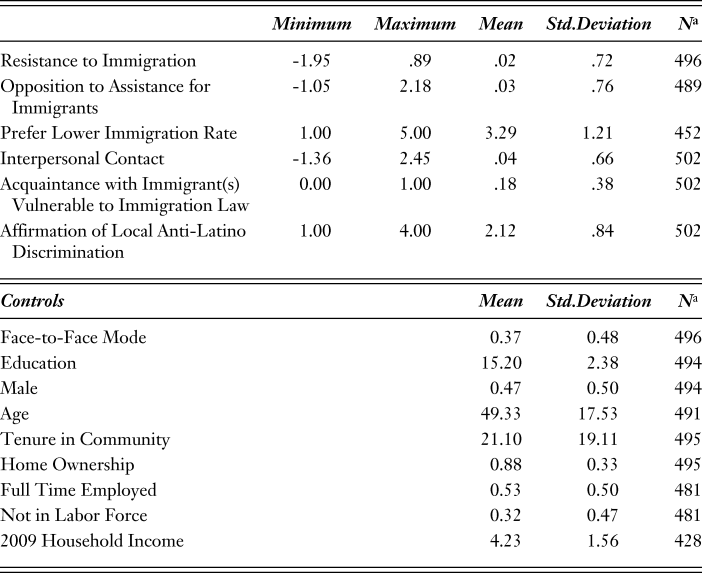
Descriptive statistics are reported in Table 1. As for other analyses, the weighted file was used, and the sample was confined to native-born Anglos whose non-missing values on Contact and the two moderators permitted their inclusion in the primary regression analyses. For the dependent variables, contact, and the two potential moderators, ranges are reported along with means and standard deviations, to support subsequent descriptions of the magnitudes of estimated effects.
Descriptive Statisticsa

a Statistics for the outcome variables were computed for native-born Anglos with non-missing values on the named variable and on the three primary predictors, Contact and the Two Moderators. For these three primary predictors, statistics were computed for cases with non-missing values on all three. Statistics for the control variables were computed on cases used in the OLS regression for Resistance, the analysis with the largest N. The weighted sample was used for all analyses.
ANALYSIS
Analyses of the Immigration Rate measure and the Resistance and Assistance policy scales were performed with a series of partially nested OLS regressions. Interview mode (face-to-face or telephone), the individual background controls, and contact were entered first into the analysis (Model 1). Model 2 introduces acquaintance with an immigrant in legal jeopardy, and Model 3 adds the interaction of the latter variable with contact. In Models 4 and 5, acquaintance with an immigrant in legal jeopardy and its interaction were taken out of the equation, and affirmation of substantial local anti-Latino discrimination was introduced, followed by the interaction of estimated discrimination with contact.
In order to fully describe the interaction effects, analyses of the full sample were followed up by analyses estimating partial effects of contact within subgroups of the two moderators. The first pair of analyses was performed on the subgroup of respondents claiming at least one acquaintance whose immigration status placed them in legal jeopardy, and on the subgroup claiming no such acquaintances. The second pair of analyses divide the sample into subgroups based on their estimates of the extent of local anti-Latino discrimination. Respondents whose average estimate of discrimination in housing, schools, and law enforcement was greater than “not very much” constitute the first subsample; respondents providing discrimination estimates averaging “not very much” or less populate the second.
All multiple regression analyses, along with supporting computations, were produced with weights that adjusted for the under-sampling of unmatched addresses and the number of adults in the household, as well as age and racial/ethnic composition. Partial coefficients reported in the tables are pooled estimates from the five rounds of imputation used to address missing values in the control variables.
RESULTS
Preference for Lower Immigration Rate
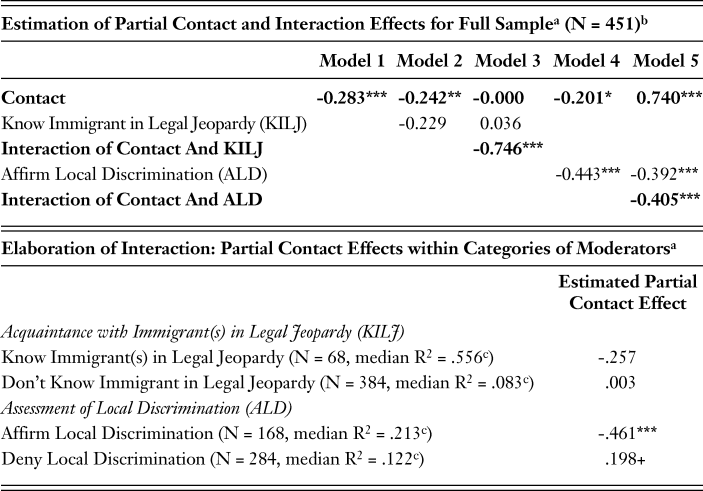
Table 2 provides estimates of the impact of personal contact with Latinos on Anglos’ immigration rate preference, and it also offers the first opportunity to assess the central hypothesis about interactions with contact. The Model 1 coefficient demonstrates that, net of the controls, greater interpersonal contact has a strong and significant inverse relationship with calls for decreased legal immigration.Footnote 14 Introduction of predictors representing acquaintance with an immigrant in legal jeopardy (Model 2) and affirmation of local discrimination (Model 4) reduces the contact effect, but leaves it statistically significant. For each of these potential moderators, high scores predict fewer calls to decrease legal immigration, as shown in the negative partial slope coefficients, although the effect on immigration rate preference is significant only for affirmation of discrimination. In fact, the highly significant partial effect of the affirmation-of-discrimination scale is stronger than that for interpersonal contact.Footnote 15
Prediction of Preference for Lower Immigration Rate.

a Values are pooled unstandardized partial coefficients from OLS analysis of five samples yielded by the SPSS Multiple Imputation procedure. Controls include: interview mode, education, gender, age, tenure in city, home ownership, employment status, and 2009 household income.
b For Model 3, median R2 for the five imputed samples = .139. For Model 5, the median R2 = .224.
c As for Models 3 and 5, the reported R2 is the median of those for the five imputed samples.
+ p < 0.10, *p < 0.05, **p < 0.01, ***p < 0.001.
The interactions estimated in Models 3 and 5 are of central interest here, and for both hypothesized moderators, the interaction with contact is highly significant. As indicated by the negative Model 3 interaction coefficient, the tendency for contact to depress calls for lower immigration rates is more pronounced among respondents acquainted with an immigrant who has run afoul of immigration law or is at risk of doing so. This interaction is elaborated in the bottom panel of Table 2, where contact effects are estimated controlling for the full set of personal characteristics. Among those having no acquaintances in immigration law jeopardy, the partial effect of contact on immigration rate preference is essentially zero. The subsample of respondents whose acquaintances do include at least one immigrant with immigration law troubles is small, so it is unsurprising that the estimated partial contact effect on immigration rate preference is not significant, but the magnitude of the negative effect is not trivial. (The standardized coefficient, not shown in Table 2 but available from the authors, is estimated as -.158.)
The significant negative interaction of contact with affirmation of anti-Latino discrimination, reported in Model 5, represents a pattern that is parallel, and more pronounced. As seen in the bottom panel of Table 2, respondents who deny substantial local discrimination show a nearly significant positive link between contact with Latinos and preference for lower immigration rates, while among respondents who affirm substantial anti-Latino discrimination there is a pronounced and highly significant tendency for contact to depress anti-immigration sentiment.
The descriptive statistics reported in the first panel of Table 1 can be used to consider the magnitude of the Model 1 contact effect reported in Table 2 for the sample as a whole, and magnitudes of the contact effects reported in the lower panel of Table 2 for the subgroup having acquaintances in immigration law jeopardy and the subgroup affirming high levels of local anti-Latino discrimination.
The range of interpersonal contact scores reported in Table 1 is 3.81. Thus the Model 1 contact coefficient of -.283 seen in Table 2 implies that for the sample as a whole, controlling for individual characteristics, those with the least contact differ from those with the most contact by 3.81 * -.283 = -1.08 units on the five-point immigration rate measure. For example, this would be the difference between (the rate should be) “decreased a little” and “same as it is now.” Turning to information reported in the lower panel of Table 2, for the subgroup of respondents who have acquaintances in immigration law trouble, the difference between those with no contact and those with the highest level of contact is estimated to be 3.81 * -.217 or -.83 units on the immigration rate measure, approaching one unit on that scale. Among the subgroup affirming relatively high levels of local discrimination, the especially large partial coefficient suggests a 3.81 * -.461 = -1.76 difference between those with the least and the most contact, e.g., amounting nearly to the difference between “decreased a lot” and “same as it is now” in the immigration rate measure.
Supplementary analyses that include political party and ideology as controls bring slightly higher R2 values, as any expanded set of predictors must, and the coefficients are slightly changed. However, these analyses bring no changes whatsoever to the patterns outlined in the preceding paragraphs; even the levels of significance remain precisely as reported in Table 2.Footnote 16
Resistance to Immigration
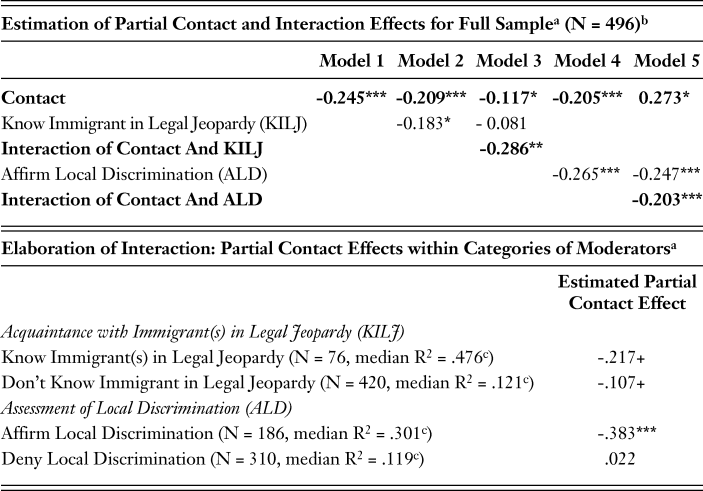
Table 3 provides a second look at important patterns in these data.Footnote 17 A highly significant partial contact effect in the predicted direction is shown in Model 1: Among these Anglo respondents, interpersonal contact with Latinos predicts less resistance (e.g., fewer calls for increased border security or workplace raids). This effect is weakened some, but not dramatically, when acquaintance with immigrants in legal jeopardy (Model 2) and affirmation of local anti-Latino discrimination (Model 4) are introduced into the analysis. Note that the partial effect of the acquaintance predictor on resistance policy attitudes is significant (p = 0.021) and negative, indicating that acquaintance with an immigrant in legal jeopardy makes anti-immigrant policy attitudes less likely.Footnote 18 In Model 4, we see the strong and highly significant (p < 0.001) negative association between perceiving substantial discrimination and anti-immigrant opinion on the Resistance scale. In fact, as noted for the preferred immigration rate analysis, the partial effect of perceiving substantial discrimination on Resistance scale scores is stronger than the partial effect of interpersonal contact. (Estimates not shown in Table 3 but available from the authors put the standardized slope coefficient for contact at -.191, that for affirmation of discrimination at -.307).
Prediction of Resistance to Immigration.

a Values are pooled unstandardized partial coefficients from OLS analysis of five samples yielded by the SPSS Multiple Imputation procedure. Controls include: interview mode, education, gender, age, tenure in city, home ownership, employment status, and 2009 household income.
b For Model 3, median R2 for the five imputed samples = .208. For Model 5, the median R2 = .302.
c As for Models 3 and 5, the reported R2 is the median of those for the five imputed samples.
+ p < 0.10, *p < 0.05, **p < 0.01, ***p < 0.001.
The results just noted are important, but again Models 3 and 5 are of particular interest. Both models show the predicted significant interaction effect: The inverse relationship between contact with Latinos and resistance to immigrants is more pronounced among those aware of the problems Latino immigrants face. More specifically, respondents acquainted with an immigrant in legal jeopardy and those who acknowledge substantial local discrimination show a greater liberalizing impact of contact than respondents with no such acquaintances and those who deny local discrimination.
The bottom panel of Table 3 deconstructs the two interaction effects. For respondents with no immigrant acquaintances who have run afoul of immigration law, contact depresses resistance to immigration, but the partial effect (-.107) is weak and only approaches statistical significance. Respondents who are personally acquainted with immigrants in legal jeopardy show a negative partial effect that is twice as large (-.217), although the small subsample depresses statistical significance and this effect does not quite meet the .05 significance criterion.
The interaction between acknowledgment of discrimination and contact is more pronounced. For Anglos who perceive little or no anti-Latino discrimination, there is virtually no partial impact of contact on the Resistance policy scale (b = .022). For respondents perceiving greater local discrimination against Latinos, the partial impact of contact is highly significant (b = -.383).
The magnitudes of selected partial coefficients for contact reported in Table 3 can be considered using a strategy parallel to that employed for Table 2 coefficients. Values of the dependent variable for resistance—means of six standardized scores—do not have tangible meaning, so we make use of the range of the resistance scale, asking what part of the difference between lowest and highest resistance scale values can be accounted for by comparison of those with lowest and highest levels of contact with Latinos. Table 1 tells us that there is a 2.84 point difference between the lowest and highest levels of resistance to immigration. The 3.81 difference in the contact scores of those with the least and most contact can again serve as multiplier for Table 3 coefficients of particular interest. The partial contact coefficient reported for Model 1 indicates that for the sample as a whole, those with lowest and highest levels of contact with Latinos are distinguished by a difference of 3.81 * -.245 = -.933 points on the resistance scale, almost exactly one third of the scale’s range. For the subsample acquainted with immigrants in legal jeopardy, net of background controls those with the lowest and highest levels of interpersonal contact differ by 3.81 * -.217 = -.827 on the resistance scale, about 29% of the scale range. And in the subsample that affirms the existence of substantial local discrimination, net of controls Anglos reporting the lowest and highest levels of contact with Latinos are distinguished by a gap of 3.81 * -.383 = -1.46 in resistance scale scores, about half the range of this policy outcome.
Supplementary analyses that added political ideology and party affiliation as controls yielded results that were only minimally different. The interaction of contact with the acquaintance moderator was weak enough that the significance level fell to p=.014, and (congruently) the difference in contact effects estimated for the two subgroups broken down by acquaintance was smaller. Other discrepancies from the Table 3 results were negligible.
Assistance for Immigrants
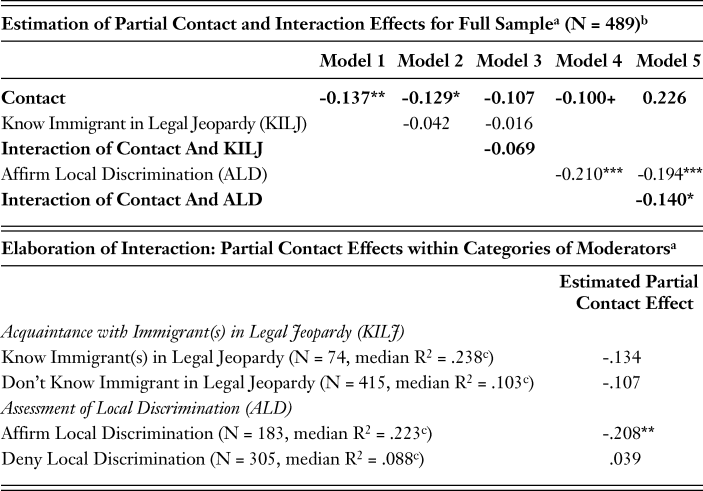
On the Assistance-for-Immigrants scale, the picture is similar but weaker and less consistent.Footnote 19 Again, the partial contact effect reported for Model 1 is significant, respondents reporting contact with Latinos expressing less opposition to assistance for immigrants, i.e., more support for such assistance.Footnote 20 Controlling for contact, acquaintance with an immigrant who faced or is facing immigration law problems is not a significant predictor of opposition to assistance, nor is its interaction with contact significant. Both run in the direction noted earlier for the Immigration Rate measure and the Resistance scale but are quite small. Results presented in the bottom panel of Table 4 confirm the weakness of the interaction: The negative estimated contact effect for respondents having undocumented acquaintances is somewhat stronger than the negative coefficient for respondents without such acquaintances, but the difference is not great.
Prediction of Opposition to Assistance for Immigrants.

a Values are pooled unstandardized partial coefficients from OLS analysis of five samples yielded by the SPSS Multiple Imputation procedure. Controls include: interview mode, education, gender, age, tenure in city, home ownership, employment status, and 2009 household income.
b For Model 3, median R2 for the five imputed samples = .122. For Model 5, the median R2 = .180.
c As for Models 3 and 5, the reported R2 is the median of those for the five imputed samples.
+ p < 0.10, *p < 0.05, **p < 0.01, ***p < 0.001.
In comparing the Assistance scale results with those for the Resistance scale, we must note the logical link between acquaintance with immigrants having immigration law problems and the Resistance scale items, which (with one exception) focus on the exclusion and detection of the undocumented. Given that the acquaintances referenced in the moderator are the very targets of the exclusionary policies that dominate the Resistance scale, it would be surprising if the “acquaintance” predictor did not show stronger main and interactive effects on the Resistance scale than on the Assistance scale.
As seen in Table 4, Assistance scale results involving affirmation of discrimination are more similar to those observed for the Immigration Rate measure and the Resistance scale: Anglos who perceive substantial local discrimination against Latinos are significantly less opposed to assistance, with a stronger effect than that seen for contact (the standardized partial slope coefficients, not shown here, are -0.230 for perceived discrimination and -0.086 for interpersonal contact). The significant interaction effect seen in Model 5 indicates that contact has a greater effect when substantial discrimination is perceived. More specifically, the bottom panel of Table 4 shows that among those who perceive minimal local anti-Latino discrimination, contact has virtually no effect on opposition to measures that offer immigrants assistance—in fact, the small contact coefficient for this group is positive (b = .039). In contrast, among respondents whose estimates of discrimination averaged more than “not very much,” greater interpersonal contact with Latinos is substantially and significantly associated with lack of opposition, i.e., with support for assistance (b = -.208).
As shown in Table 1, the range of the assistance scale scores is 3.23. Using the strategy employed for the other two immigration policy measures, we use the 3.81 range between the lowest and highest contact scores to estimate, for the entire sample, a Model 1 contact effect on the assistance scale of 3.81 * -.137 = -.522, approximately one-sixth of the assistance scale range. Among those who know immigrants in legal jeopardy, the difference between respondents reporting no interpersonal contact and those with the highest level of contact is 3.81 * -.134 = -.511, again almost one-sixth of the assistance scale range. And among those respondents who affirm substantial local anti-Latino discrimination, the gap in assistance scale scores between those reporting the lowest and highest levels of contact is 3.81 * -.208 = -.792, about one-quarter the range of assistance scale scores.
The addition of political ideology and party identification reduced the already small interaction involving acquaintance with undocumented immigrants to a near zero value, and the non-significant contact coefficients for respondents with and without undocumented immigrant acquaintances became -.093 and -.123, instead of -.134 and -.107. Otherwise, coefficients shifted minimally and significance levels were unaltered, suggesting no changes in conclusions drawn from Table 4.
SUMMARY AND CONCLUSIONS
The association of intergroup contact with favorable attitudes toward out-groups has been extensively studied and widely demonstrated (see Pettigrew and Tropp, Reference Pettigrew and Tropp2011). The Black/White divide has been the most common focus, with prejudice the most commonly studied outcome. Our research shifts the focus to Anglos and Latinos, asking not about prejudice but about immigration policy opinions. There is precedent for finding Anglo/Latino contact effects on anti-Latino prejudice (Dixon Reference Dixon2006). Patterns involving policy opinions are less well understood and documented.
The central hypothesis here was suggested, in part, by earlier researchers’ claims that policy opinions are different, perhaps not vulnerable to contact effects at all (Jackman and Crane, Reference Jackman and Crane1986), or as Pettigrew and Tropp (Reference Pettigrew and Tropp2011) conclude, affected by contact less strongly than is true for prejudice. We suspected that where policy opinions are at issue, psychological social psychology’s contribution of the interpersonal contact framework must be merged with an understanding central in sociological social psychology, namely that support for progressive policies is contingent on recognizing hardships faced by subordinate groups. Put differently, ignorance or denial of problems and barriers faced by minority groups discourages support for progressive policies. We hypothesized, then, that Anglo/Latino contact effects observed for the aggregate of Anglos are only moderately strong because contact promotes progressive policy opinions primarily, or only, among Anglos who realize and acknowledge the existence of Latinos’ problems relevant to the policies under discussion. That is the notion tested in this research.
Using a probability sample from a Chicago-area county that has seen substantial recent growth in Latino population, we examined Anglos’ opinions on three dimensions of U.S. and local immigration policy: 1) preference for lower immigration rates; 2) resistance to the presence of immigrants, in the form of heightened border security, measures to detect and deport undocumented immigrants, and expanded use of the Spanish language; and 3) opposition to educational and economic assistance for immigrants.
Anglos’ contact with Latinos, as assessed here, could take the form of neighborhood or workplace interaction and/or inclusion of Latinos in the network of interaction partners with whom important matters are discussed. Recognition of hardships faced by Latinos, the hypothesized moderator of contact effects, takes two forms in this study. One is personal acquaintance with immigrants who have run afoul of immigration law. The second, assessment of local anti-Latino discrimination, links this research with important intergroup relations literature coming from political and sociological social psychology.
The first two dimensions of immigration policy, preference for lower immigration rates and resistance to immigration, showed a highly significant impact of contact in the aggregate sample of Anglos. But also highly significant were all four predicted interaction effects. Acquaintance with an immigrant in legal jeopardy was relatively rare in this sample of Anglos, depressing significance levels. Nonetheless, the interaction effect and partial coefficients produced in the subgroup elaborations show interpersonal contact to have a greater liberalizing effect on policy views in the group reporting such acquaintances than in the group reporting none. In fact, among Anglos without an immigrant acquaintance, zero effect of contact was observed on the preferred immigration rate measure. For the immigration rate and resistance dimensions of immigration policy, interaction of contact with the other moderator, assessment of local discrimination, presents powerful, interpretable evidence. Among Anglos who deny or minimize local discrimination, interpersonal contact with Latinos does nothing to liberalize immigration attitudes. In fact, for this subgroup, those with greater contact are slightly more likely to favor decreased legal immigration. In contrast, among respondents who affirm the existence of local discrimination, there is a pronounced tendency for contact to discourage anti-immigrant attitudes. Evidently, to seriously influence anti-immigrant policy opinions, both psychological and sociological factors need to be at work—contact putatively promoting more positive sentiment toward Latinos, while the belief that this group faces handicaps born of discrimination calls attention to the need for progressive policies.
For the third dimension of immigration policy views, where educational and economic assistance for immigrants is the issue, results differ in two respects. For one thing, these scale values were generally less well predicted by our models. Variance accounted for and partial correlation coefficients tended to be lower. Also, the interaction between contact and acquaintance with immigrants in legal jeopardy is in the predicted direction but is quite small and non-significant. The lower overall predictability may reflect the fact that assistance questions don’t get the publicity that directs public attention to questions about immigration rate and resistance measures; thus opinions about assistance policies may be less well formed. Also, patterned opinion may be muted because these forms of potential assistance evoke more mixed feelings—benevolent impulses accompanied by considerations of cost or perceived competition.
Distinctive aspects of these results for the assistance policy scale point to the need for future research that focuses not just on resistance, but on assistance for immigrants. However, the assistance scale results were not altogether different from patterns on the other two dimensions of policy opinion. The main effect of affirmation of local discrimination is considerably stronger than that for contact when the two are in competition as in Model 4. And importantly, there is a statistically significant interaction between contact and assessment of local discrimination: Only among those who affirm local discrimination does interpersonal contact decrease opposition to assistance.
Considering these results from the psychological social psychology standpoint, we recall that Allport (Reference Allport1954) named equal status, common goals, cooperative structure, and sanction of authority as conditions that promote positive attitudinal outcomes of intergroup contact. Pettigrew added a fifth, friendship potential (1986). Our results suggest that where policy opinions are concerned, there may be a sixth condition for positive outcomes from intergroup contact: recognition of barriers faced by members of the minority group, barriers that call for policy remedy.
Our data give evidence that such recognition of hardships does not come to Anglos routinely as a product of interpersonal contact with Latinos. The modest correlation between interpersonal contact and acquaintance with immigrants in legal jeopardy indicates that much of the Anglo/Latino contact reported here takes place exclusively with Latinos whose immigration status is not a problem, or at least not a problem known to the Anglo interactant. This is not so surprising because undocumented immigrants often live in communities of similar others, where they are protected from detection, and from intergroup relationships. Furthermore, what contact with Anglos exists is unlikely to bring undocumented immigrants’ confessions of illegality that might evoke negative—even dangerous—reactions.
More subtle factors must create the communication barriers that result in near zero correlation between Latino/Anglo contact and acknowledgement of local anti-Latino discrimination. In part, this is probably a function of selection: Latinos for whom patterns of local discrimination are salient may be less likely than other Latinos to have personal relationships with Anglos. But also, there must be many cross-group relationships involving Latinos who are keenly aware of the magnitude of local discrimination but don’t discuss the topic with their Anglo friends and associates.
In sum, for both moderators examined here, there are probably structural factors—such as housing segregation and economic stratification—as well as psychological mechanisms that serve to block Anglos’ exposure to information about hardships Latinos face. Understanding the interplay of structural and psychological mechanisms at work is an important task for future research.
Beyond this, there is reason for special interest in Anglos’ acknowledgment of anti-Latino discrimination, which stands out in these data not only as a powerful moderator of contact effects, but also as a stronger predictor than contact for all three dimensions of policy opinion. In that sense, its importance is double barreled. Our introductory discussion noted that denial of race discrimination has been identified as an aspect of White Americans’ defense of their “dominant group position” (Blumer Reference Blumer1958; Bobo and Kluegel, Reference Bobo, Kluegel, Tuch and Martin1997), justifying inaction in the face of racial inequality and opposition to progressive race policy. The importance of denying discrimination shown in our results invites application of Herbert Blumer’s perspective to studies of Anglos’ opinions about immigration policy questions.
Blumer (Reference Blumer1958) insisted that racial attitudes of individual dominant group members are of minimal relevance—it is the collective sense of group position that matters. There is an intriguing echo of that aspect of Blumer’s message in our finding that interpersonal contact between Anglos and Latinos has no impact on policy opinion among those who deny discrimination. For Blumer, what does matter in maintaining or changing the sense of dominant group position is macrolevel dynamics and societal leadership. Applied to immigration policy questions, this would imply that the potential of interpersonal contact to affect Anglos’ immigration opinions is limited. Rather, it may be domestic and international economic and political dynamics that affect Anglos’ sense of group position, their acknowledgment of barriers faced by Latinos, and ultimately their opinions on immigration policy questions. Theoretical and empirical work in pursuit of this argument is a challenge for the future.Footnote 21
The focus of the 2010 Chicago Area Study has the advantage of providing a rich set of policy questions, encompassing forms of assistance to immigrants as well as exclusionary measures. But also, the sample is limited to residents of communities in one suburban Chicago county. Lake County, Illinois, is highly appropriate for studying opinions about immigration, having experienced Latino population growth over the last thirty years at a rate greater than that in the United States as a whole, but the generalizability of patterns reported here needs to be assessed with a national sample.
Operationalization of variables always invites questions. Here we had many more immigration policy questions than have been available to most researchers. On the other hand, the measures of interpersonal contact available to us were limited; a pertinent recent meta-analysis by Kristin Davies and colleagues (2011) found that the operationalization of a closely related variable—cross-group friendships—made a substantial difference in the strength of effects on intergroup attitudes. Similarly, variation in operationalization of our moderators might have brought a shift in results. These are limitations see that we must acknowledge. Also, our findings point to the importance of distinguishing among immigration policy issues. Particularly, there is need for fuller empirical investigation of Anglo attitudes about measures to help immigrants succeed in the United States.
In sum, our central finding—the interaction between Anglo/Latino contact and acknowledgment of barriers faced by Latinos—warrants future investigation with varied operationalization of key constructs and a more inclusive sample.
APPENDIX A
QUESTION WORDING FOR INDIVIDUAL IMMIGRATION POLICY ITEMS, WITH SUMMARIES OF RESPONSES
Preferred Immigration Rate
Do you think the number of immigrants to the United States nowadays should be increased a lot, increased a little, remain the same as it is now, decreased a little, or decreased a lot?
Increased a lot 9%
Increased a little 12%
Same as it is now 40%
Decreased a little 15%
Decreased a lot 23%
Resistance-to-Immigration Scale
(“Now we have a number of questions about policies regarding undocumented immigrants. That is, people living in the U.S. who are not authorized to be here” …)
“Should efforts to stop undocumented immigration at the U.S.-Mexico border be increased, decreased, or stay the same?”
Increased 73%
Stay the same 21%
Decreased 6%
“Should worksite raids to arrest undocumented immigrants be increased, decreased, or stay the same?”
Increased 44%
Stay the same 37%
Decreased 19%
“Should the deportation of undocumented immigrants be increased, decreased, or stay the same?”
Increased 53%
Stay the same 33%
Decreased 14%
(“Now I am going to ask you about a number of things local communities have done or might do about immigration. Whether or not your community is already doing them, we’d like to know if you would favor or oppose them in [NAME OF CITY]” …)
“How about making English its official language? Do you strongly favor, somewhat favor, somewhat oppose, or strongly oppose this?”
Strongly favor 63%
Somewhat favor 21%
Somewhat oppose 6%
Strongly oppose 11%
“How about requiring landlords to check a person’s immigration status before renting them an apartment or house? Do you strongly favor, somewhat favor, somewhat oppose, or strongly oppose this?”
Strongly favor 38%
Somewhat favor 27%
Somewhat oppose 17%
Strongly oppose 19%
“How about requiring local police to check the immigration status of anyone they suspect of a crime? Do you strongly favor, somewhat favor, somewhat oppose, or strongly oppose this?”
Strongly favor 45%
Somewhat favor 22%
Somewhat oppose 10%
Strongly oppose 23%
Assistance-For-Immigrants Scale
(“Now we have a number of questions about policies regarding undocumented immigrants. That is, people living in the U.S. who are not authorized to be here” …)
“There are many undocumented youth living in the United States who were brought to this country at a young age by their undocumented parents. The U.S. Congress is considering legislation, called the DREAM Act, that would allow those youth who are in college or serving in the military to become legal permanent residents. Do you strongly support, somewhat support, somewhat oppose, or strongly oppose this legislation?”
Strongly support 45%
Somewhat support 38%
Somewhat oppose 12%
Strongly oppose 6%
“Currently, undocumented immigrant students attending public colleges in Illinois pay the same tuition as Illinois residents. Do you strongly support, somewhat support, somewhat oppose, or strongly oppose this policy?”
Strongly support 32%
Somewhat support 29%
Somewhat oppose 18%
Strongly oppose 21%
(“Now I am going to ask you about a number of things local communities have done or might do about immigration. Whether or not your community is already doing them, we’d like to know if you would favor or oppose them in [NAME OF CITY]” …)
“How about programs that help immigrants start small businesses? Do you strongly favor, somewhat favor, somewhat oppose, or strongly oppose this?”
Strongly favor 41%
Somewhat favor 40%
Somewhat oppose 8%
Strongly oppose 11%
APPENDIX B
QUESTION WORDING FOR CONTACT ITEMS, AND FOR HYPOTHESIZED MODERATORS
Interpersonal-Contact Scale
“How often do you interact with co-workers who are Latino at your place of work? Would you say never, less than once a year, a few times a year, a few times a month, at least once as week or almost every day?”
“First, how often do you talk or chat with people in your neighborhood who are Latino? Would you say never, less than once a year, a few times a year, a few times a month, at least once a week or almost every day?”
“From time to time, most people discuss important matters with other people. Looking back over the last six months, who are the people with whom you discussed matters important to you? Just tell me their initials or first names.
Now I am going to ask you a few questions about these people.
Is (NAME) White, Black or African American, Latino or Hispanic, Asian or Pacific Islander, or something else?”
Hypothesized Moderators
Acquaintance with an Immigrant in Jeopardy
“Is anyone you consider close to you—a relative, friend, neighbor, co-worker, or someone else close to you—an undocumented immigrant?”
“Do you know anyone who has been departed or arrested by U.S. immigration officials and placed in removal proceedings?”
Affirmation of Local Anti-Latino Discrimination
“Now I’d like to ask you about how Latinos are treated in [NAME OF CITY]. How much discrimination do Latinos experience in each of the following areas?
First housing. Would you say Latinos experience a lot, some, not very much, or no discrimination in housing in [NAME OF CITY].
How about the public schools? Would you say Latinos experience a lot, some, not very much, or no discrimination in the public schools in [NAME OF CITY].
How about interactions with the police? (Would you say Latinos experience a lot, some, not very much, or no discrimination in their interactions with the police in [NAME OF CITY]?)”