INTRODUCTION
Growing evidence suggests that social engagement may be an important protective resource for cognitive functioning in older adulthood (Barnes, Mendes de Leon, Wilson, Bienias, & Evans, Reference Barnes, Mendes de Leon, Wilson, Bienias and Evans2004; Crooks, Lubben, Petitti, Little, & Chiu, Reference Crooks, Lubben, Petitti, Little and Chiu2008; Zahodne, Ajrouch, Sharifian, & Antonucci, Reference Zahodne, Ajrouch, Sharifian and Antonucci2019) and may protect against brain pathology (Bennett, Schneider, Tang, Arnold, & Wilson, Reference Bennett, Schneider, Tang, Arnold and Wilson2006). Consistent with the cognitive reserve theory (Stern, Reference Stern2002), older adults that remain actively engaged within their social networks show slower rates of cognitive decline (Béland, Zunzunegui, Alvarado, Otero, & del Ser, Reference Béland, Zunzunegui, Alvarado, Otero and del Ser2005; Zahodne et al., Reference Zahodne, Ajrouch, Sharifian and Antonucci2019) and have lower Alzheimer’s disease and related dementia (ADRD) incidence (Amieva et al., Reference Amieva, Stovkova, Matharan, Helmer, Antonucci and Dartigues2010), suggestive that contact with social network members may act as a resource that promotes cognitive efficiency and compensatory processes. Recent evidence, however, suggests that relationship type matters (Sharifian, Manly, Brickman, & Zahodne, Reference Sharifian, Manly, Brickman and Zahodne2019; Zahodne et al., Reference Zahodne, Ajrouch, Sharifian and Antonucci2019). Specifically, the link between social engagement and cognition may vary dependent on whether the individual is spending time with friends or with family.
Prior cross-sectional investigations have found that having a greater portion of family within one’s social network is associated with lower cognition (Li & Dong, Reference Li and Dong2018; Sharifian et al., Reference Sharifian, Manly, Brickman and Zahodne2019). Furthermore, having a higher number of close friends, but not children or neighbors, has been linked to better global cognition (Wang, He, & Dong, Reference Wang, He and Dong2015). Fewer studies have examined these associations longitudinally, but of those that did, a similar pattern of findings emerged. In a nationally representative US sample, more frequent contact averaged across relationships was prospectively associated with less decline in episodic memory. When broken down by relationship type, this finding was driven by contact frequency with friends (Zahodne et al., Reference Zahodne, Ajrouch, Sharifian and Antonucci2019). In another longitudinal study, having friends was associated with less cognitive decline, but only among women (Béland et al., Reference Béland, Zunzunegui, Alvarado, Otero and del Ser2005). Of note, the same longitudinal study also found a positive association between social engagement with family and cognition (i.e., Béland et al., Reference Béland, Zunzunegui, Alvarado, Otero and del Ser2005), warranting further investigation into the associations between time spent with family and cognition.
Overall, prior research suggests that contact frequency with friends may confer greater cognitive benefits than contact frequency with family members (Wang et al., Reference Wang, He and Dong2015; Zahodne et al., Reference Zahodne, Ajrouch, Sharifian and Antonucci2019); however, much less is known regarding the underlying mechanisms that drive these associations. Therefore, the current study aimed to examine the underlying behavioral pathways that may partially explain the distinct influences of contact frequency with friends versus family on cognitive functioning.
The Impact of Social Contact on Activity Engagement
Activity engagement may play an important role in explaining the robust association between contact frequency with friends (as opposed to family) and cognitive functioning in later life. Specifically, the salience of friendships may be driven, in part, by relationship maintenance behaviors. As friendships are voluntary relationships, individuals must actively work to maintain them (Lee & Ishii-Kuntz, Reference Lee and Ishii-Kuntz1987). Familial ties, on the other hand, require less maintenance to retain within one’s network. For instance, in a longitudinal study following young adults transitioning from high school to college, emotional closeness with friends tended to decrease, whereas emotional closeness with familial ties remained stable. Importantly, more shared activities and communication were associated with preserved emotional closeness with friends, indicating that friendships required greater active maintenance to avoid relationship decay over time (Roberts & Dunbar, Reference Roberts and Dunbar2015).
Consistent with prior research in younger adult populations (i.e., Roberts & Dunbar, Reference Roberts and Dunbar2015), later-life friendships are a greater source of immediate joy (Larson, Mannell, & Zuzanek, Reference Larson, Mannell and Zuzanek1986) and provide a greater sense of companionship through informal social activities than family relationships (Huxhold, Miche, & Schüz, Reference Huxhold, Miche and Shüz2013). Prior research has also linked a greater proportion of friends within one’s social network to more late-life physical activities (Shiovitz-Ezra & Litwin, Reference Shiovitz-Ezra and Litwin2012). When specifically asked about leisure activity engagement, older adults in a qualitative study reported that a strong motivator was to promote friendships/companionships (Ball, Corr, Knight, & Lowis, Reference Ball, Corr, Knight and Lowis2007).
Activity Engagement and Cognitive Functioning
Extensive prior research has shown protective effects of activity engagement for cognition (Hertzog, Kramer, Wilson, & Lindenberger, Reference Hertzog, Kramer, Wilson and Lindenberger2009; Jonaitis et al., Reference Jonaitis, La Rue, Mueller, Koscik, Hermann and Sager2013). In particular, both cognitive (i.e., board games, attending a play or lectures) and physical (i.e., walking, dancing, exercise) activities have been linked to better cognition (Hayes et al., Reference Hayes, Alosco, Hayes, Cadden, Peterson, Allsup and Verfaellie2015; Mueller, Raymond, & Yochim, Reference Mueller, Raymond and Yochim2013; Weuve et al., Reference Weuve, Kang, Manson, Breteler, Ware and Grodstein2004) and lower ADRD risk (Scarmeas, Levy, Tang, Manly, & Stern, Reference Scarmeas, Levy, Tang, Manly and Stern2001; Scarmeas et al., Reference Scarmeas, Luchsinger, Schupf, Brickman, Cosentino, Tang and Stern2009). Cognitive activities may be beneficial for cognition through cognitive enrichment and the promotion of cognitive reserve (Valenzuela, Sachdev, Wen, Chen, & Brodaty, Reference Valenzuela, Sachdev, Wen, Chen and Brodaty2008). Physical activities may benefit cognition through reduced cardiovascular disease risk (Warburton, Nicol, & Bredin, Reference Warburton, Nicol and Bredin2006), which is a strong risk factor for later-life dementia (Whitmer, Sidney, Johnston, & Yaffe, Reference Whitmer, Sidney, Selby, Johnston and Yaffe2005).
The Present Study
Despite prior research linking greater contact with friends to greater activity engagement (Ball et al., Reference Ball, Corr, Knight and Lowis2007; Ihle, Oris, Baeriswyl, & Kliegel, Reference Ihle, Oris, Baeriswyl and Kliegel2018; Shiovitz-Ezra & Litwin, Reference Shiovitz-Ezra and Litwin2012) and greater activity engagement to better later-life cognition (Gill et al., Reference Gill, Friedenreich, Sajobi, Longman, Drogos, Davenport and Poulin2015; Mueller et al., Reference Mueller, Raymond and Yochim2013; Reed et al., Reference Reed, Dowling, Farias, Sonnen, Strauss, Schneider and Mungas2011; Weuve et al., Reference Weuve, Kang, Manson, Breteler, Ware and Grodstein2004), less is known regarding whether the cognitive benefits accrued from time spent with friends operate through greater activity engagement. Therefore, the overall goal of the current study was to examine whether the benefits of contact frequency with friends for cognitive functioning operated, in part, through greater engagement in enriching cognitive and/or physical activities. Because prior research has shown that both cognitive and physical activity engagement independently influences cognitive aging, we considered them as separate, but related, mediators.
We hypothesized that activity engagement would significantly mediate the association between contact frequency with friends and cognition. That is, we hypothesized that more frequent contact with friends would be associated with greater engagement in cognitive and physical activities, and in turn, engagement in both types of activities would be independently associated with better subsequent cognitive functioning. In regard to contact frequency with family, based on prior research regarding relationship maintenance behaviors (Roberts & Dunbar, Reference Roberts and Dunbar2015), we hypothesized that activity engagement would not significantly mediate the association between contact frequency with family and cognition due to a lack of association between contact frequency with family and activity engagement. Finally, we hypothesized a positive direct effect of contact frequency with friends on cognitive functioning after accounting for covariates and activity engagement. Due to mixed literature regarding the association between contact frequency with family and cognition (Béland et al., Reference Béland, Zunzunegui, Alvarado, Otero and del Ser2005; Zahodne et al., Reference Zahodne, Ajrouch, Sharifian and Antonucci2019), we had no a priori hypothesis regarding this association.
METHODS
Participants and Procedure
We utilized two waves of longitudinal data from the national survey of Midlife in the United States (MIDUS; Brim, Ryff, & Kessler, Reference Brim, Ryff and Kessler2004). MIDUS is a national sample of noninstitutionalized middle-aged and older adults selected by random digit dialing in the contiguous 48 states. MIDUS data collection oversampled participants who were 40–60 years old. Cognitive and psychosocial assessments were administered in 2004–2006 (T1) and again in 2013–2017 (T2). All participants were provided written informed consent, and all study procedures were approved by the University Institutional Review Board.
At T1, 4198 participants were given initial tests of episodic memory and executive functioning. At T2, 2721 of the original sample were given subsequent episodic memory and executive functioning tests. Compared to nonreturnees, participants with follow-up assessments were significantly older [F(1,4187) = 25.20, p < .001, η 2 = .01], had higher education [F(1,4181) = 106.78, p < .001, η 2 = .03], had fewer chronic diseases [F(1,3698) = 29.43, p < .001, η 2 = .01], were less likely to identify as a member of a racial or ethnic minority group [F(1,4187) = 18.36, p < .001, η 2 = .004], had higher baseline episodic memory scores [F(1,4187) = 92.62, p < .001, η 2 = .02], and had higher executive functioning scores [F(1,4179) = 191.33, p < .001, η 2 = .04]. Returnees and nonreturnees did not significantly differ based on gender [F(1,4187) = 3.22, p = .073, η 2 = .001] or marital status [F(1,4187) = 3.55, p = .059, η 2 = .001]. Importantly, missing data were managed with full information maximum likelihood with robust standard errors (Arbuckle, Reference Arbuckle, Marcoulides and Schumacker1996), which handles attrition related to variables included in the model.
Our final sample included 3707 participants that were, on average, 55.80 years old (SD = 12.31), 50.50% female and 85.60% non-Hispanic White at T1 (see Table 1). Details of the MIDUS longitudinal design, sampling, and all assessment instruments are available on the MIDUS website (http://midus.wisc.edu/).
Means and standard deviations of variables of interest

Measures
Contact Frequency with Friends and Family
Contact frequency with family at T1 was assessed with one-item asking participants, “how often are you in contact with any members of your family, that is, any of your brothers, sisters, parents, or children who do not live with you, including visits, phone calls, letters or electronic mail messages?” For friends, contact frequency at T1 was assessed with one-item asking participants, “how often are you in contact with any of your friends, including visits, phone calls, letters or electronic mail messages?” Both contact frequency with family and with friends were rated on an eight-point scale ranging from several times a day (1) to never or hardly ever (8). Scores were reverse-coded, so higher scores represented more frequent contact.
Cognitive Activity
Cognitive activity was measured at T1 using six items assessing the frequency of engagement in cognitively stimulating leisure activities, including reading books, magazines, or newspapers, and attending educational lectures or courses. Engagement in each activity was rated on a six-point scale ranging from daily (1) to never (6). Scores were reverse-coded, and a composite was created by averaging responses across all six items. Higher scores indicated greater engagement in cognitive activities.
Physical Activity
Physical activity was measured at T1 using six items assessing the frequency of light, moderate, and vigorous physical leisure activities during summer and winter. Items were rated on a six-point scale from several times a week (1) to never (6). All items were then coded such that never = 0, less than once a month = 1, once a month = 2, several times a month = 3, once a week = 4, and several times a week = 5 in order to facilitate conversion of scores into their metabolic equivalents (Meyer, Janke, & Beaujean, Reference Daselaar, Cabeza, Ochsner and Kosslyn2014).
In order to calculate an overall physical activity score, first, summer and winter items were averaged for light, moderate, and vigorous physical activity. Subsequently, a summary score of their total physical activity was calculated for each individual using the following formula: (Light Physical Activity × 2) + (Moderate Physical Activity × 4) +(Vigorous Physical Activity × 8). The weighted values for each level of physical activity approximate its metabolic equivalent, consistent with prior research (Meyer et al., Reference Meyer, Janke and Beaujean2014).
Cognition
Cognition was assessed by measuring two domains, episodic memory and executive functioning, at T1 and T2 using the Brief Test of Adult Cognition by Telephone (Lachman, Agrigoroaei, Tun, & Weaver, Reference Lachman, Agrigoroaei, Tun and Weaver2014). Episodic memory functioning was measured using the immediate and delayed recall trials from the Rey Auditory-Verbal Learning Test (Rey, Reference Rey1964). Executive functioning was assessed with category animal fluency (Borkowski, Benton, & Spreen, Reference Borkowski, Benton and Spreen1967; Tombaugh, Kozak, & Rees, Reference Tombaugh, Kozak and Rees1999), digit span backward (Wechsler, Reference Wechsler1997), number series (Salthouse & Prill, Reference Salthouse and Prill1987; Schaie, Reference Schaie1996), the 30 s backwards counting task (Lachman, Agrigoroaei, Murphy, & Tun, Reference Lachman, Agrigoroaei, Murphy and Tun2010), and the Stop & Go switch task (Lachman et al., Reference Lachman, Agrigoroaei, Murphy and Tun2010). Composite scores for episodic memory and executive functioning were computed as mean Z-scores within each domain using means and standard deviations from T1.
Covariates
Analyses controlled for age, gender (1 = Male, 2 = Female), marital status (0 = not partnered, 1 = partnered), race (0 = non-Hispanic White, 1 = Other), education, and number of chronic illnesses at T1. Age was a self-reported continuous variable. Education was self-reported and could range from no school/some grade school (1) to Ph.D., Ed.D. M.D or other professional degree (12). Chronic illnesses were the sum of self-reported chronic conditions such as high blood pressure, diabetes, and stroke and could range from 0 (no chronic conditions reported) to 30 (all chronic conditions reported).
Analytic Strategy
Separate longitudinal mediation models were conducted to examine episodic memory and executive functioning. Within each model, cognitive and physical activities were regressed onto contact frequency with both friends and family. Cognitive and physical activities, as well as contact frequency with friends and family, were allowed to covary. Baseline cognition and latent change (McArdle, Reference McArdle2009) in cognition from T1 to T2 were both regressed onto cognitive activity, physical activity, contact frequency with friends, and contact frequency with family. Covariates were regressed onto exposure, mediator, and outcome variables, and therefore, model fit was perfect. Descriptive statistics were calculated in SPSS (Version 25), and the mediation models were conducted in Mplus (Version 8).
To assess whether activity engagement mediated the relationship between contact frequency and cognition, indirect effects were calculated. Specifically, indirect effects were a product of the independent association between contact frequency (with friends or family) and a mediator (cognitive activity or physical activity) and the association between that mediator and an outcome (baseline cognition or latent change in cognition from T1 to T2). Direct effects were defined as the association between contact frequency (with friends or family) and an outcome (episodic memory or executive functioning), independent of all mediators and covariates.
RESULTS
Episodic Memory
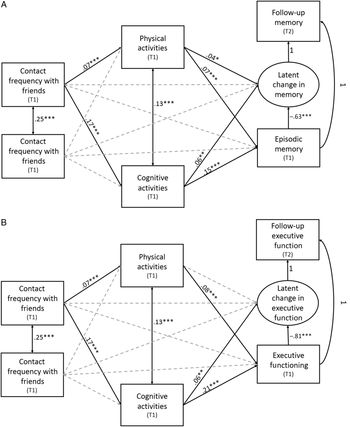
Standardized estimates for mediational pathways for this model are depicted in Figure 1A. Significant indirect effects of contact frequency with friends on both baseline episodic memory (indirect effect: β = .03, SE = .00, p < .001) and latent change in episodic memory (indirect effect: β = .01, SE = .00, p = .006) were found through cognitive activity. That is, more frequent contact with friends was associated with greater cognitive activity (β = .17, SE = .02, p < .001), and cognitive activity was, in turn, associated with higher baseline episodic memory (β = .15, SE = .02, p < .001) and less decline in episodic memory (β = .06, SE = .02, p = .005).
Longitudinal mediation models depicting associations between contact frequency with friends and family on (A) Episodic Memory and (B) Executive Functioning through Cognitive and Physical Activities. Nonsignificant pathways are depicted as gray, dotted lines. For simplicity, covariate associations are not depicted. * = p < .05, ** = p < .01, *** = p < .001.

Significant, independent indirect effects of contact frequency with friends on both baseline memory (indirect effect: β = .01, SE = .00, p = .003) and latent change in episodic memory (indirect effect: β = .003, SE = .00, p = .042) were also found through physical activity. More frequent contact with friends was associated with greater physical activity (β = .07, SE = .02, p < .001), and physical activity was, in turn, associated with higher baseline episodic memory (β = .07, SE = .02, p < .001) and less decline in episodic memory over time (β = .04, SE = .02, p = .020). After accounting for covariates and mediators, no significant direct effect of contact frequency with friends emerged for episodic memory (baseline: β = .03, SE = .02, p = .053; memory change: β = −.01, SE = .02, p = .588).
No significant direct or indirect effects of contact frequency with family on episodic memory emerged (ps > .075). With regard to covariates, older age (β = −.28, SE = .02, p < .001), not identifying as non-Hispanic White (β = −.06, SE = .01, p < .001), and higher chronic disease burden (β = −.04, SE = .02, p = .005) were associated with lower baseline episodic memory, whereas higher education (β = .11, SE = .02, p < .001) and being female (β = .22, SE = .02, p < .001) were associated with higher baseline episodic memory. Being female (β = .16, SE = .02, p < .001) and higher education (β = .05, SE = .02, p = .011) were also associated with less decline in episodic memory over time, whereas older age (β = −.31, SE = .02, p < .001) and higher chronic disease burden (β = −.05, SE = .02, p = .010) were associated with more decline in episodic memory over time.
Executive Functioning
Standardized estimates for mediational pathways for this model are depicted in Figure 1B. Significant indirect effects of contact frequency with friends through cognitive activity were found for both baseline executive functioning (indirect effect: β = .04, SE = .00, p < .001) and latent change in executive functioning (indirect effect: β = .01, SE = .00, p < .001). More frequent contact with friends was associated with greater cognitive activity (β = .17, SE = .02, p < .001), and in turn, cognitive activity was associated with higher baseline executive functioning (β = .21, SE = .02, p < .001) and less decline in executive functioning over time (β = .06, SE = .02, p = .001).
A significant, independent indirect effect of contact frequency with friends through physical activity was found for baseline executive functioning (indirect effect: β = .01, SE = .00, p = .001), but not latent change (p = .429). More frequent contact with friends was associated with greater physical activity (β = .07, SE = .02, p < .001), and in turn, more physical activity was associated with higher baseline executive functioning (β = .08, SE = .01, p < .001). After accounting for covariates and mediators, no significant direct effect of contact frequency with friends emerged for executive functioning (baseline: β = .02, SE = .01, p = .088; executive functioning change: β = −.01, SE = .02, p = .700).
No direct or indirect effects of contact frequency with family on executive functioning emerged (ps > .16). With regard to covariates, older age (β = −.34, SE = .01, p < .001), being female (β = −.09, SE = .01, p < .001), not identifying as non-Hispanic White (β = −.10, SE = .01, p < .001), and greater chronic disease burden (β = −.08, SE = .01, p < .001) were associated with lower baseline executive functioning, whereas higher education (β = .25, SE = .02, p < .001) and being married (β = .03, SE = .01, p = .030) were associated with higher baseline executive functioning. Age (β = −.30, SE = .02, p < .001), race (β = −.04, SE = .02, p = .016), chronic disease burden (β = −.06, SE = .02, p = .003), education (β = .04, SE = .02, p = .041), and being married (β = .03, SE = .02, p = .047) were also associated with latent change in executive functioning. The direction of these covariate associations is consistent with those reported for baseline executive functioning.
Additional sensitivity analyses were conducted to (1) examine the directionality of associations involving the exposures and mediators, (2) examine an alternative physical activity coding method, (3) control for personality characteristics, (4) use an alternative method to handle missing data, and (5) exclude participants with suspected cognitive impairment. Importantly, the pattern of associations was consistent with our reported findings (see Supplementary Material).
DISCUSSION
The goal of the current study was to investigate potential mechanisms underlying the relationship between spending time with friends versus family and cognition. Consistent with our hypotheses, we found that contact frequency with friends was associated with longitudinal changes in both episodic memory and executive functioning through cognitive activity. Contact frequency with friends was also associated with longitudinal change in episodic memory, but not executive functioning, through physical activity. Contact frequency with family was not significantly associated with activity engagement. Furthermore, contact frequency with family was not significantly associated with cognition, coinciding with prior research (Wang et al., Reference Wang, He and Dong2015; Zahodne et al., Reference Zahodne, Ajrouch, Sharifian and Antonucci2019).
Friendships and Activity Engagement
More frequent contact with friends, but not family, was associated with greater engagement in physical and cognitive activities. These findings are consistent with prior research with young adult populations which demonstrated that individuals must engage in more frequent communication and activities in order to maintain emotional closeness with friends, whereas this is not the case for familial ties (Oswald & Clark, Reference Oswald and Clark2003; Roberts & Dunbar, Reference Roberts and Dunbar2015). Friendships have also been linked to greater activity engagement among older populations (Ihle et al., Reference Ihle, Oris, Baeriswyl and Kliegel2018; Shiovitz-Ezra & Litwin, Reference Shiovitz-Ezra and Litwin2012). While prior research has often shown associations between having friends and engaging in leisure activities more broadly (Huxhold et al., Reference Huxhold, Miche and Shüz2013; Ihle et al., Reference Ihle, Oris, Baeriswyl and Kliegel2018), this study extends past research by showing independent links between friendship and both cognitive and physical activities.
Friendships and family relationships may differ in their requirement of active maintenance due to the nature of these relationships. First, friends are voluntary relationships that must be actively selected. As such, ideal standards for the generation and maintenance of friendships typically exist. For instance, prior research has consistently identified shared/mutual activities as an important component of friendships (Hall, Reference Hall2011; Oswald, Clark, & Kelly, Reference Oswald, Clark and Kelly2004). In contrast, individuals are not able to select who is in their family and therefore may not carry the same standards for shared activities/mutual hobbies. Greater contact with family may also be indicative of greater dependency (i.e., requiring support) and in turn be associated with worse outcomes due to a greater reliance on others compared to those who have greater contact with friends.
Although more frequent contact with family was not associated with activity engagement or cognition, it may still be the case that familial ties benefit cognitive health and well-being through other pathways (Rook & Ituarte, Reference Rook and Ituarte1999). For example, in a cross-sectional study, older adults reported that family members were a greater source of social control (reducing risky health behaviors), as well as emotional and instrumental support compared to friends. In contrast, older adults’ friends were viewed as a greater source of companionship (i.e., get-togethers; Rook & Ituarte, Reference Rook and Ituarte1999). Therefore, future research should explore other affective and behavioral pathways by which contact frequency with friends and with family members may influence cognition.
The Benefits of Cognitive and Physical Activity for Cognition
The link between cognitive activity and cognitive functioning is consistent with the “use it or lose it” hypothesis, which states that engaging in cognitively stimulating activities, such as playing board games and attending lectures, may help to preserve cognitive functioning and promote cognitive reserve, whereas disuse can lead to deterioration of cognitive skills (Hultsch, Hertzog, Small, & Dixon, Reference Hultsch, Hertzog, Small and Dixon1999; Reed et al., Reference Reed, Dowling, Farias, Sonnen, Strauss, Schneider and Mungas2011). Cognitively stimulating activities may maintain cognition through their impact on brain structure and function, such as white matter integrity (Arfanakis et al., Reference Arfanakis, Wilson, Barth, Capuano, Vasireddi, Zhang and Bennett2016) and synaptic plasticity (Buitenweg, Murre, & Riddenrinkhof, Reference Buitenweg, Murre and Riddenrinkhof2012). For example, in an intervention study, older adults who engaged in a strategy-based real-time video game over 7–8 weeks demonstrated improvements in executive functioning compared to the no-contact control group (Basak, Boot, Voss, & Kramer, Reference Basak, Boot, Voss and Kramer2008), suggestive of the protective effects of cognitive activity for cognition.
Independent of cognitive activity, physical activity was also associated with higher baseline executive functioning and episodic memory, as well as less decline in memory functioning. Physical activity may protect cognitive health in later life by increasing cardiovascular fitness (Rogers, Meyer, & Mortel, Reference Rogers, Meyer and Mortel1990). Prior longitudinal research has shown that greater cardiorespiratory fitness prospectively predicts better cognition years later (Barnes, Yaffe, Satariano, & Tager, Reference Barnes, Yaffe, Satariano and Tager2003). Greater cardiorespiratory fitness may benefit cognition by reducing the risk of cardiovascular disease which is a known risk factor for age-related cognitive decline (Warburton et al., Reference Warburton, Nicol and Bredin2006).
The greater impact of physical activity on episodic memory change relative to executive functioning may be due to the influence of physical activity on hippocampal neurogenesis (Erickson et al., Reference Erickson, Voss, Prakash, Basak, Szabo, Chaddock and Kramer2011). For example, in an intervention study examining exercise and brain aging, increased aerobic exercise over 1 year was associated with increased hippocampal volume, and in turn, spatial memory functioning (Erickson et al., Reference Erickson, Voss, Prakash, Basak, Szabo, Chaddock and Kramer2011). It may be the case that physical exercise has a more pronounced effect on episodic memory due to its specific effects on the hippocampus.
Although physical activity was significantly associated with concurrently measured executive functioning, no prospective association was found. These findings, therefore, warrant caution as they may be due to reverse causation. Individuals with greater executive functioning at baseline may be more able to engage in higher levels of physical activity. Prior interventions, however, support a causal effect of aerobic physical activity on executive functioning (Erickson & Kramer, Reference Erickson and Kramer2009). The lack of prospective association between physical activity and executive functioning in the current study may relate to its being observational rather than experimental.
After accounting for covariates and mediators, no significant direct effect of contact frequency with friends was found for either cognitive domain, suggestive of the importance of activity engagement in explaining the link between friendships and cognition. It is important to note, however, that activity engagement may not be the only pathway through which contact frequency with friends may benefit cognition. In prior longitudinal research, social activity was found to protect against age-related cognitive decline, even after controlling for the individual’s level of cognitive and physical activities (see James, Wilson, Barnes, & Bennett, Reference James, Wilson, Barnes and Bennett2011). It may be the case that shared conversation/communication may be beneficial in and of itself. Furthermore, friendships may also reap affective benefits that may help to alleviate stress and foster feelings of well-being (Larson et al., Reference Larson, Mannell and Zuzanek1986).
Overall, we found that both cognitive and physical activities were independently associated with better cognition, and cognitive activity was found to be the strongest predictor of cognition, showing prospective associations with both episodic memory and executive functioning. This may indicate that cognitive activity may have more domain-general effects for improving cognition, whereas physical activity may demonstrate more domain-specific effects. However, it may also be the case that self-reported physical activity has a higher rate of bias (recall bias/social desirability; Adams et al., Reference Adams, Matthews, Ebbeling, Moore, Cunningham, Fulton and Hebert2005; Barnes et al., Reference Barnes, Yaffe, Satariano and Tager2003), reducing its association with cognition. Additionally, it may be the case that greater variability in the types of physical activity individuals are engaging in may impact its association with cognition. Specifically, prior research has linked aerobic exercise (running/walking) but not anaerobic exercise (stretching/toning) to improved cognition (Erickson et al., Reference Erickson, Voss, Prakash, Basak, Szabo, Chaddock and Kramer2011). Due to the self-report nature of physical activity, we do not have specific information regarding the exact types of physical activity.
Limitations and Future Directions
Although the current study illuminates behavioral pathways by which social engagement with friends might promote episodic memory and executive functioning, there are notable limitations. First, our measures of contact frequency and activity engagement are limited. Specifically, we cannot disentangle more detailed information regarding the mode or duration of contact. The effects of texting friends and family versus seeing friends and family in-person regularly may have distinct effects on cognition (Teo et al., Reference Teo, Choi, Andrea, Valenstein, Newsom, Dobscha and Zivin2015). Additionally, detailed information regarding whether cognitive and physical activities were carried out in the presence of others were not available in the current data set. The scope of the cognitive activity measure was also limited and may not account for all types of cognitively stimulating activities an individual may engage in. This may weaken our conclusions that contact with friends increases engagement in activity engagement. Therefore, future studies should replicate these findings with more objective and detailed measures of activity engagement and more detailed information regarding contact with friends and family. Furthermore, future research should clarify which specific cognitive activities (reading vs. board games) are most beneficial in cognitive aging, whether intensive participation in a single activity is more impactful than less intensive participations in a variety of activities and whether the benefits of particular cognitive activities differ as a function of individual characteristics.
Second, although we demonstrated a prospective association between activity engagement and cognition years later, only two time points of cognitive data were available. Therefore, the current study could only examine linear associations. Future research should examine these associations across multiple waves in order to assess whether associations between activity engagement and cognition are indeed linear. Third, contact frequency and activity engagement were measured concurrently at T1. Of note, a sensitivity analysis revealed that the relationship between activity engagement and cognition did not operate through contact frequency, consistent with our proposed directionality. Still, future research should utilize nonconcurrent assessment waves for exposures, mediators, and outcomes in order to confirm these findings (Maxwell & Cole, Reference Maxwell and Cole2007). Fourth, the current study uses longitudinal data from MIDUS, which is a national study within the United States, but it is not nationally representative and should replicate in more heterogeneous and population representative samples.
Additionally, although the current study utilized two distinct domains of cognitive functioning which have both previously been shown to be highly sensitive to age-related decline (Daselaar & Cabeza, Reference Daselaar, Cabeza, Ochsner and Kosslyn2014; Clark et al., Reference Clark, Schiehser, Weissberger, Salmon, Delis and Bondi2012) and previous literature on the cognitive benefits of social engagement has documented effects in these domains (Seeman et al., Reference Seeman, Miller-Martinez, Merkin, Lachman, Tun and Karlamangla2011; Zahodne et al., Reference Zahodne, Ajrouch, Sharifian and Antonucci2019), other important cognitive domains (i.e., visuospatial functioning, language, or processing speed) were not comprehensively assessed in MIDUS. Furthermore, data regarding mild cognitive impairment or dementia status are not available in MIDUS. As our exposure and mediator variables are self-reported, this may introduce some bias in cognitively impaired participants as cognitive impairment may limit their ability to accurately respond to questions. Of note, a sensitivity analysis that was conducted excluded those two standard deviations below the mean for episodic memory to exclude those with suspected cognitive impairment and this did not alter our pattern of findings. Still, future research would benefit with the inclusion of a formal screening for cognitive impairment.
Finally, although we theorized that activity engagement acts as a protective factor for cognitive aging, it may be that lower levels of activity engagement are an early indicator of neuropathology. Of note, this study shows not only cross-sectional associations between activity engagement and cognition but also a prospective association between cognitive activity and episodic memory years later. Additionally, prior research linking cognitive activity to cognitive functioning found no link between cognitive activity and biomarkers of Alzheimer’s disease such as levels of amyloid and tau (Wilson, Scherr, Schneider, Tang, & Bennett, Reference Wilson, Scherr, Schneider, Tang and Bennett2007), suggesting that cognitive activity is a modifiable resource rather than a preclinical symptom of neurodegeneration.
Strengths of the current study include its longitudinal design, use of a large, national study of middle-aged and older adults, and modeling two types of activity engagement to dissect the independent effects of cognitive and physical activity on two distinct cognitive domains. An additional strength of the current study is the modeling of independent effects of contact frequency with friends versus family, which helps to illuminate the importance of considering relationship type when examining links between social engagement and cognition.
CONCLUSION
This study supports the view that the cognitive benefits of spending time with friends operate, in part, through cognitive and physical activity engagement. In contrast, contact frequency with family members may not consistently promote engagement in either cognitive or physical activities. These findings support previous reports that friendships require active maintenance through shared activities, and that these activities provide beneficial cognitive and physical stimulation that can help to preserve cognition. These findings may help to inform interventions to promote healthy cognitive aging such that future interventions could focus on facilitating contact with friends, which may have naturally beneficial effects on cognitive aging through activity engagement.
ACKNOWLEDGMENTS
This work was supported by the National Institutes on Aging (grant numbers R00AG047963 and R01AG054520). The MIDUS longitudinal study was supported by the John D. and Catherine T. MacArthur Foundation Research Network and the National Institute on Aging (grant numbers P01-AG020166 and U19-AG051426). The sponsors had no role in the current analyses or the preparation of this paper.
CONFLICT OF INTEREST
The authors have nothing to disclose.
SUPPLEMENTARY MATERIAL
To view supplementary material for this article, please visit https://doi.org/10.1017/S1355617720000259