Benzodiazepines are widely used in the management of symptoms associated with anxiety, insomnia and muscle tension (Holbrook, Crowther, Lotter, Cheng, & King, Reference Holbrook, Crowther, Lotter, Cheng and King2000; Martin et al., Reference Martin, Sainz-Pardo, Furukawa, Martin-Sanchez, Seoane and Galan2007; Olkkola & Ahonen, Reference Olkkola and Ahonen2008). While they provide short-term relief, research since the 1980s has established that long-term use typically results in dependence and the occurrence of withdrawal symptoms when intake is ceased or substantially reduced (Lader, Tylee, & Donoghue, Reference Lader, Tylee and Donoghue2009; Petursson & Lader, Reference Petursson and Lader1981; Tyrer, Reference Tyrer1980). Unlike some other drug classes where dependence and withdrawal are associated with excessive use, adverse symptoms are experienced from therapeutic doses (Hallstrom & Lader, Reference Hallstrom and Lader1981; Lader, Reference Lader1983; MacKinnon & Parker, Reference MacKinnon and Parker1982). Symptoms during withdrawal often mimic the original reasons for prescription (Vicens et al., Reference Vicens, Fiol, Llobera, Campoamor, Mateu, Alegret and Socías2006), and in long-acting benzodiazepines, some withdrawal symptoms may persist for up to a year, but at a reduced intensity (Ashton, Reference Ashton1987). In consequence, continued use is commonly attributed to difficulties associated with stopping (e.g., sleeplessness, persistent anxiety, fear of withdrawal symptoms; Barter & Cormack, Reference Barter and Cormack1996; Iliffe et al., Reference Iliffe, Curran, Collins, Kee, Fletcher and Woods2004).
The 1995 National Health Survey found that over 100,000 Australians over the age of 18 years were prescribed benzodiazepines, with more than 1 in 210 people being prescribed them for longer than 6 months. Women were much more likely than men to be prescribed them for 6 months or longer (almost 66%), and about 40% of long-term users were 65 or older (Australian Bureau of Statistics, 1996). More recent data indicate that diazepam and temazepam were classified in the top 50 highest volume drugs and accounted for 3 million of the total 183.9 million prescriptions written via the Pharmaceutical Benefits Scheme (Department of Health and Ageing, 2010).
This high rate of long-term prescription is of concern. Several adverse effects are associated with benzodiazepine use, including dizziness, daytime drowsiness and memory impairment (Holbrook et al., Reference Holbrook, Crowther, Lotter, Cheng and King2000). There is also an increased risk of falls and hip fractures in elderly long-term users (Ray, Griffin, & Downey, Reference Ray, Griffin and Downey1989; Ray, Griffin, Schaffner, Baugh, & Melton, Reference Ray, Griffin, Schaffner, Baugh and Melton1987; Ray, Thapa, & Gideon, Reference Ray, Thapa and Gideon2000). In one study, the increased risk of falls for benzodiazepine users was 1.48 (95% CI, 1.23–1.77; Leipzig, Cumming, & Tinetti, Reference Leipzig, Cumming and Tinetti1999). The risk of hip fractures increases by at least 50% (Cumming & Le Couteur, Reference Cumming and Couteur2003), with an incidence ratio of 1.18 (95% CI, 1.03–1.35; Wagner et al., Reference Wagner, Zhang, Soumerai, Walker, Gurwitz, Glynn and Ross-Degnan2004). Discontinuation of benzodiazepine use is usually beneficial as it is followed by improved psychomotor and cognitive functioning, particularly in the elderly (Lader et al., Reference Lader, Tylee and Donoghue2009), although some cognitive deficits may still be seen as much as 6 months post-cessation (Barker, Greenwood, Jackson, & Crowe, Reference Barker, Greenwood, Jackson and Crowe2004).
Despite awareness that long-term use of benzodiazepines can result in adverse symptoms after their cessation or reduction, their long-term prescription remains common. In two recent meta-analyses, the mean length of use was 9–10 years (Oude Voshaar, Couvee, van Balkom, Mulder, & Zitman, Reference Oude Voshaar, Couvee, van Balkom, Mulder and Zitman2006; Parr, Kavanagh, Cahill, Mitchell, & Young, Reference Parr, Kavanagh, Cahill, Mitchell and Young2009). Qualitative research has shown that general practitioners (GPs) are particularly likely to maintain prescribing if the patient is elderly, has been taking them for a long time, or if another GP commenced the prescription (Parr, Kavanagh, Young, & McCafferty, Reference Parr, Kavanagh, Young and McCafferty2006).
Recent reviews demonstrate that gradual dose reduction by GPs can achieve cessation of benzodiazepine use, but the addition of cognitive behavioural interventions further increases effects (Oude Voshaar et al., Reference Oude Voshaar, Couvee, van Balkom, Mulder and Zitman2006; Parr et al., Reference Parr, Kavanagh, Cahill, Mitchell and Young2009). However, many GPs remain reluctant to initiate dose reduction (Parr et al., Reference Parr, Kavanagh, Young and McCafferty2006). It is imperative that alternative strategies to engage and support cessation attempts by benzodiazepine users are trialled.
Bibliotherapy is a widely accepted approach to providing treatment for psychological problems (Glasgow & Rosen, Reference Glasgow and Rosen1978). Generally, self-managed CBT strategies resulted in better outcomes than no treatment and are often as effective as a therapist-directed intervention (Clarke et al., Reference Clarke, Kelleher, Hornbrook, Debar, Dickerson and Gullion2009; Ghosh, Marks, & Carr, Reference Ghosh, Marks and Carr1988; Lidren et al., Reference Lidren, Watkins, Gould, Clum, Asterino and Tulloch1994). A potential self-managed model for benzodiazepine cessation would involve engaging benzodiazepine users in a quit attempt via alternate technology (e.g., mailed interventions or internet). This approach enlists patients as agents in their own behaviour change and limits GP involvement to collaborating with them by monitoring their dose reduction. It acknowledges the time constraints facing GPs and the successfulness of adjunctive CBT in other areas of psychological treatment. Accordingly, an intervention was developed that involved GP oversight of a dose reduction schedule, with the CBT package delivered via mail (M-CBT). This treatment delivery strategy was informed by the findings from a series of randomised controlled trials that established that correspondence-based treatment of alcohol misuse was consistently more effective than control treatments and showed excellent maintenance of effects over 12 months (e.g., Kavanagh & Connolly, Reference Kavanagh and Connolly2009). These treatments typically involved mailed newsletters and weekly feedback on alcohol intake over a 3- or 6-month period (Sitharthan, Kavanagh, & Sayer, Reference Sitharthan, Kavanagh and Sayer1996).
The content of the M-CBT package for cessation of benzodiazepine use was derived from evidence-based treatments in both the mental health and alcohol and other drugs literature. Methods from alcohol and other drug treatments included paper-based forms of motivational interviewing (Miller & Rollnick, Reference Miller and Rollnick1991), problem-solving (D'Zurilla & Goldfried, Reference D'Zurilla and Goldfried1971) and relapse prevention (Marlatt & George, Reference Marlatt and George1984), as well as self-monitoring and therapist feedback. Development of the intervention was also informed by qualitative data on strategies spontaneously used to achieve cessation of use, including being active and enlisting the aid of a supporter (Parr et al., Reference Parr, Kavanagh, Young and McCafferty2006). Feedback on the draft program was obtained from three consumers and an education specialist prior to its introduction. The first author was responsible for the design of the M-CBT program and for providing email and phone support to participants and feedback on benzodiazepine intake and completed assessments.
Method
Participants
This preliminary study targeted individuals who had been prescribed benzodiazepines for longer than 3 months and were in regular contact with their prescribing GP. A range of marketing methods were used, including newspaper articles, brochures in community health centres and information distributed through Divisions of General Practice.
Procedure
Once participants were judged to be eligible to participate and consented to the trial, they completed the baseline assessments and were randomly allocated to receive M-CBT immediately or after 3 months. The random allocation process was conducted by an independent research associate and occurred in blocks of six participants, using a series of random permutations of the numbers 1–6 in order to ensure approximate equalisation across groups. Envelopes were provided to the research team in numbered order and allocated to participants when they commenced with the program. Participants were reassessed at 3, 6 and 12 months post-baseline. At each assessment point, they returned monitoring sheets by post, and a researcher who was blind to their condition interviewed them by telephone to confirm and clarify their consumption data and collect additional assessments that are not presented below.
Treatments
GP-managed gradual dose reduction
All participants in the study received this intervention component immediately after entry to the study. GPs agreeing to be part of the project were forwarded a booklet Benzodiazepine Reduction Guidelines for Doctors (Tranquiliser Recovery & New Existence, 2004). The booklet provided a stepped approach to systematic discontinuation using either the original medication or substitution of the prescribed agent with diazepam (since diazepam has a less acute withdrawal curve than shorter-acting benzodiazepines at equivalent doses). It advised that dose reduction could take some time and that patients would require ongoing support. An information package was also provided, containing a guide to raising the issue of reducing benzodiazepine use and articles on GP management of benzodiazepine cessation. Names and phone numbers of medical specialists were provided to assist in the management of complex cases. An associated website contained additional information on dose reduction. A summary of all assessments completed by participants was sent to their GP to facilitate ongoing management and GPs were requested to discuss with patients any assessments that indicated high levels of distress. However, they were asked not to discuss the content of the psychological intervention with their patient until benzodiazepine use had ceased, in order to preserve the validity of the randomised control trial. All participants were mailed an introductory newsletter that included information on deciding to reduce benzodiazepine use, stories on cutting back, and how to talk to their GPs about benzodiazepine cessation. It also included worksheets to help them plan weekly dose reduction and record daily intake.
Mailed cognitive-behaviour treatment (M-CBT)
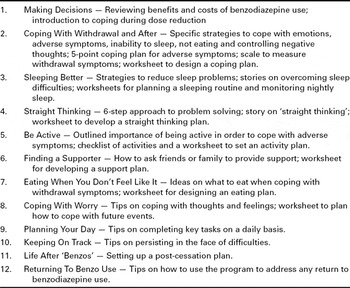
The content of the M-CBT package is summarised in Table 1. It comprised 12 weekly newsletters, together with feedback on assessments and on the progress of their dose reduction.
Contents of Newsletters

Weekly Benzodiazepine Consumption
Participants recorded daily intake of all benzodiazepines taken over a week, regardless of whether the amounts or frequency were as prescribed. They were asked to return record sheets to the researchers in reply-paid envelopes on a weekly basis. Weekly intake was converted to diazepam equivalents to enable comparisons across participants.
Ethical Approval
The study received ethical approvals from the Cairns Base Hospital, The University of Queensland and the Royal Australian College of General Practitioners. The trial was also registered with the Australian New Zealand Clinical Trials Registry (ANZCTR, ACTRN12605000691640).
Results
Participants
Despite extensive marketing, only 36 participants completed the initial screening. Of these, two were ineligible to participate due to dependence on other substances, or had only been prescribed benzodiazepines for a short period of time. Of the remaining 34, 24 completed the initial questionnaire but did not return the assessment and consent form. Ten people completed the initial assessments and were randomised to a treatment group. Four were randomised to immediate CBT and six to delayed CBT. Of these, three subsequently declined to participate due to back pain, family difficulties, and concerns about reducing benzodiazepine dose too rapidly. One potential participant did not return the first benzodiazepine intake form. Since data post-baseline are only available for the six who agreed to start the program, only those case studies are presented below. The random allocation resulted in a multiple baseline with a 3-month delay, and three subjects in each arm.
Participants Receiving Immediate M-CBT
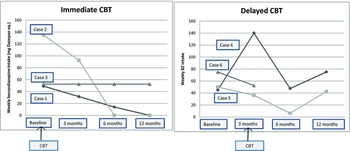
Case 1 was a 42-year-old separated woman who had a bachelor's degree and was working part-time. Two years previously, her GP had prescribed clonazepam 2 mg, which was changed to a daily dose of 7 mg diazepam when she approached the GP about entry to the study. She had previously attempted to reduce her benzodiazepine dose on her own without success. There was non-problematic alcohol use and no tobacco use. In the previous 6 months, she had felt depressed and lacked energy, and reported muscle tension, pain and tachycardia. When she missed benzodiazepine doses, she experienced insomnia, hypersensitivity to stimuli and panic. At baseline she was taking a weekly diazepam equivalent dose of 49 mg, and over the subsequent 12 months her benzodiazepine dose slowly reduced to zero (3 months: 31.5 mg; 6 months: 14.0 mg;12 months: 0).
Case 2 was a 38-year-old married man who had a bachelor's degree and was working part-time. He was originally prescribed benzodiazepines to help cope with ongoing pain from a spinal injury, resulting in limited mobility and confinement to a wheelchair as well as depression. He had previously attempted to cut down benzodiazepine use on his own without success. He reported non-problematic drinking and daily tobacco use. In the previous 6 months, he had experienced depression and a lack of energy. At baseline, daily intake of oxazepam was 90 mg, and he was also taking paroxetine 20 mg. On entry to the program, his weekly diazepam-equivalent intake was 135 mg, which reduced to 92.5mg at 3 months, and to zero at both 6 and 12 months.
Case 3 was a 58-year-old married woman who had completed junior secondary school and was now a pensioner. She had two previous unsuccessful attempts to cease benzodiazepines with GP assistance. Problems over the previous 6 months included a tingling in her face, tiredness and non-specific malaise. She did not drink alcohol or smoke tobacco. She had been prescribed 45 mg oxazepam per day for the past 30 years, originally to reduce anxiety associated with a balance problem, which still occurred. At baseline her weekly diazepam equivalent intake was 52.5 mg. There was no reduction in consumption over the 12 months.
Participants Receiving Delayed M-CBT
Case 4 was a 56-year-old married woman with a college diploma who had multiple sclerosis and was engaged in home duties. She had previously been prescribed tricyclic antidepressants for neuropathic pain, but found that benzodiazepines provided more relief. She had made previous attempts to cease benzodiazepines, but returned to using them because of her pain. During the previous 6 months she had experienced depression and a lack of energy. Missed doses resulted in nervousness, shaking and insomnia. There was no alcohol or tobacco use. At baseline she was taking a weekly diazepam equivalent dose of 45mg. During the period of GP support alone, her weekly diazepam equivalent dose increased to 140 mg. After commencing the M-CBT program she reduced to 17.5 mg, but at 12 months her intake (75.3 mg) was above her baseline level.
Case 5 was a 61-year-old married woman who had completed junior secondary school and was now a pensioner. She had one previous brief attempt to cease benzodiazepine use. While using benzodiazepines there were no adverse symptoms. There was no alcohol or tobacco use. She had been prescribed 20 mg temazepam nocte for the past 4 years to treat Bell's palsy, but this was changed to 7.5 mg nitrazepam shortly after joining the program. Other medical conditions included hypertension, breast cancer and arthritis. At baseline she was taking a weekly diazepam equivalent dose of 50mg. During the period of GP support alone, her intake decreased to 36.3mg. After commencing M-CBT there was a further reduction to 6.3 mg weekly diazepam equivalents. While adverse effects on sleep and family problems resulted in a rebound in benzodiazepine use, her intake at 12 months (42.5 mg) remained below baseline.
Case 6 was a 59-year-old divorced pensioner with junior secondary education. There had been a number of previous attempts to cut down, but they had only lasted a couple of days. During the previous 6 months she had experienced depression, and had agitation and headaches when doses were missed. There was limited alcohol use and no tobacco use. For the past 3 years, 25 mg alprazolam had been prescribed for sleep difficulties, anxiety and panic attacks. Other medical conditions included asthma, diabetes, hypertension, high cholesterol and major depression. At 3 months her intake had reduced to 52.5 mg, but she then withdrew from the project due to distress and therefore did not receive M-CBT.
Immediate Versus Delayed M-CBT
Weekly benzodiazepine intake is summarised in Figure 1. At 3 months follow-up participants allocated to the Immediate M-CBT achieved a mean reduction of 22% (−36%, −31%, 0%) in weekly benzodiazepine intake compared to a mean percentage increase of 51% (−30%, −27%, +211%) for the Delayed M-CBT group. At 6 months, when all participants had received M-CBT, the mean percentage decrease for Immediate participants was 57% (−100%, −71%, 0%) and for the Delayed group was 41% (−87%, +6%). At 12 months, the Immediate group retained a mean percentage decrease of 67% (−100%, −100%, 0%), compared with a mean increase of 26% for Delayed M-CBT (−15%, +67%). Across the whole sample, at 12 months there was a mean percent decrease in benzodiazepine intake of 30%.
Comparison immediate and delayed delivery mailed CBT.

Discussion
Since the initial aim of this research study (to conduct a full-scale randomised controlled trial) was not achieved, the strategies employed this study to engage benzodiazepine users cannot be recommended on this basis.
However, the six case studies suggested that M-CBT may assist individuals to cease long-term benzodiazepine use. Two of the three people in each condition had substantial reductions during M-CBT, although the Delayed group seemed to have greater problems maintaining that improvement, and at 12 months, the only participants to achieve continued abstinence were in the Immediate group. While the result may reflect random variations in the response of this small sample, access to M-CBT in early stages of an attempt to reduce consumption may be especially important. Greater effort and more persistence in attempts to apply M-CBT may be seen at early stages (when motivation of both the patient and practitioner are likely to be at their peak), and early success in being able to cope with withdrawal symptoms may be a critical factor in ultimate success.
Reflection on the current results led to consideration of an alternate delivery method of the content in M-CBT, in order to increase accessibility and widen the potential audience. The newsletter content was subsequently revised to emphasise a self-management framework and removed the requirement for engagement with a GP. The program was then made available as internet-based CBT, with immediate access to all newsletters, and 6 months of email support provided by the first author (Parr, Kavanagh, & Young, Reference Parr, Kavanagh and Young2011).
Additional strategies are clearly required to engage primary health care practitioners in assisting benzodiazepine users to cease use. For many people, ongoing support with management of withdrawal symptoms will be essential to successful cessation. Utilising pharmacists as the primary point of contact may be one strategy. GPs could provide prescriptions with decreasing doses, and pharmacists could then prepackage the medication accordingly and provide information and brief consultations on management of withdrawal and other adverse symptoms. The strategies used here to increase demand by patients for benzodiazepine cessation need reconsideration and given the significant challenges novel approaches using the principles of social marketing should be considered.
Further research is also required into the mechanisms that result in the experiencing of adverse symptoms during dose reduction and the establishment of more effective approaches to enable the cessation of use to occur quickly and without a great deal of discomfort.
Long-term benzodiazepine use remains common, and its important health and functional consequences makes it an important issue to be addressed. The current study both highlighted the challenges in addressing the issue, and identified a potentially beneficial treatment that warrants further study to confirm its effects.