

The problem: the origins of the Industrial Revolution
One of the big questions of economic history, and perhaps of the social sciences in general, is why Western Europe developed into an industrial society and generated a process of ‘modern economic growth’ continuing until today. Before the Industrial Revolution, which, according to most economic historians, occurred in the second half of the eighteenth century, living standards hardly increased at all whereas, in the two centuries after 1820, per capita GDP of the population of the world has grown from 667 dollars in 1820, to 1525 dollars in 1913, and to 6012 in 2000 (all expressed in international dollars of 1990). In the industrialized world, income per head increased by a factor of 15–20.Footnote 1
Before 1800, economic dynamism translated itself mainly in an increase in population numbers. However, in some regions and during limited periods, for example in Sung China, during the Roman Empire, or in medieval Italy, there may have been an increase in GDP per capita that was substantial and quasi-permanent. But these recurring phases of growth all died out after a number of generations, and the countries or empires involved became caught in a ‘high level equilibrium trap’, a term coined by Mark Elvin to describe his views on the stagnation of China after the Sung dynasty.Footnote 2 In short, before about 1800, economic change did not lead to the cumulative growth that was characteristic of the nineteenth and twentieth centuries.
It has been argued recently, most prominently by Kenneth Pomeranz in his book on the ‘Great Divergence’, that, until the eighteenth century, levels of economic development, measured in terms of the standard of living of the population, did not differ much between Western Europe and the rest of Eurasia. In particular, China, Japan, and perhaps also India, were as advanced economically as the European subcontinent.Footnote 3 And yet Western Europe industrialized and, during the nineteenth century, the ‘Great Divergence’ between this part of the world and the rest of the world economy opened up, beginning a process of global polarization that is still plaguing the world economy.
The alternative hypothesis, which can be found in the work of scholars such as Eric Jones, Angus Maddison, and David Landes, is that Western Europe had already developed differently from other parts of the world from the late medieval period onwards. In about 1750, it was already much more dynamic and prosperous than China, India, or Japan. In their view, the Industrial Revolution was not the result of a number of more-or-less accidental factors – almost a lucky coincidence – but the culmination of developments that began long before the onset of industrialization.Footnote 4
The approach: new institutional economics and the efficiency of institutions
In this article, I would like to contribute to this debate on the basis of new insights from New Institutional Economics, an approach that has been developed over the past thirty years to understand processes of long-term economic growth that focus on the quality of the institutional framework that regulates economic exchange. The core assumption of this approach is that efficient institutions (‘rules that constrain behaviour’) reduce transaction costs and thus increase market exchange and specialization, and therefore economic growth. The way to test such a hypothesis would be to develop methods for measuring the efficiency of institutions, and link such measurements to observable economic performance.
Much of the work in this field has, however, focused on the supposed efficiency of certain specific institutions such as merchant and craft guilds, on systems of property rights and tenure (how efficient is sharecropping?), or on the efficiency of the commons and their abolition via enclosures. Typically, new contributions to this literature have suggested that institutions that were previously considered ‘conservative’ and ‘inefficient’, such as guilds and commons, manors, or sharecropping, were surprisingly efficient, if the functioning of these institutions was examined more closely. Guilds, for example, took care of the efficient transfer of knowledge and technology between generations (and between regions via wandering journeymen), stabilized labour and product markets, guaranteed the quality of products (necessary for domestic consumption and export), and were an efficient source of taxation for (local) government.Footnote 5 Some have argued that this sounds too good to be true and that this revisionism ignores the ‘dark side’ of institutions such as guilds – namely that they excluded outsiders (e.g. women), monopolized markets, and tried to suppress innovation.Footnote 6
One of the problems with an approach that tries to determine how efficient different institutions were is that all institutions are embedded in a specific social, political, and cultural context, and therefore are interdependent and interconnected. Moreover, there is a complex relationship between specific institutions and the ‘problems’ they are supposed to solve: particular institutions (such as, for example, a merchant guild) are often associated with more than one problem, and the solution to one particular problem by a specific institution often has consequences for the way other problems are handled as well.
A closely related issue is that it has proved very difficult, if not impossible, to measure the effects of individual institutions on transaction costs and performance. The quantitative measures of the success of institutions that have been developed in the past few decades are almost always proxies of the degree of efficiency of markets. They therefore measure the results of a complex set of interrelated institutions, which, in combination, cause markets to perform better or worse. Hence, they do not measure the effects of individual institutions as such. The discussion on the long-term effects of the Glorious Revolution is a case in point: different ways to assess its impact have resulted in very different measures of its success, or lack thereof.Footnote 7 The point is that the institutions of a given society form a more-or-less coherent system, which makes it almost impossible to assess the efficiency and growth-enhancing effects of individual ‘rules of the game’. It seems that, in order to test the links between institutions and performance that are suggested in the theoretical literature, we have to focus on the institutional systems as integrated wholes to try to establish the effects that they have on growth, rather than try to establish the effect of any specific institutions.
In the light of the ‘Great Divergence’ debate we can specify this question as one about the relative efficiency of the set of institutions governing economic life in Europe and Asia. The question is therefore: can we assess the relative efficiency of the institutions of Western Europe with respect to those in other parts of the world (China, Japan, and India)? If Western Europe appears to have had comparatively high-quality institutions, when did they arise – and why?
The literature suggests a number of ways to assess the quality of the institutional framework of an economy, although the amount of systematic historical research on this issue is surprisingly small.Footnote 8 What I propose here is to develop specific comprehensive measurements to assess the quality of the institutional framework of a society, and to use these measurements to determine how efficient institutions in Western Europe were, and how they compared with institutional frameworks elsewhere.
There are three groups of elements that can shed light on institutional efficiency.Footnote 9 The first group consists of elements that can measure the extent to which institutions guarantee property rights and promote trust. The interest rate is probably the classic measure of the extent to which the institutions in a particular society protect property rights (of debtors and creditors) and enhance the amount of trust in a society, and therefore a low interest rate is arguably the best proxy of the quality of the institutional framework.Footnote 10 Interest rates are not always easy to observe (due to lack of sources), but indirect indicators which are linked to interest rates are: first, the skill premium – the difference between the wage of a skilled labourer and that of an unskilled labourer – which is closely related to the interest rate. The skill premium is the reward for investment in human capital; this investment in human capital involves not earning an income during (for example) an apprenticeship period, in return for the higher income that is going to be earned after the training period. When interest rates are low, a relatively low skill premium will already be sufficient to make such an investment worthwhile. In brief, a low skill premium reflects the trust that one can have in getting future returns on skill formation. Second, the seasonal variation in grain prices, following the seminal paper by McCloskey and Nash, can also be interpreted as a proxy for interest rates (and related storage costs).Footnote 11
A second group of indicators aims to measure the extent of market integration in an economy, the assumption being that efficient institutions reduce transaction costs, and therefore lead to high levels of market integration. Direct measures of market integration are the variability of (annual) prices and the convergence of prices. The variability of prices reflects the extent to which markets are able to cushion shocks via trade: generally, there is low variability in market systems with low transaction costs and high volumes of trade, where such shocks can easily be absorbed by trade, and high variability in poorly developed market systems. The convergence of prices is the extent of correlation and mutual dependence of markets – high convergence points to a highly developed market system and vice versa. Studer demonstrates, in an analysis of grain markets in eighteenth- and nineteenth-century India, that the different criteria for assessing the efficiency of markets – variability of and correlation between markets – yield very similar results, indicating that these measures all relate to the efficiency of the underlying institutions.Footnote 12 In practice, most historical studies of the extent of market integration measure the depth and breadth of the market for grain, but similar methods can and have also been applied to financial markets.Footnote 13
It may be possible to add a third group of indicators, which measure the level of development, concerning the ‘depth and breadth’ of factor markets. Historically, in most societies, members of a household have been able to earn their livelihood by becoming wage labourers, or by keeping the market ‘at arm's length’ via subsistence production. Transaction costs will (partially) determine this decision. When factor markets are weak and unreliable, and trust in markets is low – in short, when transaction costs are high – the alternative of subsistence production will be more attractive than in a situation of perfectly working, reliable markets. Therefore, if a large part of the population is active on the labour market, this may indicate that institutions are efficient and transaction costs are relatively low. On the basis of a similar logic, the extent of participation in the capital market (via savings or borrowing money) may be a proxy of its efficiency.
Theoretically, all these criteria would be expected to point in approximately the same direction. Once institutions are efficient and transaction costs are low, institutional economics predicts low interest rates, high levels of market integration, and dense markets. The factors enhancing exchange also seem to reinforce one another. Economic theory postulates that reputation mechanisms are very important for sustaining exchange, and that they are a key institutional ingredient in any market economy.Footnote 14 Reputation mechanisms cause people to behave well (to keep their promises and adhere to their contracts) because they fear being excluded from future transactions if they renege on promises. Such a sanction will depend on the number of transactions that can be expected in the future (within the network in which the actor operates), and on the interest rate (which connects the value of future transactions to their present worth). In short, people will tend to behave well and enhance trust in their behaviour when interest rates are low and the current value of future transactions is therefore high, and when they expect many transactions to occur in the future.
The level of markets exchange in general, and of interest rates in particular, will therefore explain to a large extent (if this theoretical approach is correct) the efficiency of trade networks and the degree of trust on which they are based.Footnote 15 It also follows that there may be multiple equilibria in the long-term move from thin markets and high transactions costs (and therefore high interest rates) towards high levels of market participation and low transaction costs. It has, for example, been observed that Southeast Asia seems to have been on a trajectory of thin markets and high interest rates for centuries, and was unable to move to another equilibrium.Footnote 16
With this list of criteria for institutional efficiency, we can try to answer the question, how efficient were European institutions compared to those of other parts of Eurasia? The main argument of this article will focus on the first group of criteria, especially on interest rates, because they are the easiest to measure, but other indicators will be used as well.
Global distribution of interest rates and the skill premium
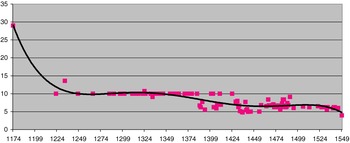
Studies by Clark and Epstein have demonstrated that, in Western Europe, interest rates declined significantly during the late medieval period, and reached a level of 5–6% as early as the fifteenth century.Footnote 17 This level of interest is still ‘normal’ today. These results are consistent with studies by McCloskey and Nash and Poynder that analyse seasonal patterns in grain prices, which also point to a sharp fall in interest rates (and seasonal variation) in the late medieval period.Footnote 18 In addition, Figure 1 provides the results of recent research on interest rates in the Netherlands by Zuijderduijn, showing the typical long-term pattern of the decline in interest rates in this part of Western Europe.Footnote 19
Long-term interest rates (on losrenten) in Holland, 1174–1550. Based on data from Zuijderduijn, Medieval capital markets.

The transition to an economy characterized by relatively low interest rates occurred in Western Europe during the fourteenth and fifteenth centuries, but what do we know about interest rates in the rest of Eurasia? Adam Smith was convinced that interest rates in Europe, especially in Great Britain and the Netherlands, were much lower than in China: ‘twelve per cent accordingly is said to be the common interest of money in China’, he stated, whereas he considered 3–4.5% to be normal in Great Britain.Footnote 20
The extreme of the spectrum of interest rates was probably Southeast Asia. Recently, a discussion has begun about the causes of the ‘high interest rates/thin capital markets’ equilibrium trap, which characterized this region in the seventeenth century and in which it still seems to be trapped.Footnote 21 The ‘normal’ interest rate found by Boomgaard, for example, in an in-depth study of the capital market in Buitenzorg (Bogor, near present-day Jakarta) in 1805, was 40–50%.Footnote 22 In another paper, about interest rates for credit transactions of the East India Company in seventeenth-century South and Southeast Asia, he shows that such high rates were not unusual in Southeast Asia, but that in general they were somewhat lower: 24–36% in Jambi (on Sumatra), 18–24% in Banten (on Java), and about 24% in Thailand. In India, the VOC (Dutch East India Company) paid or received (the Company was both a debtor and a creditor) 12–18% in Coromandel and Bengal, and somewhat less in Surat.Footnote 23 At the same time, in the Netherlands, the Company was able to borrow at 3.5–5%. Other sources confirm that relatively high interest rates were normal in South Asia. Divekar, for example, in his study of ‘prices and wages in Pune region’ quotes sources stating that 24% was considered the usual rate of interest, but that small sums were often borrowed at higher rates (up to 75% for small loans in kind).Footnote 24
But perhaps it is more relevant to look at China, especially the lower Yangtze delta, where, following the research of Pomeranz and Li, relatively advanced institutions were found.Footnote 25 James Shih observed that, during the early Ming period in the lower Yangtze delta, ‘customarily, if one borrowed one shi of rice, one had to pay back two shi after the autumn harvest; if one borrowed money (i.e., silver or copper cash), one had to pay 50 percent yearly interest’.Footnote 26 In the same period (the fifteenth century), the normal return on loans among merchants in Suzhou was a monthly 2%, equivalent to 24% per annum.Footnote 27
In the seventeenth and eighteenth centuries, Chinese interest rates had clearly come down from these very high levels. In an interesting reversal from European patterns, where wealthy merchants were always the source of royal credit, the great salt merchants of Yangzhou borrowed large sums of money from the Imperial Household Department in Beijing at a ‘rock-bottom’ interest rate of 10%.Footnote 28 The best information on eighteenth-century interest rates is in the study by Paul van Dyke on the Canton trade, analysing the many credit transactions between European and Chinese merchants in this period.Footnote 29 Europeans borrowed money from other Europeans (and sometimes from Chinese merchants) at about 10–12% annually, whereas interest rates on loans to Chinese merchants were much higher, at 18–36% (or 1.5–3% per month for short-term loans). We can conclude that Adam Smith was right: interest rates in China were much higher than in Western Europe, even if they probably showed a declining trend.
The available data for Korea point in the same direction, whereas Japan was probably the major exception in Asia. According to Jun and Lewis, the interest rate in eighteenth- and nineteenth-century Korea fluctuated from 25% to 50%, with an average of 37%.Footnote 30 In contrast, studies of the Osaka capital market that emerged in Japan in the seventeenth century indicate that, even from the start, interest rates on credit between the large merchant houses were between 12% and 15%.Footnote 31 Recent research by Saito and Settsu has shown that the long-term trend in Osaka was also clearly downward: interest rates on loans to daimyo (local lords) declined from 12–13% in the first half of the eighteenth century to about 8% in the first half of the nineteenth century, a decline that was also found in other markets.Footnote 32 Although not as low as in Western Europe, these interest rates point to an increasingly efficient way of organizing capital market transactions. When looked at from this angle, the view that Western Europe had already acquired an institutional framework that was relatively efficient in the Middle Ages, more efficient than institutions regulating the capital market and property rights elsewhere, seems to be confirmed by the evidence on interest rates.
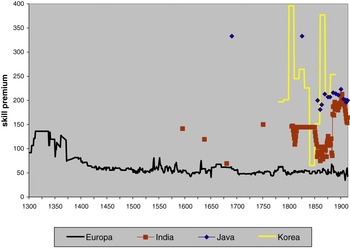
The study of the skill premium (here defined and measured as the difference between the wages of a skilled craftsman and the wage of an unskilled labourer in construction industry) points in the same direction. From the late Middle Ages onwards, the skill premium was quite low in north-western Europe, much lower than in, for example, Korea, India, or Indonesia (see Figure 2).Footnote 33 The timing of the decline of the skill premium in Europe – between 1350 and 1450 – is in fact almost identical to the timing of the decline of the interest rate there, strongly suggesting a link between the two. Two regions seem to have similar levels of skill premiums: the south of China and Japan both probably had a skill premium (and, therefore, efficient institutions regulating the supply of skilled labour) that was comparable to the Western European level, although the evidence for Japan is mixed. The north of China – including Beijing – again had a relatively high skill premium.
The skill premium of craftsmen in construction in Western Europe, India, Java, and Korea, 1300–1914. From van Zanden, ‘The skill premium’.

Market behaviour
A different approach to the same issue, measuring the efficiency of market institutions, is to look at how markets for agricultural products such as wheat or rice actually perform. When transaction costs are low, one would expect high levels of market integration and, because local demand and supply shocks can be cushioned by trade between markets, a low volatility of prices. Söderberg, for example, used measures of the volatility of markets to establish that grain markets in north-western Europe in medieval times were much less unstable than those in the Middle East in the same period.Footnote 34 In the early modern period, some additional increase in market efficiency may have occurred but this has been contested by Bateman, who has pointed out that, by as early as the fifteenth century, levels of market integration were similar to those attained in the eighteenth century.Footnote 35 If Bateman and Söderberg are correct, we have to go back to the late Middle Ages to find the genesis of the efficient markets characteristic of European economic development.
Recent research suggests that Indonesia (in particular Java) is a case of a rather poorly performing market system. Rice markets on Java in the first half of the nineteenth century were extremely volatile, which can be linked to the poor quality of institutions and the low level of commercial development of the region. An analysis of seasonal patterns also demonstrated that Javanese markets performed much more poorly than those of Qing China or early modern Europe.Footnote 36
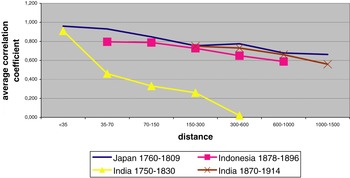
In order to add Japan, China, and India to this comparison, we follow the lead of Shiue and Keller and Studer, who have applied a common methodology to measure the degree of market integration in different parts of the world.Footnote 37 They measure the correlation coefficients between pairs of markets and relate them to the distance between them. There obviously is such a relationship, because transport and other transaction costs will increase with distance. By controlling for this, clear patterns of market integration can come to light. Studer, for example, demonstrated that levels of market integration in eighteenth-century India were rather low, much lower than the high levels found in early modern Europe and China. Shiue and Keller pointed out that, over long distances, Chinese markets seem to have been more integrated than European ones, whereas over short distances correlation coefficients between European markets were (slightly) larger. For Japan, Iwahashi has published a dataset for fourteen market places between approximately 1710 and 1860, which makes it possible to establish the relationship between distance and correlation coefficients. For Indonesia, the first set of similar data relate to 1878–96.Footnote 38
The results are presented in Figure 3. They demonstrate that, in Japan between 1760 and 1809, markets were already highly integrated. The correlation coefficients are comparable to, and sometimes even higher than, those found in Europe and China. For example, on the distance between 150 km and 300 km, European values of the correlation coefficient range from 0.65 (1770–94) to 0.94 (1831–55); for China for 1770–94 the figure is 0.74; and for Japan it is slightly higher at 0.75.Footnote 39 Eighteenth-century India is at the other extreme, at only 0.26. Only in the late nineteenth century, after the transport revolution of railways and steamships, is Indian market integration comparable to that of eighteenth-century Japan. In Indonesia, levels of market integration at the end of the nineteenth century are still smaller than those in Japan in the eighteenth century, which is a striking result.
The relationship between distance and co-variation as a measure of market integration in Japan, Indonesia, and India. From Studer, ‘India and the Great Divergence’; Shiue and Keller, ‘Markets in China’; and author's own calculations, based on Iwahashi, Kinsei Nippon and rice-price data in annual Colonial Reports of Indonesia (Koloniaal Verslag, 1878–1896).

One of the reasons for comparing Japan and Indonesia is that they have a similar geography, making it possible for a large part of the trade to use low-cost coastal shipping. This may help to explain why Japan was able to have such a highly integrated market system as early as the eighteenth century. In Western Europe, levels of market integration were on average much higher in the North Sea and Baltic regions than in the inland zone. The fact that, under similar geographical circumstances, Indonesia performed much more poorly, points to the importance of other factors, such as the efficiency of the institutions regulating exchange.Footnote 40
Finally we turn to estimates of the size and depth of labour and capital markets, which are more difficult to find and to compare internationally. The literature on the development of the labour market in the north-western part of Europe suggests, however, that, by the fourteenth or fifteenth century, a large part of the population – ranging from one-quarter to one-half, and in some cases even more – was active on the labour market during part of the year.Footnote 41 In terms of life cycle, the breadth of the labour market may even have been larger than that. During their teens and (early) twenties, much more than half the population was engaged in wage labour (or as servants, apprentices, etc.), and wage employment was a normal part of the life cycle for almost everybody living in the countryside and the cities of England and the Low Countries.
This feature was linked to the demographic pattern of this part of Western Europe, characterized by small nuclear families.Footnote 42 We have no similar studies for early modern China, India, Japan, or Indonesia, but the general impression that emerges from the relevant literature is that wage labour was much less common there.Footnote 43 The only estimate given in the literature is that in late Ming (sixteenth-century) China perhaps 1–2% of the rural population was engaged in wage labour, a figure much lower than the 30–60% that has been estimated for England and Holland.Footnote 44
It can also be established that, in parts of Western Europe (for example, in Holland), from the late medieval period almost all households participated in capital markets. In a detailed case study of the small city of Edam and its surrounding countryside, Tine de Moor and I were able to reconstruct the degree to which households participated at capital markets, whether poor and rich, and whether headed by men or women. We arrived at the conclusion that a number of institutional adaptations made it possible for almost all households to be very active on capital markets, both for the purpose of saving for their old age (or for the setting up of a household), and for the financing of their economic activities (such as shipping, fisheries, and trade).Footnote 45 The literature strongly suggests that the degree of ‘penetration’ of the capital market was already very high in the late medieval period. Again, it is difficult to find similar studies for other parts of the world.Footnote 46
The conclusion that emerges from this survey of the different measures of institutional efficiency is that Western Europe, from as early as the late medieval period, seems to have had a relatively efficient set of institutions, resulting in low transaction costs, the large-scale involvement of households in factor (and product) markets, and a high degree of market specialization. In particular, the very low interest rates suggest that property rights were respected rather well, and that Western Europe knew a relatively high level of trust, necessary for a smooth working of the market economy. Seen in this light, it does not come as a surprise that, as predicted by new institutional economics, this part of the world was able to generate long-term economic change, and developed from being a backwater of the world economy around 1000 into arguably its most dynamic part in the early modern period. In other words, the genesis of ‘modern economic growth’ in Western Europe was not an accident but the result of the relatively efficient institutions that were characteristic of the region from at least the fifteenth century onwards.
By all measures, the institutional efficiency of Western Europe contrasts sharply with the poor performance of institutions in South and Southeast Asia (India and Indonesia in particular), where markets were much less integrated, interest rates were high, and the skill premium was much higher. Before 1850, labour markets were relatively marginal, even in the more densely populated regions such as Java. Parts of India were the exception here, because we do find relatively high levels of wage labour in a few areas of the subcontinent.Footnote 47
Another important conclusion is that China and Japan seem to represent another road to efficient institutions and resulting economic development. The rise of market economies in eastern Asia was probably linked to the changing attitude of the state towards the market, in China during the Ming period (continued during the Qing) and in Japan during the early years of Tokugawa rule. In both cases, states learned that they could trust the market to take care of the provisioning of the population and the state itself. The state thus more or less withdrew from active intervention in the market economy, which had been characteristic of early Ming China and pre-Tokugawa Japan. In particular, the change in the relationship between state and market under the Ming dynasty was quite radical and, according to some, almost as radical as during the recent period. Whereas, during the early Ming, the state had relied on many forms of coercion to guarantee, for example, the supply of skilled craftsmen to the court and of money and supplies for the army, it gradually withdrew from intervening directly in the market. This led to the economic boom of the late Ming period, which has been described as the ‘second commercial revolution’ in Chinese history (the first one happening during the Sung).Footnote 48 Similarly, the reforms introduced by the Tokugawa led to the rise of a commercial economy centred around Osaka in the seventeenth and eighteenth centuries – an ‘economic society’ is the term used in the Japanese literature.Footnote 49 Typical of the more limited role played by the state in economic life is that, gradually, ‘bottom-up’ institutions such as merchant guilds appeared in Qing China and Tokugawa Japan.Footnote 50
From the (late) seventeenth century onwards, both regions began to show similar signs of institutional maturity in their market system but, in some respects (for example, the participation on the labour market and possibly the depth of the capital market), differences with Western Europe remained large. Moreover, since at least the same level of institutional maturity had already been achieved by Western Europe in the century after 1350, it appears to have had a head start of a few hundred years. When we only look at interest rates and capital market efficiency, the leading position of Western Europe went completely unchallenged: no other part of the world knew interest rates as low as 3–5%, levels which had become usual in seventeenth- and eighteenth-century Holland and England.
Explanations I: the decline of interest rates, 1350–1450
In the rest of this paper, I concentrate on the question of why, from the late Middle Ages onwards, interest rates were so low in Western Europe. There are basically two interrelated explanations. The first one, which can be found in Adam Smith, is that low interest rates in western Europe reflected the relative abundance of capital, resulting from a long process of capital accumulation, which in his view went back to the Great Discoveries of the late fifteenth and sixteenth centuries. He saw this process of accumulation as an inherent part of the general process of specialization that had occurred in the previous centuries, the result of the growing ‘extent of the market’. The second explanation is offered by New Institutional Economics, which has added the insight that capital markets are based on trust and on the protection of property rights, which in turn are based on the quality of the institutional framework of an economy.
Both factors are, I argue, important for understanding the long-term decline of interest rates in medieval Europe. My contention is that the decline from about 10–12% to 5–6% that occurred between 1350 and 1450 (which has attracted most of the attention of economic historiansFootnote 51) can to a large extent be explained by factors related to supply and demand. The first stage of the fall in interest rates, however, which had occurred before 1300, was more fundamental, and related to important changes in the institutional structure of medieval society, which also facilitated the second stage of decline, after 1350. Before turning to the story about institutional change before 1300, a few words about the second phase of capital market development.
The period before the Black Death of 1347–9 – or perhaps before the Great European Famine of 1315–17, which was probably the turning point in many parts of Western Europe – was one of rapid population growth and strong economic expansion. Investment activity was extremely high, both for religious and economic reasons. This was the period during which the great reclamations of agricultural land occurred and the large woods that covered extensive parts of Europe before 1100 disappeared. The basic infrastructure of Europe in terms of roads and bridges was constructed, cities emerged and their walls and churches were built, the countryside became dotted with many thousands of fortified castles, and so on. This spectacular investment boom ended in the first half of the fourteenth century, as is clear from the number of church-building projects started in England in these years.Footnote 52 Furthermore, the process of urbanization, one of the driving forces behind the investment boom, began to slow down during the fourteenth and fifteenth centuries.Footnote 53
The Black Death of 1347–9 suddenly changed the parameters of this economy. Investment activity dropped dramatically, owing to lack of funds and lack of need for investing in new infrastructure. Because the population fell by one-third (ranging from perhaps 20% in the Low Countries to 50% in England), and the capital stock was unaffected by these changes, the ratio between available capital and population changed suddenly. The demand for capital fell dramatically but real incomes went up, which may have increased savings per capita.Footnote 54 At the same time, demographic changes, resulting in the emergence of the nuclear household and the European marriage pattern, also enhanced the supply of savings.Footnote 55 In sum, the marked decline of population between 1350 and 1450 led to an increase in savings per capita and a fall in investment, both favouring a decline in interest rates. The ‘mysterious’ fall in interest rates in this period can easily be explained by these changes in supply and demand. As a result, Western Europe, which had been a capital-scarce and labour-abundant economy before 1315, now became an economy with low interest rates and high real wages.
Explanations II: a wave of institutional gadgets between 900 and 1300
From such an interpretation of the decline of interest rates between 1350 and 1450, it follows that the most important institutional changes making possible the low levels of interest rates characteristic of post-1450 Western Europe may already have occurred before 1300. As Figure 1 suggests, the first phase of the decline of interest rates took place during the twelfth and thirteenth centuries, when they fell from levels that were perhaps rather ‘normal’ in the world economy at the time (about 30% and more) to the 10–12% that was characteristic of pre-1300 Western Europe.
Institutional economics suggests that such a notable decline in interest rates must be related to important changes in the institutions regulating exchange and property rights. In Japan and China, there was a large degree of continuity of the state and its institutions, but efficient institutions emerged (or began to work properly) once the state to some extent withdrew from directly regulating the economy. The story of Western Europe is different: here, a more or less new institutional framework was established in the centuries between 900 and 1300, after the disintegration of the Carolingian Empire had resulted in a power vacuum. In a situation of weak (or absent) states, two forces seem to have spurred the wave of institutional innovation, which began in the final decades of the tenth century and lasted until the middle of the thirteenth century. Michael Mann and the legal historian Harold Berman have stressed the role played by the Catholic Church in initiating a process of ‘top-down’ institutional change, which helped to create the legal system that became characteristic of Western Europe.Footnote 56 At the same time, there was a process of ‘bottom-up’ institutional innovation, as for example argued by Avner Greif and Tine de Moor, who focus on the formation of new institutions such as communes, guilds, and commons, which played a crucial role in the new institutional framework that came into existence.Footnote 57
How did these developments create the preconditions for efficient institutions, making possible low transaction costs and interest rates? Douglass North has argued that the core issue is the protection of property rights of economic agents against the actions of a predatory state.Footnote 58 This implies that those without power – the poor, the peasantry, perhaps even the merchants and the middle classes – have to be protected from those in power, preferably by those in power. An efficient set of institutions therefore creates counterbalances against the ‘natural’ inclination by the wealthy and powerful to use their power for their own purposes.
Which institutions in Europe could possibly have played this role? Let me begin with the ‘idealistic’ part of the story: the legal system that was created. There is a growing interest among economic historians in the importance of different legal traditions and specific legal rules for economic development. It is often assumed that the ‘modern’ law system that emerged in late medieval and early modern Europe was largely the result of the rediscovery of Roman law,Footnote 59 but Berman has argued convincingly that the story is much more complex.Footnote 60 In fact, Roman law was very patriarchical and hierarchical. The emperor was the source of all power in Roman law, in particular according to the sixth-century Justinian code, which was actually rediscovered in the eleventh century. In contrast, the newly emerging European legal tradition considered the king also to be subject to the law itself. According to Berman, the European legal system was instead created as a side effect of the Papal Revolution of 1050–1150, when the Church developed a systematic law, regulating not only the governance of the Church but also large parts of social and economic (and political) life. Moreover, in response to these growing claims by the Church to a decisive influence in secular affairs, the emerging states of Western Europe were induced to develop their own legal systems. The growing attention to law that resulted from this clash led, in combination with the rediscovery of Roman law in the same period, to a rapidly increasing interest in different law systems and their development and (in)consistencies. A legal science was born, most visibly in the new universities that sprung up all over Europe in the next century. These institutions were mainly created to study law and to train scholars able to interpret it.
The following features characterized the new legal ‘system’ that emerged in the Latin West. First, there was strong belief in the rule of law, which applied in principle to all, to the prince as much as to his subjects. Underlying this idea of the rule of law was a strong sense of equality at law, although in practice this was mitigated by the socioeconomic inequality of the period, so that a knight would indeed often be treated differently from a peasant. A second important feature was that there existed a large number of different sub-systems: canon law (governing the Church and its believers), urban law (governing the city and its inhabitants), feudal law (governing the relations between the king and his vassals), manorial law (governing the relations between the lord of the manor and his serfs or free peasants). These coexisted with national law traditions, often based on customary law, but increasingly influenced by Roman law and conscious attempts to engineer legal traditions. This coexistence was a source of dynamic change, and law was increasingly seen as subject to steering and engineering. It was not the product of an immutable past and unchanging customs but forward looking and adapting to changing circumstances. It was not the spontaneous change of ‘tradition’ that was to characterize the European law system, but the regulated change of learned debate (as carried out by the great canonists), of written laws and constitutions and written law books and learned compendia, which became characteristic of the development of the new legal system.
This system of law may have supplied Europeans with the right legal tools to protect themselves against those in power but how did they actually manage to do this? Another key part of the story is the increasing importance of the written word. Monasteries in the tenth and eleventh centuries had begun to issue charters, as written proof that they owned certain properties, and they began to insist that the written word was a more reliable source of ‘truth’ than memory. For the clergy, who monopolized the written word because the knightly elites were largely illiterate, this was an obvious way to strengthen their position. This point of view was increasingly successful, and the written word itself acquired a special significance: it became a superior source of evidence. This development did not occur in the Muslim world, where memory continued to be preferred as evidence.Footnote 61 Laws were only valid when written down, and written evidence acquired a favoured position in court proceedings, being deemed superior to oral testimony based on memory.Footnote 62
For the subjects of kings, this meant that royal power could, in principle, be restricted by the written word. First, kings and courts themselves began to hire clerics, in particular literate men from the monasteries, to issue charters and define the rights and claims of the elite. The subjects followed soon: they understood that they could safeguard themselves against royal predation by having rights that were written down in city charters, or in royal charters such as the Magna Carta, the result of negotiations between subjects and their princes. This strong emphasis on the written word in itself severely limited the power of the king, because ‘real’ power is the power to do whatever one likes to do, unrestrained by any written code. Moreover, power that has been defined in such a way, by writing down what its limits are, is by itself restrained, constrained, and, in a way, constitutionalized.
Explanations III: institutional changes before 1300 – the silent revolution
The written word was therefore, in the long run, an important instrument for citizens to protect their interests against those in power. Yet, one might argue that, in a Hobbesian world where only the power of the sword counts, legal ideas and the written word may still be insufficient to protect the property rights of citizens. What happened during the high Middle Ages was that citizens managed to solve some of the problems of collective action and organized themselves to foster their own interests. This is, again, a long and complex story that can only be summarized here very briefly.
It was perhaps only natural that the collapse of central authority during the ninth and tenth centuries was followed by ‘bottom-up’ attempts by groups of individuals – merchants, and citizens of towns – to protect their property rights. Such initiatives could build on earlier examples. There existed, both in the Mediterranean and in the North Sea basins (building on Germanic customs), traditions of merchants working together, in which religious, social, and economic motives were often intermingled. Conviviality, notably fraternal dinners and drinking parties, was an important ingredient in these still relatively informal ‘merchant guilds’.Footnote 63
Such ‘horizontal’ institutions acquired a new significance during the century of the Investiture Struggle between 1050 and 1150. In northern Italy, the centre of the movement to establish communes (quasi-independent city governments), the first signs of increased stirrings by the inhabitants of towns to gain a larger degree of independence go back to the late ninth century. By the middle years of the tenth century, ‘insubordination grew’ (to quote Jones, who wrote the classic study on the movement) and ‘cities started seeking to limit, regulate, and in some degree appropriate government … developing further the habits if not the institutions of corporative action’.Footnote 64 But the real breakthrough came later: ‘Formal and full self government, the final, crucial transition from “liberties” to “liberty”, civitas to commune, was the work of the later eleventh century, more precisely the critical years from 1075 to 1122’, when the cities were greatly helped by the imperial–papal schism.Footnote 65 This link between the rise of the communes and the ‘general turmoil’ of these years has also been documented by John Hyde, who gives examples from Pisa (1081), Genoa (1056), and Bologna to make the point.Footnote 66
Communes were ‘personal, sworn associations’ of the inhabitants of a town, who in this way became true ‘citizens’, to defend and strengthen the rights of the town. Councils and parliaments were an integral part of the organization of the commune, which showed ‘quite a high degree of participation in the making of decisions’.Footnote 67 By the middle of the twelfth century, almost all cities in northern Italy were governed by more-or-less independent communes, an independence that was recognized at the Peace of Constance (1183), after Emperor Frederick had been defeated by the Lombard League of Italian cities.Footnote 68 Charters – in this case, the peace treaty of Constance – played a crucial role in the process. Cities jealously collected these ‘privileges’, deriving much strength from written evidence of their ‘liberty’.
A second, more-or-less independent centre of the communal movement was northern France and neighbouring Flanders. From the 1070s onwards, starting in Le Mans (1070) and Cambrai (1077), the communal movement began to spread to a large number of large (and small) cities in north-western Europe.Footnote 69 Within half a century, the movement had spread to the major cities in Flanders, to the main city in the northern Netherlands (Utrecht), to many cities in the north of France (Laon had a famous commune between 1109 and 1112), and to Cologne.Footnote 70
There are close links between the model of the ‘commune’ and that of the ‘guild’. Sometimes merchants guilds preceded the establishment of a commune, and sometimes guilds were set up after some measure of self-government of the city was realized. In Italy, guilds followed communes. Jones typifies guilds as ‘new organizations, products and instruments of expansion’, which ‘developed from the early twelfth century, comprising at first – except in the most commercial cities, Venice and partly Genoa, where trade interests required no incorporation – societies of mainly merchants and professional groups, justices and notaries (and in time even schoolmasters), then unions of shopkeepers and artisans’.Footnote 71 In England, northern France and the northern Low Countries, rudimentary merchant guilds appeared on the scene before the communal movement. The best example is probably the merchant guild from Tiel, in existence at about 1000.Footnote 72 In England, where the communal movement was less strong, owing to the greater power of the monarch, merchant guilds may to some extent have been a substitute for the growth of communal power.Footnote 73
From the eleventh century onwards, these initiatives were given a much greater degree of continuity because, out of these relatively informal groups, corporate ‘bodies’ emerged. This was one of the key concepts developed during the legal revolution of the eleventh and twelfth centuries. The core was the legal idea of treating a collective body of people as a unit, a corporation or universitas.
Legally a corporation (universitas) was conceived of as a group that possessed a juridical personality distinct from that of its particular members. A debt owed by a corporation was not owed by the members as individuals; an expression of the will of a corporation did not require the assent of each separate member but only of a majority. A corporation did not have to die; it remained the same legal entity even though the persons of the members changed.Footnote 74
This idea of a ‘group’ forming one single juridical entity, the existence of which became independent of that of the individual members of the group, was already quite old. The church was such a ‘body’; monasteries and fraternities (the latter also a relatively recent development) could be seen as ‘bodies’ as well. Muslim law knew the waqf, a foundation of which the aims could (in principle) not change once it had been founded.Footnote 75 By contrast, the medieval universitas was much more flexible, for the majority of members could in principle change its rules. This also gave the universitas a distinct ‘democratic’ flavour: the rules of the body could indeed be changed when the members so decided, which meant that one needed institutions – meetings of members, (elected) councils representing the members – that could do so.
Greif has argued that these merchant guilds helped to solve the ‘fundamental problem of exchange’ by regulating the ‘community responsibility system’, and in this way lowered the transaction costs of economic exchange.Footnote 76 The point made here, building on a tradition going back to Weber and Pirenne, is that this ‘bottom-up’ movement changed the political economy of Western Europe in a fundamental way by solving some of the collective action problems of citizens. They were the third building block of the new institutional structure that emerged, together with the new legal system and the increased importance of the written word. They formed the real countervailing power that limited the predations of the newly arising states of Western Europe. Through the further development of the institution of citizenship, they helped to solve some of the coordination and commitment problems inherent in the process of state formation that began in these centuries.Footnote 77
Moreover, these universitates were relatively efficient modes of developing new institutions. The rapid growth of market exchange during the eleventh to thirteenth centuries meant that new rules had to be invented and implemented about how to regulate the market. In fact, this was about how to ‘invent’ the market, as the market itself was and is a set of rules. These corporate bodies were grassroots organizations, whose members knew from experience what the problems were, and therefore could develop new rules (or copy ideas developed elsewhere) about the desired and optimal way of organizing market exchange. The flexibility of these corporate bodies lay in the fact that the members, in principle, had certain democratic rights to change the rules, although quite often they needed the permission of a ruler to do this. An amendment of the privileges of the guild or the city required the approval of the city or the king, but this obviously fitted with the negotiability of power that became the norm in the same period. At the same time, these corporate bodies guaranteed the stability of the market environment. They were in principle ‘eternal’, survived the generations, and therefore offered the stability that was necessary for regular market exchange. In short, these corporate bodies were good ‘instruments’ in the search for efficient institutions that could govern market exchange.
Conclusion
Economic historians tend to believe that efficient institutions are necessary for economic development. This article explores ways of measuring the efficiency of institutions in pre-industrial Eurasia by looking at a number of indices linked to institutional performance: interest rates, skill premiums, market integration, and participation on labour and capital markets. It appears that Western Europe during the Middle Ages was already developing an institutional structure that protected property rights and enhanced trust to such a degree that parts of the sub-continent (in particular the North Sea area) moved towards what might be called a ‘modern market economy’, in which households participated in factor and produce markets on a unprecedented scale.Footnote 78 By these measures, South and Southeast Asia do not seem to have developed equally efficient institutions, whereas late-Ming and Qing China, and Tokugawa Japan, displayed similar tendencies towards a maturing of the institutional framework. In China and Japan, an important cause of the development towards more efficient institutions was the changing role of the state in the economy, which to some extent withdrew from direct control of the economy, whereas in Western Europe ‘bottom-up’ changes seemed to have played a large role.
To explain the early rise of relatively efficient institutions in medieval Europe, I have used North's hypothesis as a starting point, namely that the quality of these institutions was related to the way in which they protected the powerless against the powerful. Three interrelated developments occurring during the 950–1300 period seem to have been important: the emergence of a new legal system, the growing importance attached to the written word, and the rise of organizations solving the collective action problems of citizens. Together they help to explain why Western Europe had a different political economy – that is, a different set of power relationships between social classes and the state – than other parts of Eurasia. Whereas, in other societies, ultimate power rested in the hands of the emperor or the king, and was therefore (in theory) ‘one and undivided’, in Western Europe kings had to share power with bishops and abbots, and lords had to share with cities and their citizens. Power not only became constitutionalized, but also became the subject of negotiations between power holders: between kings and bishops, or kings and cities, and, at a lower level, between city governments and guilds.
The emergence of efficient institutions for market exchange was an essential precondition for the dynamic economic development of Western Europe in the centuries before the Industrial Revolution. It should be added that it is only part of the story. During the Middle Ages, economic growth was a pan-European process, occurring everywhere in the Latin West. This changed after the fifteenth century: from then onwards, growth was increasingly concentrated in the North Sea area, which profited most from the Atlantic economy emerging after 1492, but initially owed this advantage to different institutions at the micro level of the household.Footnote 79 It was in the North Sea area that a process of cumulative investment of human capital and knowledge began that would, in the eighteenth century, result in the emergence of an industrial society.
How, in the very long run, did these institutional changes in the Middle Ages result in the industrialization of the late eighteenth century? Low interest rates were an important feature of the European development path between the late Middle Ages and the Industrial Revolution. They stimulated the development of capital-intensive technologies and enhanced investment in human capital (because it lowered the opportunity costs of schooling and training). The decline of interest rates in late medieval Europe was part of a much broader process: recent work by a team of scholars led by Peter Lindert focusing on the study of relative prices and wages in the very long run has produced new ideas about the distinct features of Western Europe's economies.Footnote 80 This team demonstrated that ‘Northwest Europe led in the development of non-agricultural productivity concentrated in the capital-goods and knowledge-intensive sectors’, and had, in fact, an early comparative advantage in ‘high-tech’ products, which required large amounts of human and physical capital. This comparative advantage in high-tech and highly skilled work had important long-term consequences. For example, it meant enlarged capabilities for producing guns and ships and other weaponry, and in this way formed the basis of the ‘military revolution’ of the fifteenth and sixteenth centuries, which made it possible to conquer and rule increasingly large parts of the globe.Footnote 81 It made possible the rapid adoption of a new ‘high-tech’ mode of producing and disseminating information: the printing press, ‘invented’ by Gutenberg in the 1450s, which laid the basis for a rapidly growing industry that was to transform the ‘knowledge economy’ of Western Europe.
The development of labour-saving technologies and the increase in human-capital formation made possible the emergence of a high-wage economy in the North Sea region in the early modern period. Recent research has uncovered that real wages in England and Holland in the early modern period were substantially higher than in the rest of the continent, and higher than in the most developed parts of China and Japan.Footnote 82 Moreover, as Robert Allen has recently argued, relative prices were an important factor behind the Industrial Revolution.Footnote 83 The mechanism driving the process was substitution: England in the eighteenth century had become a high-wage economy, at least by international standards, which prompted the search for new technologies to save on labour.Footnote 84 This process was feasible because energy and capital goods were relatively cheap, which was due, in addition to other factors, to easy access to coal, a low skill premium, and low interest rates. Thus, new technologies in textiles, mining, the iron industry, and general purpose technologies such as the steam engine were developed, which increased labour productivity and used large amounts of energy and capital. So the Industrial Revolution occurred in a society that was already a ‘high-wage economy’ with low interest rates and a cheap supply of human capital. The new technologies that emerged in eighteenth-century England made it possible to sustain a development path that had already begun during the high Middle Ages.