Introduction
Amino acid metabolism, especially the regulation of amino acid homoeostasis, is of key importance for all terrestrial life forms. How such metabolic systems could have evolved and functioned before the emergence of enzymatic networks remains a critically important unanswered question in the context of the origins of life. It has been frequently suggested that the emergence of primordial metabolism may be postulated as a continuum from Earth's geochemical processes to chemoautotrophic biochemical procedures on mineral surfaces (Russell & Hall Reference Russell and Hall1997; Russell & Martin Reference Russell and Martin2004; Wächtershäuser Reference Wächtershäuser2007). Some of the biochemical steps in extant life forms may be vestiges of certain early pre-enzymatic geochemical processes (Wächtershäuser Reference Wächtershäuser1988). To uncover the chemical origins of life, one can detect the biochemical pathways shared by all organisms in the geochemical reaction models (Smith & Morowitz Reference Smith and Morowitz2004; Morowitz & Smith Reference Morowitz and Smith2007).
Sulphide mineral surfaces in hydrothermal systems have often been argued as likely sites for the emergence of archaic metabolism (Russell & Hall Reference Russell and Hall1997; Russell & Martin Reference Russell and Martin2004; Wächtershäuser Reference Wächtershäuser2007). The minerals could have acted as a catalyst, a template and a power source for the prebiotic synthesis of biomolecules and the crucial evolutionary nascence of ancient metabolic pathways (Wächtershäuser Reference Wächtershäuser1988; Hazen Reference Hazen2001). This intriguing scenario makes sense because in the hydrothermal systems an ideal environment for the emergence of life was created by nature and many primitive organisms were found (Russell & Hall Reference Russell and Hall1997; Amend & Shock Reference Amend and Shock1998; Martin et al. Reference Martin, Baross, Kelley and Russell2008). More convincing is the fact that transition metal sulphides, which are the main constituents of hot spring precipitates, are still playing a crucial role in certain enzymes in all extant life forms (Beinert et al. Reference Beinert, Holm and Münck1997; Mulkidjanian & Galperin Reference Mulkidjanian and Galperin2009; Dupont et al. Reference Dupont, Butcher, Valas, Bourne and Caetano-Anollés2010). On the basis of these arguments and findings, some surface reactions in aqueous metal sulphide systems have been developed in the last two decades to mimic basic biochemical steps, and many interesting results have been achieved (Huber & Wächtershäuser Reference Huber and Wächtershäuser1997; Huber et al. Reference Huber, Eisenreich, Hecht and Wächtershäuser2003; Zhang & Martin Reference Zhang and Martin2006; Wächtershäuser Reference Wächtershäuser2007). In the literature of prebiotic evolution, however, little attention has been paid to the primordial emergence of biomolecular homoeostasis (Wang et al. Reference Wang, Yang, Qu, Liu and Su2011).
For prebiotic amino acid metabolism, therefore, it is of pivotal importance for the scenario to demonstrate that a biochemical pathway may proceed on a mineral surface. The question is whether we can use our knowledge of biochemistry and geochemistry on Earth to establish a geochemical model for identifying a basic biochemical reaction. As is well known, reversible amination of α-oxo acids takes place in the synthesis of most proteinic amino acids, catalysed by transaminase or glutamate dehydrogenase (GDH) (Berg et al. Reference Berg, Tymoczko and Stryer2002). The latter enzyme-assisted reaction is a reversible redox one, proceeding in two steps as follows:

In the forward direction, first a Schiff base intermediate forms between ammonia and α-ketoglutarate (α-KG). With GDH, the Schiff base is then reduced by the transfer of a hydride ion from NAD(P)H to form glutamate (Glu). The whole process is reversible. On the other hand, the mineral sphalerite (ZnS) is a prevalent constituent at the periphery of hydrothermal deposits (Edmond et al. Reference Edmond, Campbell, Palmer, Klinkhammer, German, Edmonds, Elderfield, Thompson and Rona1995). As a common semiconductor, it can absorb UV photons to produce photoelectron/hole pairs and catalyse redox reactions. The reaction of the photoelectron with an adsorbate leads to the reduction of the adsorbate, while the hole induces oxidation reactions. Therefore, it can be speculated that ZnS might have acted as a photocatalyst to trigger the reversible redox reaction in equation (1), providing an abiotic archetype for the GDH-promoted biochemical process before the emergence of life. Our focus has been on this promising means of prebiotic amino acid metabolism. Laboratory experiments have shown the reversible amination of a couple of α-oxo acids on UV-illuminated ZnS particles (Wang et al. Reference Wang, Li, Yang, Liu, Yang and Su2012b).
In the present work, in order to clarify the reaction mechanism and optimize the reaction conditions, the influence of several variable reaction parameters such as pH, temperature and hole scavenger on the reaction efficiency of the ZnS-assisted GDH-like chemistry (equation (1)) has been investigated in detail. Then, we extended the ZnS-photo-promoted reaction model to a set of other α-amino acids and their corresponding α-oxo acids, and evaluated the effect of their side chain groups on the reversible photocatalytic reactions. Finally, we discussed the potential connection between the suggested reaction model and the emergence of primordial redox metabolism.
Materials and methods
Materials
l-amino acids >99% and α-keto acids (>98%) were purchased from Solarbio and Sigma, respectively. All other chemicals (Sinopharm Chemical Reagent, China) were obtained in analytical grade, with the exception of methanol and acetonitrile that were of chromatographic grade. Ultrapure water (Millipore) was deoxygenated with high purity argon gas (99.999%) by bubbling it through 1 litre of water (1 litre min−1) for 1 hour. The deaerated water was used throughout.
Preparation of ZnS
ZnS was prepared by stirring with dropwise adding 100 ml of 0.2 M Na2S to 100 ml of 0.2 M ZnSO4. The freshly precipitated ZnS solid products were collected by filtration, washed with 100 ml of deionized water five times, sucked as dry as possible and then calcined for 2 hours at 100 °C in high purity nitrogen flow. The heat-treated ZnS was ground to 120 mesh before use.
Photochemistry experiments
All photochemical reactions were conducted under argon atmosphere by using a self-devised experimental system with a temperature-controlled water bath and a 500 W mercury–xenon lamp (Wang et al. Reference Wang, Li, Yang, Liu, Yang and Su2012a, Reference Wang, Li, Yang, Liu, Yang and Sub, Reference Wang, Qu, Yang, Liu and Suc). In a typical run, a 60 ml of quartz conical flask was charged with 2 mmol of ZnS, 1 mmol of amino acids (or 1 mmol of keto acids and 100 mmol of NH4Cl). Na2S and Na2SO3 were added as the hole scavengers when required. The final volume of the reaction solutions is 50 ml by surcharging water. The solution pH was adjusted as described by using NaOH and H2SO4. The ZnS suspension was kept stirring (1000 rpm) during the reaction.
Sample analysis
After irradiation for a selected time period, the yields of the major products including α-keto acids, amino acids and hydroxy acids were analysed using HPLC methods (Wang et al. Reference Wang, Yang, Qu, Liu and Su2011, Reference Wang, Li, Yang, Liu, Yang and Su2012a, Reference Wang, Li, Yang, Liu, Yang and Sub, Reference Wang, Qu, Yang, Liu and Suc).
Results
GDH-like chemistry
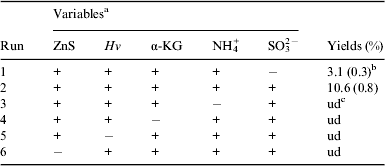
In efforts to model the amination reaction in equation (1), we tried mixtures of ammonia and α-KG in anoxic ZnS suspensions. A typical experimental mixture consisted of 1 mmol of α-KG, 100 mmol of NH4Cl, 10 mmol of Na2SO3 and 2 mmol of ZnS particles (100 mesh) in 50 ml water. After being irradiated by a 500 W mercury–xenon lamp for a selected time period, the yields of glutamate were analysed by using HPLC. The results are listed in Table 1. About 3.1% of α-KG was transformed into glutamate after being irradiated for 4 hours at pH 10 (run 1).
Control experiments to determine the mechanism for the reductive amination of α-KG on ZnS particles
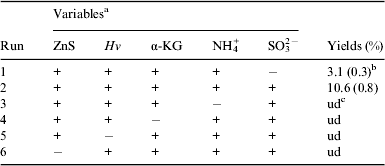
a ‘ + ’ and ‘ − ’ indicate the presence and absence of a species, respectively.
b Each value is the average of three independent repeat experiments; numbers in parentheses are standard deviations of the mean. Reaction conditions: 1 mmol of α-KG, 100 mmol of NH4Cl, 10 mmol of Na2SO3, 2 mmol of ZnS, pH 10, 30 °C, 4 hours.
c Undetectable.
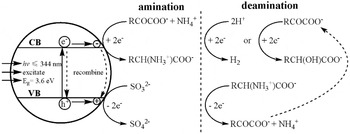
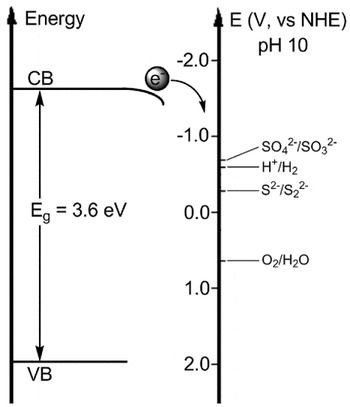
This observation can be explained by the photoelectrochemical properties of the semiconductor. ZnS has a fundamental threshold energy for the absorption of photons. The critical energy, which is termed the band gap (E g), is 3.6 eV. This means that the absorption of a photon with a wavelength shorter than 344 nm by a ZnS particle can create a photoelectron (e−) in conduction band (CB) and leave behind a positive charge, termed a hole (h+) in valence band (VB) (Fig. 1). The fate of the excited charges tends to fall into two camps: migrate to the semiconductor surface or recombine in the volume of the particle (Chen et al. Reference Chen, Shen, Guo and Mao2010). The migrated charges may also recombine. However, if an organic or inorganic species is pre-adsorbed on the surface, the separated electron and hole may transfer to the species and catalyse redox reactions. From an electrochemical point of view, the probability and rate of the charge transfer processes depend upon the relative positions between the band edges and the redox potential levels of the adsorbate. The energy level of the conduction band of ZnS lies at −1.63 V (pH 10, the same hereinafter if no specification is provided) (Xu & Schoonen Reference Xu and Schoonen2000), which is strong enough to induce the reductive amination of α-KG.
Photodriven amination and deamination reactions on semiconductor surfaces.

As stated above, the reductive amination of α-KG to produce glutamate would be an important CB reaction pathway on UV-illuminated ZnS surfaces. A second CB reaction may be the reduction of α-KG. However, since there existed excessive ammonia in the alkaline samples, the equilibrium α-KG + NH3 ↔ Shiff base (equation (1)) almost completely shifted to the right side, towards the Shiff base. As a result, we detected no α-hydroxyl glutarate, the reduction product of α-KG, in the samples.
In the reductive amination reaction system, as well as e− − h+ recombination, the photo-generated holes are mostly consumed by the following two reactions:
 $${\rm ZnS} + {\rm 2h}^ + \to {\rm Zn}^{{\rm 2} +} + {\rm S} \ E = + 0.0{\rm 1}\;{\rm V,}$$
 $$\alpha - {\rm KG} + {\rm h}^ + \to {\rm Products}{\rm.} $$
All the three processes (e−–h+ recombination, ZnS photocorrosion and α-KG degradation) would competitively inhibit the synthesis of glutamate. A desirable solution to these problems is the use of a hole scavenger with a very negative reduction potential. Sulphite is a good reducing species (E sulphite/sulphate = − 0.69 V). It acts as a sacrificial agent and competes against other species to provide electrons to fill the holes,
 $${\rm SO}_{\rm 3} ^{{\rm 2} -} + {\rm 2OH}^ - + {\rm 2h}^ + \to {\rm SO}_{\rm 4} ^{{\rm 2} -} + {\rm H}_{\rm 2} {\rm O}{\rm.} $$
Therefore, it helps not only to avoid the decomposition of ZnS and α-KG (Eqns. 2 and 3), but also alleviates the e−–h+ recombination and produces CB electrons more efficiently. By adding 10 mmol of Na2SO3 to the experimental solution we found that the yield of glutamate was enhanced more than three times (run 2, Table 1).
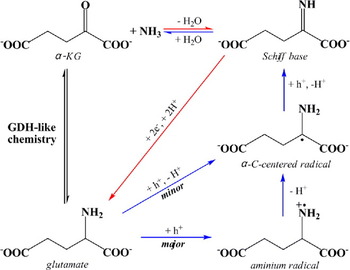
In order to further confirm the suggested mechanism, a set of control experiments have also been conducted. With no NH4Cl or α-KG (runs 3 and 4, Table 1) or without exposure to irradiation (run 5), no trace of glutamate was found. Although SO32− has a negative redox potential (−0.69 V) and is known as a good reducing agent, photoreduction never occurred under irradiation in the absence of ZnS (run 6). Therefore, it can be concluded that the photoelectron transfer from ZnS surface to Schiff base intermediate is the mechanism for the formation of glutamate (Fig. 2).
Schematic diagram of the correlation of the energy levels between a ZnS semiconductor and reducing agents considered in this study. The energy levels were calculated for an aqueous solution using standard electrode potentials with the Nernst equation at 25 °C. All redox potentials here were expressed relative to the normal hydrogen electrode (NHE).

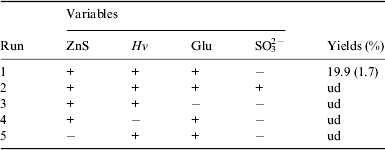
On the other side, the GDH-catalysed amination of α-KG is reversible, as mentioned above (equation (1)). In order to simulate the back reaction, we tried 1 mmol of glutamate in photo-illuminated ZnS suspensions. Table 2 shows the formation of α-KG under different experimental conditions. About 20% of glutamate was turned into α-KG after 2 hours at pH 10 (run 1). In the absence of the substrate, the light, or the catalyst, no trace of α-KG was formed (runs 3–5). In addition, if 10 mmol of Na2SO3 was introduced into the solution, there was also no detectable deamination product after the same reaction time. The sulphite forcefully competed with glutamate to be oxidized by the hole and therefore inhibited the formation of α-KG (run 2). The complete set of control experiments implies that the oxidation of glutamate is driven by the ZnS-assisted photochemical reaction.
Control experiments to demonstrate that the oxidative deamination of glutamate is driven by the ZnS-assisted photochemical reaction
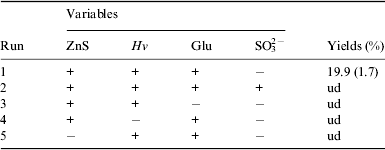
Reaction conditions: 1 mmol of glutamate, 10 mmol of Na2SO3, 2 mmol of ZnS, pH 10, 30 °C, 2 hours. For the signs and abbreviations, please refer to Table 1.
For the oxidative deamination process, a suggested mechanism is presented in Fig. 3. In water at pH 10, the carboxyl group of glutamate is dissociated, while the amino group is unprotonated, with the nitrogen atom owning an unbonded lone electron pair. These groups are both electron-donating substituents, making the α-C atom have an excess of electron density. When the amino acid molecule attached itself to a ZnS surface, the photo-generated hole (E = + 1.97 V) would grab an electron from one of the two electron-rich sites (N and α-C atoms). As a result, an aminium radical or an α-C-centred radical was formed. We have no information to distinguish these two reaction channels. However, previous studies using another oxidative species, i.e., the hydroxyl radical (E = + 1.95 V in basic solution), have demonstrated that aminium radical is the dominant one-electron oxidation product. It can spontaneously evolve into the α-C-centred form by releasing a proton (Rustgi et al. Reference Rustgi, Joshi, Moss and Riesz1977; Bonifačić et al. Reference Bonifačić, Štefanić, Hug, Armstrong and Asmus1998). Subsequently, the α-C-centred radical underwent another one-electron oxidation process to an α-imine which is then hydrolyzed to give α-KG and ammonia.
Reaction mechanisms for the photocatalytic GDH-like chemistry on ZnS surfaces, including the reductive amination of α-KG (red line) and the oxidative deamination of glutamate (blue line).

So far, we have experimentally demonstrated that a photo-illuminated ZnS surface can catalyse the reversible amination of α-KG. In organisms this process is driven by GDH. Thus, we call it GDH-like chemistry (Fig. 3). The rates of the direct and the back reactions vary with experimental conditions and show completely opposite dependence on hole scavenger concentration. In order to optimize the product yield, therefore, a detailed further investigation has been conducted. The attempts were focused on the influence of a couple of environmental variables on the catalytic efficiency of ZnS.
Effect of pH
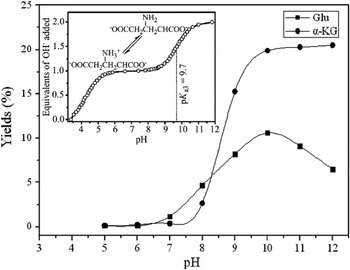
In Fig. 4 are represented the yields of glutamate and α-KG as a function of pH in the amination and deamination experiments, respectively. Besides pH, all other conditions were the same as those described in Tables 1 and 2. For the reductive amination of α-KG, the maximal photocatalytic activity of ZnS was observed at pH 10. The pH did not change during irradiation since it was highly buffered by an ammonium–ammonia equilibrium. The decrease of the yields of glutamate above pH 10 was attributed to the weaker concentration of protons. Below pH 8, the glutamate production decreased drastically, reaching a near-zero value at pH 5. It appears that the optimum pH is related to the ionized state of the amino source. The pK a of ammonia is about 9.2. Under neutral or weakly acidic conditions, therefore, it is protonated to make ammonium ions, inconducive to the formation of the Shiff base intermediate (Fig. 3).
Yields of glutamate and α-KG versus pH of the solution. The upper left inset shows the titration curve of glutamate which was experimentally performed by dropwise adding 0.1 M NaOH to 20 ml of 0.1 M glutamate.

For the oxidative deamination of glutamate, the photocatalytic efficiency of ZnS depended more strongly on the pH of the solution. Higher pH (>9) favoured α-KG production. The yield of α-KG decreased sharply by almost 80% for a drop of one pH unit from pH 9 to 8. At pH 5, the yield of α-KG was below the detection limit even after a prolonged reaction time (6 hours). The dependence of the production rate on pH approximately tracks the titration curve of glutamate (the inset in Fig. 4), suggesting that the protonated state of glutamate could occur in the rate law of the limiting step. Below pH 8, the lone pair of electrons on nitrogen atom is donated to an electron-deficient hydrogen ion thereby forming a dative covalent bond. Along with the increase of pH, the quaternized amino group gradually becomes deprotonated. By comparison, amino acids in the latter form are much more reactive with an oxidative species than the zwitterionic form (Easton Reference Easton1997; Buxton et al. Reference Buxton, Greenstock, Helman and Ross1988). Under basic conditions, the unbounded lone electron pair makes the α-amino group react more easily with the photo-generated holes to form the radical intermediates (Fig. 3), resulting in a higher yield of α-KG.
Temperature dependence
The temperature dependence of the amination and deamination reactions has been studied in the range of 30–60 °C. However, the results show that the production of both glutamate and α-KG is independent of temperature in the studied temperature range (see details in the supplementary material available at http://dx.doi.org/10.1017/S1473550412000432). Therefore, the following experiments were all conducted at 30 °C.
Influence of the hole scavenger
In the hydrothermal systems where sulphide mineral is formed, vent fluids at some sites may carry traces of SO2 in addition to H2S, produced by magma degassing. Both these reducing species could participate in the primeval photochemical reactions in their anion forms, acting as the hole scavenger. Their influence on the production of glutamate and α-KG was measured for the oxidation of SO32− and S2− ions.
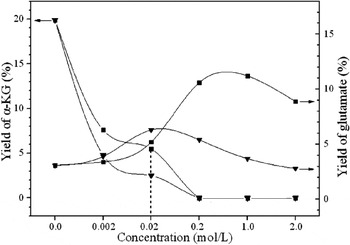
In the case of oxidative deamination of glutamate, as shown in Fig. 5, the rate of α-KG production in both media sharply decreased by increasing the hole scavenger concentration, especially when the amount of the sacrificial agent is in stoichiometric excess over the initial glutamate concentration. The presence of 0.2 M either sulphide or sulphite entirely inhibited the formation of α-KG because they forcefully competed with glutamate to be oxidized by the photo-generated holes at the surface of ZnS. The suppressing effect of sulphide was more significant than that of sulphite since the former has a stronger electron-donating capacity. In addition, sulphide oxidation in an alkaline medium mainly yields yellow disulphide ions (Reber & Meier Reference Reber and Meier1984). It happens according to
 $${\rm S}^{{\rm 2} -} + {\rm h}^ + {\rm} \to {\rm S}^ - {\rm,} $$
 $${\rm S}^ - + {\rm S}^ - \to {\rm S}_{\rm 2} ^{{\rm 2} -} $$
or
 $${\rm S}^{{\rm 2} -} + {\rm 2h}^ + \to {\rm S,} $$
 $${\rm S}^{{\rm 2} -} + {\rm S} \to {\rm S}_{\rm 2} ^{{\rm 2} - {\rm}}. $$
In the suspension, a yellow colour appeared immediately after exposure to the light and became deeper with the lapse of time. The yellow disulphide inhibited the oxidation of glutamate by reducing the light absorption of ZnS.
The influence of different hole scavenger species (■, Na2SO3; ▼, Na2S) and concentrations on the production of glutamate and α-KG. All lines are drawn to aid the eye but not to fit the plotted points. The dashed line shows the concentration of the initial organic substrates.

Concerning the reductive amination of α-KG, on the contrary, the rate of glutamate formation was enhanced by increasing the amount of the hole scavenger. However, excessive sulphide and sulphite did not further improve the yield of glutamate because of their UV absorption which is concentration dependent and their inhibitory effect on the diffusion of the organic species to and from ZnS surfaces. The results also indicate that sulphide did not act as a good electron donor compared with sulphite because of its transformation into disulphide. At lower concentration levels, the promoting effect of sulphide on the synthesis of glutamate was stronger than that of sulphite. With increasing concentration, however, it was exactly the reverse. This is because the newly formed disulphide ions not only acted as an optical filter, but could also compete with the Shiff base to react with the photoelectrons according to
 $${\rm S}_{\rm 2} ^{{\rm 2} -} + {\rm 2e}^ - \to {\rm 2S}^{{\rm 2} -} {\rm.} $$
Other amino acids
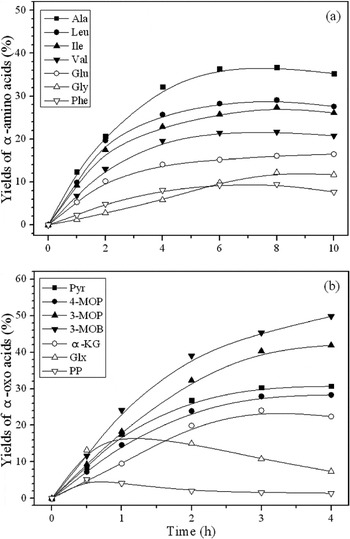
To identify the reversible amination reaction with more certainty, we extended the application of the ZnS-photo-promoted reaction model to a set of other α-amino acids and their corresponding oxo acids. In Fig. 6, the amount of each product formed during the photoreaction is expressed as a function of irradiation time. The time-dependent results of glutamate and α-KG are also represented.
Photocatalytic reversible transformation between α-amino acids and oxo acids on ZnS surfaces. Reaction conditions: 1 mmol of amino acids (or 1 mmol of oxo acids + 100 mmol of NH4Cl + 10 mmol of Na2SO3 + 10 mmol of Na2S), 2 mmol of ZnS, pH 10, 30 °C. Abbreviations of amino acids and their corresponding oxo acids: alanine (Ala)/pyruvate (Pyr); leucine (Leu)/4-methyl-2-oxo-pentanoate (4-MOP); isoleucine (Ile)/3-methyl-2-oxo-pentanoate (3-MOP); Valine (Val)/3-methyl-2-oxo-butyrate (3-MOB); glycine (Gly)/Glyoxylate (Glx); phenylalanine (Phe)/phenylpyruvate (PP).

It can be observed that neutral amino acids, especially those with a long aliphatic side chain, behaved more effectively in both the amination and deamination reactions. Regardless of their differences in reaction activity, a possible explanation for this trend is that higher the non-polarity of the side chain, more accessible the reactants are to the hydrophobic surface of ZnS and then more availability to participate in the photochemical reaction. Alanine has the highest synthetic efficiency (Fig. 6a), consistent with the surface process. Among the studied amino acids, alanine is a smaller one. Therefore, a greater amount of the Shiff base of pyruvate was adsorbed at the surface per unit surface area. The low yields of glycine and glyoxylate were ascribed to the self-aldol condensation of glyoxylate (Loh et al. Reference Loh, Wei and Feng1999) and other easily-happening side reactions between glycine and glyoxylate (Warren Reference Warren1971). Since having a strong inherent UV absorption, the production rates of phenylalanine and phenylpyruvate were also of very limited value.
A more interesting result is that the deamination efficiencies of the three long chain neutral amino acids follow the trend valine > isoleucine > leucine (Fig. 6b), while in the reductive amination experiment, their synthetic efficiencies turn out just the opposite (Fig. 6a). This may result from the difference of their activities in the adsorption–desorption equilibrium on ZnS surfaces. As far as molecular polarity is concerned, the affinity of the three amino acids to a ZnS surface falls into an approximate order leucine > isoleucine > valine. Leucine and its corresponding oxo acid, 4-methyl-2-oxo-pentanoate, are more difficult to diffuse from the surface, resulting in a lower deamination rate. In the reductive amination reaction, however, there were a large amount of inorganic ions (aqueous NH4Cl and Na2SO3) in the solution. These salts reduced the critical differences of desorption rate among the three amino acids, by accelerating the desorption process (Henrichs & Sugai Reference Henrichs and Sugai1993). Therefore, individual amino acid yields dominantly depended on the affinity of the molecules.
Another noteworthy trend in Fig. 6 is that the stoichiometric yields of the products increased along with time, and subsequently reached a constant level or decreased. This is ascribed to the consumption of the substrates and the further reactions of the products. For instance, in the deamination process of alanine, after 268 μmol of pyruvate (2 hours, Fig. 6b) was produced, 219 μmol of lactate was found in the solution. It means that 45% of the product pyruvate was reduced to lactate (E = − 0.19 V at pH 7) by CB photoelectrons (Fig. 1). This may help to explicate the observed ranking discrepancy of the yields of alanine and pyruvate in the amination and deamination reactions.
Discussion
Zinc sulphide is an n-type semiconductor characterized by a wide bandgap of 3.6 eV. In water at pH 10, the energy levels of the conduction band and valence band of ZnS are located at −1.63 V and +1.97 V versus NHE, respectively. These properties make it very effective in inducing photochemical reactions.
Since the discovery of submarine hydrothermal vents in 1977 (Corliss et al. Reference Corliss1979), it has been found that sphalerite (ZnS) and other metal sulphide minerals widespreadly occurred therein. Among these sulphide species, ZnS precipitates occurred more slowly (Mulkidjanian Reference Mulkidjanian2009). On the other hand, Zn can be stripped and remobilized from buried chimney fragments, and concentrated at the seawater interface due to some water-related geological activities (Edmond et al. Reference Edmond, Campbell, Palmer, Klinkhammer, German, Edmonds, Elderfield, Thompson and Rona1995). Therefore, ZnS is a prevalent constituent at the periphery of hydrothermal deposits.
During the last two decades, the sulphide world has been frequently argued as a very potential cradle for the origin of life (Wächtershäuser Reference Wächtershäuser1988, Reference Wächtershäuser2007; Russell et al. Reference Russell, Daniel, Hall and Sherringham1994; Russell & Hall Reference Russell and Hall1997; Martin et al. Reference Martin, Baross, Kelley and Russell2008). From a chemical point of view, however, thermodynamics and kinetics are two critical challenges in this scenario since no life can originate and survive without energy and enzyme. Solar irradiation was an important energy source on early Earth. Light energy can be converted into chemical energy (organic molecules) in the presence of water and minerals, where the minerals catalyse chemical reactions in very specific and very efficient ways, just like an enzyme. Taking into account its photocatalytic characteristics, ZnS might have played an important role in the primordial synthesis of biomolecules and the crucial evolutionary nascence of ancient metabolic pathways (Zhang & Martin Reference Zhang and Martin2006; Guzman & Martin Reference Guzman and Martin2008, Reference Guzman and Martin2009; Mulkidjanian Reference Mulkidjanian2009; Wang et al. Reference Wang, Li, Yang, Liu, Yang and Su2012a, Reference Wang, Li, Yang, Liu, Yang and Sub, Reference Wang, Qu, Yang, Liu and Suc).
According to the present work, the reactivity of ZnS particles depends strongly on environmental parameters. Thus appropriate reaction conditions are of primary importance for an acceptable efficiency. That ZnS absorbs only light of wavelength shorter than 344 nm makes it seem unattractive to trigger prebiotic redox reactions. However, it has been demonstrated that there was negligible oxygen and resulting ozone in the primordial atmosphere (Kump Reference Kump2008). The UV component of solar light reaching Earth was several orders of magnitude stronger than it is today (Mulkidjanian Reference Mulkidjanian2009). If the hydrothermal vents were located at a very shallow depth no more than 200 metres (Tarasov et al. Reference Tarasov, Gebruk, Mironov and Moskalev2005) which consisted of the ‘photic zone’ of the primitive ocean, sunlight could penetrate the waters of early Earth and reached the vents. Although many present chimneys lie thousands of metres down on the ocean floor, shallow vents were probably more prevalent in the pre-Archean era because the Earth's mantle had just cooled down and the water vapour had rarely condensed into the first oceans. In addition, there may have been less water on Earth at that time since the majority of Earth's water had not been delivered by asteroids and comets (Hartogh et al. Reference Hartogh2011). The shallow depth made it possible for solar energy to shed light on the sulphide deposits.
Our experimental data show that a high pH environment is more conducive to the reversible amination reaction. This pH requirement can be satisfied by a series of geochemical processes. The origin of life dates back to the Hadean Eon. The pristine mantle was ultramafic at that time. The crustal portions of oceanic tectonic plates were composed dominantly of basalt. Reaction of such rocks with liquid water, e.g., the serpentinization of basalt, generated alkaline seepages, providing an ideal basic environment for prebiotic reactions (Russell Reference Russell2007).
As discussed above, the reaction conditions in the current study (i.e., pH, ultraviolet light, photocatalyst and anoxic environment) were chosen to simulate the primeval hot spring environments. Therefore, the presented redox chemistry on ZnS surfaces can be related to how an extant metabolic mechanism might have evolved on early Earth.
In shallow water hydrothermal vents, ZnS first absorbs solar light to catalyse CO2 fixation (Eggins et al. Reference Eggins, Robertson, Stewart and Woods1993) and molecular chain extension (Zhang & Martin Reference Zhang and Martin2006; Guzman & Martin Reference Guzman and Martin2009, Reference Guzman and Martin2010). Through such consecutive reactions, a series of α-oxo acids such as glyoxylate, pyruvate and α-ketoglutarate are produced. These anions, serving as carriers of both matter and energy flows, then enter prebiotic metabolic cycles such as the reductive tricarboxylic acid (rTCA) cycle which is considered as a necessary platform in the development of more advanced self-replicating biotic systems (Zhang & Martin Reference Zhang and Martin2006; Guzman & Martin Reference Guzman and Martin2008; Wang et al. Reference Wang, Li, Yang, Liu, Yang and Su2012a, Reference Wang, Li, Yang, Liu, Yang and Sub, Reference Wang, Qu, Yang, Liu and Suc). In the meantime, ZnS may catalyse nitrogen fixation and ammonia production (Ranjit et al. Reference Ranjit, Krishnamoorthy and Viswanathan1994). Hydrothermal vent exhalations also comprise ammonia (Tivey et al. Reference Tivey, Stakes, Cook, Hannington and Petersen1999). Starting with α-keto acids and ammonia, photo-illuminated ZnS particles ignite the reductive amination reaction, providing a new pathway for the prebiotic synthesis of amino acids.
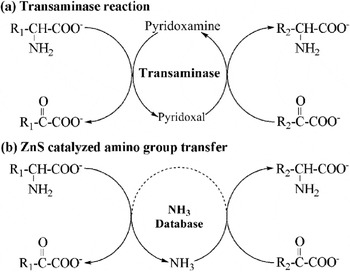
On the other hand, as is well known, redox homoeostasis is a fundamental trait of life, catalysed by a series of enzyme molecules. Before the emergence of the early enzymatic networks, the mineral surface might have performed a similar function in maintaining such equilibrium systems. For example, the reductive amination process extracts α-oxo acids from the rTCA cycle, avoiding their accumulation in the cycle. In reverse, the amino acid products may revisit the rTCA cycle through the oxidative amination reaction, balancing the entry and exit to the antique metabolic cycle (Zhang & Martin Reference Zhang and Martin2006; Wang et al. Reference Wang, Li, Yang, Liu, Yang and Su2012a, Reference Wang, Li, Yang, Liu, Yang and Sub, Reference Wang, Qu, Yang, Liu and Suc). The equilibrium between amino acids and oxo acids is controlled by the photochemical switch and tuned by the fluctuation of hole scavenger concentrations. In organisms, very important for amino acid homoeostasis are a group of enzymes called transaminases. They are able to transfer an amino group to an α-oxo acid (Fig. 7a). Given its activity in both reductive amination and oxidative deamination, the ZnS-based model presented in this study implies that it may execute a similar action to that of transaminase (Fig. 7b). It funnels α-amino groups from a variety of amino acids into an ‘ammonia database’. The ammonia storage can further be redistributed to different amino acids or other amine-bearing biomolecules (Saladino et al. Reference Saladino, Crestini, Pino, Costanzo and Di Mauro2012), regulating efficient stoichiometric homoeostasis among different amino acids and oxo acids.
Comparison of (a) the transaminase chemistry and (b) the ZnS-catalysed amino group transfer.

Subsequently, the molecular species formed on ZnS surfaces may participate in further syntheses of other biomolecules. Amino acids enter into the synthesis of peptides, the construction of the first enzymes, and the formation of other nitrogen-containing compounds (Owen et al. Reference Owen, Kalhan and Hanson2002). Alpha-oxo acids are metabolized so that the carbon skeletons can enter the metabolic mainstream as precursors to glucose or rTCA cycle intermediates. Although ZnS is effective for photocatalytic redox reactions, it is unlikely for a single mineral surface to function as a specific catalyst for several disparate reactions (Orgel Reference Orgel2000). As a component of a more complex mineral assemblage in the submarine vents (Zhang & Martin Reference Zhang and Martin2006), ZnS might have played a synergetic role with other metal sulphides in prebiotic metabolism (Huber & Wächtershäuser Reference Huber and Wächtershäuser1997; Huber et al. Reference Huber, Eisenreich, Hecht and Wächtershäuser2003; Guzman & Martin Reference Guzman and Martin2008; Wang et al. Reference Wang, Yang, Qu, Liu and Su2011).
As summarized in Fig. 3, the results in the present study have demonstrated a photocatalytic reversible redox reaction. Not only that, they also suggest a prototypical model for the origin and regulation of prebiotic redox metabolism, as discussed above. In the Hadean Eon, the world was trackless for metabolism, but many a path has been worn by geochemical processes on mineral surfaces. The mineral assemblage in shallow water vents provided a congenial environment for the origin of life. The minerals may have participated in the emergence of the first metabolism, not only by providing non-enzymatic catalytic forces but also as its building blocks (Beinert et al. Reference Beinert, Holm and Münck1997; Li & Pan Reference Li and Pan2012). In the later stage of prebiotic evolution, the enzyme-like chemistry of the minerals was replaced by the first enzymatic networks. Since in the submarine niche market the species of available metabolic substrates and intermediates were limited, the last universal common ancestor complied with and inherited the geochemical metabolic pathways/tracks, which eventually evolved into the metabolism that we know today.
Conclusions
The present study shows the photocatalytic reversible amination of α-oxo acids on ZnS particles. The shuttle process of the non-enzymatic reactions is in qualitative agreement with the mechanisms of extant glutamate dehydrogenase and transaminase (Figs. 3 and 7). Since the experimental conditions are believed to have been prevalent in shallow water hydrothermal vent systems of early Earth, these findings both develop and constrain the plausibility that sulphide minerals have played an important role in the prebiotic synthesis of biomolecules and the emergence and regulation of ancient metabolic pathways. Later on, after a long torturous trudge from simplicity to complexity, the physical and geochemical processes on the mineral surfaces may have been sufficient to assemble simple organic materials into protocellular structures, till the outgrowth of the last universal common ancestor.
Acknowledgements
This study was funded by the National Natural Science Foundation of China (No. 40902014), China Postdoctoral Science Foundation (No. 20080430918) and the Fundamental Research Funds for the Central Universities (HIT.NSRIF. 2013055).
Supplementary materials
For supplementary material for this article, please visit http://dx.doi.org/10.1017/S1473550412000432.