INTRODUCTION
Coral reefs are famous for their diversity. Coral reef species, however, are threatened by a diverse range of anthropogenic stressors (Fisher et al., Reference Fisher, Radford, Knowlton, Brainard and Caley2011). In order to effectively manage and conserve these species in the face of such threats, baseline knowledge of what lives on reefs is essential. Without such a baseline, comparisons between what lived on reefs and what remains living on them in the future will be impossible. Beyond a small number of well-studied taxa though, coral reef biodiversity is very poorly known (Knowlton et al., Reference Knowlton, Brainard, Fisher, Moews, Plaisance, Caley and McIntyre2010) and an adequate baseline so far, does not exist for most species groups. In order to redress, at least in part, this lack of adequate baseline information the Census of Coral Reef Ecosystems Project, a field project of the Census of Marine Life, has been undertaking a series of collecting expeditions to sample coral reef biodiversity. In order to understand better the patterns of biodiversity of species on coral reefs and how much still remains to be discovered, we report here the discovery rate of Pontoniinae shrimp species during a recent expedition to Lizard Island situated toward the northern end of Australia's Great Barrier Reef (GBR). Common, free-living pontoniine species such as Cuapetes amymone, most species of the ‘C. grandis’ group and Exoclimenella spp. are widely distributed in the Indo-West Pacific region. Because these widespread species would provide little additional information regarding differences in patterns of biodiversity among locations, we concentrated on collecting relatively rare symbiotic species that have often been ignored in biodiversity surveys. We compare the numbers and identities of species collected during this expedition to the previous records from this location. We also compare this rate of discovery to that of another location toward the southern end of the GBR that has in the past been more intensively studied. This comparison allows us to examine whether or not this fauna is approaching complete enumeration in the Lizard Island area.
MATERIALS AND METHODS
Symbiotic pontoniine shrimps where collected during a CReefs expedition to the Lizard Island area (14°38′S 145°28′E) during a three-week period, 24 August–14 September 2010. Shrimps were collected using a variety of sampling methods by divers using SCUBA or snorkelling. Collecting locations were determined in an ad hoc fashion whereby small areas that proved productive were sampled repeatedly. Sites in the immediate vicinity (<1 nautical mile) of Lizard Island and further afield (<= 15 nautical miles from Lizard Island) were sampled as sea conditions permitted. These more distant sites included Day (14°30′S 145°32′E) and Yonge (14°36′S 145°38E) Reefs on the outer barrier reef and MacGillivray's Reef (14°39′S 145°30′E), North Direction Island (14°45′S 145°31′E) and High Rock (14°49′S 145°33′E) within the larger GBR lagoon. MacGillivray's Reef is a coral platform reef, whereas Lizard Island, North Direction Island and High Rock are continental islands with surrounding reef development. Total collecting effort for these shrimp during this expedition was approximately 35 hours distributed among 40 dives and approximately 5 hours' snorkelling. Animals were collected from large marine invertebrate hosts, including a range of sponges, coelenterates, ascidians and echinoderms at depths ranging from 0.5 to 20 m from sheltered lagoon sites through to more exposed reef slopes and coral bommies. Collected hosts were rinsed using a weak solution of clove oil and seawater. Symbiotic shrimps associated with these hosts were collected, sorted and identified in the laboratory facilities at the Lizard Island Research Station (LIRS). All shrimp collected were identified to species where a previous description existed and then classified as either previously recorded from this locality, or as a new record. Species that could not be identified to species were classified as ‘sp.’ (i.e. could be an already known species but requiring more careful examination) or as new to science. All examined material is deposited with the Museum of Tropical Queensland (QM), Townsville, Australia. In the species references only primary synonyms, data on the locality, remarks on coloration and distribution are given.
RESULTS
The CReef expedition to Lizard Island, GBR during August–September 2010 added considerably to our knowledge of the diversity and distribution of pontoniine species for this location as well as for Australian waters more generally. One new pontoniine genus and 4 new species (two species of the genus Hamopontonia Bruce, 1970 and of Philarius Holthuis, 1952) were collected during the field trip (see Marin, in press b, c). In addition, 19 new records for pontoniine shrimps were generated for the Lizard Island area. A list of these new records is presented below. Approximately 30 pontoniine shrimp species belonging to 8 genera remain unidentified.
SYSTEMATICS
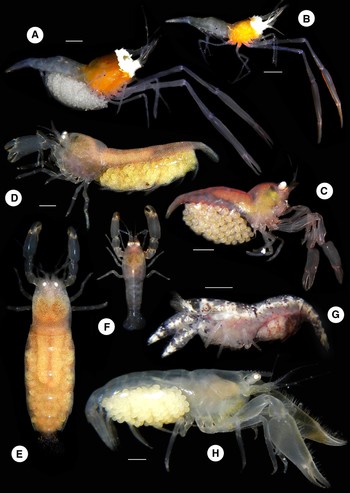
(A, B) Blepharocaris panglao Mitsuhashi & Chan, 2003, male (QM); (C) Cuapetes nilandensis (Borradaile, 1915), ovigerous female (QM); (D, E) Coralliocaris sandyi Mitsuhashi & Takeda, Reference Mitsuhashi and Takeda2008, ovigerous females (QM); (F) Hamodactylus aqabai Bruce & Svoboda, 1983, ovigerous female (QM); (G) Crinotonia attenuatus (Bruce, 1971), ovigerous female (QM).

Blepharocaris panglao Mitsuhashi & Chan, 2003: 2, figures 1–4 (type locality: Panglao Island, Philippines).
MATERIAL EXAMINED
One male (QM), GBR, Lizard Island, Little Horse Shoe, LI10-043, depth 8–10 m, collected from Alveopora sp., coll. I. Marin, 31 August 2010.
COLORATION
Collected male is generally translucent, with completely transparent appendages; eyestalk and area of hepatopancreas and proximal margin of carapace whitish (Figure 1A, B). Female (not collected) is transparent, with white eyestalk and several whitish transverse bands on the ventral site of abdominal somites I–IV.
HOST
The species is associated with hard poritid coral Alveopora sp. (Hexacorallia, Scleractinia, Poritidae). This is the first record of the host for this pontoniine shrimp species.
DISTRIBUTION
Previously was recorded only from the type locality, Panglao Island, Philippines (Mitsuhashi & Chan, 2007).
Coralliocaris sandyi Mitsuhashi & Takeda, Reference Mitsuhashi and Takeda2008: 11, figures 1C, D, 6C, D & 8–10 (type locality: Ryukyu Islands).
MATERIAL EXAMINED
Three ovigerous females (QM), GBR, Lizard Island, Mermaid Cove, LI10-018, 6 m, from Acropora sp., coll. I. Marin, 27 August 2010.
COLORATION
Eyestalk, carapace and abdomen covered with numerous white and yellow longitudinal stripes; appendages and telson generally translucent, covered with small white and red dots (Figure 1D, E).
HOST
The species is exclusively associated with hard branched scleractinian corals, Acropora spp. (Hexacorallia, Scleractinia, Acroporidae).
DISTRIBUTION
The species is widely distributed in the western Pacific from Japan to Australia; previously recorded from north-western Australia and Heron Island (Mitsuhashi & Takeda, Reference Mitsuhashi and Takeda2008).
Oedipus nudirostris Heller, 1861: 27 (type locality: Red Sea).—Heller, 1862: 279, pl. 3, figure 25.
Coralliocaris nudirostris—Borradaile, 1898: 385; Mitsuhashi & Takeda, Reference Mitsuhashi and Takeda2008: 2, figures 1A, B, 2–5 & 6A, B (full synonymy).
Coralliocaris venusta Kemp, 1922: 269 (key), 274, figures 100 & 101.
Coralliocaris venusta ‘b’.—Bruce, Reference Bruce1976: 35 (text).
Coralliocaris venusta ‘a’.—Bruce, 1980: 339 (table), 342 (text); 1983: 201 (text).
Coralliocaris venusta.—Bruce, 1998: 32 (text), 37 (key). — Mitsuhashi, 2000; 5, 6 (figure 8, colour illustration).
Coralliocaris tahitoei Boone, 1935: 180, pl. 49, figure 12 (part).
MATERIAL EXAMINED
One ovigerous female (QM), GBR, Lizard Island area, Day Reef, back reef, LI10-080, depth 1 m, collected from Acropora sp., coll. I. Marin, 5 September 2010.
COLORATION
Is generally translucent with green and red longitudinal strips along lateral margins of carapace and abdomen.
HOST
The species is found in association with hard branching corals of the genus Acropora (Hexacorallia, Scleractinia, Acroporidae).
DISTRIBUTION
Widely distributed Indo-West Pacific species known from the Red Sea to Japan and Australia. In Australia previously recorded only from Capricorn Island area, southern GBR (Mitsuhashi & Takeda, Reference Mitsuhashi and Takeda2008).
Periclimenes attenuatus Bruce, 1971: 533, figures 1–5 (type locality: Bismark Archipelago) — Marin Reference Marin2006: 317.
Crinotonia attenuatus — Marin, Reference Marin2006: 317, figures 7–10.
MATERIAL EXAMINED
One ovigerous female, 1 male (QM), GBR, Lizard Island, lagoon, Channel, LI10-084, depth 8–10 m, collected from Phanogenia sp., night dive, coll. I. Marin, 5 September 2010.
COLORATION
Body and appendages are generally transparent, covered with yellow and brown longitudinal stripes or lines consisting of irregular dots (Figure 1G).
HOST
The species was found in association with unstalked shallow water feather-star Phanogenia sp. (Echinodermata, Crinoidea, Comasteridae). Previously reported as symbiont of Phanogenia gracilis (Hartlaub, 1893) (Marin, Reference Marin2006, Reference Marin2008).
DISTRIBUTION
First report from Australian waters and the GBR area. The record of ‘Periclimenes attenuatus’ from Lizard Island (Bruce, Reference Bruce1992) belongs to Crinotonia anastasiae Marin, Reference Marin2006 (see Marin, Reference Marin2006). Crinotonia attenuatus is also recorded from Indonesia, Vietnam, Papua New Guinea and Palau (see Marin, Reference Marin2009).
Cuapetes kororensis (Bruce, 1977), ovigerous female (A), male (B) (QM); (C) Ischnopontonia lophos (Barnard, 1962), ovigerous female (QM); Onycocaris spinosa Fujino & Myiake, 1969, ovigerous female (D, E), male (F) (QM); (G) Paraclimenaeus spinicauda (Bruce, 1969), ovigerous female (QM); (H) Periclimenaeus uropodialis Barnard, Reference Barnard1958, ovigerous female (QM).

Periclimenes kororensis Bruce, 1977: 33–42, figures 1–4 (type locality: Palau).
Kemponia kororensis—Bruce, 2004: 16.
Cuapetes kororensis—Okuno, 2009: 68.
MATERIAL EXAMINED
One ovigerous female, 1 male (QM), GBR, Lizard Island, lagoon, channel, LI10-001, depth 10–12 m, collected from Heliofungia actiniformis, coll. I. Marin, 26 August 2010.
COLORATION
Generally translucent, with large whitish irregular marking on distal part of carapace and red central and proximal part of carapace; eyes and eyestalk white (Figure 2A, B).
HOST
The species is exclusively associated with anemone-like fungiid coral Heliofungia actiniformis (Quoy & Gaimard, 1833) (Hexacorallia, Scleractinia, Fungiidae).
DISTRIBUTION
The species is known from Philippines, Palau and northern Australia (Chace & Bruce, Reference Chace and Bruce1993). In Australia recorded from Broadhurst Reef, Queensland (Bruce, Reference Bruce1983). Zann (Reference Zann1980) probably reported this species (as Periclimenes holthuisi) from Lizard Island but no specimens were collected and deposited for further verification.
Periclimenes nilandensis Borradaile, 1915: 211 (type locality: Maldives).
Kemponia nilandensis—Bruce, 2004: 18.
Cuapetes nilandensis—Okuno, 2009: 67.
MATERIAL EXAMINED
One ovigerous female (QM), GBR, Lizard Island, Bommie Bay, LI10-109, depth 10–12 m, collected from unidentified bushy black coral growing approximately at 10 m into a cave, coll. I. Marin, 9 September 2010.
COLORATION
Body and appendages generally translucent covered by irregular brown, white and red dots (Figure 1C).
HOST
The single ovigerous female was found in association with unidentified bushy antipatharian (Octocorallia, Antipatharia) at Lizard Island. Known in associations with antipatharians, gorgonarians and hydroids (Chace & Bruce, Reference Chace and Bruce1993).
DISTRIBUTION
The species is known from eastern Africa, Maldives, India, South China Sea, Indonesia and northern Australia (Cobourg Peninsula) and New Caledonia (see Bruce, Reference Bruce1991, Reference Bruce1996; Chace & Bruce, Reference Chace and Bruce1993; Bruce & Coombes, Reference Bruce and Coombes1995; Li & Bruce, Reference Li and Bruce2006).
Hamodactylus aqabai Bruce & Svoboda, 1983: 26, figures 10–14 (type locality: Aqaba, Jordan).
MATERIAL EXAMINED
One ovigerous female (QM), GBR, Lizard Island, off Little Horseshoe Reef, LI10-043, depth 8 m, collected from unidentified violet-colored nephtheid coral Stereonephthea sp., coll. I. Marin, 31 August 2010, 1 ovigerous female (QM)—Bommie Bay, LI10-109, depth 10 m, collected from Stereonephthea sp., coll. I. Marin, 9 September 2010.
COLORATION
Generally translucent with transverse yellow-whitish wide band on carapace and abdomen; rostrum, eyestalk, telson and appendages transparent (Figure 1F).
HOST
The species was found in association with soft coral Stereonephthea sp. (Octocorallia, Alcyonacea, Nephtheidae). In Jordan the species is associated with soft coral Litophyton sp. (Octocorallia, Alcyonacea, Alcyoniidae).
DISTRIBUTION
Previously was recorded from Aqaba, Jordan; Heron Island and Cartier Reef, Queensland, Australia (Bruce, Reference Bruce1981, Reference Bruce2010a; Bruce & Svoboda, 1983).
Philarius lophos Barnard, 1962: 242, figure 2 (type locality: Moçambique).
Ischnopontonia lophos—Bruce, 1966: 584, figures 1–5.
MATERIAL EXAMINED
One ovigerous female, 1 male (QM), GBR, Lizard Island area, North Direction Island, LI10-039, 10 m, on Galaxea cf. fascicularis, coll. I. Marin, 31 August 2010.
COLORATION
Body and appendages generally transparent, slightly reddish in color; dorsal surface of carapace and abdomen reddish, sometimes with white spots (Figure 2C).
HOST
The species is associated with scleractinian corals of the genus Galaxea Oken (Hexacorallia, Scleractinia, Oculinidae).
DISTRIBUTION
First recorded from the Lizard Island area. The species is widely distributed in the Indo-West Pacific (e.g. Bruce, Reference Chace and Bruce1993; Bruce & Coombes, 1997), including Western Australia, Northern Territory and the GBR (Heron Island), Queensland.
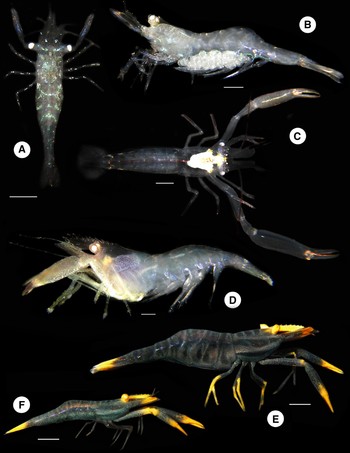
(A, B) Periclimenes diversipes Kemp, 1922, ovigerous females (QM); (C) Vir smiti Fransen & Holthuis, Reference Fransen and Holthuis2007, ovigerous female (QM); (D) Thaumastocaris streptotus Kemp, 1922, mature male (QM); Laomenes amboinensis (De Man, 1888): (E) ovigerous female (QM); (F) mature male (QM).

Anchistus amboinensis De Man 1888: 546, pl. 22a: figure 2 (type locality: Ambon, Indonesia).
Periclimenes amboinensis — Bruce Reference Bruce1983: 874, 898, 899, figures 1–3 & 7E; 1992: 66, figures 17 & 18.
Laomenes amboinensis — Okuno & Fujita 2007: 117, figure 1.
MATERIAL EXAMINED
One ovigerous female, 1 male (QM), GBR, Lizard Island area, LI10-085, High Rock, LI10-085, 14 m, on feather star Oxycomanthus sp., coll. I. Marin, 6 September 2010.
COLORATION
Generally dark violet; carapace with 2 longitudinal bands laterally; four bands cross the carapace dorsally, not reaching the middle of carapace laterally; bands are lighter than body, usually white or light yellow; abdomen with transverse bands continuing to pleura and edging them (Figure 3E, F)
HOST
The species is associated with feather star Oxycomanthus bennetti (Echinodermata, Crinoidea, Comatulidae).
DISTRIBUTION
First reported for Lizard Island area. The species is known from Vietnam, Japan, Indonesia, Philippines, Japan and Western Australia (see review in Marin, Reference Marin2009).
Onycocaris spinosa Fujino & Myiake, 1969: 429, figures 13–15 (type locality: Ryukyu Islands).
MATERIAL EXAMINED
GBR, Lizard Island area–1 ovigerous female, 1 male (QM)—Day Reef, back reef, LI10-047, 8–10 m depth, in a calcareous sponge attached to the base of colony of Stylophora pistillata, coll. I. Marin, 1 September 2010.
COLORATION
Body and appendages are transparent, covered with numerous small white dots (Figure 2D–F).
HOST
The specimens were found inside unidentified calcareous sponges (Porifera, Demospongia) attached to the base of scleractinian coral Stylophora pistillata Esper, 1797 (Hexacorallia, Scleractinia, Pocilloporidae).
DISTRIBUTION
The species was previously recorded only from Ryukyu Islands (Fujino & Myiake, 1969) and Heron Island, Queensland (Bruce, 1990, Reference Bruce2010a).
Periclimenaeus spinicauda Bruce, 1969: 164; 1979: 234; Reference Bruce2003: 225 (type locality: northern South China Sea).
Apopontonia dubia Bruce, Reference Bruce1981: 225–232, figsures 1–3; 1983: 210–213, figure 1; 1991: 258. De Grave, 2000: 111.
Paraclimenaeus spinicauda—Bruce, 2009: 499, figures 1 & 2.
MATERIAL EXAMINED
Two ovigerous females, 3 males (QM), GBR, Lizard Island, lagoon, depth 6–8 m, inside unidentified sponge, coll. I. Marin, 1 September 2010.
COLORATION
Body and appendages generally transparent; rostrum, eyestalk, dorsal surface of carapace and abdomen as well as dorsal surface of chelipeds covered with numerous small irregular white and violet dots (Figure 2G).
HOST
The species is associated with unidentified calcareous sponge (Porifera, Demospongia).
DISTRIBUTION
The species is known from northern South China Sea, New Caledonia, Papua New Guinea and north-eastern Australia (Heron Island) (after Bruce, 2009).
Periclimenaeus djiboutensis Bruce, 1970: 307 (type locality: Djibouti)—Bruce, 1974: 1568, figures 8–9 & 13a–d.
MATERIAL EXAMINED
One ovigerous female (QM), GBR, Lizard Island, MacGillivary's Reef, LI10-073, 10 m, inside sponge attached to the base of a hard coral, coll. I. Marin, 4 September 2010.
COLORATION
Body and appendages are transparent without coloration.
HOST
The species is associated with calcareous sponges (Porifera, Demospongia).
DISTRIBUTION
The species is known from Red Sea (Eilat), Djibouti, Zanzibar, Madagascar, Vietnam and eastern Australia (Heron Island) (e.g. Bruce, Reference Bruce1981; Marin, Reference Marin2007).
Periclimenaeus uropodialis Barnard, Reference Barnard1958: 18, figure 6 (type locality: Delagoa Bay, Moçambique).
MATERIAL EXAMINED
Two ovigerous females, 2 males (QM), GBR, Lizard Island, High Rock, back reef, LI10-085, 14 m, inside tube sponge Callyspongia sp., coll. I. Marin, 6 September 2010; 3 ovigerous females, 4 males (IM-75), High Rock, back reef, LI10-130, 12–15 m, inside sponge Callyspongia sp., coll. I. Marin, 11 September 2010.
REMARKS
All examined specimens are generally similar to its original description given by Barnard (Reference Barnard1958). The species clearly differs from the related species, Periclimenaeus gorgoniodarum Balss, 1913 by longer fingers and the absence of well developed snapping mechanism on minor pereiopod II (Figure 4) in contrast to Bruce's suggestion (1981) about their conspecificity (Marin, in press a).
Periclimenaeus uropodialis Barnard, Reference Barnard1958, ovigerous female (A, C, D, E–N) (QM), male (B, F) (QM): A, B, front of carapace, lateral; C, orbital corner, dorsal; D, telson and uropods; E, lateral margin of uropodal exopod; F, G, minor pereiopod II; H, major pereiopod II; I, same, proximal part of propodus; J, same, fingers; K, L, fingers of minor pereiopod II; M, pereiopod III; N, same, dactylus.

COLORATION
Body and and appendages yellow-whitish, transparent (Figure 2H).
HOST
The species was found in association with tube sponge Callyspongia sp. (Porifera, Demospongia, Callyspongiidae). This is the first record of the host for this pontoniine shrimp species.
DISTRIBUTION
Previously known from eastern Africa: Moçambique (the type locality) (Barnard, 1958), Kenya; Zanzibar and Tanganyika (Bruce, Reference Bruce1976). The only record from Australia is known by colour photo published by Debelius (Reference Debelius2001).
Periclimenes diversipes Kemp, 1922: 179, figures 36–39 (type locality: southern India).
MATERIAL EXAMINED
One ovigerous female, 1 male (QM), GBR, Lizard Island, lagoon, sandy beach in front of the Lizard Island Research Station, LI10-039, depth 0.5–1.0 m, collected from hard coral Paraclavinarina sp., coll. I. Marin, 31 August 2010.
COLORATION
Body and appendages transparent, carapace and abdomen covered with green-blue transverse stripes or irregular separate dots (Figure 3A).
HOST
Our specimens were washed out from colony of hard coral Paraclavinarina sp. (Hexacorallia, Scleractinia). The species is associated with various hard scleractinian corals (Hexacorallia, Scleractinia) (see Chace & Bruce, Reference Chace and Bruce1993).
DISTRIBUTION
Probably widely distributed Indo-West Pacific species (see Chace & Bruce, Reference Chace and Bruce1993).
Periclimenes watamuae Bruce, Reference Bruce1976: 16, figures 5 &6 (type locality: Kenya).
MATERIAL EXAMINED
One ovigerous female (QM), GBR, Lizard Island, SeaBird Islet, LI10-105, depth 1 m, collected from Goniopora sp., coll. I. Marin, 8 September 2010.
COLORATION
Species is completely transparent.
HOST
The species was found on hard poritid coral Goniopora sp. (Hexacorallia, Sleractinia, Poritidae) at Lizard Island. Other hosts are unidentified alcyonarian corals and gorgonarians as well as anemone-like fungiid coral Heliofungia actiniformis (Quoy & Gaimard, 1833) (Hexacorallia, Scleractinia, Fungiidae). (e.g. De Grave, Reference De Grave1998).
DISTRIBUTION
This is the first record of the species from Australian waters and the GBR area. The species was reported from Kenya, Seychelles and Papua New Guinea (e.g. De Grave, Reference De Grave1998).
Thaumastocaris streptosus Kemp, 1922: 244, figures 78–80 (type locality: Noumea, New Caledonia).
MATERIAL EXAMINED
One ovigerous female, 1 male (QM), GBR, Lizard Island area, North Direction, LI10-047, 6–8 m, inside tube sponge Callyspongia sp., coll. J. Caley and I. Marin, 1 September 2010.
COLORATION
Generally transparent with pereiopods I and II yellowish (Figure 3D).
HOST
The specimens were found inside tube sponges Callyspongia sp. (Porifera, Demospongia, Callyspongiidae).
DISTRIBUTION
The species is probably widely distributed in the Indo-West Pacific region being reported from Kenya, La Réunion and Queensland (e.g. Bruce, Reference Bruce2010a). In Australia the species has been recorded from Cartier and Hibernia Reefs (Bruce, Reference Bruce1992) and Heron Island (Bruce, Reference Bruce2010a).
Typton wasini Bruce, 1977: 272–285, figures 1–6 (type locality: Kenya).
Typton nanus Bruce, 1987: 49–56, figures 1–5.
MATERIAL EXAMINED
One ovigerous female, 1 male (QM), GBR, Lizard Island, Channel, LI10-051, depth 8–10 m, extracted from Pocillopora sp., probably from sponge, coll. I. Marin, 1 September 2010.
COLORATION
Body and appendages are transparent, without any coloration; hepatopancreas brown.
HOST
A single ovigerous female was washed out from a colony of Pocillopora sp. (Hexacorallia, Scleractinia, Pocilloporidae); probably associated with sponge (Porifera, Demospongia).
DISTRIBUTION
The species is known from Kenya, La Réunion and Queensland (Bruce, 2010a). In Australia it is known from the north-western coast, Heron Island and Abbot Point (Bruce, 2000, Reference Bruce2010a).
Vir colemani Bruce, Reference Bruce2003: 119, figures 1–6 (type locality: Loloata Island, Papua New Guinea).
MATERIAL EXAMINED
One ovigerous female, 1 male (QM), GBR, Lizard Island, Channel, LI10-001, depth 8–10 m, collected from colony of Physogyra sp., coll. I. Marin, 26 August 2010.
COLORATION
Species is generally transparent with dark blue longitudinal stripes along appendages.
HOST
The species was found in association with caryophyllid coral Physogyra sp. (Hexacorallia, Scleractinia, Caryophyllidae) in Lizard Island area. Also known as symbionts of other caryophyllid coral Plerogyra sinuosa (Dana, 1846) (Caryophyllidae).
DISTRIBUTION
This is first record for Australian waters and GBR area. The species has been previously reported from Papua New Guinea only (Bruce, Reference Bruce2003).
Vir philippinensis Bruce & Svoboda, 1984: 87, figures 1–4 (type locality: Cebu, Philippines).
MATERIAL EXAMINED
One ovigerous female, 1 male (QM), GBR, Lizard Island, MacGillivary's Reef, LI10-073, depth 8–10 m, collected from Physogyra sp, coll. I. Marin, 4 September 2010.
COLORATION
Body and appendages are generally transparent; eyestalk with brownish-blue stripe long dorsal margin, appendages with blue-violet longitudinal stripes (Figure 3C).
HOST
The species is associated with caryophyllid corals of the genus Physogyra Quelch (Hexacorallia, Scleractinia, Caryophyllidae) (Fransen & Holthuis, Reference Fransen and Holthuis2007).
DISTRIBUTION
This is the first record of the species from Australian waters and the GBR. The species is probably widely distributed in the west Pacific region; recorded from Seychelles, Indonesia and Philippines (Fransen & Holthuis, Reference Fransen and Holthuis2007).
DISCUSSION
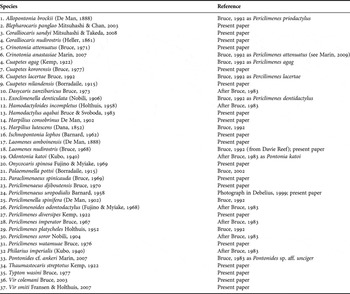
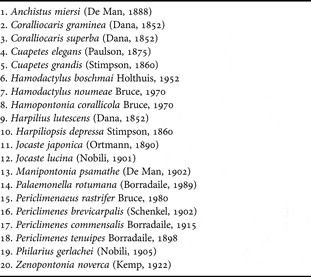
Previously, the fauna of pontoniine shrimps from the Lizard Island area has been poorly studied. Knowledge of this fauna relies on only two published taxonomical papers (Bruce, Reference Bruce1983, Reference Bruce1992; see Table 1), two scientific-popular books (Zann, Reference Zann1980; Debelius, 1999) and a list of unpublished material maintained by staff at the LIRS (Hoggett, unpublished; see Table 2). In contrast, one area toward the southern end of the GBR, Heron Island (23°27′S 151°57′E), has been studied to a much greater extent and is considered one of the most diverse localities for pontoniine shrimps worldwide. The species list at Heron Island, however, continues to grow due to recent sampling efforts associated with CReefs Australia (e.g. Bruce Reference Bruce2010a, Reference Bruceb; Marin & Anker, 2011). If one assumes a similar gradient of biodiversity for pontoniine shrimps from the southern GBR to the north that has been observed for corals (Veron, Reference Veron1993) and fish (Russell, Reference Russell1983), approximately 30–40% greater species richness would be expected at Lizard Island than at Heron Island. Given what appears to be a large unknown fauna, it will take considerable additional effort to enumerate these species.
Species of pontoniine shrimps reported from the Lizard Island area.

List of pontoniine shrimps species recorded by A. Hoggett from the Lizard Island area at Lizard Island Research Station (LIRS) (A. Hoggett, unpublished).

At the same time, relatively little effort was required to increase the total species list of pontoniine shrimps from the Lizard Island area by more than 40% as well as discover 10 species (including 4 new to science) previously unknown from the GBR. The number of species new to Australian waters or to science as a result of these collecting efforts may also increase considerably once the taxonomy of the approximately 30 remaining unidentified species is completed. Such a high rate of discovery suggests that a considerable proportion of the diversity of this group remains to be discovered.
ACKNOWLEDGEMENTS
We thank Shawn Smith for outstanding logistical support, other members of the Lizard Island 2010 expedition for their cooperation and collaboration, and Dr Anne Hoggett for maintaining and providing access to the LIRS species list. CReefs Australia is a partnership between the Australian Institute of Marine Science, BHP Billiton, the Census of Marine Life and the Great Barrier Reef Foundation. This work could not have been carried out without the generous financial support of BHP Billiton.