Introduction
Despite the ‘Kraepelinian’ distinction between schizophrenia (SZ) and bipolar disorder (BD) and the categorical classification of current diagnostic systems such as DSM-5 (APA, 2013) and ICD-10 (WHO, 1992), there is considerable overlap between these disorders. Epidemiological, genetic and neuroimaging studies comparing SZ and BD show a complex range of epidemiological, pathophysiological and phenomenological similarities and differences (Demjaha et al. Reference Demjaha, MacCabe and Murray2012). SZ and BD have overlapping genetic liabilities (Lichtenstein et al. Reference Lichtenstein, Yip, Björk, Pawitan, Cannon, Sullivan and Hultman2009), with several genes such as ANK3, CACNA1C, ZNF804A, G72/G30, DISC1, Neuregulin and Dysbindin implicated in both disorders (Schumacher et al. Reference Schumacher, Jamra, Freudenberg, Becker, Ohlraun, Otte, Tullius, Kovalenko, Bogaert, Maier, Rietschel, Propping, Nöthen and Cichon2004; Shifman et al. Reference Shifman, Bronstein, Sternfeld, Pisanté, Weizman, Reznik, Spivak, Grisaru, Karp, Schiffer, Kotler, Strous, Swartz-Vanetik, Knobler, Shinar, Yakir, Zak and Darvasi2004; Craddock & Owen, Reference Craddock and Owen2005; Crow, Reference Crow2008; Lett et al. Reference Lett, Zai, Tiwari, Shaikh, Likhodi, Kennedy and Müller2011). Large copy number variants (CNVs), however, seem to be associated with SZ but not with BD (Bergen et al. Reference Bergen, O'Dushlaine, Ripke, Lee, Ruderfer, Akterin, Moran, Chambert, Handsaker, Backlund, Ösby, McCarroll, Landen, Scolnick, Magnusson, Lichtenstein, Hultman, Purcell, Sklar and Sullivan2012; Rees et al. Reference Rees, Walters, Georgieva, Isles, Chambert, Richards, Mahoney-Davies, Legge, Moran, McCarroll, O'Donovan, Owen and Kirov2014). We have previously suggested a model whereby both disorders share a common genetic liability but SZ is associated with additional risk factors that impair neurodevelopment (Murray et al. Reference Murray, Sham, van Os, Zanelli, Cannon and McDonald2004; Demjaha et al. Reference Demjaha, MacCabe and Murray2012).
Birth cohort and conscript studies report strong associations between poor performance on cognitive batteries and increased risk of later SZ (MacCabe, Reference MacCabe2008; MacCabe et al. Reference MacCabe, Lambe, Cnattingius, Torrång, Björk, Sham, David, Murray and Hultman2008). Moreover, a systematic review and meta-analysis confirmed the presence of a premorbid IQ deficit of around 0.5 standard deviations among young people who will later develop SZ (Woodberry et al. Reference Woodberry, Giuliano and Seidman2008). By contrast, premorbid deficits seem to be absent, or even reversed, in BD. Indeed, two longitudinal studies showed that individuals with better cognitive functioning in childhood or adolescence have an increased risk for later BD (Koenen et al. Reference Koenen, Moffitt, Roberts, Martin, Kubzansky, Harrington, Poulton and Caspi2009; MacCabe et al. Reference MacCabe, Lambe, Cnattingius, Sham, David, Reichenberg, Murray and Hultman2010).
Most studies on patients with established illness find deficits in both SZ and BD; thus, a meta-analysis revealed widespread general cognitive deficits in patients with SZ and with BD, with quantitative rather than qualitative differences between the diagnostic groups (Stefanopoulou et al. Reference Stefanopoulou, Manoharan, Landau, Geddes, Goodwin and Frangou2009). Cognitive deficits have been detected in samples of both bipolar type I (BD-I) and type II disorder (BD-II) patients, even during periods of euthymia (Martino et al. Reference Martino, Strejilevich, Scapola, Igoa, Marengo, Ais and Perinot2008; Harvey et al. Reference Harvey, Wingo, Burdick and Baldessarini2010).
It is difficult to make direct comparisons between SZ and BD on the basis of studies that include one disorder but not the other. In general, studies of cognitive functioning in SZ are much more numerous than those in BD, tend to be older and thus have somewhat less rigorous methodology than the studies of BD. This difference probably reflects the growing interest in studies of BD in the past two decades. Restricting a meta-analysis to studies that have examined both disorders simultaneously removes any such bias and allows direct comparisons to be made. We therefore undertook this meta-analysis comparing premorbid and post-onset intellectual functioning between SZ and BD, restricting the analysis to studies that assessed both SZ and BD, using identical methods. We hypothesized that (a) SZ would show more severe deficits in premorbid intellectual function compared to BD but (b) both disorders would show a similar cognitive decline from pre- to post-illness onset.
Method
Literature search and selection criteria
In this study we followed the guidelines of the meta-analysis of observational studies in epidemiology (Stroup et al. Reference Stroup, Berlin, Morton, Olkin, Williamson, Rennie, Moher, Becker, Sipe and Thacker2000). Studies were identified through searches of Medline (PubMed), EMBASE and PsycINFO databases using the key words: ‘schizophrenia AND bipolar disorder’ combined with ‘IQ’, ‘intelligence’, ‘intelligence quotient’, ‘cognitive’, ‘neuropsychological’, ‘neuropsychology’, ‘neurocognitive’, ‘neurocognition’, ‘intellectual’ and ‘premorbid’. Additional studies were identified by hand searching the bibliographies of each article found, and contacting individual authors where additional information was required.
We included studies that: (1) were published in peer review journals in English between January 1990 and December 2013; (2) included both BD and SZ patients and a healthy comparison group; (3) included standardized diagnostic criteria to ascertain diagnosis, namely Research Diagnostic Criteria (RDC), DSM-III or later, ICD-8 or later; (4) assessed general cognitive or academic ability before and/or following illness onset; (5) provided separate results for the group of subjects diagnosed with SZ or BD and the healthy comparison group, drawn from the same population, using the identical sampling methods for both disorders; and (6) provided means and standard deviations of the cognitive performance measures.
Exclusion criteria were: (1) assessment of specific cognitive functions without providing an overall estimation of intellectual function (or equivalent); (2) insufficient data to estimate effect size (means, standard deviations, number of subjects for each group); and (3) data that reported the same or an overlapping sample as a more complete or relevant study.
Where the same study was reported in more than one publication (for example where results for SZ and BD were reported separately), the data set was only included once. If means and standard deviations were not provided, authors were contacted directly by email. For sensitivity analysis, the largest study was excluded in each analysis.
Statistical analysis
Meta-analyses were performed with Stata version 10.1 (Stata Corporation, USA), using the Metan and Meta packages. Effect sizes for each original study are expressed as the standardized mean difference (SMD, Cohen's d) between SZ, BD and control group performance (Cohen, Reference Cohen1969). Standardized effect sizes were meta-analyzed using random effects models. Heterogeneity between studies was assessed with the Q test (DerSimonian & Laird, Reference DerSimonian and Laird1986). The I 2 statistic was calculated to express the proportion of variation between studies that was due to heterogeneity (Higgins et al. Reference Higgins, Thompson, Deeks and Altman2003). We used a random effects model because of heterogeneity in the study design and in the neuropsychological tests used.
Egger's test of publication bias was used to assess whether there was a tendency for selective publication of studies based on the nature and direction of results (Egger et al. Reference Egger, Davey Smith, Schneider and Minder1997). Random effect meta-regression analyses were conducted for testing effects of the following potential effect modifiers: medications (percentage of patients receiving pharmacologic treatment for SZ or BD at the time of intellectual functioning assessment), duration of illness (years), age at time of cognitive assessment, clinical status (‘remitted’ or ‘symptomatic’) at the time of assessment, source population (continent where the study had been conducted), year of publication and cognitive measure [the National Adult Reading Test (NART; Nelson, Reference Nelson1982), the Wide Range Achievement Test (WRAT; Jastak & Wilkinson, Reference Jastak and Wilkinson1984) or prospectively ascertained neuropsychological batteries to assess premorbid cognitive functioning; Wechsler scales or other quantitative measure for the assessment of post-onset cognitive functioning], using Stata version 10.1. A significance level of p < 0.05 was used for the random effects model, homogeneity, publication bias, sensitivity and meta-regression analyses.
Results
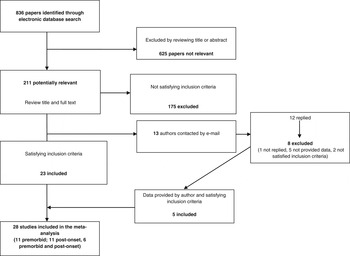
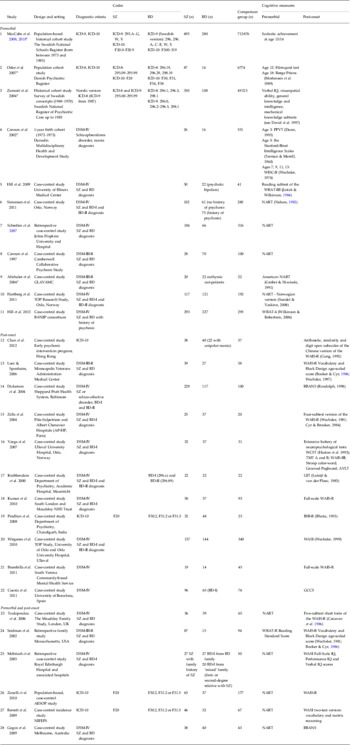
The search identified a total of 836 studies (Fig. 1). On the basis of title and abstract, 625 studies were excluded. A total of 211 studies were considered potentially relevant and full text was assessed manually. Of these, 175 did not satisfy one or more of the inclusion criteria and were excluded while a total of 23 were selected. We contacted the authors for a further 13 possible studies, and the relevant data were obtained from five studies. In total, 28 studies were included in the review (11 providing a measure for premorbid intellectual function, 11 assessing post-onset intellectual function, and six providing both premorbid and post-onset measures of intellectual function) (Table 1).
Flow chart of published papers selected and excluded from the initial online database search to the publication included in the meta-analysis.

Studies included in the meta-analysis

SZ, Schizophrenia; BD, bipolar disorder (BD-I, type I; BD-II, type II); PPVT, Peabody Picture Vocabulary Test; WISC-R, Weschler Intelligence Scales for Children Revised; WRAT, Wide Range Achievement Test; NART, National Adult Reading Test Revised; GLAVAMC, Greater Los Angeles Veterans Administration Medical Center; TOP, Thematically Organized Psychosis; B-SNIP, Bipolar-Schizophrenia Network on Intermediate Phenotypes; WAIS-R, Wechsler Adult Intelligence Scale Revised; RBANS, Repeatable Battery for the Assessment of Neuropsychological Status; WCST, Wisconsin Card Sorting Test; TMT, Trail Making Test; AVLT, Auditory Verbal Learning Test; GIT, Groningen Intelligence Test; BSB-R, Bhatia's Short Battery of Performance Tests of Intelligence; WASI, Wechsler Abbreviated Scale of Intelligence; GCCS, global cognition composite score; NHS, National Health Service; AESOP, Aetiology and Ethnicity in Schizophrenia and Other Psychoses; NIFEPS, Northern Ireland First Episode Psychosis Study.
a Data provided by authors.
All references in this table are listed in the online Supplementary Appendix.
Premorbid intellectual function
A measure of premorbid intellectual function was available from 17 studies. Of these, four were prospective cohort studies that used assessments of premorbid cognitive or intellectual functioning that were measured prior to illness onset, and 13 were retrospective case-control studies that estimated premorbid intellectual functioning based on reading tests conducted after the patient had developed the illness. There were 1993 SZ patients, 1270 BD patients and 772 138 healthy controls from the general population (Table 2).
Raw premorbid IQ scores for studies included in the meta-analysis

BD-I, Bipolar disorder type I; s.d., standard deviation.
All references in this table are listed in the online Supplementary Appendix.
SZ
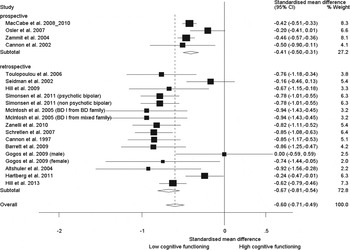
SMD in premorbid cognitive function between SZ patients and controls was −0.597 [95% confidence interval (CI) −0.707 to −0.487, p < 0.0001] (Fig. 2). There was significant heterogeneity in effect size between studies (68.50, s.d. = 19, p < 0.0001, I 2 = 72.3%). SMD for prospective cohort studies was −0.406 (95% CI −0.500 to −0.312, p < 0.0001) with a non-significant heterogeneity in effect size between studies (4.90, s.d. = 3, p = 0.180, I 2 = 38.7%); SMD for studies that used retrospective measures of cognitive function was −0.675 (95% CI −0.810 to −0.539, p < 0.0001) with a significant heterogeneity between studies (40.54, s.d. = 15, p < 0.0001, I 2 = 63.0%).
Forest plot of premorbid cognitive function in schizophrenia (SZ) versus healthy comparison group.

BD
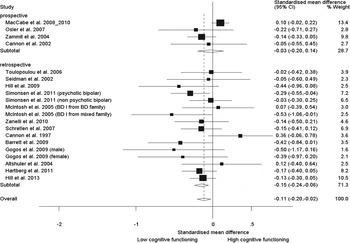
SMD in premorbid intellectual function between BD patients and controls was −0.113 (95% CI −0.202 to −0.024, p = 0.013) (Fig. 3). Non-significant heterogeneity in effect size between studies was observed (28.99, s.d. = 19, p = 0.066, I 2 = 34.5%). SMD for prospective cohort studies was −0.029 (95% CI −0.199 to +0.142, p = 0.744) with a non-significant heterogeneity between studies (5.63, s.d. = 3, p = 0.131, I 2 = 46.8%); SMD for studies using retrospective measures of intellectual function was −0.147 (95% CI −0.238 to −0.056, p = 0.001) with a non-significant heterogeneity in effect size between studies (16.54, s.d. = 15, p = 0.341, I 2 = 9.8%).
Forest plot of premorbid cognitive function in bipolar disorder (BD) versus healthy comparison group.

Publication bias
Egger's test for the meta-analyses did not show evidence of significant publication bias for premorbid cognitive function (−0.019, p = 0.824).
Potential effect modifiers
In meta-regression analyses, there were no effects of medications, age at time of assessment, duration of illness, clinical status, source population, year of publication and cognitive test used to measure premorbid intellectual functioning (results, not shown, are available from the authors).
Post-onset intellectual function
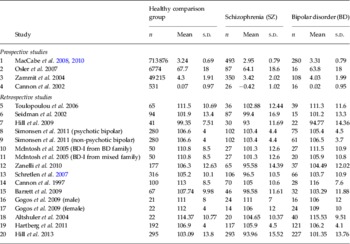
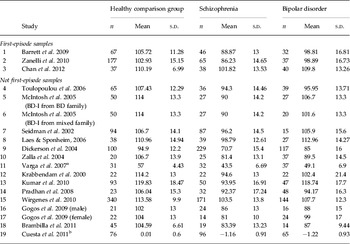
A measure of post-onset intellectual function was available from 17 studies. Of these, three were based on a sample of patients in their first episode of illness and 14 used a sample of patients not in their first illness episode. There were 1087 SZ patients, 811 BD patients and 1400 healthy controls from the general population (Table 3).
Raw post-onset IQ scores for studies included in the meta-analysis

BD-I, Bipolar disorder type I; s.d., standard deviation.
a Overall IQ was calculated from an extensive battery of neuropsychological tests (see Table 1) and converted into t scores (mean 50, s.d. = 10).
b Global Cognitive Composite Score (GCCS) calculated using: Wechsler Adult Intelligence Scale–III (WAIS-III; Wechsler, 1999) subtests of Arithmetic, Digit Span (total score), Letters and Numbers Sequencing, Symbol Search (total score) and Vocabulary, the Wechsler Memory Scale–III (WMS-III; Wechsler, 2004) subtests of Word list I (total words recalled) and Word list II (total words recalled), the Trail Making Test (Army Individual Test Battery, 1944) part A (time), and categories and percentage of iterative errors on the Wisconsin Card Sorting Test (WCST; Berg, 1948; Heaton et al. 1993).
All references in this table are listed in the online Supplementary Appendix.
SZ
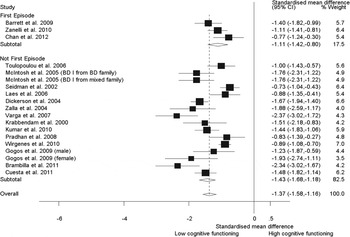
SMD in post-onset cognitive function between SZ patients and controls was −1.369 (95% CI −1.578 to −1.160, p < 0.0001) (Fig. 4). There was significant heterogeneity in effect size between studies (82.59, s.d. = 18, p < 0.0001, I 2 = 78.2%). SMD for studies assessing a sample of SZ patients during their first episode of illness was −1.111 (95% CI −1.423 to −0.798, p < 0.0001) with a non-significant heterogeneity in effect size between studies (3.85, s.d. = 2, p = 0.146, I 2 = 48%); SMD for studies that used a sample of SZ patients not in their first episode was −1.432 (95% CI −1.679 to −1.185, p < 0.0001) with a significant heterogeneity between studies (77.47, s.d. = 15, p < 0.0001, I 2 = 80.6%).
Forest plot of post-onset cognitive function in schizophrenia (SZ) versus healthy comparison group.

BD
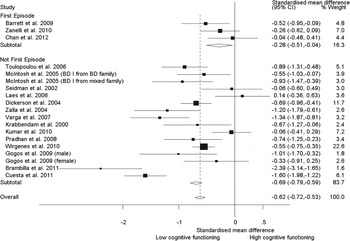
SMD in post-onset cognitive function between BD patients and controls was −0.623 (95% CI −0.717 to −0.529, p < 0.0001) (Fig. 5). Significant heterogeneity in effect size between studies was observed (97.76, s.d. = 18, p < 0.0001, I 2 = 81.6%). SMD for studies assessing a sample of bipolar patients during their first episode of illness was −0.277 (95% CI −0.510 to −0.044, p = 0.020) with a non-significant heterogeneity in effect size between studies (2.36, s.d. = 2, p = 0.308, I 2 = 15.1%); SMD for studies that used a sample of BD patients not in their first episode was −0.691 (95% CI −0.793 to −0.588, p < 0.0001) with a significant heterogeneity between studies (85.28, s.d. = 15, p < 0.0001, I 2 = 82.4%).
Forest plot of post-onset cognitive function in bipolar disorder (BD) versus healthy comparison group.

Publication bias
Egger's test did not show evidence of significant publication bias for post-onset intellectual function (−1.02, p = 0.441).
Potential effect modifiers
In meta-regression analyses, there were no effects of medications, age at time of assessment, duration of illness, clinical status, source population, year of publication and cognitive test used to measure post-onset intellectual functioning (results, not shown, are available from the authors).
Discussion
We used a meta-analytic approach to investigate the global intellectual function of patients with SZ and BD, compared to controls, pre- and post-illness onset. To our knowledge, this is the first systematic review and meta-analysis of the literature comparing premorbid and post-onset overall intellectual functioning in SZ and BD. The novelty of our study is that we compared ‘like with like’ by including only studies comparing cognitive functioning of SZ and BD patients and healthy controls, drawn from the same population and using identical methodology. It could be argued that the studies that include only one or other disorder, of which there are around 150, might have provided information on either one of these disorders' cognitive functioning, relative to healthy controls. However, for the reasons set out earlier, we do not consider that it would meaningful to compare the pooled results of all studies of SZ with those of BD, as there are many differences in methodology, cognitive tests and analysis between studies. By restricting to studies that include both disorders, direct comparisons can be made within each study and the resulting differences meta-analyzed.
As we hypothesized, our findings confirm that SZ is characterized by severe post-onset impairment and also shows significant deficits in premorbid cognitive function. BD shows a much smaller premorbid deficit, as measured retrospectively in case-control studies, but no deficit when the analysis is restricted to prospective studies. BD patients suffered a degree of post-onset impairment, much smaller than that found in SZ. Of note, the magnitude of post-onset decline is less in first-episode studies than in chronic patients. This might constitute evidence of continuing intellectual decline following the first episode; however, the number of studies on patients with a first episode of illness included in our meta-analysis is too small to draw any conclusion.
For premorbid intellectual function in schizophrenia, we found a moderate effect size (Cohen's d = − 0.597). Our results are comparable with previous meta-analytic reviews that found that premorbid intellectual function in these individuals was around one-half of a standard deviation below that of healthy comparison subjects (Aylward et al. Reference Aylward, Walker and Bettes1984; Woodberry et al. Reference Woodberry, Giuliano and Seidman2008). After illness onset, we found impairment on overall intellectual functioning in both SZ and BD, although the magnitude of the overall difference between premorbid and post-onset cognitive functioning was greater for SZ.
To reduce selection bias, we therefore report separate analyses for longitudinal population-based studies. In fact, case-control studies that assess cognitive functioning retrospectively are liable to selection bias (including through unrepresentative comparison groups) and information bias, whereby the effects of the disorder impair performance on tests, such as the NART, that are designed to estimate premorbid intelligence. The smaller estimates of effect size measured by prospective studies included in our meta-analysis compared to the effect size measured by retrospective studies suggest that such biases were present in those studies that assessed cognitive functioning retrospectively.
Limitations of this meta-analysis include considerable heterogeneity in the methodology of the studies selected, and statistical heterogeneity of effect sizes was detected in many of the analyses. We used a random effects model to allow for this heterogeneity but the results, particularly the overall estimates of differences, should be treated with caution. In particular, the type and number of tests used to estimate the global intellectual function varied considerably between studies. We included studies that used scholastic achievement as a measure of premorbid intellectual function in addition to studies that used non-standard instruments. However, Deary et al. (Reference Deary, Strand, Smith and Fernandes2007) have shown that general cognitive ability (Spearman's g) at age 11 correlate with national school examinations (GCSE scores) taken at age 16 (Cohen's d = 0.69).
Retrospective studies included in our meta-analysis assessed premorbid cognitive function using the NART or the Reading subtest of the WRAT. The high association of reading ability with general intellectual function and the resistance of reading skill to processes of cognitive deterioration (Nelson & McKenna, Reference Nelson and McKenna1975) make these two tests a quick and sensitive measure of estimating premorbid intelligence levels.
To assess post-onset intellectual function, 12 of the studies included in our meta-analysis used the full or the short versions of Wechsler scales. Wechsler scales are considered the gold standard for assessing global intellectual function, providing an individual profile of both verbal and non-verbal intelligence. However, given the extensive time needed to administer the complete test batteries, large sample studies typically estimate intellectual function using short forms with two to five subtests whose reliability and validity had been previously demonstrated (Cyr & Booker, Reference Cyr and Booker1984; Booker & Cyr, Reference Booker and Cyr1986; Canavan et al. Reference Canavan, Dunn and McMillan1986; Wechsler, Reference Wechsler2007).
We focused on overall quantitative measures of intellectual functioning in SZ and BD, so we did not assess whether profiles of cognitive functioning across subtests may have differed between these two disorders. However, previous studies conducted to compare cognitive profiles of SZ and BD have shown that patients with BD suffer from cognitive deficits that are milder but qualitatively similar to those of patients with SZ (Schretlen et al. Reference Schretlen, Cascella, Meyer, Kingery, Testa, Munro, Pulver, Rivkin, Rao, Diaz-Asper, Dickerson, Yolken and Pearlson2007; Stefanopoulou et al. Reference Stefanopoulou, Manoharan, Landau, Geddes, Goodwin and Frangou2009).
To assess potential sources of heterogeneity, we conducted a meta-regression for potential biological or environmental factors that might confound the association between cognitive performance and SZ or BD, such as sociodemographic and clinical variables (age at time of assessment, duration of illness, clinical status, and cognitive test used to measure intellectual functioning) and also the influence of medication on cognitive functioning.
Conclusions
Our study shows that SZ and BD are distinguished by premorbid cognitive impairment being found in the former but not the latter in prospective studies. This may reflect a neurodevelopmental abnormality in SZ but not in BD. The excess of CNVs or risk alleles in neurodevelopmental genes, which are present in preschizophrenic children, may interact with early environmental stressors, such as obstetric complications or other early hazards (Lodge & Grace, Reference Lodge and Grace2011). Indeed, recent evidence (Fromer et al. Reference Fromer, Pocklington, Kavanagh, Williams, Dwyer, Gormley, Georgieva, Rees, Palta, Ruderfer, Carrera, Humphreys, Johnson, Roussos, Barker, Banks, Milanova, Grant, Hannon, Rose, Chambert, Mahajan, Scolnick, Moran, Kirov, Palotie, McCarroll, Holmans, Sklar, Owen, Purcell and O'Donovan2014) shows that SZ patients with an excess of CNVs show greater cognitive impairment.
Following the illness onset, both disorders seem to be associated with further cognitive impairment, which is of greater magnitude in SZ than BD. This deficit could be intrinsic to the illnesses but could also be related to other factors such as substance misuse, physical ill-health or the effects of prescribed medications (Zipursky et al. Reference Zipursky, Reilly and Murray2012). In fact, patients with more severe deficits are over-represented in most clinical settings, and are thus more likely to be recruited into research projects than people with good outcomes. This bias, which has been termed ‘the clinician's illusion’, means that our data come from that proportion of the post-onset patients who were still in contact with psychiatrists, and that the researchers did not generally sample those patients who recovered after initial onset and were discharged from psychiatric care (Zipursky et al. Reference Zipursky, Reilly and Murray2012).
To exclude the bias resulting from the ‘clinician's illusion’ it would be necessary to prospectively follow-up and then examine all those individuals who have an onset of SZ or BD. Studies that include prospective indicators of premorbid intellectual function and post-onset intellectual function in the same individuals, although difficult to conduct, would also advance our understanding of this issue, identifying the potential causes of the deficits.
Supplementary material
For supplementary material accompanying this paper visit http://dx.doi.org/10.1017/S0033291714001512.
Declaration of Interest
None.