Ramsey et al. define innovation as “repertoire modification involving the addition of a new behavior, or the modification of an old one, underdetermined by maturation, the environment, and the behavior of conspecifics” (target article, sect. 3.5, para. 6). They also define innovation as modification which lasts into the future and, hence, differs from “improvisation.” This commentary shows that Ramsey et al.'s definition of innovation is inconsistent.
Although Ramsey et al. recognize that innovation is influenced by the environment, they insist that innovation is “underdetermined” by the environment. But Ramsey et al. seem to use the term “underdetermination” in two inconsistent senses: “source” versus “inducement” of behavior. First, they use “underdetermination” to mean that the source of the innovation is the organism's voluntary imagination, while recognizing that the environment exercises some influence. Second, Ramsey et al. use the term to differentiate “repertoire flexibility” (innovation) from “behavioral flexibility”: The environment induces behavioral flexibility but not repertoire flexibility. Their concept of “inducement” corresponds to the economist's concept of “incentive.” The organism, for example, might demand more of fruit A than fruit B in one year if fruit A turns out to be sweeter than fruit B. This expresses the law of demand: price of sugar/effort has decreased for fruit A. Ramsey et al. would call such a change of behavior “behavioral flexibility” – where the environment “determines” action in the sense of inducement. For them, there is no such “inducement” determination for repertoire flexibility – because it is already established that it has no “source” determination.
Granted that repertoire flexibility has no “source” environment determination, would it then also have no “inducement” environment determination? This need not be the case if we distinguish “source” from “inducement.” This distinction becomes clear from the proposed delineation, in light of rationality theory, between productivity and efficiency (Khalil Reference Khalil2000).
Economists use the concept of “rational choice” to cover both behavioral flexibility and behavioral repertoire. Economists broadly have two definitions of rationality. The “technical” definition of rationality specifies the axioms, such as transitivity and completeness, that guarantee consistent ends (Kreps Reference Kreps1990). The “action” definition specifies that, in response to inducements (i.e., incentives), the organism chooses actions to enhance well-being. The action definition presupposes the technical definition, but not vice versa. Gary Becker (Reference Becker1976, Ch. 1), among many others, employs the action definition to study diverse behaviors ranging from the demand for apples, to the demand for spouses, and the sharing of income with loved others (altruism). The action definition predicts, for example, that an agent would demand more of product Y when its price, ceteris paribus, decreases. It also predicts, for example, how the coal tit bird shops carefully for the eucosmid moth, Ernarmonia conicolana, which inhabits the patches of trees at different densities (Tullock Reference Tullock1971).
The action definition of rationality includes the assessment of whether or not to adopt new productive technologies in the long run and, hence, have them become innovations. Economists recognize that innovation involves a change of technology and, hence, arises from a source that is not determined by environmental changes such as climatic change or sudden discoveries. But when it concerns inducement, that is, efficiency optimization, the source of the change of resources is irrelevant. The source can be environmental change or productivity change.
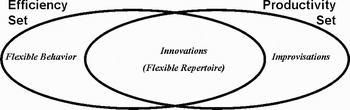
For a productivity change to be viable, that is, for it to become an innovation, it must meet necessary and sufficient conditions. The necessary condition entails that the productivity change is an improvement in comparison to old technology, that is, it expands the resource base or budget constraint. The sufficient condition entails that the productivity change is efficient, that is, it enhances well-being in light of opportunity costs. As the Venn diagrams (Fig. 1) show, if productivity change meets the necessary condition, it is part of the “Productivity Set,” whereas if it meets the sufficient condition, it is also part of the “Efficiency Set.” Only a subset of the “Productivity Set” can also fulfill the sufficient condition, that is, the “Efficiency Set.” This shared subset, here called “Innovation,” does not consist of elements ranked in absolute terms according to their productivity alone, that is, along a progressive view of evolution that abstracts from inducement or efficiency – a full cost-effectiveness consideration. In rationality theory (as well as in natural selection theory; Khalil Reference Khalil2007), innovations are ranked in relative terms, that is, according to environmental constraints or inducements.
Distinguishing Productivity from Efficiency.

Note that the “Efficiency Set” is not limited to innovations, or changes in resources arising from productivity. The “Efficiency Set” also includes behavior arising from change of climate, predators, or prey, that is, “Behavioral Flexibility.” Also note, the “Productivity Set” is not limited to innovations; it also includes nonviable productivity improvements, that is, “Improvisation.” Although improvisations are productive, they are inefficient and, hence, not repeated. So, “Innovations,” as proposed here, are novel technologies that exhibit greater productivity and efficiency by the fact that they are adopted in the future.
Ramsey et al. offer a different definition of innovations underpinned by the implicit view that makes the “Efficiency Set” and the “Productivity Set” external to each other. Therefore, Ramsey et al. do not view innovations as “inducement” determined by the environment in the same manner as “behavioral flexibility” – probably because they do not want to sacrifice the thesis, undisputed here, that innovations, related to the issue of “source,” are underdetermined by the environment.
In Ramsey et al.'s example of the chimp Eureka and the smashing of nuts, Eureka introduces a new technology when she starts to use stones instead of traditional tree branches. The stone technology would pass the necessary condition, that is, become part of the “Productivity Set,” if it entails productivity improvement as measured by output/energy, where energy is measured as if the branches and stones are equally accessible to the organism. That is, the productivity measure does not include environmental accidents such as the relative abundance of the potential tool. The productivity measure only includes energy expended in using and, given capital depreciation, repairing the tool. When we include the issue of relative abundance, we are invoking the sufficient condition in which the opportunity cost of fetching one tool as opposed to another is important. If the organism (or natural selection) judges the stone technology to be more productive than the branch technology, the organism (or natural selection) can still judge the stone technology to be less efficient than the branch technology. In judgment of efficiency, which determines whether the more productive technology is inside or outside the “Efficiency Set,” the organism (or natural selection) is induced by the issue of relative abundance. If Eureka spends too much time searching for stones relative to searching for branches, the stone technology would be less efficient, even though it could be more productive, than the branch technology. In this case, the stone technology would not be repeated, even though it is more productive than branches. If Eureka adopts the stone technology in future actions, it must have passed the sufficient condition, that is, it is part of the “Efficiency Set.” Once the stone technology is adopted, it is determined by the environment, in the “inducement” sense, whereas it can be underdetermined by the environment, in the “source sense.”
Thus, given Ramsey et al.'s definition of innovation as a modified repertoire repeated in the future, such repetition must entail that the innovation is determined by the environment, at least in the sense of inducement. But in their definition of innovation, Ramsey et al. exclude environmental determination in any sense, including inducement. So, Ramsey et al.'s definition of innovation is inconsistent.