Introduction
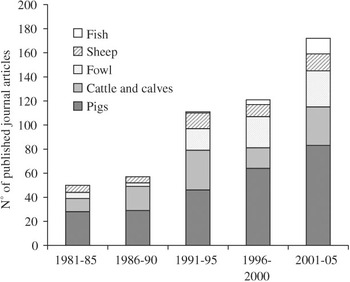
Since the publication of Ruth Harrison’s book Animal Machines in 1964, public opinion with regard to animal welfare has much changed. Animal welfare is considered a physical and mental state related to the absence of negative emotions (Dawkins, Reference Dawkins1990; Duncan, Reference Duncan1996) and probably to the presence of positive emotions (Boissy et al., Reference Boissy, Manteuffel, Jensen, Moe, Spruijt, Keeling, Winckler, Forkman, Dimitrov, Langbein, Bakken, Veissier and Aubert2007). The term of stress refers to the behavioural, physiological and emotional status of the animal confronted with a situation that it perceives as threatening with respect to the correct functioning of its bodily or mental state (Désiré et al., Reference Désiré, Veissier, Despres and Boissy2004; Terlouw, Reference Terlouw2005). Much effort has been made to reduce stress, and thus to improve animal welfare during the rearing period. Today, animal protection during the pre-slaughter and slaughter period receives increasing attention. In line with this, the Council directive 93/199/EC from December 1993 points out that ‘Animals shall be spared any avoidable excitement, pain or suffering during movement, lairaging, restraint, stunning, slaughter or killing’. Over the past 25 years, research on the effects of slaughter conditions on animal stress and ante- and post-mortem muscle metabolism has progressively increased (Figure 1). Many papers focus primarily on the consequences of meat quality, but more and more specifically study animal welfare matters, or at least discuss them.
Number of journal articles published in English in international journals, containing the key-words ‘stress’ and ‘slaughter’ anywhere in the text, as retrieved by ‘web of science’ (isiknowledge.com) over the past 25 years.

Slaughter procedures and therefore the possible causes of stress during this period vary according to species. Stress at slaughter may be of physical origin. Long and rough transports, food deprivation, inappropriate temperatures or air or water quality, aggression or shocks may cause fatigue, hunger, thermal and respiratory discomfort and pain, respectively. It may also have a psychological origin, such as social disturbance (separation from the rearing group, mixing of unfamiliar animals, high density) or fear (unfamiliar environments, handling). The slaughter procedure is complex and often a situation may represent several potential stress factors. For example, transport is associated with a change in physical and social environment, movements of the lorry that may cause physical shocks and unfavourable climatic conditions (temperature, humidity and air drafts), or water quality deterioration for fish. European standards have laid down maximal transport durations of 8 h for adult animals of all land species discussed here. For longer durations, the animals should be given a rest period and liquid and, if necessary, food (EU Directive 95/29/EC of 29 June 1995 and Council Regulation (EC) No. 1/2005 of 22 December 2004; Von Borell and Schäffer, Reference Von Borell and Schäffer2005; Cockram, Reference Cockram2007). It is further mandatory for slaughterhouses to provide food to animals that have not been slaughtered within 12 h of their arrival (Council Directive 93/199/EC).
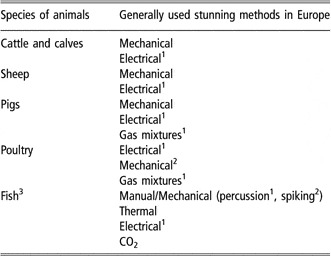
Stunning before slaughter is a statutory requirement in Europe and is performed to induce unconsciousness and insensibility in animals so that shackling, hoisting and slaughter can be performed without causing the animals any avoidable anxiety, pain, suffering or distress. If animals are slaughtered without previous stunning for religious/cultural reasons, the abattoir needs a special licence. The stunning technique is part of the slaughter procedure and the type used depends on the species (Table 1). Electrical stunning is induced by an electrical current passing through the brain resulting in a brain status similar to a grand mal epileptic fit due to a substantial depolarisation of the neurons. This status is considered incompatible with normal neuronal function and therefore believed to induce unconsciousness until repolarisation of the neurons (Hoenderken et al., Reference Hoenderken, Van Logtestijn, Sybesma and Spanjaard1979; Cook et al., Reference Cook, Devine, Tavener and Gilbert1992 and Reference Cook, Devine, Gilbert, Smith and Maasland1995). Mechanical stunning most often involves the introduction of a captive bolt into the skull. It provokes, first, an impact causing shock waves and subsequently destroys part of the brain resulting in a loss of consciousness. If the bolt is correctly introduced, loss of consciousness is permanent, although the bolt does not, in itself, kill the animal (Daly et al., Reference Daly, Gregory and Wotton1987 and Reference Daly, Kallweit and Ellendorf1988; Finnie, Reference Finnie1993). For gas stunning, a reversible technique unless the animal is killed, animals are immerged in gas mixtures containing CO2 and air, or argon and nitrogen (Raj et al., Reference Raj, Johnson, Wotton and McInstry1997; Gerritzen et al., Reference Gerritzen, Lambooij, Hillebrand, Lankhaar and Pieterse2000). Fish may, in addition, be stunned by exposure to cold temperatures (icy water). After stunning, the animals are killed by bleeding using neck cutting or chest-sticking techniques. Neck cutting can be used for most land species and implies the severing of the major blood vessels in the neck, where skin and vessels are cut simultaneously. Chest sticking, used for mammals, implies the severing of major blood vessels in the thorax or chest by inserting a knife in front of the brisket or sternum. In the case of cattle, chest-sticking needs more time, because first the skin, then, with another knife, the vessels are cut. Fish are bled by gill arch section or by manual pulling out of the gills, or by caudal vein cut, or by decapitation. Smaller fish species are not always bled. For all species, death due to blood loss should be induced before return of consciousness. All these stunning techniques are often preceded by physical and psychological discomfort for the animal. Animals may be isolated, constrained, inhale unpleasant gases, be subjected to temperature changes or shackled. In any case, proper use of stunning methods needs the presence of trained operators and adequately maintained equipment (Grandin, Reference Grandin2006).
Stunning methods used for different species

After Anon. (2004).
1May induce death.
2Induces death.
3Sometimes fish are left out of the water before bleeding, slowly inducing unconsciousness. Sometimes, they are bled without stunning.
To assess stress responses at slaughter, in addition to classically used (neuro)physiological and behavioural measurements, assessments of immunological status and ante- and post-mortem muscle metabolism have shown to be very useful. Data on resting behaviour, slips and escape attempts give useful information on the way the animal perceives its environment (Lensink et al., Reference Lensink, Fernandez, Cozzi, Florand and Veissier2001). The effects of physical activity and psychological stress on the secretion of hormones, measured in blood, urine or saliva and heart rate are well known and can be used to assess stress at slaughter (Foury et al., Reference Foury, Devillers, Sanchez, Griffo, LeRoy and Mormede2005; Hambrecht et al., Reference Hambrecht, Eissen, Newman, Smits, den Hartog and Verstegen2005; Terlouw and Rybarczyk, 2008). Stimulus-induced electro-encephalocortical responses allow one to assess whether unconsciousness has been correctly induced by the stunning technique (Raj et al., Reference Raj, Wotton and Gregory1992; Robb et al., Reference Robb, Wotton, McKinstry, Sørensen and Kestin2000; Martoft et al., Reference Martoft, Lomholt, Kolthoff, Rodriguez, Jensen, Jorgensen, Pedersen and Forslid2002). If genetic and environmental (rearing/carcass handling) aspects are controlled for, post-mortem muscle metabolism reflects partly pre-slaughter stress and physical effort (Debut et al., Reference Debut, Berri, Arnould, Guemené, Santé-Lhoutellier, Sellier, Baéza, Jehl, Jégo, Beaumont and Le Bihan-Duval2005; Terlouw, Reference Terlouw2005). Following slaughter, glycogen continues to be degraded, but in the absence of blood circulation, protons and lactate accumulate locally in the muscle cell, causing a decline in pH (Bendall, Reference Bendall1973). This decline is initially fast, then slows and stabilises at a value called ultimate pH, reached 24 h post mortem (usually between 5.4 and 6.0 for land animals and higher than 6.0 for fish). High muscle temperature and a fast pH decline during the minutes or hours following slaughter indicate increased activity and possibly psychological stress just before slaughter. A high ultimate pH (low amplitude of pH decline) indicates that the animal had reduced glycogen reserves, probably due to increased activity and possibly psychological stress during the hours preceding slaughter (Morzel et al., Reference Morzel, Sohier and Van de Vis2003; Terlouw, Reference Terlouw2005). However, pH may evolve normally, even if an animal has been stressed before slaughter (Terlouw and Rybarczyk, 2008).
The following chapters briefly describe the main procedures used to slaughter the following most consumed species: fowl, pigs, calves and adult cattle, sheep and farmed fish, and discuss the currently known associated causes of stress. We address subsequently consequences on meat quality and possible itineraries for future research.
Fowl
Fowl are either reared in very large groups of several thousands on a floor system (broiler chickens and turkeys for example) or in cages containing only a few animals (layer poultry birds for example). At least 8 h before slaughter, animals are food deprived. Before transport they need to be caught to be introduced into transport crates that are loaded onto a lorry. European legislation has fixed that transport durations over 8 h should be avoided and that food and water should be made available for transports lasting over 12 h. European standards for density during transport range from 180 to 105 cm2/kg for weights ranging from <1.6 to >5 kg live weight. At arrival at the slaughter house, the transport crates may remain for a while on the lorry until unloading, outside or in a shed. Depending on the time schedule of the abattoir and the time of arrival, they may be rapidly slaughtered or wait for several hours. The birds remain inside the crates. For slaughter, a conveyer belt takes the crates towards the stunning area. Here the birds are manually suspended on their legs on shackles that run automatically along a rail towards an electrified water bath. The birds receive an electrical shock when the head immerses in the bath, causing loss of consciousness. The birds are bled immediately after the water bath. In some European countries, birds may be gas-stunned, using various mixtures of CO2 with Argon and/or Nitrogen, or CO2 with O2. In this case, the cages are put onto a conveyer belt that enters the gas area.
Food deprivation of the birds before slaughter may have negative effects on animal welfare. Two hours of food deprivation is accompanied by an increase of corticosterone, which may result from metabolic stress and also have a psychological component (Kannan and Mench, Reference Kannan and Mench1996; Nijdam et al., Reference Nijdam, Delezie, Lambooij, Nabuurs, Decuypere and Stegeman2005). After 24 h, the birds may lose up to 10% of their initial weight (Warriss et al., Reference Warriss, Wilkins and Knowles1999). Food deprivation reduces hepatic and muscle glycogen reserves, which may increase the birds’ reactivity to stress factors during transport and slaughter (Sams and Mills, Reference Sams and Mills1993, Kotula and Wang, Reference Kotula and Wang1994; Edwards et al., Reference Edwards, McMurtry and Vasilatos-Younken1999).
Bird catching is probably a major cause of stress during the pre-slaughter procedure. The birds are carried upside down by their legs and introduced in transport cages, which may cause bruising and dislocated and broken bones (Gregory and Wilkins, Reference Gregory and Wilkins1989; Kettlewell and Mitchell, Reference Kettlewell and Mitchell1994). In broilers, carrying the birds upside down caused an increase in plasma corticosterone (Kannan and Mench, Reference Kannan and Mench1996). During subsequent crating, corticosterone levels remained high, unless the crated birds were kept in a dark, quiet place (Kannan and Mench, Reference Kannan and Mench1996; Kannan et al., Reference Kannan, Heath, Wabeck, Souza, Howe and Mench1997b). Some automatic bird-catching machines exist. They cause less fear reactions, as indicated by lower levels of tonic immobility, plasma corticosterone and lesions compared to manual catching (Duncan et al., Reference Duncan, Slee, Kettlewell, Berry and Carlisle1986; Knierim and Gocke, Reference Knierim and Gocke2003). They are, however, little used.
The welfare of the birds depends strongly on the duration and conditions of transport and waiting on the unloading dock at the slaughterhouse. For example, longer transports increased fear and stress reactions as indicated by higher levels of tonic immobility, of plasma corticosterone and creatine kinase and the heterophil/lymphocyte ratio, as well as the number of animals found dead on arrival (Freeman et al., Reference Freeman, Kettlewell, Manning and Berry1984; Cashman et al., Reference Cashman, Nicol and Jones1989; Mitchell et al., Reference Mitchell, Kettlewell and Maxwell1992; Warriss et al., Reference Warriss, Bevis, Brown and Edwards1992). During bird transport, climatic microenvironments exist in the lorry. There is an accumulation of CO2 and heat, especially at the core of the vehicle load (Mitchell and Kettlewell, Reference Mitchell and Kettlewell1994) and particularly increased temperature is considered one of the sources of transport stress (Mitchell et al., Reference Mitchell, Kettlewell and Maxwell1992). Thermal stress during transport or during lairage caused increased plasma creatine kinase and corticosterone levels in birds (Mitchell et al., Reference Mitchell, Kettlewell and Maxwell1992; Mitchell and Sandercock, Reference Mitchell and Sandercock1995; Debut et al., Reference Debut, Berri, Arnould, Guemené, Santé-Lhoutellier, Sellier, Baéza, Jehl, Jégo, Beaumont and Le Bihan-Duval2005). No water is available in the crates, and dehydration may aggravate the effects of thermal stress (Gregory, Reference Gregory1998; Knowles et al., Reference Knowles, Warriss, Brown, Edwards and Mitchell1995b). More birds are found dead on arrival after transports at higher temperatures (Gregory, Reference Gregory1994). Increased physical efforts of the food-deprived birds, during transport or during the waiting period at the slaughterhouse, explain their lower hepatic and muscle glycogen levels (Warriss et al., Reference Warriss, Wilkins and Knowles1999).
The procedure for electrical stunning may have negative effects on the welfare of the birds. Shackling causes an increase in corticosterone, but has no effect on tonic immobility (Kannan et al., Reference Kannan, Heath, Wabeck and Mench1997a; Debut et al., Reference Debut, Berri, Arnould, Guemené, Santé-Lhoutellier, Sellier, Baéza, Jehl, Jégo, Beaumont and Le Bihan-Duval2005). The shackled birds vocalise and flap their wings probably with the objective to regain the upright position (Gregory and Bell, Reference Gregory and Bell1987; Debut et al., Reference Debut, Berri, Arnould, Guemené, Santé-Lhoutellier, Sellier, Baéza, Jehl, Jégo, Beaumont and Le Bihan-Duval2005). Mecanothermal C-fibre nociceptor responses to mechanical stimulation indicate that shackling may be very painful for the birds (Gentle and Tilston, Reference Gentle and Tilston2000) and may cause broken bones, at least in layer hens (Gregory and Wilkins, Reference Gregory and Wilkins1990). Wing flapping was violent or prolonged when shackles were tight fitting (Parker et al., Reference Parker, Bajoie, Catille, Cadd, Satterlee and Jones1997). Processing plants may use dim light (<5 lux) or blue or violet light, which has a quietening effect on birds compared with light of 50 or 200 lux (Jones et al., 1998). Birds that perform more wing flapping on the shackle line have a faster pH decline, due to acceleration of their muscle metabolism just before death (Debut et al., Reference Debut, Berri, Arnould, Guemené, Santé-Lhoutellier, Sellier, Baéza, Jehl, Jégo, Beaumont and Le Bihan-Duval2005). Genetic background influences the degree of struggling during shackling with more struggling in a slow-growing compared to a standard fast-growing chicken line, possibly explained by anatomic differences (Debut et al., Reference Debut, Berri, Baeza, Sellier, Arnould, Guemene, Jehl, Boutten, Jego, Beaumont and Le Bihan-Duval2003).
Before entering the water bath, birds may receive pre-stun shocks, generally because their wings hang lower than their heads and touch the water first. Pre-shock stuns may induce wing flapping and consequently the head of the bird may partly or completely miss the water bath. Occurrence of pre-stun shocks is higher in turkeys than in chickens, due to the larger wing span of turkeys (Hewson and Russell, Reference Hewson and Russell1989; Wotton and Gregory, Reference Wotton and Gregory1991). The problem is reduced if the water does not overflow at the entrance of the water bath and if the bath is fitted with an electrically isolated entry ramp that slopes upwards towards the bath. Their effect is to support the birds’ heads until the end of the ramp where the head drops suddenly into the water bath (Wotton and Gregory, Reference Wotton and Gregory1991).
Electrical water baths vary according to manufacture. They are all constant voltage (not constant current) stunners and most use frequencies between 300 and 1500 Hz of pulsed direct currents (DC) or sine wave alternating currents (AC). Minimal current needed to induce consciousness, and duration of induced unconsciousness depend on all of these characteristics (Raj and O’Callaghan, Reference Raj and O’Callaghan2004), as well as on species of the birds. Commercial water baths may contain up to 20 chickens or five turkeys. Resistance depends on the number of birds at any one time in the water bath, i.e. its length, cleanliness of the water, conductivity between the shackles (earth electrode) and the birds’ shanks and impedance of the birds (Schutt-Abraham et al., Reference Schutt-Abraham, Wormuth and Fessel1983; Bilgili, Reference Bilgili1992; Sparrey et al., Reference Sparrey, Kettlewell and Paice1992). In the case of electrical stunning, rapid subsequent neck cutting is important. In larger plants, neck cutting is often automatic with a rotary blade severing at least one but preferably two carotids. Delay to neck cutting (i.e. the distance between the water bath and the cutting device) should be in accordance with minimal duration of unconsciousness induced and hence with electrical parameters used.
Gas stunning requires much less manipulation of the animals and avoids the pre-stunning shackling procedure, because the crates with the birds are directly put onto the conveyer belt that transports them into the gas room. The method is used in slaughterhouses in certain European countries. In the case of birds, the duration of exposure and gas concentrations are often conceived to kill, rather than only stun the birds, to avoid that the birds wake up while they are bled. Delay to cutting is not important, as the birds are dead. There are also some negative aspects to this method. Inhalation of some gases, such as CO2, is unpleasant for humans: at higher concentrations, it is pungent and induces the sensation of breathlessness (Gregory et al., Reference Gregory, Raj, Audsley and Daly1990). Various mixtures can be used to stun or kill poultry; e.g., 90% argon in air, 30% CO2 and 60% argon in air, or 40% CO2, 30% O2 and 30% N2 (Lambooij et al., Reference Lambooij, Gerritzen, Engel, Hillebrand, Lankhaar and Pieterse1999). In birds, certain mixtures may be aversive, as 30% of CO2 in argon and 30% of CO2 in 40% of O2 (remaining part being air) induced gasping (Gerritzen et al., Reference Gerritzen, Lambooij, Hillebrand, Lankhaar and Pieterse2000). Immersion in high concentrations of argon might be a better, albeit a more expensive solution (Raj, Reference Raj1996; Gerritzen et al., Reference Gerritzen, Lambooij, Hillebrand, Lankhaar and Pieterse2000). In addition, induction of unconsciousness takes longer, and recovery time is shorter when argon is used without CO2 (Raj and Gregory, Reference Raj and Gregory1990 and Reference Raj and Gregory1993).
Other techniques, captive bolt pistol or neck dislocation, are only used as back-up stunning methods. Decapitation without prior stunning is only used for small-scale on-farm killing or for disease control. It induces loss of brain responsiveness (<5% of pre-decapitation spontaneous electrical brain activity) after 32 ± 2 s (Gregory and Wotton, Reference Gregory and Wotton1986).
Pigs
Pigs are generally reared in groups of 10 to 12. Live weight of slaughter pigs is generally between 110 and 115 kg in most European countries. At arrival of the lorry, they are loaded and are either directly transported to the slaughterhouse, or they stop at other farms to fill the lorry. In the lorry, pens of a same rearing site are mixed. Sometimes, before arrival of the lorry, pigs of different pens have already been mixed while waiting on the loading quay of the farm. European legislation has fixed a maximal density of 0.51 m2 per pig of 100 kg live weight during transport. In the slaughterhouse, pigs are lairaged in pens containing from 15 up to sometimes 50 pigs, depending on the slaughterhouse equipment. Depending on the time schedule of the abattoir and the time of arrival, they may be rapidly slaughtered or wait for 3 to 18 h. In general, pigs have often been food deprived for at least 12 h, but sometimes up to 24 h before slaughter. Pigs of different farms are not mixed. For slaughter, pigs are guided to a stunning box or restrainer for electrical stunning, or to a gas stunner.
Adequately designed and maintained equipment to load pigs onto the lorry avoids slipping of the animals and favours rapid introduction of the pigs in the lorry, reducing stress. Both loading and unloading procedures, even well organised, are associated with physical effort of the pigs and provoke increased heart rates and plasma levels of cortisol and creatine kinase (Geverink et al., Reference Geverink, Buhnemann, Vandeburgwal, Lambooij, Blokhuis and Wiegant1998; Kim et al., Reference Kim, Woo and Lee2004; Brown et al., Reference Brown, Knowles, Wilkins, Chadd and Warriss2005). Three hours of transport required physical effort as it caused net glycogen consumption, sometimes resulting in higher ultimate pH (Pérez et al., Reference Perez, Palacio, Santolaria, Acena, Chacon, Gascon, Calvo, Zaragoza, Beltran and Garcia-Belenguer2002; Hambrecht et al., Reference Hambrecht, Eissen, Newman, Smits, den Hartog and Verstegen2005). The effect of transport on physiological and behavioural parameters depends mostly on conditions. Hambrecht et al. (Reference Hambrecht, Eissen, Newman, Smits, den Hartog and Verstegen2005) observed that after 50 min and 3 h of transport cortisol responses were similar. If abrupt changes of speed and direction are avoided and if ambient temperature is adapted, the pigs are able to adopt a stable posture and even rest (Geverink et al., Reference Geverink, Buhnemann, Vandeburgwal, Lambooij, Blokhuis and Wiegant1998). If the lorry is in good condition, driving is smooth and stocking density appropriate, the stress and effort related to loading and unloading have probably the largest effect, possibly explaining the higher plasma cortisol levels and lower neutrophil/lymphocyte ratio after short (15 min) compared to longer (3 h) transport (Pérez et al., Reference Perez, Palacio, Santolaria, Acena, Chacon, Gascon, Calvo, Zaragoza, Beltran and Garcia-Belenguer2002). However, the level of psychological stress due to social disturbances, including mixing of pigs, to handling and unfamiliarity of the situation, should also be considered and will be discussed below.
From the meat quality point of view, given that immediate slaughter after arrival at the abattoir may cause accelerated post-mortem pH decline, it is recommended to lairage pigs, for 1 or 2 h, but depending on the time of arrival, lairage may last up to 18 h. The consequences of lairage at the abattoir for the well-being of the pigs vary between studies and depend strongly on stocking conditions. A major cause of stress is the mixing of pigs of different pens (from the same farm), which results often in fighting. Fighting may start at the farm, if the pigs are mixed on the loading quay, or at the abattoir, during lairage. Fighting may occur during transport (Barton-Gade, 2004) if transport conditions (stocking density, driving conditions) allow for it. Fighting levels depend often on the presence of a few aggressive animals in the group (Geverink et al., Reference Geverink, Engel, Lambooij and Wiegant1996) and are generally higher at higher stocking density (Geverink et al., Reference Geverink, Engel, Lambooij and Wiegant1996), in larger compared to smaller groups (Schmolke et al., Reference Schmolke, Li and Gonyou2004) and in pigs that have been food deprived (Brown et al., Reference Brown, Knowles, Edwards and Warriss1999). The latter point shows that, although up to 12 h of food deprivation does not seem to cause physical discomfort (Beattie et al., Reference Beattie, Burrows, Moss and Weatherup2002), food deprivation increases reactivity to certain slaughter procedures and therefore contributes indirectly to stress levels at slaughter. Fighting increases plasma levels of cortisol, adrenaline and metabolites, and meat ultimate pH increases proportionally to fighting levels (Fernandez et al., Reference Fernandez, Meunier-Salaun and Mormede1994; Terlouw et al., Reference Terlouw, Porcher and Fernandez2005). However, if lairage groups are small and duration of food deprivation is short, the lairage period may allow pigs to rest and stress levels may progressively decrease (Perez et al., Reference Perez, Palacio, Santolaria, Acena, Chacon, Gascon, Calvo, Zaragoza, Beltran and Garcia-Belenguer2002).
Following lairage, pigs are driven to the stunning area. Duration and conditions of this phase depend on the equipment and line speed of the abattoir. If the corridors contain corners or obstacles, if the entrance of the automatic electrical stunning system presents a bottleneck, or if groups are very large, pigs progress with more difficulty (Grandin, Reference Grandin2006). Use of sticks and electric prods obviously causes pain and stress (D’Souza et al., Reference D’Souza, Dunshea, Warner and Leury1998; Hemsworth et al., Reference Hemsworth, Barnett, Hofmeyr, Coleman, Dowling and Boyce2002).
The pig’s history influences reactivity to slaughter procedures. Pigs reared outdoors or in enriched environments fought less and had lower skin damage levels (Klont et al., Reference Klont, Hulsegge, Hoving-Bolink, Gerritzen, Kurt, Winkelman-Goedhart, De Jong and Kranen2001; Barton-Gade, 2008; Terlouw et al., 2004). It is believed that rearing at high density or under barren conditions may disturb the normal development of social behaviour or increase fearfulness, resulting in increased aggression (Schouten, 1986; de Jonge et al., Reference De Jonge, Bokkers, Schouten and Helmond1996; Olsson et al., Reference Olsson, De Jonge, Schuurman and Helmond1999; O’Connell et al., Reference O’Connell, Beattie and Moss2004). Pigs reared under standard intensive conditions were easier to load, but showed a stronger increase in salivary cortisol during transport and lairage than pigs reared in larger pens or in an enriched environment and their meat had more drip loss (Geverink et al., Reference Geverink, Jong, Lambooij, Blokhuis and Wiegant1999; De Jong et al., Reference De Jong, Prelle, Van de Burgwal, Lambooij, Korte, Blokhuis and Koolhaas2000; Klont et al., Reference Klont, Hulsegge, Hoving-Bolink, Gerritzen, Kurt, Winkelman-Goedhart, De Jong and Kranen2001; Chaloupkova et al., Reference Chaloupkova, Illmann, Neuhauserova, Tomanek and Valis2007), although opposite results have also been reported (Lambooij et al., Reference Lambooij, Hulsegge, Klont, Winkelman-Goedhart, Reimert and Kranen2004).
The different methods used to stun pigs have different advantages and disadvantages. Electrical stunning can be induced very quickly, with manual stunning tongs or automatic systems. Automatic electrical stunning systems have the disadvantage to contain a restrainer that pigs must enter in a single line. The restrainer carries the pigs, either through two slightly inclined conveyer belts or on a central rail towards the stunning electrodes at the exit. These position themselves automatically behind the eyes to deliver the electrical shock. The restrainer causes a sharp rise in heart rate (Chevillon, Reference Chevillon2001) probably because it contradicts the gregarious instinct of the pigs and because it lifts their feet from the floor. At the narrow entrance of the restrainer, pigs may mount on other pigs, injuring them. Sometimes, when the electrodes position themselves wrongly due to different sizes of pigs, or when maintenance is insufficient, the current applied may be insufficient and painful (Sparrey and Wotton, Reference Sparrey and Wotton1997; Wotton and O’Callaghan, Reference Wotton and O’Callaghan2002). Some more recent automatic electrical stunning systems apply a third electrode on the back or chest to cause cardiac fibrillation or arrest, to avoid that animals regain consciousness (Wotton and Gregory, Reference Wotton and Gregory1986).
Carbon dioxide stunning is much used in some European countries. The system consists of a pit of several metres filled with a high (generally 70–90%) concentration of CO2. CO2 is heavier than air and therefore forms a gradient inside the pit, with lower concentrations at the upper levels. Pigs enter a box within the upper part of the pit, which subsequently closes and lowers into the pit. The system may be conceived for individual and grouped pigs. Today, there is no consensus on the level of aversion of the CO2 stunning system. The possibility to keep the pigs in groups is clearly an advantage. As mentioned above, inhalation of high concentrations of CO2 is unpleasant for humans (Gregory et al., Reference Gregory, Raj, Audsley and Daly1990). Food-deprived pigs refuse to enter an area containing 90% of CO2 to obtain a food reward (Raj and Gregory, Reference Raj and Gregory1995), while Jongman et al. (Reference Jongman, Barnett and Hemsworth2000) demonstrated that inhaling 60% or 90% CO2 is less stressful than receiving an electrical prod. Pigs inhaling 80% CO2 loose their standing posture after about 22 s (Raj and Gregory, Reference Raj and Gregory1996). At lower CO2 concentrations, loss of posture and consciousness takes longer (Dodman, Reference Dodman1977; Raj and Gregory, Reference Raj and Gregory1995 and Reference Raj and Gregory1996). Observations on 10 pigs found that immersion in 80% of CO2 caused unusual behavioural excitation. Eight pigs responded with violent jumps, all of them had apparent respiratory difficulties and eight vocalised (cf. Deiss et al., Reference Deiss, Astruc, Ferreira and Terlouw2006). There is currently no consensus on the question whether pigs lose consciousness before or after the behavioural signs (Hoenderken et al., Reference Hoenderken, Van Logtestijn, Sybesma and Spanjaard1979; Martoft et al., Reference Martoft, Lomholt, Kolthoff, Rodriguez, Jensen, Jorgensen, Pedersen and Forslid2002).
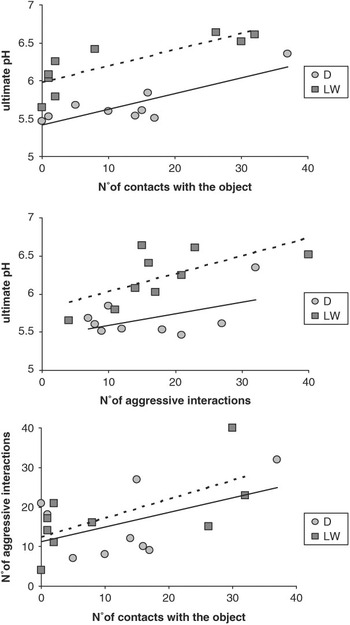
Studies have been conducted with the aim to better understand underlying factors involved in the stress reactions of pigs at slaughter. Like other species, pigs are known to show consistency in their responsiveness to different stressful situations (Lawrence et al., Reference Lawrence, Terlouw and Illius1991). Many of the slaughter procedures are associated with handling of the pigs and, therefore, reactivity to human presence was tested several weeks before slaughter, during the rearing period. Large White pigs that in the human exposure tests approached and touched more easily a person had lower muscle temperature after slaughter. This suggests that they had lower stress and/or activity levels just before slaughter (Terlouw and Rybarczyk, 2008). Other experiences show the opposite, probably because pigs that were less fearful of man were at the end of the queue and received more adverse interactions (Hemsworth et al., Reference Hemsworth, Barnett, Hofmeyr, Coleman, Dowling and Boyce2002). Genetic background plays a role in reactivity to humans: in the human exposure test, Duroc pigs approached less often the person than Large White pigs (Terlouw and Rybarczyk, 2008). Reactivity to novelty may also play a role in the stress response, as Large White and Duroc pigs that explored more a non-familiar object during a test conducted during the rearing period produced meat with higher ultimate pH, indicative of increased activity during the pre-slaughter period. Part of the increased pH was explained by the higher aggressiveness during mixing in these same pigs (Terlouw and Rybarczyk, 2008; Figure 2).
Scatter plots and regression lines between Adductor femoris ultimate pH (indicative of pre-slaughter stress reactions; see text) and bouts of exploration of the unfamiliar object (top; Pooled Pearson, r = 0.83; P < 0.001) and the number of aggressive interactions during mixing before slaughter (middle; Pooled Pearson, r = 0.59; P < 0.01) and between bouts of exploration of an unfamiliar object during a test and the number of aggressive interactions during mixing before slaughter (bottom; Pooled Pearson, r = 0.57; P < 0.01) for industrially slaughtered Duroc and Large White pigs. Data from Terlouw and Rybarczyk (2008).

Veal calves and adult cattle
Veal calves and fattening bulls are mostly loaded as large groups from a single farm. Cull cows and sometimes bull calves, as well as neonatal male calves in the UK where veal calf production is very low, are loaded individually. If only few animals are loaded per farm, the lorry is filled with animals of several farms and consequently cattle from different farms may be mixed in the same compartment. Cattle are slaughtered either immediately after arrival at the slaughterhouse or after a lairage period of 12 to 24 h. Today adult cattle are generally lairaged in individual stalls. Veal calves travel generally directly from the farm to the slaughterhouse, with transport durations between 1 and 4 h. They are lairaged in groups of 20 to 40 calves. The lairage period is generally kept short, between 30 min and 3 to 4 h, to avoid bruising resulting from the fact that the calves are tired and lie down. Stocking density standards during transport depend on the weight of the animal, from 0.4 m2 for a calf (100 kg), up to 2 m2 for an adult (1000 kg). Adult cattle are generally stunned with a captive bolt, although in some countries several abattoirs use an automatic electrical stunning system (Wotton et al., Reference Wotton, Gregory, Whittington and Parkman2000). Depending on the country, calves are electrically or captive bolt stunned (Lambooij and Spanjaard, Reference Lambooij and Spanjaard1982).
Of the transport procedure, the loading procedure on the farm seems the most stressful aspect for calves and adult cattle. The animals have to leave their familiar pen or environment and sometimes social group, are handled and are introduced into the unfamiliar environment of the lorry, sometimes containing unfamiliar animals. The whole loading procedure causes an increase in the blood cortisol rate and an increase in the heart rate of approximately 80% in calves, compared to home pen levels (Lensink et al., Reference Lensink, Fernandez, Cozzi, Florand and Veissier2001; Van de Water et al., Reference Van de Water, Heylen, Swinnen and Geers2003). Loading conditions, especially equipment (loading ramp and quay), determine largely levels of psychological stress and physical effort. Despite efforts, farms are generally insufficiently equipped. Slippery floors, sharp corners or metal structures may hurt the animals and further cause psychological and physical stress (Lensink et al., Reference Lensink, Fernandez, Cozzi, Florand and Veissier2001; Van de Water et al., Reference Van de Water, Heylen, Swinnen and Geers2003; Mounier et al., Reference Mounier, Dubroeucq, Andanson and Veissier2006).
During transport, heart rate and plasma levels of cortisol, creatine kinase, free fatty acids and lactate are higher than those observed in the home pens (Van de Water et al., Reference Van de Water, Heylen, Swinnen and Geers2003; Grigor et al., Reference Grigor, Cockram, Steele, McIntyre, Williams, Leushuis and Van Reenen2004). Sartorelli et al. (Reference Sartorelli, Dominoni and Agnes1992) showed that cortisol levels increase during the first 30 to 60 min of transport and then remain stable. Heart rate is initially high, but decreases gradually over a period by 30 to 60 min of transport, reaching values of 10% to 25% above the basic level (Lensink et al., Reference Lensink, Fernandez, Cozzi, Florand and Veissier2001; Van de Water et al., Reference Van de Water, Heylen, Swinnen and Geers2003; Grigor et al., Reference Grigor, Cockram, Steele, McIntyre, Williams, Leushuis and Van Reenen2004). These physiological changes are most probably related to emotional stress due to the unfamiliar situation and to physical effort related to loading and to keep balance in the moving and vibrating lorry (cf. Van de Water et al., Reference Van de Water, Heylen, Swinnen and Geers2003).
Transport conditions (temperature, draughts, driving style), the density and the position of the animals in the truck influence behavioural and physiological responses of calves (Kenny and Tarrant, Reference Kenny and Tarrant1987a and Reference Kenny and Tarrant1987b; Van de Water et al., Reference Van de Water, Heylen, Swinnen and Geers2003). For example, calves at the rear of the lorry have higher heart rates and lower cortisol levels than those at the front (Van de Water et al., Reference Van de Water, Heylen, Swinnen and Geers2003). Increased heart rate was explained by the increased effort to keep balance at the rear and increased cortisol levels by changes in the temperature and draught, inducing a physiological stress, at the front of the lorry (Van de Water et al., Reference Van de Water, Heylen, Swinnen and Geers2003). During long transport at low density, calves may lie down, probably expressing fatigue (Grigor et al., Reference Grigor, Cockram, Steele, McIntyre, Williams, Leushuis and Van Reenen2004). Although this allows them to rest, calves remaining standing may injure those lying down.
Introduction of adult cattle into the lorry caused an increase in frequency of urination and cortisol levels and these increased further when the truck started moving, to decrease after approximately two hours of transport (Tarrant, Reference Tarrant1990). Adult cattle may lie down after 2 to 4 h of transport if conditions are adapted allowing the animals to rest (Broom, Reference Broom2003), which is, however, rare. Adult cattle prefer to be oriented parallel or perpendicularly to the driving direction. Their orientation depends further on the driving style and road type (Kenny and Tarrant, Reference Kenny and Tarrant1987a and Reference Kenny and Tarrant1987b). Loss of balance and falling is likely to cause injury or crushing by conspecifics. Appropriate stocking density is important. High stocking density increases cortisol levels and makes it difficult for the cattle to orient themselves according to the driving direction. At too low stocking density, the animals cannot use surrounding animals to maintain their balance (Tarrant, Reference Tarrant1990; Knowles, Reference Knowles1999). Balance maintenance in these large animals involves great physical effort and may cause fatigue (Tarrant, Reference Tarrant1990). Such effort explains the increased levels of plasma creatine kinase after 15 h of transport (Knowles, Reference Knowles1999).
Several studies showed that the rearing system and the type and frequency of contacts with the stockperson influence the animals’ fear reactions to novel situations during the pre-slaughter period. For example, the calves having received positive and more frequent contacts from their stockbreeder were easier to handle and had lower heart rates during loading (Lensink et al., Reference Lensink, Boivin, Pradel, Le Neindre and Veissier2000a, Reference Lensink, Fernandez, Boivin, Pradel, Le Neindre and Veissier2000b and Reference Lensink, Fernandez, Cozzi, Florand and Veissier2001). Keeping the animals in stable groups may further facilitate the slaughter procedure. Cattle tend to follow their conspecifics, thus reducing stress due to separation or emotional reactions to the slaughter context. Bull calves kept in their social group during the pre-slaughter period had less increase in cortisol levels in blood collected at bleeding (Mounier et al., Reference Mounier, Dubroeucq, Andanson and Veissier2006). The effect was even more pronounced when the animals had been reared together (Mounier et al., Reference Mounier, Dubroeucq, Andanson and Veissier2006). Other studies found that cattle differ consistently in their reactivity to various aversive situations and that this reactivity was correlated to reactions to slaughter procedures, indicated by differences in bruising score and tenderness (Fordyce et al., Reference Fordyce, Whythes, Shorthose, Underwood and Shepherd1988; Voisinet et al., Reference Voisinet, Grandin, O’Connor, Tatum and Deesing1997).
At arrival at the slaughterhouse, animals are again exposed to various potential stressing factors such as handling, novelty and particularly for calves, mixing with unfamiliar conspecifics. Unloading conditions at the slaughterhouse are generally better than loading conditions at the farm, due to the better equipment. Although the lairage environment may be stressful for adult cattle, the lairage period may allow a recovery of the physical efforts and the psychological stress related to the unloading and transport procedure. After 24 to 48 h lairage of adult cattle, behavioural, physiological and metabolic status is similar to before transport (Warriss et al., Reference Warriss, Kestin, Brown and Wilkins1984; Knowles, Reference Knowles1999; Mounier et al., Reference Mounier, Dubroeucq, Andanson and Veissier2006). In calves, heart rate during unloading shows similar increases as those observed during loading at the farm, i.e. 70 to 75% increases compared to basal levels (Lensink et al., Reference Lensink, Fernandez, Cozzi, Florand and Veissier2001). Cortisol levels, increased after transport, reach pre-transport levels after about 2 h of lairage, while heart rate levels remain higher, suggesting psychological stress (Lensink et al., Reference Lensink, Fernandez, Cozzi, Florand and Veissier2001; Van de Water et al., Reference Van de Water, Heylen, Swinnen and Geers2003; Grigor et al., Reference Grigor, Cockram, Steele, McIntyre, Williams, Leushuis and Van Reenen2004). At lairage durations of over 2 h, the calves tend to lie down due to fatigue, which increases risks of slips, falls and injury (Grigor et al., Reference Grigor, Cockram, Steele, McIntyre, Williams, Leushuis and Van Reenen2004).
Mixing of unfamiliar adult cattle during transport or at lairage results in agonistic interactions. Young bull calves, in addition, mount each other, causing muscular fatigue and glycogen depletion (Kenny and Tarrant, Reference Kenny and Tarrant1987c). Mixing of adult cattle may thus have negative consequences for animal welfare and meat quality. Therefore, today, height of the stocking compartments of the lorries is limited to prevent mounting and lairage of adult cattle takes place in individual stalls.
Few data are available on the reactions of calves and adult cattle to the stunning procedure. The fear-inducing aspects of handling, certain odours, social isolation and darkness in the stunning box are well known (Terlouw et al., Reference Terlouw, Boissy and Blinet1998; Grandin, Reference Grandin2006). The use of the electric prod is painful and increases vocalisation, indicative of stress (Rushen et al., Reference Rushen, Boissy, Terlouw and De Passillé1999; Grandin, Reference Grandin2001). Penetrative captive bolt stunning, when correctly applied on the front of calves or adult cattle, has generally good results in terms of success rate and duration of unconsciousness. However, field observations indicate that 6.1% to 16.3% of miss-stuns may occur, often due to inadequate maintenance of the gun, or to bad quality of the cartridges (Von Wenzlawowitz, personal communication, 2004; Gregory et al., 2007). Electrical stunning can be applied manually on young calves (Bager et al., Reference Bager, Braggins, Devine, Graafhuis, Mellor, Tavener and Upsdell1992). If the system is properly maintained and used, unconsciousness can be reliably induced. Manual electrical stunning may be used with very low throughput rates for adult cattle that are calm or restrained (Von Mickwitz et al., Reference Von Mickwitz, Heer, Demmler, Rehder and Seidler1989; Schatzmann and Jäggin-Schmucker, Reference Schatzmann and Jäggin-Schmucker2000). For less-calm animals or at higher throughput rates, automatic systems should be used.
Electrical stunning has also some disadvantages. Electrically induced unconsciousness may not last long enough to allow normal killing by bleeding if cardiac ventricular fibrillation has not been also induced by application of a current in the cardiac region. Even if fibrillation has been induced, the heart can resume normal functioning if an animal is manipulated too soon after application of this so-called stun/kill procedure (Daly, personal communication). Another negative aspect is that electrical stunning (whether associated with cardiac fibrillation or not) induces tonic/clonic seizures, making prompt and accurate sticking difficult (Wotton et al., Reference Wotton, Gregory, Whittington and Parkman2000). In some parts of the world, electro-immobilisation (low-voltage spinal discharge) is applied following the stun to prevent the movements. However, electro-immobilisation masks the signs of consciousness in poorly stunned animals making visual monitoring of undue recovery of unconsciousness inadequate (Wotton et al., Reference Wotton, Gregory, Whittington and Parkman2000; Anon, 2004). Alternative systems allowing electrical stunning and immediate sticking within the restraining pen before seizures may present advantages for animal welfare (Troeger, Reference Troeger2002), but are probably not adapted for higher line speeds.
After stunning, cattle are neck-cut or chest-stuck. In adult cattle and calves, delay of loss of consciousness after neck cutting is very variable and was observed to last up to 680 s (Bager et al., Reference Bager, Braggins, Devine, Graafhuis, Mellor, Tavener and Upsdell1992). After chest-sticking, mean arterial blood pressure fell from about 70 mmHg to 0 within 8 s, suggesting that loss of consciousness is much faster and less variable after this technique (Anil et al., Reference Anil, McKinstry, Wotton and Gregory1995b). The reason is that at neck cutting only the external jugulars and the common carotids are severed, but not the vertebral arteries that continue to supply blood to the brain. In addition, after neck cutting, blood clots appear sometimes at the caudal ends of the severed carotids, causing occlusions and delaying the onset of unconsciousness (Bager et al., Reference Bager, Braggins, Devine, Graafhuis, Mellor, Tavener and Upsdell1992; Anil et al., Reference Anil, McKinstry, Gregory, Wotton and Symonds1995a and Reference Anil, McKinstry, Wotton and Gregory1995b; Gregory et al., Reference Gregory, Shaw, Whitford and Patterson-Kane2006). The chest-sticking technique is thus more efficient and particularly useful when reversible stunning techniques are used. However, chest-sticking takes more time as it is preceded by a skin cut (see Introduction).
Sheep
Sheep are bred indoors or outdoors, sometimes in extensive systems. In many European countries, sheep bred for meat are mostly slaughtered as lambs, between 1 and 8 months of age (Sañudo et al., Reference Sanudo, Alfonso, San Julian, Thorkelsson, Valdimarsdottir, Zygoyiannis, Stamataris, Piasentier, Mills, Berge, Dransfield, Nute, Enser and Fisher2007). Before transport to the slaughterhouse, outdoor reared sheep are gathered and yarded, sometimes with the help of a shepherd dog. The structures of journeys by which sheep travel to slaughter vary greatly. At simplest they are directly from the farm to the abattoir, but often they involve stops at a number of markets and farms en route. When animals are sold through electronic auctions, they are often widely scattered, making it hard to pick them up in one day. Such complex journeys often involve the separation of familiar sheep and/or the mixing with unfamiliar conspecifics and quite long transport durations. Accepted density by European standards depends on animal status (shorn/unshorn, pregnancy, weight), from 0.20 to >0.50 m2/animal. In the slaughterhouse, sheep are either directly slaughtered or lairaged overnight in groups of variable sizes. They may be washed before slaughter for hygiene, and, if they are electrically stunned, to improve stunning effectiveness due to better conductivity.
The collection of sheep in a waiting pen on the farm involves handling of the flock. Driving the flock by the shepherd provoked behavioural reactions, such as trotting and vocalisation and increases in heart rate and cortisol (Fordham et al., Reference Fordham, Lincoln, Ssewannyana and Rodway1989; Baldock and Sibly, Reference Baldock and Sibly1990). Sheep little used to handling show stronger reactions (Bassett and Hinks, Reference Bassett and Hinks1969). Use of a dog by the shepherd caused strong reactions, raising heart rates 3.5 times the pre-trial level (Baldock and Sibly, Reference Baldock and Sibly1990) and cortisol levels 8 times (Durand et al., submitted). Separation of sheep from their rearing group or mixing of different groups also caused behavioural reactions and increases in heart rate (Baldock and Sibly, Reference Baldock and Sibly1990; Parrott et al., Reference Parrott, Misson and De la Riva1994). The increases in heart rate were not fully explained by the increased activity of the animals, suggesting significant emotional stress (Baldock and Sibly, Reference Baldock and Sibly1990).
At loading and during the first hours of the journey, heart rate also increased (Knowles et al., Reference Knowles, Brown, Warriss, Phillips, Dolan, Hunt, Ford, Edwards and Watkins1995a; Broom et al., Reference Broom, Goode, Hall, Lloyd and Parrott1996; Kent, Reference Kent1997; Hall et al., Reference Hall, Broom and Kiddy1998), probably again indicating both effort and emotional stress of the animals. Plasma cortisol level of sheep increased strongly during the first 20 min and was still high after 24 h of transport (Parrott et al., Reference Parrott, Misson and De la Riva1994; Cockram et al., Reference Cockram, Kent, Jackson, Goddard, Doherty, McGilp, Fox, Studdert-Kennedy, McConnell and O’Riordan1997). Behavioural observations suggest that sheep quieten down only after 9 h of transport at a density of 0.29 m2/animal (38 kg) (Knowles et al., Reference Knowles, Brown, Warriss, Phillips, Dolan, Hunt, Ford, Edwards and Watkins1995a). Posture depends much on space allowance and transport conditions. Cortisol increases less on smooth than rough journeys (Bradshaw et al., Reference Bradshaw, Hall and Broom1996). Lambs (35 kg) at a density of 0.25 m2/animal will lie down if travelling on smooth roads and may ruminate, although rumination is less than in confined, non-transported controls (Cockram et al., Reference Cockram, Kent, Goddard, Waran, McGilp, Jackson, Muwanga and Prytherch1996, Reference Cockram, Kent, Goddard, Waran, Jackson, McGilp, Southall, Amory, Mcconnell, O’Riordan and Wilkins2000 and Reference Cockram, Baxter, Smith, Bell, Howard, Prescott and Mitchell2004). Prior experience may play a role as outdoor sheep lay down and ruminated less during transport (30–40 kg; 0.2 m2/sheep) than those from inside pens (Cockram et al., Reference Cockram, Kent, Goddard, Waran, Jackson, McGilp, Southall, Amory, Mcconnell, O’Riordan and Wilkins2000). Sheep appear to physically support transport up to 24 h rather well. For example, increases in plasma creatine kinase observed during single journeys up to 24 h are considered minor (Kent, Reference Kent1997). In addition, measurements of plasma osmolality, total plasma protein and albumin did not indicate severe dehydration of the sheep after 24 h of transport (Knowles et al., Reference Knowles, Brown, Warriss, Phillips, Dolan, Hunt, Ford, Edwards and Watkins1995a; Broom et al., Reference Broom, Goode, Hall, Lloyd and Parrott1996; Cockram et al., Reference Cockram, Kent, Goddard, Waran, McGilp, Jackson, Muwanga and Prytherch1996). However, body energy reserves were mobilised during a 24-h journey, as indicated by increases in free fatty acids and β-hydroxybutyrate levels and upon arrival, feeding and drinking activity was greater after than before transport (Knowles et al., Reference Knowles, Brown, Warriss, Phillips, Dolan, Hunt, Ford, Edwards and Watkins1995a; Parrott et al., Reference Parrott, Lloyd and Goode1997; Cockram et al., Reference Cockram, Kent, Jackson, Goddard, Doherty, McGilp, Fox, Studdert-Kennedy, McConnell and O’Riordan1997 and Reference Cockram, Kent, Waran, McGilp, Jackson, Amory, Southall, O’Riordan, McConnell and Wilkins1999). Breeds differed in their physiological reactions to transport (Hall et al., Reference Hall, Broom and Kiddy1998). The passage at distance markets (>500 km from the market place) is a source of additional stress, causing bruises and further raising plasma cortisol and creatine kinase levels and osmolality (Jarvis et al., Reference Jarvis, Cockram and McGilp1996).
While cold can generally be compensated by the heat produced by the animals, exposition to high temperatures increases mortality rate during transport (Gregory, Reference Gregory1998). Acceptable thermal conditions depend of the fleece length. For shorn ewes, the lower critical temperature is around 20°C and the upper 40°C while they are respectively −10°C and 25°C for unshorn ewes (Randall, Reference Randall1993).
At arrival at the abattoir, sheep may show bruises, habitually on the back. Increased bruising risk was found to be related to more space per animal, transport on the lower deck or at the front of the vehicle and increased handling (Jarvis and Cockram, Reference Jarvis and Cockram1994). Unloading is generally easy if the ramp is stable and has an easy-grip surface and no sharp angles or corners. Lairage at the abattoir represents a novel environment, but this novelty does not appear to have adverse effects on behaviour, blood chemistry or intake of water or familiar feed in indoor sheep as no differences were found with transported sheep introduced in a familiar environment (Burritt and Provenza, Reference Burritt and Provenza1997; Cockram et al., Reference Cockram, Kent, Goddard, Waran, Jackson, McGilp, Southall, Amory, Mcconnell, O’Riordan and Wilkins2000). There are some indications, however, that outdoor sheep may be more reactive to novelty or transport (Cockram et al., Reference Cockram, Kent, Goddard, Waran, Jackson, McGilp, Southall, Amory, Mcconnell, O’Riordan and Wilkins2000).
For hygiene reasons, sheep are often washed at the abattoir. According to Petersen (Reference Petersen1978) this is one of most stressful procedures of the pre-slaughter period. In the spray-washing system sheep are washed for 10–15 min with a hosepipe directed on to their bellies or with an overhead shower. In the dunk-washing system, an elevator lowers the sheep in a bath for 1 min. Swim-washing is particularly stressful. Sheep are forced to swim the length of a 15 m bath and may drown when they go the wrong way and cross the following batch (Gregory, Reference Gregory1998). It induces bruises on the carcass and it is associated with high ultimate pH, indicative of stress or physical effort (Petersen, Reference Petersen1978; Bray et al., Reference Bray, Graafhuis and Chrystall1989). Parrott et al. (Reference Parrott, Misson and De la Riva1994) showed an increase of plasma cortisol concentration in sheep placed in a pen containing 25 cm of water as early as the 10 first minutes of the test.
The penetrating captive bolt and electrical stunning are the most common stunning methods used for sheep. Hornless sheep should be shot at the highest point of the head, to induce an immediate and irreversible loss of brain activity (Daly et al., Reference Daly, Gregory, Wotton and Whittington1986; Daly and Whittington, Reference Daly and Whittington1989). For horned sheep, due to the thickness of their skull, the poll position should be used. Shooting in the poll position alters the mechanics of the impact and is less efficient. It can be followed by recovery of brain function and a return to sense after 33 s (Daly and Whittington, Reference Daly and Whittington1986). Therefore, poll-shot animals in particular should be stuck very rapidly, severing both common carotids and external jugulars, which induces loss of brain responsiveness after 14 s on average (Gregory and Wotton, Reference Gregory and Wotton1984b). The advantage of electrical stunning is that it can be carried out on unrestrained animals kept within their group. The difficulty is to place the electrodes correctly, behind the eyes at the base of the ears, because in this context sheep keep their heads low while staying close together (Velarde et al., Reference Velarde, Ruiz-de-la-Torre, Stub, Diestre and Manteca2000; Anon, 2004). In addition, sheep accidentally coming in contact with an animal that is being stunned, or having incorrectly positioned electrodes, can receive painful shocks (Gregory and Wotton, Reference Gregory and Wotton1984a). As for poll-shot sheep, this type of stunning is reversible and sheep should be stuck very rapidly. It is often necessary to use pointed, wet electrodes to penetrate the wool and to establish good contact with the skin (Anon, 2004).
Farmed fish
Until recently, it was believed that fish are unable to feel pain or to suffer, because they lack the cerebral cortical structures that are involved in human pain perception and awareness. More recent studies, based on neuro-anatomical evidence and behavioural expression suggest that like mammals, fish experience pain, fear and stress (Mok and Munro, Reference Mok and Munro1998; Portavella et al., Reference Portavella, Vargas, Torres and Salas2002; Sneddon, Reference Sneddon2003; Chandroo et al., Reference Chandroo, Duncan and Moccia2004). Consequently, studies addressing fish welfare at slaughter have started much later compared to land animals (Figure 1).
Fish are slaughtered either near the rearing cage or tank, or transported in a transport tank over a short distance to a private abattoir on the site, or over variable distances to a specialised fish abattoir. Depending on the temperature, a period of fasting of one to several days is necessary to empty the contents of the digestive tract and to maintain a good quality of water during transport. At present, there are no European standards for stocking density at the time of transport; the acceptable maximum density depends on the species, on the transport duration and on the quality of water. The latter depends on the presence or absence of water re-oxygenation equipment on the lorry (Wedemeyer, Reference Wedemeyer1992). For fish, various stunning and slaughter methods may be chosen, depending on context and species, for practical and physiological reasons and consumer requirements.
The gathering and loading procedures preceding slaughter are associated with netting, handling, crowding, changes of environment and sometimes with a temporary extraction from the water or changes in water quality and are stressful for fish (Miles et al., Reference Miles, Loehner, Michaud and Salivar1974; Specker and Schreck, Reference Specker and Schreck1980; Cnaani et al., Reference Cnaani, Tinman, Avidar, Ron and Hulata2004). Handling and confinement induced increased secretion of adrenaline and corticosteroids in the salmon, while struggling and hypoxia resulted in increases in the plasma corticosteroids. Metabolic disturbances, involving changes in plasma levels of glucose and free fatty acids and often decreases in hepatic glycogen levels, occurred as secondary effects of the hormonal changes (Mazeaud et al., Reference Mazeaud, Mazeaud and Donaldson1977; Hemre and Krogdahl, Reference Hemre and Krogdahl1996). During the pre-slaughter period, as with mammals and birds, potential stress factors occur often simultaneously. It was found that in fish, their physiological effects may interfere. For example, crowding was found to be stressful, but the associated deteriorated water quality blunted the acute hormonal stress responses. Compensatory increases in the plasma cortisol were observed during the recovery period of the salmon (Pickering and Pottinger, Reference Pickering and Pottinger1987), but not in the trout (Danley et al., Reference Danley, Kenney, Mazik, Kiser and Hankins2005). Stress levels due to gathering and loading depend on many factors. In tilapia and trout, stress reactivity to exposure to air or handling differs between species, and also between sexes and reproductive status/season (Pottinger and Carrick, Reference Pottinger and Carrick2000; Cnaani et al., Reference Cnaani, Tinman, Avidar, Ron and Hulata2004). In addition, different loading techniques are used for different species (e.g. pump, scoop or carpet) and do not induce the same level of stress (Wagner and Driscoll, Reference Wagner and Driscoll1994; Helfrich et al., Reference Helfrich, Bark, Liston, Weigmann and Mefford2004).
During transport, as at other times, water quality is crucial for fish welfare. Dissolved oxygen is essential for fish respiration. The critical level is defined as the threshold value above which oxygen consumption is independent of concentration. Below the critical level, oxygen consumption is increasingly restricted by concentration, until it reaches the lethal level. Critical and lethal levels depend on fish species. They are believed to be higher in cold-water fish due to a differently shaped oxyhaemoglobin dissociation curve (Boyd, Reference Boyd1982). In addition to CO2, fish excrete nitrogen as ammonia, which reacts with water to form ammonium ions in an equilibrium reaction. Un-ionised ammonia is toxic for fish. Both low dissolved oxygen or high un-ionised ammonia levels may provoke physiological stress responses and escape reactions (Pickering et al., Reference Pickering, Pottinger, Sumpter, Carragher and Le Bail1991; Danley et al., Reference Danley, Kenney, Mazik, Kiser and Hankins2005). When carried out under good water quality conditions, transport can allow recovery in certain species, resulting for example in a decrease in the plasma cortisol levels (Maule et al., Reference Maule, Schreck, Bradford and Barton1988). Oxygen levels and temperature should be similar to those experienced during farming. An adequate period of food withdrawal helps to maintain levels of carbon dioxide and nitrogen low. After unloading, the recovery time, indicated, for example, by resumption of eating activity, depends on the species (Bandeen and Leatherland, Reference Bandeen and Leatherland1997).
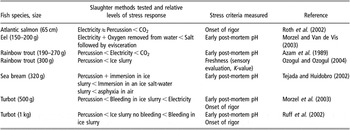
Fish are stunned before slaughter, or directly killed. Table 2 gives an overview of the most commonly used stunning and killing methods for different fish species. Exsanguination by gill cutting without stunning induces death by ischaemia. It is routinely used in some regions to kill certain species (salmon, large rainbow trout, cod, turbot and channel catfish; Anon, 2004), but is not considered acceptable from a welfare point of view as it induces vigorous reactions and brain responsiveness was lost only after 148 s or more in Atlantic salmon (Robb et al., Reference Robb, Wotton and Van de Vis2000). Asphyxiation by removal of fish from the water is used to kill small farmed fish such as trout and tilapia. Time to die depends on ambient temperature and on species and varies between several minutes to hours (eels). It induces vigorous reactions and is considered bad for fish welfare (Robb and Kestin, Reference Robb and Kestin2002). Percussive stunning can be applied manually with a plastic club or ‘priest’, or by a semi-automatic system. The manual application requires precision and force, which can decrease after approximately 30 min of practice. Semi-automatic systems require manual introduction of the fish. They are equipped with a hammer, which is triggered by the snout of the fish. Some fully automatic systems also exist, where fish are introduced mechanically. When correctly used, these percussive stunning devices can induce immediate, permanent loss of brain responsiveness, and the stunning method is considered humane (Kestin et al., Reference Kestin, Wotton and Adams1995; Marx et al., Reference Marx, Brunner and Weinzierl1997; Robb et al., Reference Robb, Wotton, McKinstry, Sørensen and Kestin2000; Roth et al., Reference Roth, Slinde and Robb2007). Compared to other commercial killing methods, percussive killing is associated with lower physical activity, as indicated by slower post-mortem muscle acidification and a slower onset of rigor mortis (Azam et al., Reference Azam, Mackie and Smith1989; Marx et al., Reference Marx, Brunner and Weinzierl1997; Morzel et al., Reference Morzel, Sohier and Van de Vis2003). Due to variations in anatomy or skull morphology, percussive stunning cannot be used for all fish species but is useful for salmonids and halibut (Van de Vis et al., Reference Van de Vis, Kestin, Robb, Oehlenschläger, Lambooij, Münkner, Kuhlmann, Kloosterboer, Tejada, Huidobro, Ottera, Roth, Sorensen, Akse, Byrne and Nesvadba2003).
Comparison of methods used for fish slaughter

Spiking is a killing method based on the insertion of a spike into the brain either manually or using specially developed equipment, causing irreversible brain damage. It uses equipment similar to the captive bolt in land animals and induces immediate loss of movement and consciousness in sea bream, salmons and eel (Nakayama et al., Reference Nakayama, Toyoda and Ooi1996; Robb et al., Reference Robb, Wotton, McKinstry, Sørensen and Kestin2000; Van de Vis et al., Reference Van de Vis, Kestin, Robb, Oehlenschläger, Lambooij, Münkner, Kuhlmann, Kloosterboer, Tejada, Huidobro, Ottera, Roth, Sorensen, Akse, Byrne and Nesvadba2003). It is more difficult to apply than percussive stunning as it requires a technical control of the gesture. The use of anatomical markers, such as the pineal window in tuna, may be important to target the brain with accuracy (Anon, 2004). The method is reserved for species (salmon, tuna) of sufficient size (4–5 kg), which can be maintained individually (Robb et al., Reference Robb, Wotton, McKinstry, Sørensen and Kestin2000).
The immersion in water saturated with carbon dioxide is used for salmon and trout and has negative consequences for fish welfare (Van de Vis et al., Reference Van de Vis, Kestin, Robb, Oehlenschläger, Lambooij, Münkner, Kuhlmann, Kloosterboer, Tejada, Huidobro, Ottera, Roth, Sorensen, Akse, Byrne and Nesvadba2003). It causes strong behavioural responses, changes in glucose and plasma cortisol levels and in the heterophil/lymphocyte ratio and induces death only after 5 min (Marx et al., Reference Marx, Sengmuller-Sieber, Hoffmann and Stolle1999; Robb et al., Reference Robb, Wotton, McKinstry, Sørensen and Kestin2000). Electrical stunning consists of the application of a current through the water and is used for various species. If the chosen electrical parameters are adapted to the species, loss of consciousness may be induced in trout, salmonids and turbot (Morzel et al., Reference Morzel, Sohier and Van de Vis2003; Roth et al., Reference Roth, Imsland and Slinde2003; Van de Vis et al., Reference Van de Vis, Kestin, Robb, Oehlenschläger, Lambooij, Münkner, Kuhlmann, Kloosterboer, Tejada, Huidobro, Ottera, Roth, Sorensen, Akse, Byrne and Nesvadba2003; Lines and Kestin, Reference Lines and Kestin2004). Certain species, such as rainbow trout, gilthead sea bream, sea bass and African catfish, are also commonly asphyxiated in ice or in ice/water slurry (Huidobro et al., Reference Huidobro, Mendes and Nunes2001; Robb and Kestin, Reference Robb and Kestin2002). Live fish are packed in flake ice or added to the ice/water slurry, following which water is drained off, usually after 10 min. The cold environment leads eventually to the loss of brain function, but generally acts slowly (Robb and Kestin, Reference Robb and Kestin2002). In addition, there is growing evidence that rapid temperature changes or the introduction to iced water is stressful for fish. Plasma cortisol and heart rate increase and fish may show escape behaviour (Donaldson, Reference Donaldson1981; Skjervold et al., Reference Skjervold, Fjoera, Østby and Einen2001; Van de Vis et al., Reference Van de Vis, Kestin, Robb, Oehlenschläger, Lambooij, Münkner, Kuhlmann, Kloosterboer, Tejada, Huidobro, Ottera, Roth, Sorensen, Akse, Byrne and Nesvadba2003).
Some fish species have specific morphological or physiological characteristics, making it difficult to stun and kill them. Eels are an example but recent work found that electrical stunning can give good results (Robb et al., Reference Robb, Wotton and Van de Vis2002). In some countries, it has been common practice to pour dry salt (NaCl) or a 1% ammonia solution over them. The eels make extremely vigorous escape attempts. The main purpose is to de-slime them. However, if left, the chemicals may render the eels also immobile and suitable for processing, inducing unconsciousness and death, albeit after more than 10 min (Kuhlmann and Munkner, Reference Kuhlmann and Munkner1996; Lambooij et al., Reference Lambooij, Van de Vis, Kloosterboer and Pieterse2002; Van de Vis et al., Reference Van de Vis, Kestin, Robb, Oehlenschläger, Lambooij, Münkner, Kuhlmann, Kloosterboer, Tejada, Huidobro, Ottera, Roth, Sorensen, Akse, Byrne and Nesvadba2003). The use of salt baths in conscious eels is criticised for animal welfare reasons, and prohibited in Germany since 1999 (TierSchlV, 1999). Another, smaller scale technique to kill eels is decapitation. However, studies found that severed eel heads lose brain reactions only after 13 to 30 min (Verheijen and Flight, Reference Verheijen and Flight1997; Van de Vis et al., Reference Van de Vis, Kestin, Robb, Oehlenschläger, Lambooij, Münkner, Kuhlmann, Kloosterboer, Tejada, Huidobro, Ottera, Roth, Sorensen, Akse, Byrne and Nesvadba2003).
The best-adapted stunning method depends primarily on the species. For example, according to their habitat, some fish are very resistant to cold (immersion in icy water) or to low oxygen concentrations. Perhaps most promising for fish welfare at slaughter is the possibility to combine different stunning techniques. Live chilling has been used to immobilise fish before killing them with other techniques. In this case, salmon were kept in oxygenated, chilled sea water and then carbon dioxide stunned (Erikson et al., Reference Erikson, Hultmann and Erik Steen2006; Roth et al., Reference Roth, Slinde and Robb2006). Similarly, eels could be rendered unconsciousness immediately and until death by applying electricity in combination with nitrogen gas to the water (Van de Vis et al., Reference Van de Vis, Kestin, Robb, Oehlenschläger, Lambooij, Münkner, Kuhlmann, Kloosterboer, Tejada, Huidobro, Ottera, Roth, Sorensen, Akse, Byrne and Nesvadba2003). This shows that to minimise stress, fish stunning and slaughter techniques urgently need further studies, for existing as well as for newly farmed or consumed fish species or sizes.
Finally, similar to other species, fish were found to be coherent in their responsiveness to stress and their levels of aggressiveness (Overli et al., Reference Overli, Olsen, Lovik and Ringo1999; Tort et al., Reference Tort, Montero, Robaina, Fernandez-Palacios and Izquierdo2001; Brelin et al., Reference Brelin, Petersson and Winberg2005). Cluster analysis found that 6 pro-active and 17 reactive individuals could be selected from an experimental stock of 99 brown trout (Brelin et al., Reference Brelin, Petersson and Winberg2005). This suggests that, similar to fowl, pigs and cattle (see above), inherent differences in responsiveness to transport and stunning/killing techniques exist in fish with a similar genetic and rearing background.
Concluding remarks and possible aims for future research
Although slaughter conditions have much improved during the last tens of years, further progress is still needed. For fowl, food deprivation, bird catching and crating, duration and climatic conditions of transport and of lairage at the abattoir and shackling of the birds before electrical stunning are the main factors affecting stress at slaughter. Possible stress due to inhalation of stunning gas deserves more study. For pigs, the main causes of stress at slaughter are related to fighting during mixing of pens, loading and unloading conditions and the quality of the stunning procedure. Food deprivation, handling and novelty of the situation contribute to the stress reactions. For veal calves and adult cattle, disruption of the social group, handling, loading and sometimes unloading conditions, fatigue, novelty of the situation and, specifically for calves, mixing with unfamiliar animals are known stress factors. For lambs and sheep, gathering and yarding are stressful if they are extensively reared and when shepherd dogs are used. Subsequent transport may induce fatigue especially if they are commercialised through auctions or markets. Washing is also stressful for sheep. For farmed fish, known stress factors are predominantly related to environmental aspects such as temperature, oxygen, cleanliness of the water and, to a certain extent, stocking density and removal of the fish from the water. Often, stunning and killing techniques protect fish welfare insufficiently. If transport and lairage conditions are good and their durations not too long, they may allow pigs, fish, sheep, calves and adult cattle to rest. For certain species, it was shown that individuals show inherent differences in responsiveness to the slaughter procedures and that genetic origin and earlier experience influence reactions to the slaughter procedure.
Good knowledge of stress reactions at slaughter is important not just for ethical reasons. Behavioural and physiological reactions to slaughter conditions influence ante- and post-mortem muscle metabolism and consequently technological and/or sensory meat quality of fowl. Thus, chickens that were slaughtered using a more stressful procedure had altered ultimate pH of thigh meat and chickens that performed more wing flapping in response to shackling had a faster pH decline, compared to their counterparts (Debut et al., Reference Debut, Berri, Baeza, Sellier, Arnould, Guemene, Jehl, Boutten, Jego, Beaumont and Le Bihan-Duval2003; Berri et al., Reference Berri, Debut, Santé-Lhoutellier, Arnould, Boutten, Sellier, Baéza, Jehl, Jégo, Duclos and Le Bihan-Duval2005). Similarly, Large White pigs that fought more or were more stressed during the slaughter period had higher ultimate pH than their less-stressed counterparts (Terlouw et al., Reference Terlouw, Porcher and Fernandez2005; Terlouw and Rybarczyk, 2008). Stress at slaughter resulted in higher ultimate pH in calves and adult cattle (Kenny et al., 1987; Lensink et al., Reference Lensink, Fernandez, Cozzi, Florand and Veissier2001; Mounier et al., Reference Mounier, Dubroeucq, Andanson and Veissier2006), and in lambs, it increased the rate of pH decline and ultimate pH, as well as the ability of muscle to hold water (Simmons et al., Reference Simmons, Young, Dobbie, Singh, Thompson and Speck1997; Bray et al., Reference Bray, Graafhuis and Chrystall1989; Bond et al., Reference Bond, Can and Warner2004; Bond and Warner, Reference Bond and Warner2007). Slaughter stress affected further flesh colour and texture in different fish species (Sigholt et al., Reference Sigholt, Erikson, Rustad, Johansen, Nordvedt and Seland1997; Jittinandana et al., Reference Jittinandana, Kenney, Slider, Mazik, Bebak-Williams and Hankins2003; Morzel et al., Reference Morzel, Sohier and Van de Vis2003). Slaughter increases muscle activity as well as psychological stress and, at present, little is known of how behavioural and physiological responses interact to modify post-mortem muscle metabolism. Effects are partly related to changes in protein degradation. In fish, soft texture was associated with accelerated degradation of collagen and cyto-skeletal proteins (Sato et al., Reference Sato, Uratsujt, Sato, Mochizuki, Shigemura, Ando, Nakamura and Ohtsuki2002; Morzel et al., Reference Morzel, Chambon, Lefèvre, Paboeuf and Laville2006). In lambs, pre-slaughter exercise-induced increases in drip loss were related to increased post-mortem proteolytic activity (Bond and Warner, Reference Bond and Warner2007). Finally, shocks, hits and fights have negative effects on carcass quality (bruises, lesions, bone fractures, haematomas).
Today, further progress with respect to animal welfare during slaughter procedures needs to be achieved at different levels. At the field level, efforts to install adequate loading, unloading and stocking equipment on the farm and at the slaughterhouse should continue. In the abattoirs, adequate, that is context- and species-specific designed corridors and races will facilitate movement of the animals and consequently reduce stress of the animals and work strain of the abattoir personnel. Climatic conditions during transport and lairage should be better controlled, especially for fowl and fish. For all species, procedures should be optimised such that transport and lairage durations are not too long and mixing is avoided. Abattoirs should employ skilled and trained personnel as much as possible and carefully maintain their stunning equipment.
Scientific research should play a crucial role in the determination of efficiency and the amelioration of stunning methods, of tools to assess animal welfare under field conditions and in the development of new stunning methods, for all species but especially for fish, including newly consumed fish species and sizes. Over the past decennia, a lot of effort has been put into the description of adaptive responses to slaughter procedures of animals, sometimes of different genetic or rearing background. This work allowed identifying the main sources of stress at slaughter and its consequences on behaviour, physiology and main indicators of meat quality. Such approaches use, however, limited numbers of animals. Today, new methodologies allow scientists to study these problems from a larger and more fundamental perspective. The meta-analysis currently taking place in the European Q-porkchains project (reference number 36245) establishes, among others, relationships between animal and production aspects and responses to different slaughter contexts, determining their impact and robustness, using a large data set derived from existing published results. Metabolomic, transcriptomic and proteomic studies screen RNA, proteins and other molecules present in the cell and may be used to identify the effects of stress at slaughter at the cellular level and predict effects on meat quality (cf. Morzel et al., Reference Morzel, Chambon, Lefèvre, Paboeuf and Laville2008).
Studies that compare reactivity profiles of animals determined during tests with their reactions to the slaughter procedure help to identify the basic aspects of slaughter procedures that cause stress responses, such as human presence or novelty (Fordyce et al., Reference Fordyce, Whythes, Shorthose, Underwood and Shepherd1988; Lensink et al., Reference Lensink, Fernandez, Cozzi, Florand and Veissier2001; Terlouw and Rybarczyk, 2008). These studies allow to further predict which individuals are likely to be more reactive to slaughter procedures and pave the way to study the role of genetic background and history in the construction of the reactivity profile. Finally, analytic behavioural and physiological approaches derived from human cognitive psychology and applied to the study of emotional responses in sheep have determined that in farm animals and humans, similar cognitive processes may underlie emotional experience (Désiré et al., Reference Désiré, Veissier, Despres and Boissy2004; Greiveldinger et al., Reference Greiveldinger, Veissier and Boissy2007). Such studies may be used to identify the elementary criteria responsible for the stress responses at slaughter, such as the discrepancy between expectation and reality and lack of controllability or predictability.
Thus, further research should include more recently developed tools and approaches. A better understanding of animal emotions and of the establishment and role of reactivity profiles in stress responses would improve our knowledge on animal welfare matters at slaughter. Consequences of stress should be studied also at the molecular level and a larger and more fundamental viewpoint could be obtained using statistical tools, such as modelling techniques.