Introduction
In contrast to the wealth of information on advanced dementia, relatively few studies have addressed the disease-specific eating problems associated with mild dementia (Ikeda and Hodges, Reference Ikeda, Hodges, Shaker, Postma, Belafsky and Easterling2013). Patients with Alzheimer's disease (AD) have various impairments in eating habits, appetite, swallowing, and food preference (Bozeat et al., Reference Bozeat, Gregory, Lambon Ralph and Hodges2000; Ikeda et al., Reference Ikeda, Brown, Holland, Fukuhara and Hodges2002; Shinagawa et al., Reference Shinagawa2009). However, only a few studies have directly investigated the gustatory function of patients with AD. Moreover, those studies have merely assessed either the detection or recognition threshold of a few kinds of tastes (Koss et al., Reference Koss, Wiffenbach, Haxby and Friedland1988; Schiffman et al., Reference Schiffman, Clark and Warwick1990; Reference Schiffman, Graham, Sattely-Miller, Zervakis and Welsh-Bohmer2002; Lang et al., Reference Lang, Leuschner, Ulrich, Stössel, Heckmann and Hummel2006). No report has assessed both detection and recognition thresholds, and only the study by Steinbach et al. (Reference Steinbach2010) investigated recognition thresholds for all four basic tastes, i.e. sweet, salty, sour, and bitter (Steinbach et al., Reference Steinbach2010). Although it had previously been reported that the gustatory function of patients with AD was not impaired (Koss et al., Reference Koss, Wiffenbach, Haxby and Friedland1988; Schiffman et al., Reference Schiffman, Clark and Warwick1990; Reference Schiffman, Graham, Sattely-Miller, Zervakis and Welsh-Bohmer2002; Lang et al., Reference Lang, Leuschner, Ulrich, Stössel, Heckmann and Hummel2006), this more recent study (Steinbach et al., Reference Steinbach2010) showed impaired gustatory thresholds even in the mild cognitive impairment (MCI) stage. However, it is still uncertain whether such dysfunction would advance with progression of the disease.
In the present study, both detection and recognition thresholds for the four basic tastes, as well as taste discrimination ability, were examined at different stages of AD.
Methods
Subjects
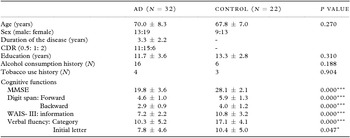
This study included 32 patients with AD and 22 normal controls without any history of neurological or psychiatric diseases. Demographic data and cognitive functions of the participants are summarized in Table 1.
Demographic data and cognitive functions

Data for years are presented as average ± SD. N = number.
*p < 0.05 ***p < 0.001.
Subjects with AD were recruited from the outpatients of the dementia clinics of Asakayama Hospital and Osaka University Hospital, both of which are departments of the general hospitals designated to dementia medical centers by the Osaka prefectural government. Inclusion criteria for participants with AD were (1) diagnosis as probable AD according to NINCDS–ADRDA (McKhann et al., Reference McKhann, Drachmann, Folstein, Katzman, Price and Stadlan1984), (2) diagnosis supported with magnetic resonance imaging (MRI) findings, and (3) Clinical Dementia Rating (CDR) scale (Hughes et al., Reference Hughes, Berg, Danziger, Coben and Martin1982) ≦ 2. Exclusion criteria were (1) apparent behavioral and psychological symptoms, (2) physical and surgical complications that affected examination conditions, and (3) diagnosis compatible with other types of dementia, such as probable vascular dementia according to NINDS–AIREN (Román et al., Reference Román1993), probable dementia with Lewy bodies (DLB) according to the revised guidelines of the Consortium on DLB (McKeith et al., Reference McKeith2005), and frontotemporal lobar degeneration (FTLD) according to the consensus diagnostic criteria for the three prototypic syndromes of FTLD, i.e. frontotemporal dementia, progressive nonfluent aphasia, and semantic dementia (Neary et al., Reference Neary1998).
Cognitive examinations
All patients had undergone routine laboratory tests and standard neuropsychological examinations, including the Mini-mental State Examination (MMSE) (Folstein et al., Reference Folstein, Fostein and McHugh1975. Japanese version; Mori et al., Reference Mori, Mitani and Yamadori1985), digit span (forward, backward), “Information” in the subtests of the Wechsler Adult Intelligence Scale-III (WAIS-III) subtest (Japanese WAIS- III, 2005), and verbal fluency tasks (animal names, and nouns with initial phoneme “Ka” in 1 minute, respectively). Behavioral and psychiatric symptoms were assessed by structured caregiver interviews using of the Neuropsychiatric Inventory (NPI) (Cummings et al., Reference Cummings, Mega, Gray, Rosenberg-Thompson, Carusi and Gornbein1994. Japanese version; Hirono et al., Reference Hirono1997).
Gustatory threshold
Threshold levels for the four basic gustatory perceptions (sweet, salty, sour, and bitter) were measured using Taste Disk® (Sanwa Kagaku Kenkyusho Co., Ltd., Nagoya, Japan). This test kit consists of four kinds of taste solutions (sweet- sucrose; salty- sodium chloride; sour- tartrate; and bitter- quinine hydrochloride) with five different concentrations ranging from 1 (lowest) to 5 (highest) for each taste. The examiner applied one drop of each solution with a syringe onto a circular disk of filter paper measuring 5 mm in diameter, and placed the disk on the tongue of the subjects, 2 cm to the left of the lingual apex. The subjects were then asked to choose a taste from the taste index table (six choices, “sweet,” “salty,” “sour,” “bitter,” “undefined taste,” and “don't know”). When answers were correct using the lowest concentration, the recognition threshold was graded as one. When answers were incorrect, the concentration of the test material was gradually increased up to five. When answers were incorrect at the highest concentration, the solution was directly dripped onto the tongue using a pipette. If this direct application method yielded correct results, the recognition threshold was graded as six. When answers were all incorrect, a grade of seven was given. Subjects were instructed to rinse their mouths after finishing every measurement of a threshold, and intervals of more than one minute were included before the next measurement was taken for a different taste. Besides the recognition threshold mentioned above, the detection threshold at which the subjects felt any taste was also measured. The detection threshold was recorded even when tastes were incorrectly identified.
Taste Disk® recommends placing reagent disks at six points in the mouth: right and left symmetrical points in the soft palate, the posterior portion of the tongue, and the anterior portion of the tongue, which are innervated predominantly by the major petrous nerves, the glossopharyngeal nerves, and the chorda tympani nerves, respectively. In the present study, testing was performed at only one point, 2 cm left of the lingual apex. The reasons for selection of this point were as follows. (1) Although many previous studies on regional taste sensitivity have used different methods (Kugino et al., Reference Kugino, Kaneko and Akiyoshi1997), a recent study using Taste Disk®, as in the present study, indicated that the thresholds of the four basic tastes are almost the lowest at the apex of the tongue (Sawada, Reference Sawada2005). (2) The chorda tympani nerves bilaterally innervate the adjacent region of the lingual apex, especially within 2 cm right and left of the apex (Tomita et al., Reference Tomita, Ikeda and Okuda1986). In addition, a study by magneto encephalography involving patients with resection of the unilateral chorda tympani nerve suggested that unilateral gustatory stimulation to the preserved side simultaneously projects to the bilateral primary gustatory cortical areas (Onoda et al., Reference Onoda, Kobayakawa, Ikeda, Saito and Kida2003). (3) Placing the test disks on the soft palate or on the posterior portion of the tongue in patients with dementia could be associated with risks of either swallowing the disk or hurting the oral cavity with the tweezers used to position the disk. (4) It is easier for a right-handed tester to operate instruments on the left side of the tongue.
Taste discrimination test (judgment of the same or different tastes)
This test was performed using each taste solution with the concentration at one grade higher than the gustatory recognition threshold. Subjects were randomly given ten taste pairs (six pairs of different tastes and four pairs of the same taste) and asked whether the pairs were the same or different. The performance of each subject was scored by the number of correct answers out of a maximum of ten. Subjects rinsed their mouths with water before each tasting trial.
Statistical analysis
The data were analyzed using the Mann–Whitney U-test or Fisher's exact test (two-sided test) for comparisons between AD and normal control groups for demographic backgrounds, as well as for performances of cognitive function tests, gustatory thresholds, and the taste discrimination test.
To obtain an indicator of overall taste sensitivity for an individual subject, total gustatory threshold values for detection or recognition, respectively, were calculated by summing up the threshold grades of all four tastes. Then, in order to examine the effects of demographic and clinical factors on gustatory threshold, ordinal logistic regression analysis was performed with each total threshold value as the dependent variable. Age, sex, histories of alcohol and tobacco consumption, and CDR grade (with normal subjects rated at zero) were used as independent variables. When we focused on dementia severity, if the CDR grade was a significant factor, we used the Kruskal–Wallis and the Mann–Whitney U post-hoc test (two-sided tests) to compare the total gustatory thresholds values among AD subgroups according to CDR grade and the normal group. Data analysis was carried out using SPSS version 22.
Ethical considerations
All procedures followed the Clinical Study Guidelines of the Ethics Committee of Osaka Prefecture University and were approved by the Internal Review Board. A complete description of all procedures was provided to the patients and their caregivers, and written informed consent was obtained from patients and their caregivers.
Results
Demographic and cognitive data
There were no significant differences in age, sex ratio, education, alcohol consumption history, tobacco use history, and the result of cognitive function tests between the two groups (Table 1). In the AD group, the mean duration of disease was 3.3 ± 2.2 years. The CDR grade (0.5/1/2) was 11/15/6. Significant differences were observed in all parameters between the AD group and normal controls.
Gustatory threshold
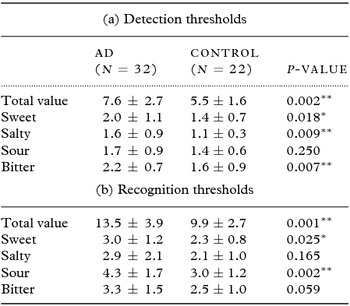
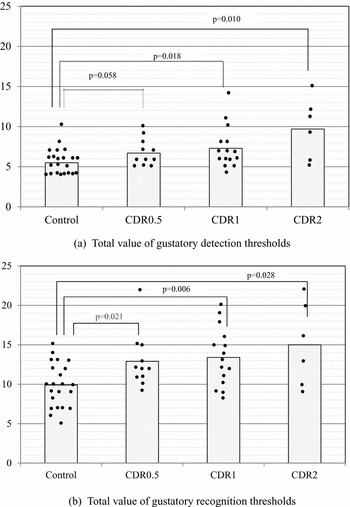
Table 2 shows the results of the gustatory threshold measurements. Concerning the detection threshold (Table 2a), significant differences between the AD and control groups were found for sweet, salty, and bitter tastes. However, a significant difference between groups was not observed for sour taste. As for the recognition threshold (Table 2b), significant differences between the two groups were found for sweet and sour tastes. The ordinal logistic regression analysis revealed that only CDR grade had significant effects on both threshold values (p = 0.000 on detection, 0.003 on recognition), and all other factors did not show significant effects (age, p = 0.938, 0.851; sex, p = 0.889, 0.857; alcohol, p = 0.689, 0.415; tobacco, p = 0. 407, 0.366). In fact, the CDR grade was found to significantly affect detection and recognition thresholds, even when the covariance of all other factors was adjusted (p = 0.000, 0.003, respectively). Figure 1a and b respectively shows the total values of the detection and recognition thresholds in the AD subgroups according to CDR grade and the control group. Both total threshold values seemed to gradually increase with CDR, and the Kruskal–Wallis test revealed significant differences in both total threshold values among the CDR groups including the normal control group (p = 0.011 in detection, p = 0.011 in recognition). However, when the significant level was corrected by the Holm–Bonferroni method, the post-hoc Mann–Whitney U-test proved significance only between CDR 1 and the control group in terms of recognition threshold values.
Gustatory thresholds

Data are presented as Average± SD.
*p < 0.05 **p < 0.01 Mann–Whitney U-test (Two-way).
Ordinal logistic regression paralyses revealed that CDR grade had significant effects on both threshold values. Kruskal–Wallis test also showed significant differences in both threshold values among the subgroups, although post-hoc Mann–Whitney U tests proved a significant difference only between CDR 1 and control groups, when the significance level was corrected via the Holm–Bonferroni method.

Taste discrimination test (judgment of same or different tastes)
In the taste discrimination test, the AD group scored 8.5 ± 1.2, and the normal control group scored 8.8 ± 1.2; this difference was not significant (p = 0.070). There were also no significant differences among the AD subgroups.
Discussion
Patients with early stage AD experience an impairment of olfactory function (Kovács, Reference Kovács2004; Welge-Lüssen, Reference Welge-Lüssen2009); however, relatively little is known about the sense of taste. Moreover, the few studies that have investigated taste have employed diverse methods, and their results are still controversial. For example, using the whole-mouth tasting approach, Koss et al. (Reference Koss, Wiffenbach, Haxby and Friedland1988) reported that patients with mild AD had no impairment in the detection threshold for sweet (sucrose) and sour (citric acid). Using a similar method, Schiffman et al. (Reference Schiffman, Clark and Warwick1990) reported that elderly patients with dementia show significant deficits in the detection of umami (glutamate), but not of bitter taste (quinine hydrochloride). Lang et al. (Reference Lang, Leuschner, Ulrich, Stössel, Heckmann and Hummel2006), using both the whole-mouth tasting method and the Taste Strip Test (TST) (Müeller et al., Reference Müeller2003), a similar method to the Taste Disk®, examined gustatory recognition thresholds for the four basic tastes in patients with dementia including those with AD. They reported that recognition thresholds in patients with dementia as a whole significantly deteriorated, although the recognition threshold detected by the TST did not differ between subjects with AD and healthy controls. Recently, using a taste test similar to that employed in the present study, Steinbach et al. (Reference Steinbach2010) showed impairment of gustatory recognition for all four basic tastes in patients with mild AD or MCI. Then, the present study showed that detection thresholds for sweet, salty, and bitter, as well as the recognition thresholds for sweet and sour, were significantly higher in patients with AD. Furthermore, total detection and recognition threshold values were significantly higher in the AD group than in normal controls.
One explanation for the discrepancies in results among the studies discussed thus far could be the various experimental methods employed. For example, the whole-mouth testing method involves a taste solution being sprayed into the oral cavity, while TST, which is a validated reliable taste test (Landis et al., Reference Landis2009), involves having the patient lick a strip of cardboard that is saturated with a taste solution of different concentrations. Most gustatory tests are either not commercially available or lack available normative data. In Japan, only the Taste Disk® has normative data (Tomita et al., Reference Tomita, Ikeda and Okuda1986) and is commercially available, which is why it was used in the present study.
Our findings indicate an interesting relationship between gustatory function and changes in the eating behaviors of patients with AD. The detection threshold in the AD group was higher for all tastes except sour, and the recognition threshold was higher for sweet and sour. These results suggest that sour is easy to detect but difficult to recognize for patients with AD, while the sweet taste is difficult to both detect and recognize. Although it seems paradoxical, this finding may explain the preference for sweet in AD (Cullen, Reference Cullen1997). The preference for sweet flavors is an intrinsic tendency, as seen in infants, because it signals the nutritious nature of food. Reduced ability of patients with AD to appreciate sweet foods might increase their desire for that taste.
Steinbach et al. (Reference Steinbach2010) reported impaired high gustatory thresholds even at the MCI stage; however, it was unclear whether impaired gustatory function would advance with disease progression. The present study showed that dementia severity significantly affected the gustatory decline of patients with AD from MCI (CDR 0.5) to the moderate stage (CDR 2). In addition, although the difference was only partially observed between subgroups, the gustatory decline seemed to begin from the early stage and advanced with disease progression. These findings suggest that, similar to the decline of olfactory function, gustatory dysfunction is possibly one of the earliest symptoms of AD.
Regarding taste discrimination, Schiffmann et al. (Reference Schiffman, Graham, Sattely-Miller, Zervakis and Welsh-Bohmer2002) used the “same or different” judgment method to show no significant differences between patients with AD and controls. The present study also found no significant difference between the AD group and controls, as well as among AD subgroups. These consistent results suggest that, despite the decline in threshold, peripheral gustatory senses and the function of the primary gustatory area in the frontal operculum and the insular cortex (Ogawa, Reference Ogawa1994) are not fundamentally damaged, even in moderate AD. Changes in eating behaviors in dementia might reflect the involvement of an integrated network that includes the ventral frontal lobe, temporal pole, amygdala, insula, and orbitofrontal cortex (Ikeda et al., Reference Ikeda, Brown, Holland, Fukuhara and Hodges2002). Therefore, the neural basis of the impaired gustatory threshold, starting with the early stage AD, should be investigated in future studies.
One limitation of this study was that AD was not confirmed pathologically. In addition, the sample size was relatively small because of strict exclusion criteria and the sophisticated taste test employed. However, the number of subjects in the present study was comparable to those of previous studies (Koss et al., Reference Koss, Wiffenbach, Haxby and Friedland1998; Schiffman et al., Reference Schiffman, Clark and Warwick1990; Lang et al., Reference Lang, Leuschner, Ulrich, Stössel, Heckmann and Hummel2006; Steinbach et al., Reference Steinbach2010).
In conclusion, while a decline in taste sensitivity is an early symptom of AD, the global gustatory function of patients with AD is not fundamentally damaged. Up to 40% of patients with AD at all stages, even before diagnosis is possible, experience weight loss (Stewart et al., Reference Stewart2005), in spite of their preference for the sweet taste. Moreover, the progression of this weight loss is faster than that observed in normal elderly individuals (Johnson et al., Reference Johnson, Wilkins and Morris2006). While many contributory factors to weight loss in this population have been identified (e.g. lack of food preparation, diminished eating skills, reduced appetite, increased physical activity (Gillet-Guyonnet et al., Reference Gillet-Guyonnet2000)), the decline of taste sensitivity might be added. Thus, the nutritional care, and consequently the health, of patients with AD could be improved by making the taste of meals stronger, while controlling calorie and mineral intake.
Conflict of interest
None.
Description of authors’ roles
M. Sakai designed the study, conducted the examinations, and wrote the article. M. Ikeda diagnosed the patients, and contributed to the writing of the article. H. Kazui and K. Shigenobu diagnosed the patients and contributed to the examinations. T. Nishikawa contributed to the design of the study, conducted the statistical analyses, and wrote the article.
Acknowledgments
The authors would like to thank all of the subjects and caregivers for their participation. This study was supported by grants provided by the Ministry of Health, Labour, and Welfare (Dementia-General-003) for H.I., T.N., and by the Ministry of Education, Culture, Sports, Science and Technology (Grant Nos. 23591718, 24249100) for M.I.