The Portuguese composer Fernando Lopes-Graça (1906–94) was born in the former Jewish ghetto of Tomar, a small city where he began his musical education in 1917. In 1928, two years after the military putsch that established Oliveira Salazar's fascist-style ‘New State’, he began to engage in political activity, as founder and director of a radical newspaper and as a member of the local communist organization. In 1927 and 1931 he completed the piano and composition courses at the Lisbon Conservatory with great distinction. He was arrested in 1931 and 1936 for political militancy, and in 1937 was exiled to Paris. After returning to Portugal in 1939 he continued to be barred from holding office in public education on account of his past political activities, and from 1955 onwards was even prevented from giving private lessons. Unsurprisingly, his works also struggled to gain performances in the context of official concert life. Nevertheless, Lopes-Graça remained highly active both musically, through his intensive ‘counter-hegemonic’ activity as a composer, pianist, choral director, musicologist, and music journalist, and politically, by opposing the régime right up to the revolution of 25 April 1974 and by openly acknowledging his membership of the Communist Party until his death.
Such was the personal and political background that shaped Lopes-Graça's convictions regarding the relationship between art and politics. In this article I shall start from his theoretical statements of the early 1930s in order to situate him within a constellation of often opposed ideological and aesthetic positions: the heritage of the Enlightenment, l'art pour l'art, socialist realism, and the critical theory of Walter Benjamin and Theodor Adorno. Situating Lopes-Graça in this way is essential in order both to understand the nuances of his own political and artistic identity and to characterize his theory and praxis as a composer and musician.
Unlike most artists and intellectuals of the Portuguese and other communist parties, Lopes-Graça opposed the principles of socialist realism.Footnote 1 He stood, rather, for artistic autonomy and freedom from any direct subordination of art to politics; for ‘modern music’, in the face of demands to simplify the nature of his own musical invention and compose works accessible to the masses; and for a counter-hegemonic cultural and political action, which resisted the social structures that conspire to exclude people from education or ‘high culture’. His defence of an autonomous art is, as will be demonstrated below, convergent in some respects with Adorno's theoretical position. However, this belief in autonomy, and the uncompromising modernism of the music to which it gave rise, coexists in Lopes-Graça's output with a substantial body of politically engaged music – an output of ‘heroic’ or revolutionary songs – that he composed from 1945 onwards. These apparently contradictory dimensions of his work – on the one hand his ‘presentational’ music, to be given in more or less conventional concert settings, and on the other his ‘colloquial’ music, to be sung at demonstrations, in the home, or even in political prisons – can nonetheless be considered as two contrasting manifestations of a single, and ultimately coherent, ideological position. How this tension between aesthetic autonomy and political engagement can be understood in the context of Lopes-Graça's resistance to the régime – and, on a wider scale, the crucial distinction between socially engaged and socialist realist composition – is the subject of this article.
Neither ‘to subjugate art to politics’ nor ‘to divorce art from life’
In a text of 1935 entitled ‘A música e o homem’ (Music and Man) Lopes-Graça uses a statement by Darius Milhaud to initiate a discussion of the relationship between art and politics:
Music should laugh at the form of the political régime. A string quartet will never be fascist or communist. A sonata in E flat will always be a sonata. Thank God, musicians have no ideal other than music nor any other concerns beyond scales and chords.Footnote 2
To Lopes-Graça such a view was scandalous:
Composers such as Beethoven or Wagner would never have made such statements, because they would have considered them demeaning to their intelligence, and because they never renounced their status as members of the social body. And we can be almost certain that Bach (a ‘musician's musician’ par excellence) would have behaved no differently, if such social issues had emerged explicitly in his own times as acutely as they did after the [French] Revolution.Footnote 3
Both Milhaud's statement and Lopes-Graça's refutation of it have to be viewed in terms of their antecedents. Milhaud seems to follow Hanslick's position, which Stravinsky had taken further still in his famous claim that ‘music is, by its very nature, essentially powerless to express anything at all’,Footnote 4 but at the same time he goes further, extending not just to music but to the musician himself the principle of indifference to anything beyond music. Lopes-Graça, while he admits that music has nothing to do directly with the form of a régime and that a quartet or a sonata is not immediately either fascist or communist, counterargues nonetheless that fascism and communism as ‘mentalities’ (‘mentalidades’) can inform music in the way that religion does. In this sense, he says, it is ‘immediately apparent that a quartet or a sonata may in actuality be communist or fascist’.Footnote 5 What shocked Lopes-Graça in Milhaud's statement was ultimately not its anti-Romantic attitude – it is not for that reason that he offers Beethoven and Wagner as counter-examples – but that it denies the musician any social or political efficacy. It was Milhaud's idea that the musician, as a musician, lives oblivious of politics, ‘that the musician has no other ideals and concerns besides music’, that Lopes-Graça found objectionable.Footnote 6
The context of Milhaud's declaration was, in Lopes-Graça's words, ‘a recent and alarmist survey’ undertaken by the newspaper Candide ‘among certain French intellectuals about what might happen to France if the Popular Front took over the government’.Footnote 7 Lopes-Graça was himself engaged in the movement to raise a Popular Front in Portugal, and this context is undoubtedly relevant to an understanding of the way he articulated the relationship between art and politics at the time. But Lopes-Graça's criticism is also that of a political activist who had already been arrested, together with other members of the Communist Organization of Tomar, following the government's prohibition of his newspaper after two years of activity,Footnote 8 and a musician who had been prevented from assuming his post of professor at the Lisbon Conservatory because of his political activity.
Shortly before he took a stand against Milhaud's statement, Lopes-Graça had moved to Coimbra, following an invitation to teach at a private music school. But he did not give up his political activity there either. After enrolling in the humanities course at the University of Coimbra, in order to resume the studies he had begun in 1931 before his arrest at the University of Lisbon, he immediately became president of the General Assembly of the Republican Academic Centre. A second arrest in 1936 resulted from his collaboration with other intellectuals in the formation of the aforementioned Popular Front, under the aegis of the Portuguese Communist Party. He was, in the meantime, continuing to write for the press. In Coimbra he began his involvement with the literary avant-garde journal Presença (where he published in 1934 his first songs on poems by Fernando Pessoa), and with the more socially engaged group of the journal Manifesto, in which he published the article under discussion here, ‘A música e o homem’.
Lopes-Graça's personal experiences undoubtedly inform the arguments that he continues to develop in this article. He condemns as ‘monstrous’ the ‘indifference of the artist before the pathetic game of social forces’.Footnote 9 It is necessary to take sides, he suggests, emphasizing the changes brought on by the French Revolution, which gave the musician a consciousness of human dignity as an autonomous individual and ‘absolute master of his destiny’ (‘senhor absoluto do seu destino’):
Man and his destiny, man and his salvation: that is the great theme of all the great works of art, especially of those kinds of art that are able to animate, agitate, and enhance man, to awaken feelings, provoke passions, inspire ideals, and create thoughts in him – and music is one of those.Footnote 10
This did not mean that one should attach art to politics but rather that one should attach art to life. Art – not only as beauty but also as knowledge, as an ‘activity of knowledge’ (‘actividade de conhecimento’), in Lopes-Graça's terms – ‘provides a total experience of life’ that may be ‘polarized’ in different dimensions, including politics ‘in its highest meaning: the social problem of mankind’. In summing up, Lopes-Graça declares his aim neither ‘to subjugate art to politics’ (‘vincular a Arte à Política’) nor ‘to divorce art from life’ (‘divorciar a Arte da Vida’).Footnote 11
Lopes-Graça's theoretical discourse gains still more precise contours in other texts that he published in the 1930s and 40s. The premise that art is knowledge can be traced back to a previous formulation regarding modernity in music, also made, though quite coincidentally, with reference to Milhaud. In a public lecture from 1933 introducing Milhaud's Poèmes juifs he denounces racist attitudes and feelings and praises the courage of the Jews in laying important foundations for modern thought. Among the names quoted as examples are Einstein, Freud, Bergson, Durkheim, Proust, Stefan Zweig, Eisenstein, Lenin, Milhaud, and Schoenberg.Footnote 12 Here and in other texts (from 1932 and 1935) he brings atonality, the theory of relativity, and communism within a common framework: modernity in art was, in his view, correlated with modernity in science and in politics.Footnote 13
By emphasizing the break with Romanticism as an important attribute of modern music, he also praises the innovative role of Hindemith, his ‘will to simplicity’ (‘vontade de simplificação’), the ‘clarity of lines’ (‘nitidez de linhas’), the ‘purity of form’ (‘pureza de forma’), the ‘power of construction’ (‘força de construção’), and the ‘asceticism of ideas’ (‘ascetismo de ideias’). Hindemith's music was the opposite of ‘post-Romantic puffiness’ (‘inchadelas da música post-romântica’) and ‘invertebrate impressionism’ (‘invertebramento impressionista’): it was ‘objective music’ (‘música objectiva’), as Heinrich Strobel had already emphasized with reference to Hindemith's and Brecht's opera Lehrstück (1929).Footnote 14 Instead of symbolizing or representing, music – even when linked to literary texts – should be pure, absolute.Footnote 15 Lopes-Graça thus quotes Nietzsche, but the most important source of such a concept of modernity was José Ortega y Gasset's ‘La deshumanización del arte’ (The Dehumanization of Art), from which Lopes-Graça nonetheless distances himself in certain key respects. Thus, in his essay ‘Introdução à Stravinsky’ (Introduction to Stravinsky) from 1930, Lopes-Graça states that the tendency of modern music is to dehumanize itself, namely ‘to free or purify itself from the rapture of subjectivism’,Footnote 16 but that it would be just as grave an error to see the ideal of classic art in terms of the polar opposite – music as a mere exercitium arithmeticae – and accordingly to justify so-called neo-classicism. A balance should be achieved.Footnote 17
In his ‘Introdução à música moderna’ (Introduction to Modern Music), published in 1942, Lopes-Graça develops his views more thoroughly. He warns against the opposition between form and content, claiming that it is a ‘pseudo-antinomy’ (‘pseudo-antinomia’), especially in music, where it can lead to the most serious errors. The ‘spirit’ of a musical work, he says,
is not a category in itself: it is inapprehensible a priori, and manifested only through the form. It is, so to speak, the very material in action. So attempts to grasp the musical message in purely rhetorical terms (commentaries or literary exegesis) often fail by not taking into account the immediate reality, the substantiality of the musical material itself and its phenomenalism.Footnote 18
This, according to Lopes-Graça, is a major, anti-Romantic assumption of modern music:
In contrast to the music of the last century, for which sound was a sign or symbol, modern music reinstated sound in its material, concrete reality. For the Romantics, sound was a means, a pretext for music, the composer a mediator, a prophet, one inspired. To modernism, sound is first and foremost a material, music a reality in itself, the composer a worker.Footnote 19
In this way, Lopes-Graça continues, modernism had ‘restored music to music’ (‘restituir a música […] à música’). Instead of the Romantic conception of music as a ‘language of feeling’ (‘linguagem do sentimento’), modern music had recovered the ‘a-conceptual and non-representational’ (‘aconceitual e a-representativa’) nature of music. A shift from music as a subjectivist source of dream and evasion to music as an objectivist, ‘almost mathematical game of contrapuntal combinations’ (‘jogo […] de quase-matemáticas combinações contrapontísticas’) had taken place.Footnote 20
However, although Lopes-Graça postulates that modern music has returned to the conception of ‘pure music’ (‘música pura’), he reiterates his objections to its most radical meaning. ‘Pure music’ should not be understood, in terms of Stravinsky's dogmatic assertion in Chronicles of My Life, as ‘an absolute denial of the possibility that music can suggest ideas or awaken feelings’. According to Lopes-Graça, ideas and feelings could indeed be suggested by music, even modern music, but only when asserted by ‘the primacy of the sound image, with the immanence of its own laws’Footnote 21 – a formulation not far removed from Adorno's notion of the reciprocal ‘mediation’ (‘Vermittlung’) of form and content.
The concept of modern music briefly delineated above not only plays a paramount role in Lopes-Graça's own profile as a composer but also sheds light on his particular way of reconciling aesthetic autonomy with political engagement. The following section will attempt to situate Lopes-Graça's position within a wider constellation of views of the relationship between art and politics.
Excursus
The following positions will be taken into account in this short critical review: (a) the ‘dehumanization of art’ in modernism, and its historical antecedents; (b) the earlier Enlightenment shift to art as a ‘tranche of life’; (c) Hanslick's criticism and the emergence of l'art pour l'art; (d) the emergence of socialist realism in the Soviet Union; (e) the dialectical approach to the relationship between art and politics, and the critical theory of the Frankfurt School.
(a) In his essay ‘La deshumanización del arte’, published in 1925, Ortega y Gasset characterized modernism, referring to Debussy and Mallarmé, as an attitude that radically separates art from life and translates the subjective into the objective. It proceeds ‘in the opposite direction’, eliminating the ‘extra-poetical’ support of reality in order ‘to “realize” the metaphor’, making the latter the res poetica.Footnote 22 In Romanticism and even realism or naturalism, Ortega continues, art was largely confessional, autobiographical: it referred to personal feelings and aimed at the ‘psychological contagion’ of the spectator, arousing ‘a pleasure that maintains a connection only with its content’, while modernism, by rejecting this tradition, recovered ‘the inhuman’ that had always been art's centre of gravity – will to style, style, ‘deforming reality’, ‘de-realizing’, ‘dehumanizing’.Footnote 23
Ortega y Gasset was justified when he spoke of recovering something that Romanticism had buried. Indeed, in the debates about art as the imitation of nature, sixteenth- and seventeenth-century philosophers such as Boileau, Fontenelle, and Du Bos had devalued illusion and defended the superiority of verisimilitude over truth. A tragedy, according to Du Bos, impresses only ‘those who know more distinctly all the resources that the poet's genius and the comedian's talent use to move’.Footnote 24 That is, the art of representing – or, for Ortega, the stylization or the ‘inhuman’ (‘inhumano’) element of the rules of art – took precedence over the human elements that were represented. To this representational strategy – whose focus on stylization was inseparable from the manners or etiquette of court society (as analysed by Norbert Elias) or from the ‘representative public sphere’ (the ‘role distance’, i.e. ‘the strict code of noble conduct’, as characterized by Jürgen Habermas)Footnote 25 – was opposed a new consensus, one that emerged from an increasingly powerful and expanding ‘bourgeois public sphere’.Footnote 26
(b) The so-called querelle des bouffons (c1752–5) – often wrongly presented as a dispute between devotees, respectively, of Italian and French music – is one of the most important manifestations of the paradigm shift that then takes place: the shift to the principle of art as ‘tranche of life’ (‘tranche de vie’) that becomes the programme of the Enlightenment, from Voltaire to Rousseau and Diderot. Accordingly, art was all the more art the more it was dissimulated and the less it was noticed. This ideal of ‘perfect illusion’ – in which the greatest skill consisted in concealing skill (‘art caché’), and the actor, or the art of acting, should disappear into the character represented – had two important functional consequences. On the one hand an art that conceals itself is available to all people (‘à la portée de tout le monde’), does not require ‘connoisseurs’, and, in its ideal at least, is universal and democratic: it refers directly to the human, both on the side of the author/performer and on the side of the receiver. In consequence of this, artists began to address themselves not to a ‘public’, but to humanity in general. On the other hand an art that induces immediate emotional identification with the human represented in it thereby becomes a ‘school of virtue’.Footnote 27 Here we are dealing with what Hans-Robert Jauss calls the ‘transformation of a religious into an aesthetic pattern of identification’.Footnote 28 As in the case of a believer, who, in praying to a cult object, does not notice its external features but only the experience of transcendence (‘auratic’ experience) to which it provides access, the spectator forgets the means of expression by experiencing the expressed.
Wilhelm Heinse, at the end of the eighteenth century, in his novel Hildegard von Hohenthal (1796), pointed out the consequences of this structure of communication for music:
Real music […] always pursues the aim of transmitting the meaning of the words and emotions to the listeners, in such an easy and pleasant way that they do not notice it [the music]. Such music lasts forever; it is so natural that we do not notice it.Footnote 29
The best music was, therefore, that which disappeared entirely into human experience, into the feelings and emotions represented in it.
(c) It is precisely against this concept – roughly coinciding with the reforms of bourgeois Enlightenment and the emergence of the concert hall as a ‘place of realization’ (‘Realisierungsort’) of autonomous musicFootnote 30 – that Hanslick takes a position. At the height of Romanticism, in opposition to the aesthetic discourse of Liszt, Wagner, and Berlioz, among others, Hanslick is an early advocate of art for art's own sake: music as Selbstzweck, an ‘end in itself’. His convergence with the concept of l'art pour l'art, coined in France at the same time (the mid-1850s), is undeniable. Pierre Bourdieu shows how this concept emerged in France as a result of a resistance movement on the part of artists and critics marginalized by the academic doxa of ‘finite art’ (as a component of the political, social, and educational new bourgeois order), a movement that led to the institution – or, rather, the rehabilitation – of the idea of the autonomy of aesthetic judgement.Footnote 31 In this sense it might be said that Hanslick recovers Kant's Critique of Judgement and, so to speak, inverts Hegel's thesis of the ‘death of art’. While Hegel sees the ‘death of art’ in the disappearance of Romantic art, proscribed by philosophy, Hanslick bases the ‘musically beautiful’ – the very notion of Tonkunst (musical art) – on the ruins of Romanticism. He bases it on the ‘noble indifference of the Beautiful’,Footnote 32 independent of its ability to move the listener, and the connoisseur's distance. To the ‘pathological’ attitude, which values music for its effects on the emotions, he opposes the pleasure of a disinterested, pure contemplation of the work of music, understood as ‘sounding forms in motion’.Footnote 33
(d) The emergence of the doctrine of socialist realism in the Soviet Union is in a way a reaction to the principle of art for art's own sake and its Soviet avant-gardist manifestations from the 1920s. The concept can be dated back to exactly May 1932, to the deliberations of a committee of five members of the Central Committee of the CPSU, which included Stalin. Over the next two years more than four hundred articles were published on the subject in Soviet literary journals, a debate that was also extended to the famous Congress of Soviet Writers (1934), in which Maxim Gorky played a prominent role.Footnote 34 In Stalin's much-quoted definition, socialist realism consists in the development of artistic cultures that are ‘national in form and socialist in content’, aiming at their ‘ultimate fusion into one General Culture, socialist as to form and content, and expressed in one general language’.Footnote 35 Gorky, in turn, summed up the concept in the formula ‘socialist ideology in a realistic way’.Footnote 36 It was, however, Zhdanov, in his speech to the Congress, who defined the concept more precisely: it was an ‘art of tendency’, a ‘tendentious’ art, which ‘is not afraid of the charge of being “tendentious”’, since ‘in an epoch of class struggle there is not and cannot be a literature which is not class literature, not tendentious, allegedly non-political […]. Our tendency is to liberate the toilers, to free all mankind from the yoke of capitalist slavery’.Footnote 37 The notion of a tendentious art went further than that of an art simply informed by the ‘spirit of party’. Lukács made this distinction in order to emphasize that, in the former, the political position of the author – her/his thesis – was explained, while, in the latter, this position had to be inferred from the work.Footnote 38 Both meanings could be found in Zhdanov's speech,Footnote 39 but the traces later added to clarify the concept were much more relevant.
Thus, according to Zhdanov (and, indeed, in accordance with Gorky, as Régine Robin has demonstrated), socialist realism was not opposed to Romanticism. Instead it was supposed to have absorbed it, albeit transformed into a new kind of Romanticism – a ‘revolutionary Romanticism’, since ‘the whole life of our Party, the whole life of the working class and its struggle consist in a combination of the most stern and sober practical work with a supreme spirit of heroic deeds and magnificent future prospects’.Footnote 40 The grandiosity of the battles to be fought and the positive heroes necessary to win them, a triumphal vision of the difficulties to overcome and of the contradictions to be resolved, the monumentality of the subject, and, finally, the clarity or transparency of the representation (‘the great mimesis’Footnote 41 of a heroic age put entirely at the service of what was represented – in other words, made easy to understand in order to reach the widest possible audiences): all these would join together to create the paradigm of socialist realism in all the arts. In terms of its communication strategy, therefore, socialist realism discovered anew the programme of bourgeois Enlightenment.
(e) Zhdanov's formulation did not coincide with that adopted at the same time by Bukharin, who saw in socialist realism essentially the application of the dialectical method to artistic creation, that is, ‘the translation of dialectical materialism in terms of art’. Robin notes the difference in the manner of its enunciation,Footnote 42 but she seems to miss the most important point, namely that Bukharin's approach did not prevail. Rather, what came to prevail as socialist realism was characterized precisely by the absence of the dialectical method. The debate that came to involve Lukács, Bloch, and Brecht can be characterized in terms of the dichotomy of realism versus dialectic. Yet Robin quotes a text by Sergei Tretyakov of 1928, which is an example of the kind of dialectical thinking in art that will also appear in Benjamin, Brecht, and Adorno, even though their respective approaches are different:
Ideology is not in the material that art uses. Ideology is in the process of developing that material; ideology is in the form. Only a material judiciously put into form can become an object with a direct social destiny. Changing [only] the stuff is nothing.Footnote 43
It is, in fact, the dialectical method behind this statement that informs both Benjamin's and Brecht's concept of the ‘politicization of art’, and Adorno's concept of the potential truth-content of art. In Adorno, that possibility of truth is manifested in the postulate of the historical and social pre-formation of the material; in the reciprocal mediation of subject and object, form and content, construction and expression; and in the critique of ideology as an immanent critique of the material (‘form is itself sedimented content’Footnote 44). In Benjamin and Brecht it leads to the deconstruction of aura and of the illusionist model, the use of processes of montage and ‘dialectical images’ that generate critical distance, the active role of the spectator as meaning-producer: ‘to set thought processes in motion, not to communicate maxims’ is, in Adorno's terms, Brecht's programme, in opposition to the praxis of socialist realism.Footnote 45
As regards the dialectic of l'art pour l'art, Benjamin diagnoses in his famous essay ‘Das Kunstwerk im Zeitalter seiner technischen Reproduzierbarkeit’ (The Work of Art in the Age of Mechanical Reproduction) of 1936 the complicity between aestheticism and fascism. Insofar as l'art pour l'art under Hitler's and Mussolini's régimes was transmuted into the ‘aestheticization of politics’ – as an example he mentions Marinetti's praise of war as a work of art – he appeals to communist artists to respond with the ‘politicization of art’.Footnote 46 If l'art pour l'art was ultimately a ‘political act’ – whether at first as an alternative to an aesthetic and ideological doxa, or later as a ‘political act’ of ‘de-politicizing art’ that paved the way for its manipulation by politics – then it was necessary to oppose it to a self-conscious ‘politicization of art’, a self-conscious political confrontation with the heteronomy of political power. Close to Benjamin's is the position of Antonio Gramsci, who developed (in his posthumously published prison notebooks, 1929–35) the theory of the ‘organic intellectual’ and ‘hegemony’ (or ‘counter-hegemony’), which would give rise to a new culture and a new art. Gramsci also postulated the idea of the active, ‘meaning-producing reader’ (or spectator).Footnote 47
Lopes-Graça's conflict with socialist realism
The preceding excursus demonstrates the roots in eighteenth- and nineteenth-century aesthetics of, on the one hand, the naturalist, illusionist paradigm of socialist realism and also, on the other, the trend towards a critical theory of art that is behind Lopes-Graça's concept of modern music. For if Lopes-Graça diverges from Milhaud, he diverges no less from the socialist realism or neo-realism (as it was known in Portugal) that was adopted by the mainstream of writers and artists committed to the Portuguese Communist Party.
Lopes-Graça's correspondence with his close friend João José Cochofel (a poet and music critic) reveals the debates that were then taking place among Portuguese communist intellectuals. In a letter of 1944 Cochofel shares with Lopes-Graça his dissatisfaction with the way in which some of their comrades – enthusiasts of neo-realism – thought of music. One of them had praised a composer of light music for commercial entertainment as representing a model of the ideal of revolutionary art. Cochofel regrets that similar opinions gained adherents also in the Soviet Union, ‘with the aggravating circumstance of emanating from official circles’. Particularly significant (especially because it was written during the war, some years before the notorious denunciations of leading Soviet composers in the USSR in 1948) is the conclusion of the letter: ‘What confusion! The National Secretary for Propaganda is to be congratulated, for he has finally achieved agreement between the aesthetics of the Fascist New State [of Salazar] and the aesthetics of the … communist New State.’Footnote 48 What Lopes-Graça and Cochofel rejected was the subordination of art to political propaganda, and the use of the most banal clichés or recipes to make music available for the ‘masses’ – music whose primary function was to convey symbols of the régime. They saw, at this level, a coincidence rather than a difference between Salazar's and Stalin's régimes, namely – and this is clearly to be inferred – that both opposed the paradigm of ‘autonomous art’.
The confrontation between aesthetic orientations within the Communist Party became more open ten years later when in the journal Vértice – a leftist magazine close to the party, to which both Cochofel and Lopes-Graça regularly contributed – a text entitled ‘Cinco notas sobre forma e conteúdo’ (Five Notes on Form and Content) appeared under the name António Vale. Only much later was it discovered that the party leader himself, Álvaro Cunhal, then detained in the Fort of Peniche, had used that pseudonym to intervene directly in the debate. His text, which testifies to his intellectual distinction and broad literary and cultural education (he studied law and was himself a talented writer and artist), can be considered among the most important documents of socialist realism as an aesthetic doctrine to be published in Portugal. Worth emphasizing here are the following key ideas, in which the influence of Zhdanov's discourse is clearly perceptible: even when art is said to be pure, it is never pure;Footnote 49 it is always ‘a reflex of the history of a social stratum in a given moment and in a given situation’; ‘like any other ideology, it is based on the life and struggles of society’, and can ‘only be explained, interpreted, evaluated, taking into account that life and those struggles’;Footnote 50 there is a ‘tendentious art’ of the social strata ‘that are condemned by social development’, and also a ‘tendentious art’ of the rising social strata;Footnote 51 ‘formalist artists’ who try to translate the aspirations of the rising strata ‘are completely powerless to do so’;Footnote 52 ‘to achieve a higher form, the principle that is valid is: “content first!”’; the artist needs to conceive his art as a means of communication with other people and, therefore, the clearer that communication is, the more powerful and more beautiful it will be.Footnote 53 As examples of the opposing ‘formalist’ conception of art, the author mentions Picasso in painting and Lopes-Graça in music, especially the latter's statements on modern music that were quoted above.Footnote 54
In fact it is hard to establish any meaningful connection between Lopes-Graça's theory and praxis as a composer and socialist realism or neo-realism. Indeed, Lopes-Graça's commitment to communist ideals does not of itself entail any a priori affiliation with a particular tendency or style in literature and the arts. Symptomatic of this impartiality is the fact that his vocal music sets all the major Portuguese poets, as well as foreign poets of different eras, including contemporaries, without distinctions of ideology or aesthetic orientation. The vocal output of Lopes-Graça joins what the literary partisanship of his time divided. Moreover, Lopes-Graça, an avowed atheist, throughout his life set religious texts to music, most of them from traditional sources but including some liturgical texts as well.
Lopes-Graça himself constantly denied allegiance to any particular aesthetic tendency. In particular, he vigorously disputed the thesis of his friend Cochofel that he had a dual affiliation to seemingly contradictory aesthetic movements: modernism and neo-realism.Footnote 55 In an essay published in 1966 (on the sixtieth anniversary of the composer's birth) entitled ‘A dupla filiação estética de Fernando Lopes-Graça’ (Lopes-Graça's Dual Aesthetic Affiliation), Cochofel took up two of the composer's statements, published respectively in the journals Presença (1933) and Vértice (1945), in an attempt to prove the dominance in his thought of ‘artistic exclusivism’ in the 1930s and social concern in the 1940s, the latter (so he claimed) influenced by Lopes-Graça's involvement with the neo-realist wing after his return to Portugal. According to Cochofel, combining these ‘two standpoints antagonistic in their origin but complementary in their results’ proved possible ‘when assimilated by such a strong intellectual temperament as his own’.Footnote 56 By speaking of a ‘turn’ to neo-realism in the 1940s, Cochofel overlooked some of the important texts discussed above, such as ‘A música e o homem’ from the 1930s and ‘Introdução à música moderna’ from the 1940s. Nevertheless, the idea of Lopes-Graça's affiliation to neo-realism has continued to be repeated in the literature with varying emphases, and without a thorough explanation of what it might mean in his case.
So how can Lopes-Graça's aesthetic position be characterized? First of all, we find that the ‘communist from birth’ draws not just on the Soviet Revolution but also on the French Revolution. ‘What I bet on is freedom’, he declared in 1973, referring to the choices that he had made as a composer. By that he meant the artist's freedom, his individual autonomy, as a historic achievement that should be defended rather than sacrificed in the name of any imposed goal or ‘historical imperative’, even the ‘myth of artistic progress’. Unlike Álvaro Cunhal, whose abovementioned text reveals the deterministic and teleological conception of historical materialism, Lopes-Graça claimed that the ‘true law of the development of art’ (and history) is the ‘law of contingency’. He believed in the freedom of creation, in the ‘infinite possibility of the renewal of music, but beyond any dogma’, any ‘historical imperatives, which cannot but lead to absurd mechanistic determinism’; at the same time he denied the ‘pernicious myth of “progress” in art, the race to novelty’.Footnote 57 In the same interview Lopes-Graça reaffirmed his position in the 1930s and 40s as regards the representation of ideas or feelings in music:
What disgusts me, what is repugnant to my sensibility and my musical conceptions is the swelling, the overflow, the hypertrophy of expression, the transformation of music into a vehicle for ideas or feelings that […] tend to take control of it, to turn it into ‘drama’, ‘confession’, ‘ideology’ – literature that, on account of impotence, does not know how to be literature, music that, on account of ambition, refuses to be music.Footnote 58
He never quotes Adorno, and probably had not read him, but his conception of the freedom and autonomy of art bears notable similarities to Adorno's in the following formulation:
In art, what is more than art is carried out only through art, through the accomplishment of its immanent demands, and not to the extent that it strikes sail and subsumes itself in purposes that are external to it. Its supra-aesthetic is mediated aesthetically. […] All music that since the era of the French Revolution has had in its content and form a share in the idea of freedom has presupposed the emancipation of heteronomous purposes.Footnote 59
By advocating freedom or autonomy versus heteronomy, aesthetic mediation versus the immediate subordination of art to external purposes, Lopes-Graça converges as clearly with the dialectical approach of Adorno as he diverges from the doctrine of socialist realism.
Aesthetic autonomy against artistic demagogy
Inasmuch as Lopes-Graça considers art ‘an activity of knowledge’,Footnote 60 he calls into question its relationship with ideology. It is for this reason that, in his book on modern music, he separates clearly the problem of content from the problem of function, the two being discussed in separate chapters. In the doctrine of socialist realism (for instance, in the article by ‘Vale’ cited above) the content of music becomes its function, or its function the content. Music and art in general are entirely subsumed in a heteronomous goal, namely to be worthy of the interest (which is to say the ideology) of either a decadent class or an ascending class in each historical moment.
While according to socialist realism the autonomy of art is in itself ideology – formalism as a symptom of alienation – Lopes-Graça sees autonomous art as an ‘activity of knowledge’, in which the author's beliefs and his life-world may be grasped only by aesthetic mediation. The fact that he discusses content and function separately suggests that he views the problem of communication with the public as one that it is not his primary job to consider, and in this too he diverges from socialist realism.
In his ‘Introdução à música moderna’ Lopes-Graça addresses the education of the public and the hegemonic systems of communication in which music is subsumed. He criticizes on the one hand the cultivated concert public, saturated in the classical idiom, crystallized in bias, and on the other hand ‘the commercialized organization of musical life, the system of manager–performer–public based on the laws of supply and demand’; the capitalist ‘overproduction of commodities that gives rise to the release of floods of commercial music that subvert the taste of the public’; the ‘demagogic culture’ disseminated by broadcasts, especially private ones, ‘a true social plague’.Footnote 61 The following quotations from music reviews, published in 1940 and 1945 respectively in the leftist magazine Seara Nova, spell out Lopes-Graça's position:
In the case of musical culture, the foundations for a serious policy for this art must consist not in serving the people exclusively what they have long been accustomed to hearing, which is not always the best, but in striving to bring them to acknowledge and accept the large amount that they do not know and the best that human ingenuity has created.Footnote 62
When you want to bring culture to the people you should start from the idea that culture, in order to fulfil this mission, has to lower its level, to adapt, to democratize itself (in the worst sense of the word, of course), running in this way the risk of offering the people only the by-products of culture, if not a damaged or worthless culture. Conceived thus, culture is merely a kind of charity that you engage in towards people – and it goes without saying that, under these conditions, neither do the people gain much by the alms, nor does culture play a very brilliant role as the generous grande dame.Footnote 63
Such statements also converge with Adorno's critique of a ‘social totality’, which promotes the so-called ‘inability of the masses to understand complexity’ – that is, the exclusion of the masses from education or Bildung.Footnote 64 Here, for Adorno, resides the ‘very inhumanity’ of those who condemn formalism:
Whoever rails against art's putative formalism, against art being art, advocates the very inhumanity with which he charges formalism and does so in the name of cliques that, in order to retain better control of the oppressed, insist on adaptation to them.Footnote 65
The communication model of a ‘dissimulated art’, emerging in the mid-eighteenth century from the bourgeois public sphere, mobilized, as we have seen, an arsenal of increasingly complex devices and resources whose ultimate goal was precisely to disguise or dissimulate themselves, a process in many ways similar to what Marx called commodity fetishism. That is, the commodity presents itself to the consumer as ‘phantasmagoria’, as something that emerges spontaneously, as a ‘second nature’, concealing within itself the whole complex chain of production and human labour that gave it birth.Footnote 66 The fetish consists in the effect of subjugation experienced by consumers, who are placed in a passive position of fascination and identification with the external surface, or with the output of what, for them, is an inscrutable ‘black box’. In the arts this model of communication has been refined continuously up to the present day: Wagner's ideal of the invisible orchestra and the invisible stage, Zola's naturalistic theatre, Hollywood movies, television soap operas, and virtual reality computer simulations all arguably date back to that foundational moment of the eighteenth-century bourgeois public sphere.Footnote 67
Such also was the model of socialist realism. Thanks to the ‘magic’ operation of using the most complex means of production to suppress any complexity in reception, the purpose of an originally democratic and emancipatory art transformed itself dialectically into its opposite. ‘You have to guide the audience with a whip in hand!’: this phrase comes neither from Stalin nor from Zhdanov – and they would never have said it, even though they might have thought it. Rather it comes from Émile Zola, in his book Le naturalisme au théâtre: ‘Il faut conduire le public fouet à la main’.Footnote 68 Not emancipated spectators, in other words, but passive spectators, exposed to manipulation, without critical autonomy – this is how the hegemonic model of communication in the arts converges, ultimately, with the effects of capitalist mechanisms of commodity production. Its purpose is to exclude the masses from critical participation in the management of the complexity of the world and of life – that is, to generate consumers instead of citizens.
From a present-day perspective, in which the diagnosis of ideology as, to use Adorno's phrase, ‘a duplication of what already is’ (‘Reduplikation dessen, was ohnehin ist’)Footnote 69 – in other words, as a replacement of other ideologies – remains acutely relevant, these aspects should be considered as further emphasizing Lopes-Graça's position in the 1940s, and its closeness to Adorno's approach.Footnote 70 Lopes-Graça assumes aesthetic autonomy as an imperative of his freedom as an artist, as a composer. Accordingly, he views his task as being not to affirm those hegemonic forms of communication that subordinate music to heteronomous (including political) goals, but rather to resist demagogy, populism, and manipulation. To this extent the problem of music's accessibility to the widest audiences is not one that concerns him. By referring ironically to the ‘arid and inhuman landscape of modern music’ (‘paisagem árida e “inumana” da música moderna’), terms which echo Ortega y Gasset's above-mentioned essay,Footnote 71 Lopes-Graça seems also to converge with Adorno's postulate that ‘emphatically modern art breaks out of the sphere of the portrayal of emotions and is transformed into the expression of what no significant language can achieve’.Footnote 72 That is to say, Lopes-Graça could have intuited the profound political dimension of his radical claim for aesthetic autonomy, as postulated in Adorno's dialectic of the ‘inhuman’:
Art becomes human in the instant in which it terminates its service. Its humanity is incompatible with any ideology of service to humankind. It is loyal to humanity only through inhumanity toward it.Footnote 73
It was precisely in this sense that Lopes-Graça's concept of modern music simultaneously broke with Romanticism and opposed itself to socialist realism. Music, as he stated in 1940, even if it was ‘expressionless’, should bring about an ‘entirely conscious’ listener who is able to follow it ‘almost as a co-producer of its sound adventure’; modern music ‘should keep our musical senses alert and place us in music's own time frame’.Footnote 74 Such music demanded a new listening culture. Under the appearance of being ‘apolitical’, one might infer, it presupposed instead emancipated listeners – that is, a political shift to critical awareness and social transformation.
Engagement in political action, critical distance in autonomous art
While rejecting the quest for cheap popularity or political demagogy in his work as a composer, Lopes-Graça invested considerable energy in concrete activities that sought to transform cultural and political reality, activities that promoted alternative, counter-hegemonic structures of communication, with the potential to create a ‘new culture’ in the Gramscian sense. These activities included his work as a founder, director, managing editor, and regular contributor to periodicals; as the author of several books destined for wide audiences; as the founder and director of the concert society ‘Sonata’, whose mission was to disseminate contemporary music; and as the director of an amateur choir for which he wrote more than two hundred arrangements of Portuguese traditional music. In these arrangements he sought to articulate a Portuguese musical identity that was nonetheless opposed to the New State's propagandistic concept of ‘national music’ – a topic in itself so ramified that it cannot be given detailed consideration here.
Particularly important for our purposes, however, is the body of revolutionary songs that Lopes-Graça began to compose from 1945 onwards, in which his political engagement is directly expressed. How this type of music emerged, what role it played, and to what extent it was able to coexist with his claim for aesthetic autonomy – these are the questions that lead us to the concluding part of this article. The categories of ‘presentational music’ (‘Darbietungsmusik’) and ‘colloquial music’ (‘Umgangsmusik’), coined by Heinrich Besseler to describe the changes that took place in European music between the sixteenth and eighteenth centuries,Footnote 75 are helpful in this regard. Until the emergence of the concert hall in the eighteenth century it was ‘colloquial music’ that largely prevailed, whether in court, as part of court manners or etiquette, or in the bourgeois milieu, through the collegia musica or domestic music. This structure of ‘colloquial communication’ was dominant even in the church and the theatre, not in the sense that all participants made music, but in the sense that all were active participants in another, primary function (liturgical, representative), for which music served only as accompaniment. From a functionalist sociological perspective, such as that of Niklas Luhmann,Footnote 76 we can see in the transition from the colloquial to the presentational model a switching of the code – a process related to the emergence of music as an autonomous art, that is, as an autonomous ‘system of communication’, in Luhmann's sense of being governed by its own code and no longer by those of religion, morality, politics, or science.
Lopes-Graça remains faithful to this heritage, for he distinguishes clearly between the sphere of art and the sphere of politics. In his presentational music, whether written for conventional concert halls or for the modest venues around the country in which his amateur choir regularly performed, he followed the criterion of aesthetic autonomy. Even if there was an immediate political motivation behind a work – for instance Cinco estelas funerárias (Five Funerary Stelae) for orchestra, composed in 1948 in homage to dead antifascist militants, or Elegia for pianoFootnote 77 – that background stimulus appears only as mediated (at an aesthetic level). Simultaneously, however, following the creation in 1945 of the Movement for Democratic Unity (MUD), in which all opposition forces, including communists, were represented and in which Lopes-Graça was a leader, he began to compose colloquial music, not to be performed in concert but to be adapted freely and sung by people in political meetings and demonstrations, on communal social occasions, at home, or even by militants detained in political prisons. The first collection, published by the journal Seara Nova in 1946 but immediately banned and seized by the political police (PVDE/PIDE), was entitled Marchas, danças e canções (próprias para grupos vocais e instrumentais populares) (Marches, Dances, and Songs Suitable for Popular Vocal and Instrumental Groups). A second collection appeared in 1960, commemorating the establishment of the Portuguese Republic, with the title Canções heróicas, dramáticas, bucólicas e outras compostas em estilo singelo para recreação da gente nova portuguesa (Heroic, Dramatic, Bucolic, and Other Songs, Composed in a Simple Style for the Recreation of the Portuguese Youth). Most of these songs were already circulating orally prior to their publication, and many others followed until the 1980s. Under Salazar's régime they remained prohibited, circulated only in the underground. This repertoire of colloquial music, or ‘heroic songs’, was entirely absorbed by its political function. It was not to be distinguished from concrete situations of political action or political resistance, in other words as ‘art’. It belonged to political praxis in real life.
In the preface to the first collection (1946) Lopes-Graça clearly defines his purpose: to follow a long historical tradition of music as an instrument of protest and struggle. He gives a series of examples from ancient Greece to his own time of the combative effectiveness of music, including the Lutheran chorale and the political songs of the French Revolution (‘Carmagnole’, ‘Ça ira’, ‘Marseillaise’). A condition of such effectiveness, one can infer from Lopes-Graça's own words, was being ‘simple, objective, and direct’ (‘simples, objectivo e directo’), both in text and music. In this way he explicitly establishes a connection with his own project of creating a repertoire of revolutionary songs. But in doing so he is not declaring his adhesion to or affiliation with neo-realism, or providing an aesthetic justification for choosing such a literary partnership. He means rather that the project emerged naturally, for the sake of political action, from a collaboration with poets who were, like him, members of or sympathizers with the Communist Party, a collaboration which began during the summer of 1945 in Cochofel's country house near Coimbra.Footnote 78 Lopes-Graça recognizes in their poems the required ‘technique and thought’, but feels himself lacking sufficient experience as a musician to master their requirements effectively:
music offers, in general, more resistance than poetry to a treatment that reconciles the demands of style and technique with the imperative of being easy without being banal, [being] popular, but not populist.Footnote 79
The ‘resistance’ to which Lopes-Graca refers represents his implicit acknowledgement of the difficulty he encountered with a style of composition that was so different from his usual approach; his collaborators, on the other hand, were well trained in this kind of poetry, which corresponded entirely to their usual praxis as writers. Besides, in these songs Lopes-Graca was not setting out to write a presentational music that would be ‘accessible to the masses’, and hence manipulative or prescriptive, but rather to concentrate his efforts on music that could be freely and actively appropriated and adapted for pragmatic uses that had nothing to do with ‘music to be listened to’. ‘Popular, but not populist’ meant the potential appropriation of this repertoire by all people, in a flexible way, according to the needs of the moment:
Our will is that these songs be for all people, and that all people might play, sing, and dance them. […] Insofar as they are for all people, all people may use them as may be appropriate: to sing them solo or in chorus, […] to arrange them for the most diverse ensembles, to introduce any modifications […], without caring too much about respecting, or not, the intentions of the authors, because the intentions of the authors are […] to provide only a poetic-musical scheme, which will be developed or completed according to the needs and the means of those who use them.Footnote 80
In his presentational music Lopes-Graça also sometimes set texts by neo-realist poets, alongside many others from different eras and representing different styles, but he approached them in such cases according to the principles of an autonomous art to be listened to in the concert hall. By contrast, in his colloquial music, to be sung and performed freely by all, he reconciled himself with his neo-realist comrades, but only for the sake of political action, switching the code from art to politics.
This dichotomy between presentational and colloquial music in Lopes-Graça's output can be understood better still if we take into account one of the main principles that he once formulated as a music critic: that ‘imagined action’ (‘acção imaginada’) should not be confused with ‘lived action’ (‘acção vivida’).Footnote 81 His colloquial music, which was to be sung as lived political action, is ‘heroic’, belonging to a moment of effective social or political struggle. Its combative tone is that of people congregating and mobilizing their energies to continue resisting or fighting. Central to it are involvement, identification, and communality of purpose and feeling. As examples one could cite ‘Jornada’ (Journey, to a poem by José Gomes Ferreira; see Example 1) and ‘Mãe pobre’ (Poor Mother; see Example 2), both from the collection of 1946 – songs, both in the tempo of a march, in which the aspirations and will to fight of the Portuguese urban and rural proletariat are strongly expressed. By contrast, the tone of Lopes-Graça's presentational music, to be listened to, is absolutely not heroic. This music is governed by the principle of autonomous art – but an autonomous art that refuses to awaken in the audience merely the effect of involvement, identification, or surrendering itself to an ‘imaginary action’. Unlike in socialist realist or neo-realist works, here there is neither the purpose of being accessible to the widest audiences, nor the bombastic suggestion of positive heroes or great causes triumphing at the end of a dramatic development. On the contrary, Lopes-Graça's concert music consistently avoids unfolding towards a telos or climax, more frequently presenting itself as ‘unfinished’, interrupted by a gesture of suspension, perplexity, or questioning. Not only his piano and chamber works, but also his works for large orchestra such as Viagens na minha terra (Travels in My Land, 1969–70) or the Requiem pelas vítimas do fascismo em Portugal (Requiem for the Victims of Fascism in Portugal, 1979), on the liturgical text of the Requiem Mass, renounce the kind of grandiloquent effects calculated to bring an audience to its feet.
‘Jornada’ (1946), text by J. Gomes Ferreira, music by Fernando Lopes-Graça. Reproduced by kind permission of the Museu da Música Portuguesa (Casa Verdades de Faria), Cascais, and CGPT-Intersindical, Lisbon.

‘Mãe pobre’ (1946), text by Carlos de Oliveira, music by Fernando Lopes-Graça. Reproduced by kind permission of the Museu da Música Portuguesa (Casa Verdades de Faria), Cascais, and CGPT-Intersindical, Lisbon.

Of the transgressive aspects of Lopes-Graça's concert works – their harmonic backgrounds constantly contradicted by unresolved dissonances and sometimes approaching the atonal, their overall sense of anti-climax, their use of concentrated forms, and the fragmentary character of their musical discourse – none has to do with emotional empathy or involvement, but rather with critical distance or, more accurately, a balance between identification and distance. Here Lopes-Graça renounces the tradition of Aristotelian catharsis, taken up once more by the reforms of the Enlightenment, Romanticism, and neo-realism, adopting instead a non-Aristotelian, Brechtian epic model of communication – epic in the proper sense, that is, based on the dissociation of the narrator from what is narrated, the art of representing from the represented, the composer's workshop from the composed music. For Lopes-Graça, ‘imagined action’ on the stage or the podium should not be a replacement for ‘lived action’ in real life. In presentational music the listener may well be moved, but is at the same time challenged to think, to co-produce the sense of a musical discourse. Reciprocal mediation of form and content, according to a dialectical approach, is what is at stake here.
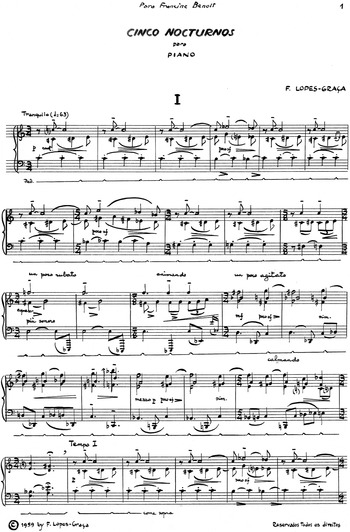
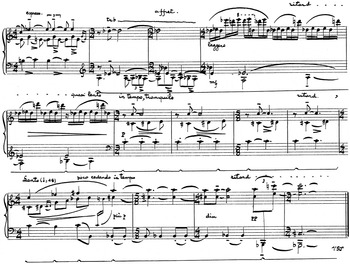
The first of Lopes-Graça's Cinco nocturnos (Five Nocturnes, 1957–9) for piano serves well to illustrate these features (see Example 3). What immediately stands out is the profusion of metric, agogic, and dynamic markings and differentiations of articulation, while dissonant intervals (those of the minor and major second, the tritone, and the minor and major seventh and ninth, as well as chords consisting of augmented fourth and perfect fifth, or augmented fourth and perfect fourth) prevail in the harmonic-melodic field, along with their unresolved tensions. Such instability in all parameters, condensed within a short piece (40 bars, c1′50″), seems to be induced by an improvisatory gesture of searching, or the tentative, even hesitant, exploration of possibilities offered by an initial figure that twice reappears (on the last occasion just like a vestige or an unfinished trace). Any predetermined plan or preordained telos seems alien to this music. The poetic idea of the nocturne becomes that of self-reflection on the very act of composing. Lopes-Graça's approach, rather than concentrating on what is ‘expressed’, makes no attempt to conceal the processes to which the material is subjected in the composer's workshop. Hence it invites the listener to that kind of double feedback in which the moment of critical distance is incorporated.
Fernando Lopes-Graça, Cinco nocturnos, for piano (1957–9): no. 1. Autograph manuscript. Reproduced by kind permission of the Museu da Música Portuguesa (Casa Verdades de Faria), Cascais.


Lopes-Graça's concept of art music is concerned neither to be music for the masses nor to convey an immediate political message. At this level his work coincides with Adorno's ideal of autonomous art and demonstrates clearly his conflict with the doctrine of socialist realism. The direct musical expression of his political engagement is confined to his output of protest songs, which, for Lopes-Graça, are not art music but rather a kind of utilitarian music (Gebrauchsmusik) to be freely used, adapted, and appropriated by people. Neither the aim nor the style – indeed, not even the texts (the majority by neo-realist poets) – of these songs would allow one to interpret them as manifestations of socialist realism or neo-realism, inasmuch as he locates them in the sphere of politics or political action rather than the sphere of art.Footnote 82 In this sense, Lopes-Graça could be compared with Hanns Eisler, who composed protest songs in a very similar style, but dealt with the relations between art and politics in music theatre (through his collaboration with Brecht) in a way that was explicitly and polemically opposed to socialist realism. Another example of communist commitment in art – one that involved a no less decided rejection of socialist realism – is the work of Luigi Nono, who never composed protest songs but, in clear opposition to Adorno, rejected the paradigm of autonomous art and brought politics into the heart of artistic communication. As communist composers, Lopes-Graça and Nono diverge fundamentally from one another, but converge at the point that separates them from socialist realism and brings them both much closer to Brecht: the moment of critical distance, of the interpellation of an active, meaning-producing listener. Gramscian counter-hegemony, in the sense of combining political and cultural action simultaneously at different levels, is also common to both.Footnote 83 Critical distance in autonomous art – as a ‘knowledge activity’ free of heteronomous, especially political, goals imposed on artists and audiences – and political engagement in real life: by means of the radical separation between these two different modes of communication and their respective codes, the presentational and the colloquial, Lopes-Graça attempted dialectically to reconcile his aesthetic beliefs with his political commitment, both as a musician and as a citizen.