A successful public health emergency preparedness (PHEP) program requires considered implementation of a number of tools. However, these tools may not lend themselves readily to the public health environment for which they were not originally intended. A prime example is the incident management system (IMS), which was initially developed and implemented by emergency responders and which public health professionals may not see as having immediate relevance for public health applications. This perception may result in poor uptake and utility of this important component of a robust and integrated emergency preparedness and response system.
In this article, we describe a series of conceptual models developed by researchers at Public Health Ontario (PHO) to meet the expressed needs of public health professionals for IMS-based training applied to public health. These visual models apply a public health lens to emergency management, introducing concepts relevant to public health and thereby shifting the focus of emergency preparedness from a strict IMS “doctrine” to a more dynamic and flexible approach that retains the essential components of traditional IMS principles. We use these models as the foundation for hands-on development of emergency plans in an interactive scenario-based workshop setting. The primary audience for this training is the staff of local public health units (PHUs), who are responsible for creating, implementing, and collaborating across sectors on community and regional emergency plans.
We begin this discussion by describing the environment within which our models have emerged, exploring the seeming lack of fit between IMS and public health organizational frameworks. Then, we locate the roles of first responders and public health professionals with respect to IMS and the emergency management cycle, thus applying a public health lens to IMS. We build these discussions and the ensuing exploration of PHEP planning tools on the foundational phases of emergency management. We conclude with some lessons learned as a result of this exploratory process.
THE ONTARIO CONTEXT
PHO is an arm’s-length agency of the Ministry of Health and Long Term Care in the province of Ontario, Canada. It was established in 2008 to protect and promote health and to reduce health inequities. Its mandate includes providing scientific and technical expertise and resources to support the province’s emergency planning and response. 1 A principal goal of PHO’s emergency preparedness activities is to support the use of IMS as a tool in public health settings in order to streamline and standardize health emergency management in the province’s health and public health settings. Our ongoing training workshops and exercises are intended to enhance public health emergency response capacity. They can be useful in identifying potential challenges in the public health environment and in clarifying the roles and responsibilities of those involved in an event.Reference Biddinger, Savoia and Massin-Short 2
Canada’s national emergency management framework 3 differs widely from that of the United States. Both emergency management and health care have been designated provincial responsibilities under Canada’s Constitution Act, 4 leading to substantial variation across the provinces. The need for a systematic approach to managing emergencies in Canada was highlighted in reports inquiring into Canada’s experiences with the ice storm of 1998 and with severe acute respiratory syndrome (SARS) in 2003. 5 More recently, a 2014 inquiry into the structural collapse of a shopping mall in northern Ontario pointed out serious shortcomings in the substance and application of IMS that contributed to a confused and inefficient response on the parts of would-be rescuers.Reference Belanger 6 Specifically, the authors of the 2014 report noted that the IMS doctrine in use in Ontario is complex and internally contradictory. They recommended that it be simplified and made mandatory for all agencies in the province. For these reasons, emergency management in Ontario is an evolving endeavor.
IMS has been defined as “a standardized approach to emergency management encompassing personnel, facilities, equipment, procedures, and communications operating within a common organizational structure. IMS is predicated on the understanding that in any and every incident, there are certain management functions that must be carried out regardless of the number of persons who are available or involved in the emergency response” (pages 7-8). 7 Currently, IMS is the standard in public health emergency management practice in Ontario. 1 The existing Ontario IMS doctrine was developed in 2008 in collaboration with approximately 30 provincial stakeholders. 8 Under the Ontario Public Health Standards of 2008, 9 Ontario PHUs are required to have plans that are consistent with an IMS. Boards of Health are required to develop emergency response plans consistent with an IMS and to ensure the provision of emergency response training. 9 However, use of IMS is voluntary in the public safety sector, 10 creating a disconnect between practices in emergency management and normative public health practice.
TRAINING NEEDS OF PUBLIC HEALTH STAKEHOLDERS IN ONTARIO
In the fall of 2011, we initiated a series of consultations with PHU stakeholders about their needs for training in emergency preparedness and IMS. They made the following observations regarding generic IMS courses:
-
∙ The emergency management definitions used in existing IMS training materials do not resonate with public health professionals because these individuals do not perform a number of the roles specified in the training materials;
-
∙ The majority of the principles espoused in generic IMS courses have limited relevance to public health settings;
-
∙ There are few learning resources available that specifically address the use of IMS for PHEP, and Ontario public health professionals often turn to out-of-province resources that may not reflect provincial policies and practices.
-
∙ IMS is often seen as a compliance-based obligation.
It has been evident in our ongoing dialogue with public health practitioners that they are knowledgeable users of IMS, both because of the legislated requirement for its use and because of the hyper-complex nature of most public health incidents. We concluded that, although a generic IMS may be effective in an overall emergency response, it is not readily understood and applied in a public health environment, and that public health professionals do not always see existing training materials, with their focus on first responders, as relevant to their practice.
Subsequent stakeholder consultations revealed that, while public health professionals in Ontario readily acknowledge the shortcomings of IMS, they view it as enhancing the organization and efficiency of responses, helping to manage communications, and clarifying internal roles and external responses. 11 We undertook to explore and address this seeming ambivalence about the role of IMS in public health in order to better inform our development of IMS-based training materials that reflect the realities of public health practice.
IMS AND PUBLIC HEALTH IN THE LITERATURE
To enhance the relevance of our IMS training resources, we explored the literature for successful models that use IMS in public health settings. We found that the issues that we had uncovered through our stakeholder consultations were reflected in the literature on public health systems elsewhere. For example, there appears to be acknowledgement that the command and control model central to IMS is at odds with the collaborative team-based culture of health care environments.Reference Christian, Kollek and Schwartz 12 - Reference VanDevanter, Leviss and Abramson 16 While public health organizations, like most health care organizations, are bureaucratic and professional in nature,Reference Mintzberg 17 decision-making is technically complex and consultative. The militaristic, male-dominated, and bureaucratic nature of the IMS model in use in the United StatesReference Buck, Trainor and Aguirre 18 , Reference Laska, Hearn Morrow and Willinger 19 is in sharp contrast to the matrix-style and collaborative cultures and decision-making styles found in public health environments.Reference Ford and Randolph 20 , Reference Duncan, Ginter and Rucks 21 In their comments on the differing problem-solving approaches used in public health and in emergency management in the United States, Botoseneanu et alReference Botoseneanu, Wu and Wasserman 22 reported what they describe as an “antagonistic” relationship between the 2 fields.
Laska et alReference Laska, Hearn Morrow and Willinger 19 have observed that management or organization systems emerging within bureaucratic environments tend to underrecognize the roles of women, and this may be a particular issue in public health if response and recovery activities have traditionally been planned and implemented by men. We note that the emergency and disaster management field as a whole is male-dominated,Reference Enarson 23 , Reference Ha-Redeye 24 whereas women constitute the majority in the public health profession.Reference Kennedy and Baker 25 , Reference Fee and Greene 26 There are potentially gendered roles and practices in emergency management in the public health setting that have received little acknowledgement in PHEP research and training.
Furthermore, DynesReference Dynes 27 has suggested that the militaristic style of the command and control model assumes “a deep distrust of individuals and structures to make intelligent decisions in emergencies” (page 184). Moore et alReference Moore, Mawji and Shiell 28 have commented on fears of “militarization” of public health with the introduction of IMS in the United States despite the growing recognition of the importance of integrating emergency management systems and public health. Health care organizational leadership using the command and control model typical of incident management structures has been criticized as ineffective in the more collaborative environments typical in health care.Reference Lurie 29
This apparent lack of fit between decision-making in public health culture and in IMS is understandable given the origins of these systems in the incident command system (ICS), which was originally developed to fight wildfires in the United States.Reference Moeller 30 The ICS was created by and for first responders as a collection of tools for conducting tasks within the response phase of an emergencyReference Stambler and Barbera 31 , Reference Stumpf 32 and was extended to other environments despite limited evidence of its applicability to settings other than fighting fires.Reference Moynihan 33 ICS and IMS materials are usually tailored primarily to first responder needs and settings, bureaucratic organizations, and emergency management logistics.
DeckerReference Decker 34 notes the lack of clear role distinctions for nontraditional partners such as public health in the ICS used in the United States. PapagiotasReference Papagiotas, Frank and Bruce 14 suggests that traditional public health response functions are not easily located in ICS-based incident management structures. As well, an IMS can constitute a “steep learning curve” in emergency preparedness activities and may actually inhibit interactions among agencies, particularly those outside of the fire-fighting field.Reference Kohn, Barnett and Galastri 35 , Reference Wenger, Quarantelli and Dynes 36 ICS has been referred to as flawedReference Buck, Trainor and Aguirre 18 and of limited use in situations involving multiple demands and multiple agencies, which are common characteristics of public health events.
As a tool that has been derived through experientially based and trial-and-error processes rather than through rigorous scientific evidence and evaluation, IMS might understandably be looked upon with some scepticism by a public health field that grounds much of its practice in the scientific method. McEntireReference McEntire 37 has advocated for exploration of theoretical concepts in emergency management, including IMS, but has observed that the field is largely atheoretical. Much of the literature focuses on case studies and lessons learned from events. In particular, there have been few reports evaluating the use of IMS in health environments. The effectiveness of IMS in real public health events has yet to be conclusively established despite its use in practice, and the available training tools do not appear to resonate with professionals in the field.
We saw evidence of the previously mentioned ambivalence that IMS appears to evoke within the health and public health sectors in the literature as well. Despite the shortcomings noted earlier, the North American public health environment as a whole has demonstrated support for IMS, which has been described as ideal for public health events because it offers flexibility and a clear organizational structureReference Adams, Scanlon and Callahan 38 and facilitates interorganizational coordinationReference Buck, Trainor and Aguirre 18 and communication.Reference Tsai, Arnold and Chuang 39 Papagiotas et alReference Papagiotas, Frank and Bruce 14 have tailored the IMS structure to public health needs through their addition of a science section. Assigning a role to science has been problematic in public health applications because it contributes to both the operations and planning functions of IMS. Papagiotas et alReference Papagiotas, Frank and Bruce 14 also changed the role title from incident commander to incident manager, which has 3 main advantages: it recognizes the managerial, coordinating, and collaborative nature of public health investigations; it acknowledges that the incident manager must operate within political and strategic guidance; and it better fits the traditional public health matrix-style organization. It would appear that public health professionals are willing to invest in IMS if it can be applied in ways that reflect the realities of their practice.
APPLYING A PUBLIC HEALTH LENS TO EMERGENCY PREPAREDNESS
As part of our efforts to create public-health relevant training resources, we developed a number of conceptual models that were informed by our workshop participants through an iterative and responsive curriculum design and implementation process.Reference Francis 40 - Reference Slavcev, Tjendra and Cheung 44 Intended to enhance appreciation of the role of public health in emergency management, the models offer a deeper understanding of the interrelationships among IMS principles, between IMS and public health, and among the various sectors that use IMS (for example, public health and public safety).
We begin our conceptual explorations with the phases of emergency management, which have traditionally been represented as a linear sequence of the discrete functions of prevention, mitigation, preparedness, response, and recovery (for example, Canadian Standards Association 45 ). All emergencies display these phases in various proportions depending on the nature of the event. In recognition of the continuous nature of these processes (in which response and recovery typically inform prevention/mitigation and preparedness planning), these pillars can also be represented as parts of a cycle (for example, US Department of Education 46 ). PHO has adapted this version for its own learning materials. It serves as the basis for mapping the interrelationships of various PHEP plans and activities.
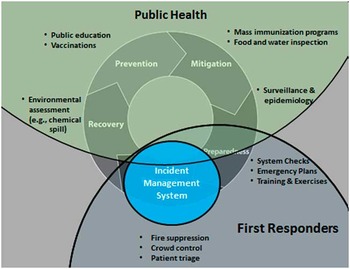
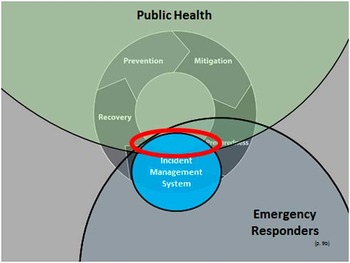
We build on this cyclical concept by illustrating that first responders (i.e., fire, police, and paramedics) tend to operate in the lower right area of this continuum, carrying out activities such as training and exercises in preparedness for their primary focus of response activities such as fighting fires or treating patients (Figure 1). First responders constructed IMS to more effectively manage the chaos of the response phase. Consistent with this mandate, most IMS documents and education are based on the assumption that an incident has occurred. Figure 2 illustrates that IMS is appropriately placed in the frontline response phase, one in which public health has, at most, a limited role.Reference Stambler and Barbera 31
Response Activities and the Incident Management System Mapped to the Emergency Management Cycle.

Intersection of Incident Management System Principles for Public Health Applications.

In contrast, public health professionals tend to operate in the upper areas of the emergency management cycle. Measures typically deployed when public health is involved in an emergency response can include
-
∙ mass immunization programs to prevent individuals from becoming ill and to mitigate disease transmission;
-
∙ food, water, and hygiene inspections for evacuation shelters and warming centers to mitigate the health impacts of disasters;
-
∙ preparedness measures such as enhanced surveillance to gather intelligence on the characteristics of an emerging health threat, informing public health interventions; and
-
∙ recovery activities such as interpreting environmental assessments after a chemical spill to determine if and when residents can return to their homes and what other actions should be taken.
Mapping these familiar public health activities to the emergency management cycle as shown in Figure 1 illustrates how they serve prevention, mitigation, and preparedness functions in the public health emergency response. Indeed, the public health “response” consists essentially of prevention and mitigation of the health effects of emergencies during the preparedness, response, and recovery phases of the emergency management cycle. Public health practitioners are neither first responders nor “first receivers”—a term coined to describe hospital emergency department personnel who do not respond to an incident scene yet are responsible for the care of multiple patients.Reference Christian, Kollek and Schwartz 12
The differing mandates of the emergency management and public health communities explain the inherent mismatch in using a traditional IMS framework to conduct public health investigations and interventions: the core concepts and principles of IMS were designed for a different purpose. For this reason, rather than coopting all of the concepts and principles of IMS, we developed a PHEP framework that targets the concepts and principles that best serve the area where public health activities and IMS tools can be seen to intersect (see the red oval area in Figure 2). Specifically, these most relevant IMS tools are scalability and flexibility, span of control, and unity of command. We focus on these tools in our PHEP workshops.
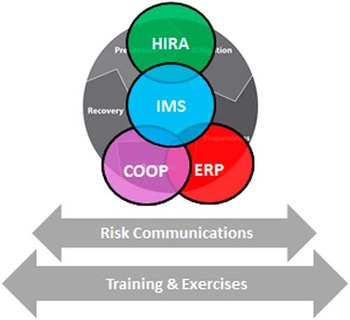
To enable hands-on application of these essential elements, we integrated this model in our scenario-based workshops by using activities that guide participants in creating and evaluating a number of key PHEP plans, including hazard identification and risk assessments (HIRAs), incident action plans (IAPs), emergency response plans (ERPs), continuity of operations plans (COOPs), and recovery plans, which we have mapped to the emergency management cycle (Figure 3).
Public Health Emergency Preparedness Plans Mapped to the Emergency Management Cycle. Abbreviations: COOP, continuity of operations plan; ERP, emergency response plan; HIRA, hazard identification and risk assessment; IMS, incident management system.

At the top of the figure, straddling the prevention and mitigation phases, is HIRA, which informs all aspects of emergency planning, including the COOP. The ERP bridges the gap between the preparedness and response phases and provides structure and tools for response. The COOP (also known as the business continuity plan) bridges the gap between response and recovery by ensuring that essential business functions and services are maintained and by promoting the return to normal business conditions. In addition, communications and training/exercise activities can be considered to be cross-cutting functions. The communications plan ensures common messaging and has internally and externally facing aspects. Testing, training, and exercises ensure that plans are current and relevant and that staff have confidence in their roles. The planning and evaluation processes are considered throughout the cycle in preparation for a formal evaluation of our actions following a response; these activities restart the emergency management cycle with renewed prevention and mitigation activities. These 3 cross-cutting functions are always active, ramping up and down throughout the emergency management continuum. IMS links and coordinates all of these activities in a standardized, flexible manner.
In an effort to apply the IMS structure in a simple yet standardized fashion, we have expanded on previous and informal representations of the IMS functions as doers/getters/thinkers/payers (for example, Lionetti et al Reference Lionetti, Snyder and Christner 47 ), showing how public health uses the planning section as a preparer of the IAP, whereas while the operations section is the implementer of that plan (Figure 4). This is in keeping with the central role that science plays in public health, advising all of these activities while fitting equally unwell in both the planning and the operations functions. The model also shows how the incident command function may be split along governance lines, with the executive lead authorizing extraordinary actions while the incident manager conducts the investigation.
Possible Incident Management System Structure Applied to Public Health.

DISCUSSION
Key messages that appear to be well received by learners in workshops based on this conceptual framework include the following:
-
∙ While public health and emergency management communities approach and apply IMS from the perspectives of their unique mandates, there are major commonalities that can enhance collaboration, communication, and shared understanding;
-
∙ IMS can be used as a planning tool and not simply for response activities;
-
∙ The IMS principles that have greatest relevance to PHEP are unity of command, span of control, simplicity and flexibility, and integrated communications;
-
∙ The IMS structure is scalable and flexible: for small events, it doesn’t have to be the “big scary chart” that so many public health professionals picture;
-
∙ There is a place for science, a key element of public health activities, in the IMS structure.
Papagiotas et aIReference Papagiotas, Frank and Bruce 14 have recommended that public health organizations incorporate traditional public health functions into the ICS, which suggests that ICS is a fixed and static entity into which public health must accommodate its roles and practices. In contrast, by recognizing and locating the unique and specific roles of public health in the emergency management cycle in our conceptual models and workshop curriculum, we propose starting with public health functions and activities and then building the IMS structure around them, without compromising the basic structures of IMS but exploiting its strengths and making full use of the scalability and flexibility that are key principles. By explicitly linking emergency planning processes to IMS functions, we situate IMS as a dynamic and unifying methodology in emergency preparedness rather than a static structure or one-size-fits-all approach. Applied in this way, IMS functions as an organizing principle, making explicit the relationships among PHEP planning tools and among stakeholders who operate within incident management system structures on a regular basis.
This framework constitutes a “meta-toolbox” 48 approach, incorporating IMS’s toolbox of concepts and principles within a larger assemblage of PHEP tools and resources. Centralizing the roles and functions identified by public health practitioners as key in their emergency preparedness and response activities repositions IMS as one of several flexible tools that serve public health professionals rather than as a rigid template to which public health must adapt. These conceptualizations of IMS have the potential to serve as a practice-based methodological foundation for elucidating a much-needed theory of incident command and incident management systems.
There are limitations to this framework. It is not entirely consistent with traditional IMS structure and function and could be subject to criticism from the nonhealth sector, particularly first responders for whom IMS appears to work well. While consistency is a laudable goal, lack of understanding, utility, and a common language among public health organizations and staff have often mitigated against the use of IMS as taught by first responders. The Public Health Incident Command System (PHICS), developed by the Columbia University Mailman School of Public Health Center for Public Health Preparedness in 2006, has helped to bridge this gap. 49 We believe that, by offering tools and practices that are congruent with current PHEP practices, our conceptual framework expands this concept to the disease prevention and emergency preparedness roles of public health, a function that is more familiar to public health professionals and applicable within our own public health system.
We have built upon these conceptual models as part of our piloting and implementation of a 1-day interactive IMS-based PHEP workshop in which participants evaluate their local emergency plans in a tabletop scenario exercise using IMS concepts and principles. In the process, we explore in depth the key IMS principles that we have found to be most applicable in public health: management by objectives, scalability, integrated communications, and unified command. We have found the scalability principle to be critical to public health acceptance of IMS. Elaborating the role of an IMS structure in smaller incidents and day-to-day activities allows public health professionals and organizations to walk through exercises and real-life experiences without the intimidation factor of a full-scale disaster. It also represents the flexibility and responsiveness required to effectively manage a dynamic environment from an otherwise bureaucratic structure.Reference Bigley and Roberts 50 Discussing integrated communications and unified command addresses the lack of clarity of roles and responsibilities such as that outlined in post-event reports after recent Ontario health emergencies (for example, Belanger 7 , Reference WalkerWalker,Reference Walker 51 and CampbellReference Campbell 52 ), which are of particular interest to our Ontario stakeholders.
A full discussion of the workshop curriculum and the related train-the-trainer activities is beyond the scope of this article. However, among the numerous lessons we have drawn from our initial explorations of the conceptual foundations for these workshops are the following: (1) demonstrated relevance to practice is essential for acceptance of IMS by public health practitioners and (2) IMS can serve as an organizing principle, making explicit the linkages among the various roles and tools that are key to preparedness planning.
CONCLUSION
Acknowledging and validating the expertise, experience, and everyday practices of public health professionals through a dialogic process has enabled us to create a set of conceptual models that appear to resonate with frontline PHEP practitioners. We see these models as applicable to public health practice in other jurisdictions and as a potential starting point for further exploration of an IMS-based public health–relevant theory of emergency preparedness in support of the work of public health practitioners. We believe that a clear need exists to establish and further the research base for the application of PHEP activities in practice, particularly with reference to the relevance, use, and training of IMS.
Acknowledgments
We acknowledge the contributions of our colleagues from Public Health Ontario (Kyle Boulden, Calli Citron, Fayola Creft, Avril Dishaw, Judyth Gulden, Amrita Maharaj, and Alkesh Patel) and the professionals from local public health units who participated in PHO’s IMS workshops.