Introduction
Male genitalia have many morphological characters that are generally species-specific and therefore useful for species identification of mosquitoes (Eberhard, Reference Eberhard1985; Huber, Reference Huber1995, Reference Huber2004; Song & Wenzel, Reference Song and Wenzel2008). Male genitalia characters have also been used to diagnose species, such as Anopheles (Nyssorhynchus) albertoi Unti, 1941 and Anopheles (Nyssorhynchus) arthuri Unti, 1941, and in the Anopheles strodei complex Faran 1980 (Sallum et al., Reference Sallum, Foster, Santos, Flores, Motoki and Bergo2010). However, some authors have reported intraspecific variation of male genitalia characters in culicids, which leads us to believe that not all features of the genitalia are taxonomically diagnostic. Examples of this are showed in Anopheles (Hribar, Reference Hribar1994; Motoki et al., Reference Motoki, Santos and Sallum2009) and Aedes (Ochlerotatus) scapularis Rondani, 1848 (Petersen, Reference Petersen2012).
Aedes scapularis is a species with vector competence for arboviruses and filarial worms (Lourenço-de-Oliveira & Deane, Reference Lourenço-de-Oliveira and Deane1995; Rachou et al., Reference Rachou, Lima, Neto and Martins1995; Vasconcelos et al., Reference Vasconcelos, Costa, Travassos da Rosa, Luna, Rodrigues, Barros, Dias, Monteiro, Oliva, Vasconcelos, Oliveira, Sousa, Barbosa Da Silva, Cruz, Martins and Travassos Da Rosa2001; Pauvolid-Corrêa et al., Reference Pauvolid-Corrêa, Kenney, Couto-Lima, Campos, Schatzmayr, Nogueira, Brault and Komar2013), which belongs to the ‘Scapularis group’, a set of morphologically-related species such as Aedes rhyacophilus Costa Lima 1933 and Aedes serratus Theobald 1901 (Arnell, Reference Arnell1976; Sallum et al., Reference Sallum, Uramoto and Forattini1988). Arnell (Reference Arnell1976) reported that the claspette filament of male genitalia of Ae. scapularis might or not bear a retrorse process (RP), and put in doubt the diagnostic power of genitalic characters for the group. Conversely, Forattini (Reference Forattini2002) considered that this morphological variation could be one of the indicatives of the existence of a complex of species and suggested that this possibility should be investigated.
The possible meaning of the variability of genitalia has not been further investigated until now, but our recently published morphogenetic findings support the idea that Ae. scapularis is a highly polymorphic species (Petersen et al., Reference Petersen, Devicari and Suesdek2015). In light of this, we hypothesized that the presence of RPs varies intraspecifically in Ae. scapularis. We then statistically investigated the variability of the presence of RPs in a single population of this species.
Material and methods
Collection of specimens
Adult mosquitoes were collected using an aspirator (Consoli & Oliveira, Reference Consoli and Oliveira1994) between 2013 and 2014 in the Parque Ecológico do Tietê (PET), located in the metropolitan area of Sao Paulo, Brazil (23 29′15″S, 46 31′90″W). This sampling site was selected because the first author had observed polymorphism of the male genitalia in some specimens of Ae. scapularis. The park has reforested areas and native species of the Atlantic Forest, and receives about 70,000 visitors monthly.
Sample preparation
Seventy-three males were identified at the species (Arnell, Reference Arnell1976; Consoli & Oliveira, Reference Consoli and Oliveira1994; Forattini, Reference Forattini2002), stored in silica gel and then dissected. The genitalia were detached from the abdominal segment VII and stained according to Lorenz & Suesdek (Reference Lorenz and Suesdek2013). This structure is rich in chitin, which is auto-fluorescent, thus each of them was evaluated using a laser-scanning microscope with differential interference contrast (Zeiss LSM 510 meta confocal system) and three-dimensional (3D) projection from a Z-section to assist in the analysis of RPs. A 488-nm laser was used for excitation and a LP 505-nm filter for emission. The images were photographed at 40× magnification and stored in the mosquito morphology database ‘WingBank’ (http://www.wingbank.com.br).
Analysis
The right and left (R–L) claspette filaments of the genitalia were analysed, and the number of RPs on each was scored separately. The RPs were scored by two of the authors (VP and FV, independently) and the scores compared; any discrepancies were resolved by re-examining the specimens involved.
We evaluated the polymorphism of two characters: the number of RPs per claspette filament and the bilateral asymmetry of genitalia according to the number of RPs. Asymmetry scores were calculated as the differences between the number of RPs on R–L sides, and asymmetry was expressed by the modules, |R–L|, of the scores for each trait (Palmer & Strobeck, Reference Palmer, Strobeck and Polak2003; Souza et al., Reference Souza, Gouveia, Perondini and Selivon2007). Individuals with equal numbers of RPs on R–L sides of genitalia were considered symmetrical. Individuals with unequal numbers of RPs on R/L sides were considered asymmetrical. The Shapiro & Wilk's (Reference Shapiro and Wilk1965) normality test was employed to evaluate the type of asymmetry. The distribution of the sample was evaluated according to the kurtosis and skewness values.
Results and discussion
We observed both inter- and intra-individual polymorphism of RPs among the specimens analysed. Moreover, we found both the absence and presence of RPs in symmetric and asymmetric conditions. Considering that RP presence varied in such a fashion in a single population, we conclude that this trait is not taxonomically informative. Based on our results and the literature (Arnell, Reference Arnell1976; Forattini, Reference Forattini2002), we consider that this character cannot be used as diagnostic for species.
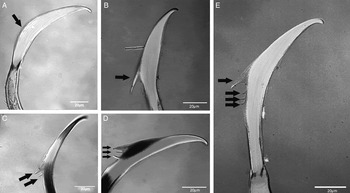
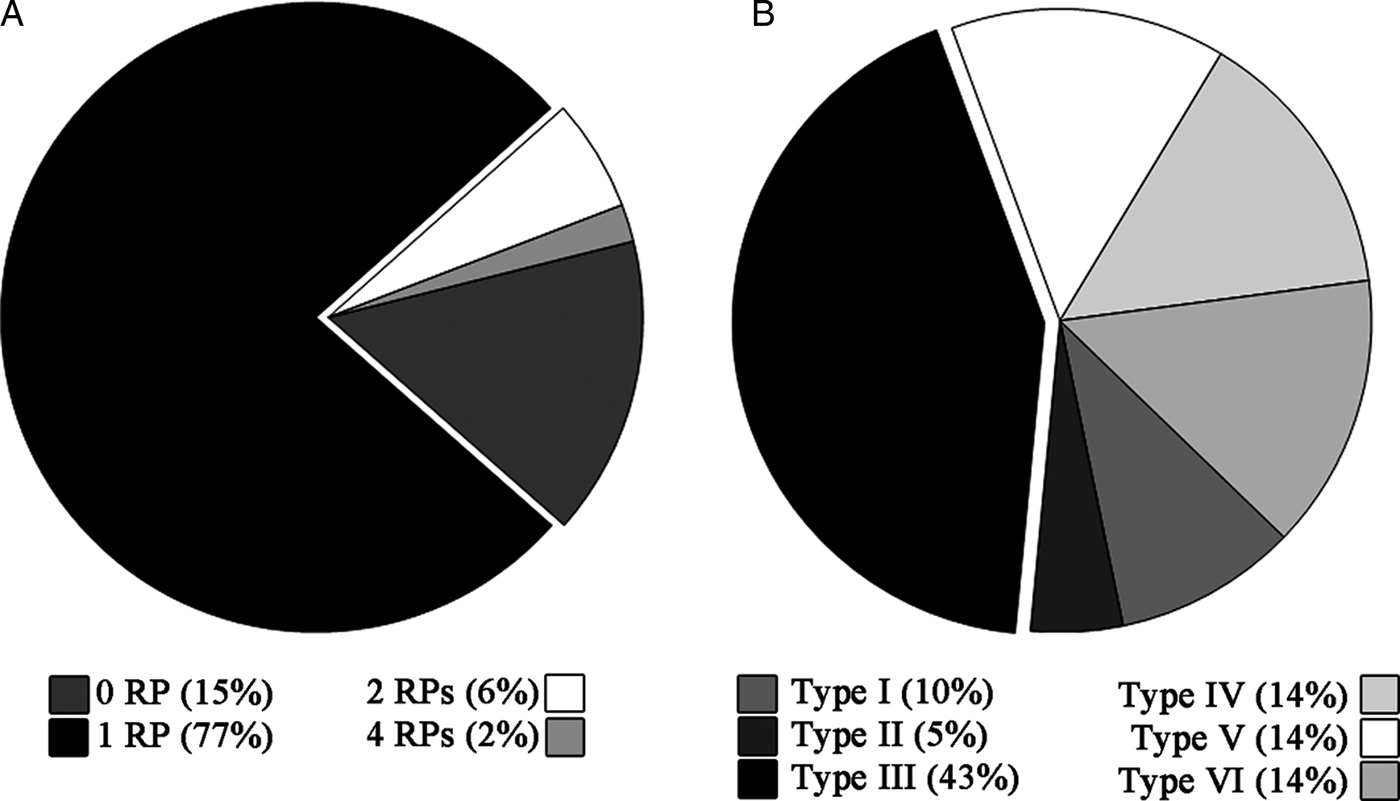
The amount of RPs of most individuals was symmetrical (71%), and among them we found the following phenotypes (fig. 1): 0 (absence of RP), 1, 2 and 4 RPs. The presence of a single RP on each claspette (77%) was the predominant condition. The absence of a RP was the second most common condition, representing 15% of the individuals, followed by two RPs (6%) and four RPs (2%). Among the asymmetric genitalia (29%), there were six different phenotypes, as follows: I (0 and one RP), II (0 and two RPs), III (one and two RPs), IV (one and three RPs), V (two and three RPs) and VI (two and four RPs). This classification does not consider whether the RPs were found on the R/L claspette filament.
Polymorphism in the number of RPs on the claspette filaments of the male genitalia of Aedes scapularis. (A) Absence of RP; (B) presence of one RP; (C) presence of two RPs; (D) presence of three RPs; (E) presence of four RPs.

The most common phenotype was type III (43%) and the least common was type II (5%) (fig. 2). The presence of more than one RP an individual, as well as the different number of RPs on the R–L claspettes of genitalia suggests that the variability of this structure is high.
Quantitative and qualitative graphical representation of percentage of males with the same number of RPs on both claspettes. (A) and those with different numbers of RPs on the left and right claspettes (B). Type I: 0 and one RP. Type II: 0 and two RPs. Type III: one and two RPs. Type IV: one and three RPs. Type V: two and three RPs. Type VI: two and four RPs.

In addition, the Shapiro–Wilk test (W = 0.73, P = 0.00001) rejected the null hypothesis, which considers that the data comes from a population with a normal distribution. The kurtosis observed was the leptokurtic type, and the distribution was negatively skewed (S = −0.37). The fluctuating asymmetry (FA) was characterized by a combination of different averages and variances of the distribution between the characteristics present on R–L claspettes (VanValen, Reference VanValen1962).
This kind of asymmetry in insects may be a result of environmental disturbances, such as pollution and/or climatic conditions, or genetic stress due to inbreeding, which may increase the phenotypic and genotypic variations of a population (Float & Fox, Reference Float and Fox2000; Mpho et al., Reference Mpho, Callaghan and Holloway2002). This effect has been seen in the number of sternopleural and outer orbital bristles of Drosophila melanogaster Meigen, 1830 (Woods et al., Reference Woods, Sgro, Hercus and Hoffmann1999), and in the number of frontal bristles and postocular setae (R–L sides) of Anastrepha fraterculus complex Wiedemann, 1830 (Souza et al., Reference Souza, Gouveia, Perondini and Selivon2007). According to the results obtained by our team (Moratore, Reference Moratore2009; Peruzin, Reference Peruzin2009) in a Culex quinquefasciatus Say, 1823 population also collected in PET, in which wing shape asymmetry was observed (bilateral asymmetry), it is possible that artificial environmental factors probably contributed to FA expression. This asymmetry may also be endogenous due an ‘epigenetic control’ in gene expression of RP development, interfering in gene effectiveness. Although we detected RP asymmetry, an explanation for the observed patterns is yet to be elucidated.
Conclusion
We concluded that the variable presence of the RPs on the genitalic claspette filament is not indicative of populational divergence or diagnostic of cryptic species within Ae. scapularis. Moreover, we found both inter- and intra-individual polymorphism and bilateral fluctuant asymmetry of RPs confirming that this is a labile character.
Acknowledgements
We would like to thank Aristides Fernandes for taxonomic identification of the specimens, Fernanda Silva Almeida for mounting genitalia slides and Henrique Krambeck Rofatto for operating the CLS microscope (Fundação de Amparo a Pesquisa do Estado de São Paulo – FAPESP grant # 00/11624-5). Financial support was provided by Conselho Nacional de Desenvolvimento Científico e Tecnológico (CNPq Grants # 140032/2013-4 and #311805/2014-0), and Coordenação de Aperfeiçoamento Pessoal de Nível Superior (CAPES Grant # 23038.005274/2011-24 and 1275/2011).