1. STUDYING ITALY'S HISTORICAL DIVIDE THROUGH ITS CULTURAL CAPITAL
On 17 March 1861, the Kingdom of Italy was proclaimed. In the spring of 1859, under the guidance of its prime minister, Camillo Benso di Cavour, and thanks to a military alliance with France, the Kingdom of Sardinia, comprising the regions of Piedmont, Liguria, Sardinia and Valle d'Aosta, had managed to wrest Lombardy from the Austrian Empire which had ruled it for over a century. Between 1859 and 1860, liberal and democratic political forces present in the old Duchies of Parma and Modena, in Tuscany and parts of the Papal States had organised popular uprisings that overthrew the legitimate sovereigns and won, through plebiscites, the annexation of those areas to the Kingdom of Sardinia. Finally, in May 1860, an expedition of armed volunteers led by Giuseppe Garibaldi had landed in Sicily and, with the help of local revolutionaries, succeeded in stirring the population into rebellion against the ruling monarch. Within six months, the whole state had fallen to Garibaldi, who officially handed it over to the king of Sardinia, Vittorio Emanuele II, who proclaimed the new kingdom, with Turin as its capital. It was some years, however, before the regions of Veneto, Friuli and Latium joined the newly formed Italy. In 1871, Rome was declared the new capital of Italy, but it was only in 1918, with the favourable outcome of the First World War, that the north-eastern territories of Trentino-Alto Adige and Venezia Giulia, until then administered by Austria–Hungary, became Italian.Footnote 1
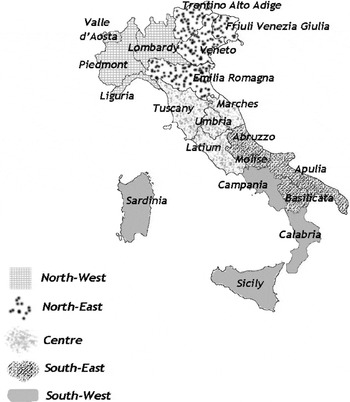
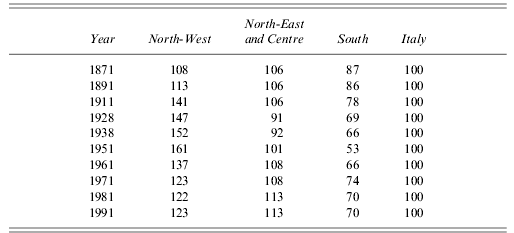
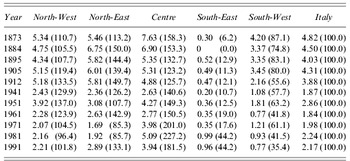
As is well known, this process of unification made clear that there was a marked disparity between the regions of the central and northern parts of Italy and those that formed the South of the new nation – a disparity that was, and still is, expressed in both economic and social terms. Between 1871 and 1951, in fact, the gross domestic product (GDP) per capita in the regions of the South-East (Abruzzi, Molise, Apulia and Basilicata) and South-West (Campania, Calabria, Sicily and Sardinia) was in continual decline compared with that of the North-West (Valle d'Aosta, Piedmont, Liguria and Lombardy), the North-East (Veneto, Friuli Venezia Giulia, Trentino Alto Adige and Emilia Romagna) and Centre (Tuscany, Umbria, Marches and Latium). The regions and their groupings are shown in Figure 1. Although the national government was able to partly reduce the gap during the next two decades through public investment, incentives for businesses and other means, that trend reversed in the period between 1971 and 1991 until the income generated by the southern regions was little more than half of that produced by the northern (North-West and North-East) and central regions.Footnote 2
The 20 Italian regions grouped into 5 macro-areas.

Index numbers of gross domestic product per capita of macro-areas (Italy=100) from 1871 to 1991Footnote a
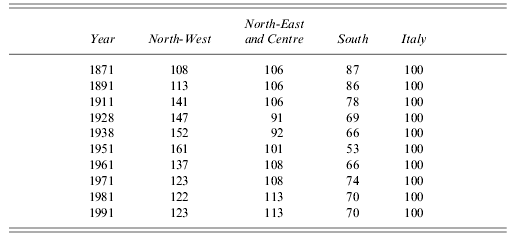
a The gross domestic product per capita data from 1871 to 1911 are calculated at constant prices 1911, from 1928 to 1951 at constant prices 1951, and from 1961 to 1991 at constant prices 1985.
Sources: processing by A.G. Esposto, ‘Estimating regional per capita income: Italy, 1861–1914’, Journal of European Economic History XXVI, 3 (Winter 1997); R. Paci and A. Saba, ‘The empirics of regional economic growth in Italy. 1951–1993’, Contributi di Ricerca, CRENoS I (April 1997).
It is true that the human development index (HDI) registered in the South has almost reached the levels of other parts of Italy during the last 100 years. The HDI is a composite indicator, introduced by the United Nations, by which the development of a country can be measured in terms of standards of living and not just in terms of wealth.Footnote 3 The index has three components: life expectancy at birth, adult literacy rate and income, and ranges from a minimum value of 0 to a maximum of 1. In 1891 the HDI was 0.286 in the South, 0.366 in the Centre, 0.390 in the North-East and 0.439 in the North-West. By 1991 those values had become, respectively, 0.835, 0.878, 0.871 and 0.869.Footnote 4 However the widespread and deeply rooted presence of organised crime in many areas of the South, the persistence of a chronic inadequacy of public services and infrastructure such as roads, hospitals and water supply, in addition to the inefficiency of local authorities in discharging their institutional duties during both the nineteenth and twentieth centuries, have prevented this improvement in the individual components of the quality of life from becoming a general advancement of society in the South.Footnote 5 During the so-called liberal age (1861–1922), the Italian state dealt with the above-mentioned problems only sporadically, partly because of a lack of financial resources to devote to socio-economic growth in the South, resulting from the large public debt accumulated in the course of unification and the general weakness of the national economy which was still largely based on agriculture, and partly due to the complaisant and tolerant attitude of the northern ruling classes towards the style of politics and power management demonstrated by the dominant classes in the South. During the Fascist period (1922–1945) the situation of the South remained virtually unchanged, Benito Mussolini's regime concentrating more on expanding the productive capacity of the North than on helping the South to catch up with the rest of the country. Only with the advent of the Republic and the parliamentary coalitions led by the Christian Democrats (1946–1992) did central government undertake, not without many contradictions and undesirable effects, to improve the living and working conditions of the southern population, nonetheless without showing any real determination to eradicate the corruption that thrived in the local political classes nor to counter with any decision, at least until the late 1980s, the encroachment of the Mafia.Footnote 6
Many studies and interpretations have been produced, from Pasquale Villari's Lettere meridionali in 1875 onwards, to identify the origins of this divide and to explain the reasons for its persistence over time. Many analyses have focused on the different types of development experienced by rural Italy, the particular social stratification in the South, the lack of industrialisation of the southern cities (with certain exceptions) or on the refusal of the inhabitants of the South to recognise as legitimate the rules that govern collective life.Footnote 7 New approaches have emerged recently in the search for the factors that have contributed to the retarded growth of the South compared with the Centre and North of the country. These approaches are based on the study of ‘non-economic conditions of development’,Footnote 8 that is, of a set of cultural, civil and associative elements specific to a particular portion of the Italian territory (region, province or municipality) that influence economic performance and administrative efficiency. Robert Putnam, for example, has highlighted how the performance of the Italian regional institutions since their origin in 1970 has been consistently lower in the South than elsewhere in Italy, due to the lack of cooperation and public spiritedness among the population and the lack of associational structures.Footnote 9 Thomas Lyon has shown how much social capital,Footnote 10 as measured by the indicators used by Putnam, has had an effect, whether positive or negative, on investments, productivity and economic performance of the twenty Italian regions between 1970 and 1995.Footnote 11
In these approaches, however, cultural resources and cultural capital – defined as a collection of art works, monuments, books, newspapers, films, theatre performances and television programmes, but also of shared ideas and values – have been neglected. The few studies completed on these questionsFootnote 12 have explored only a short period of time, usually the last 30 years, and have tended to emphasise more the improvements made in the southern regions during the 1970s and 1980s relative to their accumulated civic and social backwardness compared with the northern regions,Footnote 13 than the strong historical disparity, geographically, of citizens in the South in their access to the means of cultural enrichment. It is this aspect, on the other hand, which is the subject of the present article. Its aim is to demonstrate that one of the most important features of the North–South divide in Italy is a persisting disadvantage of the inhabitants of the South compared with those of the North in the matter of cultural and intellectual ‘functionings’.
The concept of ‘functionings’ – the various conditions of life that we are able, or not, to achieve – was developed by Amartya Sen. According to Sen, inequality can be examined by giving attention to the functionings of individuals or groups of people. These functionings can be simple, such as being well nourished or not falling ill, or complex; having self-respect, for example, or taking part in community life. It is possible to measure the degree of inequality in functionings by means of certain indicators such as life expectancy at birth, infant mortality, literacy rates and so on, broken down by age, gender or geographical area.Footnote 14 Other functionings that go to make up the well-being of each person include their cultural and intellectual interests and the desire to be informed about what goes on inside and outside their community. Scholars such as Tibor Scitovsky and David Throsby have pointed out how important it is, from the point of view of improvement of life and acquisition of the means to improve their economic condition, that the inhabitants of a country experience fairness in access to cultural resources. Having the opportunity to enrich their cultural background by reading a book or watching a play or being able to go to a museum and appreciate a painting or a sculpture, on the one hand make life more enjoyable and on the other make people feel that they share a national identity.Footnote 15 Therefore I propose to demonstrate that the citizens of the South of Italy have always had fewer opportunities, compared with the citizens of the North, to benefit from cultural goods in general – taking into account not only monuments and works of art but also films, books, newspapers, plays, radio programmes, etc. – and that this has helped to perpetuate the North–South divide, over and above differences in income. In other words, as the citizens in the South have not had the same access as citizens in the Centre or the North to public libraries for reading, to local newspapers for information about what is going on in their region or to plays or film screenings, they have not been able to enjoy a comparable standard of well-being and, as cultural functionings have a strong influence on the degree of social integration, economic growth and modernisation of a region, the South generally is comparatively less developed than the Centre or the North, despite an increase in GDP per capita after the Second World War, because of the uneven distribution of cultural facilities and products within the Italian state.
To carry out this study, statistical data on six variables for the five macro-areas (North-West, North-East, Centre, South-East and South-West) were collected and analysed: the number of libraries in existence; the number of books and the number of newspapers published; the number of radio and television licences held; the number of cinemas and the number of theatres in business. This mix of structural indicators, the physical locations of a cultural service delivery, and production indicators, the quantity of cultural goods put into service, was chosen in order to have a satisfactory and consistent picture of the means of cultural enrichment available to Italians. Due to a lack of consistent and continuous data series over time, the number of museums in existence, the number of monuments visitable and measures of the products of the music industry could not be taken into account. The study covers the period from 1863 to 1992, except in relation to cinemas and radio and television licences; data for these variables run only from 1929 to 1991. The variables were divided by the number of residents in the reference areas in order to obtain an indication, rough but reliable, of the level of diffusion of cultural facilities and products among the population. The sources used are: printed publications of the time, population censuses, the Annuario statistico italiano (Italian statistical yearbook), Annali di statistica (Annals of statistics) and Statistiche culturali (Cultural statistics) published by Istat (National Institute of Statistics) and the Annuario statistico (Statistical yearbook) of the SIAE (Italian Society of Authors and Publishers). There are obvious limits to an analysis by geographical area of cultural functionings in Italy over a long period using almost exclusively statistical data, the principal of these being the simplified image that such data can provide of a population made up of so many non-existent ‘average citizens’.Footnote 16 Furthermore, the criteria for the registration of data relating to the variables were often modified by the bodies responsible for gathering the data, making a temporal comparison free from distortion very difficult.Footnote 17 Here, however, the intention is not to exhaust the subject but simply to provide as accurate a summary as possible.
In the following sections the historical evolution of each of the variables will be analysed and their relation to trends in GDP per capita and human capital – identified as rates of literacy and education – examined, in the context of the macro-areas listed above and shown in Figure 1. Finally, the concluding section will outline a comprehensive assessment of the phenomena investigated.
2. THE NETWORK OF LIBRARIES AND THE BOOK MARKET
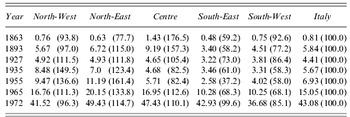
When the Kingdom of Italy was proclaimed in 1861, the existing network of libraries was characterised by a high number of small institutions, a lack of modern works in the collections and a conception of the service oriented more to conservation and consultation of the collections by a small number of educated people rather than to easy access for all to the sources of knowledge.Footnote 18 As Table 2 shows, the distribution of libraries in 1863 was biased in favour of the Centre, North-West and South-West compared with the North-East and South-East. Thirty years later, the South-West had been overtaken by the North-East with regard to the number of libraries per 100,000 residents and, in the following decades, the trend for public libraries to be concentrated more in the areas of central and northern Italy than in the South was reinforced.
Libraries per 100,000 residents in Italy and macro-areas from 1863 to 1972Footnote a
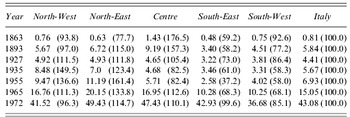
a Index numbers are given in parentheses. Starting from 1975, only the data of the state-owned libraries are available.
Sources: processing by Statistica del Regno d'Italia. Biblioteche: anno 1863 (Florence, 1865); Ministero di Agricoltura, Industria e Commercio (MAIC), Direzione Generale della Statistica (DGS), Statistica delle biblioteche, vol. 3 (Rome, 1896); ‘Statistica di alcune manifestazioni culturali italiane nel periodo 1926–30’, Annali di statistica, s. VI, vol. 15 (1933); Istituto Centrale di Statistica (Istat), Statistica di alcune manifestazioni culturali italiane nel periodo 1931–1935 (Rome, 1937); Istat, Annuario delle statistiche culturali, 1959; ibid., 1968; ibid., 1975. The number of residents in the regions, for every year, has been estimated by linear interpolation of censuses of Italian population data until 1935; afterwards, it was obtained from Istat, Annuario statistico italiano, 1956; ibid., 1966; ibid., 1973.
This weakening of the public reading facilities in the South was a consequence of the economic and social backwardness and the particular forms of population settlement existing in the region. On the one hand, the northern regions such as Lombardy, Veneto and Emilia Romagna, with their numerous cities and towns, formed an urban network and a catchment area more suited to the presence of libraries compared with the southern regions such as Molise, Basilicata and Sardinia, where the cities were fewer and not as well linked to other cities of significant size. On the other hand, the higher illiteracy rates in comparison with the Centre and the North,Footnote 19 the absence of an industrial fabric similar to that created in the North-West after 1887,Footnote 20 the waves of emigration that drained the southern provinces from 1885 onwards and the inability of local elites to use the limited collective financial resources available to increase the civil infrastructuresFootnote 21 blocked any endeavour to expand or modernise the already meagre supply of public reading facilities in the South. In turn, the lack of libraries in relation to population prevented the low level of education of the southern middle classes from improving and perpetuated their disregard for the development of such facilities. The stagnation of the library system in the South became, therefore, a self-sustaining process. A different situation existed in the North where, between the two world wars, substantial financial resources were invested by local administrative authorities to renovate library buildings, add to the book collections, establish new institutions and bring the reading and lending services up to date.Footnote 22 There was a greater sensitivity on the part of the educated middle classes towards the enhancement of library assets, resulting from increased literacy, significant urbanisation and the presence of multiple small and large libraries in the area. The effect of this was that even in 1955 the residents of the North had at their disposal more than twice as many libraries as the residents of the South-West and more than triple those of the South-East.
It was only during the 1960s and 1970s that the library system changed profoundly. The growth in income due to a period of economic ‘boom’, coupled with a rise in literacy rates, in addition to school and university reforms carried out at that time, increased the demand for both cultural consumption and cultural services. High school and university students poured into academic and municipal libraries for study and research. All this led the authorities to assign a key role to libraries in raising the cultural level of the nation. The political leadership, headed by the Christian Democrats, decided to invest some of the funds of the Cassa per il Mezzogiorno (Fund for the South), a body created in 1950 to support the economic recovery of the South with public monies, in giving special assistance to the southern regions in order to create a network of libraries in small towns. New institutions were established and book collections were increased.Footnote 23 There was a renewal of the service and a reduction in the gap in provision between South and North, a reduction greater than that recorded with respect to the income gap between the two areas. In fact, while GDP per capita in the South grew by 21 index points between 1951 and 1971 compared with that of Italy as a whole (as shown in Table 1), the number of libraries per 100,000 inhabitants in those regions increased by virtually 38 index points between 1955 and 1972 compared with the number of libraries in Italy as a whole. The areas of the North-East and the Centre kept their position at the top of the library provision league, but the South-East overtook the North-West while the South-West was left far behind by the other areas. Although public reading facilities have developed over the last 40 years, providing the residents of many provinces with the opportunity to make use of free access to books and magazines, most of the new libraries in the South are small and their primary user is still the school student; the gap between North and South has been reduced but not yet eliminated.Footnote 24
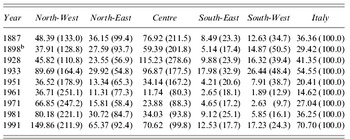
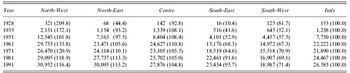
Unlike the library system, the book market did not experience great upheavals in the configuration of supply or in the evolution of the areas of publication, nor in the characteristics of the consumer. Milan, Turin and Florence were the main centres for publishing in Italy before unification and they maintained this position afterwards, while the publishing houses in the South, deprived of the subsidies and customs protection granted by the Kingdom of the Two Sicilies, were forced to close because of competition from northern companies. Between 1861 and 1880 the circulation of books in the South plummeted, and Rome, from 1871 on, became the nation's fourth most important publishing centre, due to the importance of its institutional functions. From the 1880s onwards, production and circulation of books in the southern cities was in a constant state of stagnation, except in Naples and Palermo.Footnote 25Table 3, which takes into consideration not only data on volumes but also on pamphlets, parliamentary acts, printed almanacs and company balance sheets – thereby overestimating the actual supply of books – shows that the North–South gap relating to the publication of books has, over a century, expanded more than the GDP per capita gap.Footnote 26 This huge difference between the macro-areas in question is due not only to the particular history of the Italian printing and publishing industry and to the lower wages and salaries in the South, which left families with very limited non-food consumption compared with the North, but also to the lower rates of literacy and school enrolment in the South.Footnote 27
Books published per 100,000 residents in Italy and macro-areas from 1887 to 1991Footnote a

a The index numbers are given in parentheses.
b The data for books in 1898 include 221 magazines and reviews established in that year.
Sources: processing by Ministero di Agricoltura, Industria e Commercio (MAIC), Direzione Generale della Statistica (DGS), Annuario statistico italiano, 1887–88; ibid., 1900; ‘Statistica della produzione bibliografica italiana nel 1928’, Annali di statistica, s. VI, vol. 9 (1930); Istituto Centrale di Statistica (Istat), Statistica di alcune manifestazioni culturali italiane nel periodo 1931–1935 (Rome, 1937); Istat, Annuario delle statistiche culturali, 1955; ibid., 1964; ibid., 1972; ibid., 1982; Istat, Statistiche culturali, 1992. The number of residents in the regions, for every year, has been estimated by linear interpolation of censuses of Italian population data until 1933; afterwards, it was obtained from Istat, Censimento della popolazione italiana, ad annum.
The link between education levels and cultural consumption has been analysed by economists and sociologists and it seems that the use of cultural property, understood in a broad sense, is more influenced by the human capital and the stock of experience accumulated over time by an individual than by any increase in disposable income.Footnote 28 Such a view is confirmed in our case, given that the South had the lowest enrolment rates in the country for secondary education during the 1980s and, simultaneously, had the lowest percentages of readers of books.Footnote 29 It is precisely the underdeveloped human capital of the southern regions, compared with that found in other parts of Italy, that helps to explain why the rate of book circulation in the South has always been lower compared with that in the North. The general disinclination for reading on the part of the whole population has hindered the formation of a vast network of publishers and libraries in the South, with the exception of a few large cities. This has contributed to the failure to exploit the book market in the South, but the overall supply of books has not climbed despite economic development, the fall in illiteracy and the growth in school and university enrolments over the last 50 years. A further contributing factor is the backwardness of the distribution system. In the 1990s, just as it had been a 100 years earlier, the distribution of books in Italy was still strongly based on bookshops that were too small, too scattered, and crowded with every kind of publication, many of which were very short lived, which disoriented and discouraged the casual reader and contributed to a declining love of books in Italy. In 1947, 41 per cent of the Italian population had never read a book, and by 1984 this had risen to 53.6 per cent, even though from 1961 onwards publishers had broadened the market through initiatives to encourage the reading of the ‘classics’ by the less affluent classes.Footnote 30
3. THE MASS MEDIA: NEWSPAPERS, RADIO AND TELEVISION
The evolution of the daily press in Italy has, in part, been similar to that of the circulation of books and, in part, even more negative. The North-West and the Centre have always been the most important areas of newspaper production and readership, for the same reasons underlying their predominance in book productionFootnote 31 and also because of a more deep-rooted tradition of newspaper circulation in these areas than in the South which has been increasingly distanced from the rest of the country, particularly so in the South-West area. Tables 1 and 4, for example, show how GDP per capita in the South decreased by 17 index points between 1871 and 1991 in relation to that of Italy as a whole, while the number of newspapers per 1,000,000 residents decreased by 23.79 points between 1873 and 1991. In the North-West, on the other hand, the first parameter increased by 15 index points and the second decreased by 8.94 points. The North-East and the Centre have also shown an improvement in GDP per capita and a less pronounced decline than the South in the ratio of newspapers to residents. On the national level in general the trend in newspaper circulation has always been irregular and tending downward. Excluding the South-East, all of the major areas in question have registered, from 1912 onwards, worsening ratios of newspapers to residents compared with the nineteenth and early twentieth centuries. Although progress was undoubtedly made in newspaper circulation (in the 1870s the total circulation of daily newspapers in Italy did not exceed 500,000 copies, while over 100 years later the most popular newspapers printed between 2 and 4 million copies) the ratio of newspapers to inhabitants in Italy has remained low compared with that in other advanced industrial nations.Footnote 32 Why is this?
Newspapers published per 1,000,000 residents in Italy and macro-areas from 1873 to 1991Footnote a

a The index numbers are given in parentheses.
Sources: processing by G. Ottino, La stampa periodica, il commercio dei libri e la tipografia in Italia (Milan, 1875); Ministero di Agricoltura, Industria e Commercio (MAIC), Direzione Generale della Statistica (DGS), Annuario statistico italiano, 1885; ibid., 1905–1907, issue I; ibid., 1914; Istituto Centrale di Statistica (Istat), Annuario statistico italiano, 1943; Istat, Annuario delle statistiche culturali, 1955; ibid., 1964; ibid., 1972; ibid., 1982; Istat, Statistiche culturali, 1992. The number of residents in the regions, for every year, has been estimated by linear interpolation of censuses of Italian population data until 1941; afterwards, it was obtained from Istat, Censimento della popolazione italiana, ad annum.
Besides the limitations of Italian human capital already mentioned and the low per capita income, especially in the South, the peculiar way in which the daily press developed in Italy is one of the principal causes of its stunted growth. Since their origin, the Italian newspapers have had close links with the political and economic powers. Many papers, unable to cover production costs through sales in a country with few readers, only survived thanks to the hidden financial support of large firms or the support of major political parties and the government. These political and economic ties have influenced the way news and content are presented, pushing the press into conventionality and deference towards the powerful. In addition, the format chosen by newspaper editors, the so-called omnibus, containing news of every kind, from current events to the economy, from culture to politics – the latter usually more domestic than foreign, has encouraged journalists to use language that is too learned and abstruse, and to mix their personal opinions with the description of events. This has served to keep the working classes away from the daily press; instead, as literacy grew, they preferred to turn to illustrated magazines. Despite the modernisation of processes involved in newspaper production between 1885 and 1950, permitting the reproduction of photographs, the creation of evening editions, the expansion of sports reporting and so on, the basic characteristics of the daily press have remained substantially unchanged. Finally, the meeting of newspaper demand and supply has never been very efficient because of the characteristics of the distribution system, marked by a myriad of tiny, widely scattered kiosks. Therefore, the propensity of Italians to obtain information through the newspapers has always been small and they have preferred easier-to-use and more direct means of communication such as illustrated magazines, radio and, especially, television.Footnote 33
The new mass media developed very rapidly in Italy, permeating society in less than 70 years thanks to their directness and the ease of reception of the spoken word and the image as vehicles of information and ideas. Of course this phenomenon occurred in other Western nations too, sometimes even more forcefully, but the uniqueness of Italy lies in the absolute primacy of television as the means of information and cultural enrichment for the majority of the population today.Footnote 34 The successful diffusion of radio and television among Italian families is confirmed by Table 5, which shows that only the South-West regions were less dynamic than the others in acquiring radio and television licences.Footnote 35
Radio and television licences per 100,000 residents in Italy and macro-areas from 1928 to 1991Footnote a

a The index numbers are given in parentheses.
Sources: processing by Istituto Centrale di Statistica (Istat), Annuario statistico italiano, 1949–1950; Istat, Annuario delle statistiche culturali, 1955; ibid., 1964; ibid., 1972; ibid., 1982; Istat, Statistiche culturali, 1992. The number of residents in the regions, for every year, has been estimated by linear interpolation of censuses of Italian population data until 1935; afterwards, it was obtained from Istat, Censimento della popolazione italiana, ad annum.
The gap between North and South for radio and television licences was less, from the 1960s to the 1980s, than that for the distribution of books and newspapers. It is precisely the social and educational disparities in this area in comparison with the areas of the Centre and the North that have led to a distortion of cultural consumption. Since the 1950s radio and television have become inexpensive means of information and entertainment because, after the initial costs of purchase – now much less than in the 1930s, thanks to technological and organisational advances made by the companies manufacturing radio and television receivers – and buying a licence, people can enjoy their favourite programmes for many years at little cost. Therefore, precisely in those areas where the production of printed matter was low and the habit of reading books and newspapers was limited, levels of radio and television consumption increased.Footnote 36 From the 1960s to the 1980s, when the gap in GDP per capita between the macro-areas remained constant, the gap relative to the diffusion of radio and television sets narrowed. This is probably because, until the mid 1970s, the national state radio and television broadcasting company (RAI) became established as the active centre of Italian culture production, using ordinary language comprehensible to all to broadcast both straight entertainment programmes and programmes that made high culture accessible to the working classes. Since the early 1980s this role has been filled by the private television networks of Silvio Berlusconi, but with programmes of lower quality.Footnote 37
4. PLACES OF ENTERTAINMENT (THEATRES AND CINEMAS)
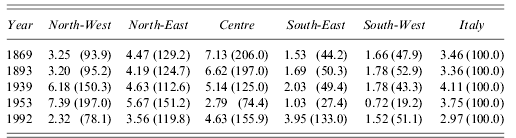
Although going to the theatre has always been, in Italy as in other countries, a relatively elitist phenomenon, until the 1920s the theatre was a place where a part of the working classes came into contact with the arts. Between unification and the First World War the less educated and less affluent would go to arenas (large amphitheatres in towns for outdoor performances) and small theatres, usually privately owned, where performances of dialect plays, variety and circus games were put on. The better-off and better-educated public would go to first-class theatres (some private, some managed or financed by the local authorities in the provincial capitals) to attend concerts, the opera and plays. Such venues were concentrated mainly in the North and Centre, as can be seen from Table 6. From the late nineteenth century onwards, in addition, some municipal governments in the North took over the management of the city theatres, trying to stimulate the working classes to go to the first-class theatres, through use of low-price tickets and a variety of types of performance.Footnote 38 However, after the First World War, a crisis that swept the world of theatre, caused by the competition of radio and cinema as means of mass entertainment and by the inability of Italian writers and actors to renew their forms of expression, significantly lowered the number of theatre and opera-goers under Fascism. Starting in the mid 1930s, the state supported the theatre sector through tax breaks and financial assistance, maintaining a very high, sometimes overabundant, supply of performances. Excluding the period 1936–1940, during which the number of theatre facilities, including temporary ones, and spectators increased, state aid did not stop a constant loss of spectators, especially in the post-war period. This was made worse by the reluctance of people working in theatre to make any change in the way they went ‘on stage’.Footnote 39 For over 50 years, theatre audiences in Italy have been highly educated but quantitatively limited. In 1984, for example, 41 per cent of Italian graduates had gone at least once to a theatre compared with just 4 per cent of Italians with only a primary school diploma, but in all, less than 10 per cent of Italians had attended a theatrical performance.Footnote 40
Theatres in activity per 100,000 residents in Italy and macro-areas from 1863 to 1992Footnote a
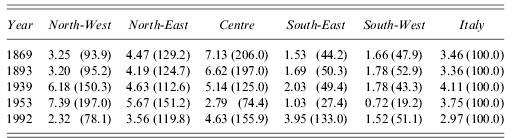
a The index numbers are given in parentheses.
Sources: processing by E. Rosmini, La legislazione e la giurisprudenza dei teatri e dei diritti d'autore, vol. II (Milan, 1872); E. Rosmini, Legislazione e giurisprudenza dei teatri (Milan, 1893); Società Italiana degli Autori ed Editori (SIAE), Lo spettacolo in Italia, 1938; Istituto Centrale di Statistica (Istat), Annuario statistico italiano, 1956; Comitato Nazionale Italiano Musica (CIDIM), Annuario musicale italiano, 1993. The number of residents in the regions, for every year, has been estimated by linear interpolation of censuses of Italian population data until 1939; afterwards, it was obtained from Istat, Annuario statistico italiano, 1954; ibid., 1994.
In other Western countries too the theatre sector is supported financially by the state and its audiences are a relatively small and well-educated segment of the population.Footnote 41 What is specific to Italy is the marked geographical imbalance in theatre facilities, supply of performances and the willingness of the public to make use of them. The disparity in the first two has been a constant in Italian cultural history, although, as shown in Table 6, during the last 60 years there has been a shuffling of positions in favour of the areas of the South-East and Centre at the expense of the North. The latter, in fact, was overtaken in 1992 by the South-East and Centre as regards theatres per 100,000 residents, while the South-West still lags far behind all the other areas. Most plays, operas and variety shows remain concentrated in the areas of the Centre and the North, just as the majority of tickets for performances have always been sold in the provincial capitals.Footnote 42 This gap between the centre and the periphery, like that between North and South in relation to theatres, is probably due to the same factors already mentioned with regard to the diffusion of libraries: the different network structure of urban sites in the regions of the North compared with those of the South and the greater propensity of local governments in the North and Centre to invest resources in the construction of cultural facilities.
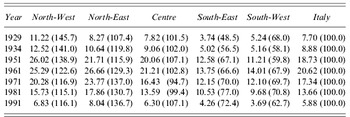
The history of cinema in Italy is a different story, particularly with respect to the dimensions and degree of permeation into society. As Tables 1 and 7 show, although the regions of the South have always had fewer cinemas than the regions of the Centre and the North, the number of cinemas in the South has grown both when GDP per capita was declining between 1928 and 1951 and when it was growing between 1951 and 1961. Moreover, until recently there were more cinemas in towns than in cities and, unlike the situation described for the theatre, the demand for films was spread uniformly over Italy. In 1929 more than 75 per cent of cinemas were located in towns and cities that were not provincial capitals; in 1991 that value was 63 per cent. In 1955 only 52 per cent of tickets sold in Italy were sold in the provincial capitals, which totalled 31.23 per cent of the total days of film screenings; 20 years later, these figures had become, respectively, 47 and 33 per cent. During the years 1971 to 1991, however, the sector underwent a devastating crisis that led to a marked decrease in the number of cinemas and a reshuffling of demand and supply of films, now concentrated in the big cities.Footnote 43
Cinemas in activity per 100,000 residents in Italy and macro-areas from 1929 to 1991Footnote a

a The index numbers are given in parentheses.
Sources: processing by ‘Statistica di alcune manifestazioni culturali italiane nel periodo 1926–30’, Annali di statistica, s. VI, vol. 15 (1933); Istituto Centrale di Statistica (Istat), Statistica di alcune manifestazioni culturali italiane nel periodo 1931–1935 (Rome, 1937); Istat, Annuario statistico italiano, 1952; Istat, Annuario delle statistiche culturali, 1962; ibid., 1972; ibid., 1982; Istat, Statistiche culturali, 1991. The number of residents in the regions, for every year, has been estimated by linear interpolation of censuses of Italian population data until 1934; afterwards, it was obtained from Istat, Censimento della popolazione italiana, ad annum.
What were the causes of such long-lasting success, and, recently, of such a rapid decline of cinema in Italy? Very probably the meteoric development of dynamic small- and medium-sized production companies in the early years of the twentieth century and the rapid and extensive multiplication of cinemas run by skilled entrepreneurs, enjoying construction and management costs far below those of theatres, in the provinces and the big cities, formed a solid basis for the population to acquire the habit of watching films as an inexpensive recreational activity. The originality of the expressive forms of Italian cinema – the invention of the epic film, for instance – and its star system (that is the creation of cinema celebrities, the divas of silent films, in Italy) made audiences very receptive to American cinema, which became the hub of the imaginative world of spectators during the years between the two world wars. Developments at the international level, such as the introduction of sound and Technicolor and the adoption of new stylistic techniques, and at the national level, such as state support for domestic production and the emergence of Cinecittà, the Italian equivalent of the Hollywood studios, strengthened cinema's appeal and made it the most popular form of mass entertainment until the end of the 1960s.Footnote 44 From 1972, however, public and private television channels started to broadcast films of all kinds, which induced the public to prefer their own comfortable sitting-rooms as places for watching films, rather than going to cinemas. This led to a marked reduction in the number of cinemas and their concentration in larger urban areas. As a result of the cost-reducing strategies employed by production and distribution companies, the number of films in circulation decreased and they were screened for fewer days. In turn, spectators go to the cinema less frequently than in the past, they enquire about the quality of the films and try to avoid titles that might disappoint them. Behaviour of this kind requires time and ability that only the more educated segments of the population have.Footnote 45
5. CONCLUSION
There is no doubt that in Italy during the last 140 years there have been major improvements in the approach to reading, the circulation of news and the access to forms of entertainment of various levels of cultivation. Today, with the possible exception of the opera, the price of a ticket or a book and the cost of a newspaper or a radio set are no longer discriminating factors between those who are able to increase their knowledge and those who do not have this possibility. Although Italy has become one of the richest countries in the world, it still suffers from a marked cultural backwardness in comparison with other Western countries. The weaknesses, now as in the nineteenth and twentieth centuries, are the reading of books and newspapers, which a minority of the population engages in, and theatre attendance; only radio and television, and to a lesser extent cinema, are appreciated by substantial numbers of people.
This weakness is most evident in the South. Residents in the South, in particular the South-West, have always benefited much less than those in the North from the cultural assets accumulated during the period examined. Many indicators of social and civil conditions have improved over the last 60 years in the South. For example, between 1951 and 1987, the infant mortality rate decreased from 82.4 to 10.9 deaths per 1,000 births, the number of doctors and nurses per 10,000 inhabitants increased from 10.8 to 48.9, and the number of cars in circulation per 100 inhabitants increased from 0.4 to 32.2.Footnote 46 Indicators of culture reported in this study, however, show how a long-lasting North–South divide in Italy is also evident in cultural functionings. Only in recent decades has the gap tended to shrink and only in the macro-area of the South-East. The long-term effects of this regional imbalance in access to cultural assets are not insignificant. One only needs to reflect on the lack of social integration among the citizens of many areas of the South, where participation in local events has been deficient due to the low circulation of newspapers; or their inability to adopt behaviours that sustain productive activities, caused by insufficient knowledge resulting in turn from the low availability of books and libraries;Footnote 47 or the more fragile secularisation of society in the South compared with the North (expressed, for example, in the percentage of civil weddings), which can be explained by, among other things, the fact that ‘modern’ models of behaviour spread by cinema and television have taken root much less.Footnote 48 The causes of this disparity in the capacity to absorb culture, however, seem to be due more to the specific history of the various sectors analysed and to the characteristics of human capital rather than to the performance of the wealth produced. In some cases, in fact, opportunities to benefit from cultural entertainment have increased despite the fall in GDP per capita; at the same time income growth has not been transformed into a proportional rise in the instruments of cultural enrichment.Footnote 49 This has meant that, in the South, only state or local government intervention has been able to reduce the cultural divide, but this intervention has not brought about a realignment of cultural consumption between North and South or set in motion a process of social, economic and civil development similar to that already under way in the North before Unification.
Acknowledgements
A previous, reduced version, of this article was presented at the Sixth European Social Science History Conference in Amsterdam, in March 2006. The author wishes to thank the anonymous referees and the editors for their guidance on how to improve the text.