Background
The use of emergency care is increasing worldwide and patients who are visiting the emergency department (ED) on several occasions account for a relatively large part of all ED patients. Earlier studies of frequent ED users have reviewed the characteristics of patients who seek emergency care repeatedly. The majority of frequent ED users have been found to come to the ED by ambulance,Reference Scott, Strickland, Warner and Dawson 1 and these patients account for a large share of all ED visits.Reference Billings and Raven 2 One study has found that frequent ED users account for 18% of all ED visits, and that this group of patients also uses other care facilities repeatedly.Reference Hansagi, Olsson, Sjöberg, Tomson and Göransson 3 The frequent ED users also appear to be a heterogeneous group.Reference Martin, Stokes-Buzzelli, Peltzer-Jones and Schultz 4 They have a high co-morbidity and visit the ED for mostly non-traumatic events.Reference Martin, Stokes-Buzzelli, Peltzer-Jones and Schultz 4 Patients without health insurance make up a large group of frequent ED users.Reference Martin, Stokes-Buzzelli, Peltzer-Jones and Schultz 4 Since health care systems can differ a lot between countries, it is important to study frequent health care users in different contexts.
Also, the use of the Emergency Medical Services (EMS) is increasing. In Sweden, the number of ambulance missions increased significantly between 2009 and 2014, and other European countries have seen similar increases.Reference Suserud and Svensson 5 In England, an increase in the demand for ambulances of 6.5% each year during the last 10 years was reported. 6 The conditions that cause a call for the EMS vary from a potentially life-threatening disease to an illness that does not require EMS. In one study, the patients’ need for EMS was assessed by the EMS clinicans.Reference Hjalte, Suserud, Herlitz and Karlberg 7 Thirty-one percent of patients were judged not to need EMS.Reference Hjalte, Suserud, Herlitz and Karlberg 7 In an earlier study from the London ambulance service, the proportion of inappropriate ambulance calls was estimated at 16%.Reference Palazzo, Warner, Harron and Sadana 8 A recent study from Sweden found that 16% of EMS missions were potentially suitable for primary care.Reference Norberg, Wireklint Sundström, Christensson, Nyström and Herlitz 9 This creates a challenge for EMS clinicians to triage patients to the right level of care at first meeting. However, there are reports of deficits in EMS clinicians’ clinical judgements and decision making, and this is regarded as the main threat to patient safety in prehospital care.Reference Bigham, Bull and Morrison 10 - Reference Wang, Fairbanks, Shah, Abo and Yealy 13
A number of patients call repeatedly for EMS.Reference Scott, Strickland, Warner and Dawson 1 Earlier studies of frequent callers show that they form a heterogeneous group. Common findings are that frequent callers are more likely to suffer from non-traumatic events and have high co-morbidity as compared to other EMS patients,Reference Scott, Strickland, Warner and Dawson 1 but there is a lack of research on frequent EMS callers. There is a lack of data on the extent to which frequent callers consume EMS resources.Reference Scott, Strickland, Warner and Dawson 1 There is also a lack of knowledge about the characteristics and the prehospital assessment of the patients who call for EMS on several occasions.
The aim of this study was therefore to study a representative cohort of patients who were characterized by calling for EMS on several occasions in 2014. The research questions were:
-
1. What were the final diagnoses among these patients?
-
2. What were the findings in the prehospital assessments?
-
3. How accurate were the associations between the prehospital assessment and the final diagnosis?
Methods
Study Setting and Population
The study was conducted at an ambulance organization in Western Sweden. Each ambulance in Sweden is operated with either two ambulance nurses or one ambulance nurse and one emergency medical technician. The ambulance nurse always has the main responsibility for patient care. The majority of the nurses in the organization have an additional specialist education in prehospital emergency care. Since 2005, all ambulances in Sweden have been obliged to be run by at least one registered nurse.Reference Suserud 14 The organization has a catchment area of 8,210.3 km2 and a population of 256,600 inhabitants. In the catchment area, 49.5% are women. The median age is 43 years with an interquartile range of 21.5-71.5 years. Since 1955, there is general insurance against diseases covering all Swedish inhabitants. This means that an ambulance transport is, in principle, free of charge for Swedish inhabitants (a minor fee of 150 Swedish Crowns is paid). Furthermore, there is an insurance against eventual accidents during ambulance transport. The Swedish BNP (Stockholm, Sweden) in 2015 was 4,159 milliards (billion) Swedish Crowns. In the organization, there are four hospitals and nine EMS stations with around 35,000 missions each year.
All the patients who used the EMS in the ambulance organization at least four times in 2014 were included in the study. The study did not include missions in which patients were transported between hospitals. Furthermore, patients who were seen by the EMS crew but remained on-scene (mostly in their homes) and were not brought to a health care unit were not included.
Study Design
This retrospective observational study was ongoing between January 1, 2014 and December 31, 2014. The study can be regarded as retrospective since it was designed after 2014. The eligible patients were identified in the ambulance organization’s patient record system (Ambulink). After this process, a total number of 339 individual patients with at least four EMS missions a year could be identified and a total of 1,855 EMS patient records were included in the study. They accounted for five percent of all EMS missions.
In each of the 1,855 ambulance patient records, the outcome of interest was:
(1) the final diagnosis in-hospital; (2) the findings of the prehospital assessment (assessment or preliminary diagnosis on-scene); and (3) the relationship between the prehospital assessment and the final diagnosis. Demographic data such as age and gender were collected in the organization’s patient record system.
To be able to determine the final diagnosis, the hospital patient record system (Melior) was examined by two of the authors, in those cases in which the patient was transported to hospital. Thirty main categories of diagnoses were created on the basis of the individual final diagnoses in the database. In principle, these main categories were organ-related. Within each of these 30 main categories, there were a number of sub-categories. Each sub-category was equivalent to one unique final diagnosis/assessment. These unique final diagnoses/assessments are described in a supplemental file (Supplement 1; available online only).
Main category 29 consisted of various symptoms (for example, non-specified chest pain), while main category 30 was called “others,” consisting of various vaguely defined conditions (for example, observation). The immediate risk on-scene was assessed according to the Rapid Emergency Triage Treatment System (RETTS) prehospital triage system.Reference Widgren and Jourak 15 Potentially life-threatening conditions according to the final diagnoses were anaphylactic shock, unconsciousness, TIA/stroke, unstable angina pectoris, acute myocardial infarction, heart failure, cardiac arrest, septic shock, pulmonary edema, failing heart conducting system, pulmonary emboli, and intoxication.
The final diagnosis was assessed according to ICD codes in the hospital records. Even among patients who were directly sent home from the ED, it was possible to find similar information. Thus, the final diagnosis was assessed on the basis of the responsible health care provider’s evaluation.
To determine the relationship between the on-scene assessment (assessment according to the emergency signs and symptoms [ESS] or preliminary diagnosis) and the final diagnosis, an instrument that has recently been described in detail was used.Reference Andersson Hagiwara, Nilsson, Strömsöe, Axelsson, Kängström and Herlitz 16 In Sweden, the EMS clinician is allowed to summarize their clinical findings in terms of a preliminary diagnosis already on-scene before arrival in-hospital, although this is not a requirement. A preliminary diagnosis indicates a suspicion of a disease (for example, a suspected acute myocardial infarction).
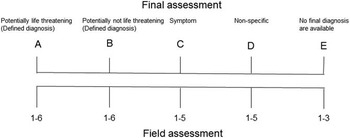
The final assessment should be categorized in one of five main categories according to the final diagnosis, depending on: (a) the seriousness of the disease (potentially life-threatening or not); (b) the precision of the final diagnosis (reflecting a disease such as pneumonia, or a symptom such as dyspnea, or a more diffuse condition such as asthenia); and (c) the availability of the final assessment (sometimes not available).
The five main categories according to the final diagnosis were therefore: (1) a potentially life-threatening disease (ie, stroke); (2) a disease which is not potentially life-threatening (ie, cystitis); (3) the final diagnosis is expressed as a symptom (ie, dyspnea); (4) the final diagnosis is expressed in non-specified terms (ie, deterioration in general condition); and (5) information on the final assessment is not available (Figure 1).
Evaluation of the Relation Between Prehospital Field Assessment and Hospital Final Assessment.

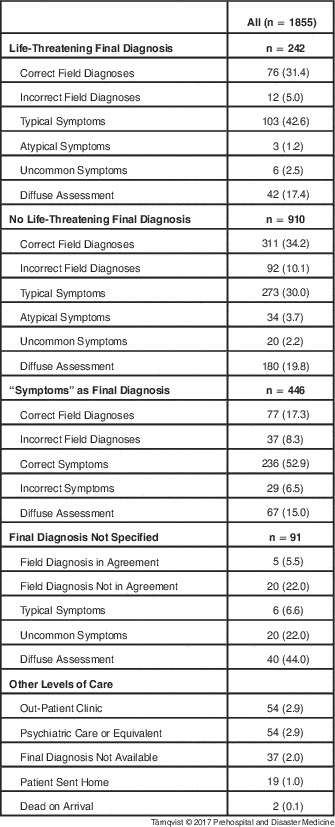
The next step is to evaluate the association between the prehospital assessment and the final assessment. For the two first main categories where there is a definite final diagnosis, there are six sub-categories (Table 1): (1) the preliminary diagnosis on-scene is in agreement with the final diagnosis; (2) the preliminary diagnosis on-scene is not in agreement with the final diagnosis; (3) the assessment on-scene indicates a typical symptom when related to the final diagnosis, for example, dyspnea when the final diagnosis is pulmonary embolism; (4) the assessment on-scene indicates an atypical symptom in relation to the final diagnosis, for example, dyspnea when the final diagnosis is myocardial infarction; (5) the assessment on-scene indicates a more unusual symptom in relation to the final diagnosis, for example, abdominal pain when the final diagnosis is myocardial infarction; and (6) the assessment on-scene describes the patient’s problem in a less specific way, for example, problems with the circulation or problems with the airways.
Association Between Prehospital Assessment and Final Diagnosis

For the third and fourth main categories “final diagnosis is a symptom” and “final diagnosis is not specified,” there are only five sub-categories since the final assessment is not specified as a diagnosis (Table 1). These sub-categories are: (1) the assessment on-scene is a preliminary diagnosis in agreement with the final assessment; (2) the assessment on-scene is a preliminary diagnosis not in agreement with the final assessment; (3) the assessment on-scene indicates a symptom in agreement with the final assessment; (4) the assessment on-scene indicates a symptom not in agreement with the final assessment; and (5) the assessment on-scene describes the patient’s problem in a less specific way.
The last main category “other levels of care” includes patients for whom there is no information on the final assessment, as these patients were not taken to a hospital. The sub-categories in this category are described in this manuscript (Table 1) with a slight modification as compared with the description in the article previously referred to.Reference Widgren and Jourak 15
In order to examine the findings in the prehospital assessment, the ESS code was used in the ambulance patient record. This code is a validated instrument used to describe symptoms and signs in the acute stage of a disease.Reference Andersson Hagiwara, Nilsson, Strömsöe, Axelsson, Kängström and Herlitz 16
The study was approved by the ethical adviser at the University of Borås (Borås, Sweden) and the recommendations of the Swedish Research Council (Stockholm, Sweden) were followed.Reference Gustafsson, Hermerén and Petersson 17
Statistical Methods
Age distribution is presented at patient level. All the other results are presented at mission level. Nested analysis of variance was used for P value calculations regarding gender and age group comparisons, with adjustments made using the stepdown Bonferroni method. Adjusted P values below .05 were considered statistically significant. All analysis was performed using SAS for Windows version 9.3 (SAS Institute Inc.; Cary, North Carolina USA).
Results
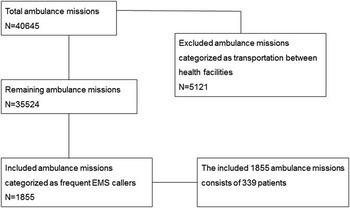
A total number of 339 individual patients with at least four missions a year could be identified, for whom a total of 1,855 EMS missions were required, and therefore they were included in the study. Those 1,855 missions conformed five percent of all EMS missions (N=35,524 mission, excluding 5,121 ordinary transports; Figure 2). In 91.0% of 1,855 cases, patients were transported to an ED. Among these patients, 67.0% were finally hospitalized. Table 2 shows the distribution of the number of missions for all patients in the study. Table 3 shows the distribution of patients according to age. More than 50.0% of patients were found in the age range of 70-89 years.
Missions Included in the Study. Abbreviation: EMS, Emergency Medical Services.

Distribution of Number of Missions Among All Patients, Women, and Men and Patients Below and Above 75 Years

a Number (percent).
Distribution of Age

Note: Age is presented for all patients and for women and men.
a Number (percent).
On-Scene Assessment
Table 4 shows the distribution of patients according to the on-scene assessment. The most frequently reported ESS code was dyspnea, followed in descending order of frequency by chest pain, abdominal pain, and infection.
The Most Frequent Emergency Signs and Symptoms Codes (only >2% included)

Note: Results are presented for all patients as well as for patients below and above 75 years.
a Stepdown Bonferroni adjusted P value, given if <.05
b Number (percent).
When patients aged ≤75 years were compared with those aged>75 years, the following codes were more frequently found in the younger patients: intoxication and psychiatric problems. There was no significant difference between women and men in terms of ESS codes.
Final Diagnosis
In Table 5, patients are divided into the 30 main categories of diagnoses. When the two last categories (29 and 30) were excluded, the most frequently found groups of diagnoses were: (1) disease in the lower airways; (2) psychiatric diseases; and (3) trauma.
The Distribution of Patients According to Final Diagnoses

a Number (percent).
The most common final diagnosis was chronic obstructive pulmonary disease (8.0%).
Psychiatric diseases were more frequent in younger patients, whereas diseases in the heart due to circulatory disorders or other disorders were more common among the elderly. No significant difference was found between men and women (Supplement 2; available online only).
On-Scene Assessment in Relation to Final Diagnosis
As shown in Table 1, there were 27 different combinations.
In 242 cases (13.0%), the final diagnosis indicated a potentially life-threatening condition. In the majority of these cases (74.0%), the prehospital assessment was in agreement with the final diagnosis. However, in 22.0% of cases, the prehospital assessment could be judged as potentially inappropriate (the preliminary diagnosis on-scene was not in agreement with the final diagnosis, or the assessment on-scene was not specified).
In 910 cases (49.0%), the final diagnosis indicated a disease which was not classified as potentially life-threatening. In the majority of those cases (64.0%), the assessment on-scene was in agreement with the final diagnosis. However, in 29.0% of cases, the assessment on-scene could be regarded as potentially inappropriate when defined similarly as in potentially life-threatening conditions.
Among the patients who, according to the final diagnosis, were defined as having a specific symptom rather than a defined diagnosis, the assessment on-scene was in agreement with the final assessment in 70.0% of cases (preliminary diagnosis or symptoms on-scene in agreement with the final assessment).
Supplement 3 (available online only) shows the most frequent ESS codes among patients with three different potentially life-threatening conditions: myocardial infarction, stroke, and sepsis. When a myocardial infarction was the final diagnosis, the on-scene assessment indicated chest pain in 72.0% of cases. When stroke was the final diagnosis, the on-scene assessment indicated stroke/neurological deficit in 71.0% of cases. If the final diagnosis was sepsis, the on-scene assessment indicated fever/infection in 50.0% of cases.
Discussion
This study explores the characteristics of patients who are frequent users of the EMS in a county in Sweden. The results of this study have two variables in common with other EMS studies of frequent users: frequent users are more likely to suffer from medical conditions, and this group of patients appears to have a high co-morbidity.Reference Scott, Strickland, Warner and Dawson 1 Important findings were that the most common symptoms were dyspnea, chest pain, and abdominal pain, and the most common final diagnosis was chronic obstructive pulmonary disease. It was found that there was a wide age span, but the majority of users were found among the elderly. Over 60.0% of the population was 70 years and over. This is in agreement with previous findings from the London area.Reference Edwards, Bassett, Sinden and Fothergill 18 However, a study from the USA found that patients in the age span of 45 to 54 years were the largest group of frequent EMS users.Reference Knowlton, Weir and Hughes 19 An ED study, also from the USA, concluded that 83.0% of frequent ED users were younger than 65 years of age.Reference Hunt, Weber, Showstack, Colby and Callaham 20
The proportion of women was similar to that of men. This is in line with the London study where 45.0% of the sample were men.Reference Edwards, Bassett, Sinden and Fothergill 18 A previous study from a midsize US city reported that males represented 63.0% of the frequent EMS users.Reference Knowlton, Weir and Hughes 19 The over-representation of males can also be found in a study of a US urban EMS system.Reference Tangherlini, Pletcher, Covec and Brown 21
It was found that the most frequent symptoms reported by the EMS clinician on the scene were dyspnea, chest pain, and abdominal pain. Even when it comes to symptom characteristics, different studies report different results. The study from a midsize US city reported behavioral and mental health problems as the most frequent symptoms, followed by asthma, diabetes, and HIV/AIDS.Reference Knowlton, Weir and Hughes 19 Another US study found that cardiorespiratory symptoms were the most frequent.Reference Weiss, Ernst, Miller and Russell 22 In a Swedish study of non-selected evaluations of EMS users, the most common symptoms were neurological, followed by cardiovascular, respiratory, and gastrointestinal symptoms.Reference Andersson Hagiwara, Suserud, Andersson-Gare, Sjoqvist, Henricson and Jonsson 23 One conclusion that can be drawn from these findings is that the demographics of frequent EMS users differ in different countries and regions.
In terms of final diagnoses, 30 main categories were defined covering a very broad spectrum of diseases. The most frequent group of diseases was lower airway disease, where chronic obstructive lung disease was in the majority. It is assumed that in most of these cases, there was an exacerbation of the underlying disease. The patients with respiratory distress form a patient group with a high risk. The mortality among patients admitted to hospital with respiratory distress has been reported to be 13.0%, and 31.0% have been reported to be in need of intensive care.Reference Prekker, Feemster and Hough 24 To the best of the authors’ knowledge, there are no previous studies which have investigated the final diagnoses among patients who use the EMS frequently.
One important finding was that 13.0% of cases were classified as having a potentially life-threatening disease (1.3% had acute myocardial infarction, 0.8% had stroke, and 1.3% had sepsis). This highlights the fact that patients who use the EMS several times constitute a relatively sick group of patients. This is an important finding, as this group of EMS users have been a focal point in connection with discussions of unnecessary EMS transport.Reference Scott, Strickland, Warner and Dawson 1 A study of frequent ED users reported that more than 50.0% of the patients in the frequent user group had chronic conditions and a large proportion had multiple chronic conditions.Reference Billings and Raven 2
When attempting to relate assessments on-scene to the patients’ final diagnosis, it was found that, in approximately two-thirds of cases, assessment on-scene could be regarded as appropriate or potentially appropriate (ie, in good agreement with the final diagnosis) among patients with both potentially life-threatening and no potentially life-threatening conditions.
The observation that in 22.0% of cases with a potentially life-threatening condition, the on-scene assessment could be regarded as “potentially inappropriate” was challenging but must be interpreted with great caution. It is important to stress that it might be difficult to confirm the inappropriateness in individual cases, as the symptoms of a potentially life-threatening disease can sometimes be extremely difficult to interpret. Furthermore, the clinical situation in the early chain of care can change over time and may not be the same on-scene as later in the clinical course.
In five percent, the EMS clinician reported a preliminary diagnosis on-scene which was not in agreement with the final diagnosis among cases with potentially life-threatening conditions. It is difficult to assess the consequences of these results. To the best of the authors’ knowledge, this is the first time an effort has been made to evaluate the EMS clinicians’ prehospital assessment in relation to the final judgement.
In overall terms, there is a shortage of studies of patient safety issues in prehospital care,Reference Bigham, Buick, Brooks, Morrison, Shojania and Morrison 25 and improvements in clinical judgement and decision making are regarded as the most important issue.Reference Bigham, Bull and Morrison 10 In an ED study of the incidence of adverse events, diagnostic issues are confirmed as the third most common problem.Reference Calder, Forster and Nelson 26 There is a need for future studies designed to examine prehospital patient assessments for all patient groups.
Limitations
One limitation in all studies of frequent EMS users is that there is no uniform definition of frequent EMS users. This study used the definition of at least four calls a year. In previous studies, the definitions range from two to six calls a month or two to 12 calls a year.Reference Scott, Strickland, Warner and Dawson 1 However, in one ED study, four or more visits to the ED a year was defined as a frequent ED user,Reference Hansagi, Olsson, Sjöberg, Tomson and Göransson 3 which stimulated the use of a similar criterion. However, this makes it difficult to compare these results with those of other studies, as it is possible that patient characteristics can differ depending on the definition.
When relating assessments on-scene to the final diagnosis, it was assumed that the final diagnosis reflected the truth. This should be regarded as a potential limitation. The instrument which was used to relate the assessment on-scene to the final assessment was recently developed and has not been validated. There are problems when attempting to compare the assessment on-scene made by the EMS clinician with the final assessment made by a physician in hospital. One reason is the number of differential diagnoses related to a single symptom. For example, the symptom of “chest discomfort” relates to a number of varying differential diagnoses. Another problem is that the prehospital health care providers sometimes describe the patient’s problems in terms of symptoms and sometimes in terms of a preliminary diagnosis based on a suspicion of a disease. It is therefore often difficult to judge the clinical consequences of the assessment on-scene. When the final assessment includes several different diagnoses, the one that could be linked to the EMS mission must be chosen. Finally, when the final diagnosis is a symptom such as non-specified chest pain or unconsciousness, this creates difficulties in the evaluation of the appropriateness of the prehospital evaluation.
Conclusion
Among patients who used EMS on multiple occasions, the most common symptoms on-scene were dyspnea, chest pain, and abdominal pain. The most common final diagnosis was chronic obstructive pulmonary disease. In 13.0%, the final diagnosis was defined as potentially life-threatening. In a minority of these cases, the assessment on-scene was retrospectively judged as potentially inappropriate.
Supplementary Material
To view supplementary material for this article, please visit https:/doi.org/10.1017/S1049023X17006458